Former professional baseball player-turned urban evangelist. Follow this daily blog that chronicles the life and ministry of revivalist preacher William Ashley "Billy" Sunday (1862-1935)
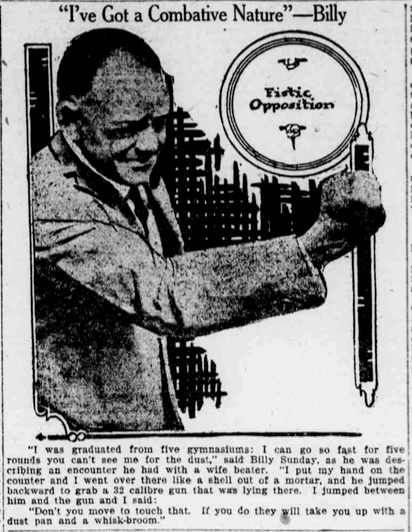
“I’ve Got a Combative Nature”—Billy Fistic Opposition
“I was graduated from five gymnasiums: I can go so fast for five rounds you can’t see me for the dust,” said Billy Sunday, as he was describing an encounter he had with a wife beater. “I put my hand on the counter and I went over there like a shell out of a mortar, and he jumped backward to grab a 32 calibre gun that was lying there. I jumped between him and the gun and I said: “Don’t you move to touch that. If you do they will take you up with a dust pan and a whisk-broom.”
Palladium-Item. Mon, Apr 17, 1922 ·Page 7
Billy Sunday Forces Determined to Win Richmond for Christ. Palladium-Item Mon, Apr 17, 1922 · Page 3
“If we had known that there was any opposition to the Sunday campaign in Richmond, we would not have come,” said Robert Matthews, secretary to Billy Sunday, Monday, following a meeting of the executive council in the Reid Memorial church, Monday morning.
“We are here now, however, and the way to breed success is by success. Every minister left the meeting this morning with fire in his eye, determined to help make the series of meetings successful. A spirit of optimism was evident and I know that the people of Richmond cannot afford to stay away from our services.”
Mr. Matthews said that Mr. Sunday had received unanimous invitations to conduct meetings in 38 cities, and that they had believed the forces of Christianity in Richmond were united.
Devil Battle Sufficient.
“It is hard enough to battle the devil,” he said, “without having to fight also among a divided Christian army.”
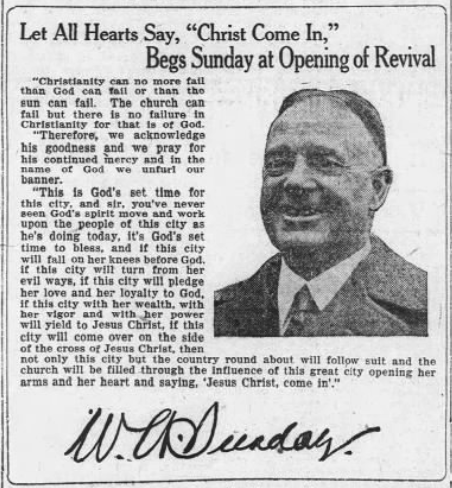
Mr. Sunday said at the church meeting Monday morning, “When I was here 26 years ago Chapman said Richmond was the hardest town he ever tried, and I have heard the same thing said by every evangelist that has come since.”
“But we are coming through in fine shape,” he declared, “for we must make a success of this campaign. It is God’s work, and it must be done.”
The Sunday party was confident that the series of meetings would be a success in the end, Robert Matthews Sunday’s secretary, insisting that Billy had come to Richmond, when he knew so much about the town, because God had work for him to do there.
Enlarge Committee
In a committee meeting following it was voted to enlarge the finance committee, in order to relieve the meetings of the money raising, and to appoint a promotion committee to “sell” the idea of Billy Sunday to the merchants and big business men of the town.
“I am back of this meeting as much as ever,” declared F. S. Dodd, “but the finance committee is tired and discouraged. I am tired, and I do not have the enthusiasm for new ideas. When the members of a committee feel like that, it is time to get some new blood in to it.”
“We have got to sell the value of these meetings to Richmond,” declared Mr. Matthews. “We do not care for any difference whether or not they are interested in religion, we have got to make them see that Richmond can not fall down on this series.”
Suggests New Blood
New blood for the finance committee was demanded by Dr. J. J. Rae, of the First Presbyterian church. “No one realizes more than I do the obstacles that the committee has been up against,” he declared, “but we have got to give them new blood to bolster up their morale.”
“You should appreciate the efforts of your newspapers to give you the news of the meetings,” said Mr. Matthews. “I am an old newspaper man, and I appreciate how their work is not appreciated. Call them up and tell them that you appreciate their efforts to give the news of the meetings.”
Determination to keep Sunday here for the whole six weeks in spite of all difficulties was evidenced at the meeting. While the offer of a theater to raise the money for the tabernacle from Charleston, and then present it during the meetings, was being discussed officially, the suggestion that the offer be taken up was hotly opposed by many members of the committee.
No Time to Quit Now.
“The time to have dropped this thing was two months ago,” said one of the members. “We must put it over now.”
The Sunday meetings are the greatest he had ever heard in a town of the size of Richmond, Sunday declared. He said that Richmond had the greatest need of a revival. The other day, after a good day with his family there, and then return to Richmond
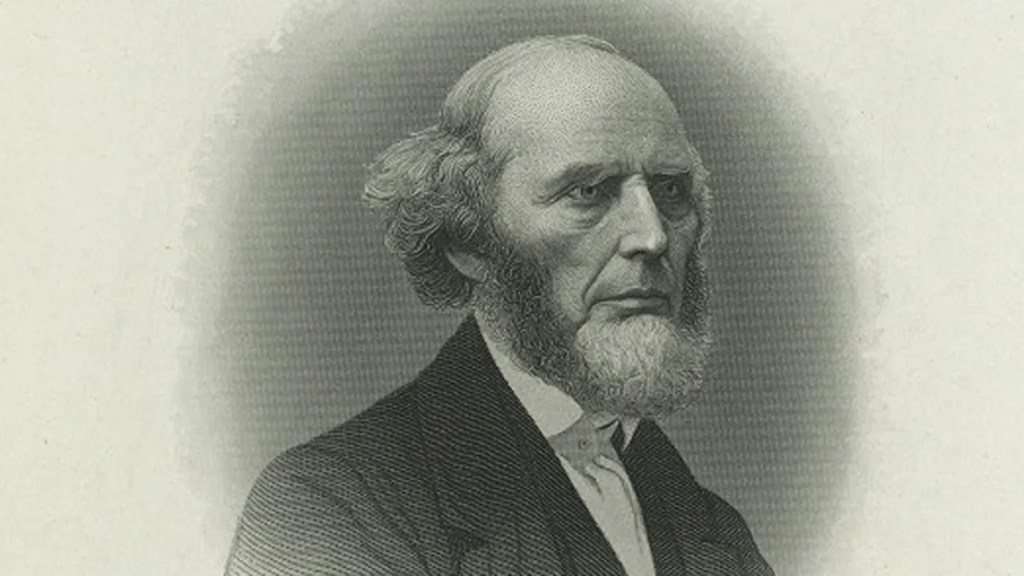
I regard Finney as the greatest preacher who has lived since the day of the apostles.
The Louisville Herald. Fri, May 04, 1923 ·Page 14
Charles Grandison Finney (1792–1875) was one of the most influential evangelists of the Second Great Awakening in the United States. A former lawyer turned Presbyterian minister, Finney was known for his innovative revival methods, bold preaching style, and theological emphasis on human responsibility in conversion. He popularized the “anxious bench” (a precursor to the altar call), promoted immediate decisions for Christ, and helped shift American evangelicalism toward a more activist and revivalistic form of Christianity.
Finney taught at Oberlin College and was a major voice in social reform movements, especially abolitionism and temperance. His theology leaned Arminian and perfectionist, differing from the Reformed Calvinism of earlier revivals.
However, Finney’s legacy deeply shaped the revivalist culture that Sunday inherited and embodied. Sunday likely admired Finney’s boldness, mass evangelism strategies, and transformative social impact. His statement calling Finney “the greatest preacher who has lived since the day of the apostles” reflects Sunday’s reverence for Finney’s lasting influence, not a personal relationship.
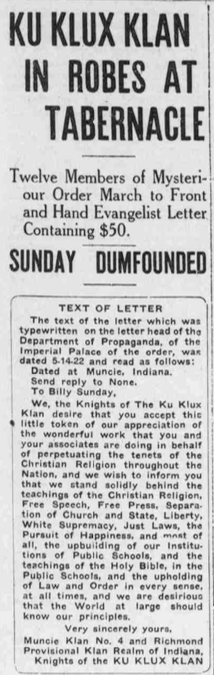
On May 14, 1922, during one of the revival meetings, twelve robed and masked members of the Ku Klux Klan entered the tabernacle, marched down the center aisle.
May 15, 1922. Palladium.
KU KLUX KLAN IN ROBES AT TABERNACLE
Twelve Members of Mysterious Order March to Front and Hand Evangelist Letter Containing $50.
SUNDAY DUMFOUNDED
TEXT OF LETTER
The text of the letter which was typewritten on the letter head of the Department of Propaganda, of the Imperial Palace of the order, was dated 5-14-22 and read as follows:
Dated at Muncie, Indiana.
Send reply to None.
To Billy Sunday.
We, the Knights of The Ku Klux Klan desire that you accept this little token of our appreciation of your wonderful work in the interest of the American people and for perpetuating the tenets of the Christian Religion throughout the Nation, and we wish you to know that we stand solidly behind the teachings of the Christian Religion, Free Speech, Free Press, and Separation of Church and State.
While supremacy, Just Laws, the Pursuit of Happiness, Liberty, and Justice, the Public School, and the thoughts of the Boy Scout in the teachings of the Bible, and in the love of the flag of our country, and in the word of every sense, that we, and we alone, should stand for these large and wholesome principles.
Very sincerely yours,
Muncie Klan No. 4 and Richmond Provincial Klan Realm of Indiana, Knights of the KU KLUX KLAN
Five thousand men and women sat spellbound in the tabernacle Sunday night while 12 masked members of the Ku Klux Klan, unopposed and fearless- ly, interrupted the service long enough to hand the Rev. W. A. Sunday an envelope containing a message of commendation and $50 in bills.
Their mission executed, their identity successfully cloaked, the twelve men marched out of the tabernacle, entered automobiles and disappeared as silently and quickly as they had made their entrance.
Members of the Sunday party had been informed of the proposed visit, however, so that some of them were prepared for the Klansmen, one of the chief ushers said.
While no clue to the identity of the men could be found, a man whose name could not be learned was found in the front of the tabernacle after the meeting, commenting on the amount of publicity which the spectacular entry would get, and asking how soon the Associated Press would get the news.
Not First Experience
This is not the first experience of Mr. Sunday with the Ku Klux Klan.
The klan has made a present to Mr. Sunday in every city he has been in during the last year, said Bob Matthews secretary to Mr. Sunday. Even the Klan in Sioux City did the same thing.
At Charleston four members of the Klan appeared, and presented Mr. Sun- day a similar communication, inclosing $200, while at Spartanburg, S. C., the Klan presented Mr. Sunday with $50.
An attempt of the reporters at the Charleston meeting to follow the Klan members and find out who they were was frustrated, the secretary said. There seemed to be an agreement among the ushers at the meeting that no one was to follow the men, and when the reporters started there seemed to be conspiracy to have them waylaid.
First Appearance
It was the first time in the history of Richmond that the Ku Klux Klan had appeared in public, according to Mr. Sunday, although he said the Klansmen were known to have met there.
The letter which they gave to Mr. Sunday bore the address of the United Klan No. 4 and Richmond Provincial Klan.
Just as Billy Sunday was beginning his sermon the twelve white clad men, wearing high pointed head gears, draped in robes that came to their feet, with flowing wide sleeves and white masks, were seen marching silently down the aisle, single file.
Sunday paused in the middle of his announcement, and stared down at them, while a hush fell over the audience, as the 12 figures lined up before the platform, and two of them mounted to the platform.
Suppressed giggles and hysterical snickers broke the stillness faintly, but for the most part, the audience was awed into immobility, except on the edges where men and women stood on chairs and benches to see what was going on.
At a grunt of command, the only sound made by the group during the entire visit, and in unison with their leader, the men lined up facing Sunday, while the other two, at the same unspoken command, turned and walked to the platform and presented the letter containing the money.
The men and women on the stairs parted for the ghost like men, whose audible footfalls could not be heard, their costumes revealing only blue eyes and black leather shoes.
It was not known what Mr. Sunday said until the visitors had marched out and the tabernacle had settled down. Then he turned and faced the audience and said firmly, “I am not afraid of anybody. I have had my car and automobiles and driver attacked, but I am not afraid. I will stand to be checked on my work.”
Sunday ceased to speak, while the men filed from the tabernacle. “I am not a member of the Ku Klux Klan, of the Masons, of the Odd Fellows, or any other secret order, but I’ve learned more about them to night than I ever knew before.
“So I guess if you behave yourself they won’t bother you,” Sunday said.
“A Hint to Others”
“Now you Masons, Odd Fellows, or any of you other fellows, if you want to give something to Winona you just come ahead,” Mr. Sunday said after he announced that the letter contained $50 in bills, which he said would be used to pay the expenses of the Winona Lake tabernacle.
“The $50 comes from the Muncie branch,” Mr. Sunday started to say in telling of the money in the envelope, when Fred Rupp interrupted to say that Richmond was also mentioned.
Fumbling with the letter for a moment, Sunday reread the closing words and corrected himself: “It comes also from the provisional Richmond klan.” After a little pause Sunday added to the audience: “Well, you seemed to sit right; they didn’t take you.” Denouncing the liberal wing of the Baptist church which is forcing a contest within that denomination, Mr. Sunday called them the “God-forsaken liberal wing,” and declared that “they ought to be in Hell.”
Denounces Liberalism.
“It’s the liberal bunch that don’t like me, and I don’t want their backing. The Baptists were the last bulwark of orthodoxy,” he said, “and now they’ve got a fight on their hands.” “There never was a greater God-forsaken liberal wing of the church, that seeks ethical death of Christ. Its the
Near the end of the sermon, but before the audience arose, Sunday called on those that wanted to make a public confession of Christ to walk down in front.
“I want to see your faces as you come,” he said. “I don’t know how you feel about it, but I want to see you come.”
“I haven’t asked for that a long time,” he added, “but I had a feeling that maybe some of you fellows would come that way.”
For a time no one moved, but a slight movement in the rear of the audience was seen. Mr. Sunday made mention of it.
“There were ten here now,” About the time it looked as if there would be plenty of room for Mr. Sunday to come down and take their hands.
63 Come Forward
After the audience stood, and the personal workers had scattered among them, more gathered at the front until 63 “trail hitters” had come forward as signed pledges of belief in Christ. The opening prayer was offered by Rev. E. Gage of the Third Methodist church, while the meeting was closed by prayer by Louis Jones, minister of the South Eighth Street Friends meeting.
The collection, as at the other meetings of the day, was taken for the Bible School, Chautauqua, and other summer meetings held at Winona Lake, Indiana.
Afternoon Service
Coatless, perspiring until he removed his collar and necktie, Billy Sunday called on the packed tabernacle Sunday afternoon to give their lives to Christ, and from an audience of 6,000, more than 300 persons came forward to shake his hand, while several hundred signed cards pledging themselves to accept Jesus Christ as their personal savior.
It was an audience composed almost entirely of out-of-town people. On a show of hands it had seemed as if there were no Richmond people present, but a rising demonstration of Richmond and of visitors showed that only a fifth were local residents.
The huge crowd gathered early, by noon the tabernacle was filled and the music began. Just before the sermon Mr. Rodeheaver called for the show of hands to account for the local poor fifth of the audience.
Calls for City
As the huge out-of-town audience stood, cries of “Richmond” Richmond” came from the ministerial section, and Mr. Rodeheaver called for the local people to stand. They were the poor fifth of the audience.
The great tabernacle of Richmond, they say, has stayed Mr. Sunday’s people could not have had the great success they have had without it. All the more, when you realize that all the people in the audience are not Richmond people, but they are the people who regularly do better than that.
Takes Off Coat
As Mr. Sunday appeared on the platform he took off his coat, and several men in the audience stood up and took theirs off. Later on invitation of Mr. Sunday, a number of others followed suit.
“In the 27 years that I have been preaching I have never seen such a small number of people from the community, in proportion to its size, as here at Richmond. I feel like I had fooled away six weeks of my time, one sixth of all that I have to give in a year, by coming here, when I had to turn down 25 other cities to do it.”
“It is not,” he added, “that you people are not welcome to come, but I do think that the community where I preach should be represented at the meetings.”
Billy Sunday conducted a significant revival campaign in Richmond, Indiana, from April 15 to May 29, 1922. This six-week event was part of his extensive evangelistic efforts across the United States during the early 20th century .
Palladium-Item Mon, Apr 17, 1922 ·Page 7
Revival Campaign Highlights
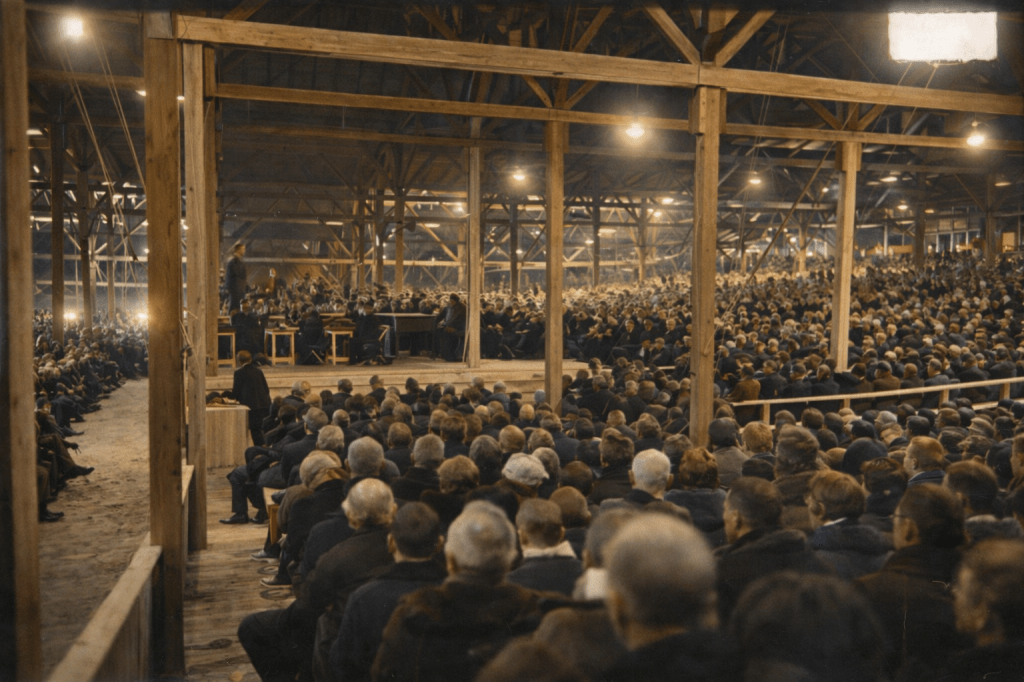
Venue: A specially constructed wooden tabernacle was erected at South 15th and Main Streets (now the site of a CVS and Family Video), accommodating up to 6,000 attendees.
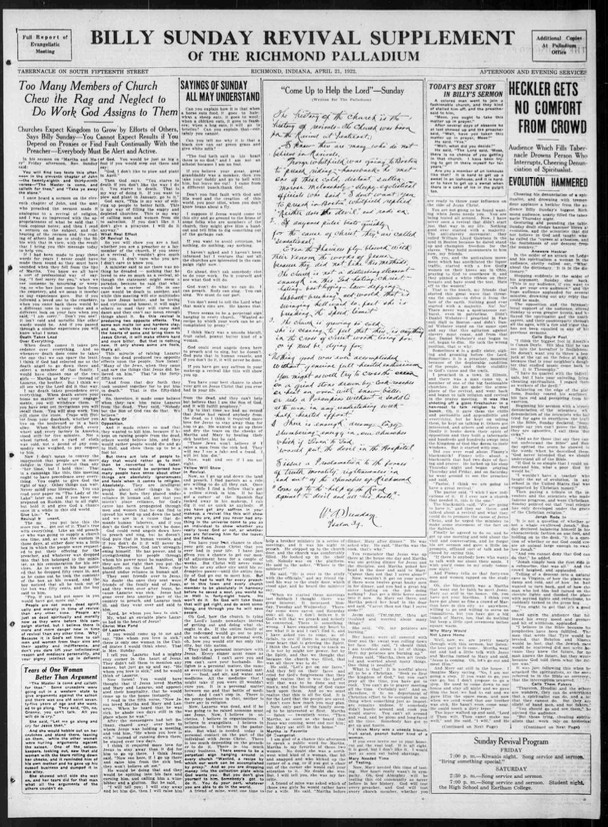
Media Coverage: The Richmond Palladium provided extensive coverage, including daily supplements featuring Sunday’s sermons, stories, and testimonials. A direct telephone line connected the tabernacle to the newspaper office to ensure timely reporting .
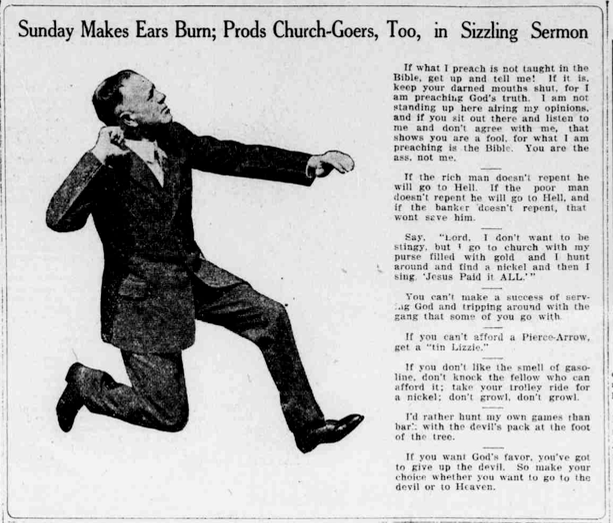
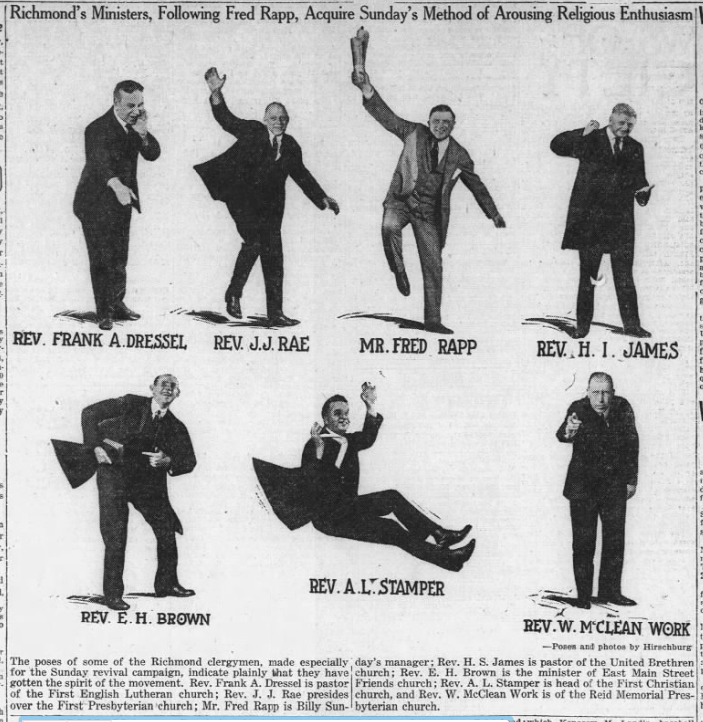
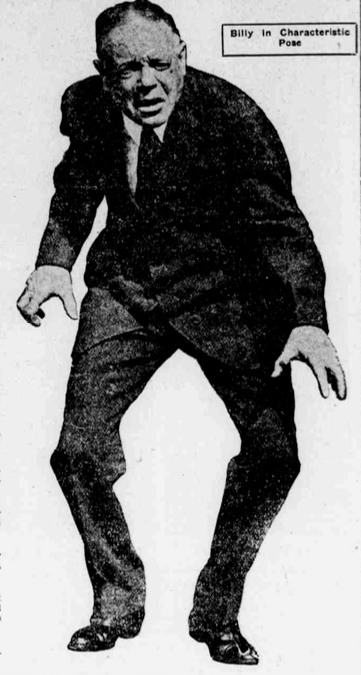
Preaching Style: Known for his dynamic and theatrical preaching, Sunday delivered impassioned sermons emphasizing themes like personal salvation, moral reform, and temperance. He often used vivid language and dramatic gestures to captivate his audience.
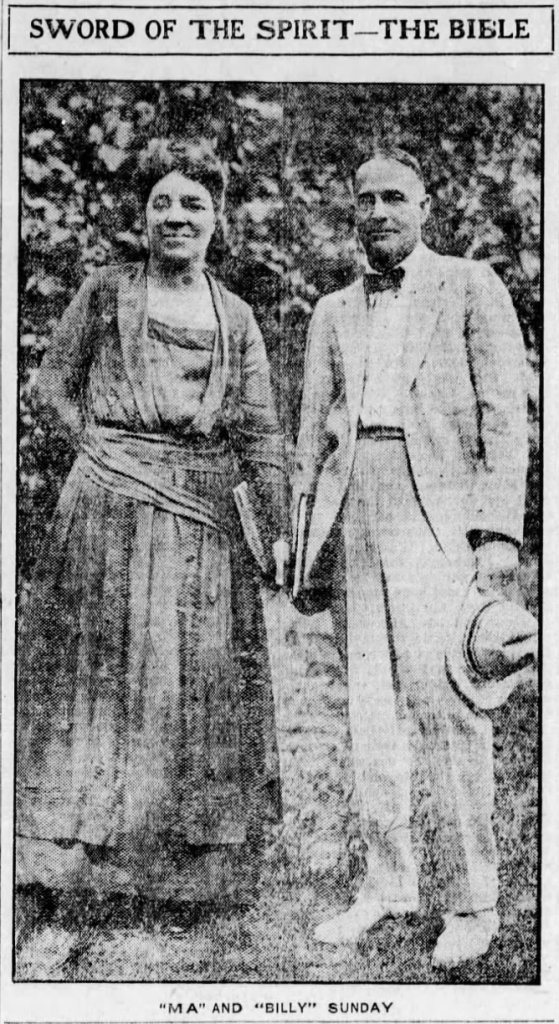
Billy wrote the following and it was published in the April 22, 1922, Richmond Palladium.
The history of the Church is the history of revivals. The Church was born in the revival of Pentecost.
I know there are many who do not believe in Revivals.
George Whitfield was going to Boston to preach, riding horseback. He met one oof these cold, distant, sullen, morose, melancholy, sleepy, egotistical officials who said, “I don’t want you to preach in Boston.” Whitfield replied, “Neither does the Devil.” and rode on.
If anyone pulse beats quickly for the cause of Christ, they are called “sensational.”
Even the Pharisees ply _______ with their venom the works of Jesus because they did not like his methods. The church is not a disturbing element enough in this God-hating, Christ-hating, boot-legging, law-defying, Sabbath-breaking, old world that is swinging hell-ward so fast she is breaking the speed limit.
The Church is growing so cold she is ceasing to feel that there is anything in the cross of Christ worth living for, or if need be, dying for.
Nothing good was ever accomplished without genuine full-hearted enthusiasm. You might as well try to cross the ocean on a grind stone drawn by cock roaches or heat an oven with snow balls, or ride a Porcupine without a saddle as to win any undertaking week-half-hearted effort!
There is enough dreamy, lazy, slumbering energy in our Churches which is given to God. I would put the Devil in the hospital.
I issue a Proclamation to the forces of truth, morality, righteousness, in and out of the Churches of Richmond, “Come up to the help of the Lord against the Devil and all his hosts.”
W.A. Sunday, Psalm 34
April 17, 1922. Richmond PalladiumApril 18, 1922. Richmond Palladium
Man Who Wrote Book for Him Sues for $100,000 for Breach of Contract.
The Rev. William A. Sunday, the evangelist, was sued in the New York City Supreme Court last Wednesday by Hugh C. Weir of New Rochelle to recover $100,000 for breach of a contract, under which Weir alleges he wrote the series of “Great Love Stories of the Bible,” which appeared with Billy Sunday’s name as the author. Weir also alleges that under the agreement with Sunday he was to write “Billy Sunday’s Own Story,” and another series based on the Bible.
Weir says that he was to get 50 per cent. of the royalties on all the books except “Great Love Stories of the Bible,” for which Sunday got 60 per cent., out of which he was to pay 10 per cent. to a Bible historical authority for proofreading. Sunday was to advance $5,000 to Weir and collect out of the latter’s share of the royalties. The plaintiff also alleges that Sunday agreed to arrange for the sale of the books at all his meetings.
The complaint alleges that although a contract has been made with a reputable house for the publication of the books the evangelist has repudiated his agreement in all respects.
Mr. Sunday has served his answer in the suit, in which he admits that Weir collaborated with him in writing “Great Love Stories of the Bible,” but denies that he has broken any agreement made with Weir
The Duluth News Tribune. Thu, May 02, 1918 ·Page 8
Billy Sunday’s Theology
WE ARE for Billy Sunday.
There are a lot of people sincerely worried because his specially built tabernacle is to cost $25,000 when money is needed for the war. There are others who worry because holes have been dug in the courthouse lawn.
Others fear that, aroused by the impassionate William, a good many people on that last day of his visit may add to his wealth. A still larger number do not like his brand of theology and rebel at his salvation processes.
But it is a fact that most folks, if they did not worry about one thing would worry about some others. The building salvage will be considerable for the tabernacle; the grass will grow again, and no one who does not wish to do so need give a cent to Billy or even go to hear him. It is all free will, not foreordination.
Moreover, there is a psychology in giving. The money he gets from his hearers would not go to any other cause; no one else could get it, and he does not destroy it. As a matter of fact, war work will get more through his coming. He himself gives liberally to every war cause and then buys Liberty bonds. But besides this, he finds the combination to purses that no one else can open. He creates and strengthens the spirit of giving.
The more any community gives, the easier it is for it to give, and this goes on increasingly. Billie knows this and for himself only asks the last day’s collection. He takes his chance, and if he gets more or less, he earns it. He works six weeks for the result, and leaves behind this greater willingness to give.
Billy Sunday certainly has one brand of theology we like. He has a religion to which we respond. He has a gospel which needs to be preached here, as everywhere. This is the theology, the religion, the gospel of Americanism.
He preaches it with unequalled force and vigor. He drives it home with a club. He has no more doubts as to it, as great a faith in it as in his old-fashioned brand of Christianity. He does not quibble, nor apologize, nor temporize, nor emasculate as to either.
Tens of thousands will go to hear him. He will have many thousands no one else can reach or attract. They will all hear this gospel of Americanism, not just preached, but driven home and spiked down. He has exactly the methods needed to accomplish the result.
Thousands who hear him may be no better Christians afterwards, or may backslide in the niceties of Christian conduct, but what is much the same thing today as is the unwavering, unquestioning Christianity he preaches, they will all be better Americans and that will stick. He takes doubt as to this war, as to its righteousness and our common duty in supporting it, and scalps it, leaving not a hair of its camouflaged head to comfort or conceal an ingrowing brain and conscience.
If for no other reason than this, we are for Billy. We do not it would be money well spent to arouse the people of all this section to their obligations just as citizens. He is the best recruiting agent, the best antidote for the slacker, the best seller of Liberty bonds, the best promoter of war giving and the most inspiring sledgehammer of unadulterated Americanism this country has produced. If for no other reason, we are for Billie Sunday. We do not care what his other theology is, his American theology is right and it is needed. We will all be better citizens, more loyal, more un- selfishly patriotic, more willing to give what is dearer than our own lives, for his coming.
The Duluth News Tribune. Mon, Apr 08, 1918 ·Page 3
ADVANCE MAN IS HERE TO PAVE WAY FOR BILLY SUNDAY
Looks to Building of Tabernacle at Courthouse Square—Construction Starts Next Week.
Actual work in preparation for Billy Sunday’s campaign in Duluth will begin early next week when workmen will commence construction of the huge tabernacle in which the meetings will be held.
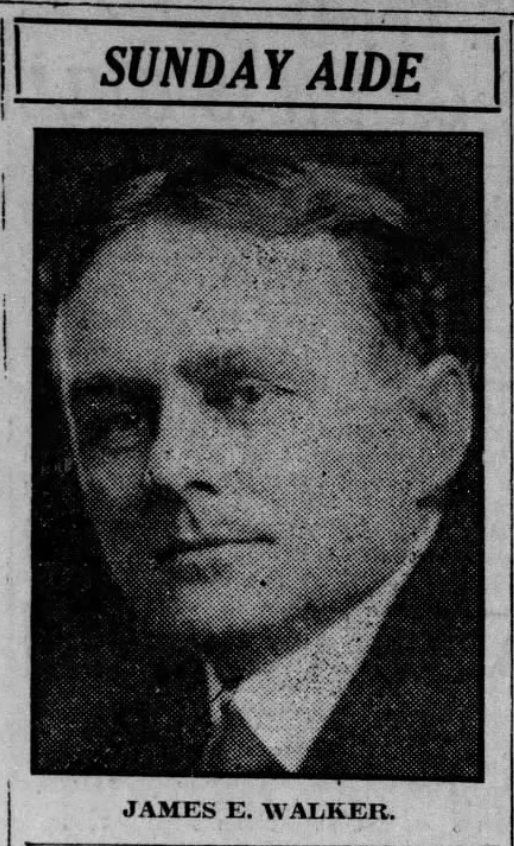
This was the announcement made yesterday by James E. Walker, advance representative for the evangelist. Mr. Walker reached Duluth Saturday and immediately plunged into the work of preparation for Sunday’s appearance in Duluth. He met representatives from Duluth, Superior and range churches at the First Presbyterian church at 3 o’clock yesterday afternoon.
Richard Close and W. L. Smithies, of the men’s interchurch council addressed the meeting. Both gave their impressions of the Sunday campaign in Chicago. Mr. Smithies was in Chicago Saturday and witnessed the mammoth parade, held at noon, which preceded the largest meeting that has yet been held at the Chicago tabernacle.
Sunday’s Methods Outlined.
Walker’s talk outlined, for the local workers, the Sunday method of conduction a campaign. His classification divides the work into three parts. The preparatory work, he says, usually covers a period of eight weeks preceding the campaigns. The latter constitutes the second division and the third division in, in Walker’s words, “the follow-up campaign or work of conservation.” The first part is now well under way in Duluth.
The Sunday campaigns are usually conducted by 15 committees. Fourteen of these will be in operation in Duluth within a short time. The fifteenth, constituting a restaurant committee, often necessary through the comparative inaccessibility of the tabernacles, will not be needed in Duluth owing to the central location of the tabernacle.
Two Thousand Ushers.
The other committees, some of which are already being formed, together with Walker’s estimate of the number required for each, follow: Music committee, including the personnel of three choruses, 2,500; Neighborhood prayer meeting committee, 2,000; ushers and doorkeepers, who will work in relays, 700; personal workers, 500; secretaries, who will take the names of “trail-hitters” at the meetings, 300; men’s Bible class organizers and workers, 500; finance, automobile, hospital and students committees, 500. This, in the round figures of Walker’s estimate, will total a working staff of 7,000. “And every one of them,” said Walker last night, “will have something to do.”
“The most important part of the work,” said Walker, “is the neighborhood prayer meetings, previous to and during the campaign. If Sunday’s coming did nothing else than serve as an incentive for the organization of these meetings, he would have done enough. It is his wish that a great deal of time and care be spent in the perfecting of the committee which will be in charge of these meetings.
Territory Divided.
“The territory surrounding Duluth and the city itself will be divided into districts, these districts subdivided into sections and these sections again divided into communities or, as we call them, neighborhoods. It is our plan to have prayer meetings for two nights each week for three weeks previous to Sunday’s appearance. These meetings will not be held in the churches of the communities but in the private homes. There were 99 conversions reported at similar meetings which preceded the Los Angeles campaign.
“Billy Sunday’s request is that, at these meetings, those who attend pray for the success of the campaign. The attendance at the Los Angeles prayer meetings was recorded at 73,938. There were 7,556 homes open for meetings.
Tabernacle 8,000 Capacity.
The Duluth tabernacle, according to the present estimate, will accommodate 8,000. It will include, besides the main auditorium, the usual rooms that are built in all Sunday tabernacles. The Duluth structure will be of the turtle-back type that is used in a majority of the cities. Its dimensions will be approximately 176 by 224 feet. It will be built on the courthouse grounds at Fourth avenue West from First to Second streets. Sunday will conclude his Chicago campaign on May 19. He will come to Duluth during the following week and will open here May 26. Walker has established his offices on the second floor of the Y. M. C. A. in the offices of Mr. Smithies. He will direct the preparatory campaign from there and will remain here until after the opening of the campaign proper.
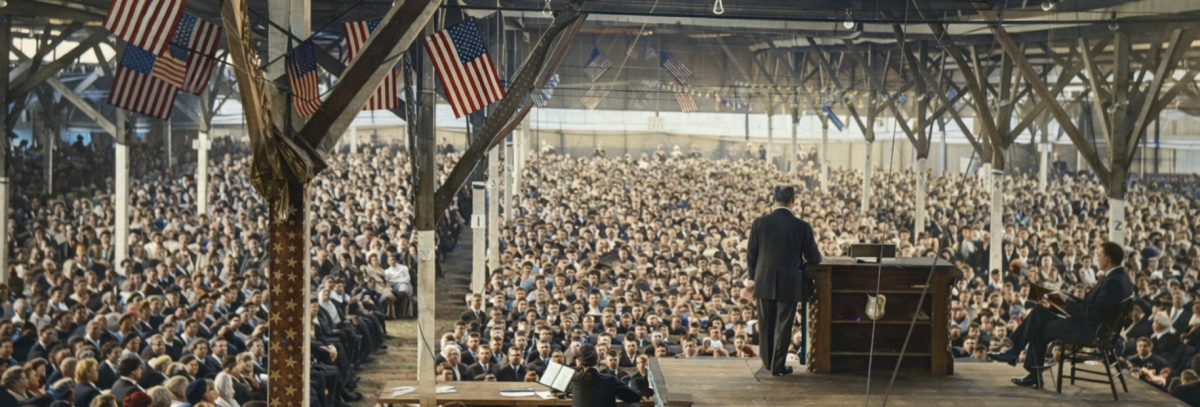
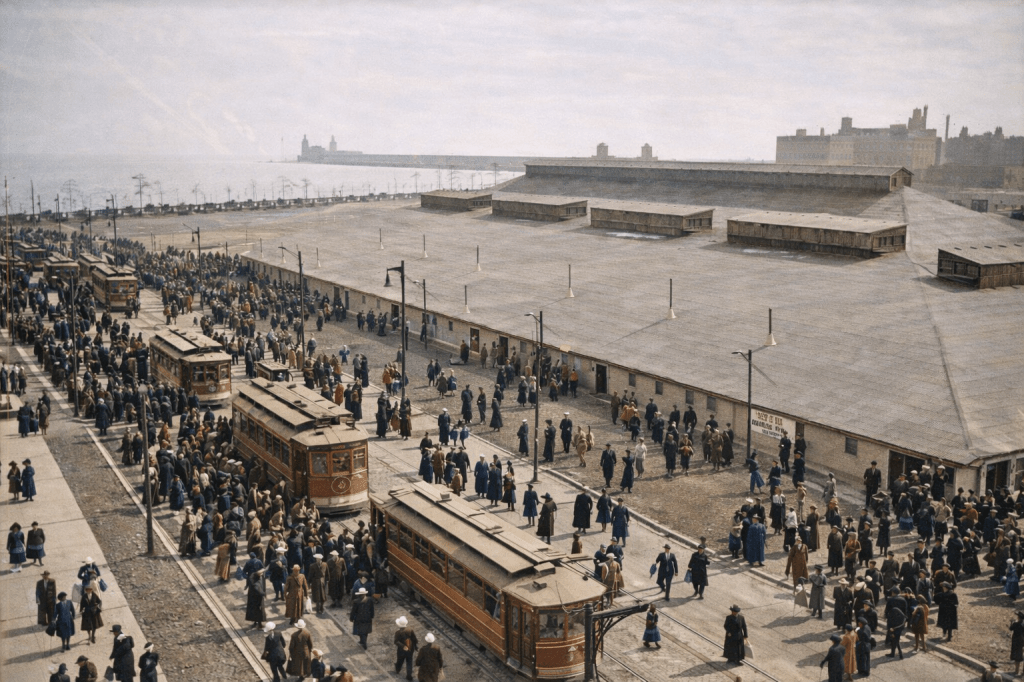
Bily Sunday Tabernacle. Chicago, Navy Pier, c. 1918.
49,165 SOULS AND $56,000, BILLY’S SCORE
Great Crowd Hears Revivalist Close Campaign.
Trail hitters (total) ………… 49,165
Attendance at tabernacle and meetings led by members of the Sunday party ………… 1,200,000
Money raised for current expenses ………… $135,000
Money raised for free will offering to Billy Sunday, which he will give in its entirety to the Pacific Garden mission ………… $56,000
Number of churches co-operating ………… 424
Length of campaign (including 11 Sundays) ………… 10 weeks
BY THE REV. W. B. NORTON.
Billy Sunday has prepared his own epitaph, which he says he wants chiseled on his tombstone when he shall be laid away in Forest Home cemetery, where, he says, he expects his body to rest. It is this:
“I have fought a good fight, I have finished my course, I have kept the faith: Henceforth there is laid up for me a crown of righteousness, which the Lord, the righteous judge, shall give me at that day.”
Last night Billy announced the end of his revival campaign here by saying:
“I’ve done my duty. Like a physician after he hands the new baby over to the mother and the nurse, takes his departure, so I commit these new converts to the churches and I go on my way to other fields.”
A Strenuous Finish.
For the first time since Billy began preaching in the tabernacle at Chicago avenue and the lake ten weeks ago, he pulled off both coat and collar and went at his task as in the old baseball days. It was his final sermon and he put into it all the power and feeling he could command.
The rain beat heavily on the roof, and occasionally an umbrella began to rise, but was quickly put down again, so as not to obstruct the view of others. Finally all of the roof windows were closed and the doors opened. At least 13,000 were present, many of them standing. A considerable number were in the seats at 5 o’clock with knitting or papers in hands, determined to have a seat for the final service, no matter how large the crowd.
Appeals for the free will offering for Billy, which is to go to the Pacific Garden mission, were made by George W. Dixon, chairman of the committee on the offering; W. A. Peterson, chairman of the finance committee; the Rev. John Timothy Stone, and Mel Trotter, superintendent of the Pacific Garden mission.
1918, Navy Pier.
Chicago Tribune. Mon, May 20, 1918 ·Page 4
Sunday Is Pleased.
“I consider the most remarkable feature of the meetings has been the evident hunger of the people to hear the gospel, their eagerness of attention, and the steadiness with which they have come,” Mr. Sunday said yesterday. “Every time the invitation has been given there has been a steady stream of hitters, not as I have seen it elsewhere, many coming at one meeting and almost no one the next time. I feel that it has been a remarkable meeting.”
Chicago Tribune. Tue, Jun 25, 1918 ·Page 3
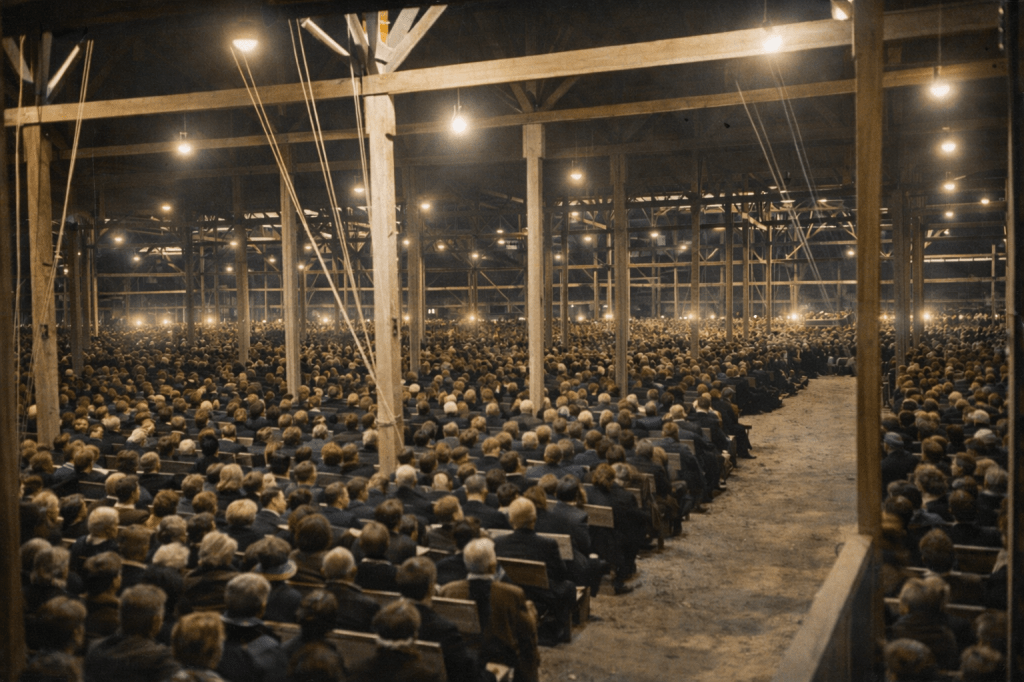
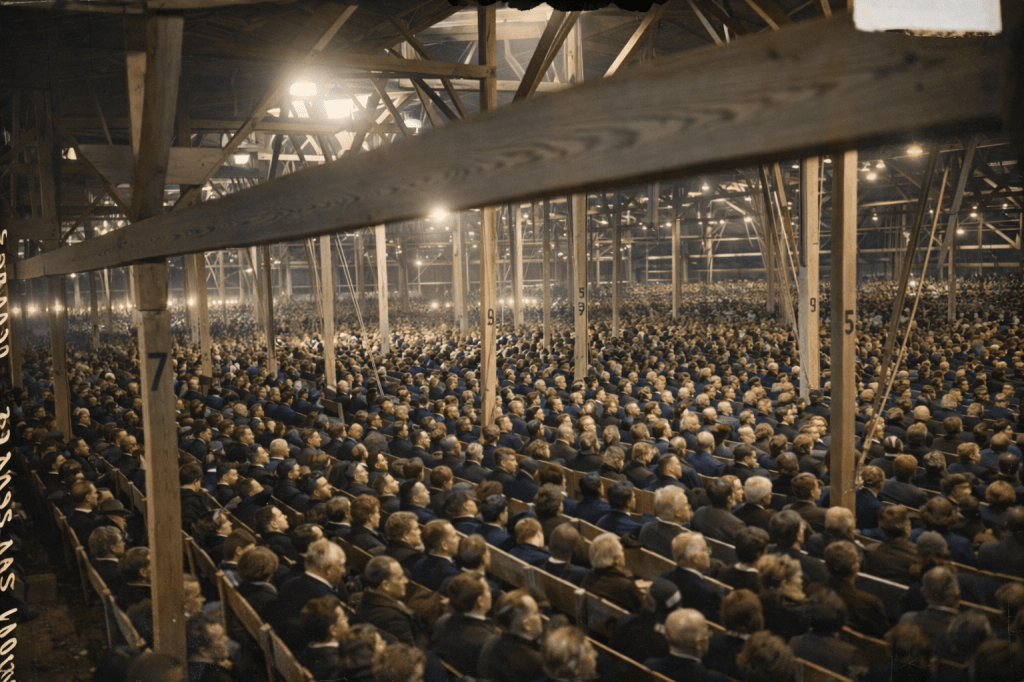
The building (at Chicago Avenue and the lake) is the largest tabernacle ever built for the use of Mr. Sunday and was fourteen feet longer than the next largest one built in New York. It accommodated an audience of 16,000 when the vestibule was filled, as was done on several occasions during the revival campaign.



 Evangelist Billy Sunday (1862-1935)