Billy Sunday on the Chautauqua Circuit: The Brief but Notable Season of 1910

In the summer of 1910, Billy Sunday stood at an interesting crossroads in his rapidly expanding ministry. By this point he was already nationally known as one of America’s most electrifying evangelists. Cities across the country were beginning to build large tabernacles to accommodate the crowds that flocked to hear him preach. Yet during the summer months—when revival campaigns often paused—Sunday occasionally appeared on the Chautauqua circuit, the great American network of traveling lecture assemblies that combined education, entertainment, reform movements, and religion.
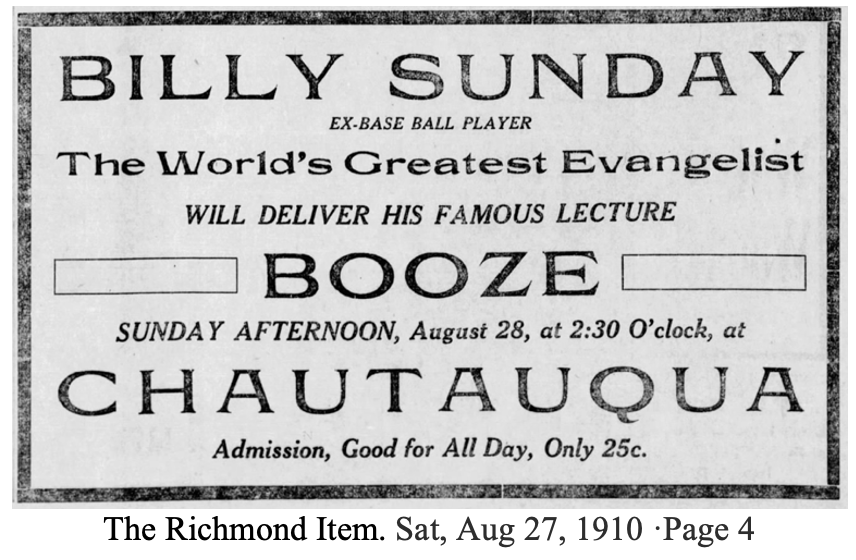
Unlike many lecturers who spent the entire season touring the circuit, Sunday’s 1910 Chautauqua schedule was surprisingly limited. He appeared only at a handful of assemblies, and his comments to the press make clear that this was intentional. Sunday had been offered lucrative opportunities to spend the entire summer lecturing. One newspaper reported that he declined an offer of $20,000 to devote the season to Chautauqua work, explaining that the exhausting schedule would leave him unable to conduct revival campaigns in the fall.

“The report that I am to retire is all pure nonsense… I refused $20,000 to give my time to Chautauqua work this summer, as I would be worn out and could not preach before January.”

Sunday’s priority remained evangelistic preaching. Nevertheless, the few Chautauqua appearances he did make during the summer of 1910 provide a fascinating glimpse into his growing national popularity and the remarkable drawing power he already possessed.


Whidbey Island: The Northwestern Chautauqua Assembly

Sunday’s Chautauqua engagements began on July 24, 1910, at the Northwestern Chautauqua Assembly on Whidbey Island, Washington.

At this gathering Sunday delivered a message titled “Forces that Win.” Like many of his sermons, it blended moral exhortation with vivid biblical storytelling. Reports indicate he illustrated his message with the story of David and Goliath, a favorite example of spiritual courage overcoming overwhelming odds.

Even among the prominent lecturers and performers typical of a Chautauqua program, Sunday stood out. His dynamic speaking style—rapid delivery, colorful language, and dramatic physical movement—contrasted sharply with the more measured lecture format audiences often expected.


Hillsboro–Litchfield: A Midwestern Assembly

In early August Sunday appeared at the Hillsboro–Litchfield Chautauqua, running from August 4 through August 11. These regional Chautauqua assemblies usually featured a mixture of lectures, concerts, political discussions, and religious addresses.

Sunday’s presence on such programs reflected the growing recognition that he was not merely a revivalist but also one of the most compelling public speakers in the country.


Maxwelton, Washington: Crowds Even in Small Communities

On August 6, Sunday spoke at the Maxwelton Chautauqua in Washington, addressing a crowd estimated at 4,500 people.

The size of the audience is striking. Maxwelton itself was a small community, yet thousands gathered to hear Sunday speak. Even outside the large urban revival campaigns for which he would soon become famous, his reputation alone was enough to draw impressive crowds.


Patterson Springs: Record-Breaking Interest
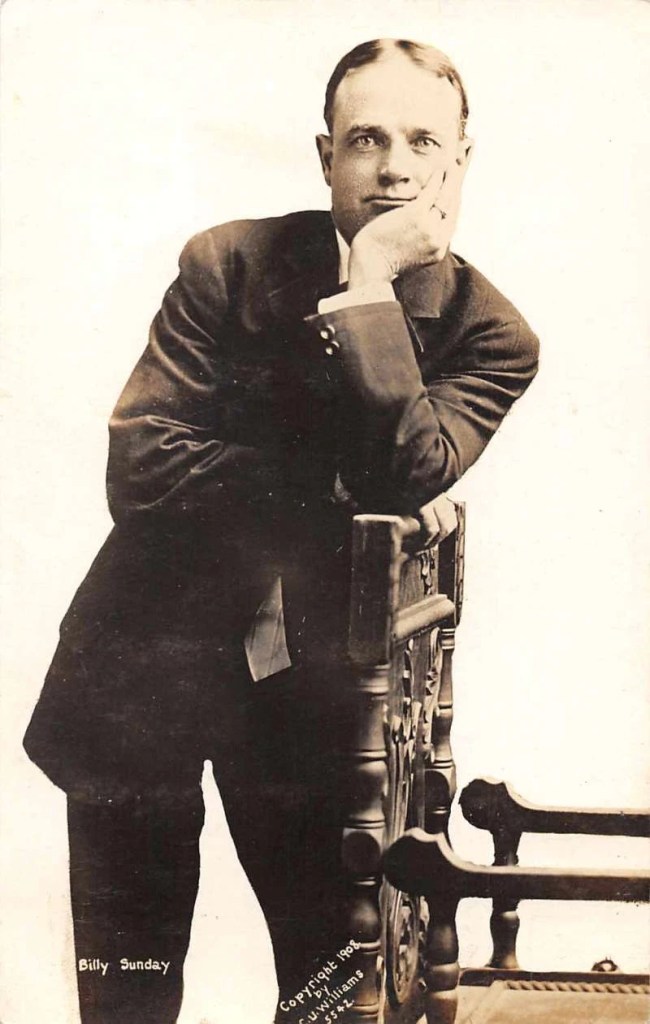
Another Chautauqua stop came on August 10 at Patterson Springs. Newspapers noted that Sunday had previously delivered a lecture there that produced $3,600 in ticket receipts, reportedly a record for a single Chautauqua lecture.

This financial success reveals something important about Sunday’s role in the Chautauqua movement. He was not just a preacher filling a religious slot in the program. He was one of the circuit’s major attractions, capable of drawing large audiences and generating significant revenue.

Even so, Sunday resisted becoming primarily a Chautauqua lecturer. His heart remained in revival work.


Lake Whatcom: The “Human Interest” Lecturer

On August 24, Sunday appeared at the Washington Assembly Chautauqua near Lake Whatcom. Promotional material advertised him as delivering the program’s “human interest” lecture, a category that perfectly suited his style.

Sunday’s talks often mixed humor, storytelling, social criticism, and passionate moral appeal. He could move easily from a humorous anecdote to a blistering denunciation of vice, particularly the liquor trade. This blend of entertainment and moral seriousness made him an ideal Chautauqua speaker.


Richmond, Indiana: A Crowd of Eight Thousand

Sunday’s most dramatic Chautauqua appearance of 1910 came on August 28 at the Richmond, Indiana Chautauqua.
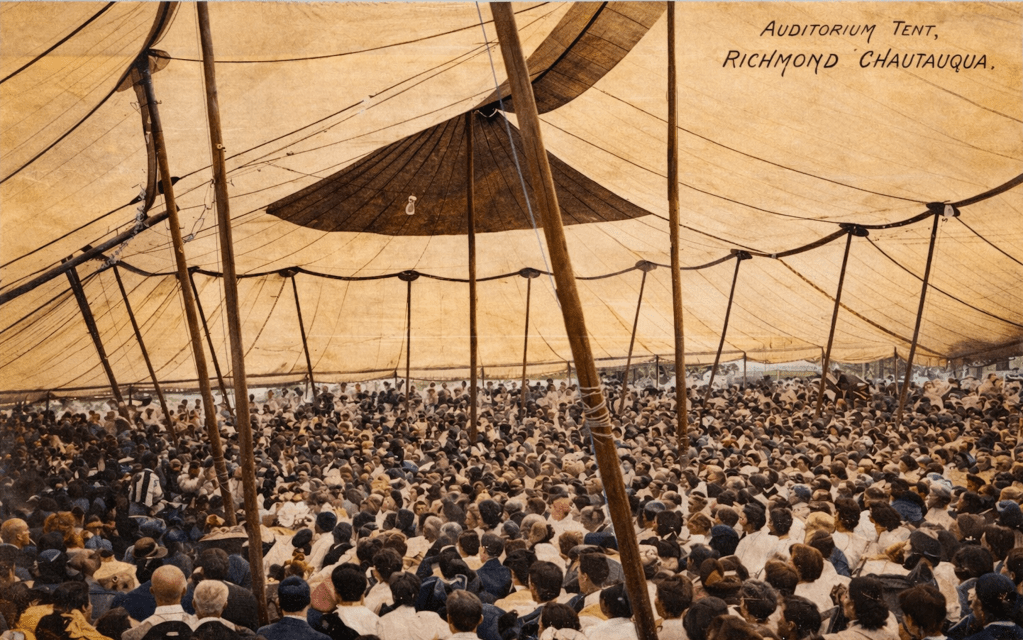
The crowd numbered roughly 8,000 people, and Sunday delivered one of his most famous temperance sermons, “Booze.”

Contemporary accounts describe a performance that was nothing short of theatrical. Once fully warmed up, Sunday removed his coat and launched into an explosive denunciation of the saloon. At one point he grabbed a red flag representing the liquor trade, hurled it to the ground, and stamped on it before triumphantly seizing the American flag to symbolize moral victory.

Such dramatic gestures were typical of Sunday’s style. Critics sometimes mocked them as stage tricks, but audiences loved them. They reinforced his reputation as the relentless enemy of alcohol and social vice.


Why the 1910 Season Was Short

One of the most interesting aspects of Sunday’s Chautauqua activity in 1910 is how limited it was.

Rumors circulated in the press that he might be retiring from public speaking altogether. In reality, the opposite was true. Sunday simply refused to devote the entire summer to the lecture circuit.

He explained that constant Chautauqua travel would leave him exhausted and unable to conduct the revival campaigns that he believed were his true calling. Instead, he used the summer months partly for rest and partly for select speaking engagements before returning to the intense schedule of fall revivals.

This decision proved wise. Later in 1910 Sunday conducted major campaigns in New Castle, Pennsylvania, and Waterloo, Iowa, drawing enormous crowds and recording thousands of conversions.


A Glimpse of Sunday’s Expanding Influence

Though brief, Billy Sunday’s 1910 Chautauqua season reveals several important aspects of his rising influence.

First, it demonstrates the extraordinary demand for him as a public speaker. Even isolated appearances drew crowds in the thousands.

Second, it shows that he was already a major figure in the reform movements of the era—especially the temperance crusade.

Finally, it highlights Sunday’s own priorities. While many speakers made their careers on the Chautauqua circuit, Sunday viewed it as secondary. His passion remained revival preaching and evangelism.

In hindsight, the summer of 1910 marks a moment when Billy Sunday could have easily become one of the most lucrative lecturers in America. Instead, he chose the harder path—returning to the sawdust floors of revival tabernacles and the exhausting pace of evangelistic campaigns.

And in doing so, he continued building the ministry that would soon make him the most famous evangelist in America.
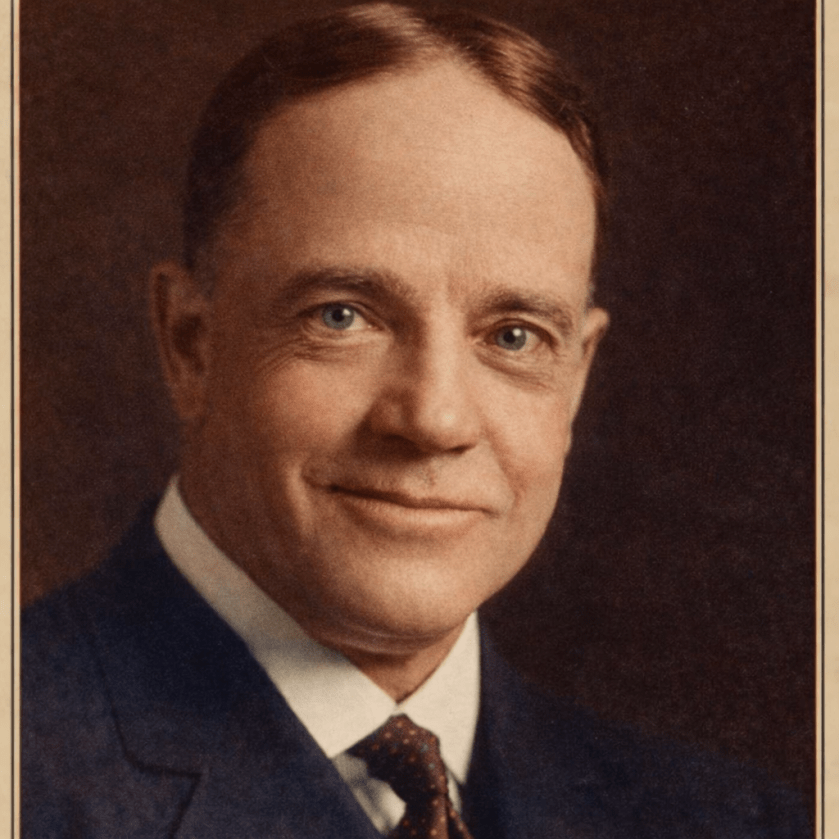
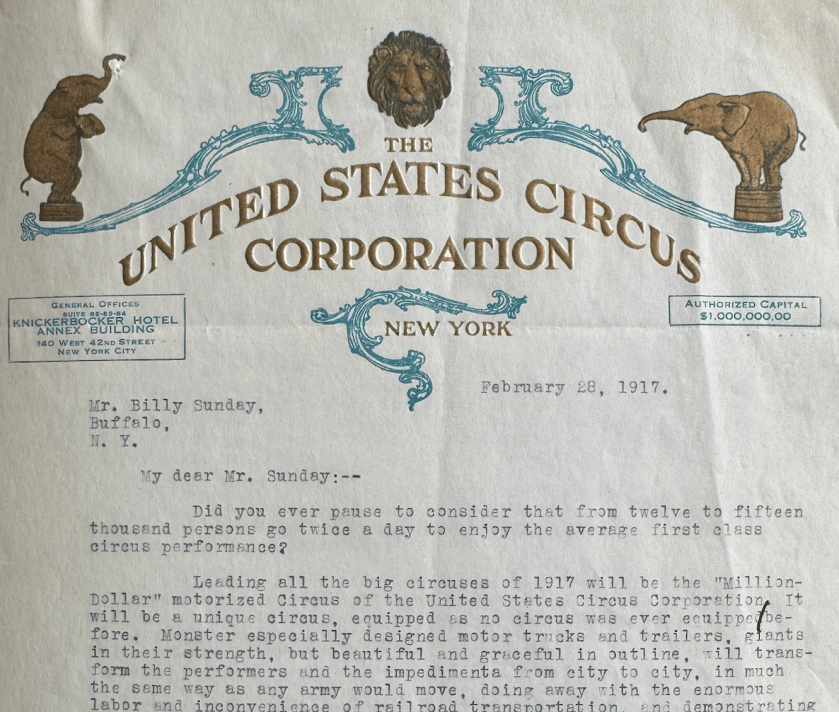
The Circus That Tried to Hire Billy Sunday, c. 1917


And Why the Offer Destroys the Claim That He Preached for Money

One of the most common criticisms leveled against evangelist Billy Sunday is that he preached for money.

Critics point to the generous love offerings that were sometimes taken at the close of his revival campaigns and conclude that Sunday must have been motivated by financial gain. It is an easy accusation to make. But historical evidence tells a very different story.

One remarkable document from 1917 puts the matter in perspective.

On February 28, 1917, Billy Sunday received an extraordinary letter from the president of the United States Circus Corporation. The proposal was simple, bold, and almost unbelievable.

The circus wanted Billy Sunday to join the show.

Original 1917 contract. Grace College. Morgan Library.

The letter opened by reminding Sunday of the enormous audiences that circuses attracted:

“Did you ever pause to consider that from twelve to fifteen thousand persons go twice a day to enjoy the average first class circus performance?”

The promoter explained that the company was launching what he called a “Million-Dollar” motorized circus, equipped with fleets of specially designed trucks and trailers that would carry the show from city to city.

The scale was enormous. Tens of thousands of people attended circus performances daily.

And the circus president believed Billy Sunday could preach to them.

Then came the offer.

“I… offer you a weekly salary of $14,000, or $2,000 a day, for as many weeks of the coming summer season as you can give.”

To grasp how staggering this proposal was, consider the numbers.

If Sunday had accepted the offer and worked for roughly ninety to one hundred days during the summer season, he would have earned between $180,000 and $200,000 in 1917.

Adjusted for inflation, that is roughly $4 million today.

In return, the circus would provide transportation, luxury touring cars for Sunday and his staff, and access to massive crowds across the country.

The promoter even suggested that Sunday hold revival meetings on Sundays as part of the circus program.

But here is the crucial point.

The proposal made no provision for Sunday to keep offerings from those meetings. In fact, the letter suggested that the proceeds from Sunday services could go largely or entirely to charity.

The circus wanted Billy Sunday not as a fundraiser—but as an attraction.

A headline act.

A revivalist who could preach to the largest audiences in America.

And yet Billy Sunday refused.


The Economics of Sunday’s Real Ministry

Now compare this circus offer to the income Sunday actually received during the same years.

During the summer Chautauqua season, Sunday could deliver 50 to 70 speaking engagements.

Typical speaking fees ranged from $250 to $500 per engagement.

That means a strong Chautauqua season might produce:

  • $12,500 on the low end
  • $35,000 on the high end

Even at the very top of that range, the circus contract would have paid five to six times more.

In other words, if Billy Sunday had been motivated primarily by money, the decision would have been obvious.

He could have become the highest-paid religious speaker in America simply by joining a circus.

Instead, he chose the sawdust trail.

He chose the revival tabernacle.

He chose the ministry that demanded months of exhausting preaching, travel, prayer meetings, counseling, and organization.

And he did it for far less money than the circus was willing to pay.

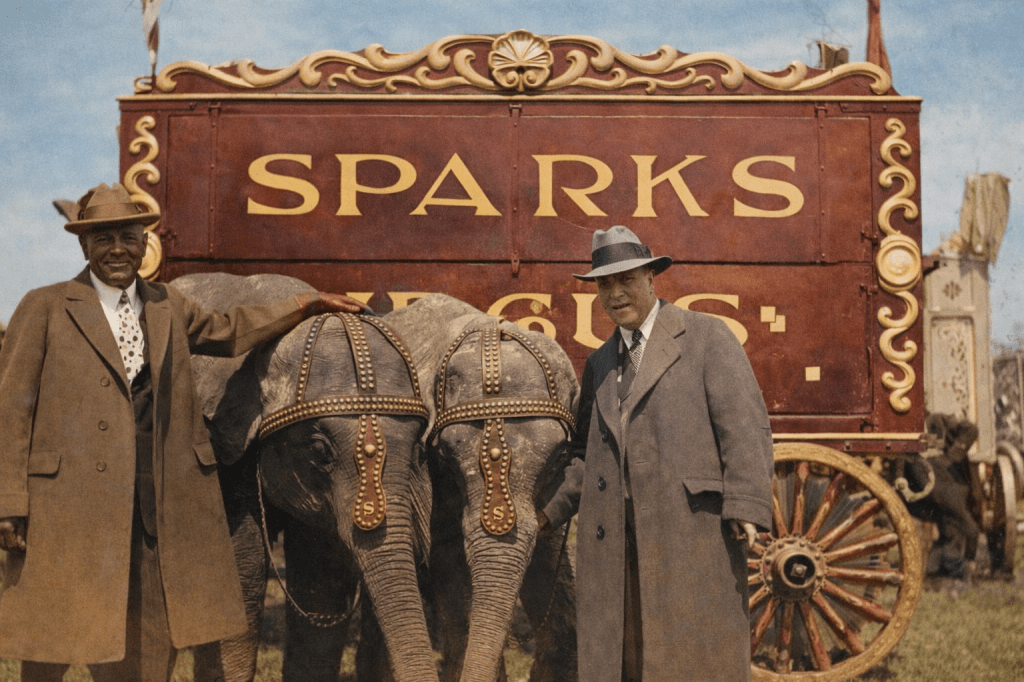
Rare original Sparks Bros Circus photograph showing evangelist Billy Sunday and Charles Sparks.

Why the Critics Miss the Point

Billy Sunday never pretended that money did not matter. Revival campaigns required large temporary tabernacles, choirs, staff members, and enormous logistical efforts.

But Sunday consistently refused opportunities that would have turned his preaching into entertainment.

The 1917 circus contract proves it.

The entertainment industry was willing to pay him millions in today’s dollars to headline the largest traveling show in America.

He said no.

The same evangelist who was accused of preaching for money walked away from a fortune.

And that fact should cause us to reconsider the narrative that Sunday’s critics often repeat.

Billy Sunday may have been many things—a fiery preacher, a former baseball player, a relentless evangelist—but the historical record shows that he was not in the ministry merely for the money.

If he had been, the circus would have had its star.

Instead, the revival fires continued to burn.


Did you know?

“It may not be generally known, but ‘Billy’ Sunday supports a mission on Van Buren street, Chicago, paying all the expenses of maintaining it out of his own pocket. He is also educating twenty boys and paying for it with his own money. These boys are waifs he has picked up out of the street. In this he is following the plan of the late Sam Jones, who in his lifetime educated hundreds of poor boys and made useful citizens out of them.”

The Kalamazoo Gazette. Fri, Jul 23, 1909 ·Page 4

Billy Sunday receives bomb death threat while in Omaha in 1915

Curated from original Omaha Daily Bee newspaper

A sensational threat upon the life of Evangelist Billy Sunday, conveyed through a crudely written “black-hand” letter, stirred the city yesterday but failed to interrupt the progress of the revival meetings at the great tabernacle.

The warning, received through the mails on Wednesday, declared that a bomb would be hurled into the tabernacle at 2 o’clock Thursday afternoon, September 23, and that Sunday would be killed unless he departed the city within ten days. The missive, scrawled in poor handwriting across ordinary note paper, bore at its lower corner the drawing of a black hand and a crude sketch of a bomb connected to a clock marking the fatal hour.

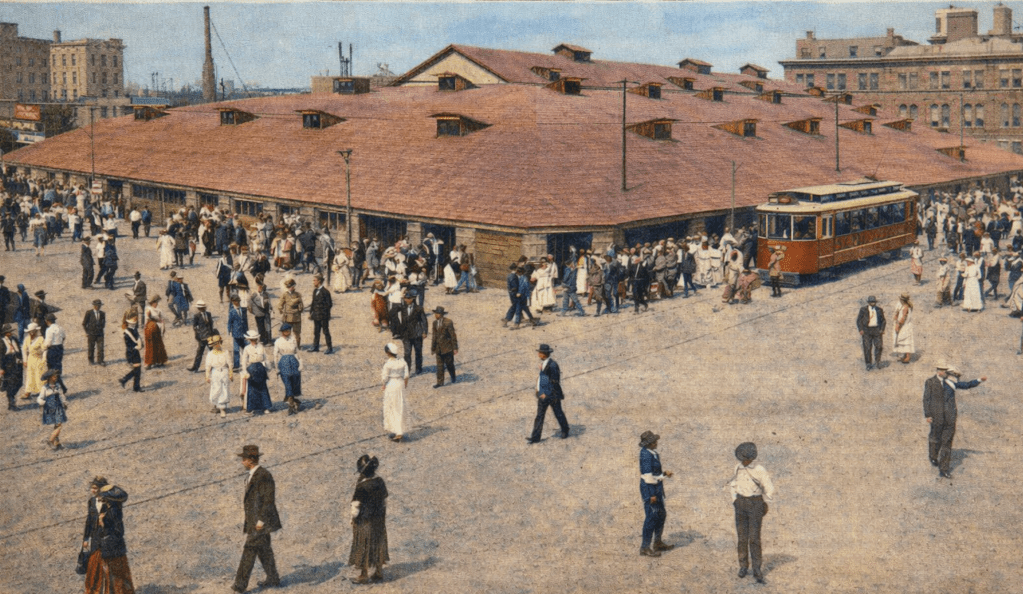
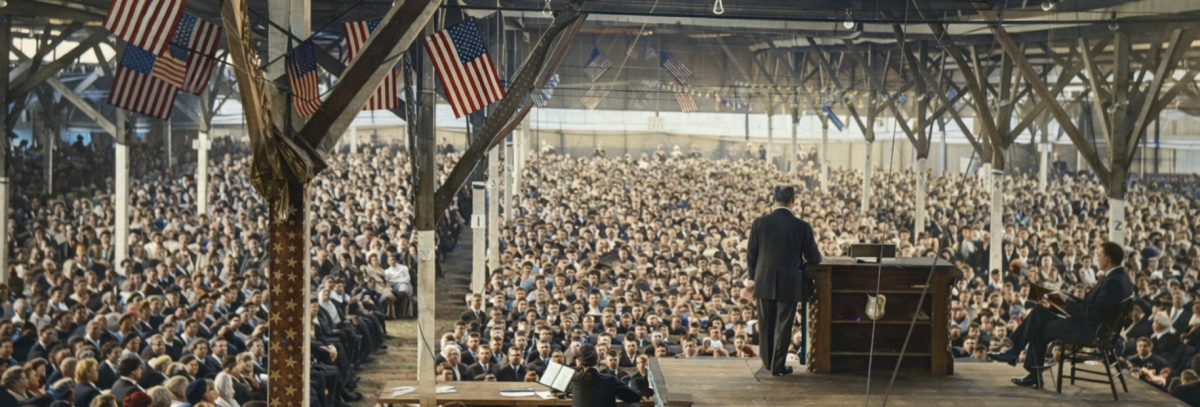
The Billy Sunday Tabernacle. Omaha, Nebraska.

Authorities were immediately notified. Chief of Police Dunn detailed detectives to trace the author of the threat, and a vigilant watch was ordered about the tabernacle grounds. Secretary Mathews, who first examined the letter, refrained from alarming the evangelist and quietly placed the matter in the hands of the police.

Despite the ominous warning, the Thursday afternoon meeting proceeded without incident. A squad of detectives, led by Sergeants Patsk Havey and Tom Donahue, mingled with the crowd, keeping careful surveillance in anticipation of any attempt upon Sunday’s life.

If the threat was intended to deter attendance, it met with mixed success. Many curious men flocked to the tabernacle, drawn by the sensational report, while the number of women present was noticeably reduced. Total attendance fell below the usual mark. Yet inside, the service moved forward undisturbed—save for the innocent crying of a baby, whose presence, smuggled past ushers, proved the only interruption to the evangelist’s address.

Thus, what promised to be a day of danger passed into one of quiet defiance. The bomb did not appear. The preacher remained. And the revival, under the watchful eye of the law, pressed on.

Adapted from: The Omaha Daily Bee, September 23 and 24, 1915

The Youngstown, Ohio (early 1910) Sunday-revival

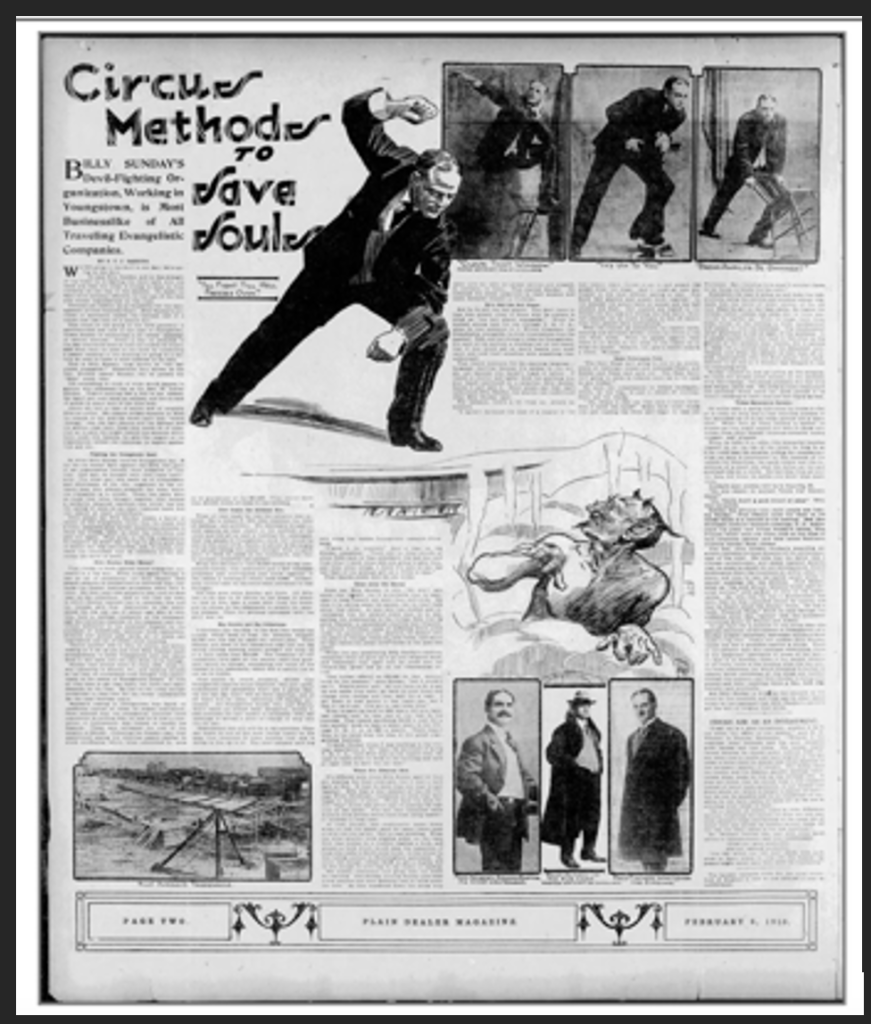
The Cleveland Plain Dealer. Feb 6, 1910  

Billy Sunday Comes to Youngstown: A City on Fire (January–February 1910)

When Billy Sunday rolled into Youngstown, Ohio, in January 1910, he did not arrive quietly—and Youngstown did not receive him quietly either.

From the very first night, it was clear that this industrial city, filled with steel mills, rail yards, immigrants, laborers, and restless energy, was primed for revival. Sunday began his campaign on January 8, 1910, and within hours it was obvious that this would be no ordinary meeting.

A city floods the tabernacle

On opening night, 5,000 people packed the tabernacle, according to the New Castle News (Jan. 10, 1910). The very next evening, crowds swelled to 7,000, as reported by The Pittsburgh Post (Jan. 10, 1910). The word had spread fast: Billy Sunday was in town, and Youngstown wanted in.

As the weeks unfolded, the numbers only grew more astonishing.

By February 4, the campaign had already recorded 2,221 conversions. That same night, 15,000 people attempted to crowd into a tabernacle that could seat only 7,000—a vivid picture of spiritual hunger and civic excitement. The Cleveland Press marveled at the scene, noting the crush of humanity trying simply to hear Sunday preach.

Youngstown had become a revival city.

The dramatic final Sunday

The campaign reached its crescendo on February 20, 1910.

That final day, 10,000 people attended, while 6,000 more were turned away for lack of space. The Marion Daily Star reported that 5,900 total conversions had been recorded over the course of the meetings, including 970 decisions on the closing day alone.

It was a stunning finish—one of those great climactic Sundays that made Sunday’s name synonymous with American revivalism.

At the conclusion of the campaign, Sunday received his customary purse of 10,000 dollars, a significant sum in 1910 and a sign both of the city’s appreciation and of the scale of the event.

What Youngstown reveals about Billy Sunday

The Youngstown campaign illustrates several hallmarks of Billy Sunday’s ministry:

  • mass appeal: from night one, thousands came. This was not a slow build—it was a tidal wave.
  • urban impact: Youngstown, a gritty industrial center, responded with remarkable intensity, showing that Sunday’s message resonated far beyond small towns or rural communities.
  • public spectacle and spiritual urgency: the overflow crowds on multiple occasions suggest that this was as much a civic event as a religious one.
  • measured results: newspapers tracked conversions closely, giving us concrete numbers that help modern historians gauge the scope of the revival.

Most of all, Youngstown demonstrates why Sunday was “the man for the moment.” In an era of rapid industrial change, social tension, and moral anxiety, he spoke with clarity, fire, and confidence—and cities like Youngstown listened.

More than a century later, the Youngstown campaign stands as one of the great urban revivals of Sunday’s early career. The numbers are impressive, but the deeper story is about a city temporarily transformed—its people stirred, challenged, and moved to decision.

J. Wilbur Chapman on Billy Sunday

Writing just days after the Youngstown campaign ended, J. Wilbur Chapman offered this striking tribute to Sunday in The Dayton Herald (Feb. 23, 1910):

“Some of the sermons he preaches now are not mine. I love him. I know his sincerity and passion for Jesus. I thank God for his ministry. Most of us are too dignified. Let rules of grammar and conventionality be broken if souls can be saved. As soon as he begins to speak the doors will be closed so you can’t get out. You’ve got to take your dose for once. If ever a man was called to preach; if ever a man had the seal of God’s approval on his ministry, that man is Sunday. I take off my hat to any man that can turn men to Jesus Christ.”

Billy Sunday in New Castle, Pennsylvania: A City Swept by Revival (September–October 1910)

When Billy Sunday came to New Castle, Pennsylvania, in the fall of 1910, the city quickly discovered that it was not ready for what was about to happen.

The campaign opened on September 18, 1910, and from the very first service it was clear that the tabernacle—built to hold 7,500 people—was not nearly large enough. According to the New Castle Herald (Sept. 19, 1910), crowds overflowed the structure on opening day, spilling into the streets and surrounding grounds. What had been intended as a major civic event immediately became something larger: a public phenomenon.

For six weeks, New Castle lived inside a revival. Night after night, thousands gathered to hear Sunday preach in his unmistakable style—direct, forceful, unsparing, and deeply earnest. Newspapers across western Pennsylvania followed the meetings closely, treating the campaign as front-page news rather than mere church business.

By the time the final service concluded on October 30, the numbers were staggering.

In total, $12,500 was collected during the campaign, as reported by the Warren Times Mirror on November 3, 1910. But far more striking were the spiritual results reported by local churches: 6,383 recorded conversions, including 1,050 decisions on the final evening alone.

The New Castle Herald captured the meaning of those numbers in a powerful editorial reflection on October 31:

“Just think of 6,383 souls being added to the churches of this city and county. This means one out of every six persons residing in this city. It means a very much larger proportion in reality, for these 6,383 are all of age to think and to accept for themselves the doctrines of Christianity. In the light of this, the money given yesterday to the evangelist seems a trivial sum, when compared with the good he has done.”

That statement goes to the heart of why New Castle mattered in Sunday’s career. This was not simply a revival that filled a building or generated headlines. It reshaped congregations across an entire region. Local churches suddenly found themselves filled with new members, new energy, and new responsibility for discipleship.

The New Castle campaign also illustrates why Billy Sunday became such a defining figure in early twentieth-century America. In an era before radio, television, or social media, he could command massive crowds purely through reputation, word of mouth, and the sheer force of his preaching. Cities did not merely host Sunday; they were changed by him.

More than a century later, the New Castle revival stands as one of Sunday’s most dramatic successes. For six weeks in 1910, a steel-town community experienced a spiritual earthquake—one that newspapers, pastors, and ordinary citizens remembered long after the tabernacle was torn down.

For historians of revival, New Castle offers a vivid case study in how Sunday’s campaigns worked: huge crowds, intense emotion, measurable results, and lasting impact on local churches.

For the people of New Castle, it was simply the season when their city met Billy Sunday—and was never quite the same again.

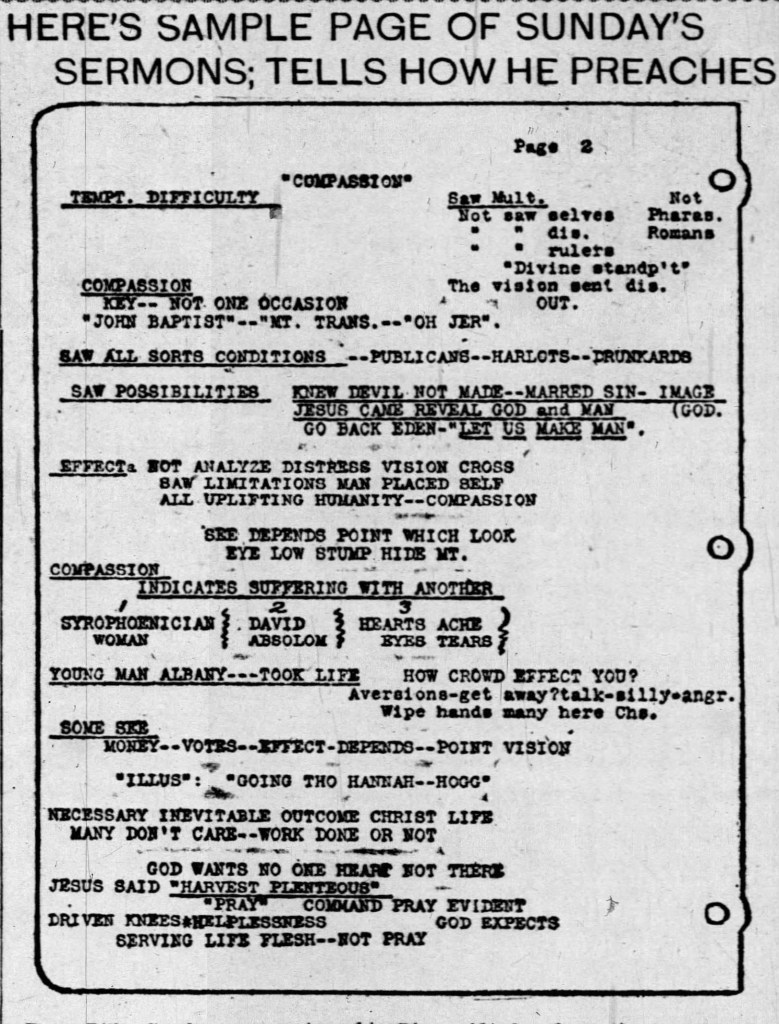
Did Billy Sunday have more than one copy of his sermons?

TO HAVE SERMONS DEPOSITED IN VAULT

BILLY SUNDAY GOING TO TAKE PRECAUTION AGAINST FIRE.

Citation: The South Bend Tribune. Tue, May 13, 1913 ·Page 7

Just Now, Evangelist Has No Duplicate Copies of His Famous Addresses—Ackley Does Work.

“No, I have only the one copy of each of my sermons,” replied Billy Sunday to a question as to whether he had duplicates of his sermons.

“These sermons are not in full,” continued the evangelist, as he showed the books in which he keeps the addresses that sway so many thousands; “they are just mere skeletons of the sermon and no one else but myself can read them, or at least I don’t think that anyone else can.”

Mr. Sunday was asked if he could remember the sermons if they were stolen and he replied that he recalled the majority of the material that composed them. He says that he intends to have duplicates made of the sermons and have them put into a safety deposit vault so that if one is stolen or should be destroyed by fire or in some other manner, he will have a copy.

“I thought at first that I would be able to get them copied this summer,” he said, “but it don’t look like the work will be accomplished, as I have so much to do this year.”

B. D. Ackley, pianist of the Sunday party, and secretary to the evangelist, copies the sermons of Mr. Sunday. This work takes up quite a bit of the pianist’s time, as Mr. Sunday is continually adding and detracting from his sermons as he acquires new material from many different sources.

“I always let Ackley fix up the sermons. He has a knack for doing things up pretty and nice,” said Sunday, while talking of his work.

“Now, boss, just because we have company you don’t need to make fun of me to my very face. He knows that I can’t fix them right,” said Ackley, as he turned to the visitor.

“That is all right; you do it just to suit me,” replied Sunday.

It is probable that sometime within the next year or so the evangelist will have all his sermons duplicated and deposited in a safety deposit vault.

The South Bend Tribune. Tue, May 13, 1913 ·Page 7

Revival and Collapse: Billy Sunday’s Fiery Campaign in Burlington, Iowa (1905)

By Kraig McNutt

From the moment he arrived in Burlington, Iowa, in November 1905, Rev. William “Billy” Sunday brought with him more than a revival campaign—he brought a storm. For six intense weeks, Sunday preached to thousands daily, confronted sin with his trademark “hammer and tongs” style, and called the city to spiritual awakening.

But the campaign didn’t just stir souls. It nearly cost him his life.


A Town on Fire—Spiritually Speaking

Sunday’s campaign in Burlington ran from November 9 to December 17, 1905. In that span, he preached to crowds of 6,000 to 10,000 in a massive wooden tabernacle built for the occasion. The energy was electric. At one point, over 1,279 converts had been counted, and by the end of the campaign, the total reached 2,484.

The Muscatine Journal described Sunday’s preaching as if “swaying a storm-beaten ocean.” In a men’s meeting alone, 112 responded to the call, with many more turned away due to overcrowding.

But Sunday’s sermons weren’t just altar calls—they were cultural critiques. He lambasted spiritual apathy, criticized parental neglect, and took direct aim at profanity, indifference, and moral complacency. In one memorable line, he warned:

“You say, ‘It is nobody’s business what I do.’ But hear me—it is everybody’s business what everybody does.”

His sermons were equal parts gospel and social conscience.


Revival or Overkill?

Not everyone was thrilled. A Cedar Rapids Gazette editorial warned that while Sunday was sincere, his tone could be offensive and even vulgar. Some churchgoers felt he used “language of the gutter” and painted humanity as far too depraved. They admired his passion but questioned his method:

“Offensiveness and vulgarity may emanate from the pulpit as well as from any other source… but ‘Billy’ Sunday is sincere, and sincerity is a virtue that is not to be despised.”

It was this very sincerity—his relentless, full-throttle commitment—that finally broke him.


The Collapse Heard Across the Midwest

On Monday, December 18, 1905, as Sunday prepared to preach to yet another crowd of 4,000, he suddenly collapsed on stage, fainting in front of the shocked audience. Reports soon circulated that his life was in danger, and that weeks of nonstop preaching had led to total physical and nervous exhaustion.

The Dixon Evening Telegraph wrote:

“He had been preaching steadily day and night for months and during the preceding week had not slept.”

While Sunday recovered and eventually continued his national ministry, the Burlington collapse marked a critical moment—a reminder that even spiritual giants are still human.


A Lasting Impact on Burlington

Despite the toll on Sunday’s health, the Burlington campaign left deep footprints in the city. By the time the tabernacle closed:

  • 2,500 had publicly confessed Christ
  • $4,000 had been raised in free-will offerings
  • The mayor ordered all saloons closed on Sundays
  • A Civic Reform League with 150 members formed to continue the moral reform efforts sparked by Sunday’s preaching

According to The Grand Rapids Press, the final night saw 7,000 people crammed inside, with 5,000 more unable to get in. It was one of the most dramatic and consequential campaigns of Sunday’s early career.


Legacy: The Revival That Cost Everything

The Burlington campaign reveals the paradox of Billy Sunday’s revivalism:

  • His methods were polarizing—but effective.
  • His energy was boundless—but not limitless.
  • His message stirred the masses—but came at personal cost.

Still, Sunday “played ball” in the pulpit the way he had on the baseball field: heart first, full speed, no reserve.

And in December 1905, Burlington, Iowa, witnessed both the brilliance—and the breaking—of a man determined to bring America back to God.

Burlington, Iowa (November 9 to December 17, 1905)

​Billy Sunday conducted his revival campaign in Burlington, Iowa, from November 9 to December 17, 1905. He saw 2,484 conversions and generated $4,000 in collections. A newspaper article tells how he fell ill and his very life was deemed threatened during the Burlington campaign.

Reported That Evangelist Sunday Was Taken Ill During Meetings.

It is reported that Rev. “Billy” Sunday, who has hundreds of friends in Dixon, has broken down from overwork and nervous strain and is dangerously sick at Burlington, Iowa. Friends here have heard nothing of this but the following item is published in an exchange:

“Billy” Sunday, the famous baseball evangelist, broke down at a revival near Burlington, Iowa, Monday, and his death is feared. Sunday started to preach to a crowd of 4,000 people when he toppled over on the platform in a dead faint. He had been preaching steadily day and night for months and during the preceding week had not slept.”

  • Dixon Evening Telegraph. Mon, Dec 18, 1905 ·Page 5

Additional related newspaper coverage of the Burlington, Iowa (1905) campaign

REV. “BILLY” SUNDAY.

Burlington is now in the throes of a religious awakening, engineered by that eminent and popular ex-baseball player who now is known as Rev. William A. Sunday, but whose numerous friends still love to call “Billy” Sunday. Sunday has been preaching the old gospel in his own inimitable style for several years, and has drawn to him the friendships of a great many people of all denominations, while he has also offended many good people by his “hammer and tongs” style of argument. He has also many friends among the people outside of all churches, for there is one thing of which “Billy” Sunday cannot be justly accused, and that is insincerity. He preaches just like he played ball—puts his whole heart into the work; in other words, he “plays ball” in his present profession. That he has done and is doing great good cannot be successfully denied, and Burlington will probably be better, for a time at least, for his coming; but he has many friends who do not believe it is necessary to use the language of the gutter in condemning evil, nor that everybody is quite as bad as Mr. Sunday would sometimes have his hearers believe.

Offensiveness and vulgarity may emanate from the pulpit as well as from any other source. And it is barely possible that a religious cathartic may not prove as effective in the long run as a less drastic and more constructive remedy.

Again, those who labor just as hard, year in and year out, and just as faithfully, in the noble calling, at a salary generally less per annum than Mr. Sunday receives in a fortnight, may be doing a more permanent work. But “Billy” Sunday is sincere, and sincerity is a virtue that is not to be despised.

  • The Cedar Rapids Gazette. Mon, Nov 13, 1905 ·Page 4

GREAT REVIVAL.

Evangelist “Billy” Sunday Stirs Up Burlington—Large Crowds.

Burlington, Ia., Nov. 28—The revival services conducted by Rev. William A. Sunday have already grown to be a remarkable thing for Burlington. They have been going on for two weeks, and the evangelist is now speaking to an average of 6,000 people daily. Sunday afternoon he held his first men’s meeting and was greeted by fully 6,000 men, old and young. He swayed this remarkable audience for an hour and a half like a storm beaten ocean and at the close 112 men responded to the call for converts, and it is estimated that 50 were turned away because of the crush in front of the evangelist. Including this number there have been a total of 602 converts since last Thursday night.

  • The Muscatine Journal. Tue, Nov 28, 1905 ·Page 1

SOME “BILLY’ SUNDAYISMS.

From Burlington papers: The indifference of many in the church is keeping back the kingdom of God.

Some of you are constantly breathing out in doing good to others, but do no breathing in; seldom or never give yourselves any time with God.

If you have done your neighbor in jury, go to him and confess it, and ask his forgiveness.

The greatest barrier to the advancement of God’s Kingdom to-day is the indifference and apathy of so many of our church members.

No wonder so many of our children go to the bad; they get no guidance, no inspiration, no help for good in the home.

There are hundreds here to-night who are convinced that Jesus Christ is the son of God, but have not back- bone enough to come down the aisle and confess it.

The historical Jesus? You may repudiate him as the son of God, but you still have the historical Jesus, and you could no more write the history of the world and leave Jesus out than you could write the history of this country and leave out George Washington.

Profanity damns and curses any man who indulges in it.

What would the world be were there no restraining influence? You say “it is nobody’s business what I do.” Bu’ hear me, it is everybody’s business what everybody does.

There are certain men who scoff at religion and at preachers, but when they come face to face with death and the fearful consequences of their dis- solute lives they begin to fear and tremble.

  • Muscatine News-Tribune. Tue, Dec 05, 1905 ·Page 6

Ten thousand people sought to hear “Billy” Sunday preach at Burlington last Sunday, 6,000 succeeding. Converts in his revival services in that city to date number 1,279.

  • Quad-City Times. Wed, Dec 13, 1905 ·Page 2

Closed by “Billy” Sunday.

Burlington, Ia., Dec. 20.—The wave of reform in Burlington, growing out of William A. Sunday’s revival meetings, resulted in the formation of the Civic Reform league of 150 members, and the issuance last night by Mayor Caster of an order closing all saloons on Sunday.

  • The Grand Rapids Press. Wed, Dec 20, 1905 ·Page 9

2,500 Converts

Secured by Rev. Billy Sunday in Burlington

Burlington, Ia., Dec. 19.—The Rev. William A. Sunday has closed his series of evangelistic meetings here. There were 7,000 people packed into the tabernacle, with at least 5,000 outside unable to get in, last night. The results of the meetings are 2,500 converts. The people of Burlington have given him a free-will offering of over $4,000.

  • Marion News-Tribune. Wed, Dec 20, 1905 ·Page 9

Billy Sunday campaigns 1904-1905

Here’s a blog-ready narrative reflecting on the 1904–1905 campaign data from Billy Sunday’s early revivals:


Billy Sunday’s Early Impact: What the 1904–1905 Campaign Numbers Reveal

By Kraig McNutt

Before Billy Sunday became a national sensation—packing tabernacles in Philadelphia and Pittsburgh—he cut his evangelistic teeth in smaller Midwestern towns. The data from his 1904–1905 revival campaigns offers a fascinating glimpse into the early momentum of a man who would become America’s most celebrated evangelist of the early 20th century.

Here’s what the numbers reveal.


Small Towns, Big Spiritual Response

Many of the towns on Sunday’s early itinerary were small agricultural or industrial communities scattered across Iowa, Illinois, Minnesota, and Colorado. Places like Exira, Iowa and Audubon, Iowa boasted modest populations—yet hundreds came forward to respond to Sunday’s message.

  • Centerville, Iowa (1905): 900 conversions
  • Sterling, Illinois (1904): 1,678 conversions
  • Macomb, Illinois (1905): 1,880 conversions
  • Dixon, Illinois (1905): 1,875 conversions

These numbers are especially impressive when viewed through the lens of population density. In many cases, Sunday was reaching 10–20% or more of the town’s residents. His message wasn’t simply heard—it reshaped the spiritual landscape of entire communities.


Collections: A Window into Support and Sustainability

While conversion data was consistently recorded, collections (monetary offerings) were only occasionally noted:

  • Centerville, Iowa: $1,500
  • Keokuk, Iowa: $2,200
  • Dixon, Illinois: $2,000
  • Macomb, Illinois: $3,100

These figures indicate that even in smaller towns, there was strong financial support for revival efforts. The money likely covered the costs of tabernacle construction, music, printed materials, and Sunday’s own ministry team.

These generous gifts also reflect the deep gratitude communities felt for the spiritual impact they experienced.


Consistent Fruit Across the Heartland

Across 22 cities recorded between 1904 and 1905, Sunday saw tens of thousands make public professions of faith. The median number of conversions hovers around 900–1,000 per town. For a relatively unknown evangelist in his early 40s, this marks a period of accelerating credibility and growing influence.

It was this consistency—town after town, soul after soul—that built the foundation for Billy Sunday’s national platform just a few years later.


A Revival Rooted in the Midwest

It’s no accident that Sunday’s early years focused on Iowa, Illinois, and Minnesota—regions that mirrored his own upbringing and values. These were towns where the church was central, alcohol was a public enemy, and personal salvation was not just a religious idea, but a community matter.

Sunday’s fiery oratory, moral clarity, and theatrical flair found fertile ground in these heartland soils.


Final Thought: The Humble Beginnings of a National Voice

The revival fires Billy Sunday lit in places like Bedford, Harlan, and Canon City were more than regional events—they were launchpads. These early campaigns showed that revival could still grip a town, change hearts, and reorder lives.

In 1904 and 1905, he wasn’t yet preaching to hundreds of thousands—but he was proving that he could.

And history shows—he would.


Enjoying this kind of historical insight? Subscribe to the blog or check out more posts at EvangelistBillySunday.com


Source: The Spectacular Career, p. 126.

CityConversionsCollections
Marshall, Minn.600
Sterling, Ill.1678
Rockford, Ill.1000
Elgin, Ill.800
Carthage, Ill.650
Pontiac, Ill.1100
Jefferson, Iowa900
Bedford, Iowa600
Seymour, Iowa600
Centerville, Iowa9001500.0
Corydon, Iowa500
Audubon, Iowa500
Atlantic, Iowa600
Harlan, Iowa400
Exira, Iowa400
Keokuk, Iowa10002200.0
Redwood Falls, Minn.600
Mason City, Iowa1000
Dixon, Ill.18752000.0
Canon City, Colo.950
Macomb, Ill.18803100.0
Canton, Ill.1120

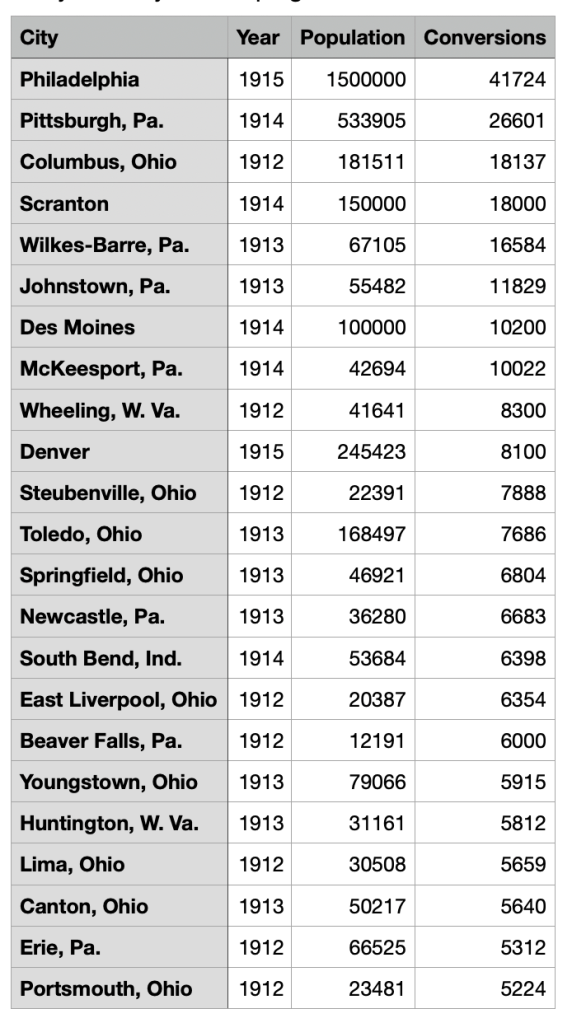
Revival in the Rust Belt: What the Numbers Reveal About Billy Sunday’s Evangelistic Impact (1912-1915)

By Kraig McNutt

In the early 20th century, few public figures stirred the American soul quite like Billy Sunday. A former professional baseball player turned dynamic evangelist, Sunday launched revival campaigns that were part gospel meeting, part moral crusade, and entirely unforgettable.

But beyond the sawdust trails and thunderous preaching, what do the numbers tell us about his real impact?

Let’s dive into an analysis of over twenty of Sunday’s campaigns—spanning from the industrial sprawl of Philadelphia to the steel towns of Ohio and Pennsylvania—to find out.


Big Cities, Big Numbers

Unsurprisingly, the nation’s largest cities saw the highest total conversions:

  • Philadelphia (1915): 41,724 conversions
  • Pittsburgh, PA (1914): 26,601 conversions
  • Columbus, OH (1912): 18,137 conversions

Impressive, no doubt. But when measured per capita, a surprising truth emerges…


The Real Revival Was in Small-Town America

Here’s where it gets fascinating:

  • Beaver Falls, PA (1912): 6,000 conversions in a city of 12,191 – nearly 49%!
  • East Liverpool, OH (1912): 6,354 conversions in a population of 20,387 – over 31%
  • Steubenville, OH (1912): 7,888 conversions out of 22,391 – over 35%

In these towns, Sunday didn’t just stir hearts—he helped reshape the entire community’s spiritual identity.


A Strategy Rooted in the Industrial Heartland

Most of Sunday’s campaigns concentrated in:

  • Pennsylvania
  • Ohio
  • West Virginia
  • Indiana

Why here?

These regions were filled with working-class cities grappling with the social challenges of industrialization: alcoholism, labor unrest, poverty, and moral uncertainty.

Sunday’s sermons, full of vivid illustrations and uncompromising moral appeals, landed powerfully in these settings. He spoke their language, addressed their fears, and challenged their habits.


His Peak Impact Years: 1912–1914

Many of the most spiritually responsive campaigns occurred just before World War I:

  • Scranton (1914)
  • Wilkes-Barre (1913)
  • McKeesport (1914)
  • Des Moines (1914)
  • Johnstown (1913)

This was Sunday’s sweet spot—a season where both momentum and message aligned. Before the war brought cultural upheaval, Sunday’s campaigns offered a moral anchor to cities teetering on the edge of change.


The Bottom Line: Revival by the Numbers

Across 23 cities analyzed:

  • Total population: 3,559,070
  • Total conversions: 250,872
  • Average conversion rate: ~7.05%

That’s 1 in every 14 people making a spiritual decision.

But the real story is this: Sunday’s numerical reach was greatest in big cities, but his transformational impact was most profound in smaller towns where community bonds were tighter, distractions were fewer, and the message spread like wildfire.


Final Thoughts: When Revival Was a Shared Story

Billy Sunday didn’t have Instagram reels or livestream sermons. He had sawdust floors, a voice like thunder, and a message about Jesus that could shake a city.

And in towns like Beaver Falls, East Liverpool, and Steubenville, it did more than shake—it changed lives. Not in abstract theological terms, but in the daily rhythms of work, family, and community.

In these places, revival wasn’t just a moment. It was a movement.


Want more historical insights like this? Subscribe to my newsletter or explore more at https://evangelistbillysunday.com/


Total population 3,559,070
Total conversions 250,872

Data from The Man and His Message, Ellis