Former professional baseball player-turned urban evangelist. Follow this daily blog that chronicles the life and ministry of revivalist preacher William Ashley "Billy" Sunday (1862-1935)
The God-forsaken dance in the schools is—I’ll knock hell out of that here. And you taxpayers have to go down and pay the bill for immorality. It’s an outrage.
Faith is a mightier force than dynamite.
You can’t hurt the Bible any more than you can stop an ocean’s wave by blowing against it with a tin whistle.
This tabernacle represents God and Christianity.
We depend too little on God and too much on the soup kitchen. There are more full stomachs than bended knees in the church.
There’s no use to go after a skunk with cologne water.
Some of us are so slightly acquainted with God that we are afraid to trust Him.
Faith takes God at His word without an IF.
When you have done your best you can trust God with the consequences.
You can pass the buck to God any time you want to if you have done your part.
God will damn any church that will run a dance.
If you want to see a dead town wake up, do something out of the ordinary.
A preacher that can’t preach as though he had authority from God, is no success. He just jimmied his way into the pulpit or had a pull somewhere.
If some preachers would talk plain to sinners in the front pews, how soon the old ice house would thaw out.
If Bible results are expected then Bible preaching must be given to the people.
There is constant disappointment in the preacher who tries to shoot bear with bird shot.
A knowledge of the Bible without education is better than education without the Bible.
The man that God sends is always the right man.
The preacher who is afraid to speak the truth is as weak as Samson was with his hair cut.
When God calls a man to preach he expects him to be as natural as when he sneezes or snores.
A safe and sane ministry is a good deal like a horse—well, one that any woman can drive.
Eternity writes no wrinkles on the brow of time.
There are some people who laugh at other people’s misfortunes. There are a few fools like that in the world.
They haven’t got through shouting up there yet since Moody swept through the gates.
Nobody ever goes to hell that he isn’t warned by God.
I am not discounting the value of education. It draws out virtues and attractions that do not appear otherwise. Education alone can not make character. Education alone can not save a soul.
I am a Christian because God said so. God’s word is the last word. I know I am a Christian.
I am not an infidel because I am not a fool.
I can’t understand your indifference to God’s love.
No rattlesnake will crawl over a rope.
Hell must be an awful place if God Almighty loved us enough to give His Son to keep us out of there.
I don’t think any man does the right thing by his family if he does not prepare for his wife and her little brood after he’s gone. I carry thousands of dollars worth of insurance.
If you are not willing to serve God, you are a God-forsaken, black-hearted ingrate and you are a fool.
Salvation belongs to God and God states the terms by which you may have it.
If you want to come to God you must come through faith in Jesus Christ.
I challenge you Lutherans, Methodists, Baptists, Episcopalians, Presbyterians, Christians, United Brethren, to show me that I don’t preach the truth. I hurl it into your teeth.
God never taught me to beat a retreat.
Some fellows will go fishing and stand in the water up to their waists all day, and watch the bobber and never get a bite and say they are having a good time. But if the preacher happens to trespass five minutes over time on Sunday morning those same birds will pull their watches and begin to fidget.
It’s a waste of time to pray to the wrong God.
If you want God’s purity in Richmond, build up the broken down altars.
What we need in the church is less pie and more piety.
You can’t wait three weeks, Richmond, Ind., to get your crop.
Before you can pray right, you’ve got to do right.
O Richmond, God’s warriors have first got to be His worshippers.
Some people are married to the church or the choir or the organ.
The stone that’s in the foundation of a building is more important than the flag staff on the roof, although the stone is not so much in evidence.
Wife of Evangelist Addresses Women at Two Churches on Sunday
More than 2,500 women heard the gospel message delivered Sunday afternoon at East Main street Friends and the First Methodist Episcopal churches by Mrs. W. A. Sunday. She appealed for an awakening of the church people to their responsibilities and especially for the conviction of Richmond church officials who have turned a deaf ear to the effort now being put forth by Mr. Sunday for the saving of men and women for the Christian life.
“There are not enough preachers in the world to tell God’s messages. The church must have an anxiety for people or sons and daughters will not be born into the Kingdom. The most important thing in the world is to win souls for Jesus Christ.
Sermon and Mrs. Clark.
“It has been said that Harry Monroe was responsible for winning Mr. Sunday to Jesus Christ. He was and he wasn’t. It was the wife of Colonel Clark who put her hand on Mr. Sunday’s shoulder and asked him to be a Christian. It was Harry Monroe’s sermon, Mrs. Clark and God who won my husband to Him.
“I can’t understand why the elders and officers of the churches shouldn’t come to the tabernacle and help raise the standard of the church of God. If some of us would make a confession in our own homes maybe we could lead some of our children to Christ. Don’t you think your boys and girls aren’t watching you. Regardless of whether they say anything or not they know what you are doing and if you need to make a public confession of your sins, you should do it. If you do a definite thing at a definite time for Jesus Christ, He will bless you.
“If your religion amounts to the time you spend in church or at prayer meeting, it isn’t the Christianity God intended you should have.”
One of 57 Children.
Mrs. Sunday said she was one of 57 children who decided to live the Christian life, her decision taking place when she was 12 years of age. She stated that, at the age of 15 years, she was asked to teach a Sunday school class in the Third Presbyterian church at Chicago. This she did for three years. At the age of 18 years, while attending a revival service at the church, she was convicted of the necessity for leading someone to live the better life. Her success in leading her Sunday school class to Christ was successful, she stated, however, saying there was one girl she did not reach. After 30 years she met that person in Detroit and was instrumental in directing her on the right pathway. Mrs. Sunday now wears a handsome wrist watch given her by that woman, as an expression of her friend’s gratitude.
The singing at the East Main street service was in charge of Mrs. Virginia Asher with Mrs. A. H. Backus at the piano. Miss Florence Kinney held the crowd at the First Methodist church by the gospel message which she delivered. The singing was conducted by Mrs. Lloyd E. Harter.
Cited in: The Richmond Item. Tue, May 09, 1922 ·Page 6
Evangelist Explains Why He Uses Language of Streets In His Sermons
“Richmond ministers are dead right when they declare that if they said in their own pulpits some of the things I say in mine, it would sound ridiculous,” Billy Sunday admitted yesterday.
“There is a time and a place for all things,” continued Sunday. “Staid old church people, reared in Sunday schools, prayer meetings and churches and familiar with elegant phraseology, do not need to have things told them in the plain language of the street in order to comprehend them. Richmond ministers preach to about the same crowd every Sunday and they understand them perfectly.
Short Over Heads.
“But I speak to multitudes whose fathers never darken a church door. If I put them to the usual pulpit terms it would be clouds over their heads. Some of my hearers never went to school, never received church training. Their vocabulary is often limited to 500 words—many of them idioms of the street and slang, and some of them bordering on cuss words. Now I do not use cuss words, but I use the slang or phrase of the street that I know they will understand and respond to—and they do.
“I saw a man seated in front of me in the tabernacle whose dress and appearance showed he was a sport. He was plainly no church-goer. When I said in my sermon, ‘Don’t pass the buck!’ his face lighted up immediately. He was all smiles and he quickly got the idea I was trying to convey. Had I used highfalutin terms they would have been wasted on him.
Never So.
“When Lincoln used the word ‘sugar coated’ in one of his messages, Secretary of State Seward said he would never do—it was not refined enough.
“All right, you put in a better word,” Lincoln told Seward. Next day Seward came back and said he couldn’t find a better word, and ‘sugar-coated’ remained in the message.
Lincoln said there never would come a time when the American people would not know what ‘sugar-coated’ meant.
The apostle said: ‘By their works ye shall know them’—and when I put it: ‘Show me! I’m from Missouri,’ the man of the street not used to going to church gets the idea in a jiffy.”
Cited in: The Richmond Item. Sun, May 07, 1922 ·Page 6
Note: To read Billy Sunday’s actual prayers, as they were published in the local paper in Richmond, visit this link.
In the spring of 1922, evangelist Billy Sunday descended upon Richmond, Indiana, for a multi-week revival campaign. Thousands flocked to the great wooden tabernacle built for the occasion. They came to hear Sunday’s famously theatrical sermons—but they also heard him pray.
Many of these prayers were transcribed by local newspapers, preserving a unique glimpse into Sunday’s heart when he spoke not to the crowds, but to Christ.
What do these prayers tell us about the man? What did he care about most? What themes, ideas, and images kept surfacing? What unusual moments give us insight into the soul of this revivalist?
After reviewing more than two dozen of his public prayers from the Richmond campaign, a compelling portrait emerges—equal parts preacher, prophet, and penitent.
1. Evangelistic Zeal and Urgency
Above all, Billy Sunday was an evangelist. His prayers are not casual introductions or polite benedictions—they are urgent appeals to heaven for conversions on earth.
Time and again he pleads, “Help them to walk down here,” or “May many tonight say, ‘Here is my hand, my heart, my pledge.’” He speaks to God with the language of altar calls. He prays as a man storming the gates of hell to rescue the lost.
In one prayer, he imagines a vast spiritual migration:
“Help hundreds of men and women to walk down the aisles tonight and take their stand for Christ… inside here, and the people outside here… help them all tonight to take their stand for Jesus Christ.”
His prayers are saturated with urgency, especially for those who might never get another chance.
2. The Devil Is Real—and He’s the Enemy
Sunday believed in the devil. Not as a metaphor, but as a malevolent force actively working to destroy lives and communities. He blames Satan for:
Every penitentiary,
Every broken home,
Every alcoholic and prostitute,
Every grave dug in rebellion against God.
In his words:
“It seems to me the devil has dug enough graves… carved enough epitaphs… made enough drunkards… enough whoremongers.”
He prays for the devil to be “beaten back” and envisions him retreating from Richmond on “crutches,” staggering in defeat. This isn’t poetic fluff—it reflects a core conviction: revival is spiritual warfare, and prayer is how you fight.
3. A God of Nearness, Not Abstraction
For all of Sunday’s thundering urgency, his prayers also reveal a tender intimacy with Christ. He doesn’t begin with “Our most gracious heavenly Father,” but with the familiar, almost childlike invocation: “Say Jesus…”
He pictures Jesus leaning over heaven’s battlements, watching, weeping, waiting. He describes God’s heart as a harbor in a storm:
“It is big enough for a world to hide in.”
And when Sunday talks about Christ’s presence, he appeals to the common-sense faith of farmers and factory workers:
“We can’t see You… but we know You are here. We don’t see the air either, but we know it’s there. We’re breathing it.”
4. Confession of Inadequacy
One of the most human aspects of Sunday’s prayers is how often he admits weakness. Despite his celebrity and rhetorical firepower, Sunday repeatedly tells Jesus:
“I feel distressingly inadequate.”
“I don’t know what more to say.”
“If I’ve failed, it’s from the head, not the heart.”
In one powerful moment, he imagines standing before God in eternity and being asked whether he preached the truth. He answers each divine question with clarity and conviction, but it’s clear he is not self-congratulatory—he’s a servant hoping he has done enough.
5. Gratitude and Specificity
Sunday doesn’t just thank God in broad strokes. He prays for:
The Starr Piano Factory
The Rotary and Kiwanis Clubs
The Odd Fellows and Masonic lodges
Factory workers, businesswomen, farmers, police, firemen, and clerks
His team: Rodey, Bob, Mrs. Asher, and others by name
This detailed intercession reflects a preacher deeply connected to his audience, not only spiritually, but culturally and economically.
6. Theology in the Trenches
Sunday’s theology comes through clearly:
The Bible is true.
Jesus is the only way of salvation.
Hell is eternal.
The Holy Spirit is active.
Salvation is by faith, not works.
But what’s unique is how conversational and concrete these doctrines become in prayer. He doesn’t just affirm them—he reasons with God about them, preaches them back to heaven, and pleads for their consequences to take root in people’s lives.
7. Vivid, Unusual, and Creative Moments
A few standout moments show Sunday’s inventive imagination:
Mock Interview at the Judgment Seat: He prays as if answering Jesus’ questions about whether he preached the full counsel of God—including hell, the Cross, and the exclusivity of Christ.
Agricultural Intercession: In one prayer, he pleads for protection from potato bugs, green aphids, boll weevils, and chinch bugs—spiritual warfare with an entomological twist!
Preaching Boards: As the tabernacle was to be converted into a gymnasium, Sunday says, “Every knot hole will seem to preach a sermon. Every board will be precious.” Even the building itself becomes a kind of legacy.
Evangelism by Auto: He imagines a man driving home from the tabernacle and being stopped by a sword-bearing angel with the question, “Did you solve the problem—what shall it profit a man if he gain the world and lose his soul?”
Conclusion: A Man on Fire, A Gospel on Display
Billy Sunday’s Richmond prayers are far more than stage-setting; they are the spiritual lifeblood of the campaign. Through them we meet a man convinced of eternal realities, obsessed with souls, conversing with God like an old friend, and pouring out every ounce of energy to bring people to Christ.
And though the world has changed in a thousand ways since 1922, the raw passion of these prayers still speaks. They call us back to a faith that is urgent, concrete, emotional, and unashamed.
Sunday once imagined God asking, “Bill, did you preach the truth?” His prayers leave little doubt how he would answer: “I did.”
Would you like this formatted into a downloadable PDF or Word doc for posting or printing?
Say Jesus, bless this great throng that has come here from office and shop and store, our friends, the Friends, our friends, the Lutherans and your friends, the Friends and Lutherans, Baptists and Presbyterian and United Brethren and Episcopalians. Hear us, Lord. We are here tonight to praise Thy name and we are here to know what to do to please Thee and to displease the devil. The devil has never done any good for this old world. May we say to the devil, ‘You have made every jail and every penitentiary. You have been the blight on this earth.’ We do pray that the glory and the power of the Lord may fall upon this audience and upon this community and upon the country round about until God shall have glory and the devil shall be beaten back until heaven shall ring and shout with joy until hell will mutter and grumble and growl. O God, that the people may say with the help of the Lord, good bye to the devil and the devil call a conclave of all the lost spirits, and they say, ‘What can we do to check the great Bible talk, that we may tear the people away from the church, may they fall from the Bible, from Christianity and from truth.’ Hear us, our God, we beseech You, the Friends here and the Lutherans, and all may everybody walk down here and say, ‘Here is my hand, my heart, my pledge to live out and out for God, have family prayer in the home, to do the right, Lord, to be faithful in my attendance, to do everything I can to help the cause of the Lord. O Lord, with Your help, I will put out of my life everything that is a hindrance and a detriment to me. I will take my ground and I will live the way I ought to live.’ Hear us, bless and keep us, our Lord. Can we say, ‘It is well with Thee?’ Not if we are away from God. Is it well with my husband? Not if he is away from Christ. Is it well with thy child? Not if it does not know Jesus Christ. And it does not hear from your lips a prayer and if you do not try to turn it in the way it ought to live. Hear us Our God, for Jesus’ sake.
Cited from: The Richmond Item. Thu, May 04, 1922 · Page 7
Mr. Sunday’s Thursday Night Prayer
Say Jesus, this is Thursday, Lord and the third week. Thank You for them, thank You for the great interest of the people. Thank You for their attention, thank You for their gifts, thank You for their contributions which almost total enough for You to pay Your debts Lord, and the treasurer will pay them. We thank You for the hundreds who have pressed down the aisles, whether to renew their vows or take their stand for the Lord, we don’t know which. That is between them and the Lord. That is none of my business. We thank You for the help that has been given by the ministers, the ushers, the doorkeepers, secretaries and all, and the committeemen and the committeewomen and for the delegations that have been here from this city and from the country round about. And Lord tonight here are the Masons, here the Junior Order United American Mechanics and their auxiliary, and our friends down there from Campbellstown. They have been here once before, Jesus. I pray Thee they will come and take their stand. Wouldn’t it be great to have every Mason, Lord, tonight, just walk down and say, ‘Here is my hand. I want to take my stand for Jesus.’ They can’t enter the lodge without acknowledging Christ. They can’t even wear that white plume. They can’t draw that sword, can’t wear the badge of Knight Templar without believing in Jesus Christ and the Cross and the Resurrection and the empty sepulchre without looking heavenward. No sir. Over the threshold and over the entrance to every Knight Templar they say, ‘No infidel can come in here. No unitarian can come in here. Nobody who denies the deity of Jesus Christ or the resurrection of Jesus Christ can come in here. Help them Lord, to take this last degree. Some of them have taken the 32nd degree and some of them have taken the 3rd degree and some of them have taken the 33rd degree, Lord. We meet a few of them here and there, Lord. We have one here that God wants to bestow and when God gives that Lord, then they have the pass-word for heaven. Help them to walk down, even if they are in the church, Jesus, to say, ‘Here is my hand. I want to be the kind of a Christian so that wherever I go people will smile and they will forget their sorrows and their crosses and they will think, O God, that is the kind of a Christian I want to be. I want to come and openly and publicly confess my faith, Lord, because I want to be that kind of a Christian for God.’ Help the Junior order, Jesus, lead with that flag, standing for the principles for which they stand, for the Bible, Lord and for true Americanism, hundred per cent. And our friends from Campbellstown, help them to come. Wouldn’t it be great, God, just to see the members of the Masonic lodge that are here and the Junior order and the Masons, and friends from Campbellstown to walk down here and avow their faith in the Lord, and willing to serve Him and do his will. Help them our Lord, we pray. Hear us for Jesus’ sake.
Cited from: The Richmond Item. Fri, May 05, 1922 ·Page 7
Mr. Sunday’s Saturday Night Prayer
Say, Jesus, have I made it plain? If I have not I ask your forgiveness and pardon. I have tried hard to do it and tried to make it clear for this audience that have come because I know they wanted to hear. Say, Jesus, I believe I have preached what You have revealed in Your word, too, though there may be some that don’t agree. That is not my fault. There are a lot of people that don’t agree with God. There are a lot of people that don’t agree with Jesus. There are a lot of people say You are not the Son of God. That is not Your fault. That does not change the fact. You are, whether they believe it or not. We have preached Your truth and You have revealed it to the people.
Now Lord, here we are nearly in the closing of this third week. When we go out of here we will say good night for the third week, and on tomorrow, Lord, we will have the beginning of the fourth week with people coming from Columbus, Indianapolis, Dayton, Cincinnati, Charleston and places ’round about and out in the country, Lord, and people here in the city will pour from their homes, old, young, rich and poor, and will flock here Lord, and fill the building and we will try to preach for You three times if You will give us mental and physical strength.
O Lord, I don’t know tonight, there must be hundreds of men and women here who will say, ‘I will tell You what I will do, I will join You in a promise that I will be ready if Jesus Christ comes before I die and I am transformed while I am alive, I will be ready to be transformed. If I am in the grave I promise You that I will so live that I will be among the first that will arise. That when He bursts on the earth that I will have lived so that I will have a part in the first resurrection. I will not live the life so that I will not be left in the grave, for there will be nobody left in the grave but sinners. I will promise You I will pledge You so that I will be transformed if I am alive and I will be resurrected if I am dead.’ Hallelujah to God! Comfort one another with these words. Help us, Jesus, help us, we pray. I will promise, Lord, with all my heart and soul.
Cited in: The Richmond Item. Sun, May 07, 1922 ·Page 7
Mr. Sunday’s Sunday Night Prayer
Say, Jesus, I don’t know what more to say. Lord, I know I haven’t said it all. No, no. But I don’t know what more to say. I don’t know what argument to use, or simile or metaphor. If men and women are not willing to accept this great salvation and this promise of life and mercy when we see all He has done and all He can do for us, and stop to think of His leaning from heaven to look at us, to send the Holy Spirit, to send preachers, to send the tabernacle—O God, what am I going to do? I don’t know. Multitudes of people are here. People have come from this town and ’round about by the thousands—and our good friends here—take them back safe, as You brought them, so help the train despatcher that no flange may break, no side rod, or any trouble, Lord. Help them all along the highway of life from here until heaven, that they may have no breakdown. Help the bridge of salvation to hold when they cross over the river of temptation. Help them, Lord, as they pull into the dark tunnel of death. Bless them, God, that the glimmering eye of God’s love can shine at the other end and say: ‘Come on, I am with you. There are two ends to it, you don’t stop here.’
So Jesus, be with us, we pray, this great throng of men and women who know what the way of death is. Lord, we can write that whole thing and go out of here saying: ‘O know what the end is. It will be heaven, salvation, Jesus Christ, God, angels, wife, mother, the redeemed. Hallelujah!’
Cited in: The Richmond Item. Tue, May 09, 1922 ·Page 6
Mr. Sunday’s Tuesday Night Prayer
Say Jesus, I don’t know what more to say. I don’t know but what I should just say, ‘Well now, you let me go, because what more could I do?’ Every sermon I preach, Jesus, I have come to the point where I say, ‘Now are you willing and ready to accept Jesus the best you know how and serve Him and keep His commandments?’
Lord, I believe there are people here tonight, hundreds of them, who will say, ‘Yes, I pledge and I am going to do my best for God.’ As the scriptures saith, ‘Not according to what a man hath not, but according to what he hath.’ The best I can do may not be the best that man out there can do and the best for that man may not be the best I can do, or any other.
We pray for our friends from Lewisville. We pray for our friends, the Spanish-American War Veterans. We pray for the Rotary club. We pray, Lord, for all the delegations that have come. And the Methodists, we pray Lord Jesus, they will all say, ‘I will do God’s will from now on the best I know how,’ in their homes, in their offices, in their stores, wherever the providence of God calls. May they say, ‘I want not only the good, but I want the best, not going to be satisfied with what I have, I want something beyond where I am. I am for you, God.’ So Lord, the great blessing will come to us if we will do Your will.
Cited in: The Richmond Item. Tue, May 10, 1922 ·Page 6
Mr. Sunday’s Afternoon Prayer
Dear Jesus, I don’t want to lie; I don’t want to swear; I don’t want to steal; I don’t want to get down on my knees to tell you about those things. I want to be positive. Help us today; help them tonight; help the people to walk down here tonight and help us all as long as we are here. Oh Jesus, we are now on the fourth week and we are amazed and staggered at things. Soon we will be talking in the past tense; the tabernacle will not be standing here. Lord bless the Rotary who we spoke to at the hotel today. They will be here tonight with their wives. The clerks will be here and for those who are now present hear and help us. Then the Methodists will be here tonight. And those from all over the country, Lord who have shown such great interest. So many came from so far away. They had a good thing and they wanted to tell the others about it Lord. Lead us all for Jesus’ sake, amen.
Cited in: The Richmond Item. Tue, May 10, 1922 ·Page 7
Mr. Sunday’s Wednesday Night Prayer
Say, Jesus they have been trying. Bob Ingersoll tried it, Tom Paine tried it, Dideraux tried it, Strauss tried it, Mills, Tyndall, Huxley, Darwin, Spencer, they all tried it. There have been millions of them tried it, but none can ever do it, none of them in the world, because there is no fault there. But Jesus, when you look down from the battlements of heaven, You can find fault with us, You can find fault with me, You can find fault with Hirget (of Cincinnati), You can find fault with Rae (Presbyterian minister), You can find fault with Brown (Friends minister), You can find fault with all the bishops, You can find fault with all the presiding elders, You can find fault with the deacons, You can find fault with the elders and stewards. You can find fault with the prudential committee men, You can find fault with the Sunday school officers and teachers, You can find fault with the memberships of the churches, You can find fault with the choir, You can find fault with the ushers, You can find fault with the doorkeepers, You can find fault with Rody, Bob, Mrs. Asher, Rapp, Miss Kinney and Pete, You can find fault with all of us Lord. There is no fault in You, Jesus, not a fault. There never will be. Help this mass of people to be willing to say, ‘Lord, help us to pray. I will be what You want me to be, full of zeal for You, because I believe in You. I believe in God. I believe in salvation by faith in Christ. I believe in the judgment. I believe in a blessed God.’ Say Lord, I want to see men and women saved in the church. I want to see them zealous for the Lord. Wouldn’t it be great, Lord, to see every man and woman, here present, the Presbyterians, whether United, or First or Second, whether they come, Lord, down from Portland or wherever they come from, College Corner, wouldn’t it be great to see them all walk down and say, ‘There is no guesswork in it, I know. You cannot find any fault in Him. I know You can find fault with me because I have sinned. I want to be the best man You can make me, so I give You my heart.’ So, Jesus help us all tonight to pledge ourselves to live for God. We know, that no matter who we may be, if we grudged against, no matter what our sin may be, if we come and are willing to confess, He says, ‘I will forgive it.’ So, Jesus, we can’t ask for anything better than that. You don’t condemn us absolutely. We condemn ourselves. You have forgiven me, You have set me. Now I want to come up and give myself to You and try to get other people to give themselves to the Lord. So, Lord, help us tonight. May many of this throng say, ‘I find no fault in Him.’
Cited in: The Richmond Item. Tue, May 11, 1922 ·Page 6
Mr. Sunday’s Thursday Night Prayer
Say Jesus, this is the fourth week of the campaign and it is Thursday. Friday night will be farmers’ night. Help Lord, the different delegations, our friends, the Baptists, the United Brethren, the Disciples and those from Dayton. Help them, Lord, in the office, factory, store and choir. Help them, we pray on the street, the farm, wherever we are. O-h-h-h-h-h-h-h-h-h-h Jesus, hear us that we may beat the devil to it and when he comes to accuse us we will be able to say ‘Too late it is all fixed up.’
Cited in: The Richmond Item. Tue, May 12, 1922 ·Page 6
Mr. Sunday’s Prayer Sunday Morning
Say Jesus, say blessed Holy Spirit, Father, Son and Holy Ghost, here we are in Richmond this beautiful, beautiful May morning that you made especially for us, it seems to me. It is not hot. It is not cold. The sun is shining and everything perfect, Lord. Fine for the farmer, fine for the business man, fine, Lord God, for the educator and for people of all classes.
Oh, God, we all depend upon the sunshine and rain. We depend upon the farmer to plant and to harvest, Lord, and without that we would starve. We depend upon You, Jesus, for all our food.
Lord, keep in check the potato bugs and the blight and the chinch bugs that eat up the wheat and the boll weevil that eats the cotton and help to ward off every insect everywhere, Lord, and the green aphid which will attack the apple. Don’t let the boll weevil destroy the cotton crops of the South and don’t, we pray, the chinch bugs and rust cut down the wheat fields of North Dakota and Minnesota. Don’t allow the insects to come and destroy the corn and grain. We are perfectly helpless. Don’t allow the potato bugs to eat the vines so that when we pull up the vines there will be nothing whatever to eat. Don’t allow the cholera to slay the hogs. Don’t allow the lion jaw, Lord, to carry away the cattle.
We are perfectly helpless and let us say, ‘Don’t allow the devil to carry the manhood and womanhood of Richmond, the young men and women.’ Don’t allow men to damn men with their lies, deceptions and outrage. Oh, God, hear us, we beseech Thee.
It seems to me the devil has dug enough graves. It seems to me he has made enough drunkards. It seems to me he has made enough prostitutes. It seems to me he has made enough whore-mongers. It seems to me he has made enough infidels. It seems to me he has dug enough graves. It seems to me he has carved enough epitaphs on tombstones. It seems to me he has drawn blood enough from human hearts to make another sea.
Oh—h—h—h—h, God, and Jesus, and Holy Ghost, make bare Your mighty arm and break the fires of hell. May the people of the churches say, ‘Me for God, me for salvation. Me for Christian salvation. I intend to be here, Lord, in these last two weeks, afternoons and evenings. Help me, God, to win others to Christ. As members of the Masonic lodge, we will win every man in the lodge. As members of the Kiwanis and Rotary clubs, and all others, here, the Odd Fellows, Knights of Pythias, the Commercial club, the men and women of society—may we win them all to Christ.’
Hear us, we pray for salvation for the people of the Starr Piano factory, for those of the McGuire lawn mower works, for those of the Atlas Underwear. For all those down at the City Hall, every member of the police department and fire department. We pray for Earlhurst, for every officer and member of the faculty, every student that they will come down here in delegations, and every member of the high school, every teacher, every boy and every girl will be won for Jesus Christ. May we pray every officer at the courthouse until every county official will be won for God.
Hear us, and we will praise Thee forever, in the name of Jesus, whom, having not seen, we love. Hallelujah.
Cited in: The Richmond Item. Tue, May 16, 1922 ·Page 6
Sunday Night Prayer
Say, Jesus, I feel so distressingly inadequate that I just feel like apologizing to You and to this audience for what I have tried to say, because any human being that tries to muster his or her wisdom, or knowledge, or eloquence, or voice, or personality to talk about You and Your plan of redemption, staggers back, and says: “Oh, how weak the combined efforts of man. How far beyond man’s greatest conception is the wonderful love of God to this old world.”
Oh, Jesus, I wish I knew of some argument, some metaphor, some simile, some illustration, comparison, Lord, something that I might be able to say or do that would lead men and women to accept of Jesus Christ, something that I might do that would bring every man and woman off this platform that is not a Christian, that is simply in a church but knows they are not Christians, that are not living for God, and the people down yonder, every usher, every doorkeeper, that everyone of them would walk down and take their stand for Jesus Christ and say, “Here is my life for God, my life for Jesus Christ from now on.”
Hear us, our Father in Heaven, as we swing into the fifth week of this campaign. Lord, You have done great things. This campaign is like a huge magnet. It has pulled thousands of people from the mountains of Virginia and West Virginia and away down in South Carolina. A man said to me today, “I have come 500 miles to hear you.” But I know some people in Richmond that haven’t come five blocks.
So, Jesus, help us for trying to do Your will. We have tried to let the people know of Jesus Christ the Lord, all through our life. We have never preached anything else. They can go back and check up on us, can’t they, Jesus? We have never done anything else but cry for world repentance. We never will do anything else, Lord, but cry for a world repentant until our friends will read in the Associated Press despatches, “Well, Bill has gone to the Lord.” When they do they may know that about the last thing I will know is: “Well, I have played the game of life fairly. I have tried to keep out of the error column. I have tried to make a few sacrifice hits. I have touched all the bases, and now I have reached home.”
Thank You, Lord, for the multitudes that are going to believe before we say goodbye to Richmond and hurry to the mountains of Tennessee to preach Jesus Christ to the people there that are waiting, and they say people have been converted now, already, in anticipation of the coming campaign just three weeks away.
So, hear us, lead us, guide us. Help hundreds of men and women to walk down the aisles tonight and take their stand for Christ, the people inside here. Lord, and the people outside here, every night, the people behind us here, and on the platform, and the people that have stood outside, and didn’t come in because it was a little cooler there. Help them all tonight to take their stand for Jesus Christ and say: “Here is my heart, here is my hand, to serve Him the best I know how from this time on.” Hallelujah.
Cited in: The Richmond Item. Tue, May 16, 1922 ·Page 7
Mr. Sunday’s Tuesday Night Prayer
Say Jesus, it is true that there is a heaven. There is a hell. It is true that You are the Son of God. It is true that God is God. It is true that the Bible is the Word of God. It is true that we cannot save ourselves. It is true that we must have a supernatural Saviour. It is true You are that supernatural Saviour. It is true that there is a day of judgment. It is true, Lord, that there is a heaven for the saved. It is true that there is a hell for the unsaved. It is true You are revealed to us in this Book we call the Bible. It is true that we have the freedom of our choice of accepting or rejecting You.
Oh God, surely people must be interested or they wouldn’t have come from New Paris in that great delegation and from Winchester, and those who came from Lynn. As we came through it today we looked out and saw the name there on the depot where we crossed that other railroad—I don’t know which one it is—and didn’t think they would be down here tonight. And every one of these other towns, “Eaton, is it Rodey?” “Yes”—(Rodey.) And the young men that came in there tonight, and the delegation of West Side people and those of the citizens of Richmond. Lord, help me pray, Oh God. Help us, we beseech of Thee, for the people here from these different delegations, that they are here to take their stand for God and “Whatsoever things are true.” All these things are true, that the Bible is the Word of God. It is true we must be saved by faith in Jesus Christ. It is true, Lord, so that being true may no man or woman go out, Lord, tonight, blessed God, and not come down here to take their stand. Help them, Lord, to come and our friends from New Paris and from Winchester, help them (and what other town?) Oh yes, Boston, Eaton, Lynn, the students and boys and the West Side and the people here from Richmond. Help them, Lord, that there may be scores of them walk down the aisle and take their stand for Christ and by so doing ally themselves on the side of God, on the side of righteousness, on the side of the church and Jesus Christ, and all that is right, and all that is noble in the world, the best in this world, then the best in the world to come.
Hear us, and we will praise You forever, through Jesus, our Saviour, who said, “Whatsoever things are true, think on these things.”
Cited in: The Richmond Item. Wed, May 17, 1922 ·Page 1
Mr. Sunday’s Thursday Night Prayer
Say Jesus, I wish I could make it plainer. I wish I could make it so plain that not a man or woman, Lord, from the Starr Piano, not a man or woman from any delegation, the farmers, merchants, bankers, school teachers, scholars, not a man or woman here tonight would go out without giving their hearts to Jesus. I wish I could do that, Lord, every time I preach. I try hard to do it, Lord. If I fail it is not because I haven’t the ambition nor desire, Lord, but it is because—well, I don’t know why, Lord. My head may not be equivalent, or my heart, or something, the stubbornness of the minds of men and women and they won’t yield to Jesus. Help them, we pray, to come for we know Thou art here. Though we can not see You, no, but You are here, Lord, in Your power and Your spirit. We can’t see the air but we know it is here. We wouldn’t argue for a minute to convince anybody that air is here, although we can’t see it, we are breathing it. We know, Lord Jesus, it is true that though we can’t see You we know You are here because You have said: ‘Where two or three are gathered together in My name I am with them.’
We pray for this vast throng that nearly fills the tabernacle and although the weather is threatening and a little inclement, we thank You, Lord, for keeping back the rain, and keep it back until they get home. Before they go home we pray that hundreds may walk down and give You their hearts and give their hands and say: ‘Here is my pledge and my promise to serve God through faith in Jesus from now on the best I know how.’
Alright, it is up to you. The Richmond Item. Fri, May 19, 1922 · Page 6
Mr. Sunday’s Friday Night Prayer
Say, Jesus, You have lighted the light by Your sacrifice on the Cross and by Your love and tenderness and Your great big heart. It is big enough for a world to hide in and shelter there, Lord, like the cove in the harbor when the storm drives the ship from her course to the shelter, Jesus, many a poor sinner has rushed in there and found shelter. I found it, Lord. I have hid in there myself. Lots of poor drunkards have crawled in there. Lots of thieves have crawled in there. Lots of men and women of all classes have crawled in there and we have all felt the cleansing power for all. Now Jesus, what can I do for You? You have given me all this. What can I do for You on this Friday night, the fifth week of this campaign? We pray You to bless these business women that have come, Lord, all the delegation. Jesus, help them to take their stand for Thee, so that therefore You will do for them here tonight in Richmond what You did for David thousands of years ago. Lord, if we will cry You will hear us. You will help us, just as You liked to help us of old. We know, God, if we will call to the Lord He will hear us and will take us out of our trouble. Not only that, but He will take us out of all our guilt, hallelujah to God. He will keep us away from what is bad, so that we won’t want to do it any more. Hear us, Jesus, here tonight.
Alright, it is up to you.
The Richmond Item. Sat, May 20, 1922 · Page 6
Evangelist’s Sunday Afternoon Prayer
Say Jesus, here is a wonderful crowd of people from office, shop, store and farm and countryside and village and city and town, from every nook and corner here. What did they come for? To look at Mary Pickford down at the movies? No. To look at Doug. Fairbanks, Bill Brady, Charlie Ray, Tom Mix? No. What for? They came down here to hear Bill Sunday and listen to him. Why? Because he was preaching Jesus Christ and their hearts want to hear the gospel.
We are glad the old gospel has not lost her power and she never will, hallelujah to God. Human beings are anxious and desirous to see and know about the Lord, so help us, Lord, that none of us may neglect this great salvation. You have provided it at the cost of Jesus Christ. It cost, God, Your great big heart of life and love. It cost suffering. It cost all that. You have offered it to us full, free, perfect and eternal through faith in Jesus Christ.
Help the men and women who stand outside, Lord. I have preached so hard, Jesus, I can hardly stand up so my voice could reach out through the open doors and windows and the boards to the men outside, 15 to 20 feet deep, away out yonder in the street in the rear end of the tabernacle that they hear me preach about Christ.
Help them, we pray, Oh God, that scores of them may say, “Here is my hand, I promise and pledge You that I will live for God through Jesus Christ.”
The Richmond Item. Tue, May 23, 1922 ·Page 6
Mr. Sunday’s Sunday Morning Prayer
Say Jesus, I thank You for Your great love. There are men and women here this morning, who, as they sat or stood and listened to me may say, “Well, God, I am sorry I was ever under the right cross. I am sorry that I was ever in that side that represented meanness, enmity, hatred, lying, adultery, boot-legging, theft, cursing, blasphemy and everything that chill the heart of the Man on the Cross, everything that cheers hell and chills heaven.”
Jesus, I thank You that 34 years ago I was freed, Lord, and that I fell and cried, “God be merciful to me, a sinner.” Jesus freed me and kissed away the guilt from my soul. I accepted His redemption that He purchased there on that cross.
Now hear us, blessed God, because I am standing here trying to preach the cross to this vast audience who have come here from office and shop and store and home. They have thronged to this tabernacle, Lord, to hear me preach, to hear the story of Christ and to meet one another in worship and adoration of this great, wonderful God, who created the heavens and the earth, and Jesus Christ, the One altogether sinless who opened His veins on the cross and bathed the world with blood that we might be saved from our guilt, and rejoice in salvation here and the hope set before us in the future, Lord.
Bless us this beautiful day. We thank You for it.
Help this people, Lord God, to lay aside everything they possibly can. Certain things need to be done. We have to eat. We have to sow. We have to run the factories and we have to plow the fields. We have to feed the stock. We have to take care of ourselves—things that have to be done, no matter whether we are Christian or sinner,—because we become Christians, that don’t mean that we have got to stop plowing, that we have got to stop eating, that we can not run the store. No, we have to do that, Jesus, and You know that,—for a man that does not provide for his family is worse than an infidel.
Help them, Lord, when that is done to come to the tabernacle at night and help us, Lord, if we can just arrange things to come here in the closing days for these last meetings, and see wonderful things.
Help every man that wears the white plume. Help every Knight Templar to take a stand for Jesus Christ. I know many, Lord, are Christians, but God, it won’t hurt them to again renew their vow, renew their covenant with Thee, and take their stand for the Lord.
Help us, Lord and we will never cease praising Thee, in the name of Jesus, our Saviour.
The Richmond Item. Tue, May 23, 1922 ·Page 7
Mr. Sunday’s Sunday Night Prayer
Say Jesus, we are swinging into the last week now. I needn’t have told You that. You know that.
I want to thank You Lord, for the five weeks that have become history, and for what I may have been privileged to do in Thy name and for the cause of Jesus Christ. I have pleaded, Lord, and I have preached to the very limit of my physical and mental strength.
I wish I could quit, Lord, when I am through here in Richmond, and go and rest, but I have to go down in Tennessee and preach, Lord, there for a month, then go up to Winona for a few days before I can go out west to rest.
Lord—I know I will get by somehow but I don’t know how, but You have promised to renew my strength as the eagles, so Jesus, I pray that You will help and hear us.
This great crowd tonight, a great many have been here all day long, morning, afternoon and evening and they are planning to drive home, Lord. It would be sad to come and stay all day and then not go home a Christian—to make that journey and go back without Jesus Christ. So, Lord, help men and women to take their stand. People on their way home, when they have grit and courage to drop down into the street, with raiment scintillating in electric light or a million diamonds and with drawn sword uplifted, should stop the automobile and say, “Wait a minute—have you solved the problem, what will it profit a man if he gain the world and lose his soul? You have been up to the tabernacle and you had your chance and you didn’t accept it.”
Oh God, we pray Thou wilt help us here! It is appointed unto man once to die and after death the judgment. We can all settle it now so that in that time we will not be afraid of the judgment. I am not afraid, Lord, whenever the time comes, but I don’t want it to come any sooner than You have it planned out, Lord and I don’t want to go yet awhile. Let me stay longer, will You, Lord?
I am feeling good, Jesus. I’m hitting on all six, so help me to stay a little bit longer. I want to preach for You and I want to give the devil an awful run for his money, Lord. Let me stay—I don’t know how long, Jesus, and I will go for all the power I have for You, for Your cause.
Hear us tonight and help this crowd. I may not see some of them until next Sunday and I may not see any of them then. I may see their pictures in the newspapers. Then I will begin to wonder, Lord, did they take their stand when they were in the tabernacle. Is that man safe or that woman?
So Jesus, I have done my utmost. Now help them, Lord, tonight. Bless them, Spirit of God. Help them to have grit and courage to get up and come down, come from the platform. Help them to be brave enough to come on time. If any of the men or women in the audience have taken their stand yet, may they do it now, so the last week they can do so much for Jesus Christ. May they come tonight and may all of the ushers and secretaries that want to take their stand but haven’t yet done so, may come tonight.
The Richmond Item. Tue, May 23, 1922 ·Page 7
Mr. Sunday’s Tuesday Night Prayer
Our Father, here we are on Tuesday night of the sixth week and I have been preaching Thy truth; telling how the Pharisees, Lord, committed sin because they rejected all evidence that You brought them and how men and women are doing likewise today because they reject all evidence that God can bring them through sermon and mind and memory and conscience and all the various ways that God appeals to them.
Thank you for this great audience that came from near and far. Men have ploughed all day in the field, Lord, and they come to this tabernacle, some of them 15 or 20 miles. They will take an hour, maybe an hour and a half going home and will have to get up early in the morning while many of you are still asleep. They will go out into the field to plow, or to sow, or to the factory, wherever they go they will remember what I have said and the memory of that will ring through their ears.
Oh Jesus, I don’t know what more I could do. Holy Spirit of God, go up and down the aisles and in and out among the seats. Go to the people that stand. Speak to the heart of that old man. He won’t have many more chances, Lord. It won’t be very long before the sands in the hour glass of time will soon sift for him. Go to that old woman, Lord, go to that buoyant young man and young woman. Go to the business man. Go to the people, Lord, with the dew of youth on their brow in the very noon-tide of their prosperity and health and intellectual faculty and power.
Oh, Spirit of God, go—wait a minute. Don’t go back to heaven yet, because we hope and pray to God that You will take back with You the names of scores and scores of men and women who will accept Jesus as their Saviour and that the angels will be kept until midnight crossing off names from the old book of sin and transferring them to the Lamb’s Book of Life.
I expect there is a mother up in heaven looking down and saying, “Is that my boy standing to his feet?”
“Yes.”
“Is that my girl. Has she a desire? Praise God. If there is anything I can do, Lord, I would fly down from heaven. I would speak to her in my own voice, Lord. If I had that privilege I would do it.”
So, Jesus, they haven’t the privilege and they won’t do that. So help them to believe God and to accept of Jesus their Saviour. Hear us our Father in heaven.
The Richmond Item. Wed, May 24, 1922 ·Page 6
Mr. Sunday’s Wednesday Night Prayer
Say Jesus, this is Wednesday night. You know that I am in Richmond. You know that. I have been preaching the Truth and You know that, because You have checked up on every word. You have checked up on all I have said and it is written down, and when I get to heaven You will say:
“Bill, did you preach the truth?”
“Yes sir, I did.”
“Did you tell those people that God was God and that Jesus Christ was the Only Begotten Son of God?”
“I did.”
“Did you speak of the Holy Ghost, Bill?”
“I did.”
“That He died on the Cross and that salvation is won by faith in his substitutionary death?”
“I did.”
“Did you tell them there was a personal devil?”
“I did.”
“That he deceives people and is the cause of murder, lying, adultery, corruption and infamy that blight and scourge the world?”
“I did.”
“Did you tell them of the presence of the Holy Ghost to convict the world of sin and of judgment?”
“I did.”
“Did you tell them the Holy Spirit had no blood?”
“Yes.”
“Did you tell them there was a hell?”
“I did. Yes, Lord, You can check there on me in Richmond and You will find lots of hell in there. I believe there is a hell. I told them they would go to hell.”
“Did you tell them they would get out?”
“No, I didn’t. I told them they would stay there forever.”
“That’s right.”
“Did you tell them if they would think good thoughts, keep good company, do philanthropic deeds, it would save them?”
“No. I told them they were liars, that it wouldn’t save them.”
“That’s right.”
“Did you tell them that matter is non-existent. That there is no such thing in a body?”
“I told them that there is not such a thing.”
“Did you tell them that Christian Science is a fraud?”
“I did.”
“That’s right, Bill.”
“Did you tell them that there was a heaven?”
“Yes sir, and I told them it was a beautiful place that had twelve gates and that each gate was made out of pearls and I told them the foundations of the city were precious stones and I told them that there was a river flowed through and a tree and that the leaves were for the healing of the nations and that the streets were paved with gold. I told them if they ever got there they would never get out, and if they got to hell they would never get out, although if they got to hell they could look over into heaven and see its beauty there.”
“Did you tell them if they would accept Jesus they would be saved?”
“Yes. I told them everything, Jesus. I told them, Lord, all over this country, over these towns and cities, New York, Boston, Richmond, Chicago, Detroit, Buffalo, and in Washington and Baltimore and down in Chattanooga, Tenn., and at Atlanta, Ga., up and down the mountains of Virginia, all through—Richmond, Norfolk. Have preached out there in California. I have preached in Los Angeles, Frisco, Portland, St. Louis, in Dakota, down in Texas, Dallas and Fort Worth. Lord, I have gone up and down. I have preached it in Spartansburg, S. C., and wherever I have gone. I have preached it, Lord, up and down—Wisconsin, Minnesota, and Nebraska and Kansas, Lord. I have told them of Jesus Christ. I have preached to a bunch of Mormons out in Salt Lake City. I preached to them Jesus, in Seattle, Billingham and Tacoma and I told them that there was nobody but Jesus Christ could save. But I have never been up in Milwaukee yet. I haven’t told them up there yet. I hope I may get a chance to go up there in Columbus, Lord, and I am going to Dayton and tell them that Christ is God.”
“What can I do to be saved? Believe in the Lord Jesus Christ and thou shalt be saved.”
The Richmond Item. Thu, May 25, 1922 · Page 6
Mr. Sunday’s Thursday Night Prayer
Say, Jesus, this is Thursday night of the sixth week of the campaign. We all knew it would come if our lives were spared and You didn’t come. We preached about Your coming but You haven’t come and I didn’t tell them You would for I didn’t know anything about it.
Now Lord, we have come to Thursday. Here is a great delegation of men and women, Lord, and they have come from the country and towns round about, from labor in the fields, and labor in the factory, office, shop and store, and college and school—they are here tonight; old and young; rich and poor; black and white; native and foreign born; male and female; aged and decrepit; all conditions, Lord, of servitude of the devil. This man has his trouble. This woman has that trouble; and this one that one. No matter what they are, Jesus, You know all about it. You are able to forgive us our sin. Isn’t it wonderful!
Here are the Odd Fellows tonight, with their cardinal principles of Friendship, Love and Truth.
Say, Jesus, You know all about it. You showed them real friendship. What would the world be if we had no friends, Lord? Wouldn’t it be an awful hell?
Love sent Jesus into the world. Love called Him and caused Him to suffer on the cross. Love caused the hearts of men to turn unto Thee. Oh Lord, what a world we would have without love—wouldn’t it be different?
Then Truth—that is what I am preaching. I am preaching the doctrine of truth—the truth that God is God, and the only God; that Jesus Christ is the Son of God; the truth that the Bible is the Word of God; the truth that there is salvation for the saved and a hell for the lost; the truth of the personality of the devil and of the Holy Spirit.
Oh Lord, it is all there in the Bible—Friendship, Love and Truth. Help them to stand for it, our God. The band across their shoulders exemplifies the spirit of the Good Samaritan, Lord, of David and Jonathan.
Oh Christ, it ought to be that they, believing what they believe, every one of them ought to be in the church.
Why should any man be a member of the Masonic lodge, the Odd Fellows, Woodmen, the Junior Order United American Mechanics, Elks, or any lodge and then not be in the church? Oh God, the great principle of Christianity is what established every one of them.
Where did the Odd Fellows get their doctrine? Only out of the Bible. Where did Masonry if they didn’t get it out of the Bible?
Why not let us all link up our principles with the church and make this world a better world than we have lived in?
Lord, do great things in these last days for Richmond. Isn’t it a beautiful town, Lord? I don’t know if You would open the windows of heaven and tell the angels to jump down on the most beautiful spot in Indiana, the first would be Winona and the second, I think this side Richmond, they would jump down in the middle of Richmond. I think they would land right down here in the middle of this block across the street—I don’t know who lives there, but they would land right in the middle of that. That is a pretty spot.
If they missed that, I think the angels would jump right through the roof of the tabernacle as about the best spot in Richmond.
Help all the people here to take their stand for God and say, ‘Here is my hand and Here is my heart to serve You, Lord, from now to the grace of God.’
The Richmond Item. Fri, May 26, 1922 ·Page 6
Mr. Sunday’s Friday Night Prayer
Say Jesus, I don’t know what more I can say. I haven’t said it all. I know that much but I don’t know what argument I can use, or illustration, or metaphor, or simile. I don’t know, Lord, what I could do to appeal to reason, conscience, sympathy, emotion, Lord. I don’t know. I have tried from every angle, every viewpoint, Lord, that I know how. Jesus, if I have failed it is from the head, not the heart. Lord, I feel myself inadequate to the opportunity with this vast crowd in this inclement weather. But Jesus, they must have been greatly interested to leave home because the clouds were lowering and it was just spitting a little rain when they started, and Jesus, I am glad they were not afraid. I am glad they did not allow that to deter them from coming.
Oh, Christ, if there is anybody that ought to be a Christian it is the merchant, it is the banker, it is the lawyer, it is the doctor—the people we trust with our lives, trust them with our savings. Help them, if they are not Christians to turn to Thee.
Help this vast crowd. I don’t know who they are—the nurses and the crowd down here, Lord, in the front. I don’t know where these different delegations are from. (Do you know Rodey?) The business men, Lord, many of whom have been so faithful and helped so much.
Help them all to come, Jesus. Wouldn’t it be a great thing when the meetings are over, Lord, you will find the churches crowded with people who have not only become church members, but who have found Jesus Christ and they have come to back up the church. Help us tonight, our Father in heaven. Help them to come—the business men, bankers, nurses to come, and the other delegations that arose when Rodey asked them.
Be Thou with us, our Father in heaven. Lead us for Jesus’ sake.
The Richmond Item. Sat, May 27, 1922 · Page 6
Mr. Sunday’s Saturday Night Prayer
Say Jesus, this is Saturday night, the sixth week. Yes, six weeks ago tonight. Lord—this afternoon at 3:35 we got off of the G. R. & I. train. The mayor was down to meet us, the chief of police and the citizens, Lord, and our good friends, the American Legion with their band, went down the street and went to the Westcott hotel, where the people stood along the street, and, Lord, they bid us welcome to Richmond, knowing we had come for no other purpose than to hold up the form of Jesus Christ, and for six weeks, blessed God, we have been trying to do it.
If You would so will it I am willing to go to heaven tonight and stand before You and the people of this community and the country round about and tell them then as I tell them now that I have not failed to declare the whole counsel of Thine as I understand it, Lord, for the six weeks that have become history.
Oh, Jesus, there are many things that I would like to have had happen. There are multitudes of people I would like to have seen take their stand for Jesus Christ. There are many, Lord Jesus, that I would have been more than honored to have clasped in the six weeks that have come and gone. There are men and women whose faces I would have been glad to have known, Lord, and looked into.
So Lord Jesus Christ, we come to the closing point of the campaign almost. It, in a few hours now, will become a matter of history; the books of heaven will be closed, the building will be torn down. Earlham college has bought it. They will move it over there, Lord, for a gymnasium for the boys. As the people gather there for the basket ball games, the track meets, and all, Lord Jesus, every board of it will echo with the sermons we have preached and the songs that have been sung, and when the people walk into it, blessed God, they can see all this come back again, and every knot hole will seem to preach a sermon. Every board will seem to be precious, Our God, and every upright and every particle.
So we pray Thou wilt make bare Thy mighty arm, and scores and hundreds may walk down here tonight and take their stand for Jesus Christ and renew their vows and covenants for God, and even now if they have allowed six weeks to go by and haven’t done it, and if by failing to do that they have not been able to help anybody into the Kingdom of God they perhaps have not got so much of a blessing out of this as they might have gotten.
So, Lord, You know I have been preaching with all the power You have given me. I have not spared myself of energy, or zeal or anything to hold up the bleeding form of Jesus, and now Lord, I am standing here on this last Saturday night of the last week. And in the words of my text, ‘And ye will not come to me, that ye might have life.’
I have stood here as the representative, as the ambassador of Jesus Christ, to tell them what You can do for them. Well then, we pray that there won’t be a man or woman go out of here tonight unsaved, Lord, but they will all come and say, ‘I will take it. I will accept it.’ Help them tonight that they may not wait until tomorrow night but do it now.
Bless the stewards and the prudential committeemen, vestrymen, and Sunday school teachers, any church official, Lord. Help them all, we pray. Oh God! Help them from the farm, help them from the railroad. Lord God, from the McGuire Lawn Mower company, help them from our good friend, Adam Bartel’s. Adam is a good scout and he has been with us all the way, and our friend, the superintendent of the railroad, Higginbottom, Lord, You know he is a good scout. He has been such a help. Help them from the Starr Piano company, Lord, if any of them are here. Help them from all of these various industries, down here at the Underwear works where Mrs. Asher has been working, down through the George Knollenberg company. They are good scouts. They have been coming in their automobiles and taking us about.
May everyone come in the spirit of enthusiasm for the last day. May they come with open hearts that God Almighty can fill them with the benediction until tomorrow will be a red letter day, and it will be such a day that the devil will stagger back and he’ll be in the hospital and on his crutches saying, ‘I’ve got some solar plexis blows. I am about all in.’
Oh, Lord Jesus, help us that if I have said anything that has not been according to Your will in all of these six weeks, forgive me. If there is anything I should have said that I have not said let me know and I’ll make it up tomorrow.
So help us, and be Thou with us, I pray.
The Richmond Item. Sun, May 28, 1922 ·Page 6
Billy Sunday’s Farewell Prayer
Say Jesus, I am through. I would like to just be starting, Lord, where we are leaving off. Oh, God, You could re-write the history of Wayne county and every county, Lord that joins it. It would reach and spill over, Lord, into Winchester and Portland, away over to Newcastle, Lord, and to Hagerstown, over, Lord, to Eaton, down, Lord to these other towns around; over to Spiceland, down to Liberty, over to Campbellstown and in the country round about where there are people by the hundreds living and the country not saved who would be, Jesus, if we were starting where we are saying good-bye.
But say, Lord, we thank You, Lord, for what we have been privileged to do here. We thank You, Lord, for the honor of preaching Jesus Christ. I have not stood on Indiana soil for years to preach it since I was up in South Bend. Oh Lord, I thank You that I have had the opportunity.
And now, Lord God, help us, we pray, they that will stay and we that will go. Bless the ministers. They have been kind. Surely Lord, as Brown said, they did stand by magnificently and did everything in their power.
Bless our poor friend. Work, Lord, as he is taking his wife to put her in the grave and then come back with two little children without a mother, and he without a wife, to take up the duties of the church. My God, help them not to add to his burdens by being indifferent or critical.
Help us, we pray, and be with us, we beseech of Thee and bless this great audience. They have stood out there, Lord and I have torn my throat with the effort that the fellow out there might hear, with his ear glued against the window and his hand behind his ear, to hear the words as they rang out and clear across the street.
Lord, look at the automobiles, I expect a thousand of them here tonight and on the morning, Lord, as they drive down the street there will be none. Lord, I don’t know that the people will ever live to see so many flock in the town again. I don’t know what it will be, because nothing draws people like the gospel.
So we are about ready to say good-bye. God, we hear it so much. Good-bye, we say it when the children go away to school; good-bye when our friends come to visit us, we say it; good-bye when the ship swings out in the channel and steers for the open sea to lands we have never seen. They on the dock say, ‘Farewell, Bon Voyage,’ and they on the ship say, ‘Farewell, good-bye to you.’ We say it as the hearse goes away. We say it as the bridal carriage takes our boy or girl away. Lord, we say it as the train pulls out, we wave it from the rear, good-bye to those that stand and watch us. Jesus, good-bye, we have to say it, but in heaven we never will say it.
We have reached the point where we have to say it, preachers, secretaries, doorkeepers, ushers, newspapers, the good people of Richmond and the country round about—Indiana and Ohio, where they have all come and by their presents and their gifts to help pay the current expenses and contribute, Lord, to my offering, and whatever they may have given, Lord, bless them.
Help us, Lord. Lead us, guide us. And now, Jesus, in a few minutes before we say good-bye, we want to give them a chance to come and accept of Thee as their Saviour, Lord, in this last meeting tonight.
Cited in: The Richmond Item. Tue, May 30, 1922 · Page 6
Evangelist’s Sunday Morning Prayer
Say Jesus, we have reached the last Sunday morning. Men and women have come from near and far. I saw the names on the automobiles, Indiana, Ohio, Kansas and states round about, and Michigan too. They have come from near and far. Perhaps tourists journeying from New York and Pennsylvania, journeying on the highways, heard about the meetings and stopped to attend them and then hurry away with their wives and children to catch the beauty of this wonderful day, to live under the stars and stripes of liberty and freedom. Oh God, as they go along they will see no team in the fields today. They will see no tractors plowing the ground. They will see the scores of herds in the succulent grass up to their sauce and pepperino, Lord, up to the very last minute and when I macadamized highway of this great land were we live and which Thou hast loved enough to make all these wonderful things for us, and all the materials out of which they are made.
Oh blessed Jesus, perhaps some are here this morning that will not be this afternoon and I am preaching my farewell sermon to some man or woman. It may be the last sermon for them this morning, Lord. I don’t know. It may be that You will close their eyelids and You will stop their heart. The undertaker will come and crepe will flow from the door in the morning. I don’t know how soon it will be, Lord, but I do hope, before it ever comes to anybody, that they will not allow an opportunity like this to pass without accepting Jesus Christ.
I thank Thee, Lord, from the depths of my soul for the co-operation that the ministers have extended to me and the members of my party, for the assistance they have been and they have been good fellows. They have stood by me to the last ditch, blessed God, when it was dark and the clouds were lowering and it was hard and criticism was being hurled and people wouldn’t come, and all that, they have stood by.
Lord God, the people ought to thank You that they have as the pastors of the churches men that are willing to stand by in a cause like this.
Oh God, Richmond has not alone had the opportunity for people within her own borders. She has been given the opportunity to spread the gospel of Jesus Christ. The people have come from the country round about, not simply has it been confined within the corporate limits of their own community. There is not a church, blessed God, in any city, village or hamlet within 50, 75 or 100 miles that has not felt the influence of these meetings.
Thank You for the ushers; thank You for the secretaries; thank You for the choir; thank You for all those that have done anything, that have given any help to the tabernacle expenses which are all paid. The bills have been paid. Thank You for it. For whatever they may give to help along Thy cause and to help us to go and preach the gospel of Jesus Christ.
Wilt Thou be near. Bare Thy mighty arm and show Thy power to those who do not know Thee.
It won’t be very long, Lord, till the ventilators will be closed, the doors will be closed, the building will be closed and it will be ance and their prayers and their gifts to help make it a great success a gymn.
Oh, be Thou with us our God, hear us, help us, bless us, we appeal to Thee in the name of Jesus. If we have said anything we should not have said, forgive us, Lord. If we have left anything undone, let us know and we will do it.
Let us all have zeal for Christ, zeal for salvation. I don’t want anything less, Lord. I want to have the same vim, ginger, tabasco my hand to serve God better than I ever have. To do more for God am about ready to go, if you will just give me a little bit more strength, I will jump up and give the devil one more wallop and then stand on the coffin and sing, ‘Hallelujah for Christ.’
Oh Lord, be with us, lead us, and guide us and may there be men and women here this morning who will take their stand for Jesus and give themselves to Him to serve Him and do His will.
Hear us and we will never cease to praise Thee, in the name of Jesus, our Saviour.
Cited in: The Richmond Item. Tue, May 30, 1922 · Page 7
Mr. Sunday’s 2:00 P. M. Service Prayer
Say Jesus, here is a great crowd of folks. They have been good, standing by this campaign, Lord, and I thank them for standing by it until the end. What a great comfort it is to look into the faces of people to know they have given their attendance and their assistance, and say, “Surely God is good,” as they pass along the cess. Lord Jesus, bless them, for it won’t be long until we will hurry home for a little rest, then down to the mountains of Tennessee to preach Jesus, then out to the Pacific coast to have a littl rest, Lord.
Now, hear us Lord, today. There may be someone here today, Lord, that has not yielded to Christ. They have been making up their minds as they have come in time after time and have said, “This is the time, the last day.”
Lord, help us, that the people who stood out there to receive the words as they reached through the windows and doors. I hope they have reached them. I have strained my voice solely for their benefit. I am glad to do it. If they can only hear and heed the gospel. Help them to walk down here and say, “Here is my pledge and my vow to serve God and the Lord in the church. Here is turned over to Earlham college here. They will take it and make it church and the pastor and my neighborhood and community in my life. I am going to be a friend to it and I am going to help it along.
Oh God, hear us, we pray. Lead us, bless us for Jesus’ sake.
Cited in: The Richmond Item. Tue, May 30, 1922 · Page 7
The following note appeared in the Richmond Item, May 2, 1922:
To The Rev. William A. Sunday
Thou sendeth a man for race, creed and color
To the places where prayers are unsaid.
Thou sendeth a man for race, creed and color
To quote from the living to quote from the dead.
I wish that everybody would either read or go to hear Rev. Sunday preach his sermons. They are the first that have come out of the ice-box since the days of Crucifixion. I do believe his sermons are just as essential as a serum scratched into the flesh of the arm to keep one from taking small pox. So should Rev. Sunday’s sermons be scratched on the heart to prevent us from taking the devil’s itch.
Rev. Sunday is impartial. He is fearless in backing up what he knows about God, man, beast or bird. He is fearless in relating history and its rare fruit. In his comparisons he brings to light what is unseen.
None desire to dispute his thought for his inspiration comes from beyond his power.
The key which he handles is—Stop lying, stop stealing, stop cussing, stop living in adultery, stop quarreling at the table and clean Supremacy. This key in part unlocks everybody’s door. This truth has been crushed to rise again by a man within a man.
As reported in The Richmond Item. Sun, Apr 16, 1922
CROWDS THRONG STREETS DURING MARCH TO HOTEL
American Legion Band Leads Parade; Evangelist Delighted With Reception
Opening Service
Opening service—2:30 p. m. The Rev. R. W. Stoakes presiding.
Introducing C. F. Hutchins, chairman of music committee.
Introductions—Mrs. William Asher, Robert Matthews, Miss Florence Kinney by Mr. Hutchins.
Song service—Mr. Matthews.
Devotionals.
Introducing Mr. Sunday—The Rev. Mr. Stoakes.
Remarks—Mr. Sunday.
Welcome—Mayor Lawrence A. Handley.
Financial statement and collection talk, the Rev. E. Howard Brown.
Collection.
Sermon.
“Here he comes!”
“That’s Sunday!”
“There’s ‘Mr’ Sunday!”
“See Billy!”
Those were the exclamations heard yesterday afternoon from hundreds of spectators lining the sidewalks during the triumphal march in automobile of Mr. and Mrs. William A. Sunday from the Pennsylvania station to the Westcott hotel. Richmond gave them a great welcome.
Eager to See “Billy”.
Both Mr. and Mrs. Sunday were waving their hands all the time of the ride, acknowledging the salutes and smiles of Mr. and Mrs. Richmond and their children. The hearty welcome of the populace along the line of march was only equaled by the reception at the station where many more hundreds had every vantage point to see the world’s greatest evangelist, and Mrs. Sunday.
As they made their snake-like trail into the station the American Legion band started to play “The Star Spangled Banner.” The Sundays stepped on the platform a slender man in his early fifties, in a suit of clothes, showing the vigor of youth in every move.
With Mr. Sunday, who was introduced as master of ceremonies, Fred N. Page introduced Mayor Lawrence A. Handley and Chief of Police William F. Eversman. After viewing the mayor’s band, the mayor and the chief of police escorted Mr. and Mrs. Sunday to the automobile.
Salutes Everyone.
As Mr. Sunday passed the national colors, bareheaded, his hand went to salute while the people clapped. Billy missed nothing. Heads were craned from the Arlington hotel windows but they were not that high but Billy could see them and he waved his salutations at them.
Cameras clicked. “Right here, Mr. Sunday,” someone called, and the man of note posed for his picture. “Come in,” he called to others and in twinkling he had the mayor by his side. Mrs. Sunday stepped up, then came the chief of police, Rapp and the Rev. R. W. Stoakes.
The above six with the Rev. Dr. J. J. Rae, pastor of the First Presbyterian church entered the automobile and escorted by the American Legion band with the Sunday school boys and girls of the First church along E street, north Eighth street, north Ninth street, west Main street, west Tenth street to the park where the automobile was waiting with its notable passengers, thinking of the wonderful reception they had received.
Automobiles stood in a double line for a block and a half on both sides. Eight street was thronged. Every available inch of sidewalk was filled with people.
Thanks War Veterans.
Billy was the first to alight at the Westcott hotel. Did he enter the hotel at once? He did not. The band was standing in a circle north of the Tenth street entrance of the Westcott and like a youngster just out of school, Billy scampered off to the bandsmen, shaking hands heartily with the players.
“Lieutenant,” Billy said to Lieutenant Urqupley, “my boy was a lieutenant with the signal corps in the Rainbow division.” Lieutenant Rapp, who by this time had found his chief.
“Where’s Major?” Billy asked as he gained the hotel entrance. “Right here” replied the latter as he entered the hotel.
After Mr. and Mrs. Sunday went to their rooms many of the local pastors and members of the general council were received in the rooms and were being greeted by everyone, he beaming countenance his ever smiling the showing that he was delighted with the welcome he had received in Richmond. Mrs. Sunday also shook the hands of many who were introduced to her.
A platoon of police was at the station regulating the human and (Continued on Page Two)
CROWDS GREET SUNDAY
Continued from Page One)
the automobile traffic. And it was needed, so great was the throng. Preaches Twice Today. Mr. Sunday will preach twice today but last night was not ready to announce his subject for the afternoon meeting. He will speak on “Why Calle Ye Me Lord, Lord,” or “The Sins of Society” at 7:30 p. m.
Albert Peterson, Robert Matthews, Mrs. William Asher and Miss Florence Kinney also arrived here yesterday. Homer Rodeheaver will not be here until Wednesday. Mr. Matthews, Mr. Sunday’s secretary will direct the music today, while Miss Kinney and Mr. Peterson will be at the pianos. The opening hymn will be “Faith of Our Fathers.”
Mr. Sunday will address campaign workers at the United Presbyterian church at 10 a. m. tomorrow.
While the Rev. Dr. William A. Sunday will be the big drawing card for the six weeks’ revival that will begin in Richmond today, it must not be forgotten that Mr. Sunday has surrounded himself with a corps of workers that hold the record of being second to none in evangelistic work. Counting both Mr. and Mrs. Sunday the Sunday party is composed of nine persons—five men and four women.
Homer Rodeheaver is probably as well known as a gospel singer as his ‘boss’ is as an evangelist, just as Mr. Sunday preaches the gospel, Mr. Rodeheaver sings it. He has been with Mr. Sunday for 12 years. Not only is he a soloist, but he has frequently led the singing at the great revivals held in the country.
At last year’s Chautauqua Mr. Rodeheaver, or ‘Rody’ as he is nicknamed, was reared in eastern Tennessee. After attending the public schools he attended Ohio Wesleyan university. His first public work as a musician was with the Jellico, Tenn., Silver Concert band. He studied music under Oscar Saenger in New York city and Madame Turner Kurtz in Philadelphia. He was for years song leader for W. E. Biederwolf.
Mr. Rodeheaver was sent overseas during the world war by the Y. M. C. A. playing his trombone and singing songs on practically all the battlefronts. Mr. Rodeheaver is proud of the fact that probably his instrument is the only trombone that played the soldiers’ favorite songs while flying over the massed regiments of doughboys.
‘Rod’ is not married in spite of the fact that on frequent trips to southeastern West Virginia, it was said by a newspaper that ‘Mr. and Mrs. Rodeheaver played and sang songs in Richmond.’ The only Miss Ruth Rodeheaver, his sister, and a niece of Mr. Rodeheaver has been labeled Miss Rodeheaver as Mrs. R.
Mr. Rodeheaver is a Rotarian, a member of the Sons of Veterans, the Spanish American War Veterans, Knights of Pythias, the Mystic Shrine and the Methodist church, his home is at Winona Lake.
Robert Matthews, familiarly known as ‘Bob’ is a former newspaperman and served his apprenticeship to ‘journalism’ on some large newspapers, including The Chicago Tribune. He is pianist and solo secretary to Mr. Sunday. Traveling with Billy Sunday from city to city is nothing to Mr. Matthews who has seen many capitals of the world. He has been on every sea, including the Arctic and the Antarctic.
Mr. Matthews was born at Carrollton, Ky. He was educated in the public schools and is a graduate from Lake Forest, Ill., university. His father, Robert J. L. Matthews was a Presbyterian minister. Following his college course he accepted the editorship of a newspaper at Keokuk. He was also city editor of the Burlington Journal, of Des Moines News and the Chicago Record Tribune for five years.
Mr. Matthews is a Rotarian, a Shriner, and is an elder in the Presbyterian church.
Mrs. William Asher, who has sung before in this city, lives at Winona Lake. For seven years Mrs. Asher was associated with the Rev. J. Chapman during his evangelistic work. She has been a member of the Sunday party for eight years. While she is frequently heard in duets with the musical director, her principal work with the party is directing the women’s work. One of the big ‘hits’ of Mr. Rodeheaver and Mrs. Asher as singers in every campaign, is the singing of ‘The Old Rugged Cross.’ The two sang that at the last Chautauqua here and received an ovation.
Miss Florence Kinney is a member of the Methodist church of Springfield, O., where her father has been with Mr. Sunday five years. She will direct the student work in the event and be the Bible teacher with the party.
Miss Kinney is a graduate of the Cincinnati Conservatory of Music and of Ohio state university. She is greatly interested in bird life and is one of the consulting directors of the Audobon Society of America. She is a former president of the Women’s Federation of clubs of Clark county, of which Springfield is the county seat. Miss Kinney is recognized as one of the leading workers among young people in the country.
Her musical attainments are frequently shown and if it is ever necessary for ‘Bob’ Matthews to be absent or ‘Rody’ then Miss Kinney takes over ‘Bob’s’ vacated seat at the piano.
Fred W. Rapp, business manager of the party is already known to thousands of church goers in Richmond. He is a graduate of the Nebraska university and has been engaged in Y. M. C. A. administrative work for 15 years. He is a native of Allentown, Pa. His home is at Winona Lake. He is married and has one daughter, Helen.
Like his colleague, ‘Rody,’ Mr. Rapp was overseas during the world war engaged in ‘Y’ work. Owing to his administrative abilities he was one of 12 men selected by John R. Mott, head of the national Y. M. C. A. to go to France. He was on several battle fronts engaged in special administrative work with the American forces. He is a Mason, Kiwanian, star tennis player and amateur boxer.
Albert Peterson, familiarly known as ‘Pete,’ is tabernacle custodian. He is a big fellow. He weighs 215 pounds and stands six feet three inches. He is unmarried. Of Swedish descent, he claims to have his home in the land of Blaker, Minn. He is classed as the major-domo of the tabernacle. He has been with the party for 10 years. He is a member of the Methodist church. He is a member of the Masonic lodge and the Knights of Pythias. He was a star wrestler in his younger days.
Keeping the tabernacle in good condition and seeing that the temple is not the only duty that falls to ‘Pete.’ He plays the piano when a ‘sub’ is necessary, he sings tenor and will be a frequent speaker at the shop meetings that will be held here during the campaign.
Miss Alma Thomas herself is the authority for saying that she is not a member of the Sunday party, but she is placed here as part of personnel notwithstanding her status. Perhaps she can better be placed as the ‘advance’ of the party, for while the others are carrying out their duties in one city, Miss Thomas is acting as Mr. Rapp’s secretary. She is generally ahead of the campaign and works perfecting the plans that bring the various organizations into being to bring the rest of the party to the next stop of the campaign.
Miss Thomas is from the Empire state and makes her home with her mother in New York city. She has been with Mr. Sunday for 10 months. Mr. Rapp is not known to have a secretary with the Sunday party, and Miss Thomas is the first one he has been doing here for the last six weeks.
MILTON, IND.
MILTON, Ind.—The Cary club met Thursday with Mrs. Henry Mueller. The following program was given: ‘Education in South America,’ Mrs. Frank Broaddus; ‘Women and the Family in America,’ Mrs. Aaron Doll; ‘Fusion of Races,’ Mrs. E. C. Denny; ‘Relation of South America to the Rest of the World,’ Mrs. William Huddleston.
Dayton Warren and Blance Coyne are home from Ohio State university for a few days’ vacation.
Roderick McCormick is home from Butler for a few days’ spring vacation.
The senior class of the high school took a trip to Dayton Wednesday evening.
Alma Wagner and Ernest Jones are home for a few days’ vacation from Indiana university.
Miss Naomi Squier, of Richmond, spent Sunday night with Ina Crawford.
I think one of the curses of the church today is putting unconverted men and women into the church.
Some say, “I don’t like his mannerisms.” It’s none of your business. If God likes it what’s it to you then? None, is it? Not at all—no, sir!
Women go daffy over pictures, men don’t much. Women listen to music and say, “Oh, it is divine.” Men listen and say, “That is punk.”
Men need the church a darn sight more than the church needs the men. They all need one another.
The main trouble in the church today is not in the pews. It is up in the pulpit.
I repeat it, there is more Christian faith in the pews today than in the pulpit. I am just the boy that will tell you, too.
If you don’t believe in God, don’t stay in the pulpit.
There is about as much connection between some men and Jesus Christ as there is between a man with a wooden leg and the rest of his body a fellow.
Tell me why a man will be true to business, true to lodge, true to his wife, and yet he will be false to Jesus Christ.
You can’t beat the devil sister, he has been preying this old world for 6,000 years, he never has rheumatism, appendicitis or peritonites. If you get to playing tag with the devil in his door yard he will hit you on the back and say, “tag you are it.” You can’t put it over on him.
Some church members have the hoof and mouth disease, they round the neighborhood and windjam about their neighbors and talk about them.
No draft has ever been made from an honest heart on the bank window of heaven that God Almighty ever has refused to honor.
There is no one I so despise and abhor as a contemptible snake in the grass, an untrue man or an untrue woman.
You have got to have more claims on heaven than the fact that your mother is there.
I am ashamed to say there are some men whose honor hangs like meat in a butcher shop and you can buy it for so much a pound, so much a head, but thank God, they are in the minority.
What is wrong for a woman to do is wrong for man to do, and the crying need of America today is the single standard for men and women.
There are some that want a little boost in the world and they will win out.
What is hard to gain can be easily lost.
The devil puts every obstacle in the way of man or woman that wants to return to God. But the road to hell seems to have been greased for the occasion.
In 1922, Billy Sunday stepped into a new technological frontier by preaching over the “wireless”—what we now call radio. At the time, this was cutting-edge communication. The term “wireless” referred to the transmission of audio over electromagnetic waves, without the use of physical wires or cables. In just a few years, this technology had moved from military and maritime use into the public sphere, and by 1922, commercial radio broadcasting was beginning to take off across the United States.
The form of radio Sunday used was known as AM, or amplitude modulation. This early method involved taking the sound of a person’s voice—captured by a microphone—and superimposing it onto a high-frequency radio wave using a modulator and vacuum tube amplifier. That modulated signal was then broadcast through an antenna and picked up by receivers—early crystal sets or tube radios—scattered in homes and offices around the region. It was basic by today’s standards, but revolutionary in its day.
In practical terms, this meant that Sunday’s sermons, once confined to large wooden tabernacles or revival tents, could now reach thousands of listeners in real time over great distances. His voice might have been carried by pioneering stations such as WJZ in Newark or WEAF in New York, allowing people who had never set foot in one of his campaigns to hear his preaching live.
This was no small development. At the start of 1922, fewer than 50 licensed radio stations existed in the U.S.; by the end of that year, over 500 were on the air. The nation was gripped by what some called “radio fever,” and Billy Sunday—ever the showman and communicator—was quick to embrace it.
For Sunday, radio was not just a novelty. It was a powerful extension of his mission. He had long understood the role of mass media in spreading his message, leveraging newspapers and advertising better than any evangelist of his time. Radio became the next logical step, and his use of it helped set the stage for a new generation of radio preachers and religious broadcasters, including names like Charles Fuller and Aimee Semple McPherson.
Sunday’s move into the airwaves marked a turning point—not only in his ministry but in the story of American religious life. It was one of the earliest moments where evangelical preaching and modern technology met in a way that would change both forever.
BILLY ENJOYS FIRST PROGRAM BY RADIO; LISTENS IN HIS ROOM
Billy Sunday has been converted— to wireless.
For the first time in the history of the evangelistic party, a concert was given by members over a wireless telephone Wednesday night, and after listening in on a set that had been installed in his room, Mr. Sunday requested the operators, Messrs. Paul Showalter and Harold Cutler, to return after his evening sermon and allow him another chance to listen. The special program of the evening was given in The Palladium wireless room. The bulbs of the receiving set in Mr. Sunday’s room burned until 10:30 o’clock while local and out-of-town stations were turned in.
At Mr. Sunday’s request also, the set was left in place all day Thursday to allow him to hear the noon and evening programs of The Palladium. Arrangements will be made to furnish him a set for the entire time he is in Richmond. With a set installed, the former baseball player expects to follow the fortunes of the different teams as they are shown in the daily broadcasts of baseball scores and to get other sport news ‘hot off the bat.’
Complete success for the special program, in spite of unusually adverse weather conditions, was reported by listeners. ‘Fine.’ ‘Best program you have given yet,’ ‘unusually clear and distinct,’ were some of the phrases used in praise of the vocal and instrumental concert. Some difficulties were met in broadcasting music from the original performers as this is the first time it has been attempted by the Richmond station, but the results aroused a quickly expressed delight at all the stations listening.
First Radio Performance.
Although Mr. Rodeheaver has been with the revivalist for 12 years, Mr. Peterson for five, Miss Kinney for six, Mr. Matthews for eight and Mrs. Asher for 11 years, this was also the first occasion that any of the party had made a ‘radio appearance.’ Yet there was no trace of ‘radio fright’—akin to stage fright—common to those accustomed to public appearances when they are first asked to talk or sing into an inanimate transmitter for the benefit of an invisible audience.
Gathering in the Palladium wireless telephone room promptly at 6:30, the program began on schedule time and was heard by the regular listeners to the Palladium evening program. In many cases, out-of-town amateurs invited neighbors and friends to listen and entertained them with the special concert.
A photograph was taken of the singers in the radio room during the program.
The duet, ‘The Old Rugged Cross,’ sung by Mrs. Asher and Mr. Rodeheaver, seemed to find especial favor with some listeners. Mrs. Maude Winder, 413 North Thirteenth street, who is active in the Billy Sunday organization, had the opportunity of listening over a set operated by her husband, Joseph Winder, president of the
(Continued on Page Twelve.)
BILLY IS
(Continued from Page One.)
Richmond wireless amateurs’ organization and expressed deep appreciation Thursday morning. The final song was her favorite. “The last song was beautiful,” she said, “but we listened to and enjoyed the whole program from beginning to end. The instrumental solos were fine also.”
Trio Number Choice.
The trio which sang negro spirituals was the choice of R. G. Bruce, teacher in the Boston school, who listened over Walter Rife’s set. “That was the best of all, it was exceptionally good,” he said, “but the trombone solo was beautiful also. It was very clear and the words of the songs were wonderfully plain as well.”
Mr. Rife, an amateur of Boston, was host to Mr. Bruce and to a group of his neighbors whom he had invited for the special program. Unable to attend the services at Richmond, these Boston citizens still enjoyed the benefit of all but Mr. Sunday’s sermon. Mr. Rife reported a very clear and distinct transmission for the Palladium telephone, which he was unable to obtain with other stations that night.
A report was telephoned in by Park Snider of Connersville, one of the prominent amateurs and a radio dealer, immediately after the program. “Your telephone came in very loud here,” he said, in spite of some bad interference through which the program was received.
Loud In Praises
A group listening at the station of C. O. Snyder in West Richmond, was loud in praises of the program. Two of the listeners for whom this was the first experience with wireless, expressed amazement at the excellent quality and the loudness of the voices of the singers. “It’s just as though they were in the room,” said one.
David R. Pottenger, a real estate dealer, who was one of the new listeners at Mr. Snyder’s set, was especially interested in the program and expressed surprise at the perfect manner in which voices and music could be transmitted.
Another informal radio party was held at the store of Leslie Hart, radio dealer, on Main street. Many other amateurs of Richmond listened to the program and gave efficient and valuable assistance in their suggestions and prompt reports at the beginning of the program.
Express Gratification
Gratification was expressed by local listeners for the opportunity to hear the special program, as except for the few that were able to hear Wednesday night on account of the bad weather conditions which made transmission difficult. Only a few stations could be tuned in by Rife at Boston, with none as loud as the Palladium station. Rike-Kumler’s station at Dayton was heard by C. O. Snyder and other amateurs after the Palladium program, but was reported very weak locally, although usually it comes in very loud. This station was heard also by Billy Sunday at the hotel after the close of the special program.
As stated above, Billy Sunday was one of the most interested listeners, this being the first occasion on which he had had any experience with wireless, or had a chance to hear his party over the wireless, although he has travelled with them from Duluth south to Tampa and from New York to California.
Solo, duet, trio, vocal numbers and solo piano and trombone numbers were given by the Sunday party.
The Palladium-Item. April 18, 1922Billy “Listening In” for the First Time to a Wireless Telephone Program Richmond Palladium Item. April 29. 1922
Members of Sunday’s Party All Set to Give Their First Wireless Concert
This picture shows the talented artists of the Billy Sunday party gathered in the Palladium wireless room, ready to send their vocal and instrumental harmony into the unfathomable ether. It was their first experience of the kind. ‘Their ‘Boss’, the great evangelist, ‘listened in’ on the concert over a receiving set installed in his hotel room. Those in the picture reading from left to right, are Robert Matthews, Miss Florence Kinney, Mrs. William Asher, Homer Rodeheaver and Albert Peterson. Many amateurs for miles in all directions enjoyed the party’s gospel songs. It is possible that they may again delight radio fans before ending their engagement here.
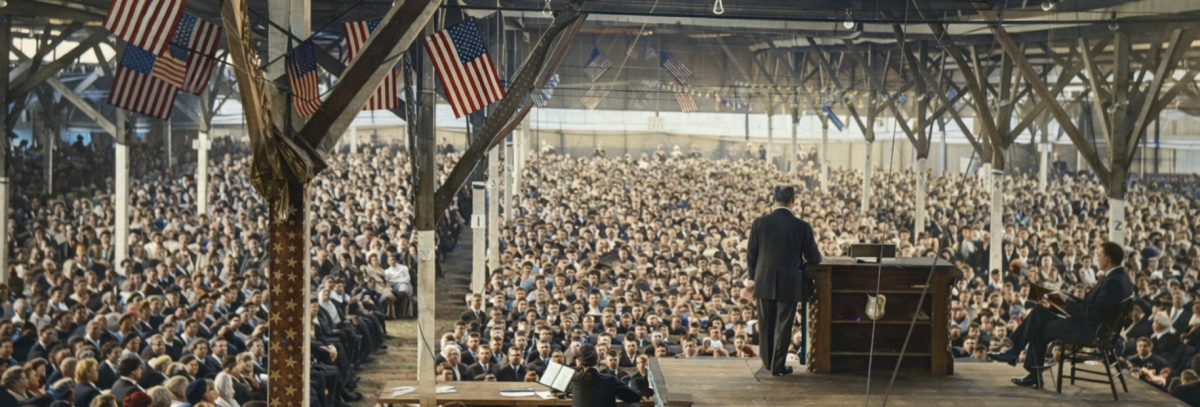
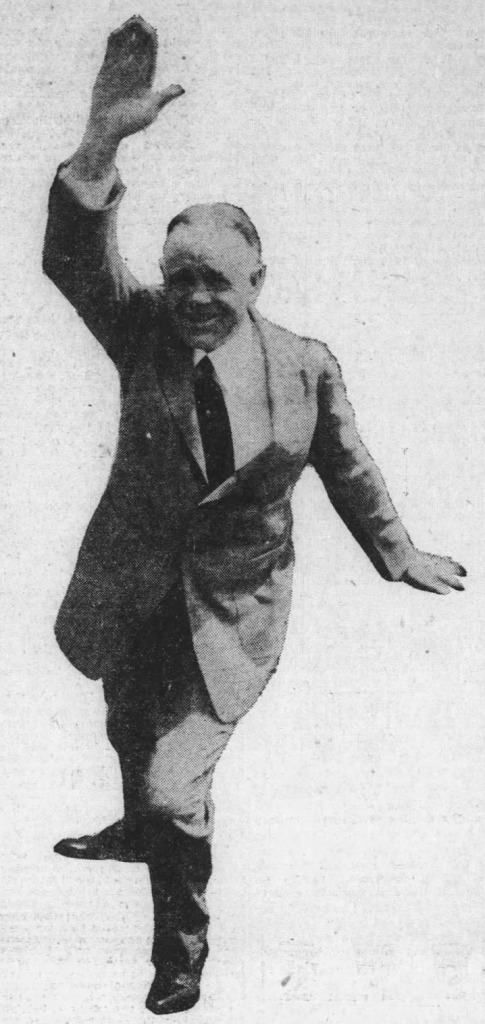

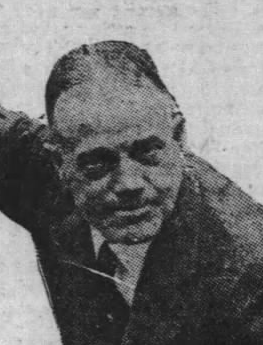
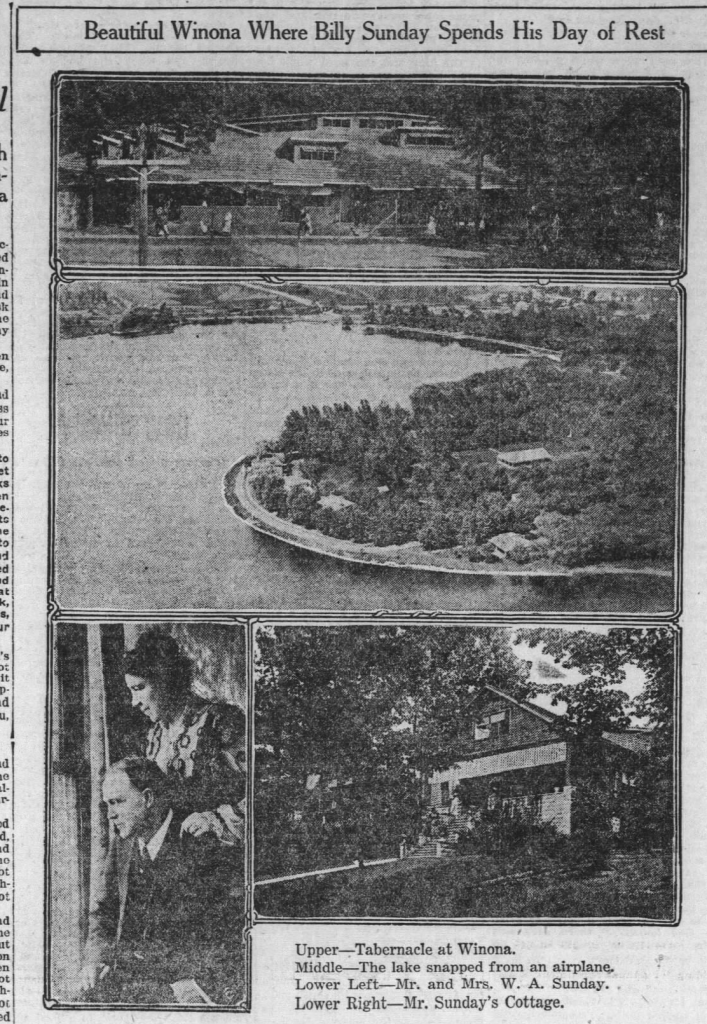
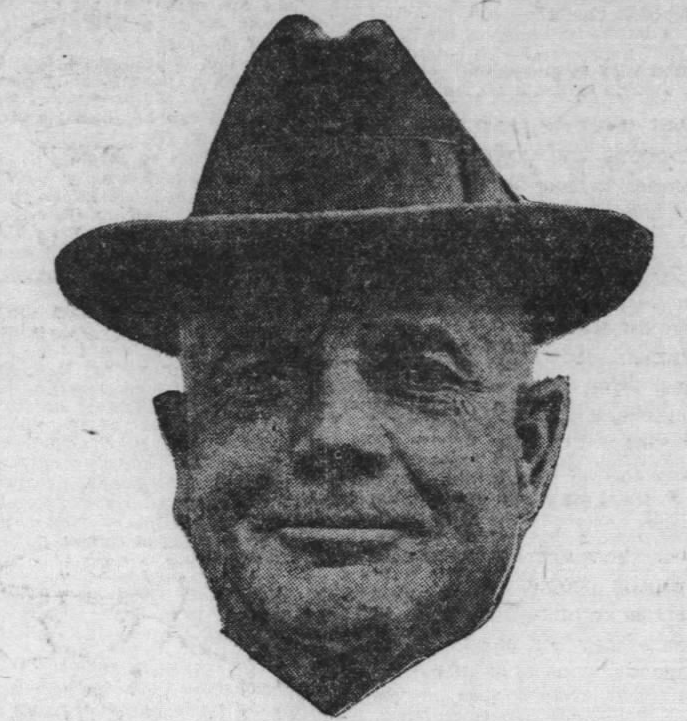
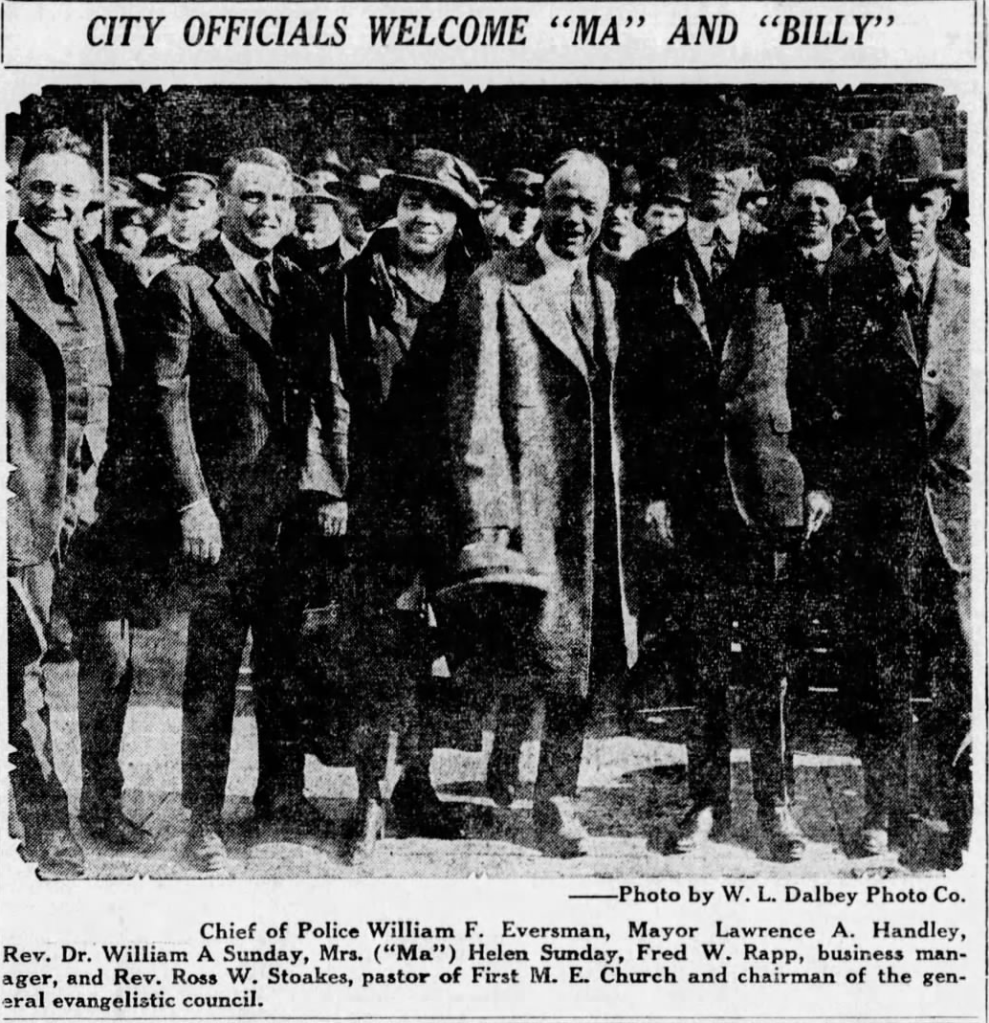
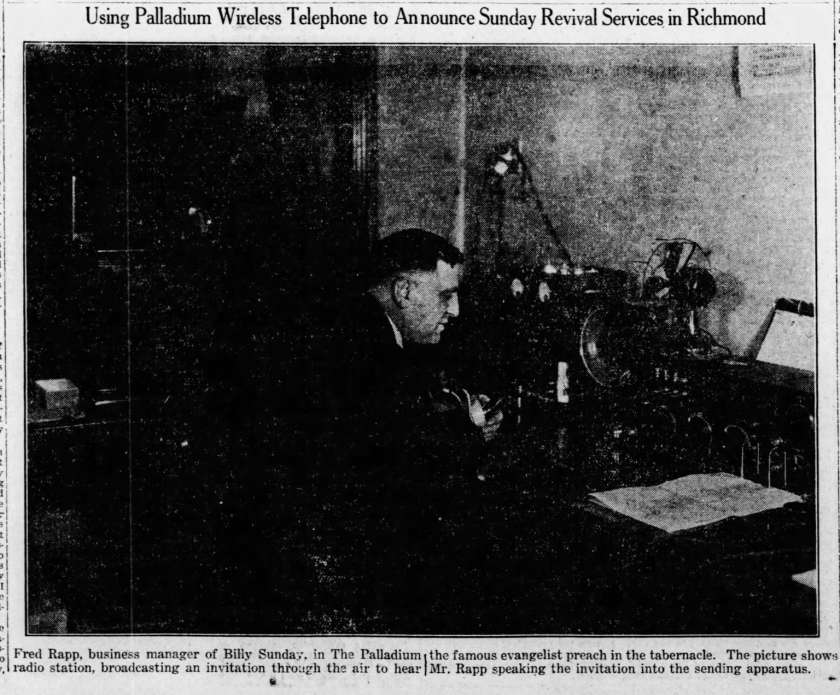
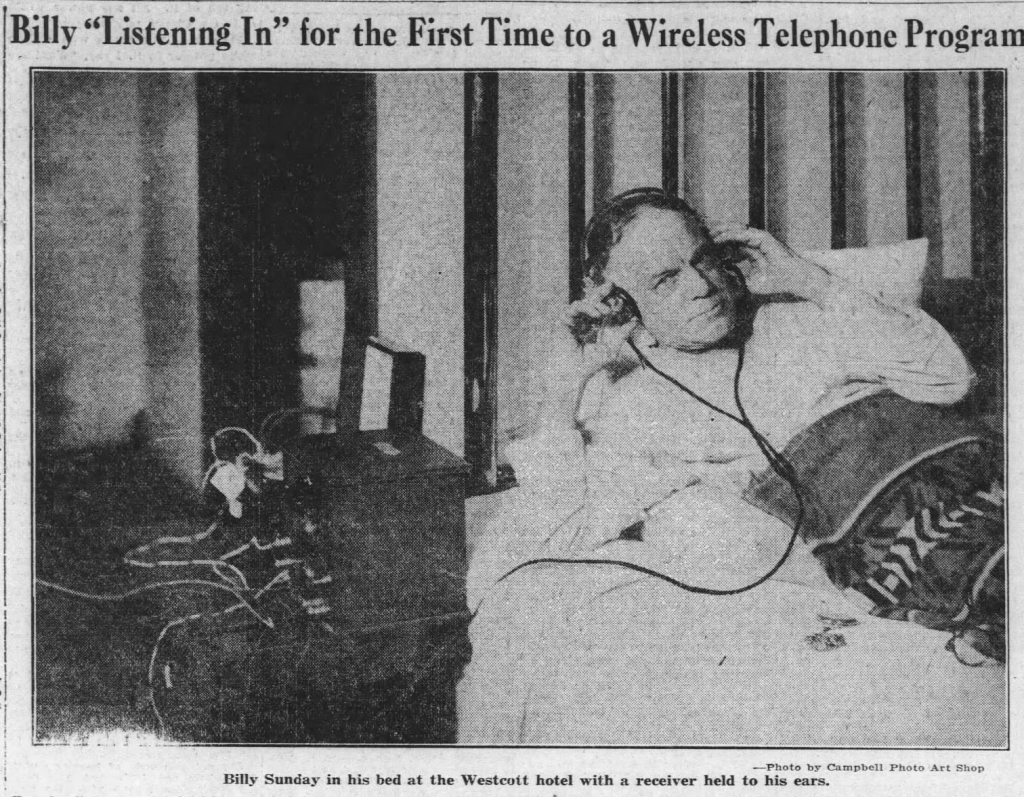
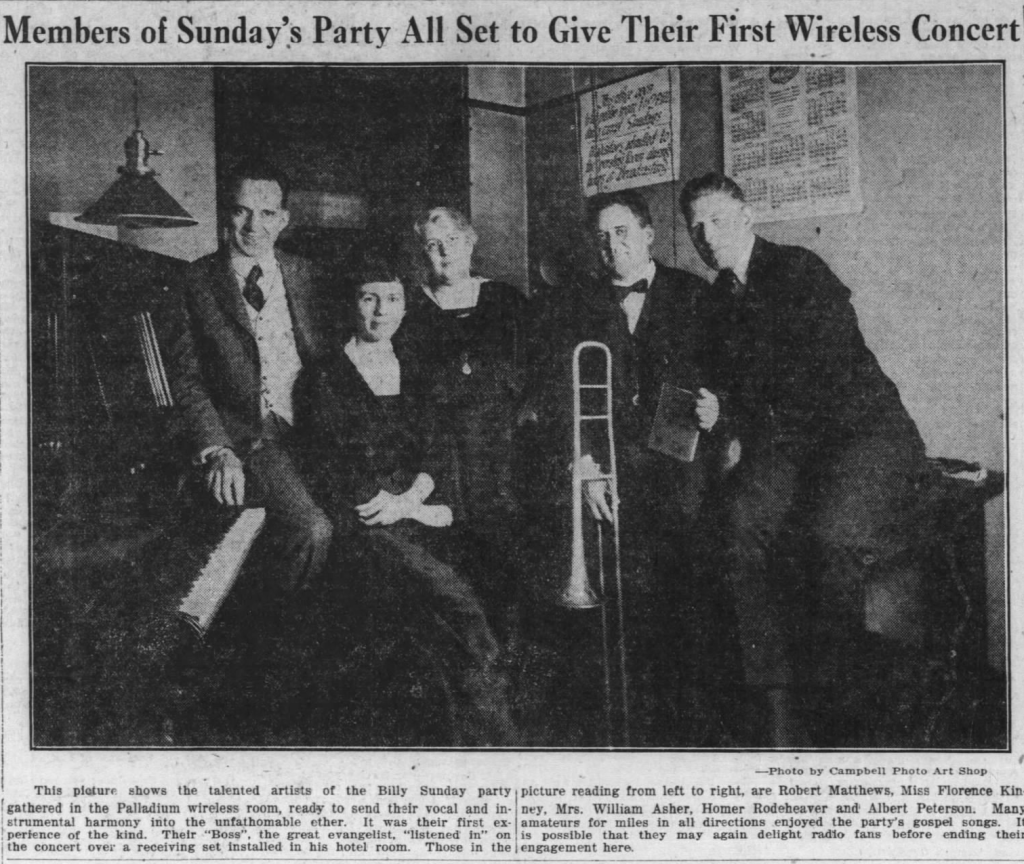
 Evangelist Billy Sunday (1862-1935)