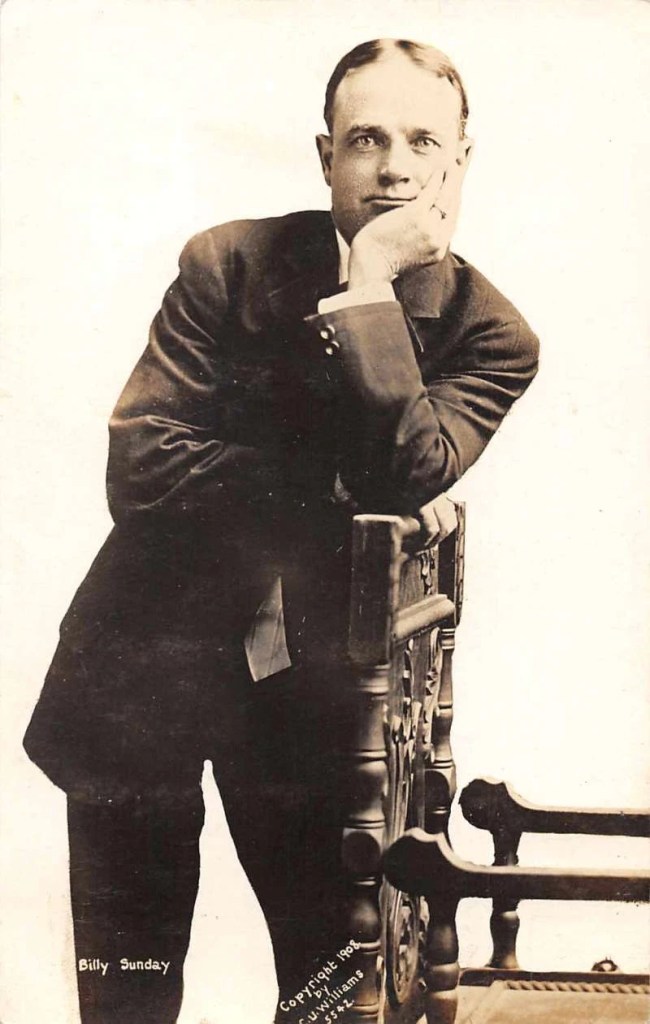
Former professional baseball player-turned urban evangelist. Follow this daily blog that chronicles the life and ministry of revivalist preacher William Ashley "Billy" Sunday (1862-1935)
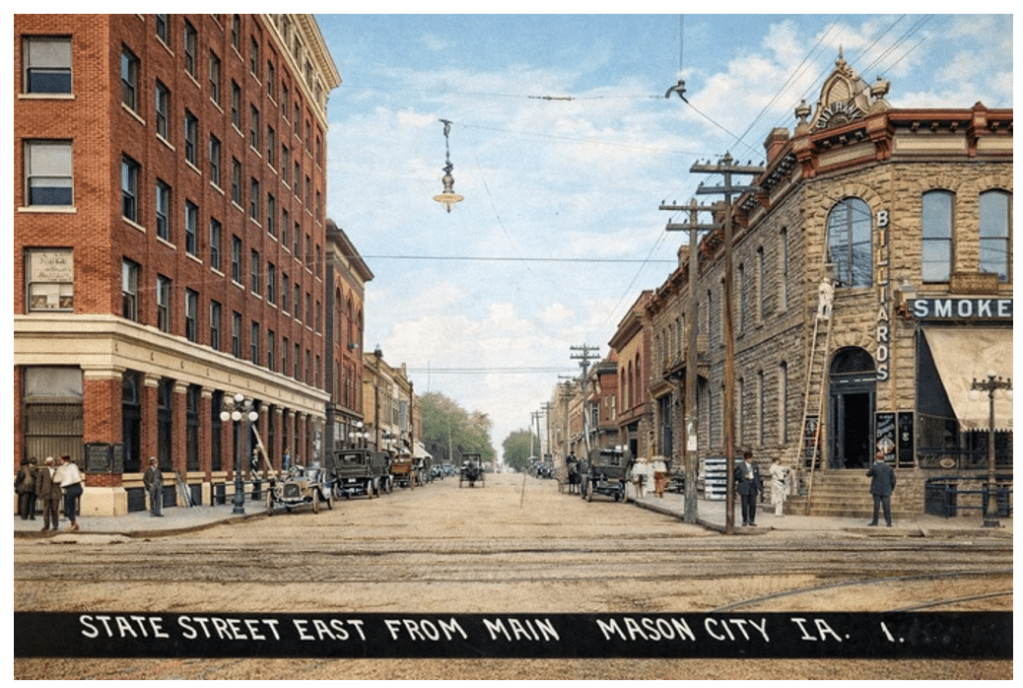
Billy Sunday conducted a month-long revival campaign in Mason City, Iowa, from January 13 to February 12, 1905, during a period when the city’s population was only about 8,300 and total church membership was roughly 3,000. A temporary tabernacle constructed of rough boards and tar paper—heated by six furnaces to withstand winter conditions—served as the central venue for the meetings.
Attendance was substantial for a community of Mason City’s size. One January meeting drew 2,000 men, while associate evangelist Ira E. Honeywell simultaneously addressed 1,000 women in a separate gathering. During a notable men’s meeting on January 29, Sunday delivered a forceful sermon condemning social vices; more than 50 men responded for prayer and conversion. The revival continued despite severe winter weather, including temperatures reported at twenty below zero.
By the campaign’s conclusion, the meetings had produced approximately 700 conversions, including 200 on the final day. Sunday received a $1,800 love offering, while an additional $2,500 was raised for campaign expenses and $800 for the city’s poor. Contemporary newspapers widely reported the revival and praised Sunday’s energetic preaching style and his unusual ability to sway large crowds.
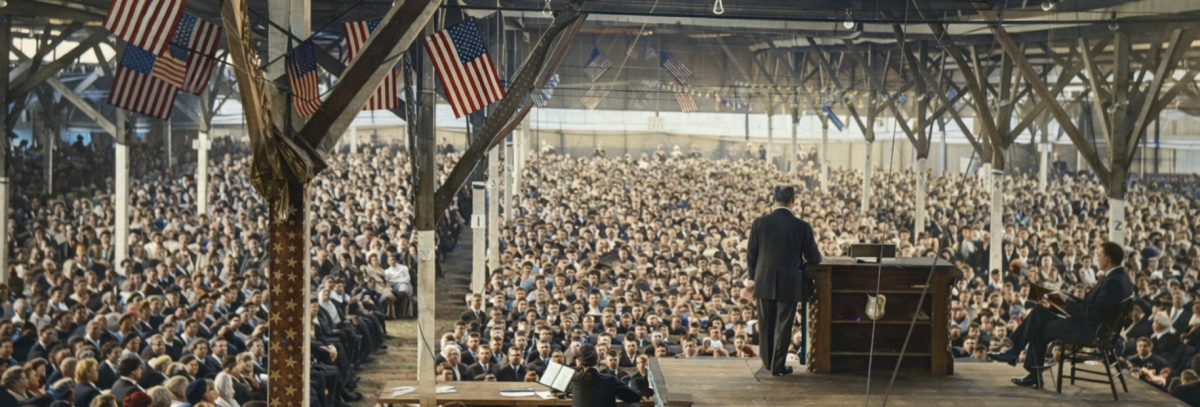
In the summer of 1910, Billy Sunday stood at an interesting crossroads in his rapidly expanding ministry. By this point he was already nationally known as one of America’s most electrifying evangelists. Cities across the country were beginning to build large tabernacles to accommodate the crowds that flocked to hear him preach. Yet during the summer months—when revival campaigns often paused—Sunday occasionally appeared on the Chautauqua circuit, the great American network of traveling lecture assemblies that combined education, entertainment, reform movements, and religion.
Unlike many lecturers who spent the entire season touring the circuit, Sunday’s 1910 Chautauqua schedule was surprisingly limited. He appeared only at a handful of assemblies, and his comments to the press make clear that this was intentional. Sunday had been offered lucrative opportunities to spend the entire summer lecturing. One newspaper reported that he declined an offer of $20,000 to devote the season to Chautauqua work, explaining that the exhausting schedule would leave him unable to conduct revival campaigns in the fall.
“The report that I am to retire is all pure nonsense… I refused $20,000 to give my time to Chautauqua work this summer, as I would be worn out and could not preach before January.”
Sunday’s priority remained evangelistic preaching. Nevertheless, the few Chautauqua appearances he did make during the summer of 1910 provide a fascinating glimpse into his growing national popularity and the remarkable drawing power he already possessed.
Whidbey Island: The Northwestern Chautauqua Assembly
Sunday’s Chautauqua engagements began on July 24, 1910, at the Northwestern Chautauqua Assembly on Whidbey Island, Washington.
At this gathering Sunday delivered a message titled “Forces that Win.” Like many of his sermons, it blended moral exhortation with vivid biblical storytelling. Reports indicate he illustrated his message with the story of David and Goliath, a favorite example of spiritual courage overcoming overwhelming odds.
Even among the prominent lecturers and performers typical of a Chautauqua program, Sunday stood out. His dynamic speaking style—rapid delivery, colorful language, and dramatic physical movement—contrasted sharply with the more measured lecture format audiences often expected.
Hillsboro–Litchfield: A Midwestern Assembly
In early August Sunday appeared at the Hillsboro–Litchfield Chautauqua, running from August 4 through August 11. These regional Chautauqua assemblies usually featured a mixture of lectures, concerts, political discussions, and religious addresses.
Sunday’s presence on such programs reflected the growing recognition that he was not merely a revivalist but also one of the most compelling public speakers in the country.
Maxwelton, Washington: Crowds Even in Small Communities
On August 6, Sunday spoke at the Maxwelton Chautauqua in Washington, addressing a crowd estimated at 4,500 people.
The size of the audience is striking. Maxwelton itself was a small community, yet thousands gathered to hear Sunday speak. Even outside the large urban revival campaigns for which he would soon become famous, his reputation alone was enough to draw impressive crowds.
Patterson Springs: Record-Breaking Interest
Another Chautauqua stop came on August 10 at Patterson Springs. Newspapers noted that Sunday had previously delivered a lecture there that produced $3,600 in ticket receipts, reportedly a record for a single Chautauqua lecture.
This financial success reveals something important about Sunday’s role in the Chautauqua movement. He was not just a preacher filling a religious slot in the program. He was one of the circuit’s major attractions, capable of drawing large audiences and generating significant revenue.
Even so, Sunday resisted becoming primarily a Chautauqua lecturer. His heart remained in revival work.
Lake Whatcom: The “Human Interest” Lecturer
On August 24, Sunday appeared at the Washington Assembly Chautauqua near Lake Whatcom. Promotional material advertised him as delivering the program’s “human interest” lecture, a category that perfectly suited his style.
Sunday’s talks often mixed humor, storytelling, social criticism, and passionate moral appeal. He could move easily from a humorous anecdote to a blistering denunciation of vice, particularly the liquor trade. This blend of entertainment and moral seriousness made him an ideal Chautauqua speaker.
Richmond, Indiana: A Crowd of Eight Thousand
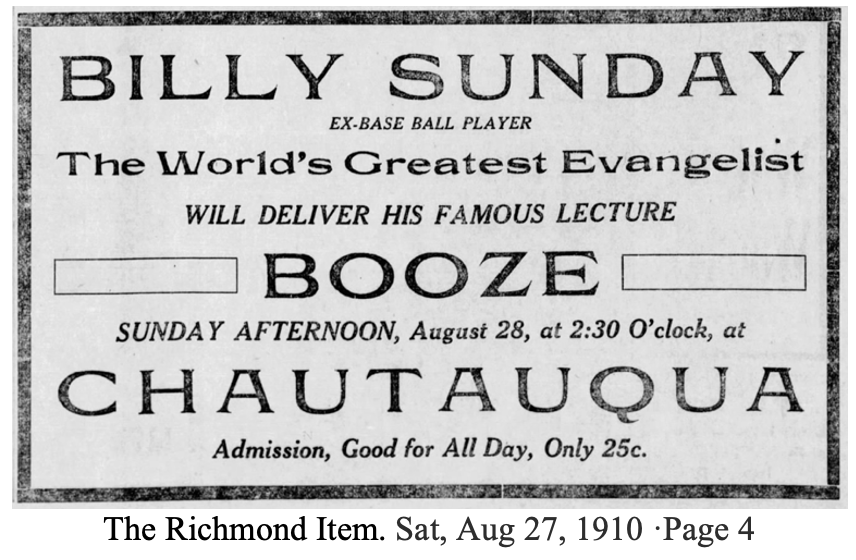
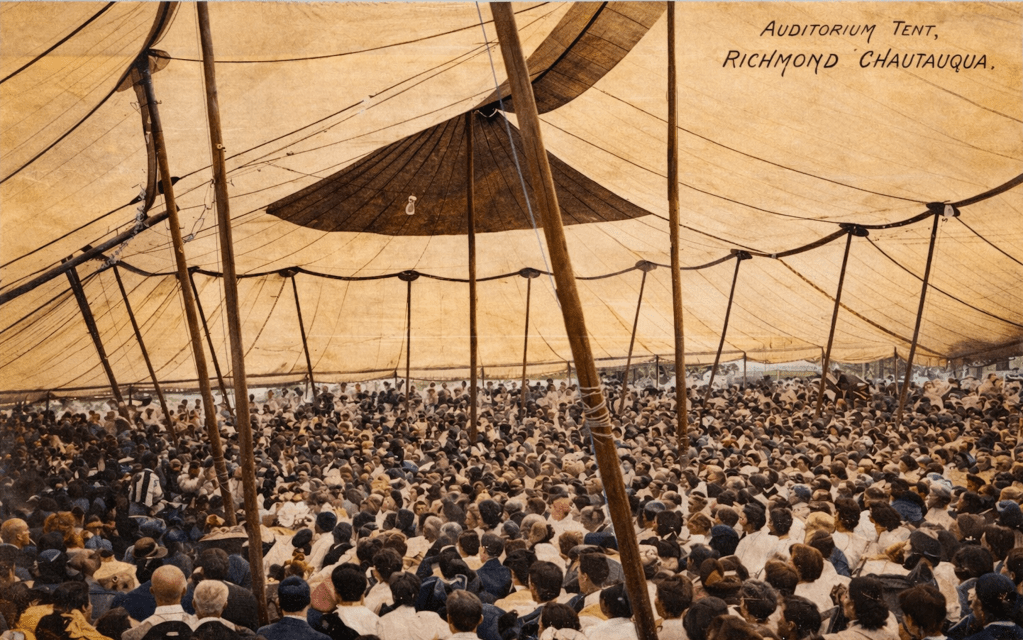
Sunday’s most dramatic Chautauqua appearance of 1910 came on August 28 at the Richmond, Indiana Chautauqua.
The crowd numbered roughly 8,000 people, and Sunday delivered one of his most famous temperance sermons, “Booze.”
Contemporary accounts describe a performance that was nothing short of theatrical. Once fully warmed up, Sunday removed his coat and launched into an explosive denunciation of the saloon. At one point he grabbed a red flag representing the liquor trade, hurled it to the ground, and stamped on it before triumphantly seizing the American flag to symbolize moral victory.
Such dramatic gestures were typical of Sunday’s style. Critics sometimes mocked them as stage tricks, but audiences loved them. They reinforced his reputation as the relentless enemy of alcohol and social vice.
Why the 1910 Season Was Short
One of the most interesting aspects of Sunday’s Chautauqua activity in 1910 is how limited it was.
Rumors circulated in the press that he might be retiring from public speaking altogether. In reality, the opposite was true. Sunday simply refused to devote the entire summer to the lecture circuit.
He explained that constant Chautauqua travel would leave him exhausted and unable to conduct the revival campaigns that he believed were his true calling. Instead, he used the summer months partly for rest and partly for select speaking engagements before returning to the intense schedule of fall revivals.
This decision proved wise. Later in 1910 Sunday conducted major campaigns in New Castle, Pennsylvania, and Waterloo, Iowa, drawing enormous crowds and recording thousands of conversions.
A Glimpse of Sunday’s Expanding Influence
Though brief, Billy Sunday’s 1910 Chautauqua season reveals several important aspects of his rising influence.
First, it demonstrates the extraordinary demand for him as a public speaker. Even isolated appearances drew crowds in the thousands.
Second, it shows that he was already a major figure in the reform movements of the era—especially the temperance crusade.
Finally, it highlights Sunday’s own priorities. While many speakers made their careers on the Chautauqua circuit, Sunday viewed it as secondary. His passion remained revival preaching and evangelism.
In hindsight, the summer of 1910 marks a moment when Billy Sunday could have easily become one of the most lucrative lecturers in America. Instead, he chose the harder path—returning to the sawdust floors of revival tabernacles and the exhausting pace of evangelistic campaigns.
And in doing so, he continued building the ministry that would soon make him the most famous evangelist in America.
The following article excerpt was carried in several newspapers in mid August 1910.
MIDDLE WEST HAS A RELIGIOUS FERMENT
In Chicago Itself Other World Matters Have the Floor.
“The rest of the country can hardly realize the breadth and the depth and the fervor of the spiritual tumult which is stirring the Middle West with Chicago as its center. Chicago newspapers regularly carry columns of sermons in their paid advertising columns. In Chicago street cars are displayed glaring placards advertising the “Book of Mormon,” and 48,000 copies have been sold in the city during the past two or three years. Billboards are covered with big four-sheet posters in colors, calling upon the public to attend great free mass meetings in the Coliseum, with a gospel choir of 2000 voices as the special attraction. Every Sunday morning the Auditorium—the largest theater in the city—is packed with the congregation of Central Church, and every Sunday evening Orchestra Hall is filled with people attending the religious services, which are supported by a voluntary club of Chicago business men. And during the clement season of each recent year scores of Middle West towns, with populations of ten and twenty thousand people, have practically dropped all their ordinary occupations and given themselves over for weeks at a time to a strange, fanatical religious ecstasy, under the acrobatic ministrations of “Billy” Sunday, baseball evangelist. And these are only the more normal the more nearly orthodox manifestations of the spiritual unrest.”—Henry M. Hyde in Collier’s.
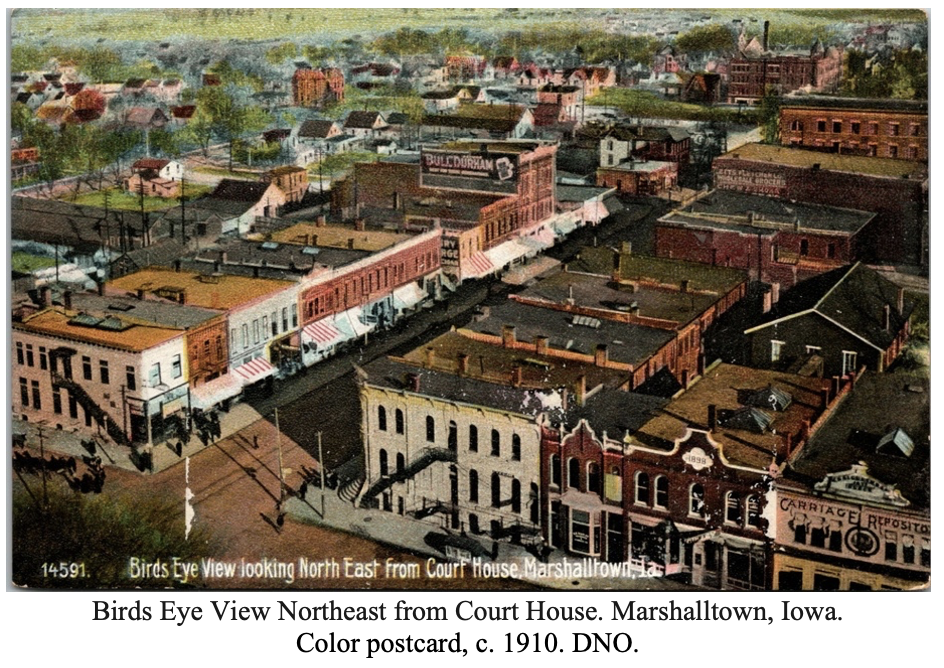
Fresh off a successful campaign in Springfield, Billy Sunday and his team rolled into Marshalltown in late April of 1909. This was not foreign soil. It was home turf.
Sunday had been raised in Iowa, shaped by its churches, and had even lived briefly in Marshalltown in the early 1890s while learning the mechanics of evangelistic work. By 1909 he returned not as an unknown ballplayer-turned-preacher, but as a nationally rising evangelist whose methods were becoming increasingly organized, efficient, and powerful.
Marshalltown was the right kind of proving ground. Large enough to sustain a six-week revival. Small enough to rally around one of its own.
The Setting: A City Poised for Revival
Marshalltown in 1910 had a population of 13,374—a fraction of Springfield’s 51,678. It was a growing industrial town, commercially strong, strategically located, and connected by rail. It was not metropolitan. But it was energetic.
A wooden tabernacle was erected at the corner of Third and Main, seating 5,000. The Sunday machine was now running at full stride.
Opening night—April 25—saw over 12,000 people attend across all services. On the final day, June 6, Sunday preached to 13,200. In a town of just over 13,000 residents, that level of saturation is staggering.
By campaign’s end:
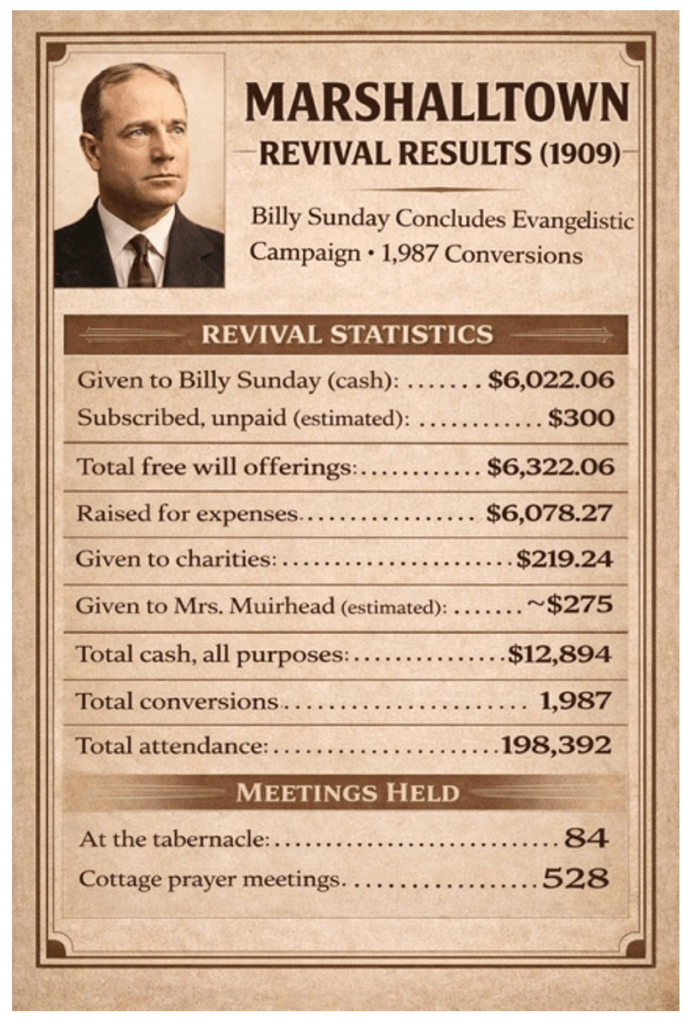
2,000 total conversions (125 on the final day)
84 tabernacle meetings
528 cottage prayer meetings
Nearly 200,000 in total attendance
For six weeks, Marshalltown was consumed by revival.
The Money and the Machine
The final purse for Sunday was $6,139. Total funds raised during the campaign reached $12,894.
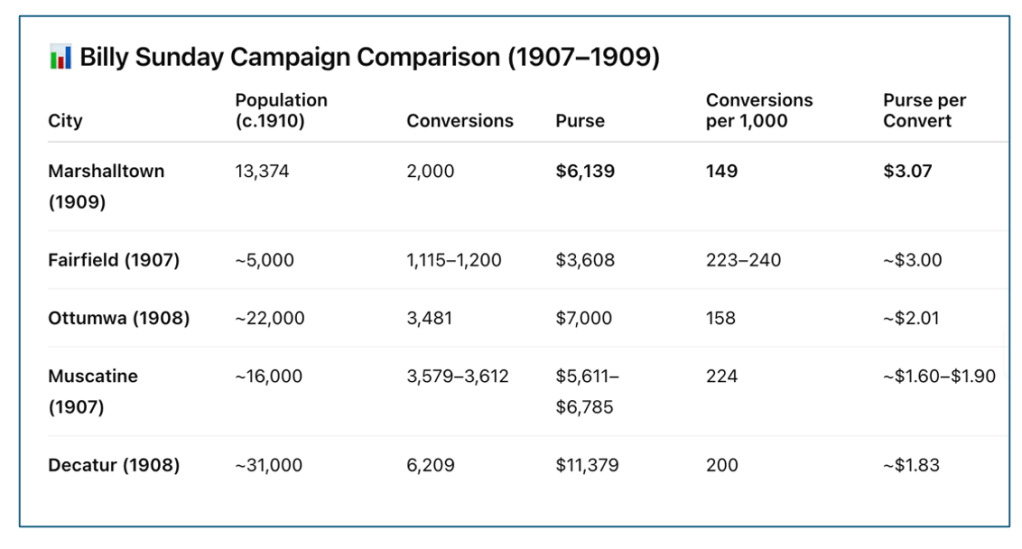
For comparison, that purse nearly matched Muscatine’s and approached Ottumwa’s from the previous year. Financially, Marshalltown demonstrated strong committee organization and enthusiastic backing. This was not a struggling campaign.
It was disciplined. Systematic. Mature.
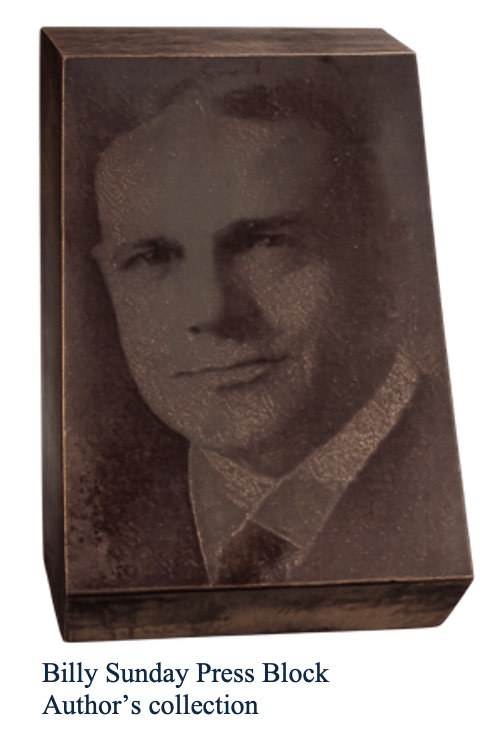
The press block used to print Sunday’s image during this period—now in my collection—reflects that growing sophistication. By 1909, Sunday was no longer improvising revivals. He was executing them.
Did Marshalltown “Underperform”?
One skeptical paper, the Davenport Weekly Democrat and Leader, suggested that Marshalltown’s results did not compare favorably with Fairfield, Ottumwa, Muscatine, and Decatur.
On the surface, that seems correct.
Measured per capita:
Marshalltown: ~149 converts per 1,000 residents
Fairfield: over 220 per 1,000
Muscatine: about 224 per 1,000
Decatur: around 200 per 1,000
Ottumwa: about 158 per 1,000
In raw totals, Marshalltown trailed Muscatine (3,579–3,612), Ottumwa (3,481), and especially Decatur (6,209).
So yes—the numbers were not dominant.
But numbers alone miss something important.
The Press: Praise and Pushback
The reaction was revealing.
The Audubon Republican declared the meetings closed in a “blaze of glory.” It reported over 500 cottage prayer meetings and said the town had been “thoroughly stirred up.”
The Marshalltown Evening Times-Republican went further, calling Sunday:
“One of the splendid prophets of the elder time…”
“One of the greatest revivalists in existence.”
“One of the plainest, simplest and happiest of men…”
Meanwhile, the skeptical Davenport Weekly Democrat and Leader offered sharper commentary. It described Sunday as a “contortionist of uncommon ability” with “remarkable versatility,” while acknowledging the “magnetic power of Mr. Sunday.”
Its most fascinating observation was psychological:
“The psychology of it all is that the people who are not regular attendants at churches must be reached not as individuals but in mass. They like to be moved by each other; and it is probable that this explains the success Mr. Sunday attains. He is helped greatly by the excitement and the enthusiasm of the crowds…”
That critique reads today like an astute analysis of mass evangelism. It wasn’t merely preaching. It was momentum. Atmosphere. Collective energy.
Sunday understood something about crowds that many pastors did not.
What Marshalltown Really Proved
Marshalltown was not Sunday’s most explosive campaign numerically.
But it demonstrated something perhaps more important in 1909:
Massive attendance penetration in a modest city
Financial stability and strong committee structure
Organizational maturity (over 600 total meetings)
National press attention—positive and critical
Marshalltown proved that Sunday could saturate an entire city.
Critics were talking. Admirers were praising. Nearly 200,000 attendances in six weeks ensured that no one in town was untouched by the revival’s presence.
He was no longer just holding meetings.
He was creating civic events.
A Blaze of Glory
The revival closed the way many Sunday campaigns did—intense, loud, emotional, decisive. A blaze of glory.
Marshalltown may not have produced the highest per-capita conversion rate of his Iowa stops. But it stands as a revealing moment in his rise.
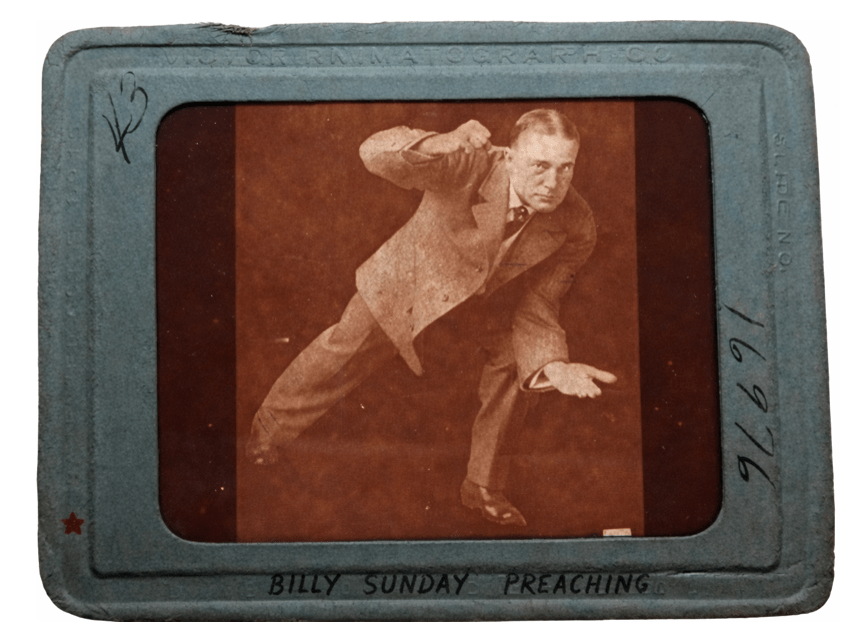
Magic lantern slide. Author’s collection.
By 1909, Billy Sunday was refining his method. The tabernacle system was humming. The prayer networks were mobilized. The press was watching closely.
And Iowa—his Iowa—was watching one of its own step onto a larger stage.
Marshalltown mattered because it showed that Sunday’s machine worked not just in isolated bursts, but in sustained, organized, city-wide saturation.
Springfield, Illinois February 26 – April 11, 1909
In the spring of 1909, something happened in Springfield that people would talk about for decades.
Not a political convention. Not a legislative battle. A revival.
For forty-five days, the capital city of Illinois — population 51,678 — was overtaken by a wooden tabernacle, a former professional baseball player turned evangelist, and what many believed was a visitation of God.
By the time it ended, nearly 5,000 people had walked the sawdust trail.
And Springfield would never quite be the same.
The Numbers — and the Scale
The statistics alone are staggering.
4,729 reported conversions
774 converts on the final day alone — the largest single-day total of Sunday’s career to that point
607,000 total attendance over the course of the campaign
35,000+ at the final Sunday service
$20,218 in total contributions
$10,734 to Sunday
$9,483 to campaign expenses
To put this in perspective: Springfield’s population was just over 51,000. Attendance over the campaign equaled more than twelve times the city’s population.
One hundred thousand people attended special weekday meetings. 35,800 participated in cottage prayer meetings.
This was not a tent revival on the fringe of town.
This was the town.
Even Governor Charles Deneen and members of his family were reported among the converts on the closing day, joining First Methodist Episcopal Church . When the governor walks the aisle, you know something seismic is happening.
And yet, remarkably, Billy Sunday himself was reportedly disappointed with the conversion numbers. He believed “personal work was not begun early enough.”
That was Sunday. Five thousand souls, and he still thought the church could have done more.
The Night Billy Was Horsewhipped
The campaign did not begin quietly.
On opening night, in front of 8,000 people, Sunday was assaulted.
A man named Sherman Potts rushed forward with a buggy whip and struck Sunday multiple times. The audience teetered toward panic. Women wept. Children screamed. Sunday leapt from the platform and knocked his assailant down. They rolled in the aisle before ushers and police subdued the attacker.
The papers reported that Potts had previously been declared insane and had been confined at Jacksonville. He claimed he acted in defense of women’s virtue, alleging that Sunday had criticized them.
What could have ended the revival instead amplified it.
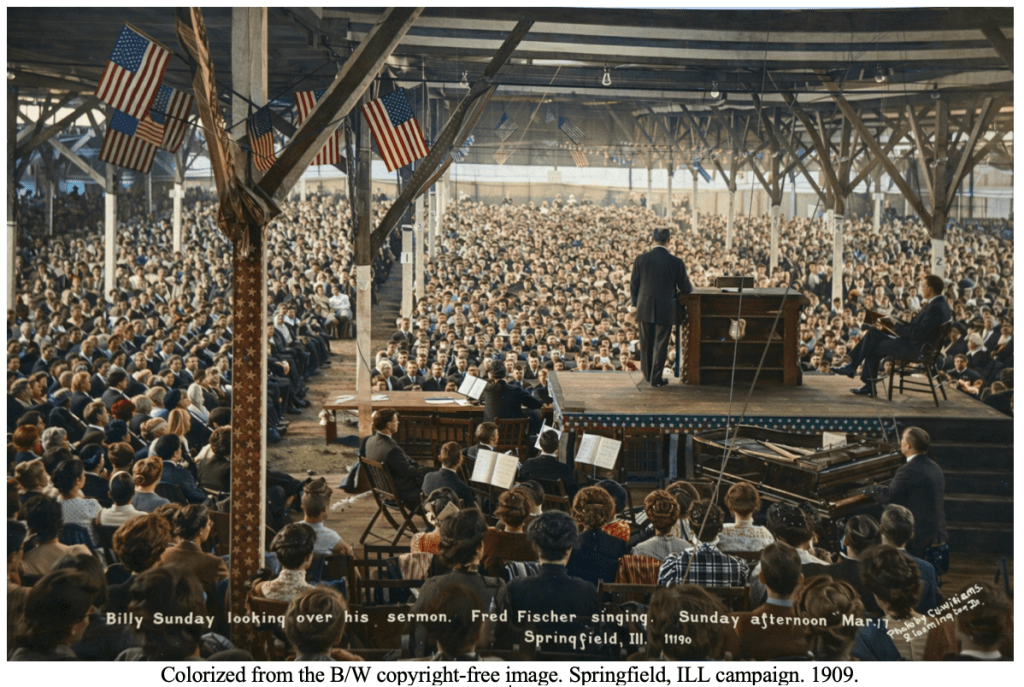
Fred Fischer directed the choir to sing, calming the crowd. The meeting continued.
Springfield had just witnessed the kind of drama that headlines love — and revivals sometimes ride.
The “Judgment” Sermon and the Men
On one Sunday afternoon, 8,000 men packed the tabernacle to hear Sunday preach what was described as his “judgment” sermon.
Three hundred men responded.
Sunday’s masculine appeal — direct, confrontational, athletic — was reshaping revival culture. This was not sentimental religion. It was muscular, public, civic.
He preached like a ballplayer sliding into home — coat off, body leaning, words cutting.
And men came.
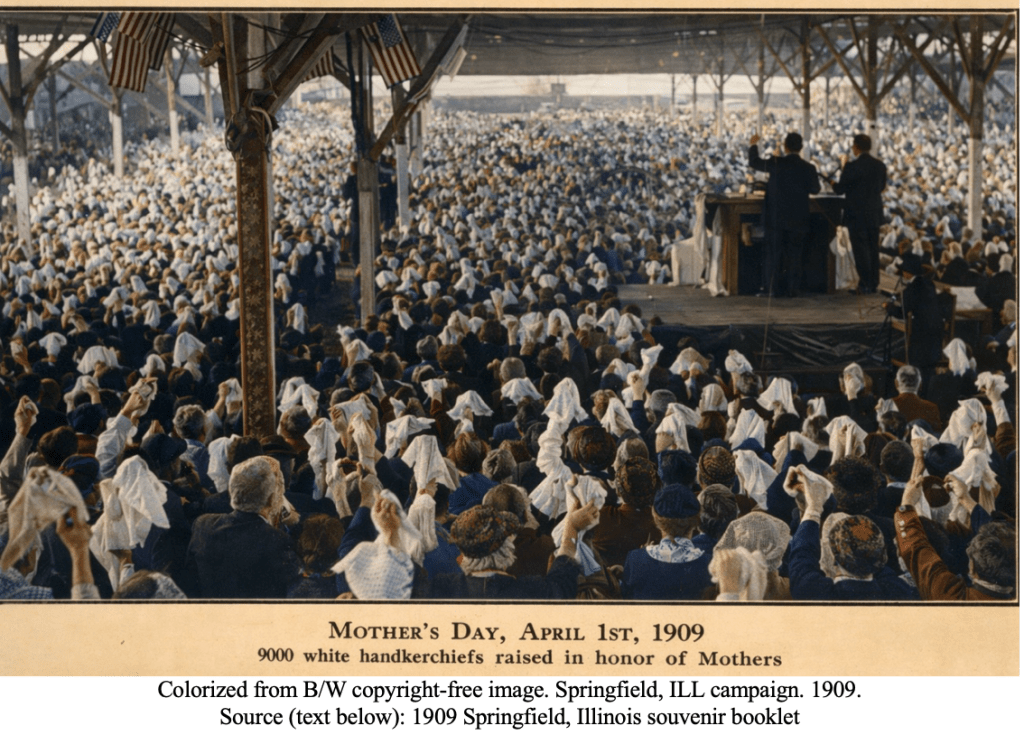
Mother’s Day: 9,000 White Handkerchiefs
One of the most remarkable moments came on Mother’s Day.
Sunday requested that every person wear a white flower or ribbon in honor of mother. If your mother was alive, do her an act of kindness. Write her. Telegraph her. Give her a gift. If she was gone, do something kind for someone else’s mother.
He invited businessmen to close their stores from 2–4 p.m. and pledged that an offering would go to the Woman’s Club for distribution to city charities.
Then it happened.
Nine thousand white handkerchiefs rose in the air in honor of mothers.
In an era before official federal recognition of Mother’s Day, Springfield became a tableau of white cloth and public gratitude.
It was revival fused with civic virtue. Sunday understood symbolism.
Inclusion: Deaf Mutes and Interpreted Sermons
Another remarkable feature of the campaign was the regular attendance of a large group of deaf men from Jacksonville.
Professor Frank Reed, Jr., of the State School interpreted Sunday’s sermons. Reports indicate that between thirty and forty deaf attendees were converted during the Springfield meetings .
When the offering was taken, the deaf men gave ten dollars — a meaningful sum in 1909. Sunday seized the moment: If men who could not hear a word of what I say were contributing to this extent, what ought some of you fellows down there do who hear it all?
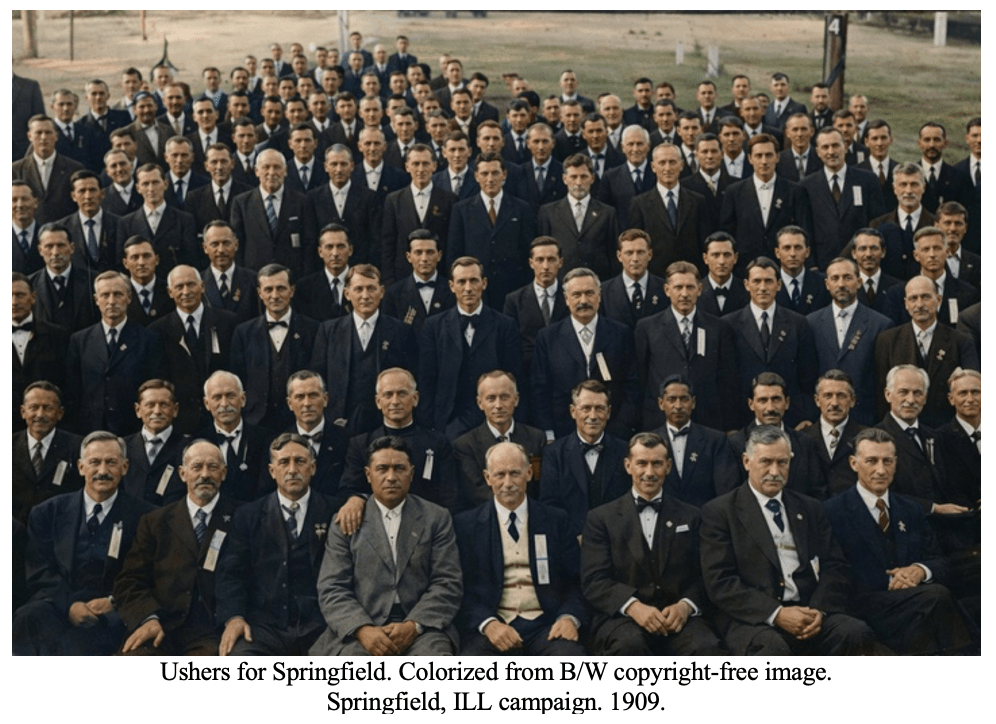
Photographs from the campaign show massive ranks of ushers — disciplined, suited, organized.
Springfield was not spontaneous chaos. It was structured revival.
This was the era when Sunday’s campaigns became logistical marvels:
Massive wooden tabernacle
Coordinated prayer meetings
Choirs
Personal workers
Cottage gatherings
Financial accountability
The revival was both spiritual movement and operational achievement.
Sunday was not merely a preacher. He was building a machine.
“A Good and Great Man”
After the campaign, C. C. Sinclair, pastor of Stewart Street Christian Church, offered this assessment:
“A good and great man, mighty in word and in deed; a prophet, and more than a prophet… The church has been purged and strengthened, and Springfield is being turned to God. It is such a revival of religion as comes to a community but once in a generation.”
That language is not casual.
Once in a generation.
Springfield’s churches reported strengthening and purging — language that suggests repentance within the church as much as conversion outside it.
Revival, for Sunday, was not merely altar calls. It was institutional recalibration.
Why Springfield Mattered
Springfield 1909 was a hinge moment.
It proved Sunday could sustain massive attendance over weeks.
It demonstrated his appeal to political and civic leadership.
It showed that controversy could fuel momentum.
It fused patriotic symbolism, moral reform, and evangelical urgency.
It revealed a revival model scalable to larger cities.
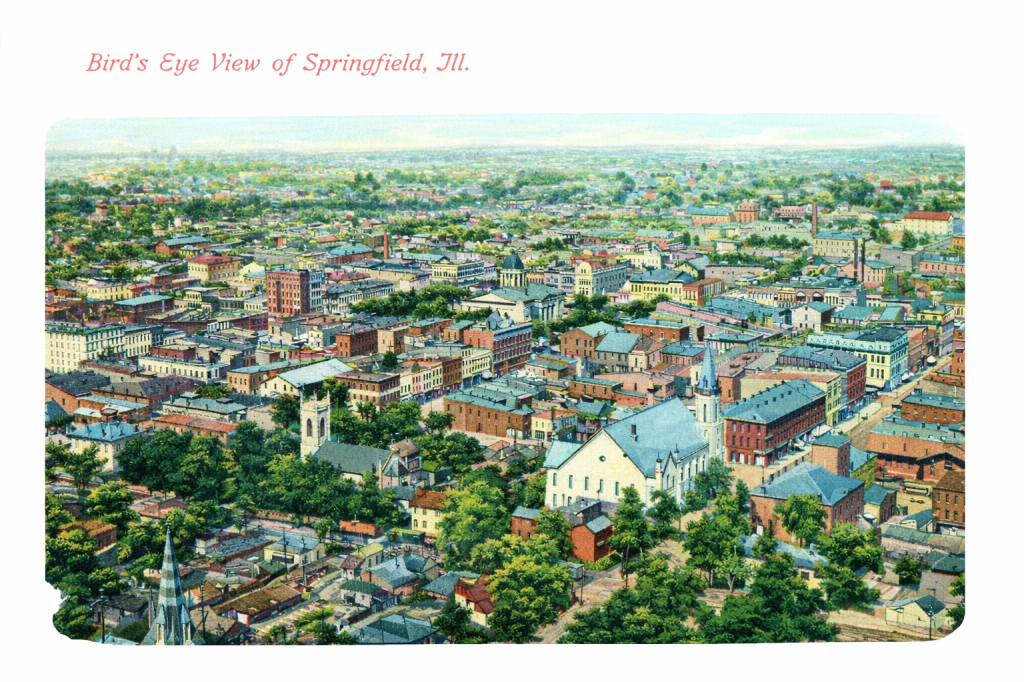
1909 postcard of Springfield, Illinois. Color-corrected. Author’s collection.
In many ways, Springfield was the rehearsal for the metropolitan campaigns to come.
And for a city of 51,000 to generate 607,000 in cumulative attendance? That’s not ordinary religious enthusiasm.
That’s a cultural event.
The Artifact That Survived
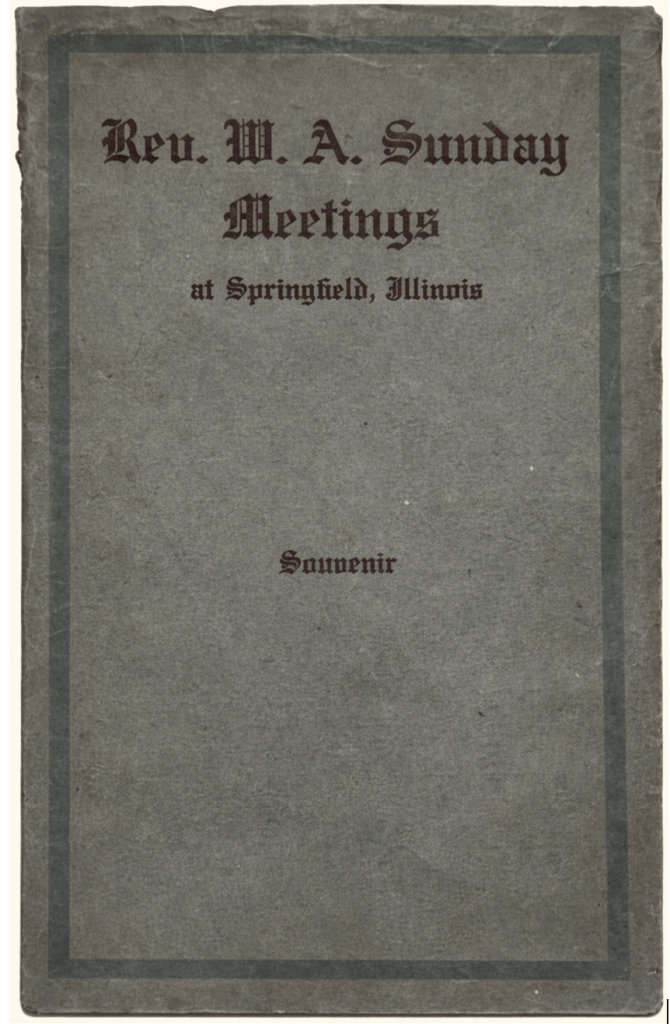
I own a 60-page souvenir booklet titled Rev. W. A. Sunday Meetings at Springfield, Illinois (c. 1909). When it arrived in November 2025, the bottom left corner throughout the entire booklet had been ripped away and was missing from the package .
It’s fragile. Imperfect. Scarred.
But so is revival history.
What Springfield experienced in 1909 was messy, dramatic, organized, emotional, public, controversial, generous, patriotic, and deeply evangelical.
It was America before the Great War.
It was Protestant civic religion at full throttle.
It was Billy Sunday in ascent.
And for forty-five days, Springfield stood still — while thousands walked forward.
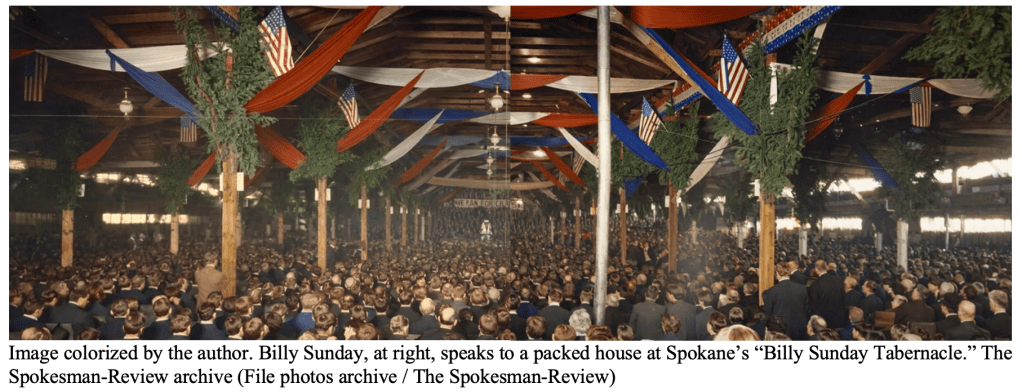
When Billy Sunday arrived in Spokane on Christmas Day, 1908, expectations were already high—and confusion lingered. Earlier reports had announced a December 20 opening. That date came and went. But on December 25, the Sunday party finally arrived, and Spokane discovered that the delay mattered little. The revival that followed would become one of the most significant religious events in the city’s early twentieth-century history.
Opening night attendance was estimated at 8,000 people, filling the newly constructed tabernacle on Christmas Day. The Spokesman-Review reported the crowd the following morning, setting the tone for what would unfold over the next six weeks .
A City Drawn In
The Spokane campaign officially ran from December 25, 1908, to February 10, 1909. In that span, Sunday recorded 5,666 converts, with the single largest night producing 446 responses. Offerings totaled $15,000 to cover campaign expenses, and Sunday’s personal purse amounted to $10,000—figures that place Spokane among his more successful revivals of the era .
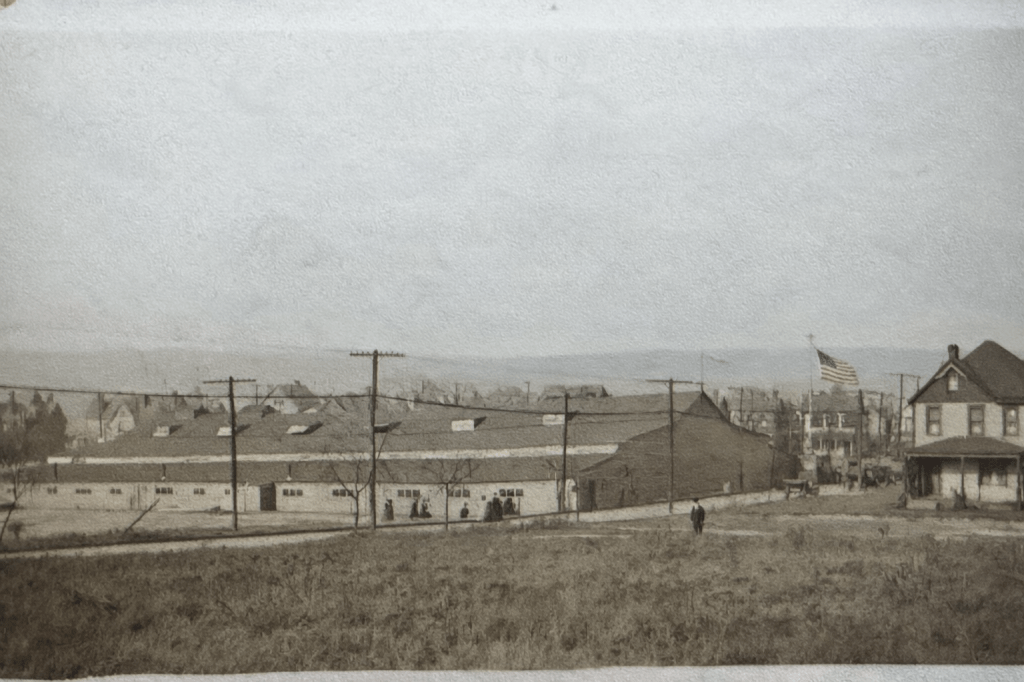
The tabernacle itself had been erected in early December, even before Sunday arrived, and disassembly began almost immediately after the meetings concluded. It was a temporary structure for what proved to be a lasting civic event.
Attendance figures tell only part of the story. According to the Daily Herald, the revival spilled far beyond the tabernacle walls. Hundreds of prayer meetings and semi-public gatherings sprang up across the city. Homes were opened for religious meetings. Crowds swelled so large at times that police were required to control access to the tabernacle. The paper described the total attendance as “hundreds of thousands,” calling some of the gatherings among the largest in Spokane’s history .
Methods, Manhood, and Controversy
Sunday’s style continued to provoke strong reactions—both admiration and criticism. Rev. T. H. Fertig, a Spokane minister, offered one of the most telling assessments in February 1909. He contrasted Sunday with what he saw as the overly academic bent of modern clergy, arguing that Sunday had carried his “manhood” from baseball into the pulpit. Fertig admitted that many of Sunday’s methods were objectionable, but insisted they bore the unmistakable stamp of originality and personal force. Seminary training, he warned, too often erased individuality rather than refining it .
That tension—between polished theology and raw persuasion—was a recurring theme wherever Sunday preached. Spokane proved no exception.
Measurable Impact on Churches
The post-revival accounting offers a rare snapshot of how different congregations interpreted the results.
Some churches reported substantial growth. First Methodist Church received 270 new members, while First Methodist (reported separately in another account) claimed as many as 360. Emmanuel Baptist added 45 converts. First Baptist expected at least 80. Central Christian welcomed approximately 60. Westminster Congregational received 30, and Plymouth Congregational added about 50 new members .
Other responses were more restrained. All Saints Episcopal Church reported 12 new members. Holy Trinity Episcopal Church reported none, with its minister expressing concern about conversions driven by fear rather than conviction. Our Lady of Lourdes likewise expected no new members as a result of the campaign .
The uneven distribution underscores a reality often lost in revival mythology: success was not universally defined, nor universally embraced.
Social and Civic Effects
Beyond church rolls, Spokane newspapers noted broader social effects. One headline captured the contrast succinctly: “Beer Sales Fall. Bibles in Demand.” While such claims invite scrutiny, they reflect how contemporaries interpreted the revival’s moral influence .
Financially, the churches emerged ahead. After expenses were met, including nearly $12,000 in costs and the feeding and sheltering of hundreds of homeless men during a severe cold wave, local churches anticipated a surplus of $2,000 to $3,000. These funds came from post-expense collections and tabernacle bonds that were allowed to lapse in favor of the churches .
The revival also intersected directly with political reform. During the campaign, 110 representative men traveled to Olympia to lobby for a county-unit local-option bill, coinciding with Sunday’s repeated delivery of his fiery “Booze” sermon. For supporters, this fusion of evangelism and activism marked one of the revival’s most consequential achievements .
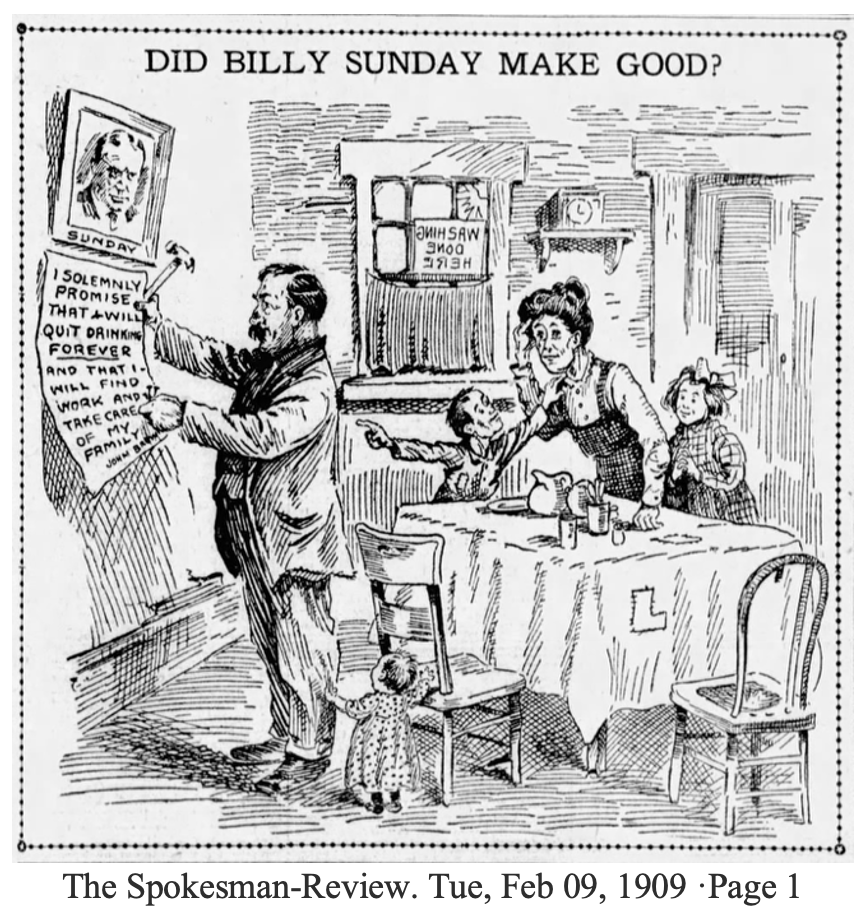
Did Billy Sunday “Make Good”?
As the meetings drew to a close, Spokane’s press asked the question directly—illustrated in editorial cartoons and front-page reflections. By February 1909, the answer, at least in terms of attendance, conversions, and civic impact, appeared clear.
Spokane did not merely host Billy Sunday. For six winter weeks, it reorganized itself around him. Whether one applauded his methods or questioned them, the revival left behind measurable change, lasting debate, and a vivid example of early twentieth-century evangelical power at its height.
For Billy Sunday, Spokane was another city on a relentless circuit. For Spokane, it was a season that reshaped its religious and moral landscape—if only for a time.
ONE of the most impressive and successful days in the great campaign was Mother’s Day, as suggested by Rev. Mr. Sunday. The following request was published:
Every person is requested to wear a white flower or ribbon to-day in honor of mother. If your mother is alive do her an act of kindness. Telegraph or write to her, or give her a gift to express your love. If mother is not alive, perform an act of kindness to somebody else’s mother. The services at the tabernacle will be for mothers, although everybody is invited. Businessmen are invited to close their places of business from two to four o’clock, or at least to let as many employees off as possible. An offering will be taken at the tabernacle to be given to the Woman’s Club to be distributed to the charities of the city as the club deems best.
He prays as though God Almighty were standing right before him.
He prays for everybody.
He prays with the same earnestness and energy that marks his preaching. He prays with the zeal and vim that starred him in baseball.
He expects his prayers to land.
He prays for you and me, for the plumber and the telephone girl, for the banker and the street cleaner, for the washwoman and the debutante.
There’s nothing perfunctory in Sunday’s praying.
Sunday’s prayer is not what he says many a prayer is—“Just a funny noise.” Sunday has something to ask for and he asks for it.
He prays for the salvation of souls, for the success of his meetings, for men to “hit the trail for Jesus Christ.”
Billy Sunday at prayer is the picture of a lawyer pleading to a court. Sunday is the attorney at the bar. Those he prays for are his clients. God Almighty is the supreme judge. God is on the bench hearing the argument.
Sunday states his case. He tells the “judge” what he wants; he gives his reasons; he makes his argument; he pleads:
“For Christ’s sake, God, grant what I ask.”
There’s punch in Sunday’s praying. His prayers distinguish him.
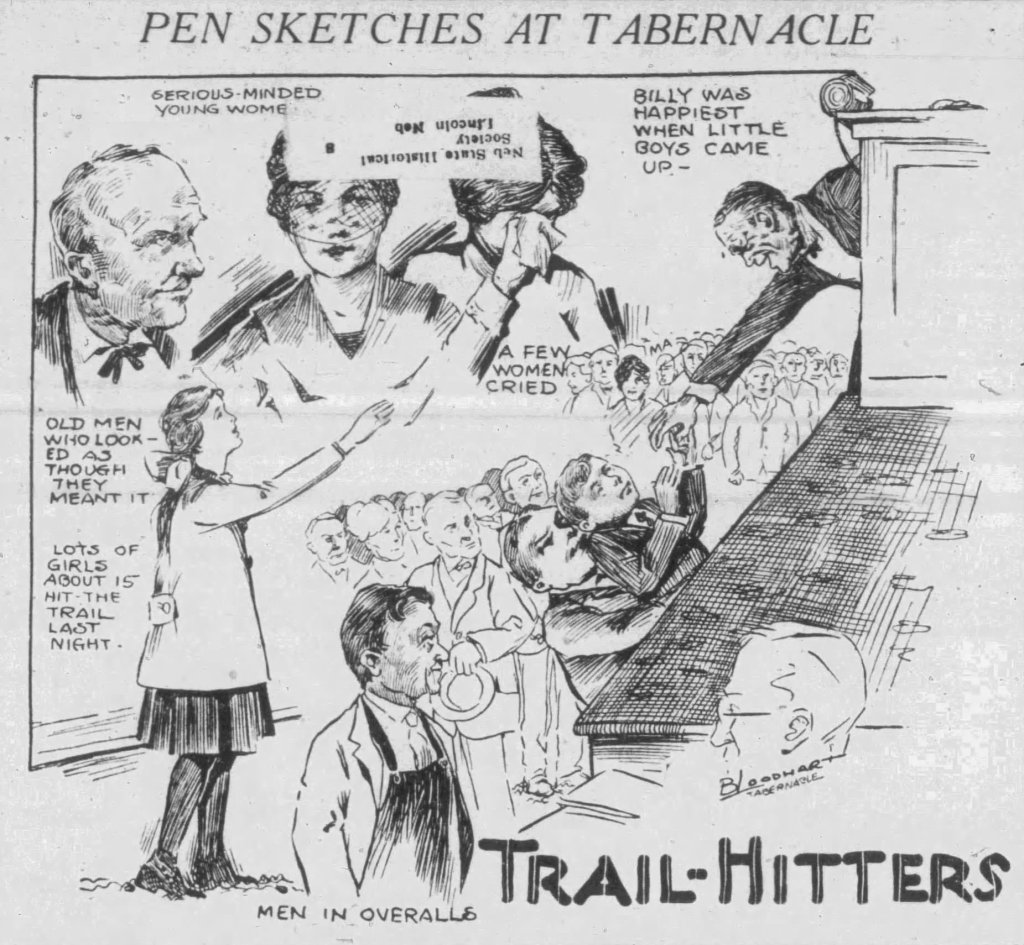
Cited from: The Omaha Daily News. September 19, 1915: 10.
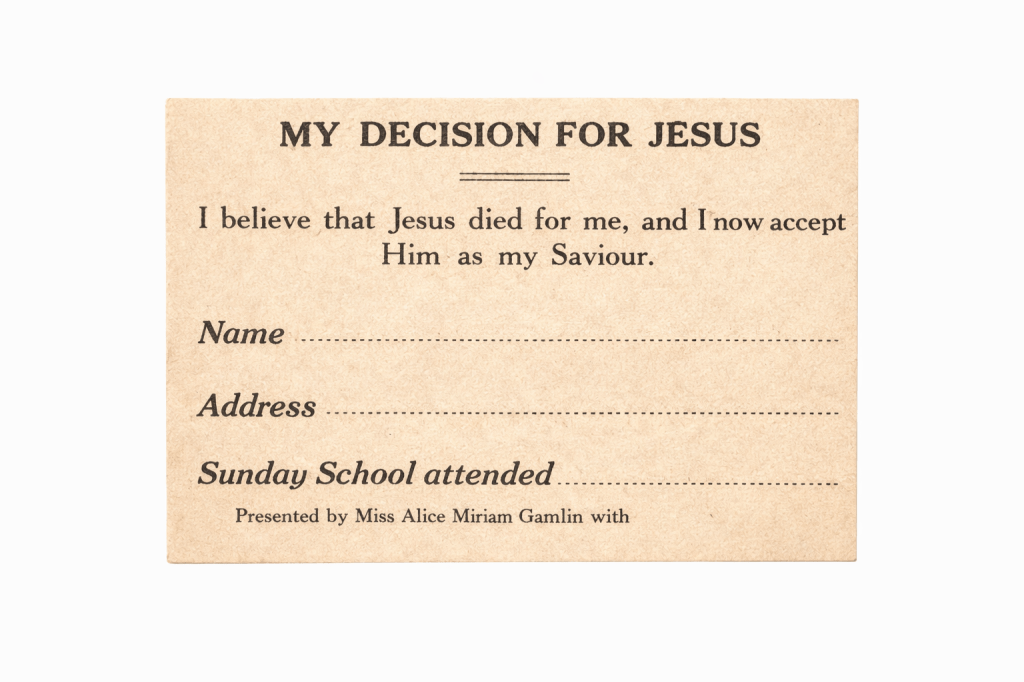
Here is what a ‘trail hitter’ filled out who walked the sawdust trail during a Billy Sunday revival. Omaha saw 13,000+ conversions, closing on October 24, 1915 (opening Sept 5). Billy preached at least 96 times just in the tabernacle during this revival, and scores more outside of the tabernacle venue.

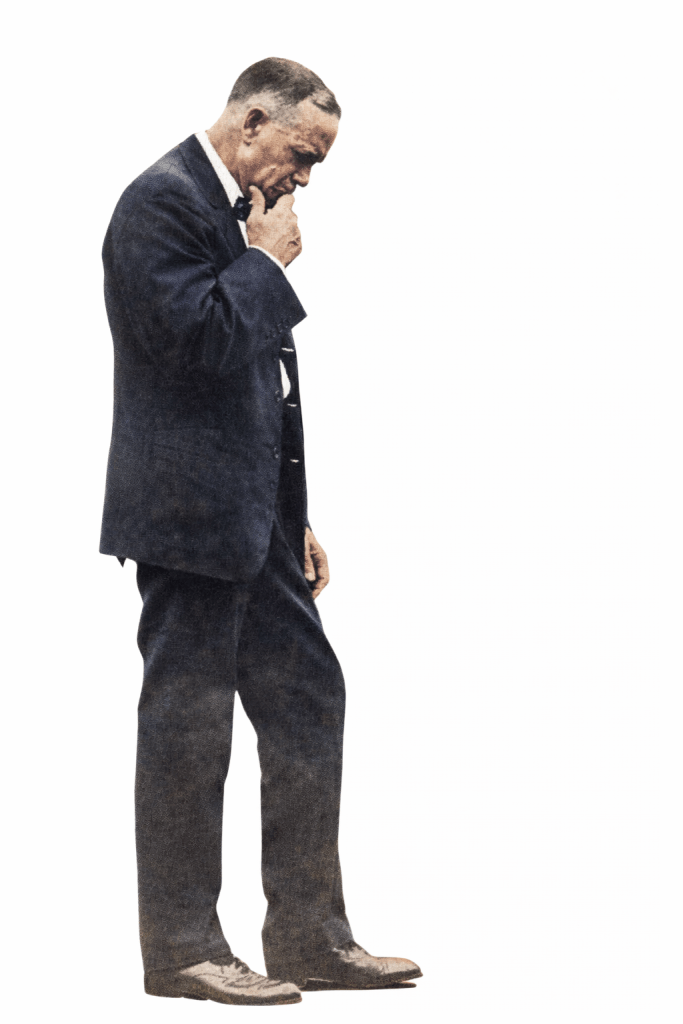
 Evangelist Billy Sunday (1862-1935)