Springfield, Illinois
February 26 – April 11, 1909
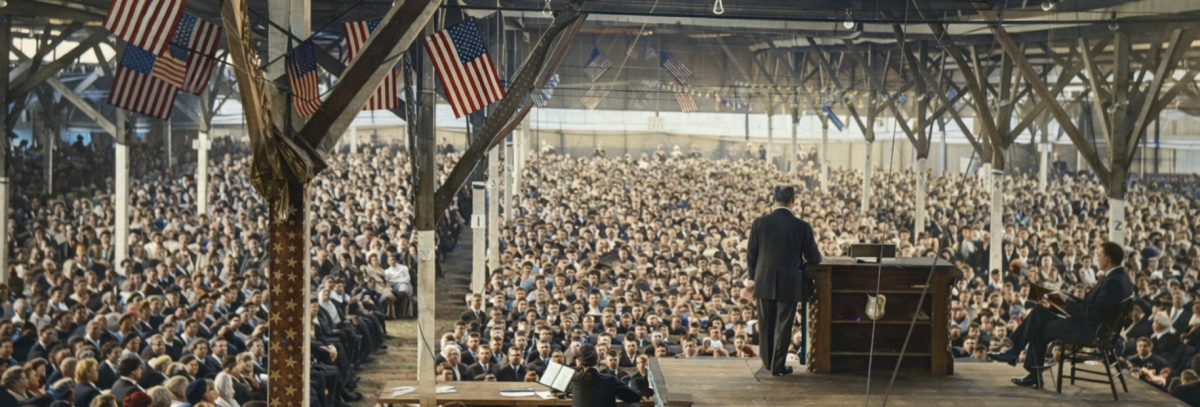
In the spring of 1909, something happened in Springfield that people would talk about for decades.
Not a political convention.
Not a legislative battle.
A revival.
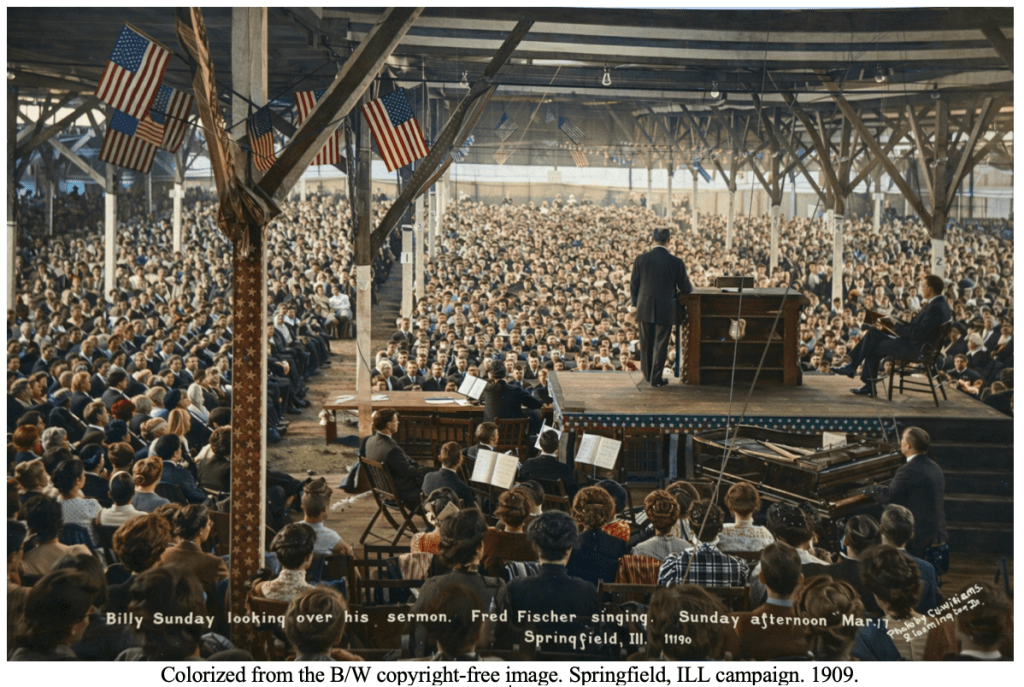
For forty-five days, the capital city of Illinois — population 51,678 — was overtaken by a wooden tabernacle, a former professional baseball player turned evangelist, and what many believed was a visitation of God.
By the time it ended, nearly 5,000 people had walked the sawdust trail.
And Springfield would never quite be the same.
The Numbers — and the Scale
The statistics alone are staggering.
- 4,729 reported conversions
- 774 converts on the final day alone — the largest single-day total of Sunday’s career to that point
- 607,000 total attendance over the course of the campaign
- 35,000+ at the final Sunday service
- $20,218 in total contributions
- $10,734 to Sunday
- $9,483 to campaign expenses
To put this in perspective: Springfield’s population was just over 51,000. Attendance over the campaign equaled more than twelve times the city’s population.
One hundred thousand people attended special weekday meetings.
35,800 participated in cottage prayer meetings.
This was not a tent revival on the fringe of town.
This was the town.
Even Governor Charles Deneen and members of his family were reported among the converts on the closing day, joining First Methodist Episcopal Church . When the governor walks the aisle, you know something seismic is happening.
And yet, remarkably, Billy Sunday himself was reportedly disappointed with the conversion numbers. He believed “personal work was not begun early enough.”
That was Sunday. Five thousand souls, and he still thought the church could have done more.
The Night Billy Was Horsewhipped
The campaign did not begin quietly.
On opening night, in front of 8,000 people, Sunday was assaulted.
A man named Sherman Potts rushed forward with a buggy whip and struck Sunday multiple times. The audience teetered toward panic. Women wept. Children screamed. Sunday leapt from the platform and knocked his assailant down. They rolled in the aisle before ushers and police subdued the attacker.
The papers reported that Potts had previously been declared insane and had been confined at Jacksonville. He claimed he acted in defense of women’s virtue, alleging that Sunday had criticized them.
What could have ended the revival instead amplified it.
Fred Fischer directed the choir to sing, calming the crowd. The meeting continued.
Springfield had just witnessed the kind of drama that headlines love — and revivals sometimes ride.
The “Judgment” Sermon and the Men
On one Sunday afternoon, 8,000 men packed the tabernacle to hear Sunday preach what was described as his “judgment” sermon.
Three hundred men responded.
Sunday’s masculine appeal — direct, confrontational, athletic — was reshaping revival culture. This was not sentimental religion. It was muscular, public, civic.
He preached like a ballplayer sliding into home — coat off, body leaning, words cutting.
And men came.
Mother’s Day: 9,000 White Handkerchiefs
One of the most remarkable moments came on Mother’s Day.
Sunday requested that every person wear a white flower or ribbon in honor of mother. If your mother was alive, do her an act of kindness. Write her. Telegraph her. Give her a gift. If she was gone, do something kind for someone else’s mother.
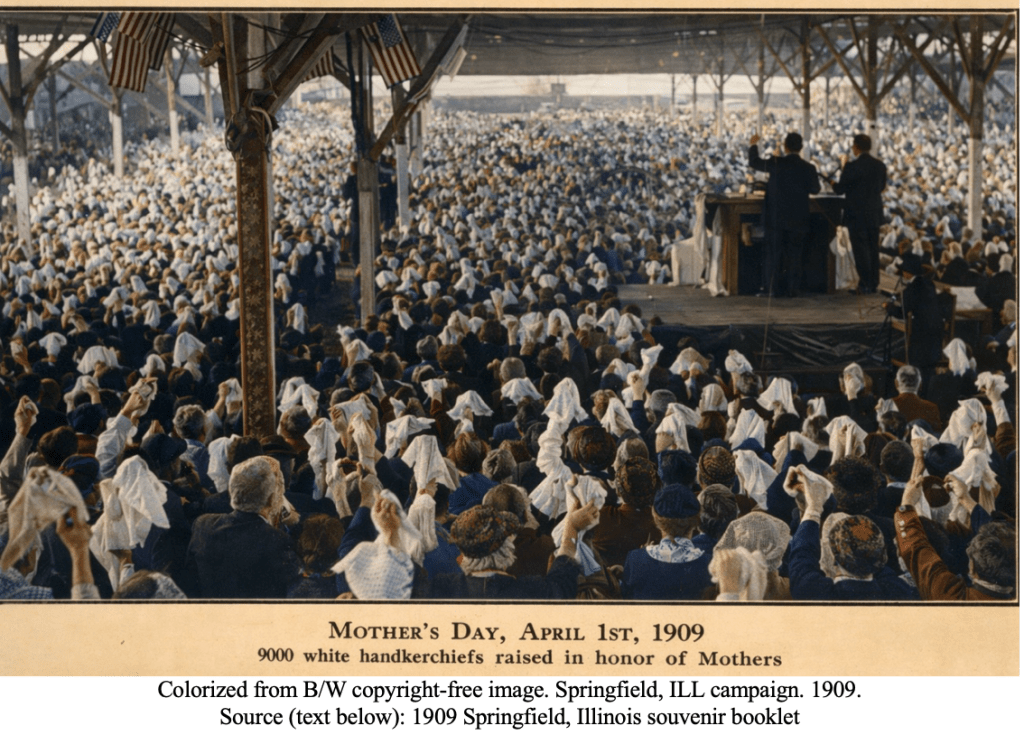
He invited businessmen to close their stores from 2–4 p.m. and pledged that an offering would go to the Woman’s Club for distribution to city charities.
Then it happened.
Nine thousand white handkerchiefs rose in the air in honor of mothers.
In an era before official federal recognition of Mother’s Day, Springfield became a tableau of white cloth and public gratitude.
It was revival fused with civic virtue. Sunday understood symbolism.
Inclusion: Deaf Mutes and Interpreted Sermons
Another remarkable feature of the campaign was the regular attendance of a large group of deaf men from Jacksonville.
Professor Frank Reed, Jr., of the State School interpreted Sunday’s sermons. Reports indicate that between thirty and forty deaf attendees were converted during the Springfield meetings .
When the offering was taken, the deaf men gave ten dollars — a meaningful sum in 1909. Sunday seized the moment: If men who could not hear a word of what I say were contributing to this extent, what ought some of you fellows down there do who hear it all?
That’s classic Sunday — sharp, public, convicting.
The Ushers, the Machinery, the Organization
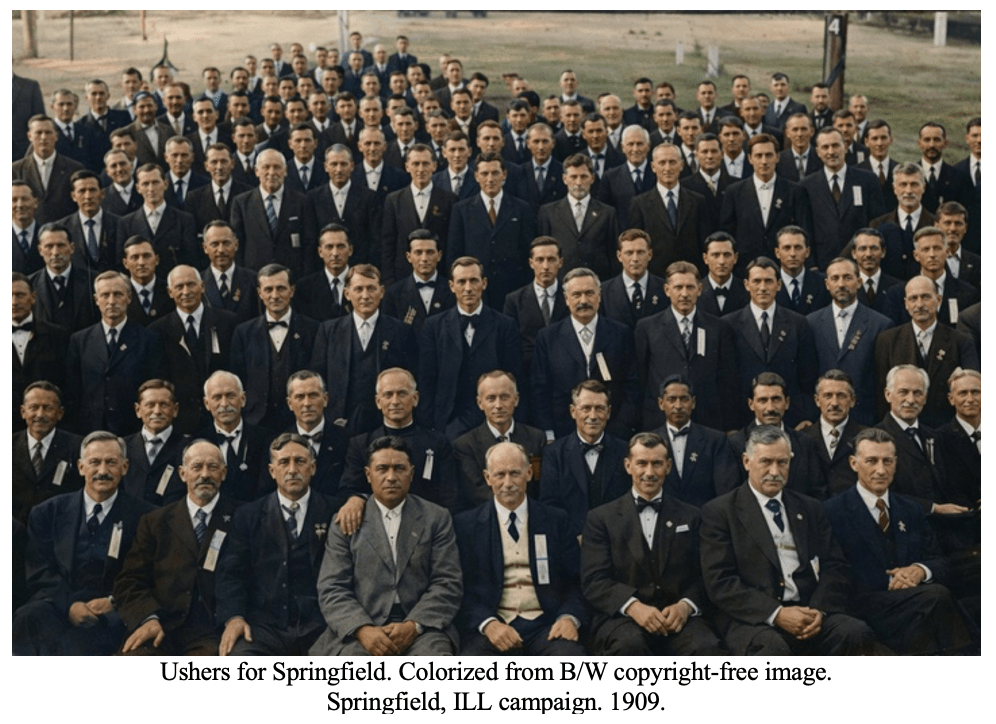
Photographs from the campaign show massive ranks of ushers — disciplined, suited, organized.
Springfield was not spontaneous chaos. It was structured revival.
This was the era when Sunday’s campaigns became logistical marvels:
- Massive wooden tabernacle
- Coordinated prayer meetings
- Choirs
- Personal workers
- Cottage gatherings
- Financial accountability
The revival was both spiritual movement and operational achievement.
Sunday was not merely a preacher. He was building a machine.
“A Good and Great Man”
After the campaign, C. C. Sinclair, pastor of Stewart Street Christian Church, offered this assessment:
“A good and great man, mighty in word and in deed; a prophet, and more than a prophet… The church has been purged and strengthened, and Springfield is being turned to God. It is such a revival of religion as comes to a community but once in a generation.”
That language is not casual.
Once in a generation.
Springfield’s churches reported strengthening and purging — language that suggests repentance within the church as much as conversion outside it.
Revival, for Sunday, was not merely altar calls. It was institutional recalibration.
Why Springfield Mattered
Springfield 1909 was a hinge moment.
- It proved Sunday could sustain massive attendance over weeks.
- It demonstrated his appeal to political and civic leadership.
- It showed that controversy could fuel momentum.
- It fused patriotic symbolism, moral reform, and evangelical urgency.
- It revealed a revival model scalable to larger cities.
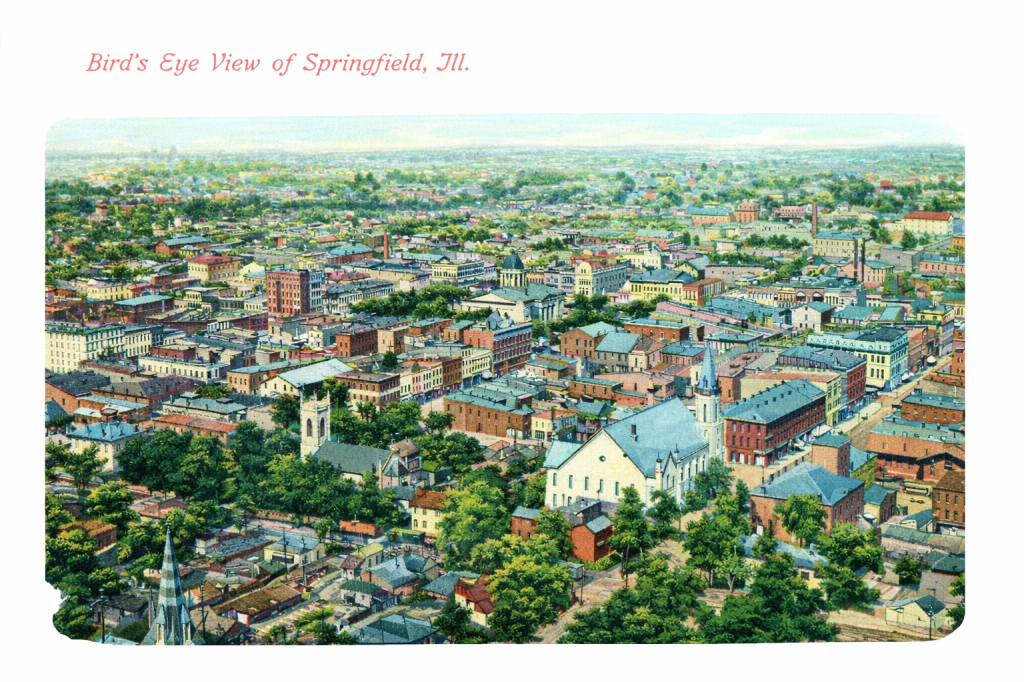
In many ways, Springfield was the rehearsal for the metropolitan campaigns to come.
And for a city of 51,000 to generate 607,000 in cumulative attendance? That’s not ordinary religious enthusiasm.
That’s a cultural event.
The Artifact That Survived
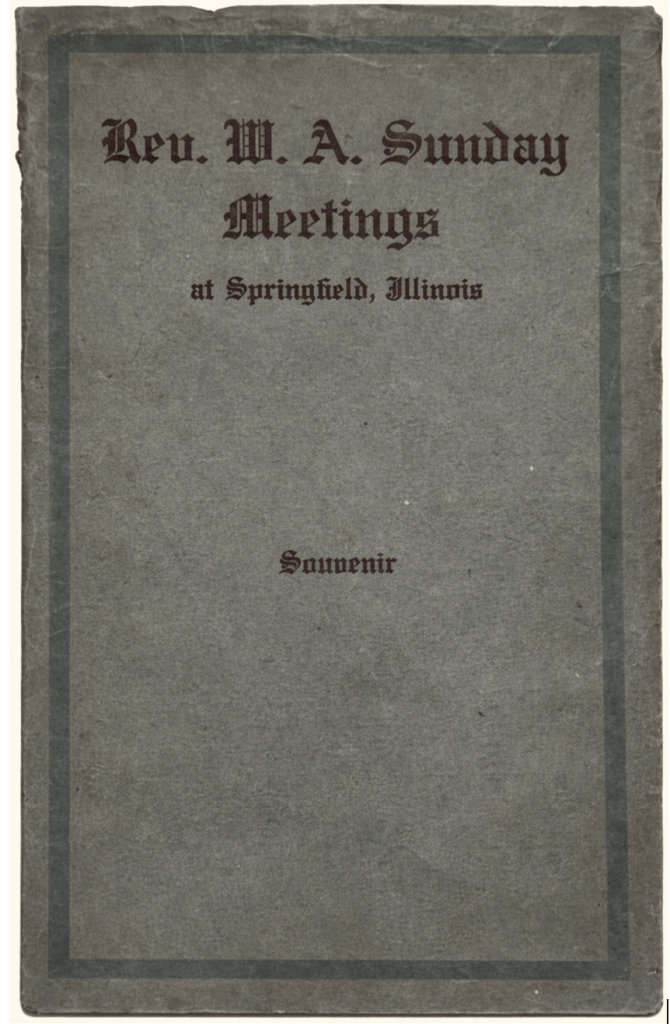
I own a 60-page souvenir booklet titled Rev. W. A. Sunday Meetings at Springfield, Illinois (c. 1909). When it arrived in November 2025, the bottom left corner throughout the entire booklet had been ripped away and was missing from the package .
It’s fragile. Imperfect. Scarred.
But so is revival history.
What Springfield experienced in 1909 was messy, dramatic, organized, emotional, public, controversial, generous, patriotic, and deeply evangelical.
It was America before the Great War.
It was Protestant civic religion at full throttle.
It was Billy Sunday in ascent.
And for forty-five days, Springfield stood still —
while thousands walked forward.

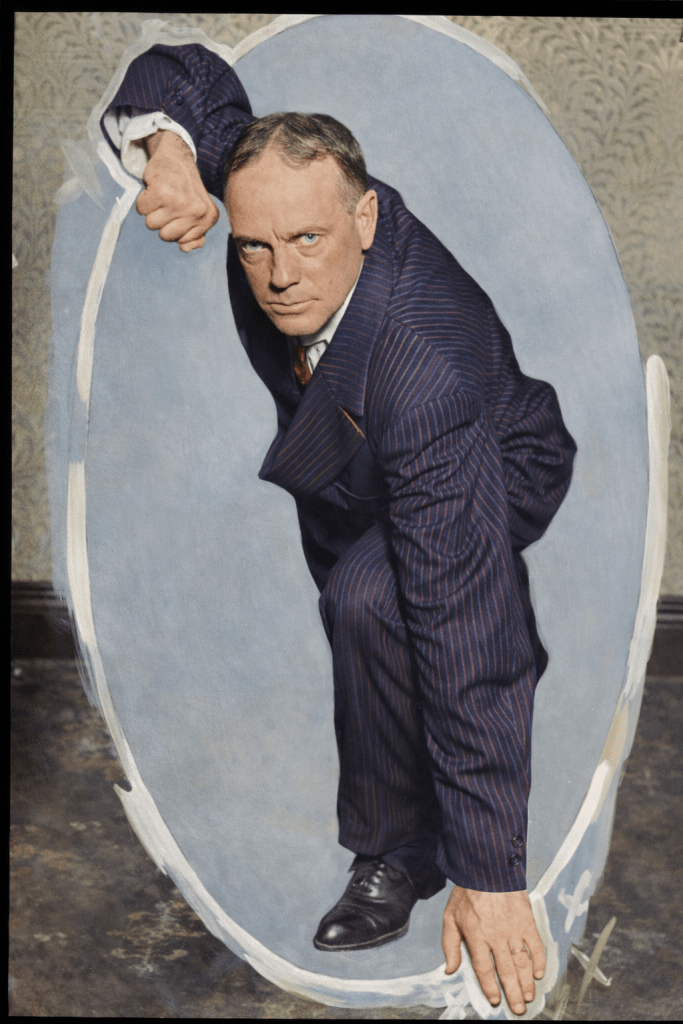
 Evangelist Billy Sunday (1862-1935)