Former professional baseball player-turned urban evangelist. Follow this daily blog that chronicles the life and ministry of revivalist preacher William Ashley "Billy" Sunday (1862-1935)
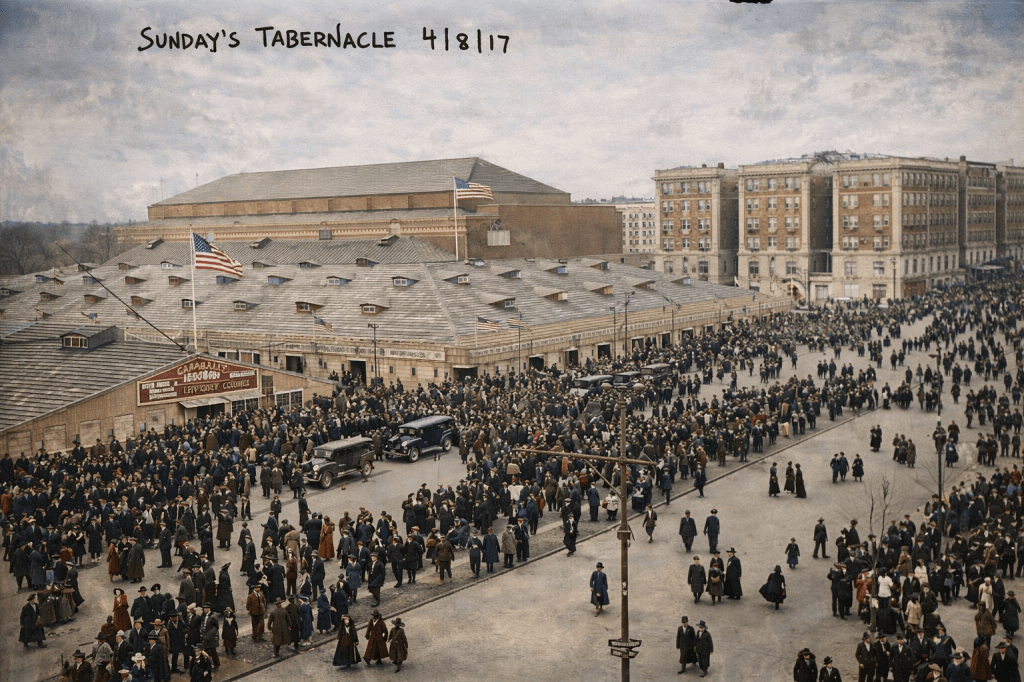
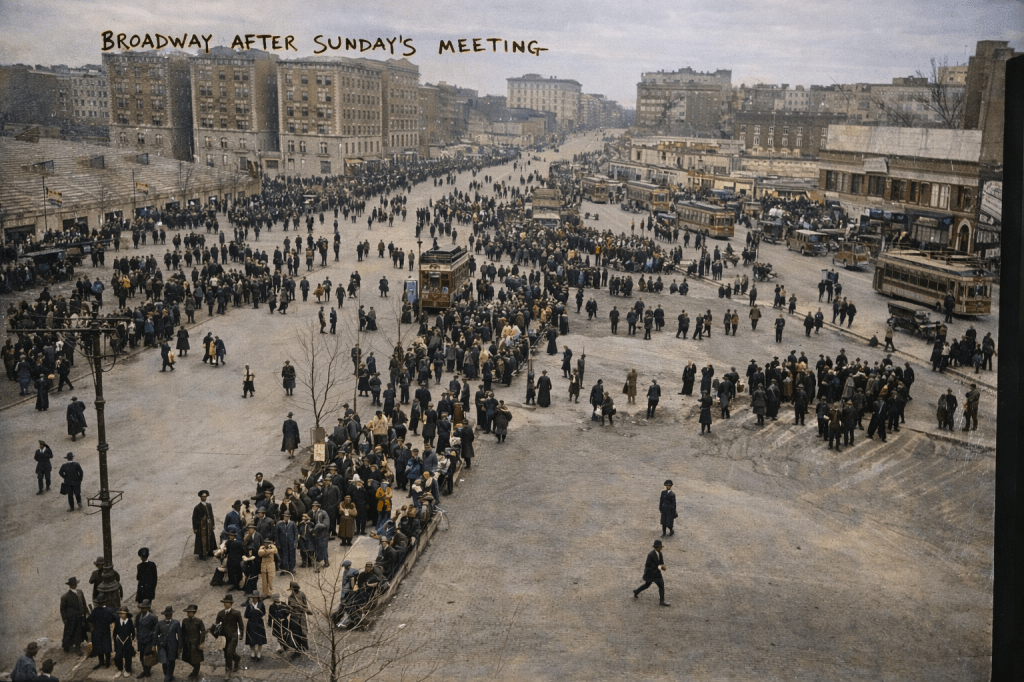
Billy used the newly constructed Kosair Auditorium for his Louisville revival meetings (April 22 – June 2).
” . . . during the six weeks of the revival to be held at the Kosair Auditorium, on Broadway between Floyd and Brook streets.” Source – newspaper
Now location of the 1922-23 Kosair Auditorium, adjacent to the Kosair Temple (now the Norton Research Institute).
The current Norton Research Institute was the original Kosair Temple, NOT the Auditorium. 224 E. Broadway (between Brook and Jackson Streets)
The Auditorium (Broadway between Floyd and Brook) pre-dated the Temple and likely served as a temporary venue while the Shrine built its new home a few blocks east (between Brook and Jackson).
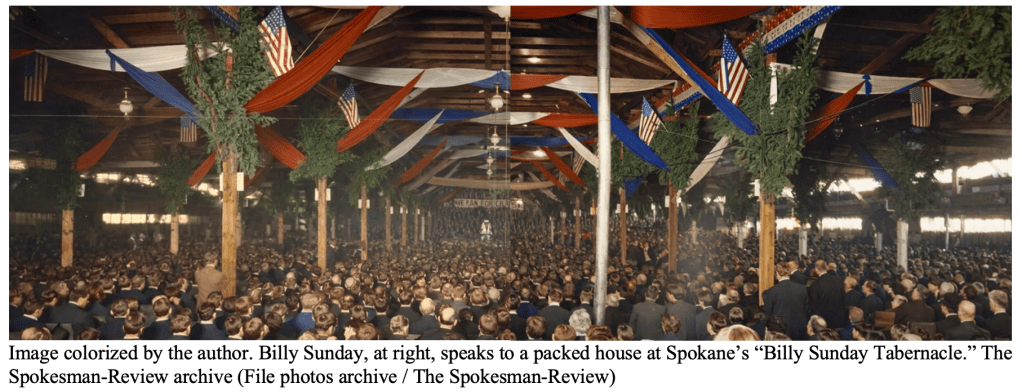
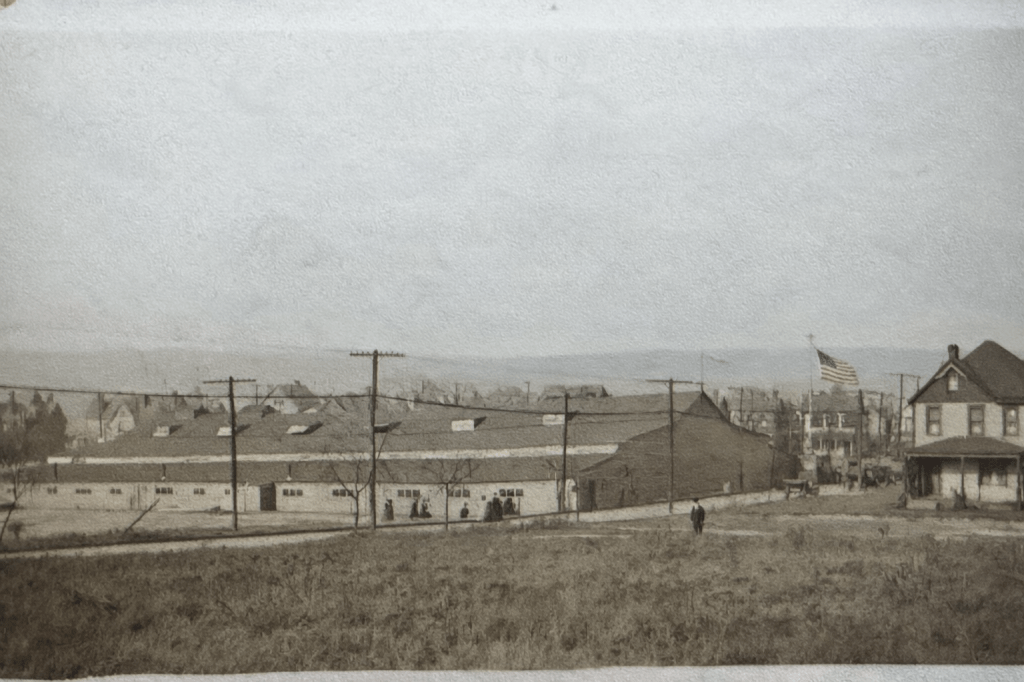
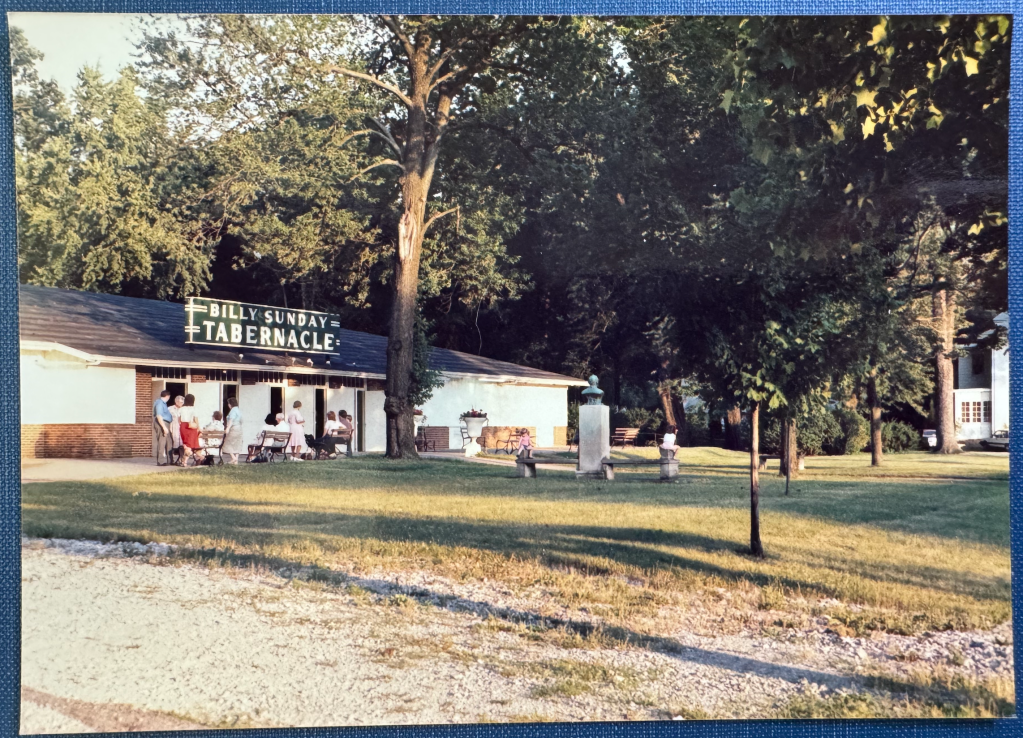
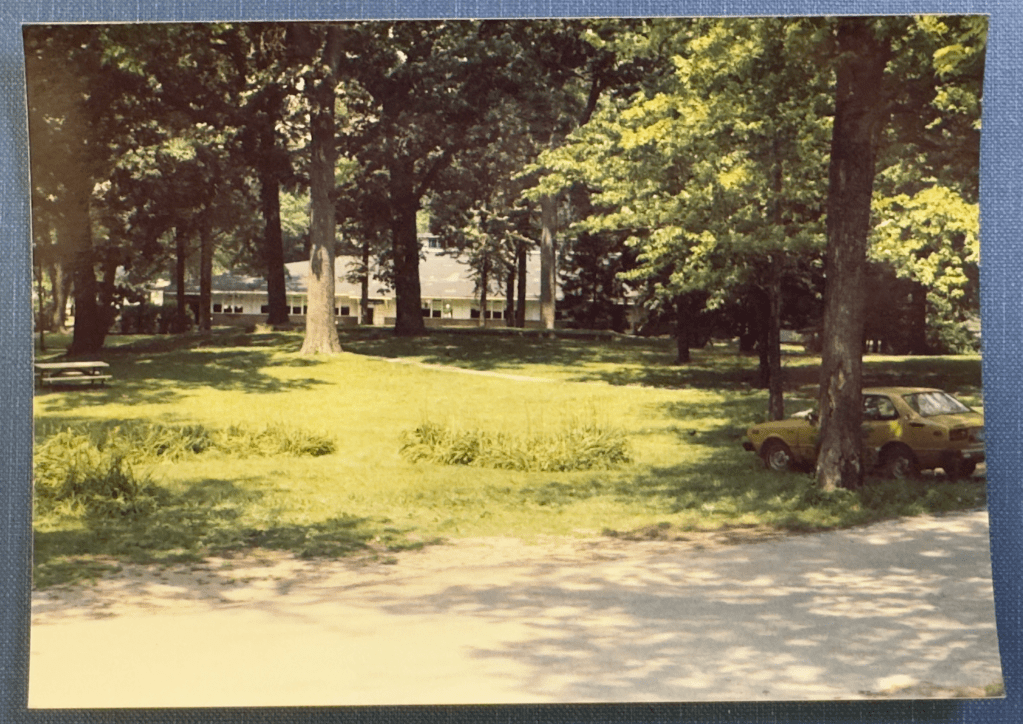
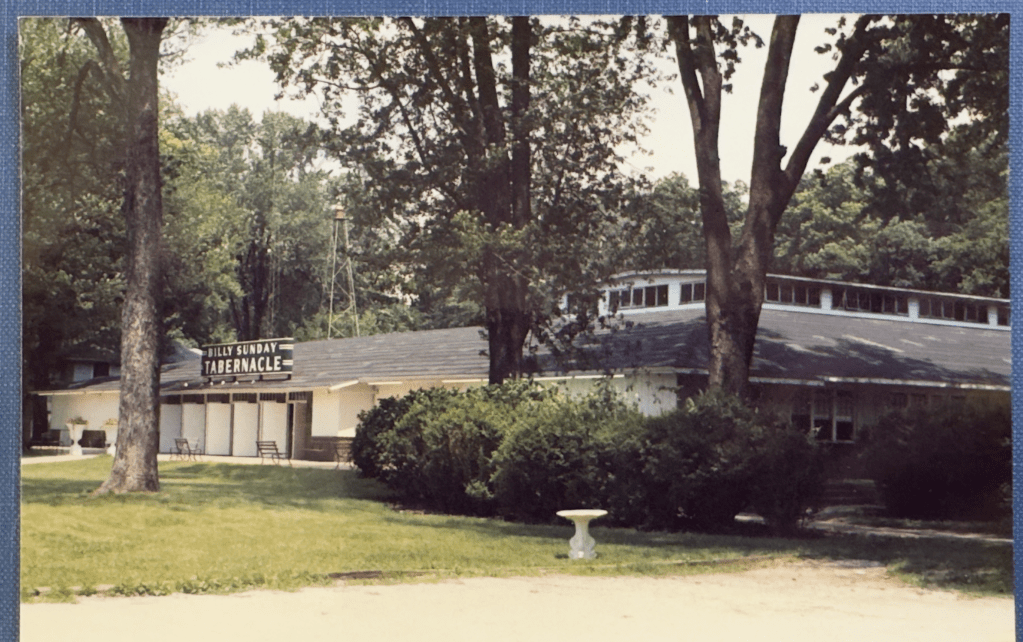
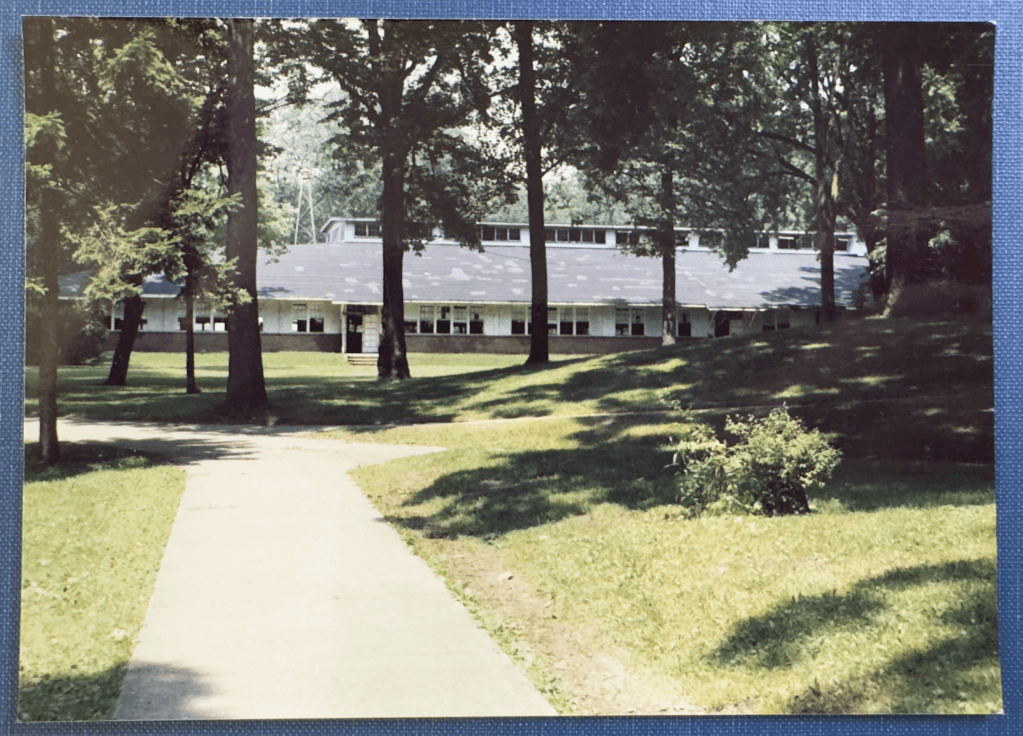
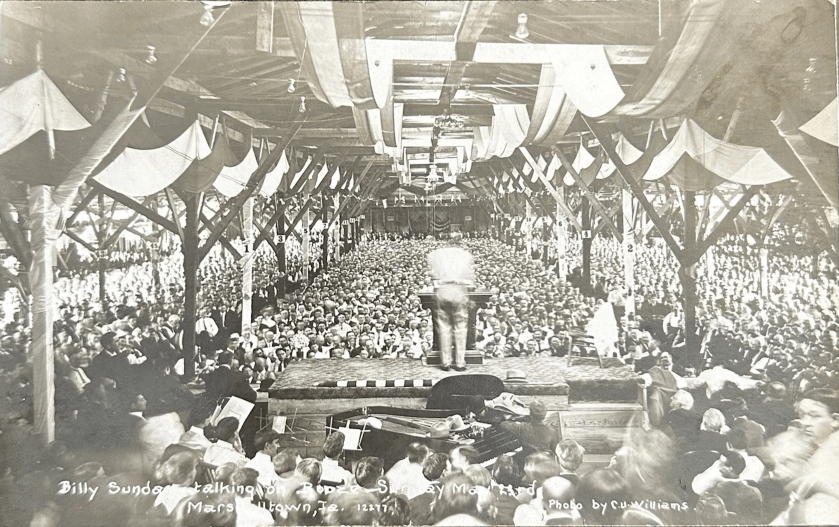
I was living in Winona Lake in 1992 – attending Grace Theological Seminary – when the Billy Sunday Tabernacle was demolished. Knowing this was the last time anyone would see the sole remaining Sunday tabernacle in America, I took these pictures.
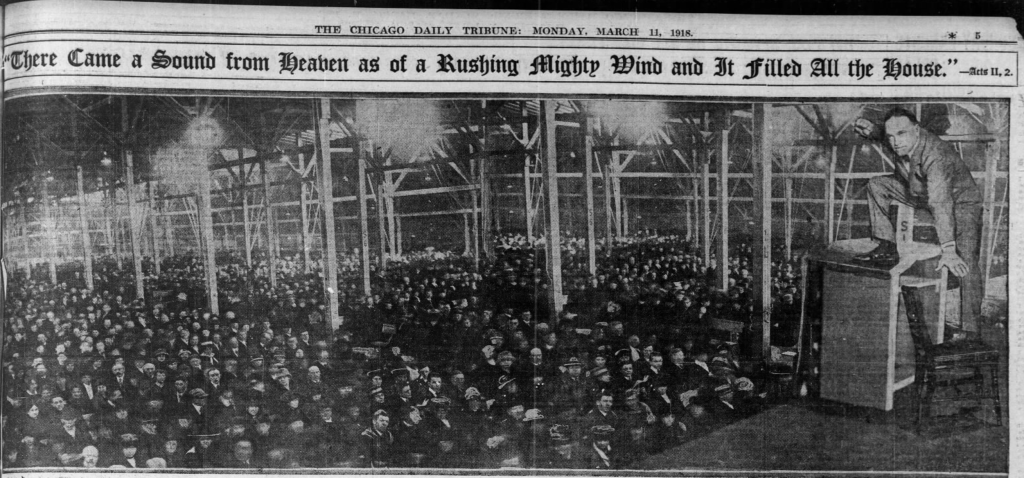
When revival calls crowds to the aisle, a critical question follows: “Will that decision endure?” In 1918, after Billy Sunday’s campaigns, journalists followed up with converts and organizers to ask whether the spiritual fervor survived time. The answers—preserved in this article—offer rare insight into how revival might seed long-term change. Read on to see what those trail hitters said, and what it teaches us about lasting faith.
Effect of Sunday Revivals in Other Cities Has Been Permanent.
BY ARTHUR JOYCE.
Does ‘trail hitting’ at Billy Sunday campaign meetings show any permanent results? Are those persons who walk the sawdust aisles over at the Tabernacle interested only in formally shaking the hand of the evangelist – or is there something definite behind it all?
Thousands who have seen approximately 6,000 persons ‘hit the trail’ at the Tabernacle in this city are asking these questions. And about the only way in which they can be answered with any degree of accuracy is to look over the field where the evangelist has campaigned and see what’s the situation a year or two following the campaigns.
I recently had a talk with two influential representatives of cities in which Billy has campaigned and I put the questions to each of them. One is Gen. C. Edward Murray, quartermaster general of New Jersey, the other is Lucius L. Jeddy, head of the Merchants National Bank, of Syracuse, N.Y. Both were Billy Sunday ‘trail hitters’ – Gen. Murray in Trenton, N.J., and Mr. Eddy in Syracuse.
Big Sunday Club.
Gen. Murray is president of the Billy Sunday Club, of Trenton, an organization of ‘trail hitters’ formed after the evangelist’s Trenton campaign. That club now has a big membership and every member in it is personally interested in leading others to Christ.
‘The campaign in Trenton,’ said Gen. Murray, ‘awakened a remarkable interest in Christian work, especially among the men and women who ‘hit the trail.’ Churches have increased their membership to a remarkable extent; booze joints that keeled over; Sunday schools are crowded and everywhere there is shown a wonderful interest in things religious. I know many noted men who have passed up the cigars and joined the church and I know of one politician who formerly represented the booze interests, who has been converted and is now an active election on an anti-booze ticket.
‘On the whole, I should say that the Sunday campaign in Trenton has done more to evangelize the city than any other one happening in recent years. And I’m satisfied that the men who ‘hit the trail’ are still going right with the Lord and are doing their best to lead the aisles for Christ.’
Mr. Eddy told of the workings of the Billy Sunday Club in Syracuse. Every member of the organization was a ‘trail hitter’ and in the last two years, he said, they have led more than 20,000 men to Christian lives.
‘The ‘trail hitters’ not only themselves ‘stuck to their declarations to stand on God’s side,’ said Mr. Eddy, ‘but they’ve inaugurated an active campaign to bring others into the fold. And if that doesn’t show the permanency of ‘trail hitting’ I’ve lost my guess.’
Senator Vardaman, of Mississippi, made the statement that if the evangelist shall win only one person to Christ in his Washington campaign, ‘we will have been well repaid for our efforts in the revival cause here.’
In Philadelphia – three years after the Sunday campaign – there is a ‘trail-hitting’ organization in virtually every church where the evangelist assisted in the revival. There are probably 7,000 members enrolled in these organizations, and they’re campaigning every day to bring others to the church.
In Scranton, Pa., one church added 2,000 members to its rolls within six months after the Sunday campaign. Another Scranton church increased its enrollment by 1,000 in a year following the campaign. The same is true of the churches in Wilkes-Barre, Pa., and in Carbondale, Pa., churches.
In Wichita, Kan., three men of national reputation have been converted who call ‘gospel teams.’ These ‘teams’ go about the country and work in the Middle West to preach the gospel and tell of the wonderful work Billy Sunday did in their campaigns. Out of these teams has been formed a National Federation of Gospel Teams’ which are made up of leading men throughout the country – all of whom are either ‘trail hitters’ at Sunday meetings or are in the church as a result of the work of ‘trail-hitters’ who have taken up personal work. These teams have a record of 11,000 conversions to their credit.
Don’t All Stay.
Detroit has a ‘trail-hitters’ club’ of nearly 1,000 members; Los Angeles has one with about 500 men on its rolls; Atlanta has just finished organization of a Billy Sunday Club with several hundred members. And in virtually every city and town where the evangelist has campaigned there are similar organizations continuing the work Billy began. Nearly every ‘trail hitter’ in these places has associated himself with these clubs.
Of course, every person who ‘hits the trail’ isn’t a sticker. But records made by Sunday party experience year after Billy’s campaigns in leading cities show that approximately 85 per cent of those who ‘walk the aisles’ represent permanent converts.
The object of the ‘trail hitting’ is not only to bring to the ‘front’ in a public confession of faith those who have been more before taken any stand in the matter. Billy’s ‘invitations’ are intended to induce the church members to ‘reconsecrate’ themselves and ask to be more earnest Christian life from those who have already ‘accepted’ Christianity.
Legacy & What It Means This article offers more than historical curiosity: it reveals Sunday’s conviction that conversion must stick. His method didn’t end with a call to the front — it extended into communities, clubs, and networks of believers committed to nurturing change.
Application for Today In contemporary ministries, it’s easy to emphasize decisions without long-term follow-through. What lessons does Sunday’s model offer us? Perhaps this: revival without discipleship is incomplete.
Reflection & Invitation If “trail hitters” in 1918 were expected to keep walking, not wander off, who in your context needs that same encouragement today? How will the faith you ignite be sustained, multiplied, and anchored in life?
Source – the author of this article is probably the wife to Evangelist M.B. Williams.
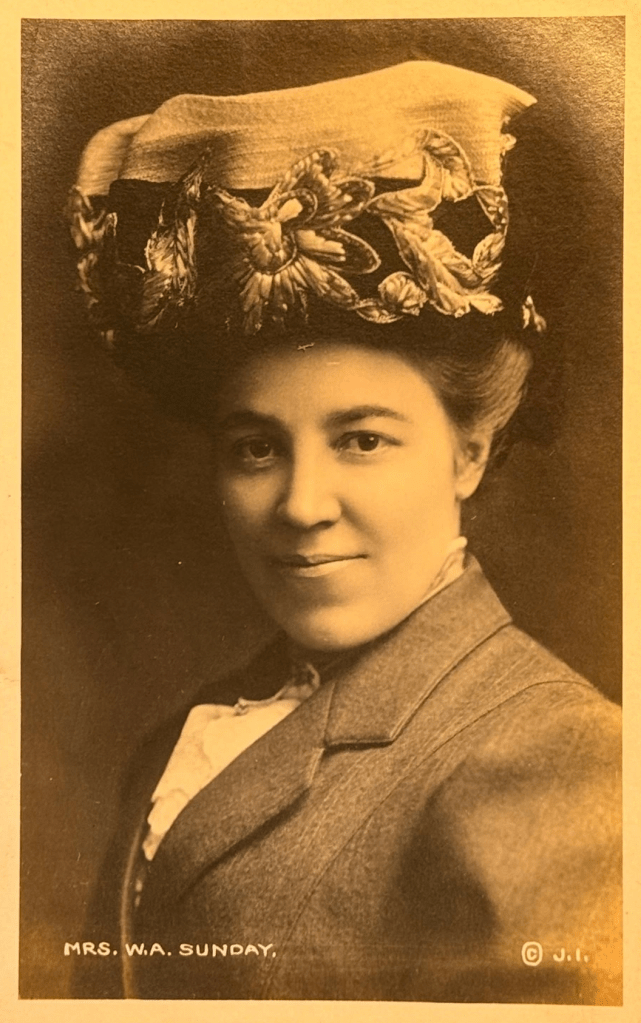
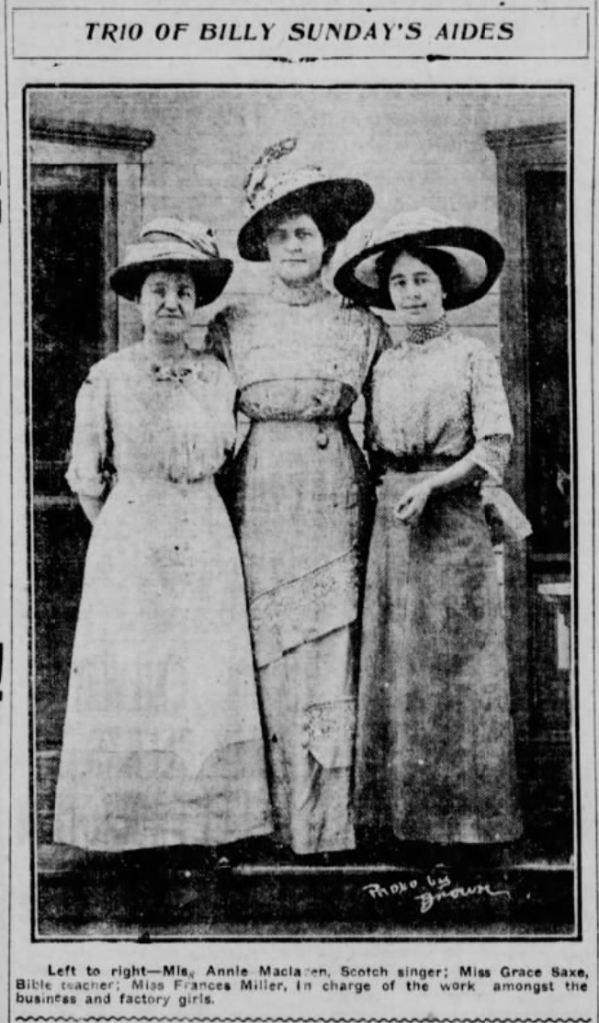
Grace Sax joined the Sunday team in February 191. She immediately assumed the leader of the cottage prayer meetings, as well as Bible teaching and training local churches to handle the fruit of the Sunday revivals.
The Liverpool Evening Review. Wed. Sept 18, 1912:1. Grace is in the center.
This article in a 1911 newspaper gives a glimpse of the importance of prayer to Grace.
Miss Saxe then held up little blank book which is called “Answered Prayer.”
She calls it, “A Record of the Footsteps of a Prayer Hearing and Prayer Answering God.” It is divided into four blank columns headed. First, date of asking; second, the request; third, the special promise pleaded; fourth, date when answered.
In this record she puts only the prayers which to man’s eyes it seem impossible to have answered. All of her prayers, she says, have not been answered thus far—many of them have however been answered fully.
“There are conditions to fulfill if prayers are to be answered.” These seven conditions she has in the back of her “Answered Prayer”
1. Personal condition, Psalm 66:18,
2. Forgiving Spirit, Mark 11:25,
3. Spiritual Motive, James 4:3.
4. Asking, Matthew 7:7,
5. Asking in Faith, Mark 11:24,
6. Asking according to God’s will (not to interfere with His plans) 1 John 5:14,
7. Asking in Jesus name, John 16:23. “Pray so that if it were written we could ask Jesus to sign it.”
In our prayers Miss Saxe suggests that the following should be the form of approach to God: Adoration, Confession, Thanksgiving, Supplication.
Taking the first letters of these words in order, we spell the word Acts. In Genesis 32:9-12 we find that order observed in Jacob’s prayer. In conclusion Miss Saxe suggested the reading of Andrew Murray’s ‘With Christ in the School of Prayer.’—Mrs. A. R. Williams.
Source – the author of this article is probably the wife to Evangelist M.B. Williams.
The following story was printed in a paper on March 3rd, 1915:
“One of the special features of the meeting yesterday afternoon came when Miss Grace Saxe, of Sunday’s party, rushed from the platform and threw her arms around the shoulders of a woman trail hitter. Miss Saxe later explained that the woman was a relative, living in this city, and that she has been praying for her to come to the front since the opening of the campaign.”
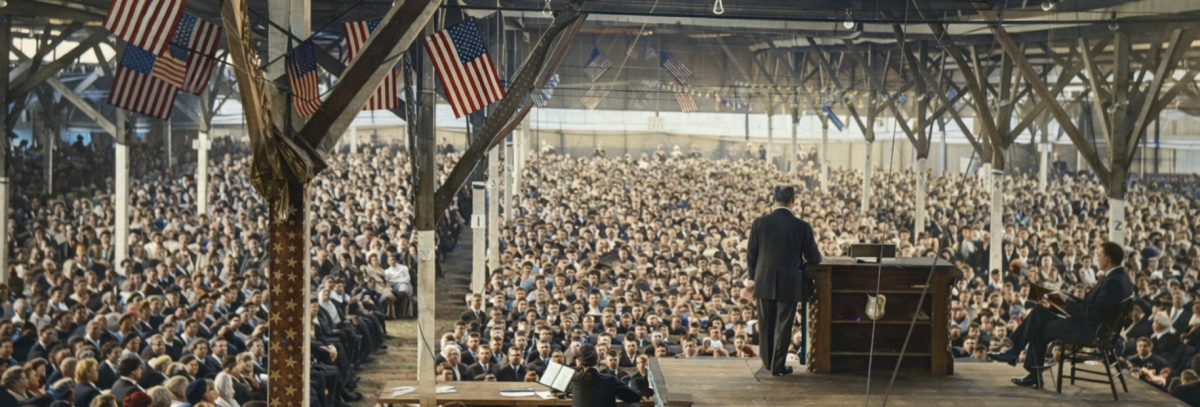
Location of tabernacle—Second and Washington streets.
All hats must be removed within building.
Members of choir required to be in their places promptly.
Tabernacle may be entered from any side and ushers will look after all.
A section of reserved seats is provided in the front for those whose hearing is defective. Another block, in direct center, is for the children.
First to arrive have choice of seats, except those in the choir loft which are reserved by checks for members of that body.
No one is permitted to walk through the aisles of the tabernacle while Sunday is preaching. All are expected to refrain from talking or making other unnecessary noises during the services.
Those who attend services are expected to start early so as to not create a disturbance by entering late. Late comers are admitted, but are required to enter building from rear doors. The purpose is to make as little disturbance as possible.
Ushers, officers and firemen, detailed by police and fire departments, will be on duty at all services to prevent disorder or accidents.
Hand books of the campaign, giving detailed information concerning transportation facilities, telephones, committee headquarters, prayer meeting districts and many other important items of information are distributed gratuitous at the tabernacle.
Changes in the hour of holding services, or any other important development, will be given in the Evening Review.
“First, he is natural, never tries to be another, is never affected. The champion of the diamond is in action for God. Second, he uses the word of God, knows it, believes it, and preaches it with consummate skill and commanding power. Third, he knows the heart of man, and helps every hearer to find and see one’s self. In papers, parts of his sermons may appear to be jokes, but they are no joke to the one whose soul is uncovered by them. A friend said Saturday, ‘I can’t laugh at the jokes, they are too awfully true.’ Another said, ‘Billy’s ‘darns’ aren’t nearly so large when you hear them as they appear to be in the press.” Mr. Sunday shows us the dead body of sin to which we are chained until we loath it and groan to be delivered from it.
Fourth, best and most important of all, he believes in and depends upon the Holy Spirit; who is here working in, working for, and working with Mr. Sunday, and every consecrated follower of God. Just so sure as these things be true, we shall see a great work in Scranton. Every lover of God and man ought to pray most earnestly that this may be fact as well as prophecy. We ought not to judge until we see and hear. Come to the tabernacle and you will wish that all of your family and friends were with you. Mr. Sunday is more than a man working with human skill. He is a man of God being used to help men. Years hence we shall regret it if we fail to hear Billy Sunday now.”
“Billy Sunday is an American Product – Where methods differ
More Lasting Good.
The old school of revivalists were of the itinerant class, moving rapidly through the country, their evangelism seemed sudden in its effect and I am afraid somewhat evanescent in its general results. It is just here that Mr. Sunday’s campaign gives promise of more lasting good. His coming has been carefully prepared for, his meeting place is undenominational in character. It is a movement conducted with great business acumen and sound common sense. He trains the ministers and church workers in such a way as to make them capable of caring for the harvest when it comes. Like a good farmer, he prunes the fruit trees with vigor cuts out all the dead wood and sprays them well to get rid of moths, beetles and canker worms, so that when the new fruit shall ripen it will be sound and beneficial. And the leaves of the trees shall be for the healing of the nations. Mr. Sunday is a man endowed with a great faith, He prays for the blessing, he prepares for the blessing, he is sure of getting it and it is therefore no surprise that he is so eminently successful.”
It is a campaign in the name of God against the world, the flesh and the devil, and against a revival you will find every brewer …. every whiskey seller in this valley; every blackleg gambler in this valley; every sham madame of the red-light district; every man and woman that feeds and fattens and gormandizes upon the virtue of men and women, so if you want to line up with a bunch like that, God pity you; that is the best compliment on God’s earth.
Men say the day of the revival is over. Fellows harp on that in the Methodist conference, in the Presbyterian meetings, in the Baptist associations, in the Congregational associations—the day of the revival is over. No, it is not. No, only with the fellow who vomits out the sentiment; but it is not over with God. The day of the revival is over. God Almighty leaned over the battlements of heaven and looked down into the coal mines of Wales and said, “Oh. Roberts!” and out of the depths of the coal mine came that grimy, soiled man, with dirty face, with a little lamp in his cap, and he said, “What is it, God?” And God said, “I want you to go and shake up Wales,” and he gave Wales the greatest revival that ever swept over that land since the days of Pentecost. There was not a college professor or preacher in Wales that God would trust with the job.
The Tribune-Republican. Wed, Mar 04, 1914 ·Page 10