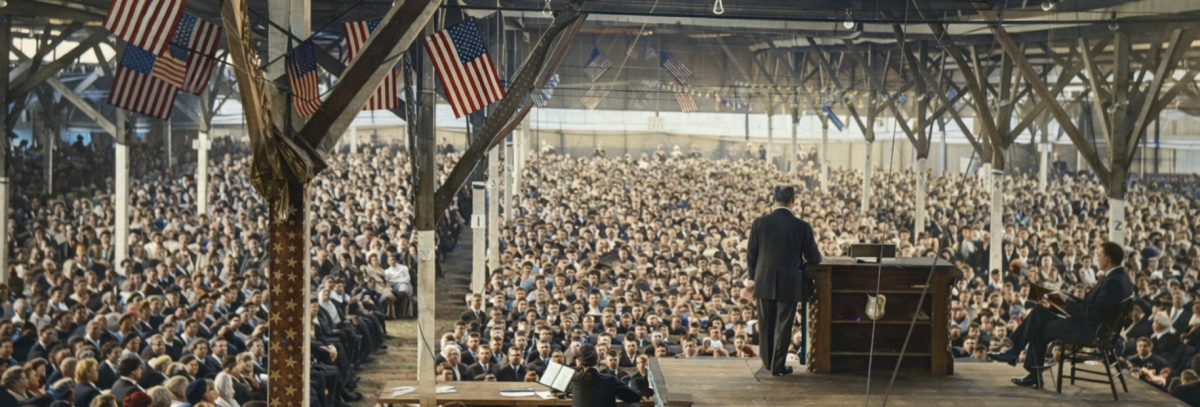
As reported in The Richmond Item. Sun, Apr 16, 1922
CROWDS THRONG STREETS DURING MARCH TO HOTEL
American Legion Band Leads Parade; Evangelist Delighted With Reception
Opening Service
Opening service—2:30 p. m. The Rev. R. W. Stoakes presiding.
Introducing C. F. Hutchins, chairman of music committee.
Introductions—Mrs. William Asher, Robert Matthews, Miss Florence Kinney by Mr. Hutchins.
Song service—Mr. Matthews.
Devotionals.
Introducing Mr. Sunday—The Rev. Mr. Stoakes.
Remarks—Mr. Sunday.
Welcome—Mayor Lawrence A. Handley.
Financial statement and collection talk, the Rev. E. Howard Brown.
Collection.
Sermon.
“Here he comes!”
“That’s Sunday!”
“There’s ‘Mr’ Sunday!”
“See Billy!”
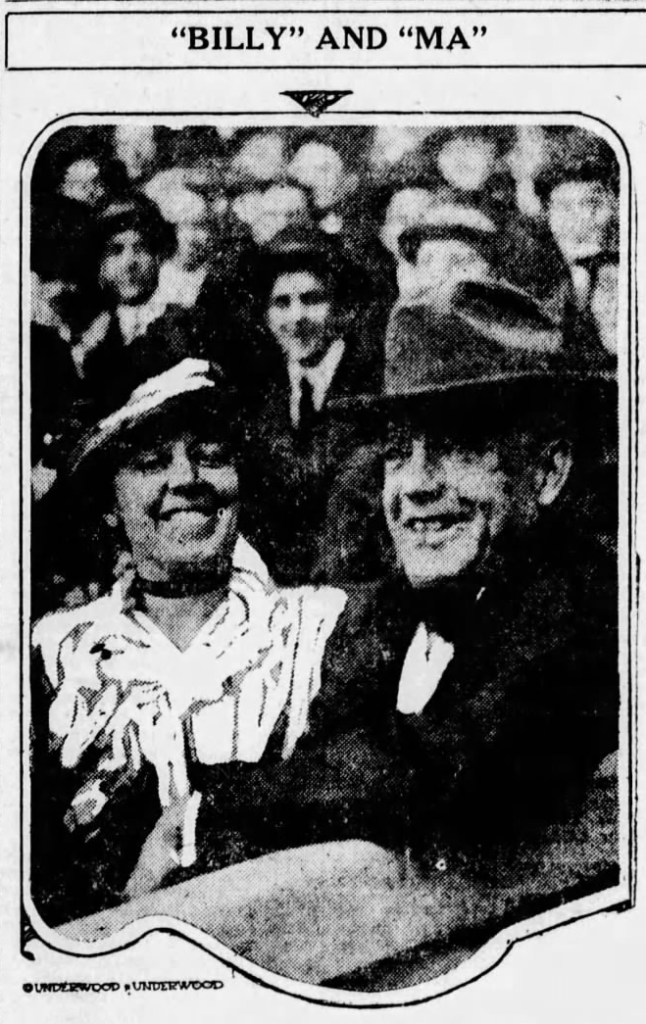
Those were the exclamations heard yesterday afternoon from hundreds of spectators lining the sidewalks during the triumphal march in automobile of Mr. and Mrs. William A. Sunday from the Pennsylvania station to the Westcott hotel. Richmond gave them a great welcome.
Eager to See “Billy”.
Both Mr. and Mrs. Sunday were waving their hands all the time of the ride, acknowledging the salutes and smiles of Mr. and Mrs. Richmond and their children. The hearty welcome of the populace along the line of march was only equaled by the reception at the station where many more hundreds had every vantage point to see the world’s greatest evangelist, and Mrs. Sunday.
As they made their snake-like trail into the station the American Legion band started to play “The Star Spangled Banner.” The Sundays stepped on the platform a slender man in his early fifties, in a suit of clothes, showing the vigor of youth in every move.
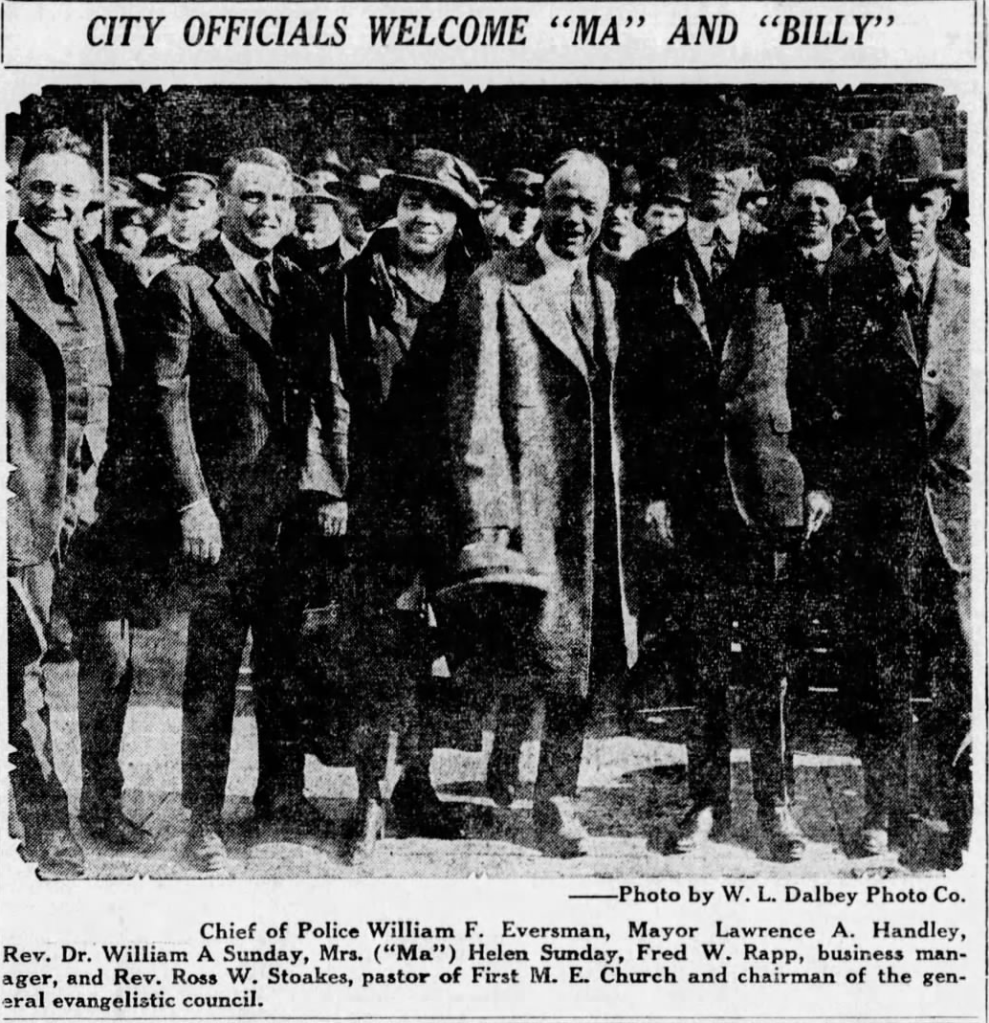
With Mr. Sunday, who was introduced as master of ceremonies, Fred N. Page introduced Mayor Lawrence A. Handley and Chief of Police William F. Eversman. After viewing the mayor’s band, the mayor and the chief of police escorted Mr. and Mrs. Sunday to the automobile.
Salutes Everyone.
As Mr. Sunday passed the national colors, bareheaded, his hand went to salute while the people clapped. Billy missed nothing. Heads were craned from the Arlington hotel windows but they were not that high but Billy could see them and he waved his salutations at them.
Cameras clicked. “Right here, Mr. Sunday,” someone called, and the man of note posed for his picture. “Come in,” he called to others and in twinkling he had the mayor by his side. Mrs. Sunday stepped up, then came the chief of police, Rapp and the Rev. R. W. Stoakes.
The above six with the Rev. Dr. J. J. Rae, pastor of the First Presbyterian church entered the automobile and escorted by the American Legion band with the Sunday school boys and girls of the First church along E street, north Eighth street, north Ninth street, west Main street, west Tenth street to the park where the automobile was waiting with its notable passengers, thinking of the wonderful reception they had received.
Automobiles stood in a double line for a block and a half on both sides. Eight street was thronged. Every available inch of sidewalk was filled with people.
Thanks War Veterans.
Billy was the first to alight at the Westcott hotel. Did he enter the hotel at once? He did not. The band was standing in a circle north of the Tenth street entrance of the Westcott and like a youngster just out of school, Billy scampered off to the bandsmen, shaking hands heartily with the players.
“Lieutenant,” Billy said to Lieutenant Urqupley, “my boy was a lieutenant with the signal corps in the Rainbow division.” Lieutenant Rapp, who by this time had found his chief.
“Where’s Major?” Billy asked as he gained the hotel entrance. “Right here” replied the latter as he entered the hotel.
After Mr. and Mrs. Sunday went to their rooms many of the local pastors and members of the general council were received in the rooms and were being greeted by everyone, he beaming countenance his ever smiling the showing that he was delighted with the welcome he had received in Richmond. Mrs. Sunday also shook the hands of many who were introduced to her.
A platoon of police was at the station regulating the human and (Continued on Page Two)
CROWDS GREET SUNDAY
Continued from Page One)
the automobile traffic. And it was needed, so great was the throng. Preaches Twice Today. Mr. Sunday will preach twice today but last night was not ready to announce his subject for the afternoon meeting. He will speak on “Why Calle Ye Me Lord, Lord,” or “The Sins of Society” at 7:30 p. m.
Albert Peterson, Robert Matthews, Mrs. William Asher and Miss Florence Kinney also arrived here yesterday. Homer Rodeheaver will not be here until Wednesday. Mr. Matthews, Mr. Sunday’s secretary will direct the music today, while Miss Kinney and Mr. Peterson will be at the pianos. The opening hymn will be “Faith of Our Fathers.”
Mr. Sunday will address campaign workers at the United Presbyterian church at 10 a. m. tomorrow.
Coverage in: The Richmond Item. Sun, Apr 16, 1922 ·Page 1
Who’s Who In Sunday’s Party; Open Revival Today
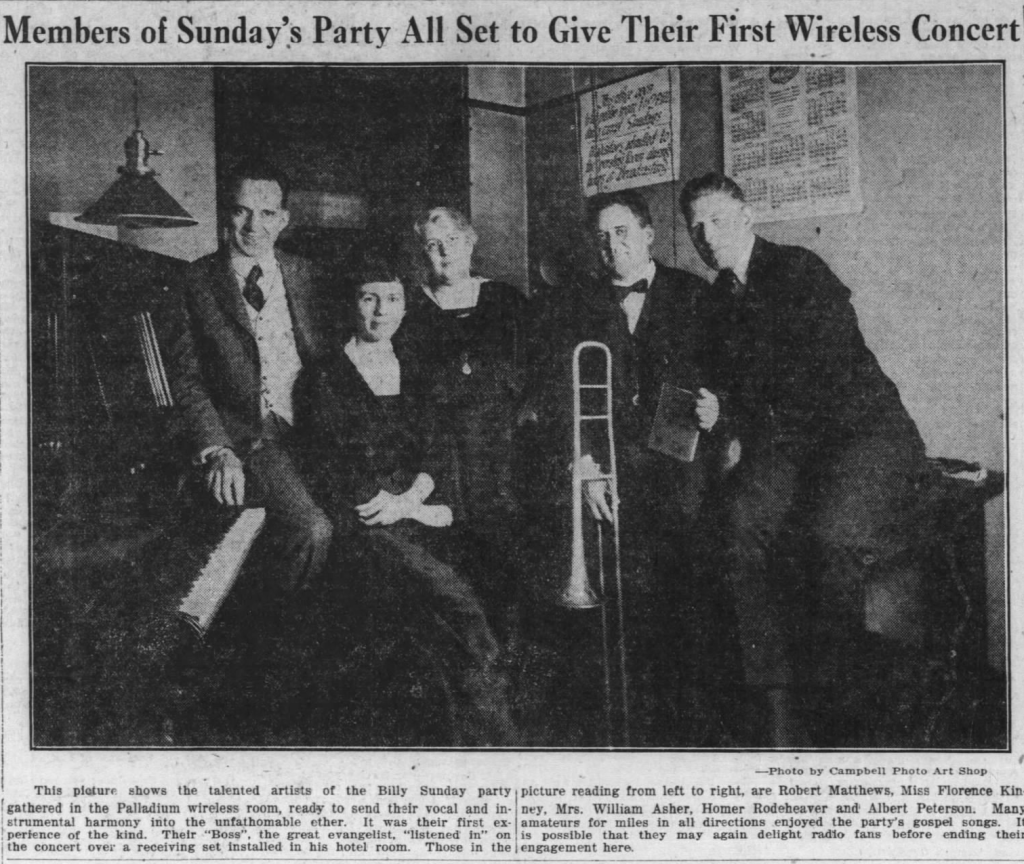
While the Rev. Dr. William A. Sunday will be the big drawing card for the six weeks’ revival that will begin in Richmond today, it must not be forgotten that Mr. Sunday has surrounded himself with a corps of workers that hold the record of being second to none in evangelistic work. Counting both Mr. and Mrs. Sunday the Sunday party is composed of nine persons—five men and four women.
Homer Rodeheaver is probably as well known as a gospel singer as his ‘boss’ is as an evangelist, just as Mr. Sunday preaches the gospel, Mr. Rodeheaver sings it. He has been with Mr. Sunday for 12 years. Not only is he a soloist, but he has frequently led the singing at the great revivals held in the country.
At last year’s Chautauqua Mr. Rodeheaver, or ‘Rody’ as he is nicknamed, was reared in eastern Tennessee. After attending the public schools he attended Ohio Wesleyan university. His first public work as a musician was with the Jellico, Tenn., Silver Concert band. He studied music under Oscar Saenger in New York city and Madame Turner Kurtz in Philadelphia. He was for years song leader for W. E. Biederwolf.
Mr. Rodeheaver was sent overseas during the world war by the Y. M. C. A. playing his trombone and singing songs on practically all the battlefronts. Mr. Rodeheaver is proud of the fact that probably his instrument is the only trombone that played the soldiers’ favorite songs while flying over the massed regiments of doughboys.
‘Rod’ is not married in spite of the fact that on frequent trips to southeastern West Virginia, it was said by a newspaper that ‘Mr. and Mrs. Rodeheaver played and sang songs in Richmond.’ The only Miss Ruth Rodeheaver, his sister, and a niece of Mr. Rodeheaver has been labeled Miss Rodeheaver as Mrs. R.
Mr. Rodeheaver is a Rotarian, a member of the Sons of Veterans, the Spanish American War Veterans, Knights of Pythias, the Mystic Shrine and the Methodist church, his home is at Winona Lake.
Robert Matthews, familiarly known as ‘Bob’ is a former newspaperman and served his apprenticeship to ‘journalism’ on some large newspapers, including The Chicago Tribune. He is pianist and solo secretary to Mr. Sunday. Traveling with Billy Sunday from city to city is nothing to Mr. Matthews who has seen many capitals of the world. He has been on every sea, including the Arctic and the Antarctic.
Mr. Matthews was born at Carrollton, Ky. He was educated in the public schools and is a graduate from Lake Forest, Ill., university. His father, Robert J. L. Matthews was a Presbyterian minister. Following his college course he accepted the editorship of a newspaper at Keokuk. He was also city editor of the Burlington Journal, of Des Moines News and the Chicago Record Tribune for five years.
Mr. Matthews is a Rotarian, a Shriner, and is an elder in the Presbyterian church.
Mrs. William Asher, who has sung before in this city, lives at Winona Lake. For seven years Mrs. Asher was associated with the Rev. J. Chapman during his evangelistic work. She has been a member of the Sunday party for eight years. While she is frequently heard in duets with the musical director, her principal work with the party is directing the women’s work. One of the big ‘hits’ of Mr. Rodeheaver and Mrs. Asher as singers in every campaign, is the singing of ‘The Old Rugged Cross.’ The two sang that at the last Chautauqua here and received an ovation.
Miss Florence Kinney is a member of the Methodist church of Springfield, O., where her father has been with Mr. Sunday five years. She will direct the student work in the event and be the Bible teacher with the party.
Miss Kinney is a graduate of the Cincinnati Conservatory of Music and of Ohio state university. She is greatly interested in bird life and is one of the consulting directors of the Audobon Society of America. She is a former president of the Women’s Federation of clubs of Clark county, of which Springfield is the county seat. Miss Kinney is recognized as one of the leading workers among young people in the country.
Her musical attainments are frequently shown and if it is ever necessary for ‘Bob’ Matthews to be absent or ‘Rody’ then Miss Kinney takes over ‘Bob’s’ vacated seat at the piano.
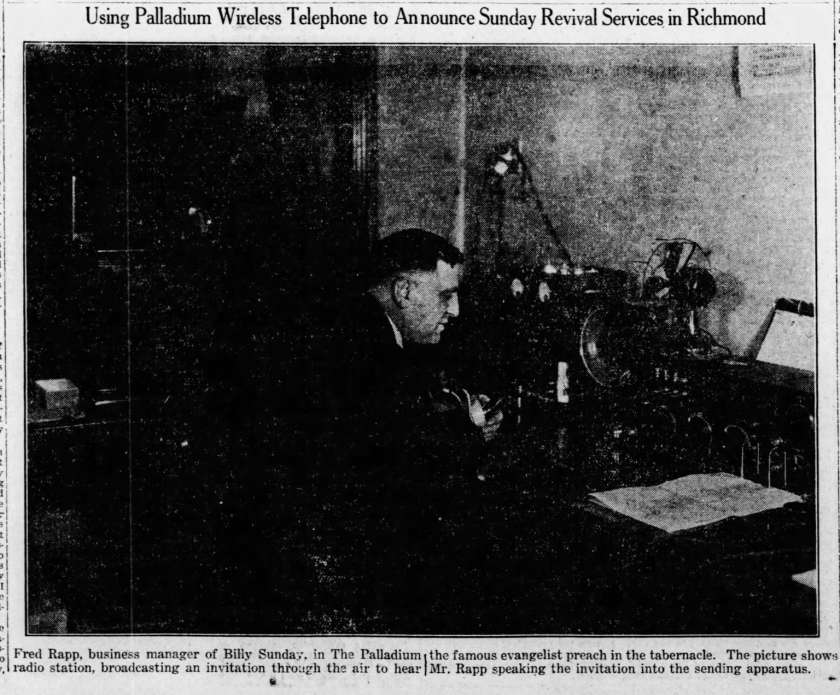
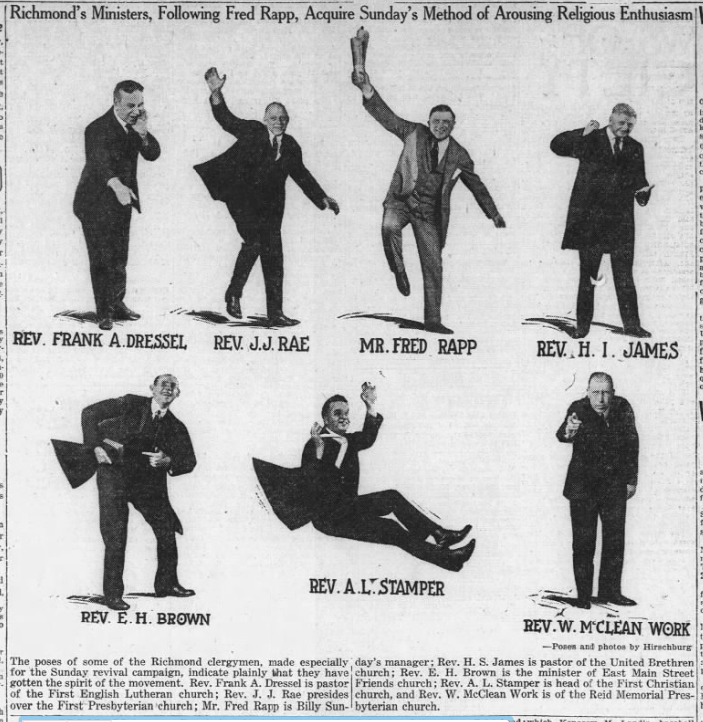
Fred W. Rapp, business manager of the party is already known to thousands of church goers in Richmond. He is a graduate of the Nebraska university and has been engaged in Y. M. C. A. administrative work for 15 years. He is a native of Allentown, Pa. His home is at Winona Lake. He is married and has one daughter, Helen.
Like his colleague, ‘Rody,’ Mr. Rapp was overseas during the world war engaged in ‘Y’ work. Owing to his administrative abilities he was one of 12 men selected by John R. Mott, head of the national Y. M. C. A. to go to France. He was on several battle fronts engaged in special administrative work with the American forces. He is a Mason, Kiwanian, star tennis player and amateur boxer.
Albert Peterson, familiarly known as ‘Pete,’ is tabernacle custodian. He is a big fellow. He weighs 215 pounds and stands six feet three inches. He is unmarried. Of Swedish descent, he claims to have his home in the land of Blaker, Minn. He is classed as the major-domo of the tabernacle. He has been with the party for 10 years. He is a member of the Methodist church. He is a member of the Masonic lodge and the Knights of Pythias. He was a star wrestler in his younger days.
Keeping the tabernacle in good condition and seeing that the temple is not the only duty that falls to ‘Pete.’ He plays the piano when a ‘sub’ is necessary, he sings tenor and will be a frequent speaker at the shop meetings that will be held here during the campaign.
Miss Alma Thomas herself is the authority for saying that she is not a member of the Sunday party, but she is placed here as part of personnel notwithstanding her status. Perhaps she can better be placed as the ‘advance’ of the party, for while the others are carrying out their duties in one city, Miss Thomas is acting as Mr. Rapp’s secretary. She is generally ahead of the campaign and works perfecting the plans that bring the various organizations into being to bring the rest of the party to the next stop of the campaign.
Miss Thomas is from the Empire state and makes her home with her mother in New York city. She has been with Mr. Sunday for 10 months. Mr. Rapp is not known to have a secretary with the Sunday party, and Miss Thomas is the first one he has been doing here for the last six weeks.
MILTON, IND.
MILTON, Ind.—The Cary club met Thursday with Mrs. Henry Mueller. The following program was given: ‘Education in South America,’ Mrs. Frank Broaddus; ‘Women and the Family in America,’ Mrs. Aaron Doll; ‘Fusion of Races,’ Mrs. E. C. Denny; ‘Relation of South America to the Rest of the World,’ Mrs. William Huddleston.
Dayton Warren and Blance Coyne are home from Ohio State university for a few days’ vacation.
Roderick McCormick is home from Butler for a few days’ spring vacation.
The senior class of the high school took a trip to Dayton Wednesday evening.
Alma Wagner and Ernest Jones are home for a few days’ vacation from Indiana university.
Miss Naomi Squier, of Richmond, spent Sunday night with Ina Crawford.
The Richmond Item. Sun, Apr 16, 1922 ·Page 8
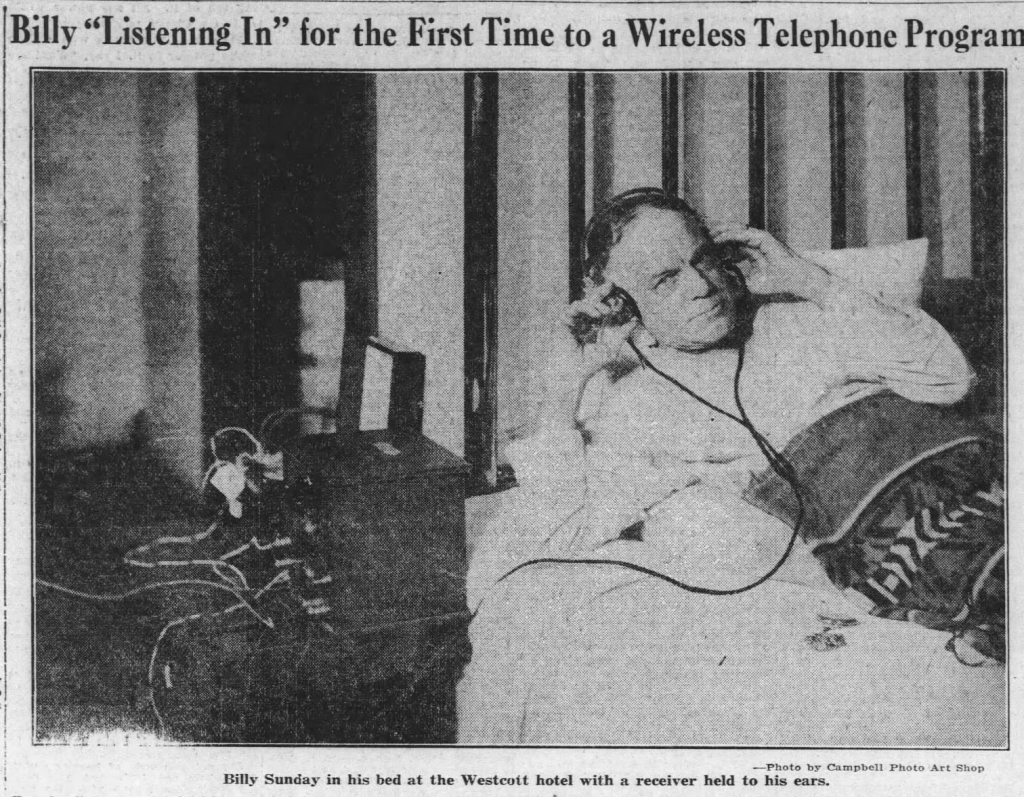

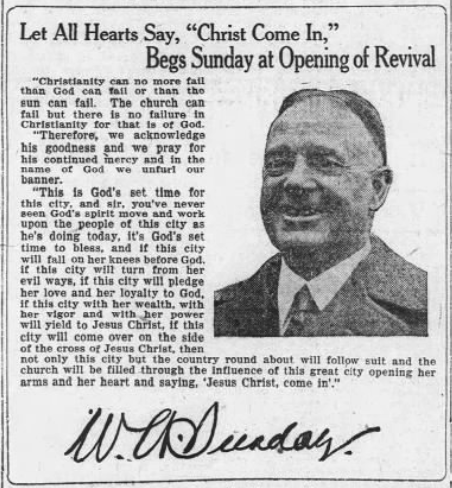
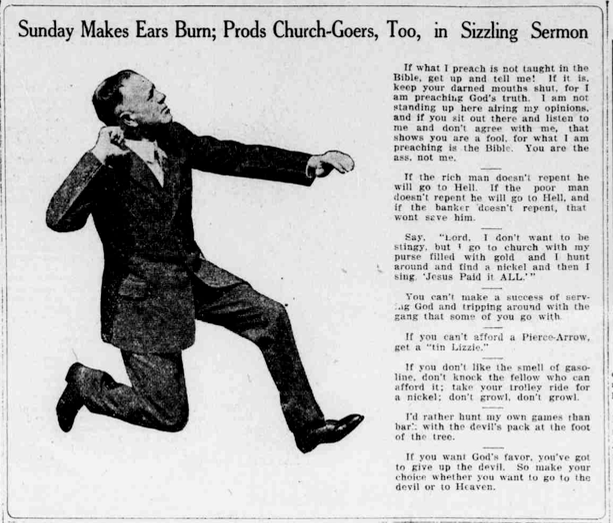


 Evangelist Billy Sunday (1862-1935)