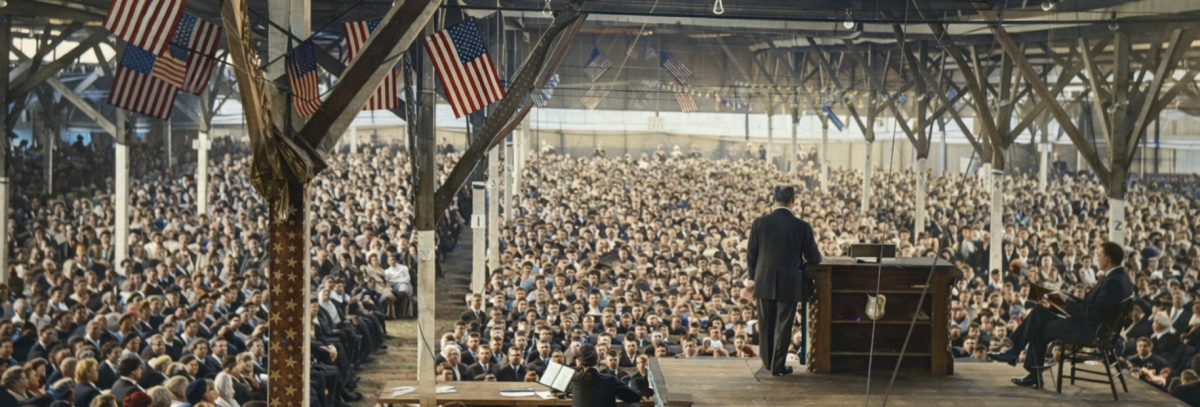
The Ways and Works of Moody, Gypsy Smith and Chapman—Men Whose Methods Were as Different as Their Personalities.
By WILLIAM RADER
Cited in: The Philadelphia Evening Ledger. January 8, 1915:8.
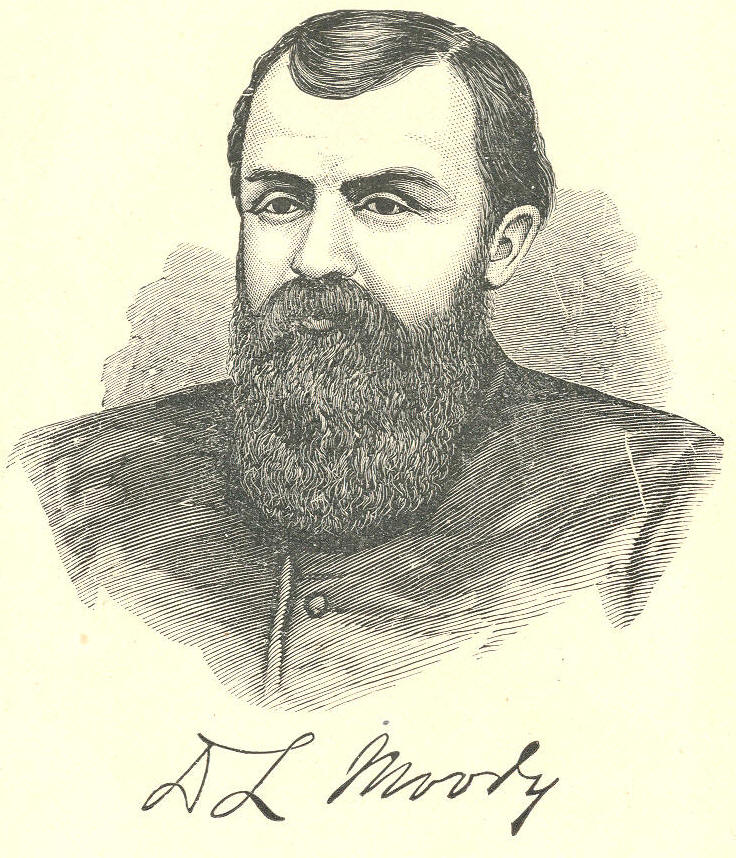
DWIGHT L. MOODY sleeps on Round Top, at Northfield, Mass. A few miles away, in Swanzey, N. H., is a simple shaft which marks the grave of Denman Thompson, of “The Old Homestead.” It is probable that the two men never met, but they were not unlike in appearance. Both were big, hearty Americans with good appetites, warm hearts and filled with loving kindness. The one spoke fiction on the stage as if it were truth; the other—to repeat a thought of Garrick—spoke truth on the pulpit as if it were fiction.
When Moody was a clerk in a Chicago shoe store, he became interested in religion through Dr. Edward N. Kirk and Edward Kimball. Without college or theological training, he began his great work and preached the gospel throughout the English-speaking world.
In the Old Pennsylvania R. R. Depot
One of his notable campaigns was in Philadelphia. The meetings were held in the abandoned freight depot of the Pennsylvania Railroad, used afterward as the Wanamaker store. The building was provided with seats to accommodate 10,000.
A striking incident of Moody’s Philadelphia campaign was the meeting set apart especially for intemperate men and women. His tender appeal to that assemblage is still remembered by Philadelphians who heard him.
Singing helped the preaching of Moody. The songs of Sankey grew to be as famous as the sermons of Moody. A hymnal was published which caused Moody and Sankey much trouble, since it was reported that they received royalties from the sale. Certain watchdogs of the moneybag believe that the blackest sin on the calendar is for a preacher or evangelist to make money. Every evangelist must make it plain that he is not a grafter.
Mr. Moody was the greatest evangelist-preacher of his generation. He did not use the best grammar, but he had common sense. Who could forget his sermons on “Sowing and Reaping,” “The New Birth” and “Repentance”?
Everybody Sing!
There was no claptrap in the Moody method, no straining for effects, but conviction, point and directness, and irresistible persuasiveness. He did not shatter the icicle of sin with well-directed aim, but melted it with words hot with a passion for redemption.
The first time I heard Moody he did what I thought at the time a sensational act. It was in Tremont Temple, Boston. Anxious to see him, as a student at Andover, I went early and took a seat near the front. The big choir on the platform was being trained while the people gathered. An old gentleman sat on one side of me, a lady the other. Moody soon appeared. He was announced by a man reading a paper in the audience, and asked him to put it away and join in the singing. “Everybody sing!” he shouted. “Everybody get a book!” He announced a hymn, but the singing was very unsatisfactory, and he had the people sing it over several times. Seeing I had no book and showing annoyance, he took fair aim and threw a hymn book as straight as a bullet at me. It took me in the stomach, and I think it raised me about two feet from the pew, but my consternation was no whit greater than the surprise of those who sat with me. We were strangers, but we all sang out of the same book, and Moody from that moment was an acknowledged master.
He was a man-finder. He discovered Henry Drummond and introduced him to the American people. He found a great preacher in Campbell Morgan, of London, and made him at home in the American pulpit. He took keen interest in liberal and conservative.
The Northfield conferences, which continue to this day, furnished an opportunity for testing the mettle of promising men in England and this country. A number enjoy an international reputation who owe their start to the insight of Mr. Moody.
He was a builder of institutions. The Y. M. C. A. work throughout the country was assisted by him. He raised great sums of money for the work. The Mount Hermon schools for young men and women are one of his memorials. His evangelistic work reached its zenith in his British campaign and at the World’s Fair in Chicago.
The Stolen Overcoat
The last time I heard Moody he made an impassioned plea in behalf of criminals and prisoners, and while he was making it an ex-convict stole his valuable new overcoat. It was a study in practical theology to observe the effect of this disappointment upon the great preacher, who, while furious at first, finally submitted to the inevitable with grace that an evangelist is supposed to possess.
Gypsy Smith is one of my favorite evangelists. He is a full-blooded gypsy, swarthy skin and beautiful brown eyes. Socially he is “a hail fellow well met,” one of the ripe fruits of the Moody-Sankey British campaign. He has a sense of humor and a wit that is irresistible. His voice is musical, and it is a treat to hear him sing.
Gypsy Smith uses faultless English. I asked him how he acquired this gift of English diction, and he said that after leaving the gypsy camp he was placed in a refined English home, where he heard the best grammar. If you have ever heard Gypsy Smith’s great sermon on “With the Stripes” you have listened to a discourse that has all the qualities of great preaching.
A Cultivated Gypsy
He is the perfect gentleman on the platform, winsome, attractive, eloquent, cultured and sympathetic. As a maker of sermons he has no equal. His breadth of scholarship, depth of feeling and height of intellectual reach make him a superior man in the field of higher evangelism.
Rodney is his real name. He is of the Tachine Roman gypsy tribe, and his mother was a fortune-teller. The life in the tent has enriched his imagination, given him a strong body and aided him in living a clean, pure life, and not since the day John Bright has any man appeared in England who has more perfectly revealed the possibilities of Anglo-Saxon speech.
J. Wilbur Chapman was a Philadelphia pastor. For some years he was the pastor of Bethany Presbyterian Church; then he became a world evangelist.
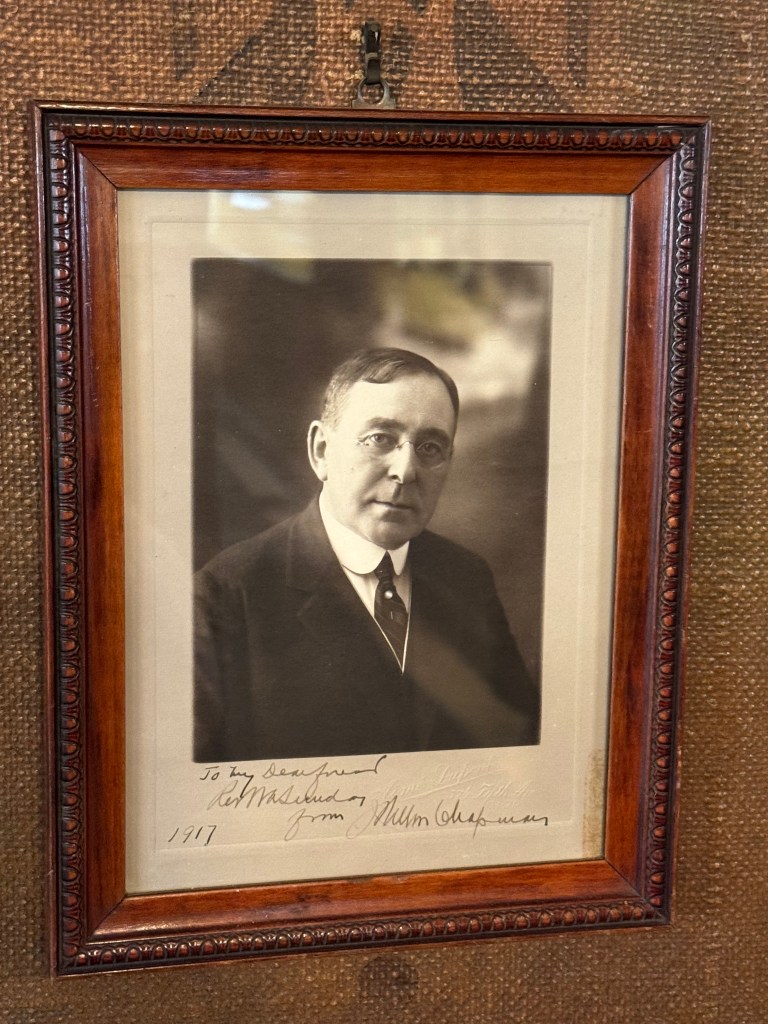
Doctor Chapman’s approach to the masses may be likened to the sun eating its way through a snowdrift. Here is a quiet, modest, devout man who takes a passage of scripture and illuminates it with his interpretations. His sermons search and reach as the leaven works its way through a meal. Doctor Chapman is not the sort of man who creates a big furore, though his campaign in Australia and Great Britain made a profound impression. He is unostentatious, with a charming modesty, intense in his mission, with deep convictions, while a man of sweetness and light, is on occasion a real son of thunder.
The popular response to evangelists is a matter which compels a study of the human mind and of the organized preparation of every great evangelistic effort. The multitudes do not fill large tabernacles to hear a man talk, but to hear him talk about religion. The sea of public feeling is tossed while wave crests and eddies by emotional religion. It is a question whether these men could gather such crowds to listen to a lecture on Browning or Shakespeare. I believe that if the press and literary men should back the movement Rudyard Kipling or Bernard Shaw or Theodore Roosevelt might fill for a period of time a vast audience discussing a literary or secular subject.
Doctor Wanted
It must be conceded, however, that men are interested in matters which concern their destiny. Wicked men have a strange desire to hear a good man denounce them; people—most of them—like to see the dog.
All men have spasms of goodness; aspiration loves company. A man with a rope on a stormy sea will have no trouble attracting attention. Perhaps the attitude of the public toward the evangelist is best illustrated by the scene on the Atlantic when it was sinking. Jews, Catholics, Protestants and skeptics gathered in the cabin. Moody, with one arm clasping the pillar, read the 91st Psalm. Then he went to his berth and fell asleep. Men who give help and comfort will have the multitude, for people are sheep—they follow a shepherd.
DEFIANCE
Let life its legioned army throw
Against my pennoned castle walls,
With curse and jibe and bitter groan
Its band of lowly seneschals;
But when the dust of conflict blows
And sounds the bugle o’er the lea,
They shall not find me fallen, dead;
They shall not kill the love in me!
Tho stained with blood of bleeding heart
Up in the ramparts’ evening breeze,
My banner floats the same as yore
Above the brooding cypress trees.
The sun has set; the shadows fade;
The night comes silent from the sea;
They shall not find me fallen, dead;
They shall not kill the love in me!
—Alonzo Harbaugh, in New York World
 Evangelist Billy Sunday (1862-1935)