“The Town of Beer and Pretzels Shaken Awake”: Billy Sunday’s 1906 Revival in Freeport, Illinois

By Kraig McNutt

In the spring of 1906, the city of Freeport, Illinois—nicknamed by some as the “town of beer and pretzels”—became the unlikely stage for one of the most memorable revivals in early 20th-century American evangelicalism. It was led by none other than Rev. William Ashley “Billy” Sunday, the baseball-star-turned-evangelist whose fiery sermons and athletic stage presence would eventually captivate audiences across the country. But in Freeport, his gospel campaign left an impression still remembered more than a century later.


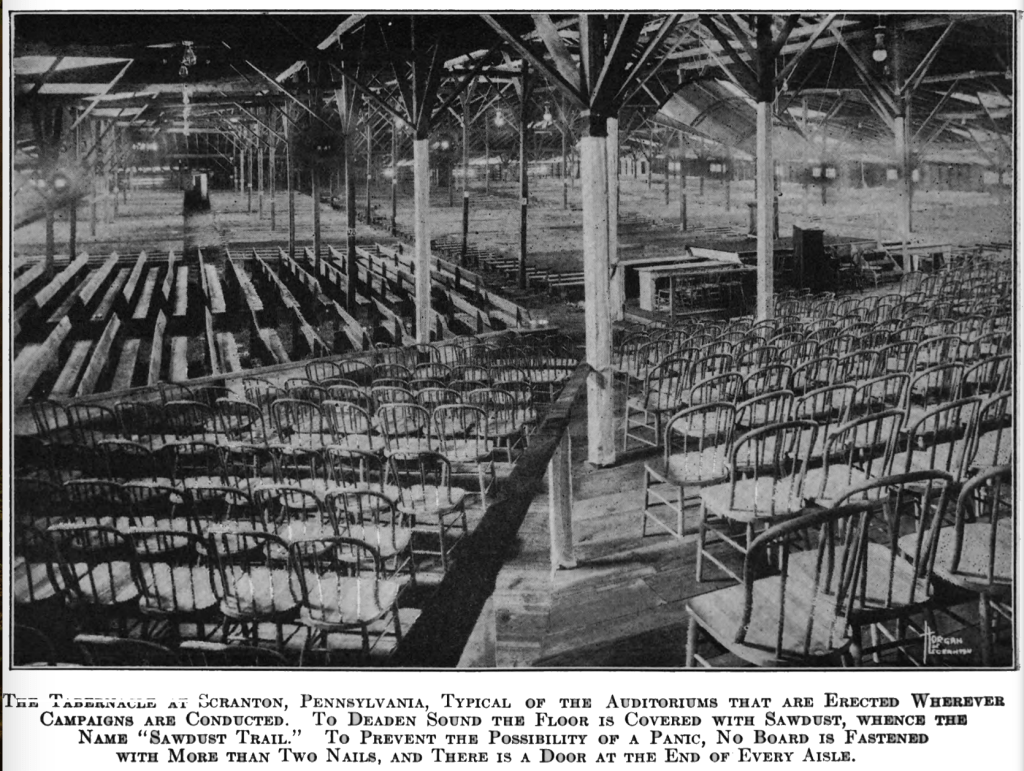
A Tabernacle Rises

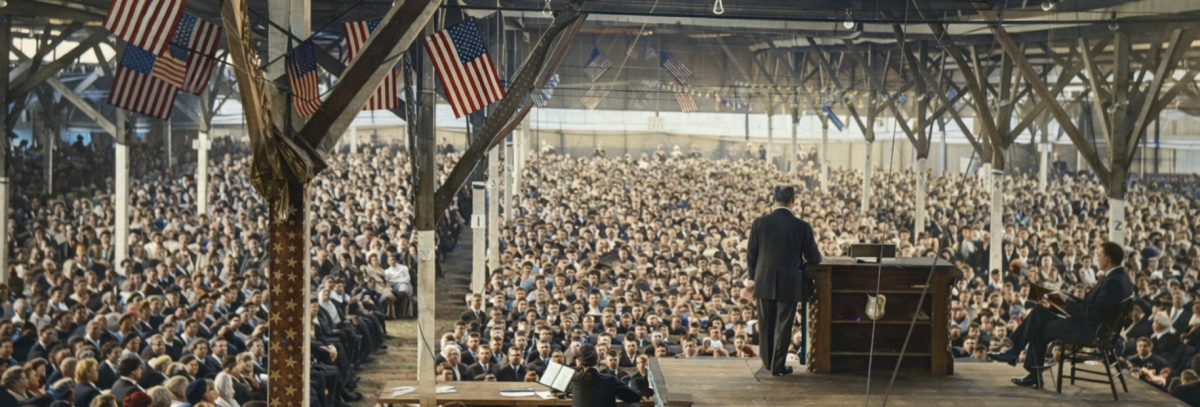
On January 25, The Freeport Journal-Standard announced plans for a wooden tabernacle to be built at the corner of Jackson and Walnut Streets—a temporary structure, 90 by 120 feet, with seating for 2,000. The project, including lumber, lighting, and labor, came with a hefty price tag of nearly $7,000, a bold investment for a campaign that hadn’t even begun.

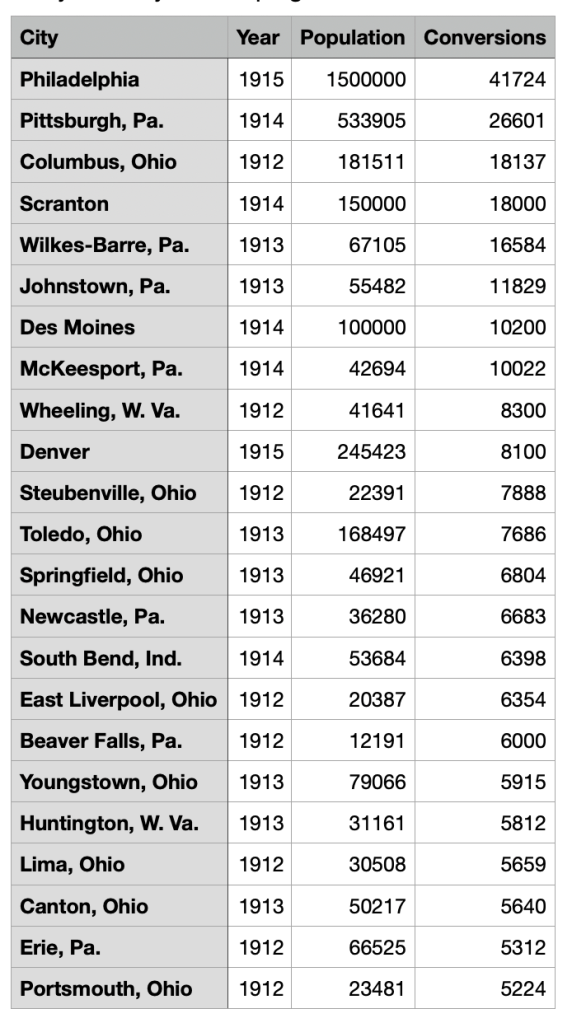
But the momentum was building. By February, reports described a “revival wave sweeping the state” (Freeport Daily Bulletin, February 17), with Sunday’s campaign seen as the crest of that spiritual tide. Sunday had just completed a campaign in Princeton, Illinois, where 1,890 people—over one-third of the town’s population—had responded to his call for conversion.

Anticipation spread quickly in Freeport. On March 26, area churches agreed not to hold their own meetings during the revival, uniting in support of the citywide effort. By April 4, the Hamlyn Brothers had completed the tabernacle—just in time.


“Hit the Trail!”: Revival Fire Ignites

The meetings began on April 28 and were originally scheduled to conclude May 11. But it didn’t take long before city leaders and church officials realized something extraordinary was happening. The campaign was extended through June 3.

Night after night, thousands packed into the tabernacle to hear Sunday thunder against sin and call the city to repentance. By May 22, just eleven days after the originally scheduled end date, 490 conversions had been recorded. Local papers declared the Freeport tabernacle the largest Sunday had ever used at that point in his ministry.

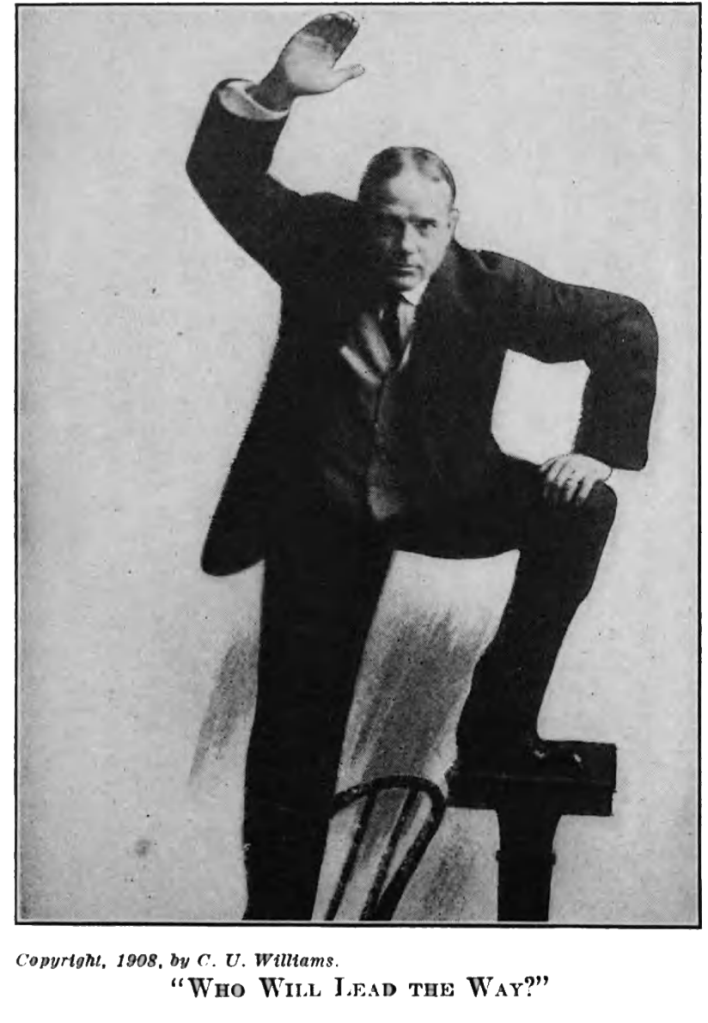
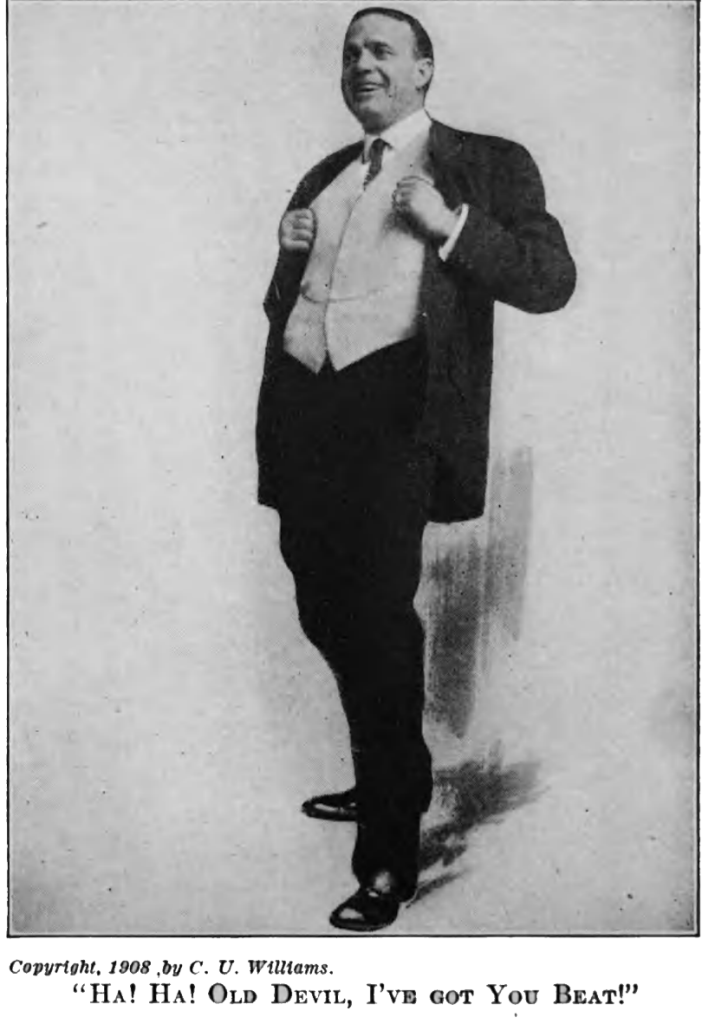
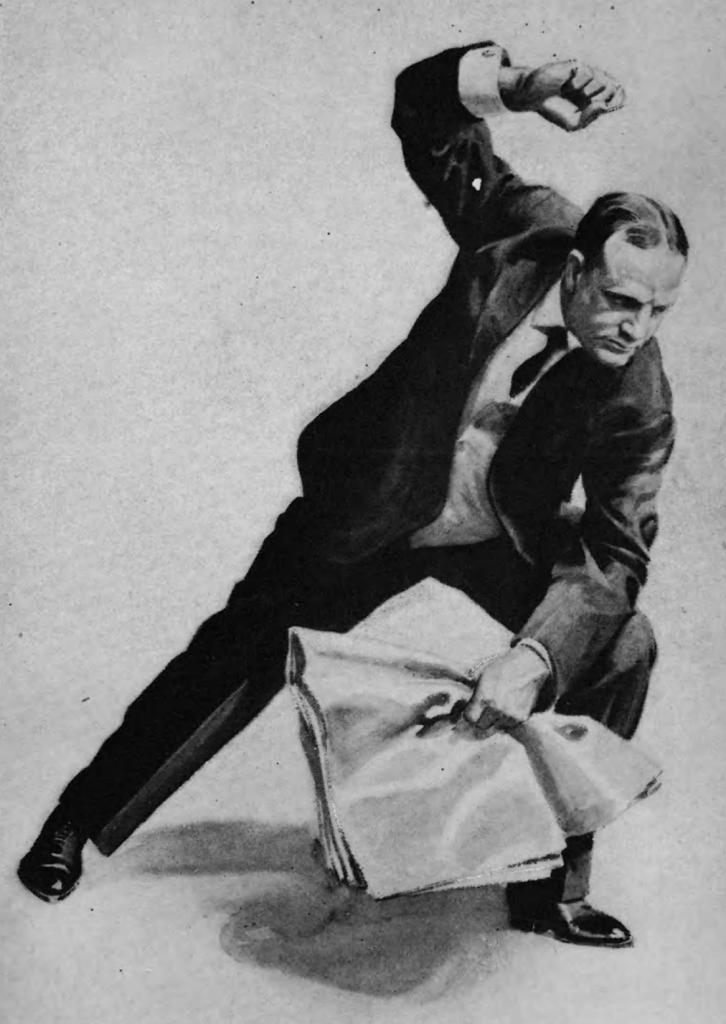
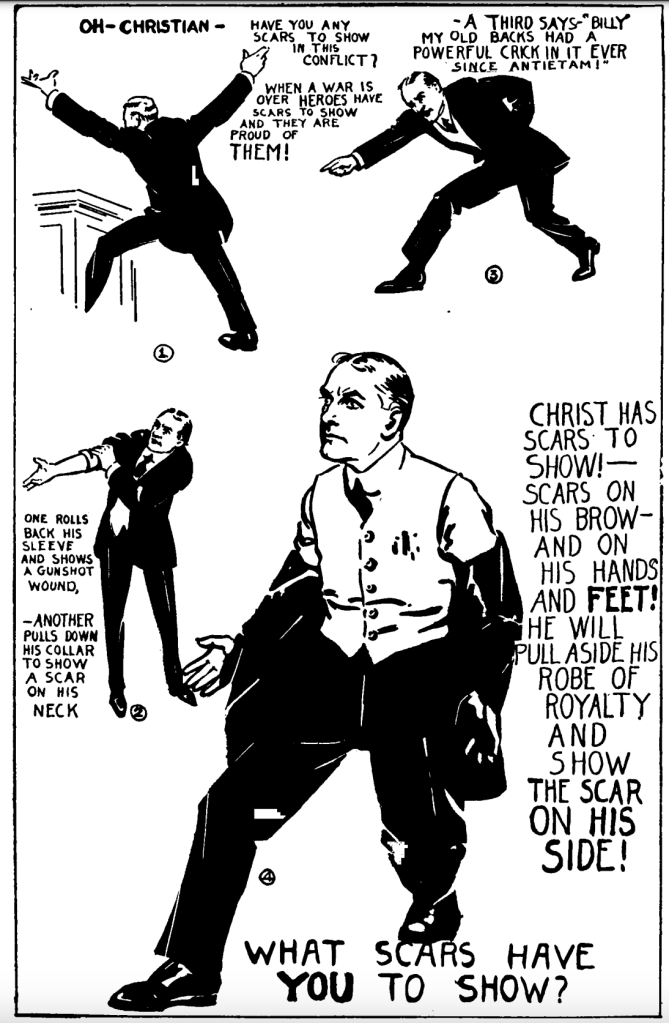
He preached with unmatched energy—sometimes leaping onto the pulpit or running across the stage—and wielded everyday language that even the most skeptical workingman could understand. Sunday brought the gospel to life with baseball metaphors, streetwise illustrations, and all the force of a man who believed eternity was at stake.


“A Lasting Benefit to the City”

The campaign officially ended on Sunday, June 3. Though complete statistics remain elusive, the revival had clearly left its mark. One local newspaper would later reflect that Sunday’s campaign had done “more good than we thought it would” and credited it with producing “better citizens, law-abiding and self-respecting men.”

The same article pointed out that even those who didn’t remain in the church long after the revival had still taken a meaningful step: they had responded, they had come forward, they had heard. “A step in the right direction,” it noted, “builds character.”

Sunday himself moved on to Prophetstown by early July (Freeport Journal-Standard, July 5), but in Freeport, something remained. The revival had galvanized the churches, stirred the consciences of many, and sparked conversations about faith, morality, and public life that would reverberate for months to come.

Beyond Freeport: Sunday’s 1906 Trail of Revival

The Freeport campaign was not the end of Billy Sunday’s evangelistic fire for the year—far from it. Fresh off the sawdust trail in northern Illinois, Sunday continued his whirlwind revival circuit, reaching small towns and stirring hearts across the Midwest and beyond.

Just a month after concluding in Freeport, Sunday preached in Prophetstown, Illinois, in July 1906, continuing to draw crowds eager for his message of repentance and salvation. By fall, he had moved westward to Salida, Colorado, where an unexpected snowstorm destroyed his revival tent. That loss became a turning point in his method: from that point forward, Sunday transitioned away from using large tents and instead began constructing permanent wooden tabernacles—just like the one used in Freeport.

But it was Kewanee, Illinois, in late October through early December of 1906, that demonstrated just how rapidly his influence was growing. Holding a five-week revival in the newly built National Guard Armory, Sunday drew crowds of 2,000 to 4,000 each night, with a staggering 200,000 total attendees reported. So many people flocked to hear him that some had to be turned away at the doors.

Each campaign added to Sunday’s legend, but in many ways, Freeport stood as the hinge moment—a city that proved how a local revival could shake not just individuals but an entire community. And as Sunday’s trail moved on from town to town, the echoes of his voice still lingered in the tabernacle on Jackson and Walnut, where for a few electric weeks in the spring of 1906, revival fire had burned hot in the town of beer and pretzels.

Legacy

Billy Sunday’s Freeport revival was, in many ways, a preview of what was to come. He would go on to preach to millions, become the most prominent evangelist of his era, and leave behind a complex legacy that combined bold preaching with theatrical flair. But in the spring of 1906, before national headlines, before the surge of prohibition politics and radio broadcasts, he stood in a sawdust-covered tabernacle in northern Illinois and offered one simple message: “Choose you this day whom ye will serve.”

Results from Freeport, ILL revival?

The Pantagraph. Sat, Jan 25, 1908 ·Page 5

[Refers to previous year’s campaign in Freeport.]

AFTERMATH OF SUNDAY’S WORK IN FREEPORT

SITUATION NINE MONTHS AFTER REVIVAL.

How Many of the Converts Have “Stuck” —General Effect on Some of the City—Bloomington Men to the Front.

(By Staff Correspondent.)

Freeport, Ill., Jan. 23.—Less than a year ago Rev. William Sunday, who is now holding forth in union revival meetings in Bloomington, waged war on sin and unrighteousness in this city, nicknamed the town of beer and pretzels. How have the converts stuck? Have they remained true to the public confession made when they stepped forward and gave Billy Sunday a shake of the hand? The answer must be yes or no. This is true of all revivals and the meetings conducted by the great evangelist named above are no exception. His converts remain steadfast or backslide just as those of other leaders, great or small, have in the many years gone by.

A Benefit Certainly.

No matter what the critics may say of Billy Sunday the man, or of his methods, the results of his protracted meetings are beneficial to a city. It has helped Freeport and it will likewise benefit the city of Bloomington. The fact that he has made some men in this city better citizens, law-abiding and self-respecting men, cannot be denied and the city is now much more the gainer by their residence here.

Are Marked Men.

Walk down Stephenson street, the principal business and residence thoroughfare, in company with a Freeporter, and mention the name of Billy Sunday and he will, in nine cases out of ten, raise his finger and point out a convert won by this evangelist. They are marked men, and one hears this remark often: “There goes one of Billy’s converts.” He won for Christ men and women in all walks of life, many of whom united with the church, all denominations adding to the membership roll. Some remained true but a short time, yet even so, the step they took was in the right direction and indicated a previous good thought and good thoughts build up and make character.

A Good Judge.

Perhaps there is no one in a city who knows the people, their history and life better than the newspaper man. A local newspaper writer said: “Billy Sunday did more good in this town than I thought he could and it seems to be a lasting benefit. While, of course, many backslide, some as soon as the evangelist departed, others have remained true to their vow and have become leaders in church work. Really more “stuck” by far than I expected.

It is said one of the leading business men of the town, who used to go on periodical sprees, after hearing Billy Sunday’s sermon on “Booze” became converted and his friends have been congratulating him on his stick-to-it-tive-ness.

About Usual Number.

Another resident said as the result of the meetings conducted here last year about the average number of converts are continuing steadfast. The pastors, following Mr. Sunday’s departure, put their shoulders to the wheel and took up the work where the evangelist left off.

They got young people into the church and put them to work, so on the whole it must be admitted that Freeport was made a better city by the religious awakening under the leadership of the man who is arousing such interest in things religious in Bloomington.

A Comparison.

This city has a population of 20,000 in round numbers and, being the center of 26,000,000 people, all within 400 miles, had a good territory from which to draw the crowds to hear Mr. Sunday, whose meetings continued from April 28 to June 4 of last year. Yet the attendance was small compared to that in Bloomington. The tabernacle was not quite so large and the crowds were not so immense. The people did not hang from rafters and almost by the eyebrows as is the case in Bloomington. In fact, the record shows an average attendance of only 2200 at a meeting, while the 5000 mark was only reached one evening, on June 3.

It took over three weeks to raise the amount needed for the expenses of running the meetings, about an equal sum as required in Bloomington. The Rev. Mr. Sunday called the people here, who are chiefly Germans, the “stingy Dutch,” but before his meetings closed the purse strings were loosened like they had not been in years past. The people of this city did well by Mr. Sunday. He on one occasion declared the curse of Freeport to be “the set of infidels who live here.”

Amount Paid Mr. Sunday.

The first converts were secured May 11, when sixteen went forward, and the largest number at any one time 184, on May 30, the total number of converts being 1365. Up to January 28 in Bloomington the total number of converts was 2,000, with a total attendance on that date of 20,000. The people of Freeport gave Billy Sunday $3064.38 for his services, extending over a period of five weeks and three days.

Helped Y.M.C.A.

Mr. Sunday remained over one day to help the Y. M. C. A., which had a debt of $11,500 hanging over it. Secretary Ralph Smedley, of the local Y. M. C. A., formerly of Bloomington, had just assumed charge at this time and had secured, with the assistance of others, some $9000 in pledges. Mr. Sunday at his farewell meeting raised $2000 and all pledges were announced at this meeting, showing a sum total of $12,000 secured by the Y. M. C. A., placing the association on a substantial footing.

Bloomington Men to the Front.

Heading two of the most important institutions which go to make any city are two Bloomington young men, Mr. Ralph Smedley, secretary of the Y. M. C. A., and Mr. Wilbur Coons, secretary of the Freeport Business Men’s Association. So successful has been Mr. Smedley in his work that the committee in search of a secretary for the Business Men’s Association made straight for Bloomington to find their man. And if the town needs others there are plenty more at home like these. No lack of material in the Evergreen City. Mr. Smedley received his training in the work while educational secretary of the Bloomington Y. M. C. A. and is making good progress. Under his leadership all departments of work have taken on new life and the membership is steadily growing. The register now shows 432 and they are passing toward the 500 mark.

Secretary Coons, who was a member of the Bloomington Bulletin editorial staff and a first-class newspaper man, has only recently taken up his new duties here. He has just issued a new circular setting forth the advantages of this city which is growing rapidly. It is largely a manufacturing town, several very large establishments being located here. Here are also the largest windmill factories in the world. The Business Men’s Association has over 150 members and owns fine factory sites. There are over thirty miles of paved streets, nine of these are of brick laid since 1902, and twenty-one of macadam.

Sermon: Literal and Eternal Hell Absolutely

The Pantagraph. Fri, Jan 17, 1908 ·Page 6

LITERAL AND ETERNAL HELL ABSOLUTELY

THAT’S WHAT SUNDAY PREACHES

Evangelist Insists He Will Resign From Ministry Before He Would Cut it Out of Sermons.

UNIQUE DISCOURSE YESTERDAY AFTERNOON.

Large Crowds Continue to Throng the Tabernacle—Roll of Converts Increased—Revival News Notes.

Sunday believes absolutely that there is a hell and says he intends to fearlessly preach it as long as he remains in the ministry. Last night at the tabernacle in one of his characteristic sermons he said before he would omit the reality of hell from his preaching that he would resign from the ministry. “It’s up to you to accept or reject the gospel; it’s God or nothing,” said Sunday.

Last night the regulation crowd of 5,000 filled the tabernacle and heard Sunday preach on “How Shall We Escape if We Neglect So Great Salvation?” It is remarkable how Sunday attracts the populace. It takes a speaker of more than ordinary ability and power to draw two or three thousand people every afternoon and again each evening five or six thousand people to hear him preach, but Mr. Sunday possesses those qualities. His magnetic personality and peculiar eccentricities as a public orator combine to make up his extraordinary drawing force. After last night’s powerful sermon forty-six persons went forward and made the profession of faith.

The Sermon.

My text tonight assumes the form of a question, and although it seems to be a paradox it is absolutely unanswerable,” said Mr. Sunday. “I could go to the leading merchant in the town and when I would ask him he could tell me the principles by which to build business to success, but if I would ask him the question of my text I would gaze into a face that would give no reply. I might go to your leading physician and he could explain to me all about materia medica, about hygiene, about medical jurisprudence and about obstetrics, but if I would ask him this question I would gaze into a face of blank despair. I might go to the office of your most brilliant lawyer, a man that can interpret the law before the supreme court, a man with brains enough to codify the state laws and that knows all about organic and constitutional law, yet if I would ask him my question-text I would go down the stairs without a reply. If I could go to the lost world and the souls there could cease their shrieks long enough for me to ask this question, I would come back without an answer. If an angel of God would come to the tabernacle and I would ask it the question it would fly back and fold its wings like a tired dove in the presence of God without speaking a word.

“How Shall We Escape?”

“The text is found in the second chapter of Hebrews and the third verse—’How shall we escape if we neglect so great salvation?’ There is absolutely no escape; there is absolutely no answer to the question.

“Our first thought about salvation is saving from punishment. True, but you are not beginning to live unless you are a Christian. You have been merely existing. The one who lives in sin is driving the dagger into his own heart, for all that is polluting and corrupting and debasing comes through sin, yet men follow it. All that is noble and uplifting comes through Jesus Christ, yet men spurn Him.

God’s Plan.

“God has given us so many things. He knew we needed air—He gave it to us. He knew we needed water—He gave it to us. He knew that we needed eyes and ears and lungs and hands and feet, and He gave them to us. And He has salvation ready if we want it. And I have no patience with any who puts his asinine judgment up against God’s and says that he knows best. Of course there is a hell, the plan of salvation contains it. There would be no good in leaving hell out. I am not the author of the plan of salvation, but I am here to preach it as it is, whether it is pleasant to you or not. Because you do not believe in hell, that doesn’t make any difference. That don’t make you immune. A fact is a fact, whether you believe it or not. Because you don’t believe in God and heaven and hell and the divinity of Christ, don’t change the facts or scheme of salvation because you didn’t have sense and decency enough to believe. You can’t fix God’s word to suit yourself. You can’t blue-pencil His plan of salvation. You have to take it as it is or leave it. I have no doctrine. I preach God’s word. I have no use for a man who has a doctrine. Let him preach God’s.

The Truth of Hell.

“I don’t say that I’ve seen hell and I don’t intend to try and see it just to convince you. I don’t want to find out whether the fire in hell is like that in your stove or whether the word fire is an emblem chosen to represent conditions as bad. I am faithful and true to God’s trust and I never expect to know whether or not hellfire burns.

It is to the class who expect some time to be Christians that I am especially preaching tonight. This is the man who acknowledges that God has a claim on him and who sometimes expects to change and be a Christian. But that man who may be too late and who may find death before him before he has time to change. The church can only answer the question of hell in one way. He that believeth in Christ is saved, and he that believeth not is damned. If there is no hell, preachers are taking money under false pretenses.

“Is There a Hell?”

“In preaching hell and making reference to it I encounter a difficulty. Men and women don’t like to accept it. They think they cannot be happy with a hell, therefore they say there is no hell and think that settles it. Some people think they could be happy if hell was fixed like a big club with an ice chest full of Anheuser-Busch, Schlitz, and Pabst, with a button handy so they could call a servant if they wanted anything, and then could sit down, sip lemonade and puff a twenty-five-cent straight.

“Suppose I met three men walking on a road toward a precipice. To the first I say, ‘This is a dangerous road, and if you go on you will plunge over the precipice to death,’ but he doesn’t thank me.

He just sneers and walks on. The second asks, ‘Have you ever been to the end?’ and when I admit I have not, he says I don’t know what I am talking about, then. The third says that he knows it, but that he intends to turn off just this side of the precipice.

‘I meet three journeying from the cradle to the grave. The first curses and damns me when I speak to him of Christ and tries to show that he knows more than God. He ends in hell. A fellow told me to go there the other day and I told him if he wanted to go he could just pack up, but I wasn’t going. Whatever hell is, I don’t want to test its reality. It must be an awful place or God wouldn’t open a plan of salvation in order to keep us out. The second man asks me if I’ve ever been there to find out, and the third tells me that he believes he is a sinner, believes the bible is the word of God, believes in hell, but that he will repent before he dies.

‘Why put it off? Nearly everybody expects to become a Christian before he dies. Almost nobody wants to spend eternity in hell. I only met two men who believed in a literal hell who said they expected to spend eternity, and they were both converted.

‘How God will damn I do not know. But I do not want to go to hell. How shall we escape if we neglect so great salvation? You can depend on it, there is no escape.

‘What is the use of churches and religion and temples and tabernacles, if there is no hell? Why open up a plan to save you if there is no hell? But, my friends, if heaven is eternal, hell is eternal. Don’t make God out a liar. Just take His word. You can’t find the truth from ethical and philosophical lines. You can’t settle a spiritual truth by scientific revelations. God has set before you an open door. You can accept or reject. God will never have another plan for you. It is accept Jesus Christ or nothing. Don’t shut your eyes to God’s danger signals.

Don’t rush like stampeded cattle to destruction. Don’t try to test the reality of hell.

The Plan of Salvation.

Wonder of wonders is the plan of salvation. So simple it is that a child can grasp it and so complex that scientists are puzzled. You can better afford to neglect anything else than your salvation. Neglect your health, your business, your education, rather than your salvation.

There are multitudes in hell who did not expect to go there, but who waited too long. I have seen men and women in Bloomington grasp the backs of the seats to steady themselves. I have seen them turn pale as I have hurled the truth at them. I have done my part. If you won’t take advantage of a thing when you may, don’t complain when it gets beyond you. A man can’t afford to trifle with God. The greatest calamities of the world have come from neglect—Johnstown, Ashtabula, Martinique—multitudes have had no more intention of spending eternity in hell than you have, yet they waited too long, and they are there. It is not that you have failed to hear, but that you have failed to heed. It is the only salvation; Mother Eddy or any of the rest of the bunch have nothing like it. The scheme of it shows God’s love. If you are damned, you have only yourself to blame. God has provided. You won’t go to hell because you are a sinner, but because you have failed to repent that sin. The bitterest dregs of hell that you will taste will be the thought that you have no one to blame but yourself.

eformation Not Salvation.

Oh, said a wrinkled browed, stoop shouldered, gray bearded old gambler to me. I’ll tell you what I’ll do, Bill. I’ll quit gambling.

Good I said. And I booze fight a little, not very much for no gambler can and keep ahead of the game but I booze fight a little, and I’ll cut that out.

Good. And I’ll stop my impure living.

Good. And I’ll quit my cussing.

I said. And what else? Well, I guess that’s about all, isn’t it? he asked.

Won’t you accept Jesus Christ? I said.

Why, I won’t have to, will I, if I live straight? he asked.

Say, and Sunday seized his bible to illustrate his point. Suppose you reach the age of accountability at this point, and he indicated a spot, and you are here when you reform and will be over here when you die. Your reformation counts all right from this point where you reformed to where you die, but what about the sins you committed from the time you reached the age of accountability? Your reformation doesn’t wipe them away and the only way they can be wiped away is through Jesus.

Just Faith.

No matter who you are—no matter how smart you are, you are damned and I tell you in your teeth you are damned. You can talk about salvation by refinement and culture. You can go to hell with all your culture. It is not worth a snap of your finger. By repentance and faith is the only way. If God could do no more than simply pardon a man, it would not be so much. But God pardons and justifies—makes you as if you had not sinned.

Don’t forget the story of the rich man and Lazarus. The rich man was a good fellow. He was not a bad man. He was just too busy to pay attention to God. He was like a lot of business men I met at the banquet at the Illinois the other night—cracking good fellows but too busy for God—and the rich man went to hell and cried aloud there for help. In hell you will carry with you the fact that you had the chance and failed to take it. You will remember in hell—God pity you. You are hurtling back every tender thought—every offer—God pity you.

In the name of my God and my Christ, I hurl to you a life line tonight.

A Sunday Prayer.

The sermon was closed with the following prayer: “Jesus, it seems too good to be true that you would provide salvation for us. But God to see men and women pass it up. That is staggering to me. I could understand why you would not love us; why you would not provide salvation for us, but Lord: to step in and provide salvation, to send prophets and priests, and to send Christian mothers to weep and beg and importune us to receive it and to see men pass it by and shake their heads. Jesus, I do not know what to do; I do not know what to say. Lord, I pray men and women may yield and say ‘I give up; I have neglected it long enough; there is too much at stake. My heart may stop tonight; my lungs may congest; there might be a blood clot on my brain. Lord, I will do it now.’ The trumpet may sound for me tonight and might shake a shroud round me tonight. What will it profit a man to gain the whole world and lose his soul? Give me the answer. Give me the answer. Give me the answer. What will it profit you if you gained McLean county and lose your soul?”

SUNDAYISMS ON BOOZE

[Appeared in a 1908 newspaper.]

—The curse of God is already on the saloon, sir.

—This nation can’t long exist half drunk and half sober.

—Every anarchistic plot is hatched out in a grog shop.

—To license such a dirty incarnation is the meanest thing on earth.

—If I were a devil, I would rather dwell in a good decent body than in some men I know.

—I don’t rate the saloon as a legitimate business; I don’t care a rap if the law does.

—Of the 106 counties in prohibition Kansas, only twenty-five of them have an inmate in their jails.

—If all the whiskey-orphaned children stood hand in hand, they would belt the old globe five times around.

—A banker in Kansas City, Kans., said that after one year of prohibition his bank had over a million of new deposits.

—The food to feed your family well is in the grocery stores, but you spend your money over the bar and your family goes hungry.

—Let the farmers of the United States get a whack at the saloons, and they will send it to hell at the first smack out of the box.

—The saloon is a sneaking coward; it stabs in the back; it works in the dark; it beats out right against every man that it cannot debauch.

—The beef steak your wife and children ought to have are in the butcher shop, but you carry home a load of booze instead of the meat.

—I defy the whole damnable gang (of saloon people) to come up and show anything in my life that is not in accordance with that old book.

—There are three towns in Kansas which openly defy prohibition laws, and the population of those towns is constantly on the decrease.

—It is up to you, men of Bloomington, you men of Normal, men of Illinois, to say that your damnable period of perdition and corruption shall end.

—I have as much respect for the saloon keeper as I have for the man who votes for the business, or the man who rents his buildings for the business.

—The farmers are not such a disgraceful gang that they won’t go to a town to trade unless they can fill their hides with booze like a Comanche Indian.

—To license a business that will take bright American boys and manufacture them into sots, insane patients and criminals is the dirtiest business on earth.

—The saloon could not exist if it wasn’t for the church. When the members of all the churches get ready to act together against them they send it to hell in twenty-four hours.

—It (the liquor traffic) is a thief; it steals the coffin from the dead; it steals the milk from the breast of the nursing mother; it steals the last nickel from the starving child. It’s a dirty thing robbing our land and our homes.

—It (the liquor traffic) has no faith in God; it would close every church; it would hang its sign in every choir loft and from every pulpit. It would wrap the mantle of crepe about our manhood and the virtue of womanhood. Its conversation is polluted with obscenity and corruption.

Revival campaigns Billy Sunday hosted in 1908?

In 1908, Billy Sunday significantly expanded his evangelistic reach, conducting several impactful revival campaigns that elevated his national prominence. Notable revivals that year included:​

  • Bloomington, Illinois: This campaign marked Sunday’s first major urban revival, setting the stage for subsequent large-scale efforts. ​​The dates of the Bloomington meetings were December 27, 1907-February 3, 1908.
  • Spokane, Washington: Invited by Prohibition advocates, Sunday held a significant revival here, reinforcing his influence in the temperance movement. ​Society for American Baseball Research
  • Jacksonville, Illinois: Photographs from 1908 depict Sunday preaching against “booze” in a tabernacle on South Main Street, highlighting his commitment to the temperance cause. ​
  • Charleston, Illinois: In April 1908, Sunday led a revival that influenced the local baseball team to adopt the moniker “Charleston Evangelists,” reflecting the impact of his campaign on the community. ​Wikipedia
  • Springfield, Illinois: Sunday’s initial efforts in 1908 laid the groundwork for a comprehensive six-week revival in 1909, which resulted in over 4,000 conversions and the establishment of enduring community institutions like the Washington Street Mission. ​Illinois Times

These 1908 campaigns were pivotal in transitioning Billy Sunday from regional evangelist to a national figure, capable of organizing large-scale revivals and mobilizing extensive volunteer networks.

The Living Sacrifice

“Brethren”—that’s what God calls his true followers. No speaking from the loft. If there’s any lesson we need to learn it is that of being “brethren.”

Sinners are not called “brethren” in the Bible. God commands sinners. They are in rebellion. He entreats Christians. When Lincoln called for volunteers he addressed men as “citizens of the United States,” not as foreigners.

The man who is appreciative of God’s mercies will not have much mercy on himself. Don’t stand up and say: “I’ll do what Jesus bids me to do, and go where he bids me to go,” then go to bed. Present your bodies—not mine—not those of your wives; you must present your own. Present your bodies; not your neighbor’s; not your children’s; it is their duty to do that. Do you trust God enough to let him do what he wants to do?

Henry Varley said to Moody, when that great American was in England, that God is waiting to show this world what one man could do for him. Moody said: “Varley, by the grace of God I’ll be that man”; and God took hold of Moody and shook the world with him. God would shake the world with us today if only we would present our bodies as a living sacrifice to him, as Moody did. Are you willing to present yourself? I am tired of a church of five hundred or seven hundred members without power enough to bring one soul to Christ.

At the opening of the Civil War many a man was willing that the country should be saved by able-bodied male relatives of his wife, who made themselves bullet-men, but he didn’t go himself. God isn’t asking for other men’s bodies. He’s asking for yours. If you would all give to God what rightfully belongs to him, I tell you he would create a commotion on earth and in hell. If God had the feet of some of you he would point your toes in different ways from those you have been going for many years. If he had your feet he would never head you into a booze joint. If he had your feet he would never send you into a ball-room. If he had the feet of some of you he would make you wear out shoe leather lugging back what you’ve taken that doesn’t belong to you. If God had your feet he would take you to prayer-meeting. I’m afraid the preacher would have nervous prostration, for he hasn’t seen some of you there in years. If God had your feet you’d find it harder to follow the devil. Some of you preachers have your children going to dancing school and I hear some of you go to dances. He would make your daily walk conform to the Golden Rule and the Sermon on the Mount.

Some people work only with their mouths. God wants that part that’s on the ground. Some soldiers sit around and smell the coffee and watch the bacon frying.

If God had your hands he would make you let go a lot of things you hold on to with a death-like grip. If you don’t let go of some of the things you hold so tightly they will drag you down to hell. He would have you let go some of the things you pay taxes on, but don’t own, and he would make you let go of money to pay taxes on some that you do own. Some people are so busy muck-raking that they will lose a crown of glory hereafter. If God had your hands, how many countless tears you would wash away. A friend of mine bought a typewriter, and when he tried to use it his fingers seemed to be all sticks, but now he can write forty-five words a minute. Let God have your hands and he will make them do things that would make the angels wonder and applaud.

“BILLY” SUNDAY: THE MAN AND HIS MESSAGE. Ellis: 1914.

Billy used his platform as a former professional baseball player to share the gospel

The Pantagraph. Thu, Jan 02, 1908 ·Page 10

“BILLY” SUNDAY AS UMPIRE

PRESIDED AT INDOOR BASE BALL GAMES.

Large Crowd Witnessed the Ex-Base Ball Evangelist Handle the Indicator—Cheered in Decisions.

Sunday’s New Year.

11:30—Addresses children.

2:30—Preaches at tabernacle.

4:30—Umpire ball games.

7:30—Preaches again.

Several hundred people witnessed an unusual sight at the South Center street armory on the afternoon of New Year’s day. It was the playing of indoor base ball under the guidance of a man of national reputation in the diamond, but now turned preacher and evangelist. Unusual was the scene, in the first place, because indoor base ball itself is something of a novelty in this city. In years gone, there have been occasional games played, but never before was there a regularly organized league with a fixed schedule, and when there were games in the past, they were witnessed mainly by a few score of the enthusiastic fans. It is said that yesterday’s game was seen by hundreds who had never before witnessed such a contest.

And in the second place, it was unusual and unique to have a game of indoor base ball umpired by Rev. “Billy” Sunday, theevangelist who was himself once a star player on the outdoor diamond. His presence in the city to conduct a revival was taken as an opportunity for the managers of the league to secure his services to umpire this game. And the announcement of this fact drew a crowd of people who would otherwise have been probably entirely ignorant of the existence of the game or perhaps of the existence of such a sport.

Arrives From Meeting.

Rev. Mr. Sunday had been preaching over at the tabernacle, which is only a block away from the armory. The religious meeting there overlapped for some twenty minutes the time scheduled for the ball game in the armory, hence the first of the games had proceeded about half way through before the famous umpire arrived on the scene. The first part of the initial game was umpired by Frank Will, the regular league umpire.

While the enthusiasm of the spectators was running at a high K. C. T. game, a new horde of people, many of them women, at the door, caught of the announcement that the religious meeting was over and that Sunday was coming. The crowd had been standing about before him, but with the additional contingent added, all the available room for spectators was crowded.

Mr. Sunday entered the hall in company with a number of local preachers, and this was probably the first time an indoor ball game had been honored by so great a company of spectators. Mr. Sunday lost no time after entering the room in getting to his position behind the bat.

Umpire Will giving way gracefully. Presides in Two Games. A cheer arose from the crowd, and the magnificence lifted their din as the people recognized the preacher-umpire on the home plate. Mr. Sunday doffed his overcoat and was found clad in a business suit of light gray. He had been heated up pretty well in speaking at the revival, and the air of the armory seemed cool to him. He at once turned up his coat collar to protect his throat.

After a few minutes, some one handed the new umpire a base ball hat, and he donned this, wearing it throughout the rest of the game.

With the indicator in his hand, Umpire Sunday shouted out at regular intervals the familiar words often heard on the diamond in announcing strikes and, two balls, one ball, foul strike, or batter out.

Nearly every time the umpire would announce a decision, the crowd would cheer at the beginning of his work, but after so much attention was paid to him, and interest returned to the game when Mr. Sunday was not engaged.

His mannerisms, his shoulder or head motion before the ball was delivered by the pitcher, and the way he himself threw the ball back to the pitcher, at Story of the Games.

The first game was won by the Turners, who defeated the Knights of Columbus by a score of 1 to 0 in an exciting and clean contest. Miller won the game for the Teutons with a two bag hit in the fifth. The Turners played a scoreless game and the K. C.’s had but two misplays charged against them. The games went five innings by agreement, as did the second game. The score by innings:

R. H. E.

Turners 0 1 0 0 0 – 1 2 0

K. C.’s 0 0 0 0 0 – 0 1 2

Batteries: Turners, Richanne and Miller; K. C.’s, Reardon and Day. Umpires, Wise, Sunday and Zier.

Olympics Win Second Game.

A batting rally in the final inning won the second game for the team representing the Olympic Athletic Club. The Olympics were shut out until the fifth, when the opposing team, that from Company D, had scored three runs. Then the Olympics came up to the Adams slants and the game was finally entered as a victory. The score by innings:

R. H. E.

Olympics 0 0 0 0 4 – 4 5 2

Company D 0 0 0 3 0 – 3 4 2

Batteries: Olympics, Muhl and Noonan; Company D, Adams and Keenan. Umpires, Wise, Sunday and Zier.

A few less than five hundred—486 to be exact—saw yesterday afternoon’s games. In both cases the spectators saw pretty battles.

Billy Sunday

Springfield, Illinois (early 1909)

Billy Sunday held his revival campaign in Springfield, Illinois, from Feb 26 – Apr 11, 1909. This campaign followed his successful 1908 revivals—including the one in Bloomington—and was a major early-city campaign that further cemented his national reputation.

Key details of the Springfield 1909 revival:

  • Duration: 6 weeks
  • Location: A large wooden tabernacle was specially built on 2nd Street between Monroe and Capitol for the meetings.
  • Estimated Attendance: Tens of thousands attended over the course of the campaign.
  • Conversions: 4,729 people were said to have made commitments to Christ during the meetings.
  • Social Impact: His preaching led to the founding of Washington Street Mission, which continues to serve the community today.
  • Historical Context: Sunday’s campaign came just a few months after the 1908 Springfield Race Riot, making his calls for moral reform and community healing especially resonant.

This Springfield campaign was a milestone in Sunday’s ministry, helping launch a decade of high-profile urban revivals across the United States.