A contemporary account of Billy Sunday (c 1921)?

The following account (excerpted) is in the Morgan Library Billy Sunday Archives.

“Life and Labors of William A. Sunday”

[Billy’s own view of his first sermon.]

“I diagnosed the sins and difficulties of people as existing in the gray matter. I figured I had to show people. You ought to have heard my [first] sermon. It was a hummer. I had stacks of books all around me. There were words that would make the jaws of a Greek professor squeak for a week. When I sprung it, it went off like a firecracker and busted in the middle. I figured that I was going to the old sinful world to its knees and yet nothing happened. Then I loaded my old muzzle loading gun with ipecac , buttermilk, rough on rats, rock salt and whatever else came handy and the gang has been ducking and the feathers flying ever since. I was wrong. It was the heart and not the gray matter that was wrong.

“In 1891 Sunday left baseball to become secretary of religious work at the Chicago Y.M.C.A. After three years he became advance man for J.Wilbur Chapman, also holding meetings in connection with the campaigns. About Jan.1,1896 Chapman returned to the pastorate and simultaneously Sunday received his first call [editor: this is not correct] as an evangelist. This meeting was held at Garner, Iowa and dates the beginning of this mans remarkable career.”

[Billy as a man of prayer.]

In regard to the personality of the man I would say first that he is fundamentally a man of prayer. Let the mistaken critic of Sunday rid himself at once of the notion that his meetings are merely big displays of the powers of advertising and organized enthusiasm and the product of a man who is called “a great salesman”. The life of the man and the activities of a campaign are shot through and through with prayer. In every place where he holds a meeting he chooses a secluded spot from whence he storms heaven. This place becomes a Bethel to him. In prayer he is natural. His prayers are not long but to the point and usually open with “and now Jesus” from whence he proceeds in his peculiar manner to pray for all the matters pertaining to the success of the meetings. Without prayer he believes he would be as Samson shorn of his strength. He makes no decision or takes no step without first taking the matter to the Lord.

[Billy’s passion for souls?”

He has an intense passion for souls. Here is a man who carries the people of a community upon his heart and is ready to give his very life and strength and energy in order to see them saved. He will continue day after day, preaching twice and three times only to see men turn to God.

[Billy’s power of perception?]

Mr. Sunday is endowed with a remarkable power of perception. Passing through a building he sees things that readily lend themselves for sermon stuff. His remarkable memory is brought into evidence in his sermons as he pours forth anecdote, history, statistics and quotations from literature with remarkable rapidity. He is equipped with a clear eye that takes in the entire tabernacle into its scope and gives him a remarkable advantage over his audience.

[Billy’s executive ability?]

We must here mention the executive ability of the man. He has the happy faculty of surrounding himself with co-workers who are very efficient and it is to the credit of Mr. Sunday that the personnel of his staff is the same today that it was in 1916 with the possible exception of the tabernacle building as my memory fails me on this point. Space will not permit us to discuss the form of organization in a campaign except the fact that towns from 5 to 20 miles from the seat of activity are touched through the organized spirit of prayer that emanates from the campaign.

[Billy’s imagination?]

His imagination enables him to make the commonplace radiant with beauty. He uses no Greek or Latin but the plainest and most expressive language. He calls things by their right name and often his words burn and blister. It is doubtful if there is any living preacher who can pour out such a stream of red-hot and sizzling adjectives to show his scorn and contempt for sin. There are moments when he makes you think of the way Jesus denounced the scribes and Pharisees.

[Billy’s use of slang?]

We must give a little space to the matter of slang. It is futile to attempt to apologize in behalf of Mr. Sunday as he would not welcome such an apology. It is his point of contact. He calls it, “corn bread and potatoes”. Asked to tone down his preaching in this regard he replied to a committee of ministers that, “If I preached like you do I would have about as many people to preach to as you do.” Slang is defined as language in the making and unconventional speech. Study carefully the Bible characters whom God has used. How many are there of the stereotyped kind? It was the rams horn rather than the silver trumpet that led Joshua’s army to victory. Samson thinned the army of the alien with the jaw-bone of an ass. David used a sling and Shamgar an ox goad and we are also reminded that the Master himself “taught not as the scribes”.

[Billy’s use of illustrations?]

. . . his style is direct and expressive. His sermons teem with illustrations that illustrate. He combs the ends of the earth for material for his sermons and his ready references to science, history, literature and other branches both delight and stagger the hearer. Sentiment, pathos, logic, word pictures, impersonation etc are all used to drive home truth.

Evangelist Billy Sunday compared to others in the itinerant class

The following information* was addressed to the Wilkes-Barre Editor in 1913, probably just before the February revival. It was likely drafted by Billy himself or someone else close to him from his campaign team. The revival at Wilkes-Barre took place February 22 (23), thru April 13th, 1913.

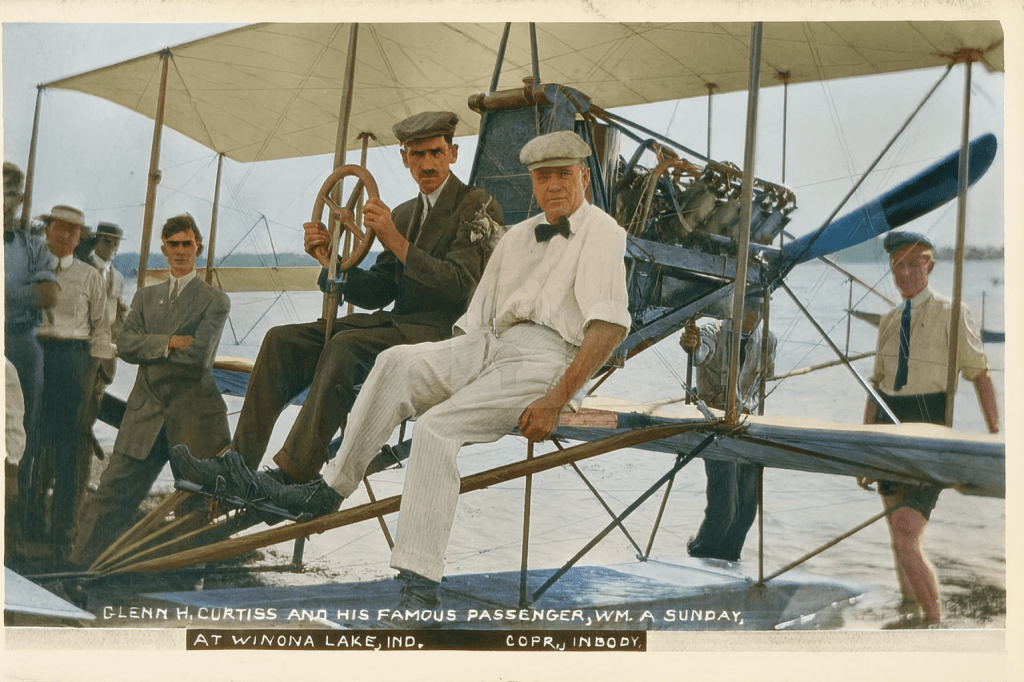
Image made by J. Inbody, Elkhart, Indiana. Author’s collection. From a 1915 postmarked postcard.

“He [Billy] has skimmed the literature of the English race for information and illustrations, and has a slang vocabulary that is simply astounding. He uses his knowledge with such telling effect that those who come to scoff remain to pray. His earnestness, his transparent honesty, carries his hearers with him, and his slang is all forgotten in his clarion call for repentance; his denunciation of all that is bad, vile and wicked, and in his praise of God, home and country.

“The old school of evangelists were of the itinerant class, moving rapidly through the country, their evangelism seemed sudden in its effects, and I am afraid somewhat evanescent in its results. It is just here that Sunday’s campaign gives promise of more lasting good. His coming has been carefully prepared for, and his meeting place is undenominational and unconventional in character. His is a movement conducted with great business acumen and sound common sense. He trains the ministers and church workers in such a way as to make them capable of caring for the harvest when it comes. Like a good farmer, he prunes the fruit trees with vigor, cuts out all the dead wood and sprays well to get rid of moths, beetles, and such like, so that when the new fruit shall ripen it will be sound and good. Mr. Sunday is a man with a great faith. He prays for the blessing, he prepares for the blessing, and he is sure of getting it. It is therefore no surprise to him when it comes.”

*Original artifact is in the Billy Sunday Archives at the Morgan Library, Grace College.

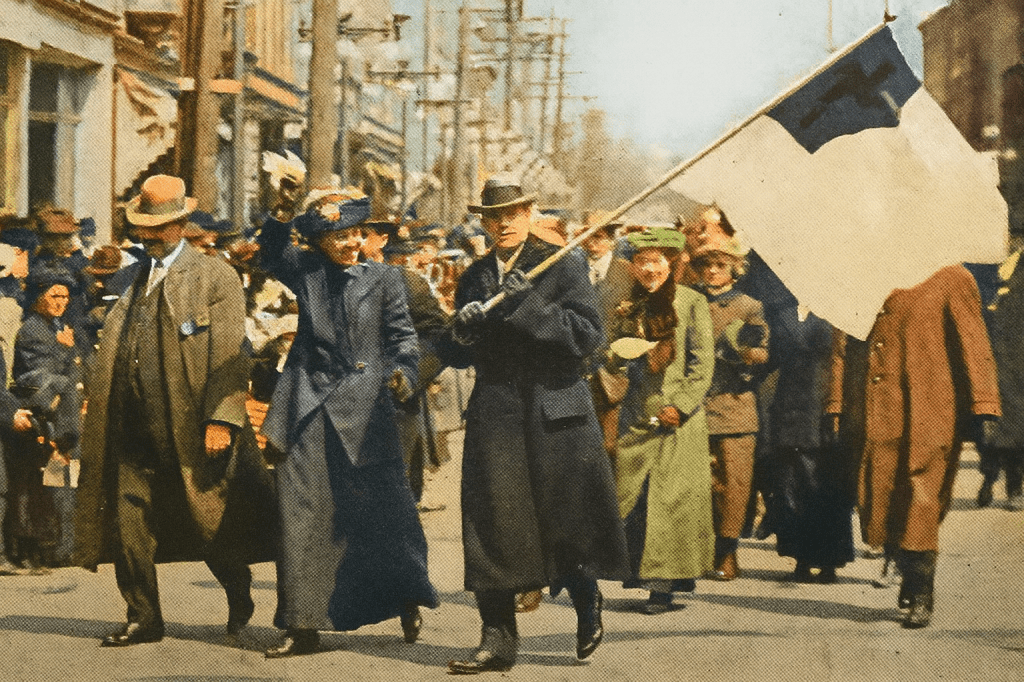
Billy Sunday, and wife Helen, lead a procession of around 20,000 people in a
Sunday School parade at Wilkes-Barre. Colorized by the author.

Who came to dinner at the home of Billy Sunday in Winona Lake?

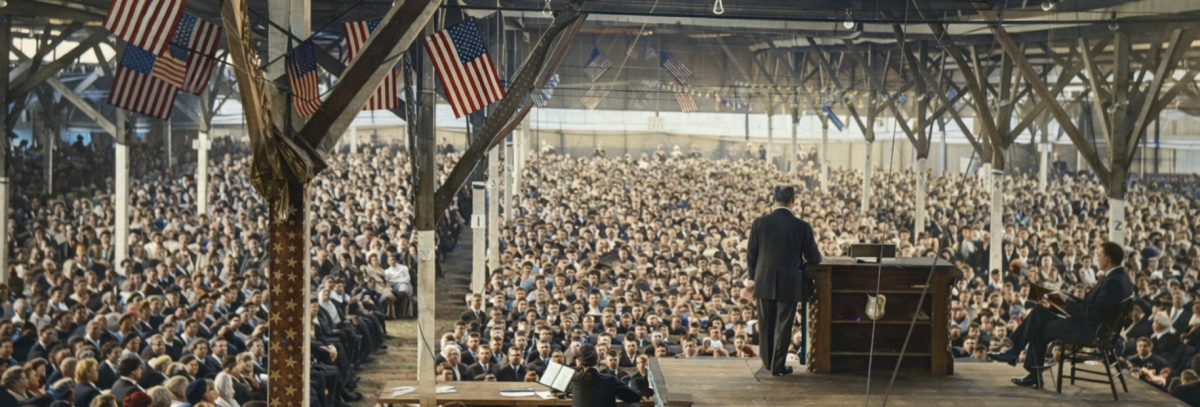
During the height of his ministry-career (1905-1920) Billy Sunday was more popular than Mark Twain or William Jennings Bryan. He even turned down an offer for $1,000,000 for a contract with “moving pictures.” He was a friend to multiple U.S. Presidents and dignitaries. One can only imagine whom he and Helen entertained in their living room below.

The Bill Sunday Home, Winona Lake.

Billy knows his Bible – says a fellow minister, c. 1913

“Dr. Sunday (Westminster College had just conferred an honorary doctorate upon Sunday) knows his Bible which is the true body of divinity in theological lore. Mr. Sunday has devoted his life to the supreme task of world evangelization for which the Bible is the great charter.

He is, therefore, both in scholarship and practical effort entitled to the degree. Just as a Doctor of Medicine is supposed to know the Science of Medicine and practice the art of healing, so a Doctor of Divinity who know the truth about God and practices the art of saving 1s entitled to the degree. In many institutions it is customary to bestow the honorary degree of Doctor of Divinity upon those who are men noted for their knowledge of “the traditions of the scribes and pharisees” than for knowledge and practical use of the Bible itself.”

Sincerely yours,

R.M. Russell to T.T. Frankenberg (Columbus, Ohio)
August 30, 1913

Artifact credit: Morgan Library, Grace College

The recipient of this letter, Theodore Thomas Frankenberg, was no casual correspondent. A Columbus-based journalist and author, Frankenberg was in the midst of gathering materials for what would become the first popular biography of the evangelist, Billy Sunday: The Man and His Message (published in 1914). Letters like Russell’s provided him with both anecdotal color and institutional validation—evidence that Sunday was not just a charismatic revivalist but a figure respected by the academic establishment.

This exchange captures an important cultural moment. Westminster’s degree signaled a rare bridging of worlds: a Presbyterian college recognizing a frontier-style evangelist whose power lay not in polished scholarship but in the raw urgency of his preaching. To Sunday’s critics, the degree may have looked like a concession to populism. To his supporters, it was overdue acknowledgment that the man who knew his Bible best and preached it most widely deserved the honor more than those “scribes and Pharisees” who merely debated it in lecture halls.

In the end, Frankenberg’s biography helped cement Sunday’s reputation, weaving together stories, letters, and testimonies like this one. And tucked inside that narrative is the 1913 moment when Westminster College draped Billy Sunday in academic robes, placing him—at least symbolically—among the doctors of divinity.

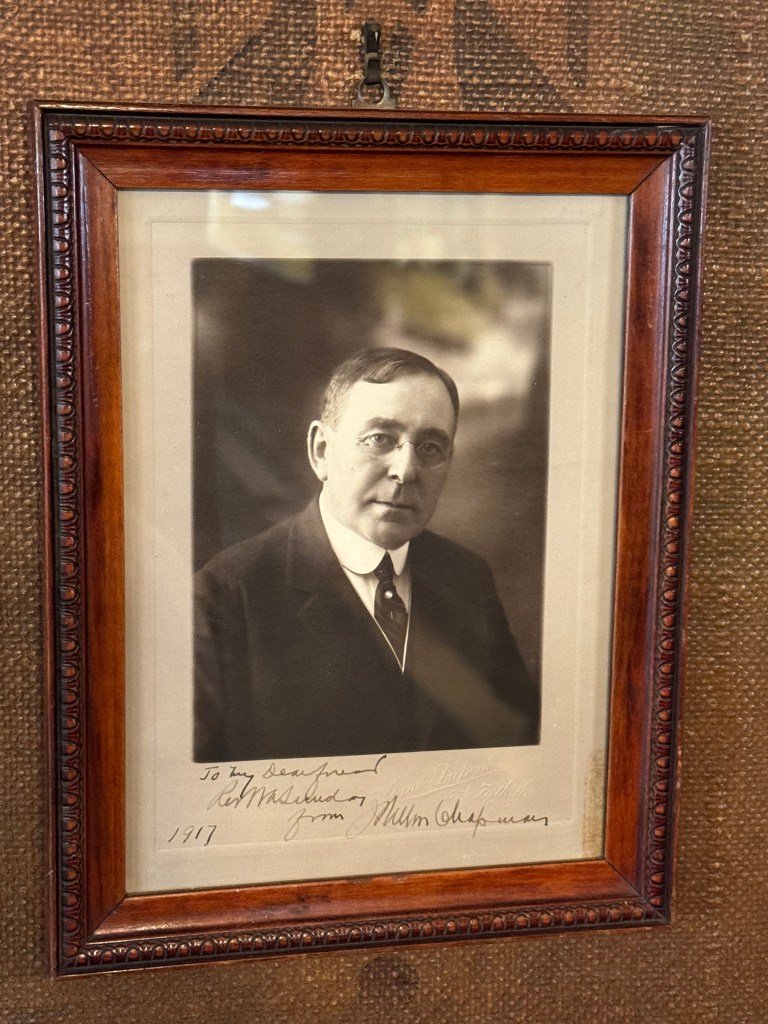
Billy Sunday was mentored by J. Wilbur Chapman

The following (1917) signed picture of J. Wilbur Chapman, in the Billy Sunday home in Winona Lake, attests to the massive influence Chapman had on Sunday.


When the Apprentice Met the Evangelist: How J. Wilbur Chapman Shaped Billy Sunday’s Early Ministry

Before the tabernacles were packed, before the crowds surged forward by the thousands, before the name “Billy Sunday” echoed across the country like a revivalist’s thunderclap—he was simply a former ballplayer, freshly converted, and hungry to make his life count for Christ.

That’s when J. Wilbur Chapman stepped into the picture.

It was 1893. Chapman, already an established evangelist with a Presbyterian pedigree and a knack for drawing the spiritually curious, needed an assistant—someone to handle logistics, rally local churches, and stir up enthusiasm before his campaigns. Billy Sunday had the energy and the zeal. Chapman had the method and the message.

For two critical years—1893 to 1895—Sunday shadowed Chapman like a student to his rabbi. He wasn’t yet preaching, but he was watching. Learning. Absorbing. Chapman’s campaigns weren’t just events—they were carefully orchestrated spiritual operations. Inquiry rooms. Personal follow-ups. Gospel invitations that were both clear and convicting. Sunday took it all in.

But it wasn’t just technique that Chapman passed on—it was a vision. A way of doing evangelism that held fast to the truth of Scripture while reaching real people in real places. Sunday saw in Chapman a man who carried both conviction and compassion. And though their styles couldn’t have been more different—Chapman, the dignified clergyman; Sunday, the kinetic whirlwind—it worked. Like iron sharpening iron.

In 1895, Chapman surprised many by stepping back from itinerant preaching to take a pastorate in New York. The pulpit reclaimed him. But for Billy Sunday, it was a release—a gentle push from the nest. With his mentor’s example still fresh, Sunday stepped onto his own stage. He started small—tiny Iowa towns, rough-hewn tabernacles, handfuls of seekers. But something was forming. Something bold.

It’s hard to overstate what those two years meant. Without Chapman, Sunday might’ve remained a sideshow curiosity—a saved athlete giving testimonies. But with Chapman’s imprint, he became an evangelist. A revivalist. A force.

And though their paths diverged, Sunday never forgot the man who shaped his earliest steps. He took Chapman’s gospel framework, set it ablaze with his own personality, and carried it farther than either man probably imagined.

Chapman taught him how to build the fire. Sunday learned how to preach like it mattered.

Billy Sunday’s prayer in the House of Representatives, Jan 10, 1918

Advertiser (Adelaide, SA : 1889 – 1931), Saturday 23 March 1918, page 7

The U.S. House of Representatives, 1918. Colorized by author.

BILLY SUNDAY’S PRAYER.

CHEERED IN PARLIAMENT.

Billy Sunday prayed in the House of Representatives at Washington on Thursday, January 10, and was applauded at the close of his appeal. Mr. Champ Clark, Speaker of the House, extended the invitation to Mr. Sunday to take the place of the regular House chaplain. Mr. Sunday, in his prayer, verbally assailed the Germans, and invoked the aid of Divine Providence to help the President, the Secretary of War, and Congress to defeat Prussianism.

“We thank Thee that we are Americans,” prayed the evangelist, ‘”and live beneath the protecting folds of the Stars and Stripes. We thank Thee, that Thou canst look over the battlements of glory on our land and see that there is not one stain on any star or stripe. We thank Thee for our happy homes. We thank Thee for our wives and little ones. We thank Thee for the fruitful trees and bountiful harvests. We thank Thee that as a nation we have never gone to bed  hungry, or scraped the bottom of our flour barrel, and we pray for Thy continued mercy and blessing.

Most Infamous Nation in History.

“We pray that Thou wilt forgive our transgressions and blot out our iniquities. Thou knowest, O Lord, that we are in a life-and-death struggle with one of the most vile, infamous, greedy, avaricious, bloodthirsty, sensual, and vicious nations that ever disgraced the pages of history.

‘”Thou knowest that Germany from the eyes of mankind has wrung enough tears to make another sea; that she has drawn blood to redden every wave upon that sea; that she has drawn enough shrieks and groans from the breasts of men, women, and children to make another mountain.

‘”We pray Thee that Thou wilt bare Thy mighty arm and strike that great pack ot hungry, wolfish Huns, whose fingers drip with blood and gore. We pray Thee that the stars in their courses and the winds and waves may fight against them.

“We pray Thee that Thou wilt bless our beloved President and give him strength of mind and body and courage of heart for his arduous duties in these sorrow laden, staggering days. We pray Thee to bless the Secretary of War and the Secretary of the Navy, and bless, we pray Thee the Navy Strategy Board. Bless we pray Thee, the generals at the head of our army and the boys across the sea. somewhere in France, and bless those protecting our transports, loaded to the water’s edge with men and provisions.

Prays for Allied Victory- ‘ “Bless our boys at home who are in ‘ cantonments. Bless, we pray Thee, this Senate and House, and give them wisdom and strength, for they seem to have come into the kingdom for such a time as this.

“‘And, Lord, may every man, woman, and child from Maine to California, from Minnesota to Louisiana, stand up to the last ditch and be glad and willing to suffer and endure until final victory sha’ll come. Bless our Alliée, and may victory be ours. And in Thy own time, and in Thy own way, we pray Thee that Thou wilt release the white-winged dove of peace until it shall dispel the storm and clouds that hang lowering over this sin-cursed, blood-soaked, and sorrowing world, and when it is all over we will uncover our heads and lift our faces to the heavens ‘ and ring with a new meaning

“‘My country, “tis of thee, sweet laud of Liberty.

” Of thee I sing.’

“‘And the praise shall come to Thee forevermore through Jesus Christ. Amen.”

The House broke into instant applause at the ending words of the prayer. Many members crowded around the evangelist, and shook hands with him, and an in-formal reception was held in the lobby.


The Billy Sunday archives at Grace College in Warsaw, Indiana have the following related artifact in their archives. He seems to have spoken at Union Station Plaza, starting January 6, 1918.

Champ Clark (James Beauchamp Clark, 1850–1921) was a prominent American politician and leading Democrat in the early 20th century. By 1918, he was near the end of his long and distinguished career in the U.S. House of Representatives, which he had served in almost continuously since 1893.

Transcription of above letter:

WALLACE BASSFORD, SECRETARY

THE SPEAKER’S ROOMS
HOUSE OF REPRESENTATIVES

WASHINGTON, D.C.

January 8, 1916.

Rev. William A. Sunday,

My dear Friend:

Don’t you forget that you, your wife, and your son and his wife and Mr. Rodehever are to take luncheon with me at the Capitol at 12:30 on next Thursday. Chaplain Couden asked me last week one day, if I would have any objection to your opening the proceedings of the House with prayer. I told him, of course not. I would be delighted.

I asked him about the day, and he said he had written you a letter which he had not sent but would send it, asking you to pray at the opening ceremony, and telling you to set your own day.

Now, I have this suggestion to make to you: The House meets at twelve o’clock sharp and we begin our luncheon at twelve thirty. You come up to my office about ten minutes before twelve on Thursday, bringing your folks with you. They can go up in the gallery and you can open the proceedings with prayer and in a few minutes we can go to lunch, so that you can perform both functions at once.

I am not advised as to whether you have any automobile. If you have not, and will let me know at once, I will send my own, which is big enough to hold five or six people and have it bring you up to the Capitol and then take you and yours wherever you desire to go afterwards.

So please send me an answer to all these queries by the bearer, as to whether you can come up Thursday in time to open with prayer.

I enjoyed your Sunday sermon very much. I hope your meeting will be a great success.

I will have a pleasant, small company to lunch with us.

Your friend,

Champ Clark

Sunday answered the ‘cultural cry’ of his age


Part 1: A Nation in Turmoil and Transition

How Industrialization, Urbanization, and Moral Upheaval Set the Stage for Revival

When Billy Sunday’s voice rang out across America’s wooden tabernacles, he wasn’t just preaching sermons—he was answering a cultural cry. From 1900 to the early 1920s, the United States was spinning in the whirlwind of transformation. Old institutions were cracking, new cities were rising, and the American soul was searching for an anchor. Into that spiritual vacuum stepped Sunday—a preacher who didn’t just understand the moment; he embodied it.

By the early 20th century, America was moving from farm to factory. In 1870, only 25% of the population lived in cities. By 1920, over 50% did. The dizzying shift from rural life to urban sprawl left many disoriented. Long-standing community structures—churches, front porches, family farms—were being replaced by crowded tenements, anonymous factory work, and the fast pace of modern life. People needed clarity, direction, and moral certainty.

Sunday gave it to them—loudly, plainly, and with baseball-player bravado.

The U.S. was also undergoing its greatest wave of immigration, with over 14 million new arrivals between 1900 and 1920. While these immigrants enriched the nation’s culture, they also stoked fears among native-born Protestants about identity, religion, and national character. Sunday’s revivals, though not overtly anti-immigrant, often appealed to a kind of nostalgic Protestant Americanism that comforted people who felt their world slipping away.

Meanwhile, the Industrial Revolution was rewriting the rules of labor and wealth. Robber barons rose; workers organized. Socialist ideas were gaining traction. Against this backdrop, Sunday didn’t call for revolution—he called for regeneration. He told workers to repent, not revolt. He urged bosses to clean up their lives, not just their payrolls. In an age when ideologies were competing to explain human brokenness, Sunday offered the most American answer imaginable: personal repentance and individual transformation.

And of course, moral reform movements were gaining steam—chiefly the push for Prohibition. The saloon had become a symbol of urban vice, immigrant excess, and male irresponsibility. Billy Sunday didn’t just preach against alcohol—he declared war on it. His famous line, “I’m against the saloon with all the power I’ve got,” wasn’t just rhetoric; it helped catalyze a national movement that led to the 18th Amendment.

So why did Billy Sunday rise when he did?

Because he stepped into a nation off balance, morally confused, spiritually hungry, and socially uprooted. He didn’t just ride the wave—he harnessed it. His sermons shouted what many Americans were whispering: that the old truths still mattered, that the Bible still had authority, and that one man’s conviction could still move a crowd.

In an age of massive upheaval, Billy Sunday stood like a lightning rod—conducting fear, hope, outrage, and repentance into one electrifying movement.


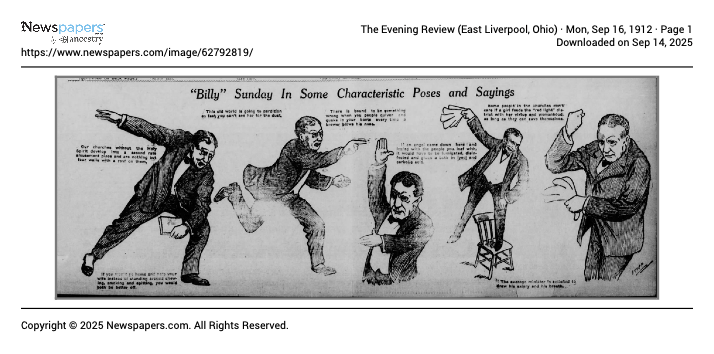
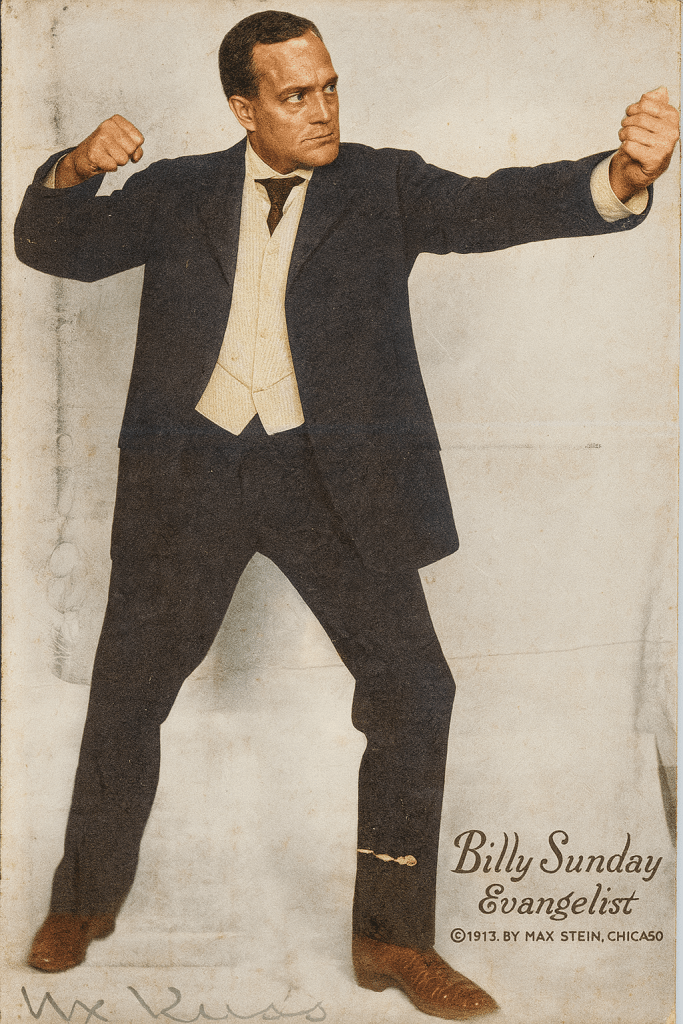
Billy Sunday ‘makes almost 2,000 moves in a single talk’

The movements and gestures of Billy Sunday have never failed to attract attention everywhere he goes. He is probably more active in the pulpit than any other preacher in the world to-day. Many try to imitate him, but none entirely successfully.

It has been figured the evangelist will make 1,700 or 1,800 moves in the ordinary sermon and in some of the longer ones, he moves 2,000 or 2,500 times, or even more.

In a recent sermon an effort was made to keep tally of every move the evangelist made. He gesticulated with one or both hands 884 times in less than one hour on that occasion, this being the most numerous movement of any one kind. He struck the pulpit in front of him with his clenched fist 826 times, and he swung from one side of the pulpit to the other exactly 229 times. On 121 different occasions, he paced from one end of the platform to the other, and 68 times he waved his handkerchief, either in the air or by his side.

The South Bend Tribune. Sat, Jun 07, 1913 ·Page 6

Are you gonna ‘take the count to the Devil’ asks Billy?

THIS IS HOW BILLY FINDS OUT IF YOU ARE GOING TO “TAKE THE COUNT”

BILLY SUNDAY IN UNUSUAL POSE.

Billy Sunday in a famous pose.
C. 1908. Author’s Collection.

The above is a characteristic position for Billy Sunday to assume during one of his meetings for men only.

He bends over until his right knee nearly touches the floor of his platform; then he pulls out his watch and inquires if you are going to “take the count” for the devil.

Sunday’s sermons are filled with such unusual features as this, but they are never so plentiful as in the men’s sermons. There is no doubt about it the evangelist is at his best in these talks. He always bends every energy to the end of impressing his male audience with the truth of what he is saying, and in this he never fails.

The South Bend Tribune. Thu, Jun 05, 1913 ·Page 10