Former professional baseball player-turned urban evangelist. Follow this daily blog that chronicles the life and ministry of revivalist preacher William Ashley "Billy" Sunday (1862-1935)
During the 1916 revival campaign of Billy Sunday in Kansas City, one of the most striking moments came when the evangelist’s wife, Helen Amelia Thompson Sunday—known widely as “Ma Sunday”—took the pulpit herself.
A report in the The Kansas City Star described her address as unmistakably in the style of her famous husband: energetic, blunt, and deeply challenging to church members.
The newspaper noted that Kansas City audiences had not heard her preach before, but the reaction was immediate. Speaking rapidly and with confidence, she quoted Scripture freely, used expressive gestures, and even thumped the pulpit for emphasis.
By the end of her half-hour address, the reporter observed, “she was perspiring freely,” a familiar description for anyone who had watched Billy Sunday preach.
Her message was aimed squarely at professing Christians, not skeptics or outsiders. She criticized believers whose lives contradicted their testimony.
“The professed Christian who forgets his vows every time a joy ride is offered… is a liar—she said liar—every time testimonials are called for.”
Like her husband, Ma Sunday believed revival depended not only on converting sinners but also on awakening the church. In her view, too many Christians expected evangelists to do the spiritual work while they remained passive.
“Don’t you think that we are going to carry the load and let you sit back and say, ‘I hope you have a good meeting.’”
Instead, she challenged church members to take personal responsibility for the spread of the gospel. Her message emphasized the role of ordinary believers as witnesses for Christ.
She even offered a striking calculation:
“If every church member would win one person to God a year in twenty-five years the world would be saved.”
But she also warned that careless Christian living could damage the church’s influence.
“The church member who proves himself a liar every time he testifies is more harm than good to the church.”
At one point she posed a simple question to the audience: how many people were praying for others? Only a few hands rose. Yet when she asked how many were professed Christians, nearly every hand went up. The contrast, she implied, revealed the problem.
Another theme in her address was the temptation of worldly distractions. She criticized believers who treated recreation as more important than spiritual discipline.
“Lots of Christians forget every time they have a chance to go joy riding.”
Her solution was straightforward: prayer and active participation in the revival effort.
“Get a prayer list… I don’t mean to show around and talk about, but to pray for.”
She also defended the unusual style of her husband’s ministry. Critics often accused Billy Sunday of being theatrical or unconventional. Ma Sunday reminded her listeners that religious leaders throughout the Bible had often acted outside ordinary expectations.
“The Pharisees tried to trip up Jesus for doing things out of the ordinary… Mr. Sunday has lots of authority for doing things out of the ordinary.”
Her address illustrated an important aspect of the Sunday revival campaigns: they were family efforts. While Billy Sunday delivered the dramatic evening sermons, Ma Sunday frequently reinforced the message by speaking directly to believers about prayer, personal responsibility, and spiritual integrity.
In Kansas City that spring of 1916, the newspaper report made one thing clear. The revival was not powered by one voice alone.
Ma Sunday had her own message—and she delivered it with the same urgency and conviction that had made the Sunday campaigns famous across America.
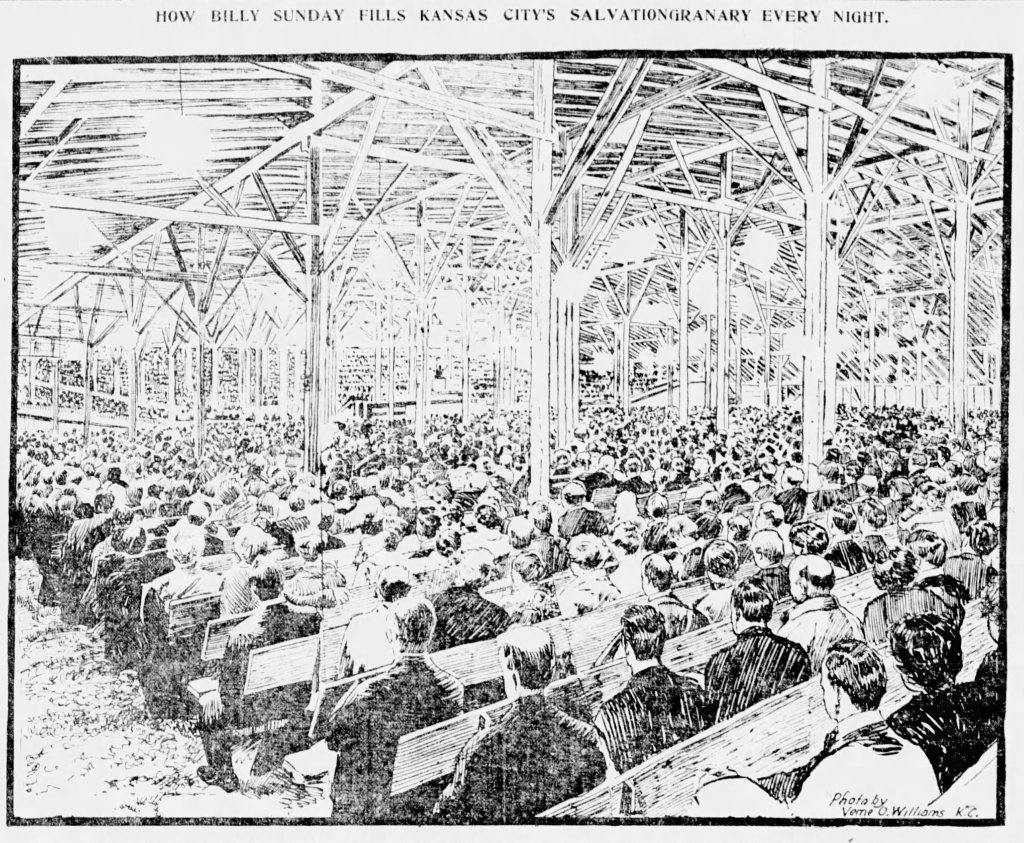
When Billy Sunday preached in Kansas City during his 1916 revival campaign, his sermons often struck directly at the spiritual condition of the church itself. One message, reported by the The Kansas City Star, carried a sharp and revealing title: “Why the Church Is Weak.”
Sunday did not begin by blaming society, politics, or culture. Instead, he argued that the church’s weakness came from within.
“The sermon by Billy Sunday this afternoon had for its subject this verse from Judges xvi, 20: ‘He wist not that the spirit of the Lord had departed from him.’”
Drawing from the story of Samson, Sunday warned that the modern church could lose its spiritual power without even realizing it. In his view, the problem was not a lack of organization, buildings, or membership.
“Nothing in the world can substitute for the spirit of God.”
For Sunday, the church had become timid. Instead of confronting sin, it had grown cautious and respectable. He charged that many congregations had traded spiritual authority for social approval.
“The church is afraid of men and women; we are to be in the world, but not of the world.”
The evangelist insisted that the church had gradually surrendered its moral courage. Leaders often hesitated to rebuke wrongdoing among their members, even when it was obvious.
“Leading church members lead in nothing but card parties and society functions.”
To Sunday, such compromises drained the church of its influence. A church that tolerated worldliness could no longer confront it.
He argued that the true strength of Christianity had never been found in numbers or wealth. The early church, he reminded his audience, possessed little of either.
“God’s church has not increased correspondingly in power as it has in numbers… it has decreased in spiritual power.”
Sunday contrasted the modern church with the first believers described in the book of Acts. They had no impressive buildings, no social prestige, and little money. Yet they possessed something far greater—spiritual conviction.
“There was a time when the church had more members than she has today; there never was a time when she had more money than she has today… but there was a time when she had more spiritual power than she has today.”
Another cause of weakness, Sunday argued, was the church’s tendency to accommodate fashionable society. Rather than confronting sin, some congregations had become comfortable with it.
“That is why many a preacher is a failure today; he is a compromiser.”
Sunday spoke especially bluntly about moral compromise among church members. When churches tolerated behavior they should have challenged, they undermined their own witness.
“We have lost our power because we have compromised.”
But the evangelist did not end his message with criticism. He pointed his listeners toward the remedy: a return to genuine spiritual life. The church needed renewed faith, repentance, and courage.
He concluded with a simple but urgent appeal. If the church wanted to regain its strength, it needed to return to prayer and dependence upon God.
“If there’s anything the church of God needs it is to climb the stairs and get in an upper room.”
In the packed tabernacle that afternoon, Sunday’s message was unmistakable. The problem facing the church was not outside pressure or hostile culture. It was the quiet erosion of conviction within.
And until the church rediscovered the spiritual power that marked its earliest days, Sunday warned, its influence would continue to fade.
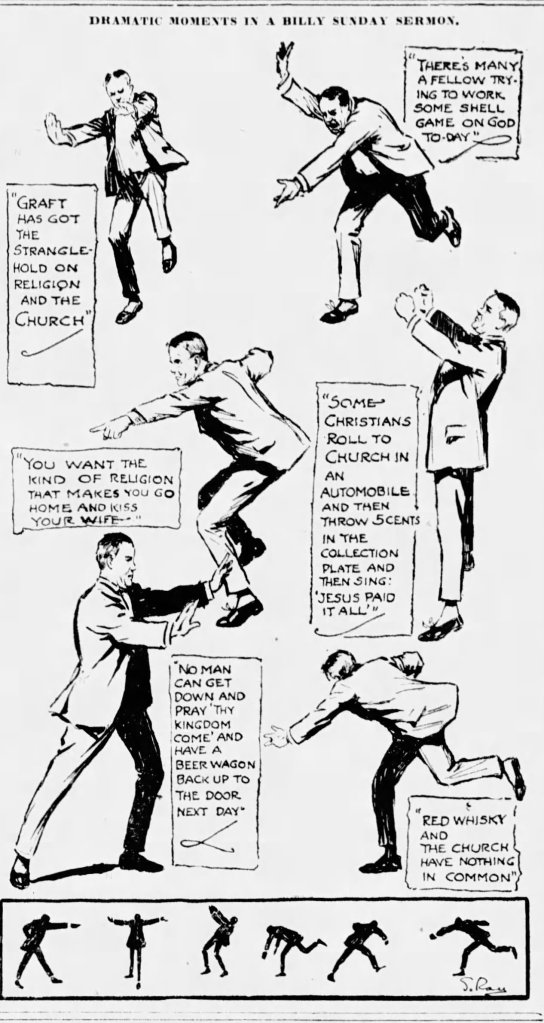
When Billy Sunday arrived in Kansas City during his 1916 revival campaign, reporters tried to explain what made his preaching so electrifying. One article in the The Kansas City Star offered an unusual perspective. Rather than describing Sunday simply as a preacher, the writer analyzed him as something closer to a dramatic performer.
The article was titled “Billy Sunday as an Actor,” and it attempted to dissect the evangelist’s method from a theatrical standpoint. What the reporter saw was not merely a sermon but a kind of living drama unfolding on the sawdust platform.
According to the writer, Sunday had the ability to bring invisible scenes vividly to life:
“Mr. Sunday, erect and eloquent, is addressing some jury which is corporeally invisible, but which instantly lives before the eyes.”
In other words, Sunday’s sermons created mental pictures so vivid that listeners could almost see the courtroom of heaven forming before them. The preacher might begin by placing his audience before the bar of divine judgment, describing the sinner standing before God.
But the sermon did not stay in one place for long. Sunday constantly shifted roles, turning the message into a dramatic sequence of scenes. One moment he might portray a bartender leaning over a counter; the next he was the drunken customer staggering through the gutter.
The article described these rapid transitions with striking clarity:
“Then he becomes a barkeeper… And in another instant he is the drunkard—‘a dirty rum guzzler’—cringing, broken, swaying to the gutter.”
Through pantomime, gestures, and changes in voice, Sunday acted out moral situations that his audience immediately recognized.
The reporter concluded that Sunday’s preaching relied heavily on what he called melodrama. But the word was not meant as criticism so much as explanation. Melodrama, the article observed, was easy for ordinary people to understand because it dealt in clear moral conflict.
“Melodrama has nothing to do with character and is easy to understand,” the writer noted. “It is the drama of situation.”
That description captures something essential about Billy Sunday’s preaching. His sermons did not revolve around abstract theological debates. Instead, they focused on recognizable human stories: the drunkard, the wandering son, the sinner facing judgment.
Another feature the reporter noticed was Sunday’s physical intensity. The evangelist rarely stood still. He ran, leaped, stamped his foot, pointed accusingly, and pounded the pulpit for emphasis. The effect, the article suggested, was almost like watching an athlete or dancer.
One colorful comparison even likened him to the famed ballet performer Vaslav Nijinsky—an extraordinary metaphor for a revival preacher.
Perhaps the most perceptive observation in the article concerned the simplicity of Sunday’s language. The reporter noted that his words were blunt, Anglo-Saxon, and forceful:
“Short, pungent… Saxon derivatives of English… packed full of powerful stimulus.”
This plainspoken style, filled with vivid phrases and sharp imagery, helped Sunday communicate with audiences drawn from every social class.
In the end, the Kansas City writer recognized something that many critics missed. Billy Sunday’s sermons were not merely lectures about religion. They were dramatic moral confrontations, staged in front of thousands of listeners each night.
On the bare platform of a temporary tabernacle, without scenery or props, Sunday created entire scenes through voice, motion, and imagination. His preaching was not simply heard—it was seen and felt.
And that, the reporter concluded, was the secret of his remarkable power over a crowd.
Adapted from: The Kansas City Star. May 4, 1916:2.
Billy Sunday preached “Atonement Through the Blood of Jesus” as part of his core doctrinal sermons, often reserved for Sunday evenings or major campaign nights. While the exact first delivery date is unclear (since Sunday didn’t publish a formal collected works), this sermon was prominently featured during several of his middle and later campaigns, including: 1916 Boston campaign – Multiple newspapers noted a stirring sermon on the blood of Christ and substitutionary atonement, delivered to tens of thousands in the tabernacle built on Huntington Avenue.
Atonement Through the Blood of Jesus by Evangelist Billy Sunday
“For if the blood of bulls and of goats and the ashes of an heifer sprinkling the unclean, sanctifieth to the purifying of the flesh” – Paul argued in his letter to the Hebrews “how much more shall the blood of Christ, who through the eternal Spirit offered himself without spot to God, purge your conscience from dead works to serve the living God.” (Heb. 9:13-14) No more of this turtle-dove business, no more offering the blood of bullocks and heifers to cleanse from sin. The atoning blood of Jesus Christ – that is the thing about which all else centers. I believe that more logical, illogical, idiotic, religious and irreligious arguments have been fought over this than all others. Now and then when a man gets a new idea of it, he goes out and starts a new denomination. He has a perfect right to do this under the thirteenth amendment, but he doesn’t stop here. He makes war on all of the other denominations that do not interpret as he does. Our denominations have multiplied by this method until it would give one brain fever to try to count them all. The atoning blood! And as I think it over I am reminded of a man who goes to England and advertises that he will throw pictures on the screen of the Atlantic coast of America. So he gets a crowd and throws pictures on the screen of high bluffs and rocky coasts and waves dashing against them, until a man comes out of the audience and brands him a liar and says that he is obtaining money under false pretense, as he has seen America and the Atlantic coast and what the other man is showing is not America at all. The men almost come to blows and then the other man says that, if the people will come tomorrow, he will show them real pictures of the coast. So the audience comes back to see what he will show, and he flashes on the screen pictures of a low coast line, with palmetto trees and banana trees and tropical foliage and he apologizes to the audience, but says these are the pictures of America. The first man calls him a liar and the people don’t know which to believe. What was the matter with them? They were both right and they were both wrong, paradoxical as it may seem. They were both right as far as they went, but neither went far enough. The first showed the coast line from New England to Cape Hatteras, while the second showed the coast line from Hatteras to Yucatan. They neither could show it all in one panoramic view, for it is so varied it could not be taken in one picture. God never intended to give you a picture of the world in one panoramic view. From the time of Adam and Eve down to the time Jesus Christ hung on the cross he was unfolding his views. When I see Moses leading the people out of bondage where they for years had bared their backs to the taskmaster’s lash; when I see the lowing herds and the high priest standing before the altar severing the jugular vein of the rams and the bullocks; on until Christ cried out from the cross, “It is finished,” (John 19:30) God was preparing the picture for the consummation of it in the atoning blood of Jesus Christ. A sinner has no standing with God. He forfeits his standing when he commits sin and the only way he can get back is to repent and accept the atoning blood of Jesus Christ. I have sometimes thought that Adam and Eve didn’t understand as fully as we do when the Lord said; “Eat and you shall surely die.” (Gen. 2:17) They had never seen any one die. They might have thought it simply meant a separation from God. But no sooner had they eaten and seen their nakedness than they sought to cover themselves, and it is the same today. When man sees himself in his sins, uncovered, he tries to cover himself in philosophy or some fake. But God looked through the fig leaves and the foliage and God walked out in the field and slew the beasts and took their skins and wrapped them around Adam and Eve, and from that day to this when a man has been a sinner and has covered himself, it has been by and through faith in the shed blood of Jesus Christ. Every Jew covered his sins and received pardon through the blood of the rams and bullocks and the doves. An old infidel said to me once, “But I don’t believe in atonement by blood. It doesn’t come up to my ideas of what is right.” I said, “To perdition with your ideas of what is right. Do you think God is coming down here to consult you with your great intellect and wonderful brain, and find out what you think is right before he does it? ” My, but you make me sick. You think that because you don’t believe it that it isn’t true. I have read a great deal – not everything, mind you, for a man would go crazy if he tried to read everything – but I have read a great deal that has been written against the atonement from the infidel standpoint – Voltaire, Huxley, Spencer, Diderot, Bradlaugh, Paine, on down to Bob Ingersoll – and I have never found an argument that would stand the test of common sense and common reasoning. And if anyone tells me he has tossed on the scrap heap the plan of atonement by blood, I say, “What have you to offer that is better?” and until he can show me something that is better I’ll nail my hopes to the cross. Suffering for the Guilty You say you don’t believe in the innocent suffering for the guilty. Then I say to you, you haven’t seen life as I have seen it up and down the country. The innocent suffer with the guilty, by the guilty and for the guilty. Look at that old mother waiting with trembling heart for the son she has brought into the world. And see him come staggering in and reeling and staggering to bed while his mother prays and weeps and soaks the pillow with her tears over her godless boy. Who suffers most? The mother or that godless, maudlin [drunk] bum? You have only to be the mother of a boy like that to know who suffers most. Then you won’t say anything about the plan of redemption and of Jesus Christ suffering for the guilty. Look at that young wife, waiting for the man whose name she bears, and whose face is woven in the fiber of her heart, the man she loves. She waits for him in fright and when he comes, reeking from the stench of the breaking of his marriage vows, from the arms of infamy, who suffers most? That poor, dirty, triple extract of vice and sin? You have only to be the wife of a husband like that to know whether the innocent suffers for the guilty or not. I have the sympathy of those who know right now. This happened in Chicago in a police court. A letter was introduced as evidence for a criminal there for vagrancy. It read, “I hope you won’t have to hunt long to find work. Tom is sick and baby is sick. Lucy has no shoes and we have no money for the doctor or to buy any clothes. I manage to make a little taking in washing, but we are living in one room in a basement. I hope you won’t have to look long for work,” and so on, just the kind of a letter a wife would write to her husband. And before it was finished men cried and policemen with hearts of adamant were crying and fled from the room. The judge wiped the tears from his eyes and said: “You see, no man lives to himself alone. If he sins others suffer. I have no alternative. I sympathize with them, as does every one of you, but I have no alternative. I must send this man to Bridewell [house of correction].” Who suffers most, that woman manicuring her nails over a washboard to keep the little brood together or that drunken bum in Bridewell getting his just deserts from his acts? You have only to be the wife of a man like that to know whether or not the innocent suffer with the guilty. So when you don’t like the plan of redemption because the innocent suffer with the guilty, I say you don’t know what is going on. It’s the plan of life everywhere. From the fall of Adam and Eve till now it has always been the rule that the innocent suffer with the guilty. It’s the plan of all and unless you are an idiot, an imbecile and a jackass, and gross flatterer at that, you’ll see it. Jesus’ Atoning Blood Jesus gave his life on the cross for any who will believe. We’re not redeemed by silver or gold. Jesus paid for it with his blood (1 Peter 1:18). When some one tells you that your religion is a bloody religion and the Bible is a bloody book, tell them yes, Christianity is a bloody religion; the gospel is a bloody gospel; the Bible is a bloody book; the plan of redemption is bloody. It is. You take the blood of Jesus Christ out of Christianity and that book isn’t worth the paper it is written on. It would be worth no more than your body with the blood taken out. Take the blood of Jesus Christ out and it would be a meaningless jargon and jumble of words. If it weren’t for the atoning blood you might as well rip the roofs off the churches and burn them down. They aren’t worth anything. But as long as the blood is on the mercy seat (Lev. 16:14), the sinner can return, and by no other way. There is nothing else. It stands for the redemption. You are not redeemed by silver or gold, but by the blood of Jesus Christ. Though a man says to read good books, do good deeds, live a good life and you’ll be saved, you’ll be damned. That’s what you will. All the books in the world won’t keep you out of hell without the atoning blood of Jesus Christ. It’s Jesus Christ or nothing for every sinner on God’s earth. Without it not a sinner will ever be saved. Jesus has paid for your sins with his blood. The doctrine of universal salvation is a lie. I wish every one would be saved, but they won’t. You will never be saved if you reject the blood. I remember when I was in the Y.M.C.A. in Chicago I was going down Madison Street and had just crossed Dearborn Street when I saw a newsboy with a young sparrow in his hand. I said: “Let that little bird go.” He said, “Aw, g’wan with you, you big mutt.” I said, “I’ll give you a penny for it,” and he answered, “Not on your tintype.” “I’ll give you a nickel for it,” and he answered, “Boss, I’m from Missouri; come across with the dough.” I offered it to him, but he said, “Give it to that guy there,” and I gave it to the boy he indicated and took the sparrow. I held it for a moment and then it fluttered and struggled and finally reached the window ledge in a second story across the street. And other birds fluttered around over my head and seemed to say in bird language, “Thank you, Bill.” The kid looked at me in wonder and said: “Say, boss, why didn’t you chuck that nickel in the sewer?” I told him that he was just like that bird. He was in the grip of the devil, and the devil was too strong for him just as he was too strong for the sparrow, and just as I could do with the sparrow what I wanted to, after I had paid for it, because it was mine. God paid a price for him far greater than I had for the sparrow, for he had paid it with the blood of his Son, and he wanted to set him free. No Argument Against Sin So, my friend, if I had paid for some property from you with a price, I could command you, and if you wouldn’t give it to me I could go into court and make you yield. Why do you want to be a sinner and refuse to yield? You are withholding from God what he paid for on the cross. When you refuse you are not giving God a square deal. I’ll tell you another. It stands for God’s hatred of sin. Sin is something you can’t deny. You can’t argue against sin. A skilful man can frame an argument against the validity of religion, but he can’t frame an argument against sin. I’ll tell you something that may surprise you. If I hadn’t had four years of instruction in the Bible from Genesis to Revelation, before I saw Bob Ingersoll’s book, and I don’t want to take any credit from that big intelligent brain of his, I would be preaching infidelity instead of Christianity. Thank the Lord I saw the Bible first. I have taken his lectures and placed them by the side of the Bible, and said, “You didn’t say it from your knowledge of the Bible.” And I have never considered him honest, for he could not have been so wise in other things and such a fool about the plan of redemption. So I say I don’t think he was entirely honest. But you can’t argue against the existence of sin, simply because it is an open fact, the word of God. You can argue against Jesus being the Son of God. You can argue about there being a heaven and a hell, but you can’t argue against sin. It is in the world and men and women are blighted and mildewed by it. Some years ago I turned a corner in Chicago and stood in front of a police station. As I stood there a patrol dashed up and three women were taken from some drunken debauch, and they were dirty and blear-eyed, and as they were taken out they started a flood of profanity that seemed to turn the very air blue. I said, “There is sin.” And as I stood there up dashed another patrol and out of it they took four men, drunken and ragged and bloated, and I said, “There is sin.” You can’t argue against the fact of sin. It is in the world and blights men and women. But Jesus came to the world to save all who accept him. “How Long, O God?” It was out in the Y.M.C.A. in Chicago. “What is your name and what do you want?” I asked. “I’m from Cork, Ireland,” said he, “and my name is James O’Toole.” Here is a letter of introduction.” I read it and it said he was a good Christian young man and an energetic young fellow. I said, “Well, Jim, my name is Mr. Sunday. I’ll tell you where there are some good Christian boarding houses and you let me know which one you pick out.” He told me afterwards that he had one on the North Side. I sent him an invitation to a meeting to be held at the Y.M.C.A., and he had it when he and some companions went bathing in Lake Michigan. He dived from the pier just as the water receded unexpectedly and he struck the bottom and broke his neck. He was taken to the morgue and the police found my letter in his clothes, and told me to come and claim it or it would be sent to a medical college. I went and they had the body on a slab, but I told them I would send a cablegram to his folks and asked them to hold it. They put it in a glass case and turned on the cold air, by which they freeze bodies by chemical processes, as they freeze ice, and said they would save it for two months, and if I wanted it longer they would stretch the rules a little and keep it three. I was just thinking of what sorrow that cablegram would cause his old mother in Cork when they brought in the body of a woman. She would have been a fit model of Phidias [ancient Greek sculptor], she had such symmetry of form. Her fingers were manicured. She was dressed in the height of fashion and her hands were covered with jewels and as I looked at her, the water trickling down her face, I saw the mute evidence of illicit affection. I did not say lust, I did not say passion, I did not say brute instincts. I said, “Sin.” Sin had caused her to throw herself from that bridge and seek repose in a suicide’s grave. And as I looked, from the saloon, the fantan rooms, the gambling hells, the opium dens, the red lights, there arose one endless cry of “How long, O God, how long shall hell prevail?” (Psa. 74:10) You can’t argue against sin. It’s here. Then listen to me as I try to help you. When the Standard Oil Company was trying to refine petroleum there was a substance that they couldn’t dispose of. It was a dark, black, sticky substance and they couldn’t bury it, couldn’t burn it because it made such a stench; they couldn’t run it in the river because it killed the fish, so they offered a big reward to any chemist who would solve the problem. Chemists took it and worked long over the problem, and one day there walked into the office of John D. Rockefeller, a chemist and laid down a pure white substance which we since know as paraffine [paraffin wax]. You can be as black as that substance and yet Jesus Christ can make you white as snow. “Though your sins be as scarlet they shall be as white as snow.” (Isa. 1:18)
Feb. 22—Fifty Boston ministers and laymen go to Philadelphia; hear Sunday preach for first time; walk into his bedroom the next morning and demand that he come to Boston. Sunday accepts and date is fixed for Fall of 1916.
March 6—Organization of Boston committee announced at big meeting in Park Street Church.
March 7—Committee files papers at State House as “Boston Sunday Evangelistic Committee, Incorporated.”
1916
Jan. 21—Committee decides to build tabernacle on Huntington-av site.
March 22—Twenty members of Boston Committee go to Baltimore to learn their jobs from campaign workers in that city.
April 27—Wooden tabernacle bill vetoed by Gov McCall. Committee nonplussed.
April 30—Campaign for $100,000 in guaranty pledges launched.
Aug. 10—Ground broken for tabernacle. Mayor Curley attends. Joe Spiece begins work.
Oct. 2—Cottage prayer meetings open.
Nov. 12—BILLY SUNDAY PREACHES FIRST SERMON IN BOSTON.
As appearing in The Boston Globe Sun, Oct 15, 1916 • Page 80
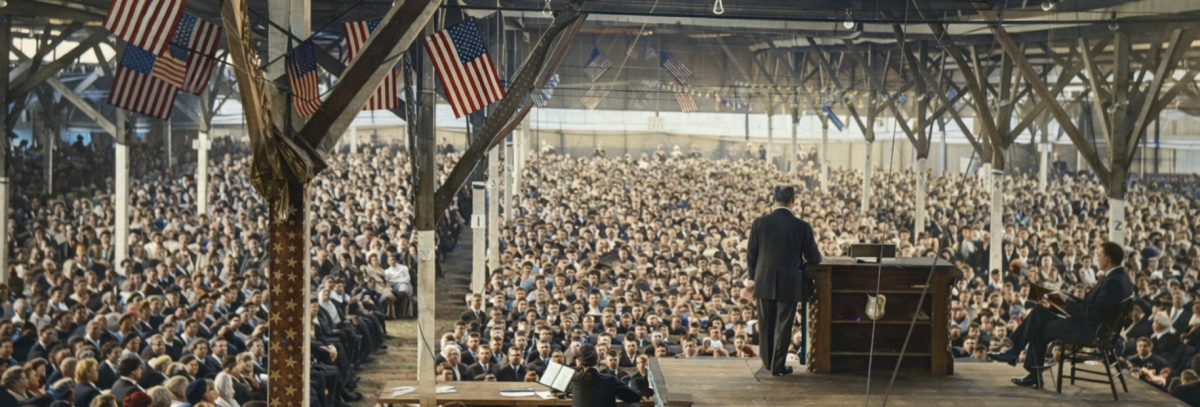
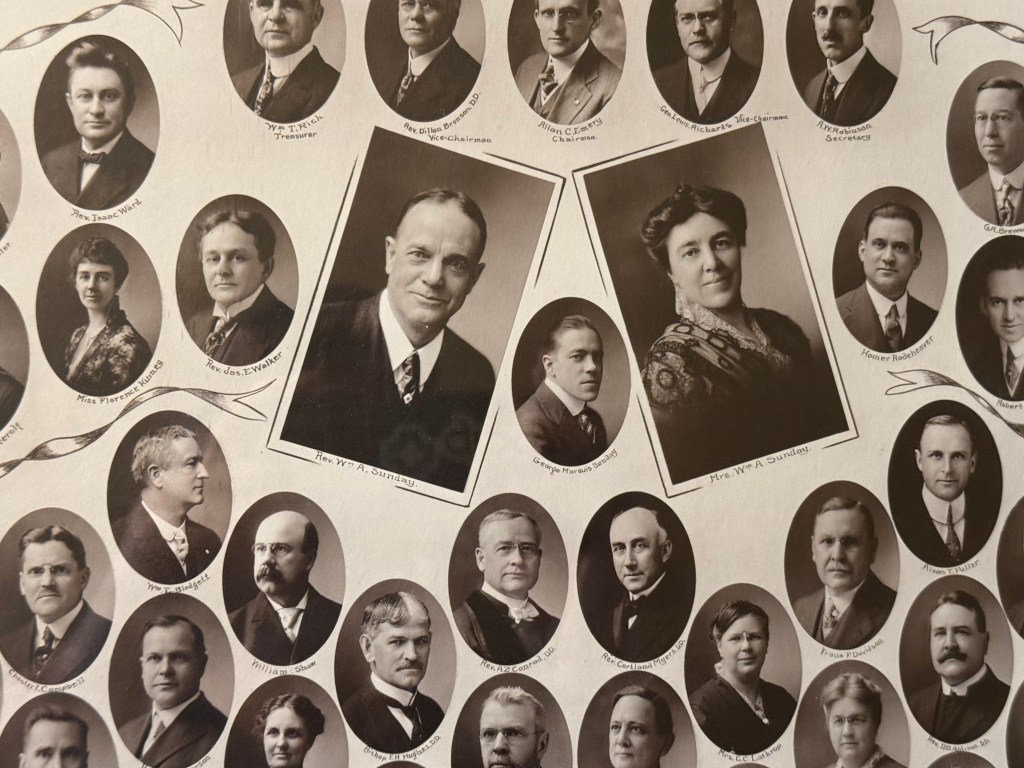
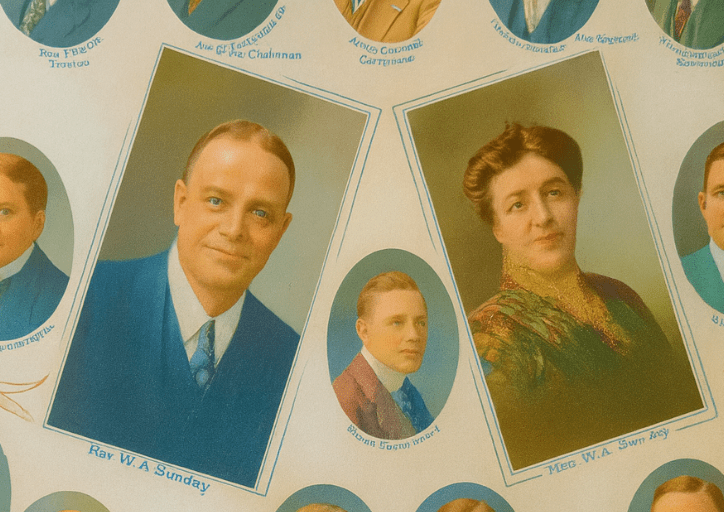
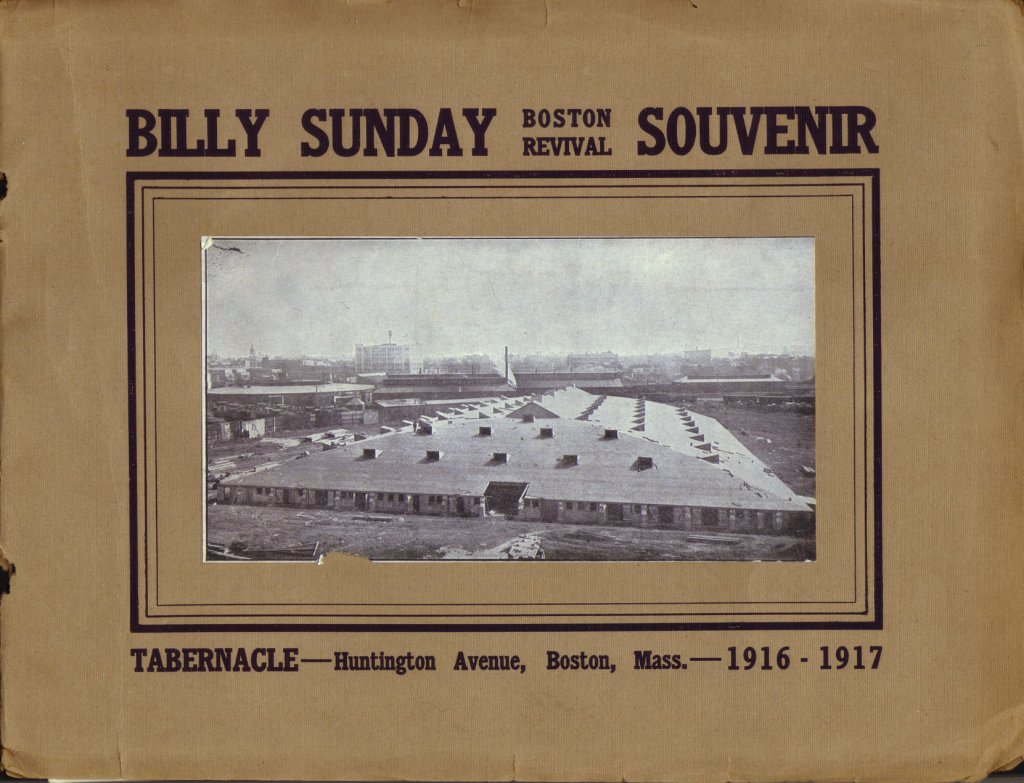
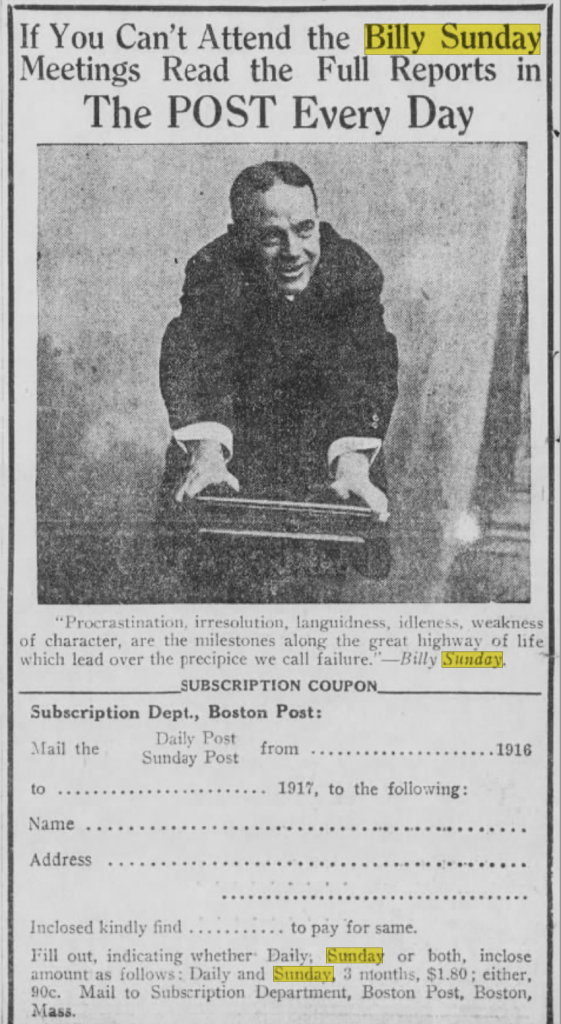
In early 1916, Billy Sunday launched one of the most ambitious evangelistic campaigns of his career in Boston—a city known for its intellectualism and religious diversity. Running from January through April, the campaign was meticulously organized, with more than 5,000 volunteers and significant cooperation from local churches. A massive tabernacle, seating up to 20,000 people, was specially constructed on Huntington Avenue, symbolizing the scale and seriousness of the effort.
Over the course of the revival, more than 1.5 million people attended Sunday’s fiery sermons. His preaching, characterized by dramatic flair and passionate appeals, emphasized personal salvation, moral reform, and national righteousness. At a time when World War I loomed and social tensions were high, Sunday’s message struck a chord. He was especially vocal against alcohol, aligning his campaign with the growing Prohibition movement.
Despite initial skepticism from Boston’s more refined religious circles, Sunday’s influence grew as thousands “hit the sawdust trail” in public commitment to Christ. Media coverage was extensive, and the revival became a citywide spectacle. The impact extended beyond the tabernacle, as many local churches reported a lasting spiritual renewal.
Sunday’s 1916 Boston campaign stands as a milestone in American revival history—an event that combined religious fervor, civic organization, and cultural theater in a way that few evangelists before or after have matched.



 Evangelist Billy Sunday (1862-1935)