Billy Sunday in Spokane (1908–1909): When the Revival Hit the Inland Empire


When Billy Sunday arrived in Spokane on Christmas Day, 1908, expectations were already high—and confusion lingered. Earlier reports had announced a December 20 opening. That date came and went. But on December 25, the Sunday party finally arrived, and Spokane discovered that the delay mattered little. The revival that followed would become one of the most significant religious events in the city’s early twentieth-century history.

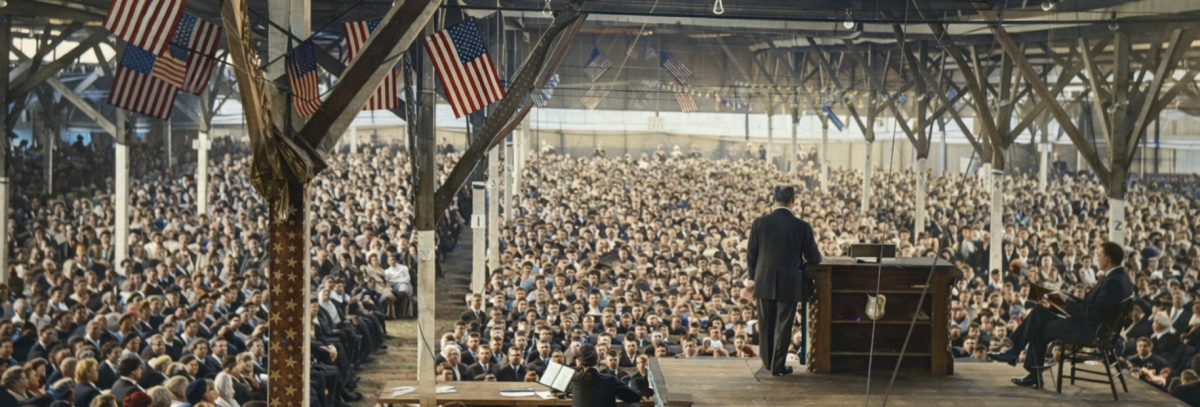
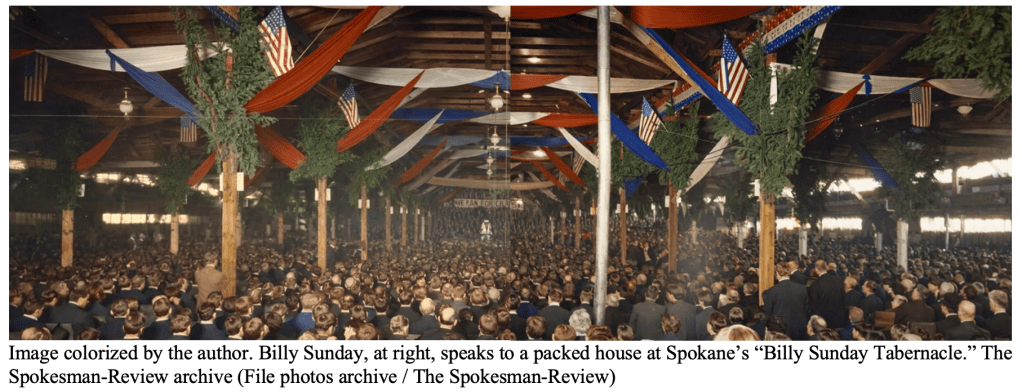
Opening night attendance was estimated at 8,000 people, filling the newly constructed tabernacle on Christmas Day. The Spokesman-Review reported the crowd the following morning, setting the tone for what would unfold over the next six weeks .
A City Drawn In

The Spokane campaign officially ran from December 25, 1908, to February 10, 1909. In that span, Sunday recorded 5,666 converts, with the single largest night producing 446 responses. Offerings totaled $15,000 to cover campaign expenses, and Sunday’s personal purse amounted to $10,000—figures that place Spokane among his more successful revivals of the era .

The tabernacle itself had been erected in early December, even before Sunday arrived, and disassembly began almost immediately after the meetings concluded. It was a temporary structure for what proved to be a lasting civic event.

Attendance figures tell only part of the story. According to the Daily Herald, the revival spilled far beyond the tabernacle walls. Hundreds of prayer meetings and semi-public gatherings sprang up across the city. Homes were opened for religious meetings. Crowds swelled so large at times that police were required to control access to the tabernacle. The paper described the total attendance as “hundreds of thousands,” calling some of the gatherings among the largest in Spokane’s history .

Methods, Manhood, and Controversy

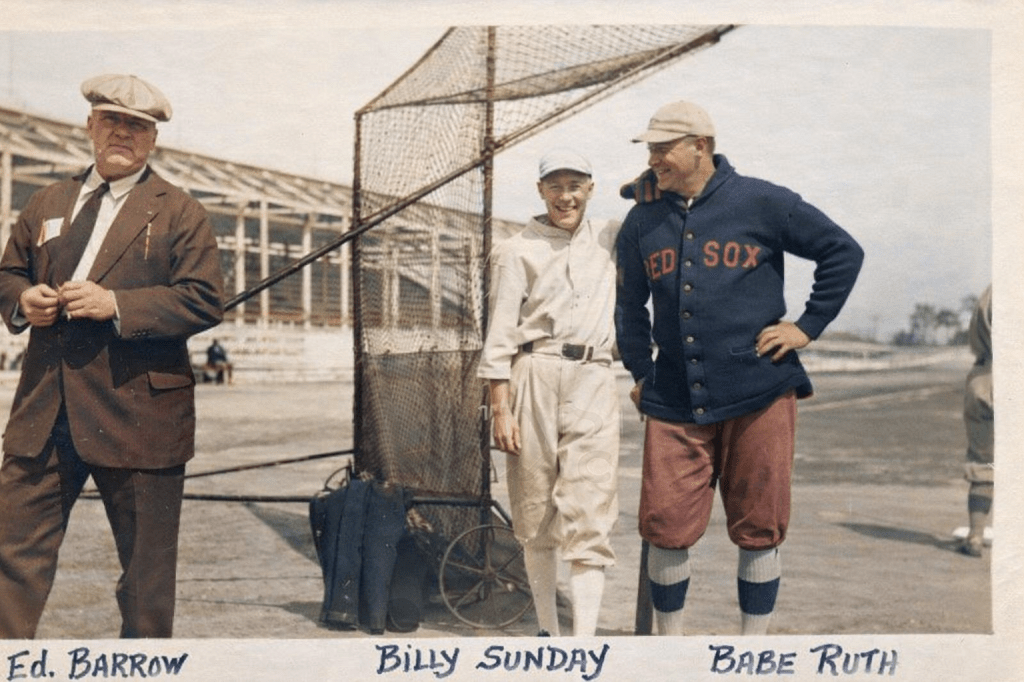
Sunday’s style continued to provoke strong reactions—both admiration and criticism. Rev. T. H. Fertig, a Spokane minister, offered one of the most telling assessments in February 1909. He contrasted Sunday with what he saw as the overly academic bent of modern clergy, arguing that Sunday had carried his “manhood” from baseball into the pulpit. Fertig admitted that many of Sunday’s methods were objectionable, but insisted they bore the unmistakable stamp of originality and personal force. Seminary training, he warned, too often erased individuality rather than refining it .

That tension—between polished theology and raw persuasion—was a recurring theme wherever Sunday preached. Spokane proved no exception.

Measurable Impact on Churches

The post-revival accounting offers a rare snapshot of how different congregations interpreted the results.

Some churches reported substantial growth. First Methodist Church received 270 new members, while First Methodist (reported separately in another account) claimed as many as 360. Emmanuel Baptist added 45 converts. First Baptist expected at least 80. Central Christian welcomed approximately 60. Westminster Congregational received 30, and Plymouth Congregational added about 50 new members .

Other responses were more restrained. All Saints Episcopal Church reported 12 new members. Holy Trinity Episcopal Church reported none, with its minister expressing concern about conversions driven by fear rather than conviction. Our Lady of Lourdes likewise expected no new members as a result of the campaign .

The uneven distribution underscores a reality often lost in revival mythology: success was not universally defined, nor universally embraced.

Social and Civic Effects

Beyond church rolls, Spokane newspapers noted broader social effects. One headline captured the contrast succinctly: “Beer Sales Fall. Bibles in Demand.” While such claims invite scrutiny, they reflect how contemporaries interpreted the revival’s moral influence .

Financially, the churches emerged ahead. After expenses were met, including nearly $12,000 in costs and the feeding and sheltering of hundreds of homeless men during a severe cold wave, local churches anticipated a surplus of $2,000 to $3,000. These funds came from post-expense collections and tabernacle bonds that were allowed to lapse in favor of the churches .

The revival also intersected directly with political reform. During the campaign, 110 representative men traveled to Olympia to lobby for a county-unit local-option bill, coinciding with Sunday’s repeated delivery of his fiery “Booze” sermon. For supporters, this fusion of evangelism and activism marked one of the revival’s most consequential achievements .

Did Billy Sunday “Make Good”?

As the meetings drew to a close, Spokane’s press asked the question directly—illustrated in editorial cartoons and front-page reflections. By February 1909, the answer, at least in terms of attendance, conversions, and civic impact, appeared clear.
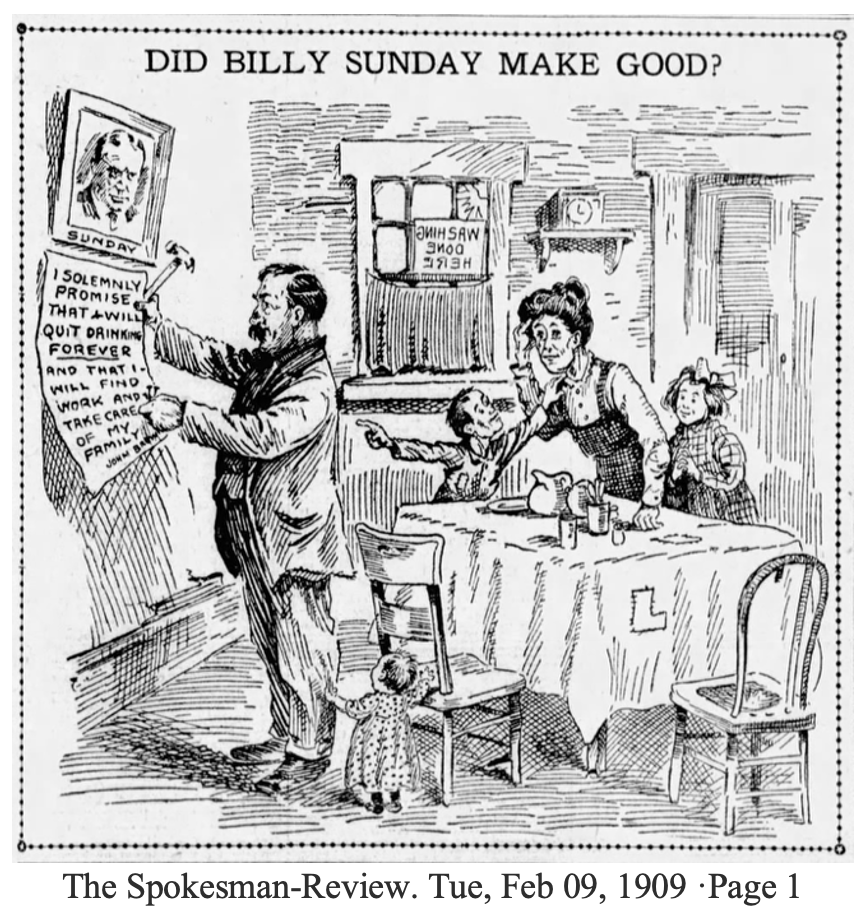
Spokane did not merely host Billy Sunday. For six winter weeks, it reorganized itself around him. Whether one applauded his methods or questioned them, the revival left behind measurable change, lasting debate, and a vivid example of early twentieth-century evangelical power at its height.

For Billy Sunday, Spokane was another city on a relentless circuit. For Spokane, it was a season that reshaped its religious and moral landscape—if only for a time.
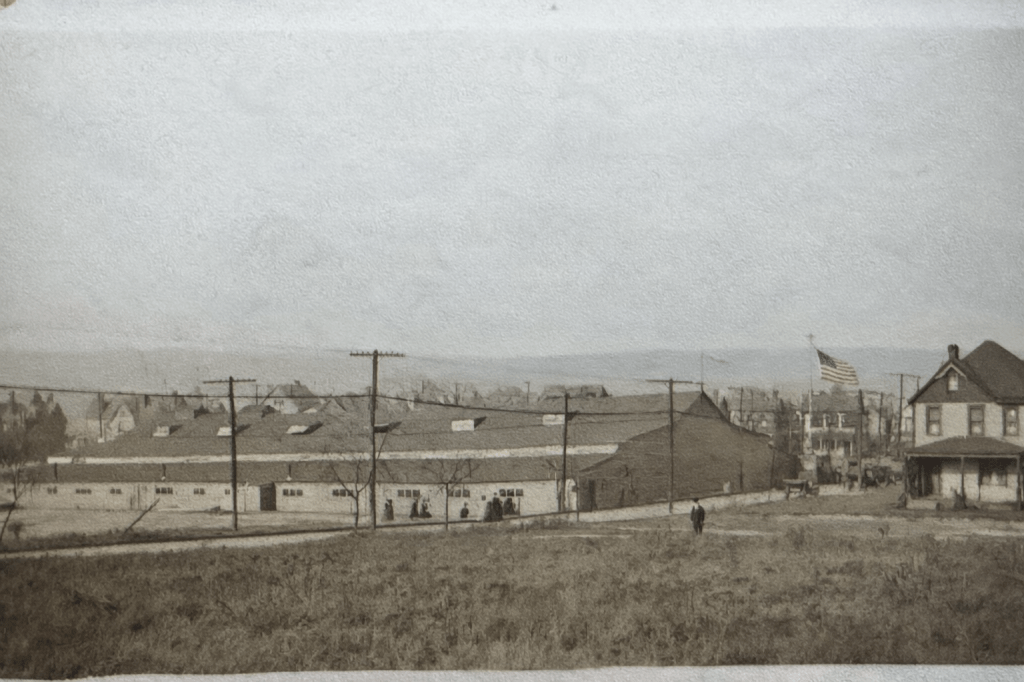

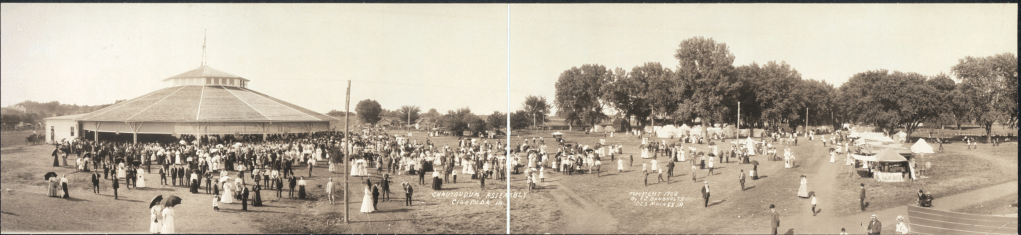
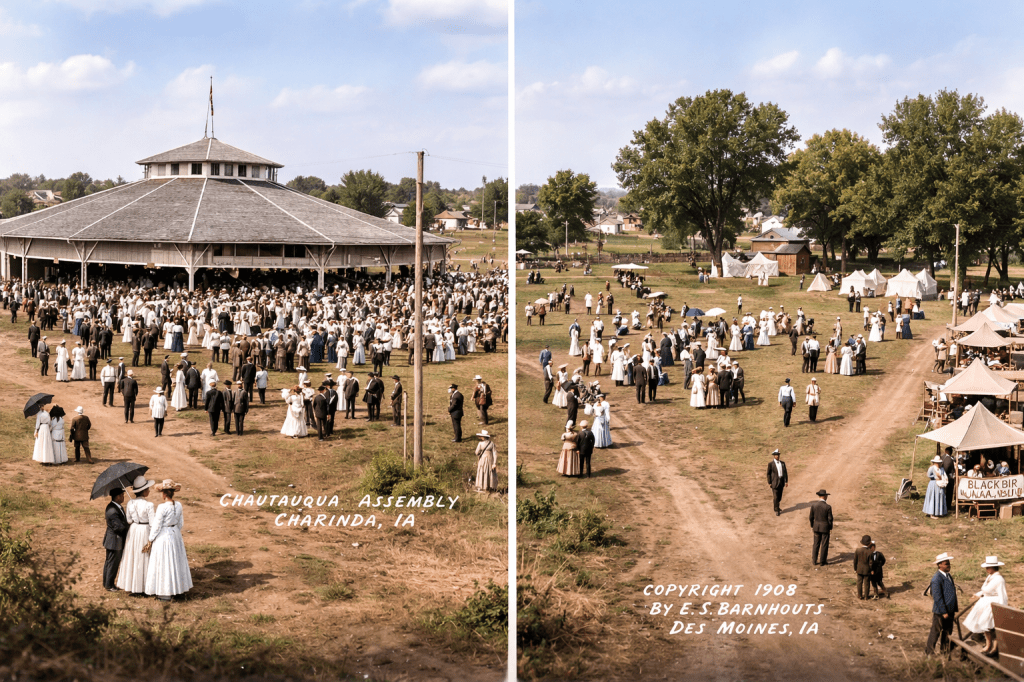
Need help identifying this Billy Sunday Tabernacle

I recently acquired this image. It is obviously a Billy Sunday Tabernacle but I can’t 100% confirm its location.

It is close to his Lima and Toledo tabernacles, but its not one of those.

I am hoping the town in the background and the house on the right helps it being properly identified.

It feels like the 19-teens.

It almost feels like its Pennsylvania. I know he did a revival in Sharon, PA (May 1st – June 22, 1908. Sharon, PA (Shenango Valley).

Please put your thoughts in the Comments field.

Mother’s Day, 1909

ONE of the most impressive and successful days in the great campaign was Mother’s Day, as suggested by Rev. Mr. Sunday. The following request was published:

Every person is requested to wear a white flower or ribbon to-day in honor of mother. If your mother is alive do her an act of kindness. Telegraph or write to her, or give her a gift to express your love. If mother is not alive, perform an act of kindness to somebody else’s mother. The services at the tabernacle will be for mothers, although everybody is invited. Businessmen are invited to close their places of business from two to four o’clock, or at least to let as many employees off as possible. An offering will be taken at the tabernacle to be given to the Woman’s Club to be distributed to the charities of the city as the club deems best.

 W. A. Sunday

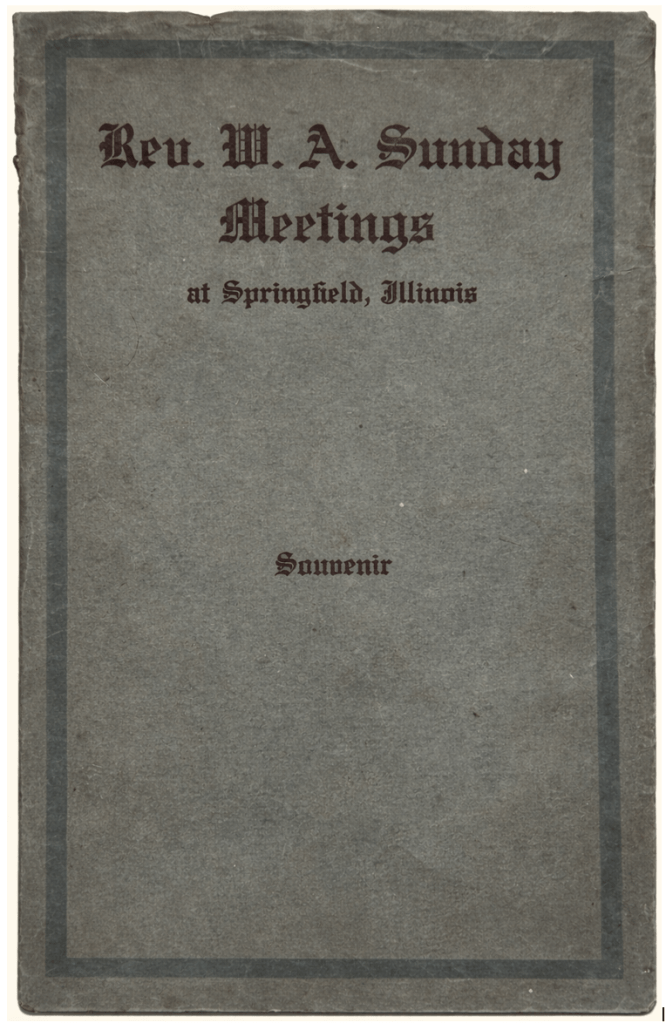
Source (text above): 1909 Springfield, Illinois souvenir booklet

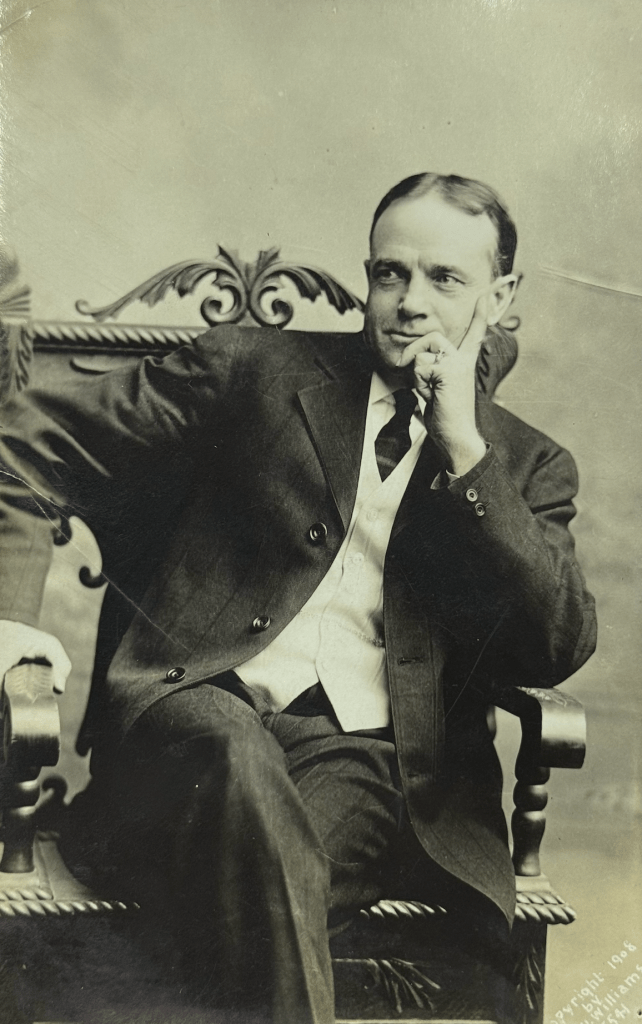
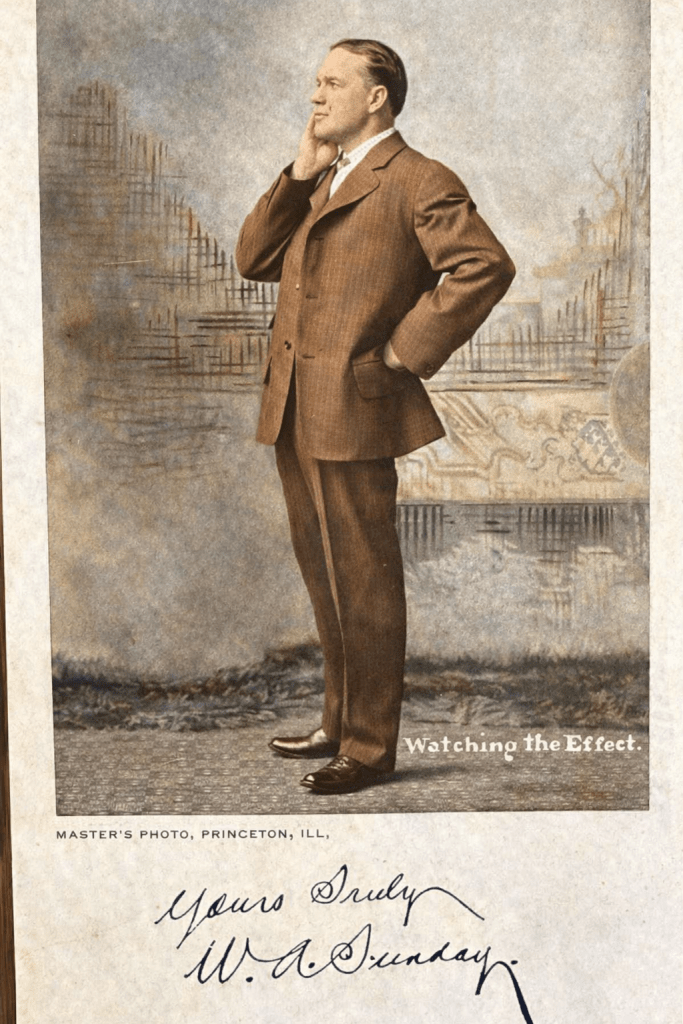
Who is Billy Sunday c. 1909

The Billy Sunday campaign published a souvenir booklet in 1910 that summarized the Springfield, Illinois campaign (Feb 26 – Apr 12, 1909). The following narrative shared much about the Rev. William A. ‘Billy’ Sunday

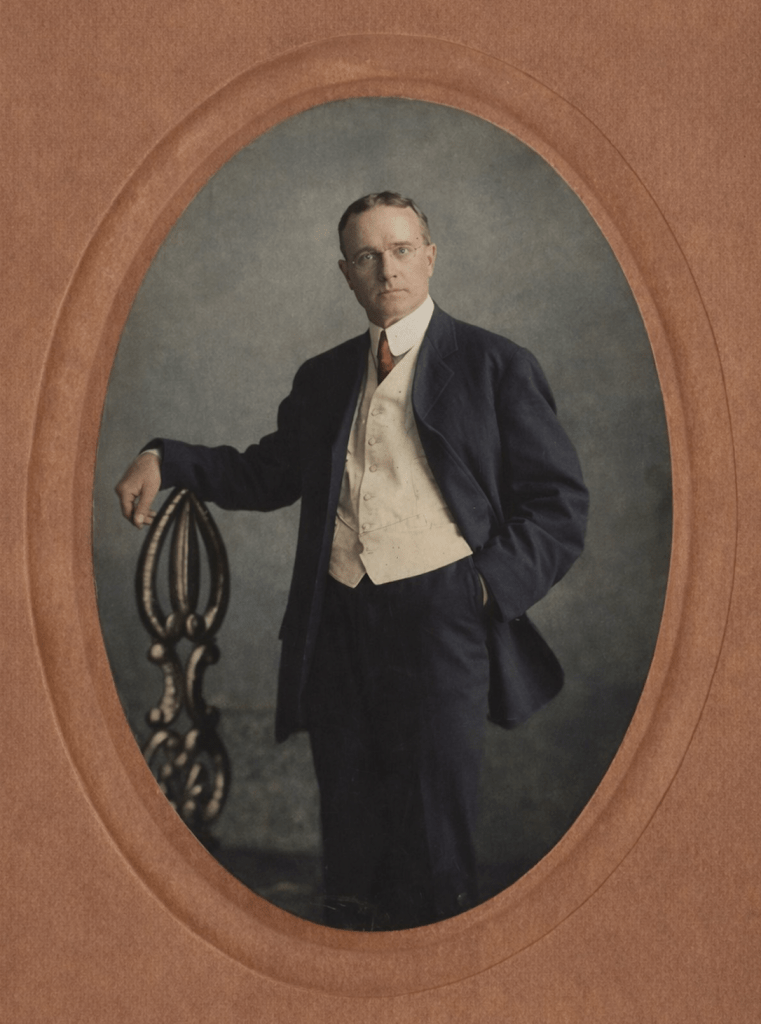
Rev. W. A. Sunday

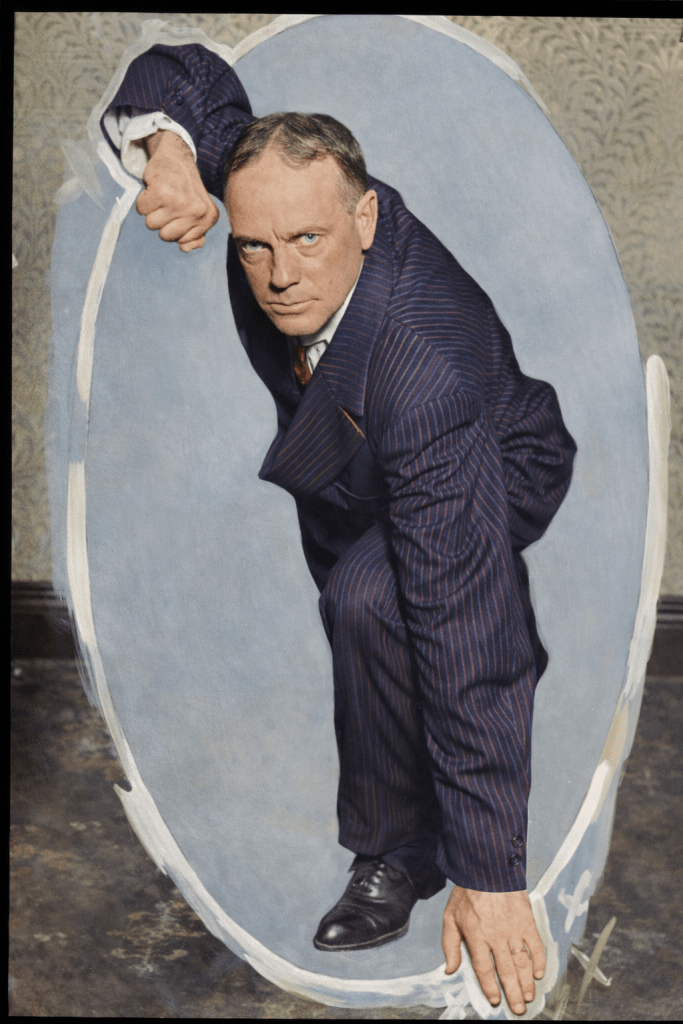
WILLIAM ASHLEY SUNDAY is the best beloved and the most abused, the simplest and the most misunderstood, the most soulful and the most like a vaudeville performer, the most powerful in oratory and the least appealing to the emotions, the most persuasive and the most controversial, the most scholarly and the plainest, not to say coarsest, the greatest poet in essence and the greatest scrapper, of any man on the forum, the platform, or the stage of the world today.

He has been styled, the polygonal preacher, because he has so many sides, each a complete, finished, forceful fact. A character picture of the man, to be complete, must be a description of each of these baker’s dozen sides of his personality, none of which is much more important than any other one. The most that can be done within a small space—or indeed within any limitation of space—is to sketch in broad lines the mere outlines of this evangelist who is preaching the gospel of peace on earth and fighting the devil with the hottest of fire at the same time.

His father was killed in the civil war. The little boy was sent to the Iowa home for soldiers’ orphans. Later he made his own living at a youthful age, and his school teacher of that time says she would often watch him on the playground and wonder whether he would be the greatest crook or the greatest power for good in America—she was even then sure he would be one of the two. The boy took the right hand road.

When a young man he was a locomotive fireman on the Chicago and Northwestern Railroad and lived at Marshalltown. This was also the home of the famous A. C. Anson, captain of the old Chicagos, who watched Billy Sunday play baseball on corner lots while at home in Marshalltown. Anson took him to Chicago, discovered in him a great baseball player, and Sunday held the record for base running for years, a record which he still holds; was the second man chosen on the All-American team to tour the world—an accident to his knee kept him from making the tour—and was a popular idol of the fans.

An old time catcher for the Louisville team says that in those days when en route the rest of the men would play poker in the Pullman, but Billy Sunday was always back on the cushions with a book. He has kept close to books ever since. He has a remarkable faculty of choosing the very best and most authoritative writing on any particular subject and reading that only—and hence the range of subjects upon which he is thoroughly and accurately informed, includes almost everything from histology to astronomy and from bacteriology to history—it is a little interesting to notice that chemistry is the one topic unmentioned in his sermons. Three medical college professors who met at the end of his sermon which includes a half hour of the deepest microscopical pathology, agreed that William A. Sunday is the only layman they ever heard or read who was accurate in all he said about medical science.

One night a bunch of baseball players strolling along a Chicago street ran into a curbstone evangelist and stopped to be amused. Sunday stayed after the others went on. He went from there to the Pacific Garden mission, where he was converted. He kept on playing baseball, and nobody who ever heard it will ever forget his own description of how the others of that famous Chicago team approved his home run into Christianity.

A little later he was employed by the Chicago Young Men’s Christian Association at a small salary, only part of it paid during the panic of 1893, and refusing offers of $500 a month to return to the diamond. As a part of his work, he addressed groups of men—he always did know men, because of his early life and hard struggles. The addresses became longer and stronger with the growth of the work and experience in it. That great evangelist, Wilbur F. Chapman, took Sunday away from the Chicago Y.M.C.A. to be his assistant. Sunday learned the art of evangelizing and after learning it thoroughly treated it as Napoleon treated the art of war—he re-made it for himself, so that its old practitioners hardly recognize it, and at the same time made it produce victories hitherto undreamed of. The William A. Sunday methods of campaigning for Christ are unlike any others; they include the best of those of the past and many things unique; probably only Sunday could use them successfully in all their details; but it seems certain that they have factors not found in most others which really are the corner stones of successful work in evangelism. Some of the chief parts of the art of evangelism, as practiced by William A. Sunday, are these: Absolute accuracy in every statement made, whether one of the essential parts of the argument, or merely an illustration; hew close to the line that Jesus Christ laid down, regardless of the falling chips, and wherever that line leads; use language that everybody can understand, never talk down to an audience, but be lucid to the most ignorant while you are talking up to the most scholarly persons before you; avoid sectarianism; demand united work from all the evangelical churches in the city, and push united work by all the members of those churches; roast the skin of vice and sin in all its forms, from backsliding and carelessness to murder and adultery, rub salt into the burnt flesh, and then apply a healing balm that causes the object of the criticism to leave the tabernacle chastened in spirit, but loving the rod that smote him; avoid all fads and fancies, all tangential movements of society, but do a common thing in a most unusual way; and—many others. Starting with small towns and a few hundred converts at each series of meetings, the same plan of campaign has been used for all the years involving campaigns in cities of all sizes, and the first meetings years ago were, so far as Mr. Sunday is concerned, almost exactly like the meetings in Springfield. Of course, some minor modifications have been made, but these are few. Always there are the first sermons to get the church members back out of the world into the influence of Christ and to get the public to come to the tabernacle—the public seems to find its greatest attraction in hearing church-member hypocrites and Pharisees skinned like eels. Always the strenuosity of the sermons almost imperceptibly lessens gradually until the preacher who preaches as man never preached before is less athletic and more rhetorical about the middle of the series. Then, to the amazement of people who judged the man from his first pulpit stunts, the Reverend William Ashley Sunday preaches like the great orator that he is, the scholar that he is, the poet-philosopher that he is. This many sided man cannot be even sketched within a hundred pages. There is competent authority for saying of him these superlatives as being strictly true: He understands the minds and feelings of men as few men ever have done. He is one of the greatest orators the world has ever seen—and this is proved by the results of his work.

He is one of the most remarkable stylists in literature, his perfect imitation in one hour of the styles of Carlyle, Gibbon, Ingersoll, and several other writers of individual styles being an unprecedented feat.

He is said by scientists to be the most—and indeed the only—perfectly accurate preacher in matters of science. And a large part of his sermons deal with science.

He appeals entirely to the reason of the people, and rarely or never to their emotions, and in this he is the greatest of evangelists in the opinion of many people.

In numbers of converts, dramatic height of scenes, and wonderful stirring of the audience, several of his meetings have eclipsed anything in the history of evangelism since pentecost—and the most of these have been meetings for men.

Who is Hellen ‘Ma’ Sunday? c. 1909

The following is a biographical sketch of Helen Sunday, wife of Billy Sunday. Part of the 1909 Springfield campaign souvenir.

Mrs. W. A. Sunday

THE biographer who omits to study the wife of his subject certainly will miss the key to his problem of investigation. The world talks of the influence of the mothers upon its men; but it, curiously enough, generally omits appreciation of the strong influence of the wife upon any man; and perhaps more men have been made and unmade by their wives than by their mothers, when heredity is omitted from the matter.

Mrs. William A. Sunday was a girl of great strength of character when she was Miss Helen A. Thompson, the daughter of a Chicago business man. She married a famous baseball player and found herself the wife of one of the greatest of evangelists—and she not only made the revolutionary change with him but is one of the chief causes of William A. Sunday being what he is in the eyes of the world. She was a church worker, a shining exception to the rule of the results of marrying a man to make him better. She upheld the hands of her husband when he was in poverty and the poorly paid worker of the Chicago Y.M.C.A., writing letters declining, for seven times his salary, to return to the baseball field. When William A. Sunday was starting out as an evangelist along entirely new lines of endeavor which merged into In his entirely unprecedented lines of achievement, his wife helped greatly to keep up his courage, keep him along the line he had chosen, and keep him as much as possible free from worries. Mrs. Sunday complements her husband perfectly—they are not at all similar, and she is strongest where he is weakest and weakest where he is strongest. If he had a helpmeet like himself, Mr. Sunday might be plunging into hot water every month and every year. Luckily for him, his wife guides him around and over most obstacles, keeps his fingers out of the fire, and does what Mr. Sunday never thinks of doing—looks after his own interests.

The wedding of Mr. and Mrs. William A. Sunday was not the kind one finds pictured in Paul and Virginia by any manner of means; it was a twentieth-century marriage of two distinct individuals joining as helpmeets, without either submerging a personality in the other—certainly not the old kind of entire submergence of the wife in the husband. They disagree about as many things as other people do, but each knows in what things the other is best informed or strongest, and the one best qualified always decides the question. The result is that they are more free from actual, important disagreements—the kind called love spats or marital troubles—than most people. This is a match of brains as well as of hearts, of sense as well as of souls, and of respect as well as of love.

Mrs. Sunday does what she can in public during a series of meetings conducted by her husband, but the most important thing she does is to keep her husband able to do the great things he accomplishes in every city in which he works. She is a perfect wife for a very remarkable man.

“BILLY” SUNDAY ASSAULTED.


Page 2 of The Britt News, published in Britt, Iowa on Thursday, March 4th, 1909
Horsewhipped by Religious Zealot at Springfield.

Rev W. A. Sunday, better known as “Billy” Sunday, a former baseball player, who is now an evangelist, was horsewhipped Friday night by a religious fanatic at the Sunday tabernacle in Springfield, Ill., where, in the presence of 8,000 persons he was conducting the opening meeting of a religious revival.

The evangelist had just made his opening remarks and was leaning against the pulpit while a hymn was sung by Fischer and Butler, his choral leaders, when a powerful man who says his name is Sherman Potts ran forward with a buggy whip and struck Sunday several terrific blows.

Sunday leaped from the platform and dashed at his assailant, whom he knocked down. The audience was on the verge of a panic, with women weeping and children screaming while Potts and Sunday rolled and tumbled in the aisle.

Mr Fischer directed the choir and the audience to sing, and in a few moments the entire audience was calmed Several men seized Potts and held him until policemen came and took him to jail.

Mr Sunday suffered several painful bruises from the whip The prisoner said his home was near Lexington, Ill According to his statements at the jail he was once declared insane and committed to the Jacksonville asylum, whence after a brief confinement he was released.

He made the attack he said, in defense of the virtue of women which he declared had been criticized by the evangelist The police say that Potts is a religious fanatic.

  • Page 2 of The Britt News, published in Britt, Iowa on Thursday, March 4th, 1909.