When a Revival Outdrew the State Fair: Omaha, 1915

In the fall of 1915, Nebraska found itself hosting two of the largest public gatherings in its history.

One was expected.
The other was not.

In Lincoln, the Nebraska State Fair was in full swing. Newspaper headlines called it “the greatest ever held.” Despite rain and poor weather early in the week, crowds poured through the gates. By the time it ended, total attendance reached 180,767—a record-setting year. The fairgrounds were packed with machinery exhibits, livestock judging, aerial shows, wrestling matches, and the familiar buzz of a state coming together for its biggest annual spectacle.

It was, by every measure, a success.

But sixty miles away, something far more remarkable was unfolding.

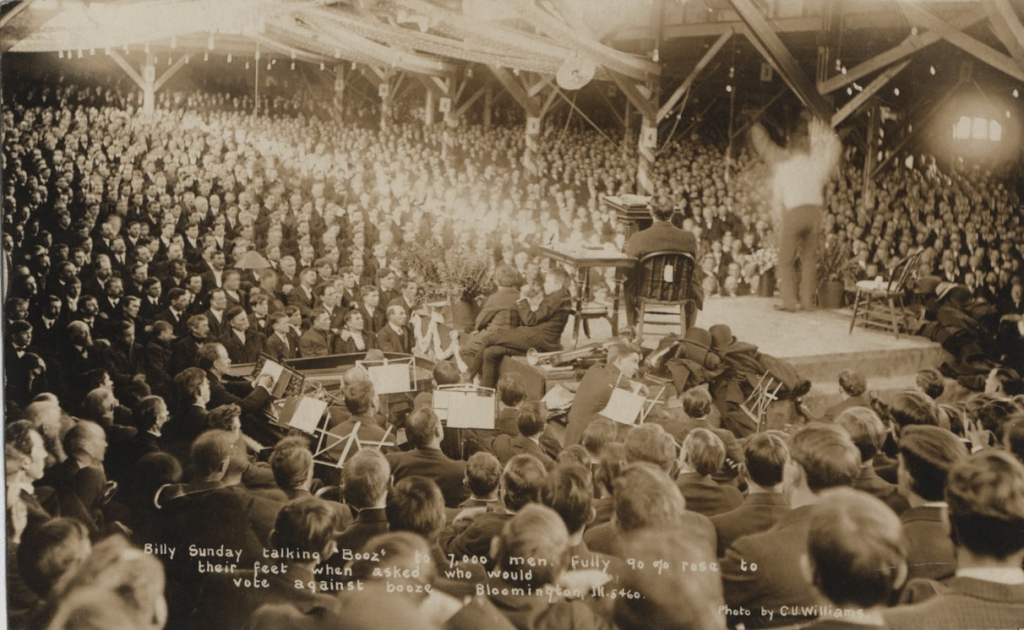
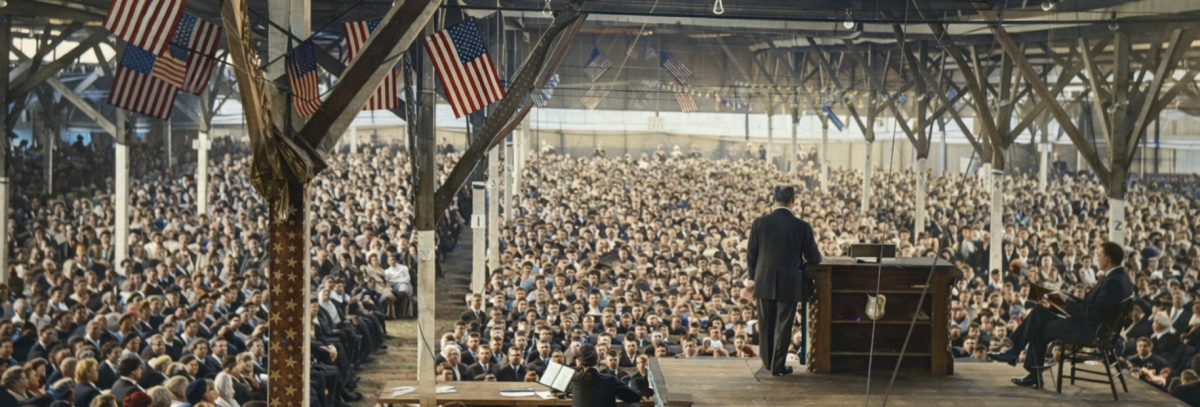
In Omaha, a temporary wooden tabernacle had been erected for evangelist Billy Sunday. There were no rides. No prize livestock. No grandstand attractions. Just sawdust, benches, a pulpit—and a preacher.

Yet by the time Sunday’s campaign ended, the numbers told a different story.

The revival recorded approximately 930,000 total attendees across its six weeks of meetings. Of those, nearly 795,000 passed through the tabernacle itself. More than 13,000 people walked the “sawdust trail,” publicly declaring their decision for Christ.

Let that sink in.

The largest civic event in the state drew just over 180,000 people in a week.
Billy Sunday’s revival drew over five times that number (in six weeks total).

The 1915 Omaha Billy Sunday revival, bookstore.

And it wasn’t confined to a single venue or moment. The revival spread throughout the city:

  • Over 2,100 cottage prayer meetings during the campaign
  • Tens of thousands attending women’s meetings, Bible classes, and noon gatherings
  • Business leaders, factory workers, students, and families all pulled into its orbit

This was not simply a series of sermons. It was a citywide movement.

The contrast is striking. The State Fair represented the best of Nebraska’s agriculture, industry, and entertainment. It was planned, promoted, and expected to succeed.

Sunday’s revival, on the other hand, was built on something less tangible but far more powerful—a shared spiritual hunger that transcended social boundaries.

For a brief moment in 1915, Omaha became the epicenter of something larger than spectacle. Larger than tradition. Larger even than the state’s greatest annual event.

The fairgrounds would empty. The tabernacle would be torn down.

But for those who were there, the memory remained:

A season when the crowds came—not for entertainment—but for transformation.

Sources: curated from Omaha newspapers from 1915.

When “Ma” Sunday Called Them Forward, c.1915

Ma Sunday in Omaha, c. 1915

There are moments in the Sunday campaigns that feel almost hidden in the shadow of Billy’s larger-than-life presence—but when you find them, they reveal something just as powerful.

One such moment came during a women-only meeting led by “Ma” Sunday.

The tabernacle was full—some 6,000 to 7,000 gathered—but this was a different kind of service. No booming theatrics. No sawdust-charged bravado. Instead, there was a quieter, deeply personal appeal.

And when she called them forward, 115 women and girls rose and walked the aisle.

A Different Kind of “Trail-Hitting”

The newspapers called it a “replica” of Billy’s famous trail-hitting—but it wasn’t quite the same.

There was a tenderness to it. And, at first, a bit of confusion.

Many of the women thought they were simply going forward to greet Mrs. Sunday—to shake her hand, to thank her, to meet her. They came quickly, almost instinctively, forming what one observer described as a “bee-line” down the aisle.

It took a firm voice from Mrs. Asher, one of the Sunday team, to steady the moment:

This is not a reception line. This is for those who want to be saved.

And just like that, the tone shifted.


Faces in the Crowd

The reports linger on the people—and that’s where the story lives.

A housemaid, still in her work attire, came forward and clasped Mrs. Sunday’s hand, covering it with kisses.

A weeping mother walked the aisle with her small son, alongside her grown daughter.

Two young girls, barely ten years old, came arm in arm.

High school girls stepped forward carrying their school pennants.

Even the choir—singing hymn after hymn—was visibly moved, some of them weeping as they sang.

This wasn’t spectacle. It was personal, family-bound, deeply human.


Her Message: Personal Service

If Billy Sunday’s sermons often thundered, Ma Sunday’s message pressed inward.

She didn’t just call women to come forward—she called them to act.

  • Make a prayer list.
  • Win at least one person to Christ.
  • Take responsibility for the spiritual lives around you.

Her appeal was practical, almost methodical—but never cold. It was rooted in experience, shaped by her own life, and delivered with a kind of plainspoken honesty.

At one point, she reflected on her upbringing—rigid, formal, spiritually lifeless—and contrasted it with her determination to move forward anyway:

I was going to bust.

It’s the kind of line that doesn’t sound polished—but it lands.


Tears—and Resolve

Perhaps the most telling moment came when she addressed women with unsaved husbands and children.

Many of them broke down.

The article notes they wept bitterly.

This wasn’t abstract theology. This was eternity pressing into the home.

And Ma Sunday didn’t leave it there. She pointed them toward action, toward prayer, toward persistence.

She even set her sights on the next gathering—calling for a packed house of mothers and grandmothers, marked by a simple white flower.


The Broader Picture

What we see here is something easy to miss if we focus only on Billy:

The Sunday campaigns were not a one-man operation.

They were a network of voices, and Ma Sunday’s was essential—especially among women. Her meetings didn’t mirror Billy’s so much as complement them.

Where he confronted, she invited.
Where he thundered, she persuaded.
Where he called for decision, she called for ongoing service.

And in doing so, she mobilized an entire segment of the revival that might otherwise have remained on the margins.


Final Reflection

In the end, the numbers—115 responding—tell only part of the story.

What matters more is what those women carried home with them:

  • A renewed sense of responsibility
  • A burden for their families
  • A call to personal witness

Ma Sunday didn’t just ask them to walk an aisle.

She asked them to live differently when they walked back out.

And for many of them, that’s where the real revival began.

Source: The Omaha Daily Bee, Sept 20, 1915:1

Sermon: When chickens come home to roost

One of Billy’s favorite sermons was When chickens come home to Roost. He would preach it often and usually in the first 1-2 weeks of a revival.

What was the sermon about?

In “Chickens Come Home to Roost,” Billy Sunday argues that sin is never isolated or harmless—it inevitably returns with consequences that grow over time. What begins as a small compromise develops into habit, then character, and ultimately destruction. He emphasizes that sin corrupts the individual internally before it manifests outwardly, dulling the conscience and weakening the will. Sunday also stresses that sin is not merely personal; it affects families, communities, and even nations. He dismantles common excuses—denial, delay, and comparison—and insists that no one escapes moral accountability. The sermon builds toward an urgent appeal: repentance must happen now, before sin’s consequences fully mature and bring irreversible damage.

Representative Quote:
“Your sin may seem quiet tonight, but it will rise up tomorrow and demand its wages.”

The sawdust Trail poem

This poem was sent to Billy and Ma c.1922. It is housed in Morgan Library at Grace College.

Transcription

THE SAW-DUST TRAIL

The Devil sure is hiding out
Since Billy Sunday came to town;
He’s getting knocked and cuffed about,
For Billy’s surely got him down.
He smashed his nose and blacked his eye—
The Devil howled a mighty wail
When sinners heard the pleading cry
And marched along the saw-dust trail.

The Devil now is quite a monk
Since Billy tore his mask aside;
He does not show one bit of spunk—
Begs us to spare his rotten hide;
With injured look and sickly smile
He hopes that pity will avail.
Ah no! for hundreds yet will file
Right down along the saw-dust trail.

The primrose path where evil lures
Is shown in all its bleak despair;
All pleasures fade—not one endures—
When we have reached old Satan’s lair.
And Billy shows the hateful Thing
That makes our lives a woeful tale;
You almost hear Hell’s anvils ring,
And we are drawn to hit the trail.

His doctrines may not all be clear,
But Billy’s surely fighting sin;
We know his motives are sincere,
And we can’t help from joining in.
He makes you see the battle strong
That’s not for cowards who would quail;
We join the right against the wrong,
And march right down the saw-dust trail!

Old Satan thought he had a cinch
On Charleston souls, both young and old;
But now he knows he’s in a pinch,
For Billy’s punch has knocked him cold.
Aggressive Right will always win—
The Serpent knows he’s doomed to fail;
He cowers low, with sickly grin,
When strong men hit the saw-dust trail!

Charleston, W. Va.
March 20, 1922.

T. J. Honaker

“With my compliments, and very great admiration for ‘Billy.’”

“Just Sit Still, Boys”: Billy Sunday’s Journey to the Soldiers’ Orphans’ Home

Billy Sunday often told audiences that his life had not begun in comfort or advantage. Long before he stood before great crowds in revival tabernacles, he had known poverty, loss, and uncertainty. One story he occasionally shared reached back to the earliest days of his childhood.

“My father enlisted four months before I was born,” Sunday recalled. “He went to the front with his Company of Twenty-third Iowa Infantry, but he never came back.” The elder Sunday died during the Civil War and was buried at Camp Patterson, Missouri. The evangelist never saw him.

The war left Billy’s mother alone with two small boys to raise, and life on the Iowa frontier was hard. “I have battled my way since I was six years old,” Sunday said years later. “I know all about the dark and seamy side of life. If ever a man fought hard every inch of his way, I have.”

Eventually the strain became too great. One day his mother gathered Billy and his brother Ed and told them quietly what must happen.

“Boys,” she said, “I am going to send you to the Soldiers’ Orphans’ Home at Glenwood, Iowa.”

The boys would have to travel there by train. The night before their departure Billy noticed something unusual about his mother. “I looked into mother’s face. Her eyes were red and her hair was disheveled.” Only later did he understand why. “All the time Ed and I slept, mother had been praying.”

When the moment came to leave, the goodbye was heartbreaking. “Mother put one arm about me and the other about Ed and sobbed as if her heart would break.” Passersby noticed the scene but did not understand its meaning. “People walked by and looked at us,” Sunday remembered, “but they didn’t say a word. They didn’t know, and if they had they wouldn’t have cared. Mother knew; she knew that for years she wouldn’t see her boys.”

The train pulled away and the boys cried out, “Good-by, mother!”

Their journey was not easy. When they reached Council Bluffs it was cold, and the boys had little money and thin coats. They turned their collars up against the wind and wandered about the town. Finally they went into a small hotel and asked a woman for something to eat.

“What is your name?” she asked.

“My name is Willie Sunday and this is my brother Ed,” he answered.

“Where are you going?”

“Going to the Soldiers’ Orphans’ Home at Glenwood.”

The woman wiped her eyes when she heard their story. “My husband was a soldier and he never came back,” she said softly. “He wouldn’t turn anyone away, and I certainly won’t turn you boys away.” She took them in and fed them both breakfast and dinner.

But the hardest part of the journey still remained. The boys had no money for the train that would take them the last miles to Glenwood. When they saw a freight train standing on the tracks, they climbed into the caboose and hoped for the best.

Soon the conductor appeared.

“Where’s your money?” he asked.

“Ain’t got any.”

“Where’s your tickets?”

“Ain’t got any.”

“You can’t ride without money or tickets,” the man said. “I’ll have to put you off.”

The boys began to cry. Ed handed the conductor a letter addressed to the superintendent of the soldiers’ orphans’ home. The man read it slowly. When he finished, he gave the letter back. Tears were running down his cheeks.

“Just sit still, boys,” he said gently. “It won’t cost you a cent to ride on my train.”

A short time later, as the train rounded a curve in the Iowa countryside, the conductor pointed toward a hill in the distance.

“There is the home on the hill.”

For Billy Sunday, the journey to the Soldiers’ Orphans’ Home marked the beginning of a difficult but formative chapter in his life. Years later, when he stood before vast revival crowds, he sometimes told this story—not simply to recount his past, but to remind listeners that even in the hardest moments, kindness and providence could appear in unexpected places.

Adapted from: March 13, 1916 (8). The Baltimore Sun.

How did Billy’s Baltimore revival sermons compare to his Trenton campaign (both in 1916)?

From Trenton to Baltimore: How Billy Sunday’s Preaching Evolved in 1916

When Billy Sunday concluded his revival campaign in Trenton, New Jersey, in February 1916, he had already delivered an extraordinary number of sermons in just a few winter weeks. Soon afterward he moved south to begin what would become an even larger campaign in Baltimore, Maryland.

A comparison of the sermon lists from the two cities reveals something fascinating about Sunday’s preaching strategy. While the evangelist was famous for repeating certain signature sermons from city to city, the Baltimore campaign shows a noticeable shift in emphasis and structure compared with Trenton.

The Baltimore Tabernacle

The Trenton Campaign: Classic Revival Preaching

The Trenton sermons follow the pattern of a traditional evangelistic revival. Many of the titles focus directly on conversion, repentance, and the urgency of salvation. Messages such as What Must I Do to Be Saved?, After Death, Judgment, Rich Young Ruler, and What Shall the End Be? formed the backbone of Sunday’s preaching.

These sermons were part of Sunday’s well-known revival repertoire. In Trenton he rotated them rapidly, returning to the themes of judgment, repentance, and personal decision again and again. Titles like Backsliding, Get Right, Choose Ye This Day, and Be Sure Your Sins Will Find You Out show how directly he pressed the audience toward a response.

This approach reflected the classic revival method: present the danger of sin, call for repentance, and invite listeners to make a public decision.

Baltimore: A Broader and More Structured Campaign

When Sunday arrived in Baltimore later in February, the preaching program became noticeably broader. While the evangelistic messages remained, the sermon list shows a wider range of topics and a more deliberate sequence of themes.

Several sermons addressed revival within the church itself, including The Need of Revivals, Revive Thy Work, and The Restoration of the Church. Others focused on Christian living, such as Following Christ, Positive and Negative Religion, and Show Thyself a Man.

New Sermons Appear

The Baltimore list also introduces several sermons that do not appear in the Trenton campaign. Messages such as The Authenticity of the Bible, God’s Battle Line, The Temptation of Christ, Love Your Enemies, and The Incarnation of Christ reveal a more doctrinal dimension to the preaching.

In other words, Baltimore was not only about winning converts. It also included teaching aimed at strengthening believers and encouraging churches.

The Core Sermons Remained

Despite these differences, Sunday’s core sermons appear in both campaigns. Titles such as Dr. Jekyll and Mr. Hyde, The Fig Tree, Samson, The Atonement, Choose Ye This Day, and What Must I Do to Be Saved? were staples of his preaching for years.

These messages formed the foundation of Sunday’s evangelistic ministry, and he carried them from city to city with remarkable consistency.

A Larger Revival

The Baltimore campaign also dwarfed Trenton in size. By the time the meetings ended in April, reported attendance had reached 1,376,000 people across the entire series of services.

Such a large audience may explain the broader range of sermons. A major metropolitan revival like Baltimore required not only evangelistic appeals but also teaching, church renewal, and special meetings addressing different audiences.

Two Cities, One Evangelist

Taken together, the Trenton and Baltimore sermon lists provide a revealing glimpse into Billy Sunday’s methods. Trenton shows the evangelist operating in his classic revival mode—pressing the claims of the gospel with urgency and repetition. Baltimore shows him expanding that message into a wider program of preaching that addressed both unbelievers and the church itself.

In both cities, however, the heart of the message remained the same. Whether speaking in a smaller industrial city like Trenton or in a large urban center like Baltimore, Billy Sunday continued to deliver the message that had defined his ministry from the beginning: a call to repentance, faith, and a transformed life.

How did Billy Sunday sum up his own theology (c.1916)?

“My theology is really summed up in four letters: H-e-l-p. I am here to do my best to help the people in this old world live better, and to show them the way to do it. Some people can see no way out for the sinner except through the police court or the potter’s field. I have come to tell you there is another way—through repentance and belief in the Lord Jesus Christ.

“Some people have put their trust in government, but there is no salvation through government. They all have failed to suppress vice and develop virtue, America as well as the rest. Others put their trust in education. You can dot every hill with a schoolhouse and put a university in every block and it will save no one unless it is combined with virtue and faith.

Source: April 13, 1916. Baltimore Sun (p.6)

When the Union Veterans Marched Up the Sawdust Trail, Maryland (c.1916)

Baltimore, April 1916

During Billy Sunday’s great revival in Baltimore in the spring of 1916, one evening at the tabernacle took on a distinctly historic tone. The sawdust aisles—normally filled with businessmen, laborers, and curious citizens—were suddenly occupied by a different kind of procession. A body of Union veterans of the Civil War, many gray with age but still proud of their service, marched forward together into the meeting.

1915 Civil War veterans, source unknown

According to the Baltimore Sun, nearly 500 veterans of the Grand Army of the Republic (GAR) attended the revival that night. The GAR, the powerful national organization of Union veterans, was still an important presence in American civic life in the early twentieth century. Though the war had ended more than fifty years earlier, the men who had fought to preserve the Union remained symbols of sacrifice and national memory.

The veterans were led by James E. Van Sant, commander of the Maryland Department of the GAR, along with E. R. Monfort of Iowa, who at the time served as Commander-in-Chief of the national organization. When they entered the tabernacle they were warmly received, and the crowd greeted them with enthusiastic applause.

The occasion had the character of both a patriotic ceremony and a revival meeting. The veterans arrived with a brass band, and when the musicians began to play familiar airs the audience responded with equal fervor. The strains of “Maryland, My Maryland” and “The Star-Spangled Banner” rang through the building, followed by old martial tunes such as “Yankee Doodle” and “Dixie.” The building reportedly shook with applause as the music echoed beneath the great wooden roof of the tabernacle.

The veterans also presented Billy Sunday with a gift—a ceremonial Old Glory mounted on an elaborately wrought brass standard. It was a gesture that connected the evangelist’s message with the patriotic ideals the veterans had fought to defend half a century earlier.

The evening was opened with prayer by Rev. B. F. Clarkson, chaplain of the Maryland GAR. Both Billy Sunday and his music director Homer Rodeheaver spoke warmly of the veterans and the sacrifices they had made for the nation. Rodeheaver added to the patriotic atmosphere by playing martial music and bugle calls on his trombone.

For the aging soldiers, the gathering was more than a nostalgic reunion. Many of them walked the same sawdust aisles as the younger men and women attending the revival. Their presence reminded the audience that the Civil War generation was rapidly passing from the scene. These men had once marched into battle for the Union; now they marched into a revival meeting in search of spiritual renewal.

By 1916, the Civil War was already receding into history, but its memory still held powerful emotional force. That night in Baltimore, the veterans’ appearance created a striking moment where patriotism, memory, and revival religion met under one roof.

The sight of those aged soldiers marching forward—flags waving, band playing, and the crowd cheering—must have been unforgettable. For one evening at least, the old warriors of the Union once again marched together, not onto a battlefield, but down the sawdust trail of Billy Sunday’s revival.

On the Sawdust Trail: A Night at Billy Sunday’s Tabernacle, Philadelphia (Week One)

Curated from: The Philadelphia Evening Ledger. January 6, 1915:3.

You don’t just attend a Billy Sunday meeting—you step into it.

By the time I reached the tabernacle, the place was already alive. Not just crowded—alive. Policemen lined the edges, firemen stood ready, and yet there wasn’t even “the merest hint of disorder.” Whatever this thing was, it had structure. It had gravity. And it was pulling people in.

Colorized image of the Billy Sunday tabernacle in Philadelphia, c.1915.

Inside, the air carried that peculiar mixture of sawdust, sweat, and anticipation. Outside, though—that’s where you heard the real story.

A man near me, confident as a prophet, said to no one in particular:

“Billy Sunday has only started… it’s going to get worse and worse. He arouses more enthusiasm each day. If you don’t believe me, ask Scranton.”

That was the mood—this wasn’t the event. This was the beginning of the event.

The Crowd Watching the Crowd

It struck me quickly: people weren’t just watching Billy Sunday.

They were watching each other.

One visitor said it plainly:

“I was naturally interested in ‘Billy’ Sunday, and perhaps even more so in the crowd.”

And what a crowd it was.

A boy—no more than ten—hobbled in on crutches just to hear him. A sailor from the battleship Kansas had been waiting “for months” to catch a meeting. A woman stood nearby, nervous, almost whispering:

“Oh! no. I cannot give my name… my husband would throw a fit if he knew I had been in here.”

And yet—there she was.

That’s how you knew something was happening. Not just attendance—but risked attendance.

What People Were Saying

If you wanted to understand Billy Sunday, you didn’t start with the sermon.

You started with the talk afterward.

“What do you think of ‘Billy’?” someone asked.

The answers came quick, overlapping:

“Great.”
“Some man.”
“An ace.”
“I like him because he goes after the hypocrites.”

Others reached for bigger words:

“Wonderful… splendid… marvelous.”

But not everyone could quite put their finger on it.

One woman, looking slightly dazed, said:

“I have had so many things fired at me in the last hour that I can’t quite set my bearings.”

That may have been the most honest response of all.

More Than a Sermon

There was something else in the air—something heavier than excitement.

A man, speaking to a small group of women, said what many were thinking:

“I would like to see ‘Billy’ Sunday wake this city up and get the rum out of it… Look how many homes he would make happy.”

And then, almost quietly, another moment:

In the northeast corner of the tabernacle, someone reported hearing a man say:

“This is my last drink.”

No sermon transcript can capture that.

That’s the sawdust trail doing its work.

The Unexpected Details

Not everything was solemn.

Someone joked about the sawdust itself:

“They say Mr. Sunday hates noise, and I know I am going to sneeze. I always do when around sawdust.”

Even the ministers weren’t immune to the moment. One well-known clergyman was said to amuse himself before preaching by reading The Fun of Getting Thin—and now, thanks to the crowds, “occupies two seats.”

And everywhere—evidence of men lingering longer than usual:

“There were enough cigar butts left in the gutters… to start a true second-hand cigar store.”

It wasn’t tidy.

It wasn’t polished.

But it was real.

Order in the Midst of It All

For all its energy, the thing held together.

The crowds were vast, but they moved. The police managed them. The firemen stood watch. The machinery of the city seemed, for a moment, to cooperate with something larger than itself.

One observer summed it up best:

“To get and hold a vast throng like this on a weekday for the purpose of hearing the gospel certainly is a tribute to the man himself.”

And It’s Only the Beginning

If you stood there long enough, listening—not to the sermon, but to the people—you began to realize something:

The revival hadn’t peaked.

It hadn’t even arrived yet.

It was building.

You could hear it in the confidence of the man who said, “ask Scranton.”
You could see it in the boy on crutches.
You could feel it in the nervous woman who came anyway.
You could sense it in the man who muttered, “my last drink.”

Billy Sunday may have been the preacher.

But the city—
the crowd—
the conversations spilling out onto the streets—

They were becoming the message.

And Philadelphia, whether it knew it yet or not, was just getting started.

‘MA’ DOES MUCH TO HELP ‘PA’ IN HIS LABOR

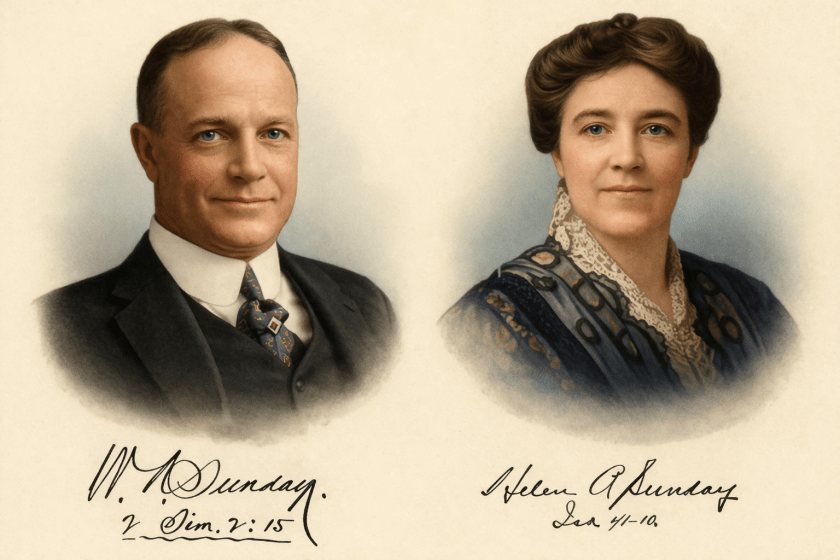
Mrs. William A. Sunday always denies the statement so often and so lovingly made by her son, George, also of the party, that she is the ‘boss’ of the Sunday campaign, but that doesn’t do away with the fact that it was largely through her efforts that the wonderful system of the Sunday’s has been developed.

Along with her many charming feminine qualities Mrs. Sunday is a woman of unusual executive ability, and her keen ability to see the needs and apply the remedies required in work of this kind has made possible the plans whereby the campaigns are made so effective.

‘Do you not relieve Mr. Sunday many tasks, of seeing people, of making plans and of deciding questions concerning the work,’ Mrs. Sunday was asked.

‘Oh, Yes, we all give him as much help as we can, but in the last analysis it is ‘papa’ who decides, and we, of course, do all that I can in this line.’

It has even been said by people who ought to know that Mrs. Sunday frequently suggests phrases for some of his sermons, and also the subjects. This is what she says about that:

‘When I go around with ‘papa’ I don’t just sit and look about, but I think and plan. I frequently see things which might be of use to ‘papa’ and I tell him about them. He is always welcome to all that I have to give him, to every suggestion I can make.’

Besides the work which Mr. and Mrs. Sunday are doing and which they both consider ‘God’s work,’ the nearest thing to Mrs. Sunday’s heart is her home. Her children are very dear to her. By reason of campaigns held in cities far from their home in Winona Lake, Mr. and Mrs. Sunday see little of their children during the nine months when they are doing evangelistic work.

‘I make it a point to go back home two or three days at a time, just to be where we are at home,’ Mrs. Sunday declares. ‘One of my greatest sorrows is the fact that my boys must grow up without the direct influence of Mr. Sunday and myself.’

‘Do you ever feel unhappy about leaving home to begin a new campaign,’ Mrs. Sunday was asked.

‘Yes, we both feel that way sometimes, but the thought that this is the greatest work which we could be given to do, helps us. For several days before we leave home, however, Mr. Sunday is completely broken up, and frequently is unable to eat.’

The Sundays do not grudge the sacrifice that they give, but instead they enter into the work with vim and with an intense desire to ‘live up to what God expects them to do,’ as they express it.

Paul, the eight year old son of the Sundays, who broke an ankle while playing football in the autumn, has recovered and is back at school and back too at his favorite sports.

In a very different way, Mrs. Sunday has just as great getting powers as her husband and when she addresses a group of women her sincere manner, her definite message and her wide-awake methods win the immediate attention of her audience.

‘Ma’ has her trail hitters too, and when she extends the invitation to the women to accept Christ and to lead Christian lives many are eager to shake her hand and to promise better living in the future.

It is an interesting life that Mr. and Mrs. Sunday have led ever since they were married out in Chicago years ago. For two years after their marriage ‘Billy’ played ball but he finally gave that up to do permanent work in the Y. M. C. A., in which he had been working in the winter months. Soon after that he became assistant for Dr. Wilbur Chapman and upon the retirement of that evangelist from active revival work Mr. Sunday conducted revival services in towns outside of Chicago.

Since then he has been in revival work.

Mrs. Sunday was formerly Miss Helen Thompson, one of four daughters of pioneer Chicago business men. Before her marriage she was interested in the church and was an active worker and since that time she has always assisted Mr. Sunday in God’s work.

Cited from a period 1915 newspaper