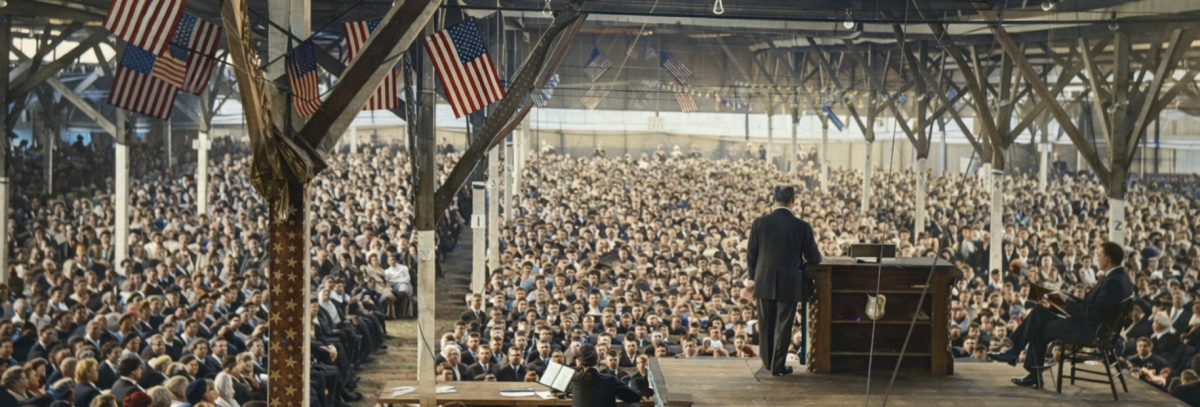
Omaha Sunday Bee – September 26, 1915
Here is the Narrative of How He Lost His Father in the War and Was Raised Then in the Orphans’ Home at Glenwood, a Few Miles from Omaha
I was bred and born (not in old Kentucky, although my grandfather was a Kentuckian), but in old Iowa, November 19, 1862. I am a rube of the rubes. I am a hayseed of the hayseeds, and the malodors of the barnyard are on me yet, and it beats Pinaud and Colgate, too.
I have greased my hair with goose grease and blacked my boots with stove blacking. I have wiped my old proboscis with a gunny sack towel; I have drunk coffee out of my saucer, and I have eaten with my knife; I have said “done it” when I should have said “did it” and I have “saw” when I should have “seen,” and I expect to go to heaven just the same. I have crept and crawled out of the university of poverty and hard knocks, and have taken post graduate courses.
My father, William Sunday, went to the war four months before I was born, in Company E, Twenty-third Iowa. I have butted and fought and struggled since I was 6 years old. That’s one reason why I wear that little red, white and blue button. I know all about the dark and seamy side of life, and if ever a man fought hard, I have fought hard for everything I have ever gained.
The wolf scratched at the cabin door, and finally mother said: “Boys, I am going to send you to the Soldiers’ Orphans’ Home!” At Ames, Ia., we had to wait for a train, and we went to a little hotel, and they came about 1 o’clock and said: “Get ready for the train.”
I looked into my mother’s face. Her eyes were red, her hair was disheveled. I said, “What’s the matter, mother?” All the time “Ed” and I slept mother had been praying. We went to the train; she put one arm about me and the other about “Ed” and sobbed as if her heart would break. People walked by and looked at us, but they didn’t say a word. Why? They didn’t know, and if they had they probably wouldn’t have cared. Mother knew. She knew that for years she wouldn’t see her boys. We got into the train and said, “Good-bye, mother,” as the train pulled out.
We reached Council Bluffs. It was cold and we turned up our coats and shivered. We saw a hotel and went up and asked the woman for something to eat. She said, “What’s your name?”
“My name is William Sunday, and this is my brother, ‘Ed.’”
“Where are you going?”
“Going to the Soldiers’ Home at Glenwood.”
She wiped her tears and said, “My husband was a soldier and never came back. He wouldn’t turn anyone away and I wouldn’t turn you boys away.” She drew her arms about us and said, “Come on in.” She gave us our breakfast and dinner, too. There wasn’t any train going out on the “Q” until afternoon. We saw a freight train standing there so we climbed into the caboose.
The conductor came along and said, “Where’s your money or ticket?”
“Ain’t got any.”
“I’ll have to put you off.”
We commenced to cry. My brother handed him a letter of introduction to the superintendent of the Orphans’ Home. The conductor read it and handed it back as the tears rolled down his cheeks. Then he said, “Just sit still, boys. It won’t cost a cent to ride on my train.”
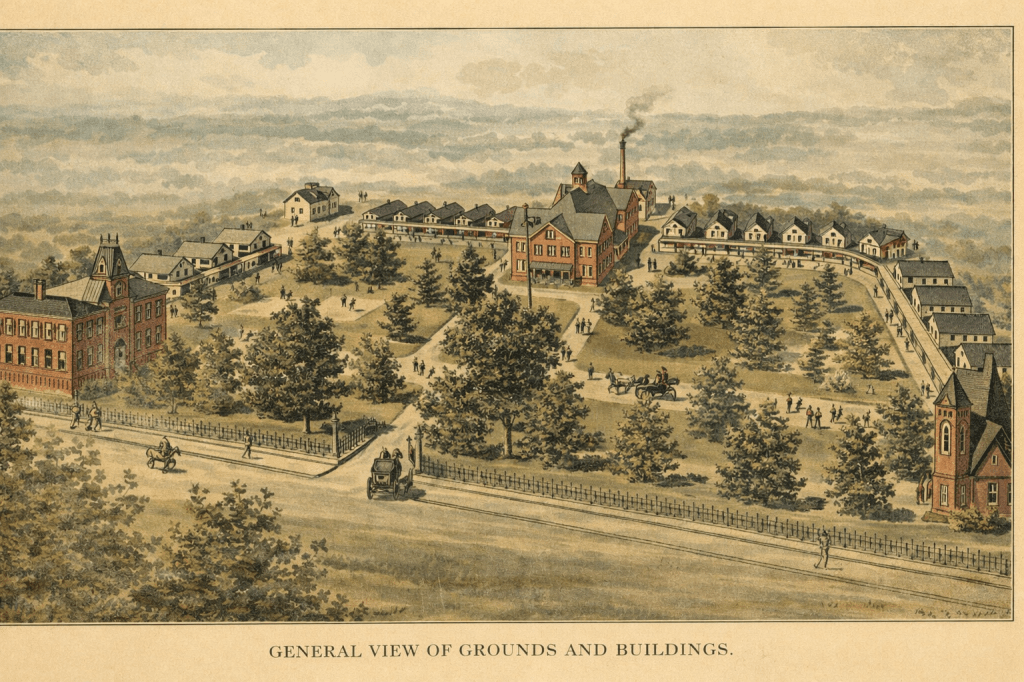
It’s only twenty miles from Council Bluffs to Glenwood, and as we rounded the curve the conductor said, “There it is, on the hill.”
I want to tell you that one of the brightest pictures that hangs upon the walls of my memory is the recollection of the days when as a little boy, out in the log cabin on the frontier of Iowa I knelt by mother’s side.
I went back to the old farm some years ago. The scenes had changed about the place. Faces I had known and loved had long since turned to dust. Fingers that used to turn the pages of the Bible were obliterated and the old trees beneath which we boys used to play and swing had been felled by the woodman’s axe. I stood and thought.
Once more with my gun on my shoulder and my favorite dog trailing at my heels I walked through the pathless wood and sat on the old familiar logs and stumps, and as I sat and listened to the wild, weird harmonies of nature, a vision of the past opened. The squirrel from the limb of the tree barked defiantly and I threw myself into an interrogation point, and when the gun cracked the squirrel fell at my feet. I grabbed him and ran home to throw him down and receive compliments for my skill as a marksman.
And I saw the tapestry of the evening fall. I heard the lowing herds and saw them wind slowly o’er the lea—and I listened to the tinkling bells that lulled the distant fowl. Once more I heard the shouts of childish glee. Once more I climbed the haystack for hens’ eggs. Once more we sat at the threshold and ate our frugal meal. Once more mother drew the trundle bed out from under the larger one, and we boys, kneeling down shut our eyes and clasping our little hands, said, “Now I lay me down to sleep; I pray the Lord my soul to keep. If I should die before I wake, I pray Thee, Lord, my soul to take. And this I ask for Jesus’ sake, amen.”
I stood beneath the old oak tree and it seemed to carry on a conversation with me. It seemed to say:
“Hello, Bill. Is that you?”
“Yes, it’s I, old tree.”
“Well, you’ve got a bald spot on the top of your head.”
“Yes, I know, old tree.”
“Won’t you climb up and sit on my limbs as you used to?”
“No, I haven’t got time now. I’d like to, though, awfully well.”
“Don’t go, Bill. Don’t you remember the old swing you made?”
“Yes, I remember; but I’ve got to go.”
“Say, Bill, don’t you remember when you tried to play George Washington and the cherry tree, and almost cut me down? That’s the scar you made, but it’s almost covered over now.”
“Yes, I remember all, but I haven’t time to stay.”
“Are you coming back, Bill?”
“I don’t know, but I’ll never forget you.”
Then the old apple tree seemed to call me and I said, “I haven’t time to wait, old apple tree.”
When I was about 14 years old, after leaving the Soldiers’ Orphans’ Home, I made application for the position of janitor in a school. I used to get up at 2 o’clock and there were fourteen stoves and coal had to be carried for all of them. I had to keep the fires up and keep up my studies and sweep the floors. I got $25 a month salary.
Well, one day I got a check for my salary and I went right down to the bank to get it cashed. Right in front of me was another fellow with a check to be cashed, and he shoved his in, and I came along and shoved my check in, and the teller handed me out $40. My check called for $25.
I went to a friend of mine, who was a lawyer in Kansas City, and told him. I said, “Frank, what do you think, Jay F— handed me $40 and my check only called for $25.” He said, “Bill, if I had your luck I would buy a lottery ticket.” But I said, “The $15 is not mine.” He said, “Don’t be a chump. If you were shy $10 and you went back you would not get it, and if they hand out $15, don’t be a fool—keep it.”
Well, he had some drag with me and influenced me. I was fool enough to keep it, and took it and bought a suit of clothes. I can see that suit now. It was a kind of brown with a little green in it, and I thought I was the goods, I want to tell you, when I got those store clothes on. That was the first suit of store clothes I had ever had, and I bought that suit and I had $25 left after I did it.
Years afterward I said, “I ought to be a Christian,” and I got on my knees to pray, and the Lord seemed to touch me on the back and say, “Bill, you owe that Farmers’ bank $15 with interest,” and I said, “Lord, the bank doesn’t know that I got that $15,” and the Lord said, “I know it.”
So I struggled along for years, probably like some of you, trying to be decent and honest and right some wrong that was in my life, and every time I got down to pray the Lord would say, “Fifteen dollars with interest, Nevada county, Iowa; $15, Bill.” So years afterward I sent that money back, enclosed a check, wrote a letter and acknowledged it, and I have the peace of God from that day to this, and I have never swindled anyone out of a dollar.

 Evangelist Billy Sunday (1862-1935)