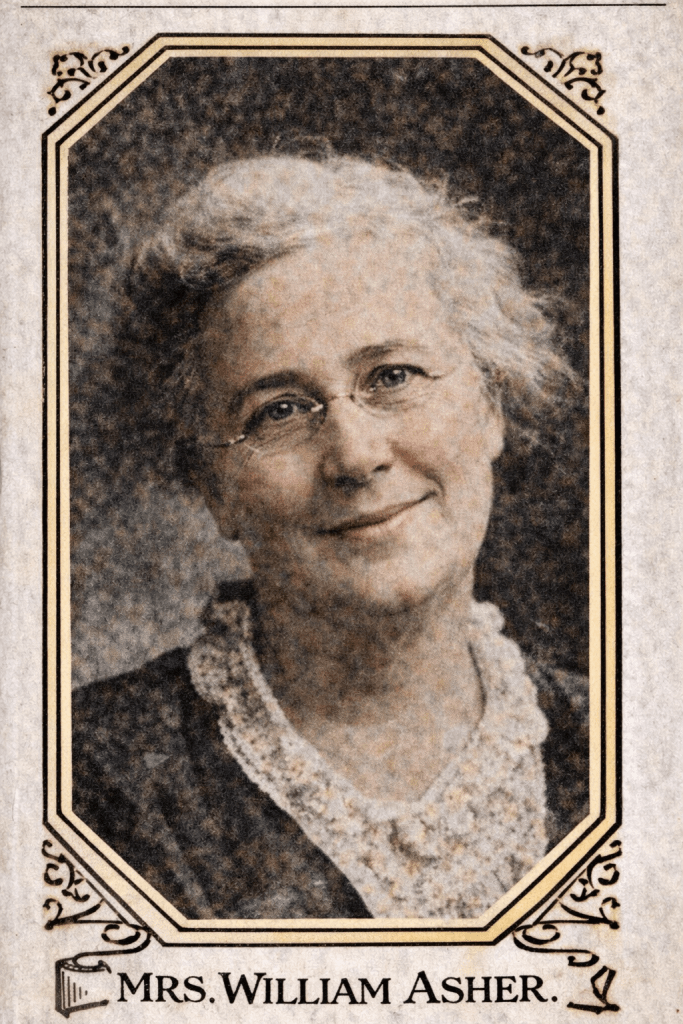
Mrs. William Asher, the director of the extension department of the business women’s work, seems to me to be just like the mother of the Sunday party—not that she is older than the rest, for she isn’t—but she has an abundance of gray hair which is now almost white and this gives her a very motherly appearance. Then her eyes, too, carry out the idea for they are heavy with pity for all of the suffering and sorrow that she has seen. It just happens that Mrs. Asher is the same age as Mrs. Sunday and everybody knows that that isn’t old. In Mrs. Ashers’ case, as in that of many persons, grief caused her gray hair, for within three months of each other her mother and her sister died.
“Yes, Mr. Asher and I and the Sundays are old friends,” she said in response to a question. “Years ago out in Chicago, which is my native city, we all worked in the same church. Mr. Asher was the assistant pastor, Mrs. Sunday was superintendent of the intermediate department of the Sunday school, and I sang in the choir and taught also. My friendship for Mrs. Sunday was cemented when her mother died. Mrs. Sunday was grief-stricken, of course. I sang at the funeral.”
Mrs. Asher not only sang at the funeral, but did all within her power to make the last days of the mother of Mrs. Sunday as pleasant as they could be.
There is no doubt that all of the members of the Sunday party have had unusual experiences and Mrs. Asher has been no exception. Practically all of her life, Mrs. Asher has been in evangelistic work. When she was a little girl of 11 years old, she was converted in the famous Moody Church in Chicago. Many persons have been converted under interesting circumstances; but few come into the church in an atmosphere such as surrounds the old Moody Church.
Years ago Mrs. Asher met and married William Asher, who was at that time a Pullman conductor on the run between Chicago and New York City. His uncle was a railroad man and had given the young man a start in life, but Mr. Asher soon realized that he was working on the wrong track. Giving up his position, he went to a theological seminary, where he studied and was ordained a minister.
It seems that opportunities in the case of Mr. Asher the opportunity came soon. DeWitt Talmage, the famous minister, needed an assistant and Mr. Asher was selected to fill this place, which he held for several years. Afterward he resigned to take up Bethel work in Duluth, Minn.
Dr. Wilbur Chapman was in Chicago conducting a religious revival one time and the Ashers became interested in his work.
“We were so interested in fact that Dr. Chapman asked and we did,” said Mrs. Asher here. “During the first five years of our connection with him we did saloon work. This was work that had been practically unattempted before. We had a little portable organ and with this we would go into the saloons and sing. We always got the consent of the owner of the saloon first before we went. The owner always understood the conditions upon which we worked. We did not do reform work, but we merely went to sing.”
“Was it very hard?” was suggested.
“Harder than you can imagine. Only those who have attempted it have any adequate idea of what it means,” she replied. Many a time Mr. and Mrs. Asher would be put out and their little organ thrown out of
This was trying work, but they stuck to it for five years, a long time for any person to spend in such a gruelling occupation. At the end of the five years they left the work, not because it was hard, but because larger opportunities for greater and more effective work offered themselves. The new work was arduous, though it did not have the hardships attendant upon it that the saloon work had. On several of Dr. Chapman’s trips around the world the Ashers accompanied him.
But the story of the relations with the Sundays is now the topic of perhaps greater interest. After the death of Mrs. Sunday’s mother, the bond between Mrs. Sunday and Mrs. Asher became closer. They worked together in the little church until Mr. Sunday entered upon his career as a revivalist. In 1911 they came together again and since then they have been engaged in the same work.
Mrs. Asher does splendid work among the women and girls of the factories, shops and mills and the girls grow to love her.
“We try to get the girl to realize her responsibility to herself to lead a Christian life and then to other girls around her. We want her to lead a life that will count for something in the love of those who live and work with her.”
Mr. Asher does a work that is of great value to Mr. Sunday, and of great benefit to the towns that Mr. Sunday cannot cover, and that are longing for a revival. To these towns Mr. Asher goes and conducts religious services. Just at present he is at work in Phelps, New York, although he is spending today in Trenton.
The Times (Trenton, New Jersey) · Sun, Jan 16, 1916 · Page 6 Downloaded on Mar 10, 2026

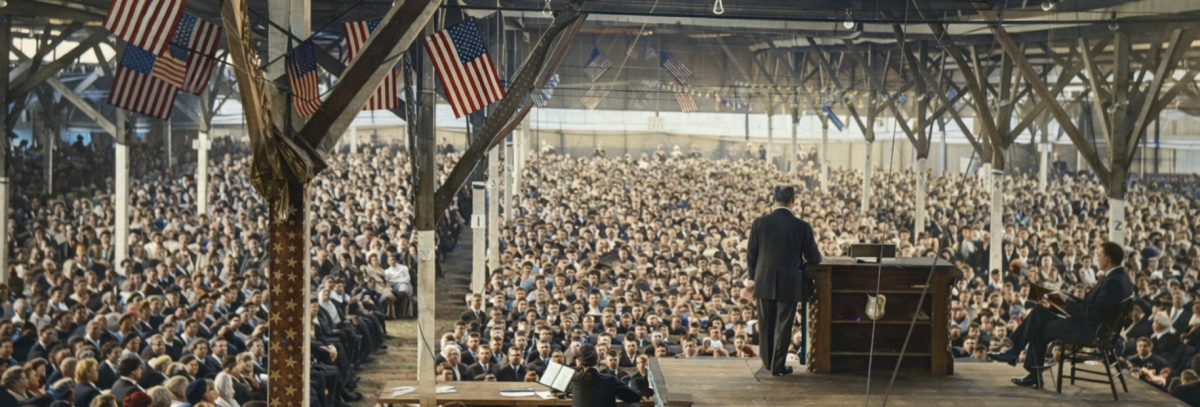
 Evangelist Billy Sunday (1862-1935)