“Lord, If You Ever Helped Mortal Man…”
One of the things I love most about researching Billy Sunday is when we can let him speak for himself.
Tucked inside The founding of Pacific Garden Mission: over thirty-five years contribute to the Master’s service by Sarah D. Clarke is a brief autobiographical sketch written by Sunday in September 1902. It is not polished theology. It is not retrospective myth-making. It reads like a man remembering the night that changed everything.
He begins with Chicago.
“Fifteen years ago one Sunday night I walked down State street, Chicago, in company with several baseball players… We entered a saloon, drank, and passed on to the corner of State and VanBuren…”
Then something happened.
A small band from Pacific Garden Mission was singing on the street. Sunday sat on the curb and listened.
“I had heard those songs from mother back in Iowa, in the Methodist Sunday School in Ames, Iowa, and God painted on the canvas of my memory the scenes and recollections of other days and faces. I bowed my head in shame and the tears rolled down my cheeks like rivers of water.”
The song that broke him was “Where is my wandering boy to-night.”
Col. Clarke invited the men to the Mission. Sunday’s response was immediate:
“I arose and said, ‘Boys, good-by, I’m done with this way of living.’”
That sentence is vintage Sunday. Abrupt. Decisive. No hedging.
But what follows is equally revealing.
The next morning, newspapers reported his church membership. He dreaded facing his teammates. He confessed:
“I would rather have faced a six-shooter…”
Yet when he arrived, the first to greet him was Mike Kelly.
“With a heart as tender as a woman’s… he took me by the hand and said: ‘That’s a grand thing to do, “Bill.” If I can help you let me know.’”
Cap Anson, Ed Williamson, Fred Pfeffer, Jno. Clarkson, Tom Burns, Dalrymple — they all encouraged him. And if they swore in his presence, “they would immediately ask my pardon.”
This detail matters. It corrects the caricature. Sunday did not convert in isolation from the baseball world. He converted in it.
Then comes one of the most famous episodes of his early testimony — the Detroit game.
Bottom of the ninth. Two out. Men on second and third. Charley Bennett at bat.
“I offered up a prayer and said, ‘Lord, if You ever helped mortal man, help me get that ball.’ I leaped the bench, looked over my shoulder, threw out my hand and the ball struck and stuck. The game was ours.”
Then the line that perfectly captures Sunday’s theology-by-experience:
“I am sure the Lord helped me catch that ball. This deduction may not be according to theology, but it’s according to experience.”
That is pure Billy Sunday — unfiltered, confident, experiential, unapologetic.
After baseball, he attended Northwestern University “where I picked up some Methodist enthusiasm and vim to counteract the stiff, staid Presbyterianism.” That phrase alone tells you how he would preach for the next thirty years.
He left professional baseball, became assistant secretary of the Chicago Y.M.C.A., then joined Rev. J. Wilbur Chapman in evangelistic work. Of Chapman he writes:
“All I am today as an evangelist I owe to Dr. Chapman and to Prof. R. R. Lloyd… with whom I studied privately.”
Notice that. Sunday never claimed to be self-made. He acknowledged formation, mentorship, study.
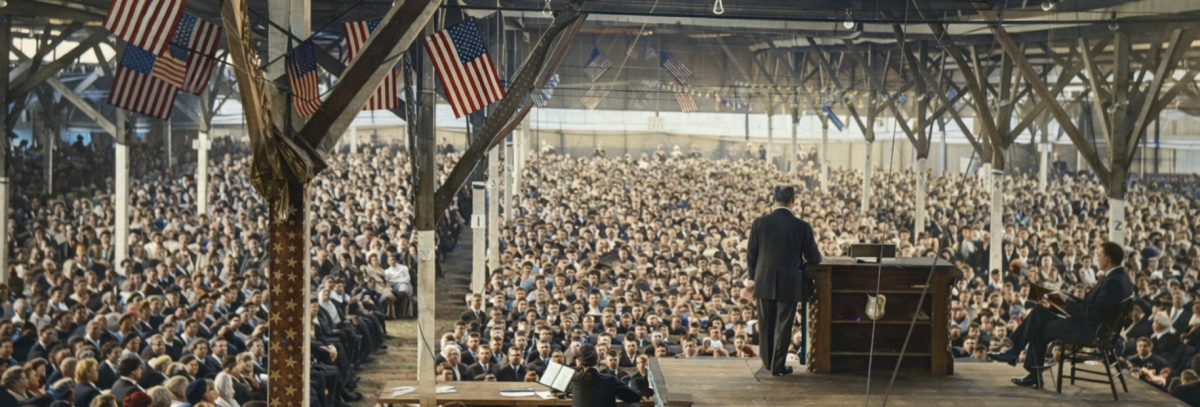
This 1902 piece is significant for another reason. It predates the massive tabernacles, the sawdust trails, the millions who would hear him preach. It shows us Sunday before the fame hardened into legend.
What do we see?
- A mother’s hymns remembered.
- A curbside conviction.
- Public courage in a locker room.
- A prayer in right field.
- A man mentored, trained, and sent.
If you want to understand Billy Sunday, start here.
Not with the headlines.
Not with the critics.
Not even with the later statistics.
Start on a Chicago curb, with a baseball player weeping while a gospel song drifts through the night air.
And listen to him say it himself:
“Boys, good-by, I’m done with this way of living.”
Adapted from: The founding of Pacific Garden Mission : over thirty-five years contribute to the Master’s service / by Sarah D. Clarke

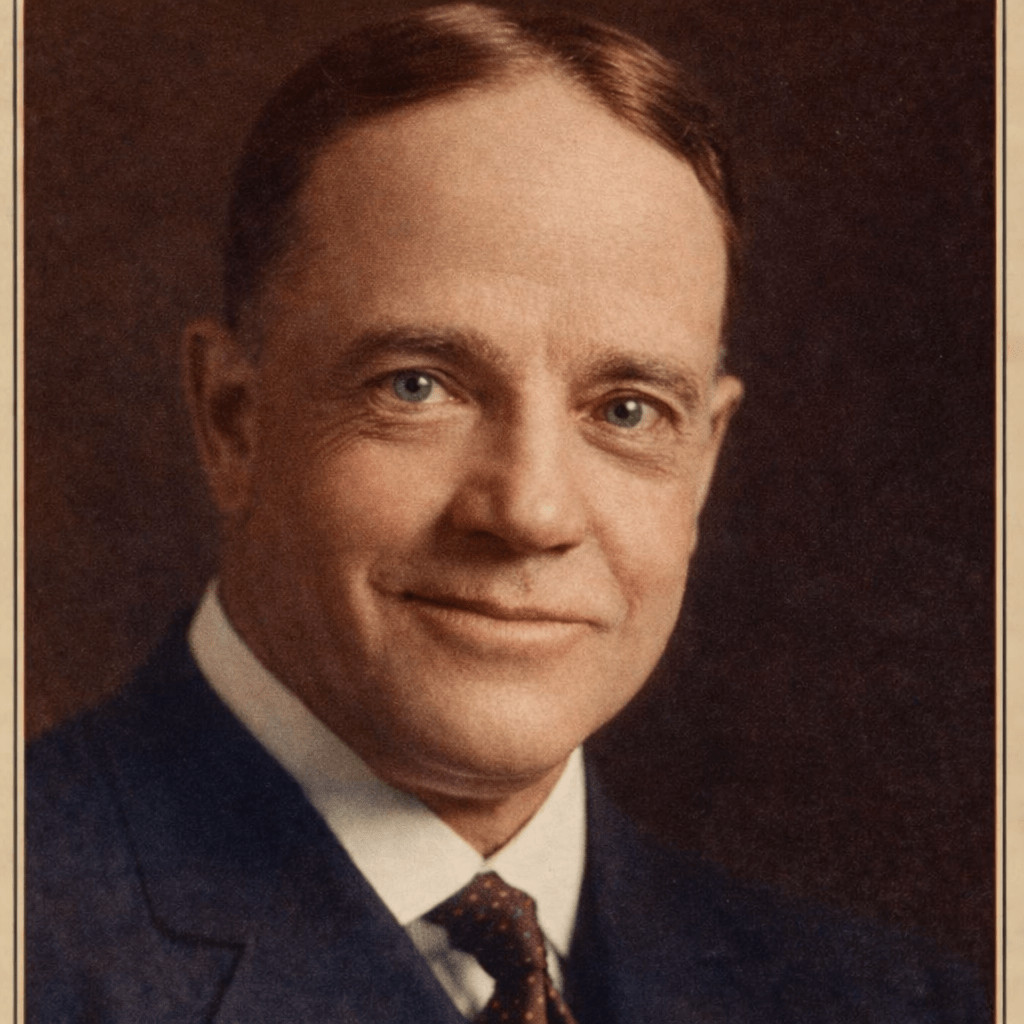
 Evangelist Billy Sunday (1862-1935)