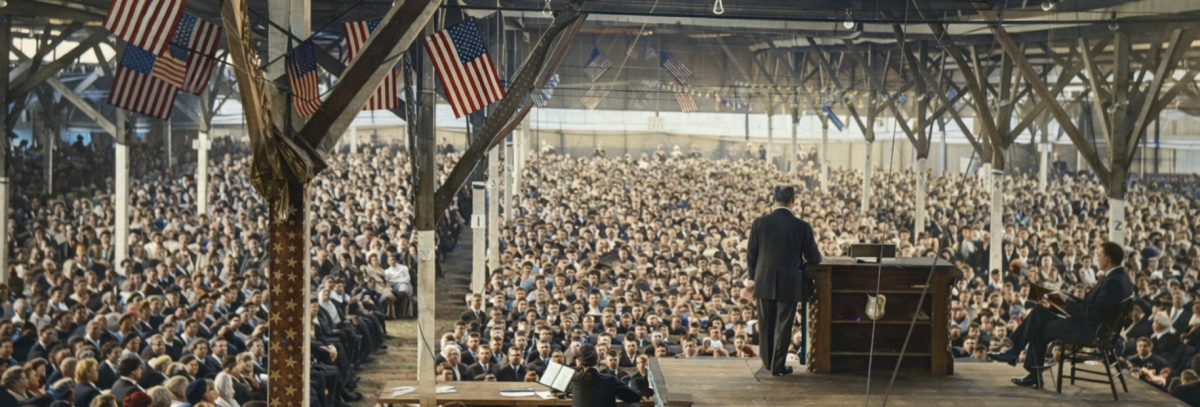
BILLY SUNDAY REAL AMERICAN PRODUCT
EVANGELIST IS DISCUSSED BY WILKES-BARRE, PA., MAN.
COMPARED WITH OTHERS
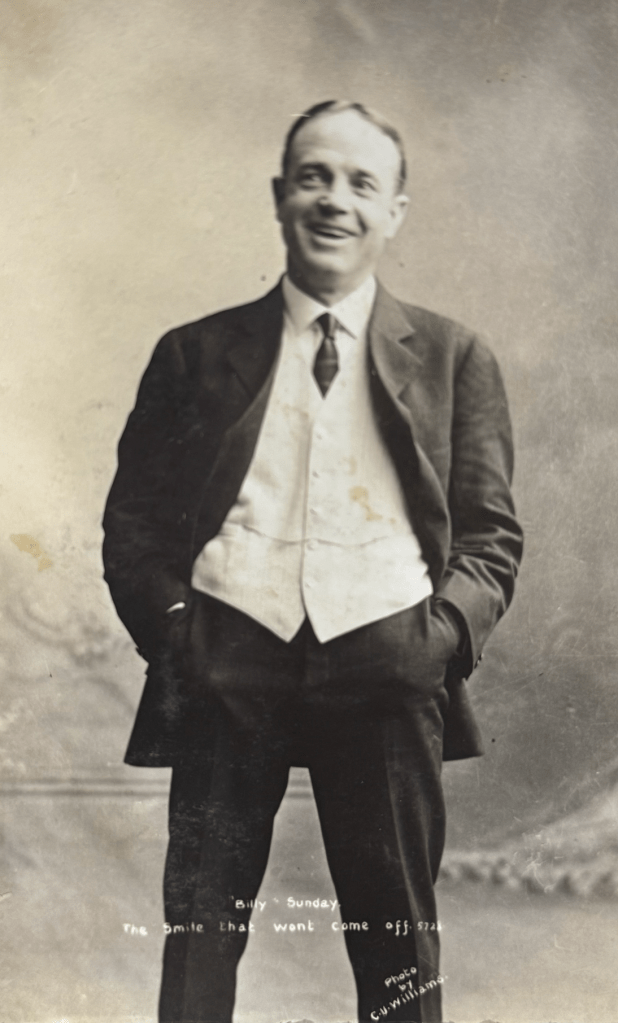
Writer in Newspaper Compares Former Baseball Player With Famous Evangelist of Few Year Ago—Does Much Good.
The Tribune’s Special Service.
WILKES-BARRE, Pa., May 9.—Rev. William A. Sunday and his methods have been reviewed from so many angles that it seems difficult even for a veteran to add anything to the sum total of knowledge of this wonderful evangelist, says “G. A. E.” writing for the Wilkes-Barre Record.
Continuing “G. A. E.” who made a careful study of the evangelist while he was conducting his campaign here, says:
“However, as the preachers say, ‘firstly, secondly, thirdly and one word more,’ and this may be ‘finally and in conclusion.’
“Billy Sunday, as we now familiarly term him, stands in a class by himself, and if I compare him with evangelists of other days it is not for disparaging comment or odious comparison. He is peculiarly an American product and becomes immediately at faith with his audiences because of his intense patriotism, his love of the starry flag and his intense belief in the present and future greatness of the United States. He is a paladin of defense.
Sunday Protector.
“No, siree, the devil shall never capture this country so long as Billy Sunday can put up his dukes or raise his voice in protest.
“I have been privileged to hear many great pulpit orators and revivalists both in this country and abroad, among the latter, Weaver, Spurgeon, Booth (before his Salvation army days) Moody, Torrey. Of these for keenness of argument, beauty of diction, fierceness of invective and charm of pathos. I would place Rev. Charles H. Spurgeon in first place, with Gen. W. Booth in the next. But from speech of my mother and grandparents even these giants could not compare with Whitfield, Williams O’Wern, Charles Wesley, Christmas Evans and Rowland Hill. The men I have named were all different in their method, none of them staying long in one place, and their work was largely denominational in character. These men were all successful and their trumpet calls led many to a newness of life.
Orthodox Gospel.
“The story they told and the gospel they preached was the old orthodox one, ‘He that believeth shall be saved, and he that believeth not shall be damned.’ Sunday’s success is in proportion as he sticks to the old doxv and the old ‘Thus saith the Lord,’ but it is worth noting that while the old exhorters emphasized ‘hell fire,’ and ‘fire and brimstone,’ Billy does not add to the agony of those consigned to the place prepared for unbelievers by using those words.
“Mr. Sunday, like Spurgeon and many other successful exhorters, is a voluminous speaker, but not a profound thinker. He has read for dramatic effect, he has skimmed the literature of the English race for illustrations, and is endowed with a slang vocabulary that is simply astounding. He uses his knowledge with such marvelous effect that all who come ‘to scoff return to pray.’ His earnestness, his transparent honesty, carries all his hearers with him and his slang solecisms are all forgotten in his clarion call for repentance, his denunciation of all that is bad, vile and wicked and in his praise of God, home and country.
More Lasting Good.
“The old school of revivalists were of the itinerant class, moving rapidly through the country, their evangelism seemed sudden in its effect and I am afraid somewhat evanescent in its general results. It is just here that Mr. Sunday’s campaign gives promise of more lasting good. His coming has been carefully prepared for, his meeting place is undenominational in character. It is a movement conducted with great business acumen and sound common sense. He trains the ministers and church workers in such a way as to make them capable of caring for the harvest when it comes. Like a good farmer, he prunes the fruit trees with vigor, cuts out all the dead wood and sprays them well to get rid of moths, beetles and canker worms, so that when the new fruit shall ripen it will be sound and beneficial. ‘And the leaves of the trees shall be for the healing of the nations.’ Mr. Sunday is a man endowed with a great faith. He prays for the blessing, he prepares for the blessing, he is sure of getting it and it is therefore no surprise that he is so eminently successful.
Campaign Well Conducted.
“The late revival in Wales was a marvelous spontaneous outburst of religious fervor and roused large sections of the community. It was conducted by a young man named Roberts, who was ill fitted both mentally and physically and he subsequently broke down. Want of well directed effort, want of unity on the part of the churches to look after and care for the converts robbed the movement of much of its success. The converts were left to the mercy of the world, flesh and the devil, and thus the promise of a great and last revival petered out.
“The Sunday campaign is conducted vastly different. It is an old evangel, presented in racy Americanesque speech and run upon up-to-date business principles. The evangelical churches are a unit. It has been aided by the enterprise of the daily newspapers and publicity is given to the religious movement unknown to our fathers. Despite a few doubting Thomases the spirit of success is in the air, for the Wyoming valley is realized that the ‘hour and the man’ glorious religious revival has just passed and the effects of it are to continue.”
The South Bend Tribune. Fri, May 09, 1913 ·Page 7
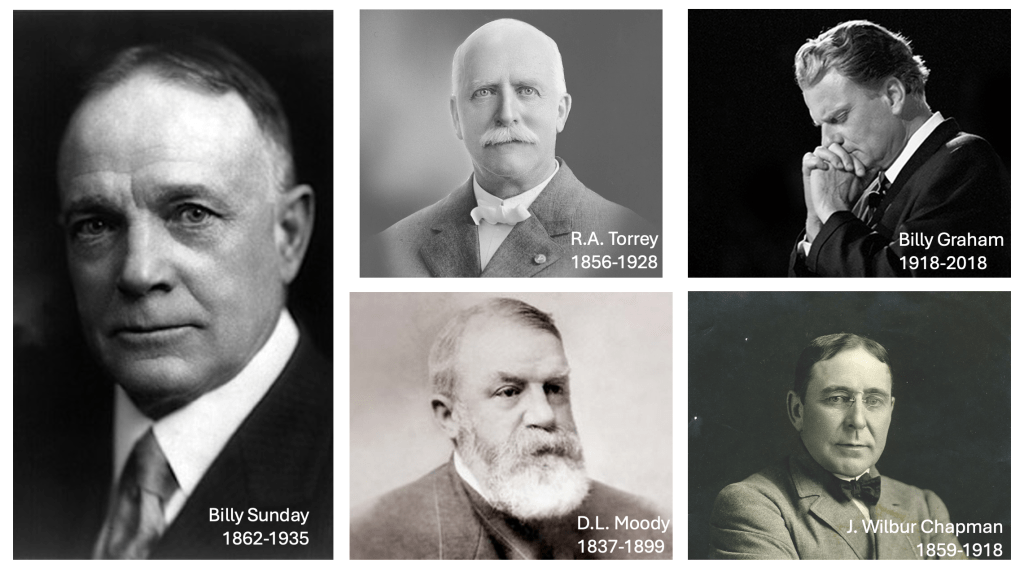
 Evangelist Billy Sunday (1862-1935)