Former professional baseball player-turned urban evangelist. Follow this daily blog that chronicles the life and ministry of revivalist preacher William Ashley "Billy" Sunday (1862-1935)
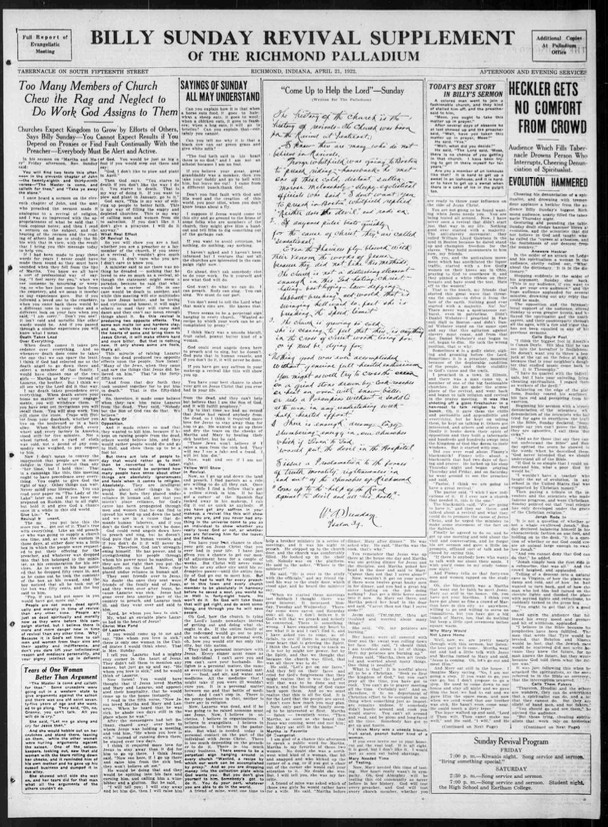
Billy wrote the following and it was published in the April 22, 1922, Richmond Palladium.
The history of the Church is the history of revivals. The Church was born in the revival of Pentecost.
I know there are many who do not believe in Revivals.
George Whitfield was going to Boston to preach, riding horseback. He met one oof these cold, distant, sullen, morose, melancholy, sleepy, egotistical officials who said, “I don’t want you to preach in Boston.” Whitfield replied, “Neither does the Devil.” and rode on.
If anyone pulse beats quickly for the cause of Christ, they are called “sensational.”
Even the Pharisees ply _______ with their venom the works of Jesus because they did not like his methods. The church is not a disturbing element enough in this God-hating, Christ-hating, boot-legging, law-defying, Sabbath-breaking, old world that is swinging hell-ward so fast she is breaking the speed limit.
The Church is growing so cold she is ceasing to feel that there is anything in the cross of Christ worth living for, or if need be, dying for.
Nothing good was ever accomplished without genuine full-hearted enthusiasm. You might as well try to cross the ocean on a grind stone drawn by cock roaches or heat an oven with snow balls, or ride a Porcupine without a saddle as to win any undertaking week-half-hearted effort!
There is enough dreamy, lazy, slumbering energy in our Churches which is given to God. I would put the Devil in the hospital.
I issue a Proclamation to the forces of truth, morality, righteousness, in and out of the Churches of Richmond, “Come up to the help of the Lord against the Devil and all his hosts.”
W.A. Sunday, Psalm 34
April 17, 1922. Richmond PalladiumApril 18, 1922. Richmond Palladium
The Duluth News Tribune. Mon, Apr 08, 1918 ·Page 3
ADVANCE MAN IS HERE TO PAVE WAY FOR BILLY SUNDAY
Looks to Building of Tabernacle at Courthouse Square—Construction Starts Next Week.
Actual work in preparation for Billy Sunday’s campaign in Duluth will begin early next week when workmen will commence construction of the huge tabernacle in which the meetings will be held.
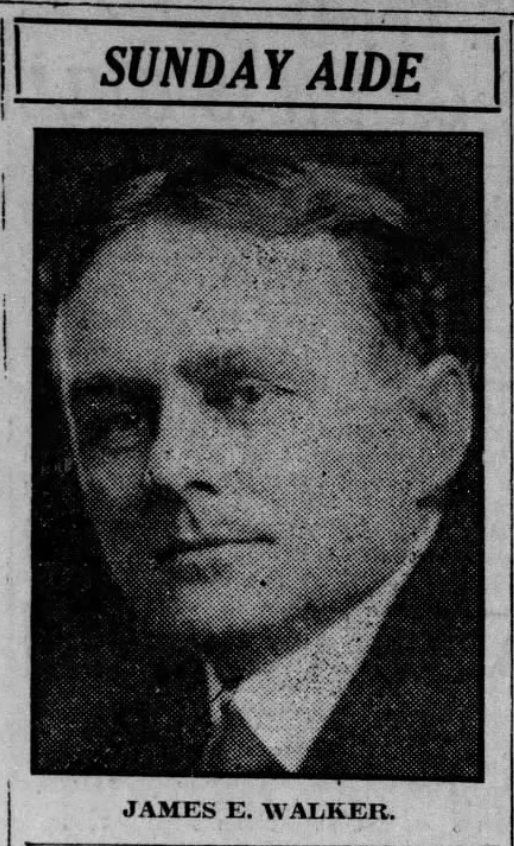
This was the announcement made yesterday by James E. Walker, advance representative for the evangelist. Mr. Walker reached Duluth Saturday and immediately plunged into the work of preparation for Sunday’s appearance in Duluth. He met representatives from Duluth, Superior and range churches at the First Presbyterian church at 3 o’clock yesterday afternoon.
Richard Close and W. L. Smithies, of the men’s interchurch council addressed the meeting. Both gave their impressions of the Sunday campaign in Chicago. Mr. Smithies was in Chicago Saturday and witnessed the mammoth parade, held at noon, which preceded the largest meeting that has yet been held at the Chicago tabernacle.
Sunday’s Methods Outlined.
Walker’s talk outlined, for the local workers, the Sunday method of conduction a campaign. His classification divides the work into three parts. The preparatory work, he says, usually covers a period of eight weeks preceding the campaigns. The latter constitutes the second division and the third division in, in Walker’s words, “the follow-up campaign or work of conservation.” The first part is now well under way in Duluth.
The Sunday campaigns are usually conducted by 15 committees. Fourteen of these will be in operation in Duluth within a short time. The fifteenth, constituting a restaurant committee, often necessary through the comparative inaccessibility of the tabernacles, will not be needed in Duluth owing to the central location of the tabernacle.
Two Thousand Ushers.
The other committees, some of which are already being formed, together with Walker’s estimate of the number required for each, follow: Music committee, including the personnel of three choruses, 2,500; Neighborhood prayer meeting committee, 2,000; ushers and doorkeepers, who will work in relays, 700; personal workers, 500; secretaries, who will take the names of “trail-hitters” at the meetings, 300; men’s Bible class organizers and workers, 500; finance, automobile, hospital and students committees, 500. This, in the round figures of Walker’s estimate, will total a working staff of 7,000. “And every one of them,” said Walker last night, “will have something to do.”
“The most important part of the work,” said Walker, “is the neighborhood prayer meetings, previous to and during the campaign. If Sunday’s coming did nothing else than serve as an incentive for the organization of these meetings, he would have done enough. It is his wish that a great deal of time and care be spent in the perfecting of the committee which will be in charge of these meetings.
Territory Divided.
“The territory surrounding Duluth and the city itself will be divided into districts, these districts subdivided into sections and these sections again divided into communities or, as we call them, neighborhoods. It is our plan to have prayer meetings for two nights each week for three weeks previous to Sunday’s appearance. These meetings will not be held in the churches of the communities but in the private homes. There were 99 conversions reported at similar meetings which preceded the Los Angeles campaign.
“Billy Sunday’s request is that, at these meetings, those who attend pray for the success of the campaign. The attendance at the Los Angeles prayer meetings was recorded at 73,938. There were 7,556 homes open for meetings.
Tabernacle 8,000 Capacity.
The Duluth tabernacle, according to the present estimate, will accommodate 8,000. It will include, besides the main auditorium, the usual rooms that are built in all Sunday tabernacles. The Duluth structure will be of the turtle-back type that is used in a majority of the cities. Its dimensions will be approximately 176 by 224 feet. It will be built on the courthouse grounds at Fourth avenue West from First to Second streets. Sunday will conclude his Chicago campaign on May 19. He will come to Duluth during the following week and will open here May 26. Walker has established his offices on the second floor of the Y. M. C. A. in the offices of Mr. Smithies. He will direct the preparatory campaign from there and will remain here until after the opening of the campaign proper.
“Billy” Sunday has come and gone. His mission is a matter of history. What did it signify? Some of the facts of the great revival are indicated in figures. The famous “trail” of the tabernacle for example was touched by nearly 50,000 pairs of feet seeking Mr. Sunday.
Chicago Daily News, no copyright.
The combined audiences at all the Sunday meetings are again reckoned at something like 1,200,000. Plainly a very considerable section of Chicago listened to the Sunday message. No politician, nor even a statesman, ever enjoyed such a hearing.
The novelty in the evangelist’s preachments arose from his unique personality. The doctrines preached by the Rev. William A. Sunday were essentially much the same as those the Chicago of another generation heard from the Rev. Dwight Moody. They were the same to be heard today in the four hundred-odd churches which were represented by the Sunday campaign.
The homely virtues, individual rectitude in business, personal morality in domestic life—these were the essentials. The code preached by “Billy” Sunday was familiar to his congregations. It is characteristically American. The “thou shalts” and “thou shalt nots” are the precepts and the prohibitions of the United States.
Mr. Sunday gave a new emphasis to a creed learned by most of his hearers in infancy. Like all successful missionaries in the home field, he affirmed persuasively what his converts believed, but did not consistently practice.
Many of those who renewed their religious pledges in the tabernacle will be better citizens. Chicago like Billy Sunday. His sincerity and disinterestedness made a good impression.
Every one wishes him success in his next public work.—Chicago Herald- Examiner.
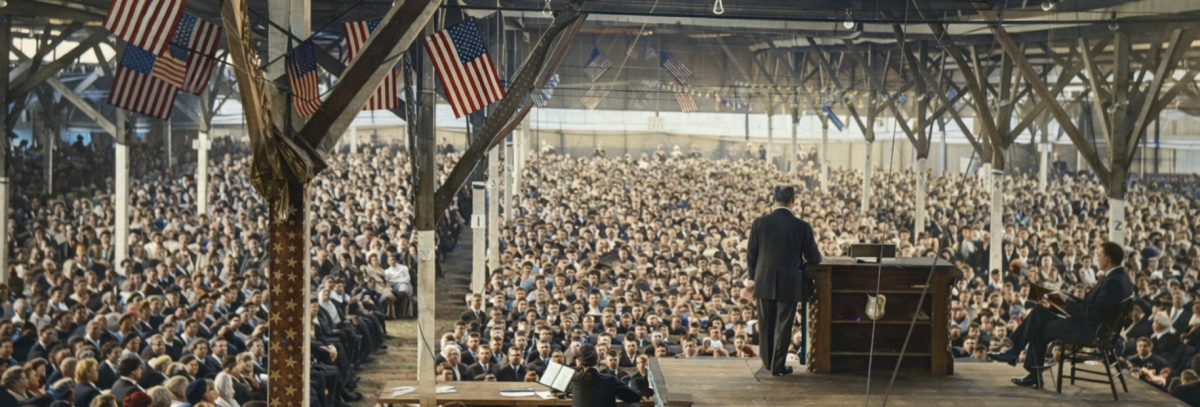
Billy Sunday’s 1918 revival campaign in Chicago, held from March 10 to May 20, was one of his most ambitious and high-profile efforts. It occurred during a pivotal moment in American history, as the nation grappled with World War I, the temperance movement, and the looming influenza pandemic.
The Billy Sunday Tabernacle, Chicago. 1918. Bill Sunday (left), Homer Rodeheaver (right). Public domain.
Campaign Overview
The campaign was strategically timed to bolster support for Prohibition in Chicago, a city known for its vibrant nightlife and strong opposition to temperance reforms. Sunday, a fervent advocate for the ban on alcohol, delivered his fiery sermon “Get on the Water Wagon,” in which he vividly denounced the liquor industry. He likened the “booze interests” to a “rattlesnake that wriggled its miserable carcass out of hell,” vowing to fight them relentlessly—even “on ice” if hell froze over.
Despite his passionate rhetoric and widespread attention, Sunday’s efforts did not yield the desired political outcome. Chicago voters rejected a local Prohibition initiative during the campaign, a defeat famously referenced in Frank Sinatra’s song “Chicago (That Toddlin’ Town)” with the line: “The town that Billy Sunday could not shut down.”
Attendance and Impact
The campaign drew substantial crowds, with estimates suggesting that over 650,000 people attended the meetings over the course of seven weeks.
Sunday’s dynamic preaching style and the campaign’s extensive organization contributed to its broad reach and influence.
Legacy
Although the immediate goal of enacting local Prohibition in Chicago was not achieved, the campaign underscored Sunday’s significant role in the national temperance movement. His efforts contributed to the broader momentum that led to the ratification of the Eighteenth Amendment in 1919, establishing Prohibition across the United States. The Chicago campaign remains a notable example of Sunday’s impact on American society during a transformative era.
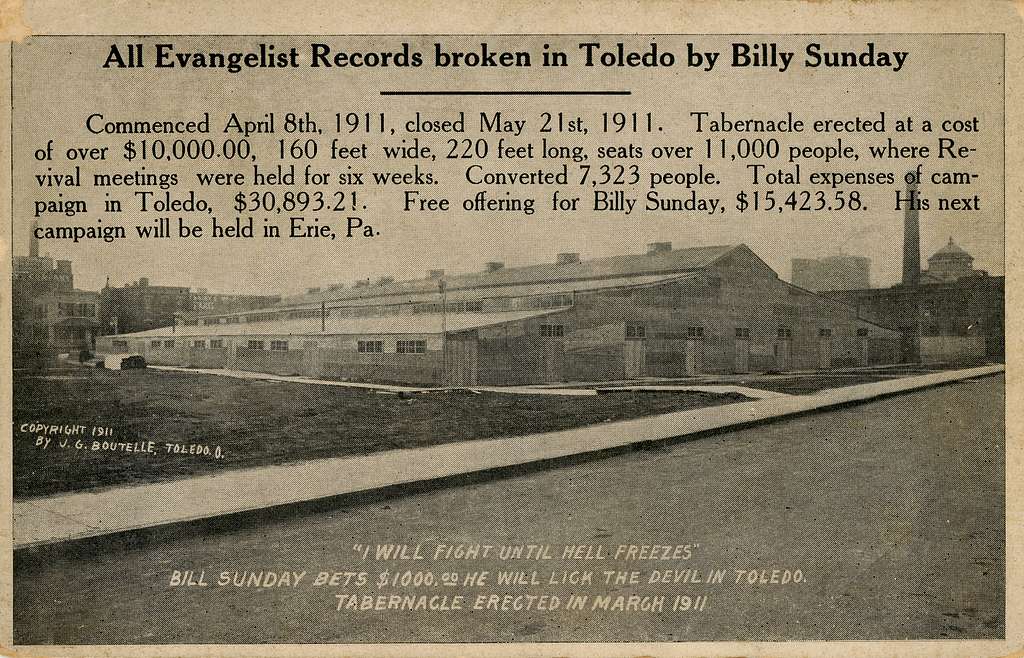
In early 1911, the city of Toledo, Ohio, found itself at the center of a spiritual and cultural whirlwind when Billy Sunday brought his revival campaign to town. Running from January 29 to March 12, this six-week crusade marked a significant moment not just in Sunday’s ministry, but in the broader urban revival movement sweeping America in the early 20th century.
To accommodate the expected crowds, a massive wooden tabernacle seating around 9,000 was constructed along Jefferson Avenue, near downtown. Though the city’s population at the time was just under 170,000, more than 350,000 people flooded into the tabernacle over the course of the campaign. It was not unusual for Sunday to preach three or four times a day to packed audiences, some standing in the aisles or spilling outside the structure just to hear his voice thunder through the open air.
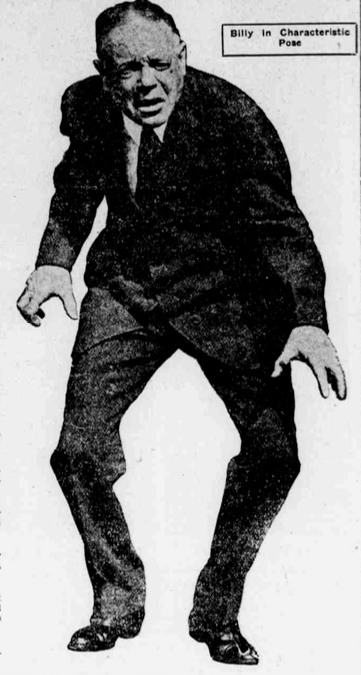
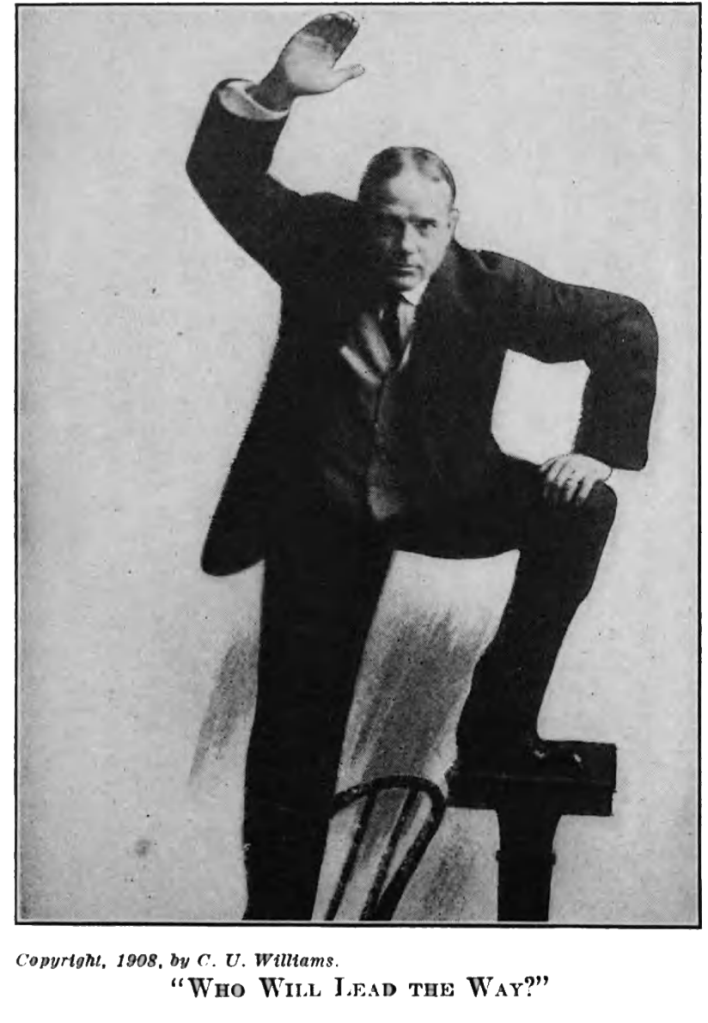
Sunday’s preaching style in Toledo was vintage Billy—fiery, theatrical, and unforgettable. He ran across the stage, leapt onto chairs, punched the air, and peppered his sermons with vivid imagery and baseball metaphors. Among the messages he delivered were some of his most iconic: “Booze,” “Backsliding,” “If Hell is a Joke,” and “The Ten Commandments.” His attack on the saloon business in “Booze” especially struck a chord in a city known for its proliferation of taverns and political corruption. “I want to preach so plainly,” he declared, “that the man who runs may read, and that even the saloonkeeper will know that I mean him!”
The results were staggering. Over 18,000 individuals reportedly made decisions for Christ, and local churches saw a dramatic uptick in attendance and membership. The spiritual momentum didn’t stop at the altar. Sunday’s relentless promotion of Prohibition, moral reform, and church revitalization left an indelible mark on Toledo’s civic and religious landscape.
The local press—especially The Toledo Blade—covered the revival extensively, offering daily summaries and commentary. While some editorials criticized Sunday’s bluntness and emotionalism, many praised the campaign’s influence on the moral climate of the city. Business leaders, city officials, and pastors saw firsthand the social power of mass evangelism, and Sunday’s reputation as a national revivalist soared.
Toledo was more than a successful campaign—it was a turning point. It proved that Sunday could handle large urban centers with complex political, economic, and moral challenges. It set the stage for even bigger crusades in Detroit, Boston, and New York, and solidified his status as one of the most influential evangelists of his time.
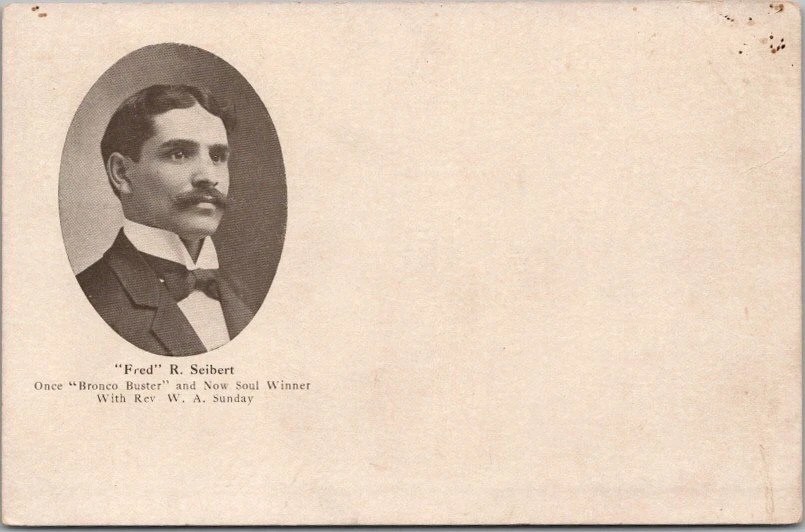
Fred R. Seibert played a pivotal role in Billy Sunday’s evangelistic campaigns during the early 20th century. As a member of Sunday’s core team, Seibert was known as the “handy man of the tabernacle,” overseeing the logistical and operational aspects of the revival meetings. His responsibilities included managing the physical setup of the tabernacle, coordinating volunteers, and ensuring the smooth execution of events.
Beyond his logistical duties, Seibert was deeply involved in the spiritual mission of the campaigns. He authored Rescue the Perishing, a guide aimed at assisting new converts in their Christian journey. Published in 1921, this work provided practical advice and biblical teachings to support individuals in their newfound faith.
Seibert’s contributions were integral to the success of Billy Sunday’s revivals, combining organizational acumen with a commitment to spiritual mentorship.
BELOW – Article in The South Bend Tribune. May 1, 1913.
HERE IS STORY OF FRED’S LIFE
If you have heard Billy Sunday, you have also heard him say, “Here, Fred, open some of these ventilators, it’s too hot in here,” or “If you people want song books, you can get them from Fred.”
In fact, Billy started talking about Fred long before South Bend people ever knew there was a Fred. But most of the people who are going to the tabernacle these days, know Fred now.
Fred is a stock sort of a fellow, with raven black hair. His last name is Seibert and his initials might be “A. B.”—always busy—but they are not.
Fred Seibert is official custodian of the big Sunday tabernacle on Vistula avenue and he guards the immense building day and night. If you want to hear an interesting story sometime, just step up to Fred and ask him to tell something of his life history.
But maybe Fred would be backward in speaking to a stranger about the matter, so you can be saved the trouble of approaching Fred by continuing to read this story.
Eighteen years ago, in a little town out in Iowa, there lived a young man who, like many other young men, was wasting his life away on cards and similar vices.
One night the young fellow got up from the gaming table with no money. Some people call it “broke,” while others who are without money, say they are “strapped.”
Well, “broke” or “strapped,” the gambler had no money, and he was disgusted with cards, the world and himself. He left the place and went out in the street. Near the corner he heard music. It was the singing of a church choir, but the fellow did not know that when he entered the building.
He knew it a minute after, however, when an evangelist in the front of the room arose to announce his text for the evening.
The man tried to leave the building, but a usher held him.
“I guess I done passed by my station,” said the gambler, but the usher thought otherwise and told the other so.
That gambler, broken spirited and penniless, was Fred Seibert, the “Fred” to-day of the Billy Sunday party.
And to-day Seibert can look the best man in the world in the eye and say casually:
“My friend, my life has not been in vain for the reason I have had the pleasure of bringing 12,000 people to the altar, and showing them the presumptive military pages to them who accept it.”
And Fred has earned a nation wide reputation as a Bible student and a personal worker. He has committed 1,400 books of scripture to memory and can do a trick with the Bible which is a common enough one with playing cards, but is a decidedly unique one when it comes to the Bible. He also enjoyed the privilege of assisting to escort his mother and six brothers and three sisters to the altar.
Pick up the Bible and turn to any page in it, and Fred will tell you the name of the book and just about the chapter you have your hand on.
Seibert was born in Waverly, Ia., and worked as a broom twister for nine years. After he was converted he entered the Moody Institute, where he stayed for a year and a half. Five years ago he joined the Sunday party. Ever since his duties have been that of taking care of the tabernacle and personal work.
To assist himself and others in this work, Fred wrote a little pamphlet, “Rescue the Perishing,” which has been accepted as an authority by experts of the Bible throughout the country.
Seibert is married, and as two children, who live in Santa Monica, Cal., but the greatest thing, next to his family and his God, is the greatest respect.
Fred pays his children so much for learning scripture and they have to memorize every week and recite it word for word.
The little boy and girl of mine keep on learning scripture and they interrupt their “daddy,” said Fred.
And they that follow me, because I do not believe he doesn’t care.
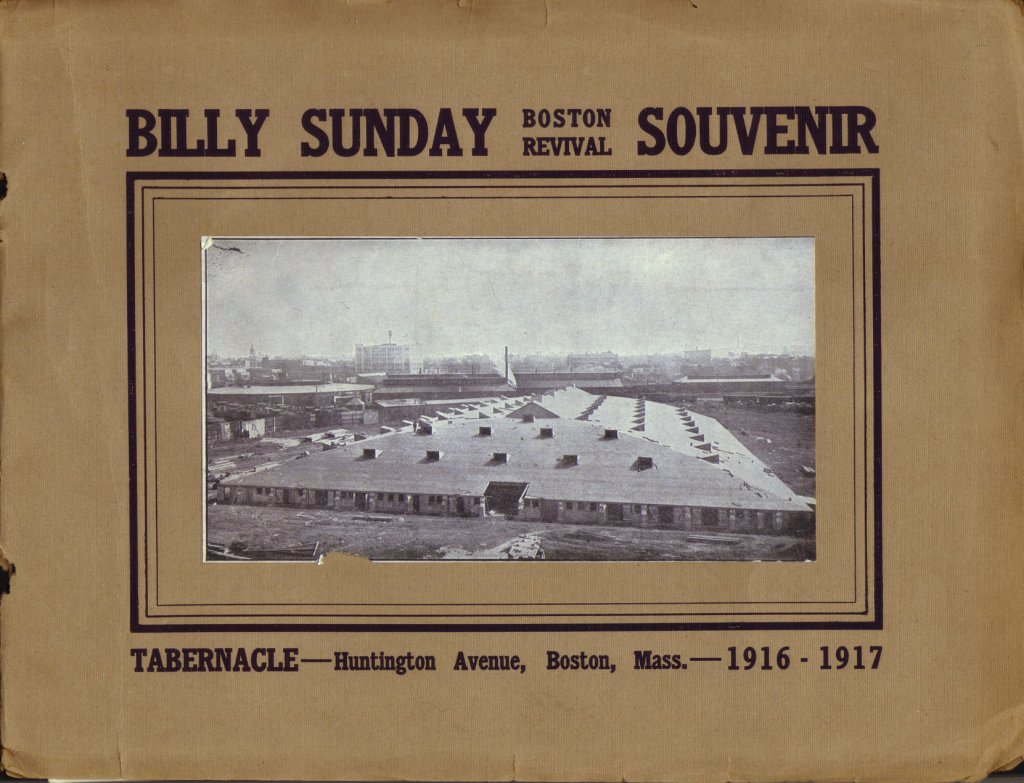
Feb. 22—Fifty Boston ministers and laymen go to Philadelphia; hear Sunday preach for first time; walk into his bedroom the next morning and demand that he come to Boston. Sunday accepts and date is fixed for Fall of 1916.
March 6—Organization of Boston committee announced at big meeting in Park Street Church.
March 7—Committee files papers at State House as “Boston Sunday Evangelistic Committee, Incorporated.”
1916
Jan. 21—Committee decides to build tabernacle on Huntington-av site.
March 22—Twenty members of Boston Committee go to Baltimore to learn their jobs from campaign workers in that city.
April 27—Wooden tabernacle bill vetoed by Gov McCall. Committee nonplussed.
April 30—Campaign for $100,000 in guaranty pledges launched.
Aug. 10—Ground broken for tabernacle. Mayor Curley attends. Joe Spiece begins work.
Oct. 2—Cottage prayer meetings open.
Nov. 12—BILLY SUNDAY PREACHES FIRST SERMON IN BOSTON.
As appearing in The Boston Globe Sun, Oct 15, 1916 • Page 80
In the early 20th century, no evangelist captured the American imagination quite like Billy Sunday. With his blazing speed on the baseball diamond and firebrand preaching style in packed tabernacles, Sunday became a household name. But who was the man behind the headlines and revival tents?
While some 1930s newspapers portrayed him as a tragic figure in decline, the truth is both richer and more inspiring. Here are the most accurate and meaningful highlights of Billy Sunday’s life—stories that are not only true, but worth remembering.
1. From Iowa Log Cabin to Orphan’s Home
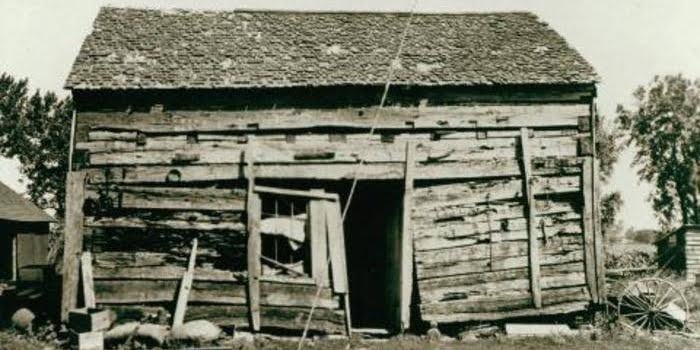
Billy Sunday was born on November 19, 1862, in a humble two-room cabin in Story County, Iowa. His father, a Civil War soldier, died when Billy was just a month old. Poverty and hardship followed. By age 8, Billy was working odd jobs to help support his family, and at 9 he was sent to live in state-run orphanages in Glenwood and Davenport with his brother Edward. It was a rough start—but one that forged a resilient spirit.
Sunday childhood cabin
2. A Baseball Star is Born
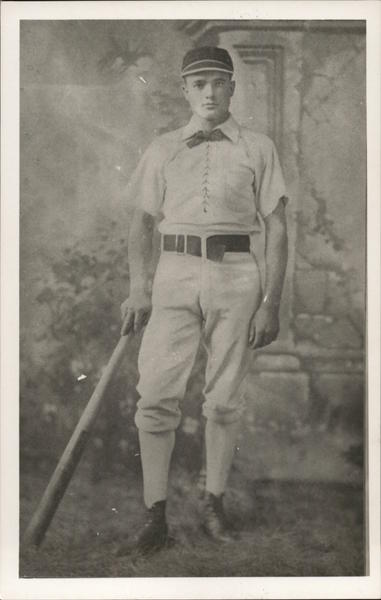
Billy Sunday
Billy’s speed made him a local legend in fire brigade races and eventually caught the attention of Cap Anson, manager of the Chicago White Stockings. In 1884, Billy went straight from sandlot baseball to the major leagues, where he played for Chicago, Pittsburgh, and Philadelphia. He was known for:
Circling the bases in 14 seconds
Lightning speed and dramatic fielding
Coaching at Northwestern University in the off-season
Though not a superstar at the plate, Sunday’s athleticism and work ethic made him a fan favorite.
3. A Saloon, a Hymn, and a Mission
In 1887, while still a ballplayer, Billy heard hymns outside the Pacific Garden Mission in Chicago. Drawn in by the music, he began attending services and was soon converted to Christianity. His transformation was real and lasting.
He turned down lucrative baseball contracts and took a $1,000-a-year job at the Chicago YMCA, launching a new career path—urban evangelism. He later joined J. Wilbur Chapman as an assistant before launching his solo revival ministry in 1896.
Pacific Garden Mission circa 1914
4. Revivalism Redefined
Billy Sunday became one of the most dynamic preachers in American history. His sermons were:
Full of slang, humor, and action
Delivered in massive tabernacles, often seating 10,000–20,000
Focused on personal repentance, moral reform, and civic virtue
In New York City (1917), he preached to over 1.5 million people in ten weeks. He gave the entire $120,465 offering to war charities. In Chicago, he donated another $65,000 to the Pacific Garden Mission.
No other evangelist of his day had such reach—or gave so much away.
5. The Power Couple: Billy and “Ma” Sunday
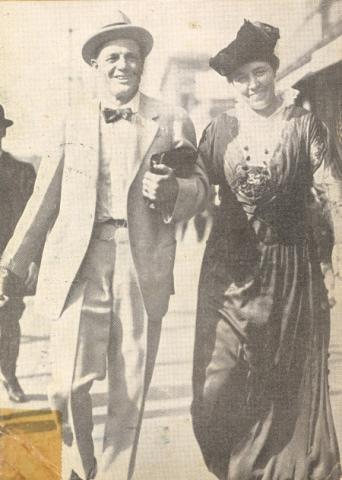
Billy met Nell Thompson in Sunday school, and after overcoming her family’s resistance to marrying a ballplayer, the two became partners for life. Nell—or “Ma,” as the nation came to know her—was the administrative backbone of Billy’s ministry. She managed his schedule, finances, and logistics, allowing him to focus on preaching.
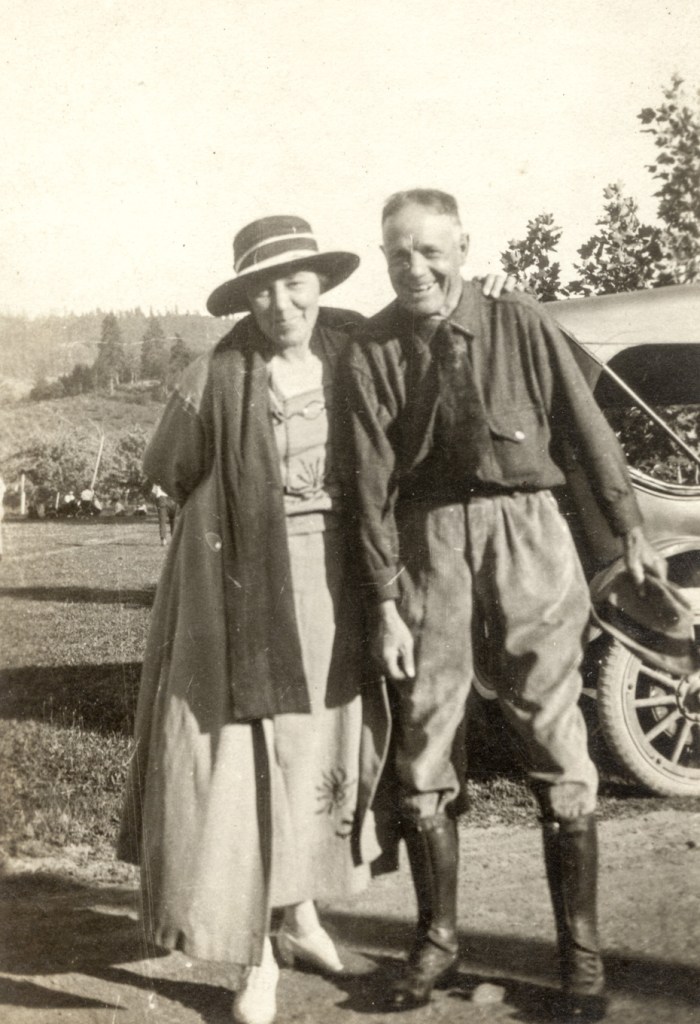
Ellen Sanders Collection: Photos from her grandmother Ruth Shafer Hines who taught in Odell School 1920-1921. She came to Hood River with her aunt and uncle Jen and Dan Feldwish.
6. Later Years: Sorrow, Sacrifice, and Perseverance
Though his ministry never lost its power, Billy’s later years were marked by tragedy:
His daughter Helen died in 1932.
His son George died in 1933 after personal and financial collapse.
He suffered a heart attack in 1933 but returned to preaching against doctors’ orders.
He resumed small-town revivals to support his grandchildren, after spending his savings trying to rescue George’s failed business.
Despite failing health and shrinking crowds, Billy Sunday kept preaching. Not for fame. Not for money. But because he believed the gospel still needed to be heard.
Final Reflection
Billy Sunday’s story is often misunderstood. Yes, he lived through grief, made financial sacrifices, and returned to smaller venues. But he did not die penniless. He died spent—having poured out his life in the service of others and the cause of Christ.
🗣️ A Quote to Remember
“I want to preach until I can’t preach anymore, and then I want to crawl up into the pulpit and die.” —Billy Sunday
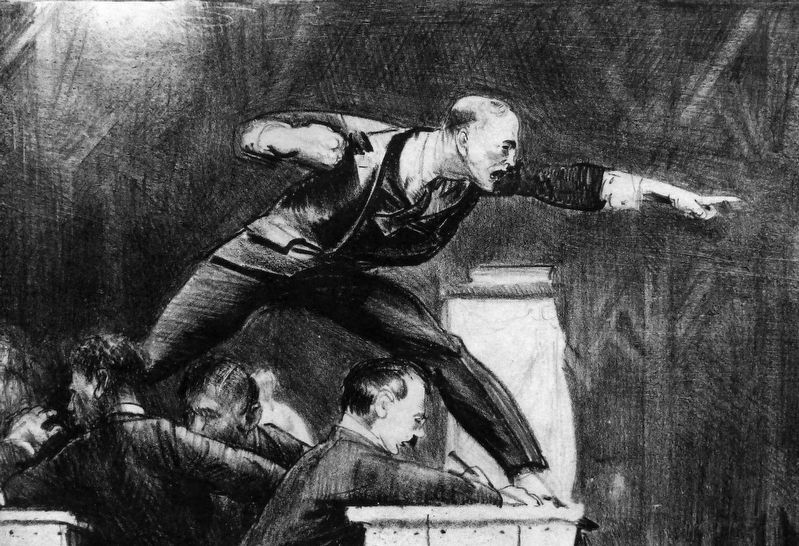
This 1923 lithograph of Billy Sunday by George Bellows (detail) “…captures the fiery, spiritual intensity of Sunday’s oratory skills by emphasizing his forceful gesture one that delights his audience and charges the whole scene with a celestial glow.” — National Portrait Gallery
—Literally From November 9 to December 17, 1905, Billy Sunday preached daily to crowds of 6,000–10,000 in a massive wooden tabernacle. On the final night, 7,000 packed the building, with 5,000 more turned away.
2. Sunday Preached Himself to Collapse
On December 18, Sunday collapsed in front of 4,000 people, fainting from exhaustion after weeks of near-constant preaching. Newspapers feared for his life. He had been preaching “day and night for months” with little rest.
3. 2,500 Converts Publicly Responded
By the end of the campaign, 2,484 people had “hit the trail”, coming forward in response to Sunday’s bold calls for repentance. Men’s meetings alone drew thousands, with hundreds responding in a single afternoon.
4. $4,000 Raised in Free-Will Offerings
The people of Burlington gave Sunday over $4,000, a substantial sum for the time, reflecting both appreciation and the revival’s reach across economic lines.
5. The Mayor Ordered Saloons Closed on Sundays
The revival’s influence extended beyond the pulpit. Mayor Caster issued a public order to close all saloons on Sundays, a clear response to Sunday’s fiery sermons against the liquor trade.
6. A Civic Reform League Was Born
Sunday’s preaching catalyzed long-term impact: 150 citizens formed the Civic Reform League to continue fighting for moral reform and social change after the campaign ended.
7. His Style Divided the Crowd
While many were inspired, others were offended. The Cedar Rapids Gazette praised his sincerity but criticized his “gutter language” and aggressive tone. Sunday, however, refused to hold back: “You say, ‘It’s nobody’s business what I do.’ Hear me—it’s everybody’s business what everybody does.”
8. His Sermons Were a Fusion of Gospel and Social Commentary
Sunday denounced profanity, spiritual apathy, poor parenting, and cultural decay with equal fire. His sermons were revival messages with a conscience, tackling both personal sin and systemic vice.
9. Sunday Preached to a City, Not Just a Crowd
He reached every class—from maids to manufacturers, skeptics to civic leaders. His revival stirred the homes, workplaces, newspapers, and even local politics of Burlington.
10. Burlington Witnessed Both the Brilliance and the Breaking of a Revivalist
The Burlington campaign was a turning point in Sunday’s early career. It showed his remarkable reach, but also the cost of his calling. He preached with such intensity that it nearly ended his ministry—or his life.
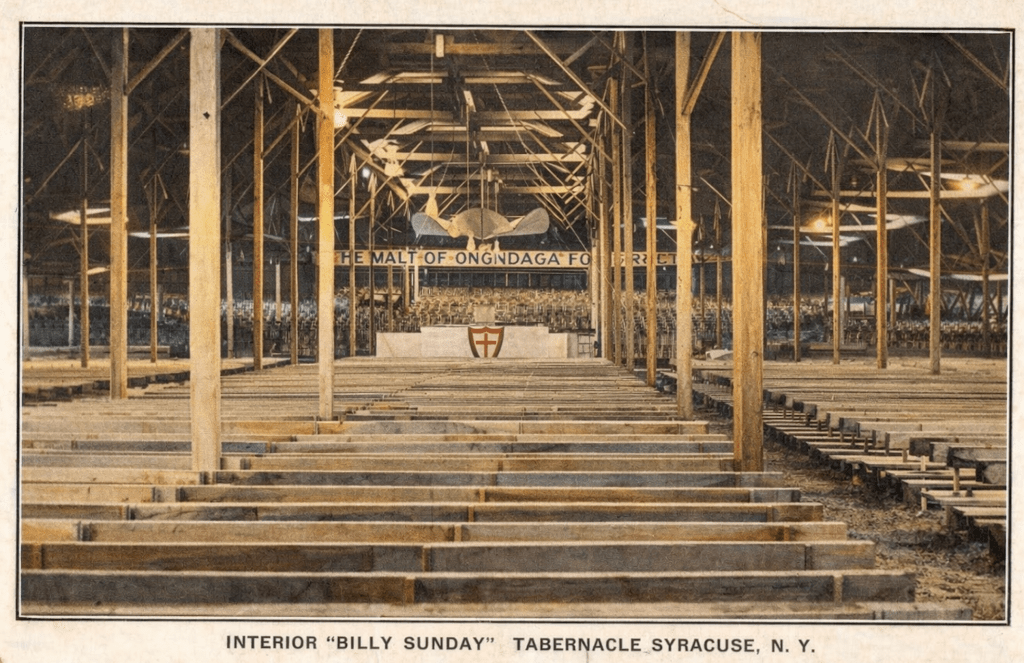
1. Massive Crowds Turned Out —Even in the Snow From October 31 to December 19, 1915, Sunday preached to 911,000 total attendees across seven weeks. Even snowstorms didn’t deter the crowds of 12,000 to 15,000 per service, and many were turned away due to overflow.
2. More Than 22,000 “Hit the Trail” A stunning 22,449 people came forward during the campaign to publicly commit to Christ—among them hundreds of university students, local business leaders, bartenders, and skeptics.
3. Syracuse University Played a Major Role Over 3,000 faculty and students marched to the tabernacle on “University Night,” led by the Syracuse University brass band. Sunday addressed students in chapels, dorms, and fraternities, resulting in over 400 student conversions.
4. Sunday Preached to Every Layer of Society From “maids in kitchens” to “people of refinement and wealth,” no social group was overlooked. Even those who initially rejected the campaign—like certain churches—eventually joined in.
5. A Choir of 4,500 Lifted the Campaign A multi-racial, interdenominational choir of 4,500 singers, broken into rotating choruses of 1,500, filled the tabernacle with powerful music. One men’s chorus was directed by “Rhody,” Sunday’s trombone-playing music leader.
6. Sunday’s Preaching Hammered the Liquor Trade Sunday’s infamous “booze sermon” hit hard. One bartender gave up his bar and called his brewery partners to end the business. Liquor sales dropped as much as 80% in some saloons, and 18,000 voters signed a petition for better Sabbath law enforcement.
7. The Campaign Reached Beyond Syracuse Sunday’s team held satellite revivals and Bible classes in towns within a 50-mile radius. People traveled from as far as Buffalo to attend his services.
8. The Campaign Raised Over $50,000 The free-will offering totaled $23,112, with some reports suggesting over $50,000 collected when including uncounted checks and charitable gifts. Sunday received $11,155 of that total, with much going to local causes.
9. The Local Press Gave Him Their Blessing Even once-skeptical newspapers eventually endorsed the revival, noting “cleaner speech,” moral renewal, and a “fresh and bracing moral ozone” in the city’s atmosphere.
10. It Ended with Song, Tears, and a Chautauqua Salute On December 19, at the closing service attended by 13,000, Sunday invited his team to the platform, and the crowd sang “God Be With You Till We Meet Again.” Thousands followed him to the train station to sing one final goodbye.







 Evangelist Billy Sunday (1862-1935)