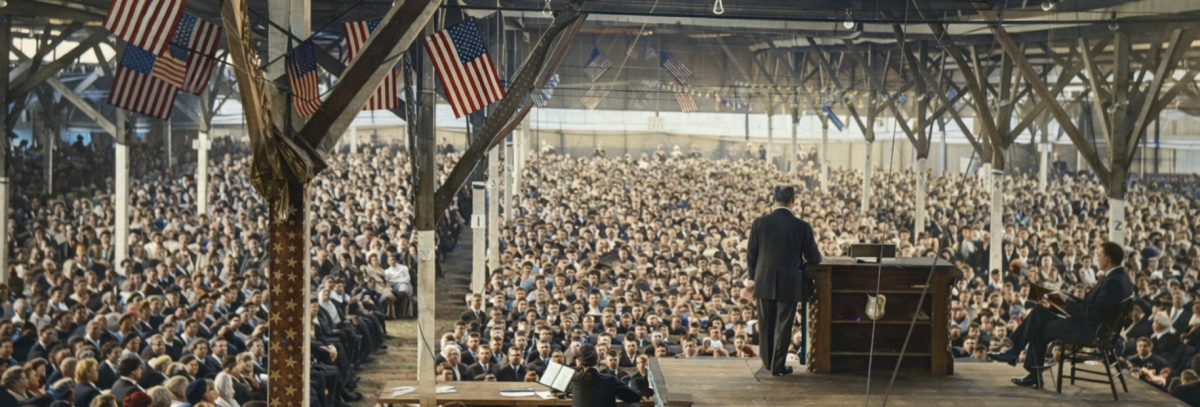
TABERNACLE SERVICE RULES AND REGULATIONS, c 1912

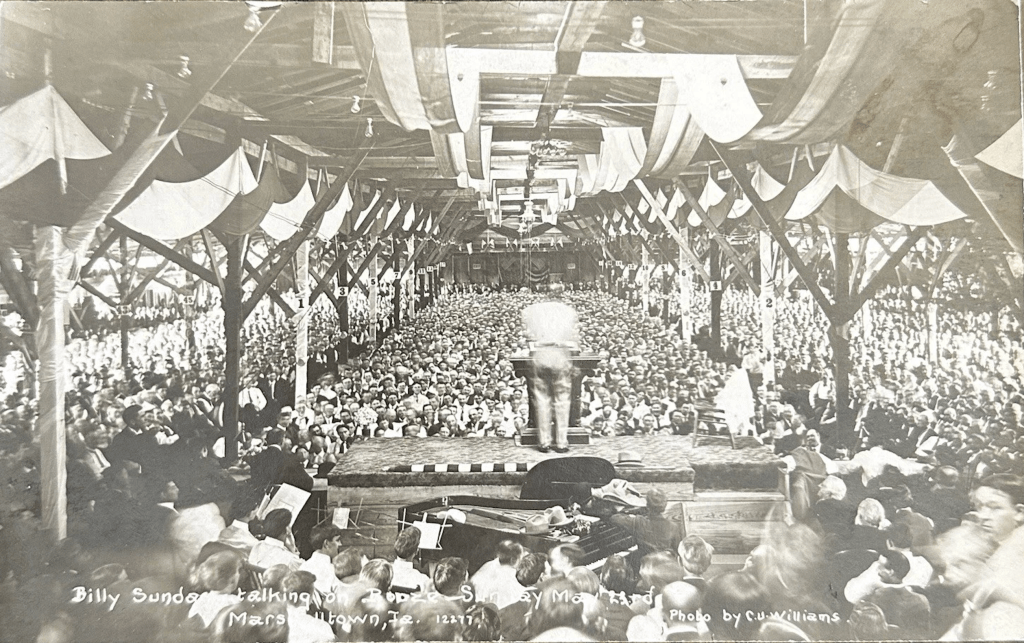
Location of tabernacle—Second and Washington streets.

All hats must be removed within building.

Members of choir required to be in their places promptly.

Tabernacle may be entered from any side and ushers will look after all.

A section of reserved seats is provided in the front for those whose hearing is defective. Another block, in direct center, is for the children.

First to arrive have choice of seats, except those in the choir loft which are reserved by checks for members of that body.

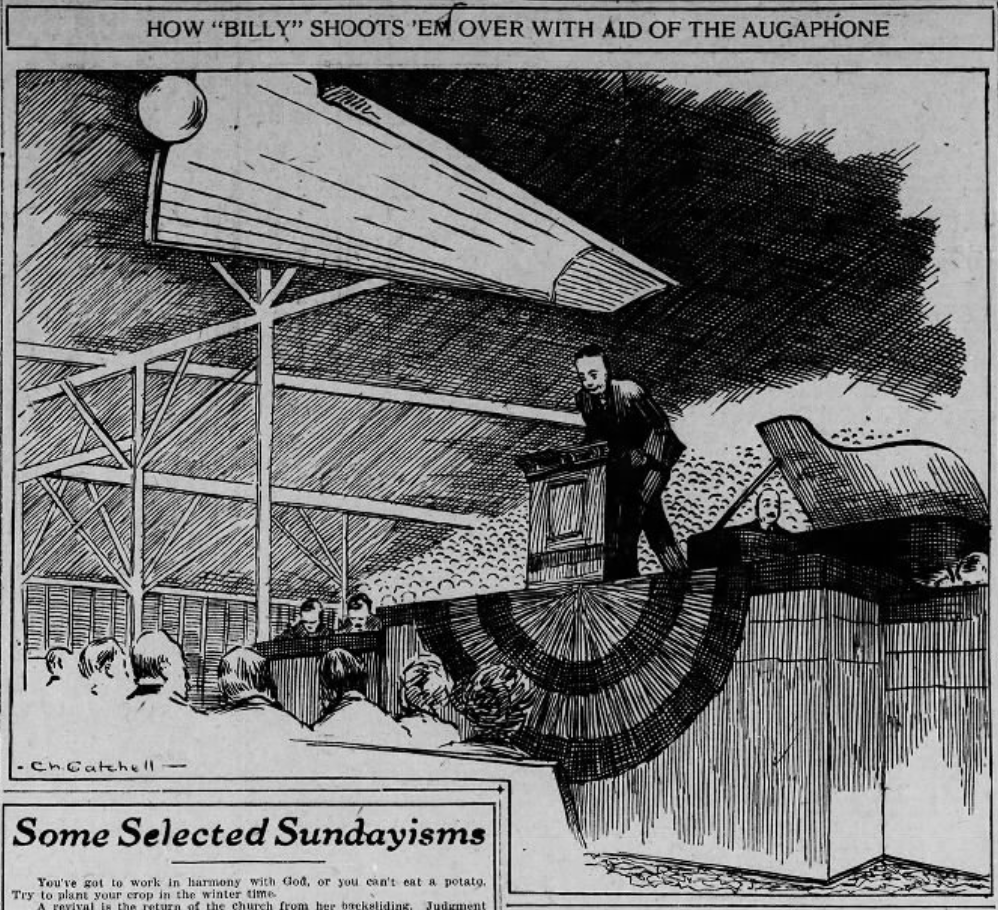
No one is permitted to walk through the aisles of the tabernacle while Sunday is preaching. All are expected to refrain from talking or making other unnecessary noises during the services.

Those who attend services are expected to start early so as to not create a disturbance by entering late. Late comers are admitted, but are required to enter building from rear doors. The purpose is to make as little disturbance as possible.

Ushers, officers and firemen, detailed by police and fire departments, will be on duty at all services to prevent disorder or accidents.

Hand books of the campaign, giving detailed information concerning transportation facilities, telephones, committee headquarters, prayer meeting districts and many other important items of information are distributed gratuitous at the tabernacle.

Changes in the hour of holding services, or any other important development, will be given in the Evening Review.

Sept 1912 paper
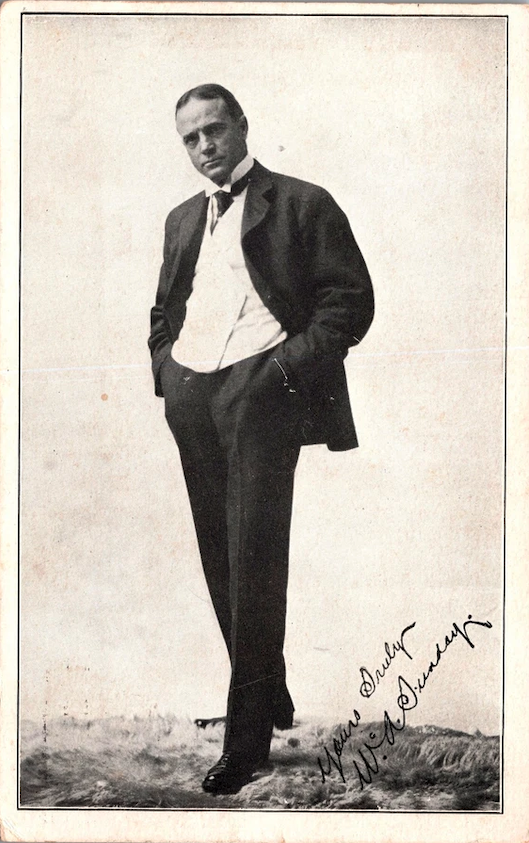
What did preachers think about Billy Sunday, c. 1914?

“First, he is natural, never tries to be another, is never affected. The champion of the diamond is in action for God. Second, he uses the word of God, knows it, believes it, and preaches it with consummate skill and commanding power. Third, he knows the heart of man, and helps every hearer to find and see one’s self. In papers, parts of his sermons may appear to be jokes, but they are no joke to the one whose soul is uncovered by them. A friend said Saturday, ‘I can’t laugh at the jokes, they are too awfully true.’ Another said, ‘Billy’s ‘darns’ aren’t nearly so large when you hear them as they appear to be in the press.” Mr. Sunday shows us the dead body of sin to which we are chained until we loath it and groan to be delivered from it.

Fourth, best and most important of all, he believes in and depends upon the Holy Spirit; who is here working in, working for, and working with Mr. Sunday, and every consecrated follower of God. Just so sure as these things be true, we shall see a great work in Scranton. Every lover of God and man ought to pray most earnestly that this may be fact as well as prophecy. We ought not to judge until we see and hear. Come to the tabernacle and you will wish that all of your family and friends were with you. Mr. Sunday is more than a man working with human skill. He is a man of God being used to help men. Years hence we shall regret it if we fail to hear Billy Sunday now.”

Tribune-Republican. Tue, Mar 10, 1914 ·Page 10

Billy Sunday’s methods? An American Product

“Billy Sunday is an American Product – Where methods differ

More Lasting Good.

The old school of revivalists were of the itinerant class, moving rapidly through the country, their evangelism seemed sudden in its effect and I am afraid somewhat evanescent in its general results. It is just here that Mr. Sunday’s campaign gives promise of more lasting good. His coming has been carefully prepared for, his meeting place is undenominational in character. It is a movement conducted with great business acumen and sound common sense. He trains the ministers and church workers in such a way as to make them capable of caring for the harvest when it comes. Like a good farmer, he prunes the fruit trees with vigor cuts out all the dead wood and sprays them well to get rid of moths, beetles and canker worms, so that when the new fruit shall ripen it will be sound and beneficial. And the leaves of the trees shall be for the healing of the nations. Mr. Sunday is a man endowed with a great faith, He prays for the blessing, he prepares for the blessing, he is sure of getting it and it is therefore no surprise that he is so eminently successful.”

Time-Republican. Thur, Mar 05, 1914 ·Page 10

What is revival? Billy Sunday answers

Part of his sermon, Revival Methods Defended.

What is a revival?

It is a campaign in the name of God against the world, the flesh and the devil, and against a revival you will find every brewer …. every whiskey seller in this valley; every blackleg gambler in this valley; every sham madame of the red-light district; every man and woman that feeds and fattens and gormandizes upon the virtue of men and women, so if you want to line up with a bunch like that, God pity you; that is the best compliment on God’s earth.

Men say the day of the revival is over. Fellows harp on that in the Methodist conference, in the Presbyterian meetings, in the Baptist associations, in the Congregational associations—the day of the revival is over. No, it is not. No, only with the fellow who vomits out the sentiment; but it is not over with God. The day of the revival is over. God Almighty leaned over the battlements of heaven and looked down into the coal mines of Wales and said, “Oh. Roberts!” and out of the depths of the coal mine came that grimy, soiled man, with dirty face, with a little lamp in his cap, and he said, “What is it, God?” And God said, “I want you to go and shake up Wales,” and he gave Wales the greatest revival that ever swept over that land since the days of Pentecost. There was not a college professor or preacher in Wales that God would trust with the job.

The Tribune-Republican. Wed, Mar 04, 1914 ·Page 10

Philadelphia campaign. January 3 – March 20, 1915

Billy’s words to the people at Philadelphia, farewell:

“And this is only the beginning. The revival is a failure that comes to a close when the tabernacle is torn down; we have enlisted –not for a campaign—but for the war. “There remains much land yet to be possessed”. Not in many years has a large city been so generally permeated by the Spirit of God. But only in part has the harvest been gathered; the convicted should be converted; the lives of those who have taken their first step must be linked to the church of Christ; the young convert must be taught; These thousands of men “whose hearts God has touched” must be kept true by being kept

busy for the Master”. – Morgan Library

A Human Dynamo

The Evening Review (East Liverpool, Ohio) · Mon, Sep 16, 1912 · Page 4

A Human Dynamo.

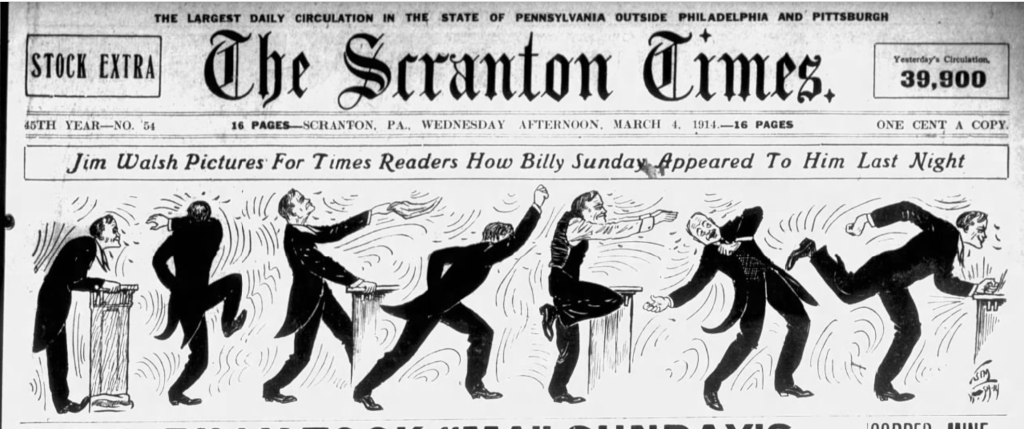
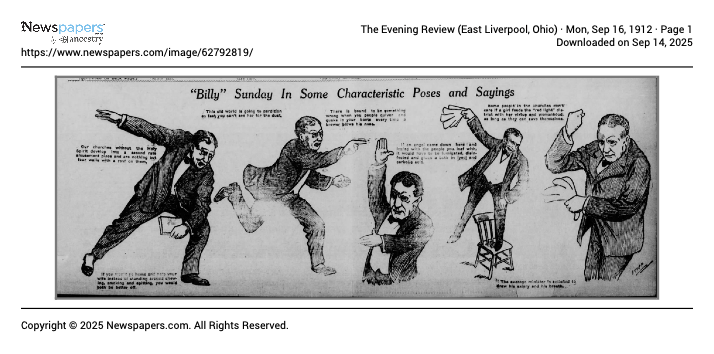
That is Billy Sunday in action—a human dynamo working for the cause of religion. No one could listen to the evangelist, yesterday, without absorbing some of his wonderful energy as he sent it out in great dynamic waves through the huge tabernacle. The air of the big structure was saturated with it.

Billy Sunday literally pumps religious enthusiasm into people. And no matter how much of it he pours out, the supply seems inexhaustible. It is almost incredible that one man could have such a lot of vim and vinegar stored up in his one little body and his brain.

Billy Sunday believes in a Christianity that does things, that is carried out into the lives of people, that accomplishes results, that “delivers the goods.” This is the core of his evangelism. This is why he is so vitriolic in his denunciation of the Christian who sits back and is satisfied with announcing that he believes in the Lord but does nothing for the Lord.

Nothing in oratory could be more impressive or effective than the evangelist’s word painting of histrionic scenes, especially those of the battlefield, and the application of some striking incident to the life and work of the soldier in the Christian army. It is the very essence and soul of eloquence.

The audiences that met yesterday to hear Sunday’s first three sermons, would have been most encouragingly large on the pleasantest of days. On a rainy day such as it was, they may well be regarded as remarkable, and as most auspicious.