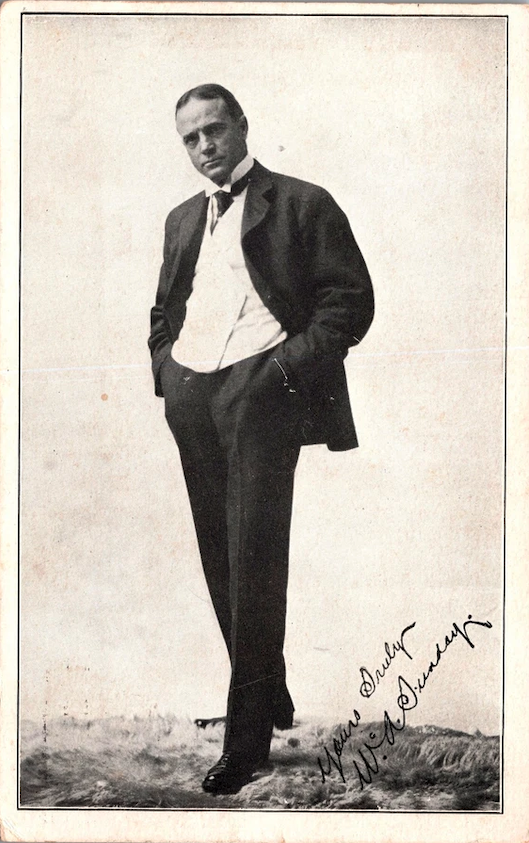
Billy knows his Bible – says a fellow minister, c. 1913

“Dr. Sunday (Westminster College had just conferred an honorary doctorate upon Sunday) knows his Bible which is the true body of divinity in theological lore. Mr. Sunday has devoted his life to the supreme task of world evangelization for which the Bible is the great charter.

He is, therefore, both in scholarship and practical effort entitled to the degree. Just as a Doctor of Medicine is supposed to know the Science of Medicine and practice the art of healing, so a Doctor of Divinity who know the truth about God and practices the art of saving 1s entitled to the degree. In many institutions it is customary to bestow the honorary degree of Doctor of Divinity upon those who are men noted for their knowledge of “the traditions of the scribes and pharisees” than for knowledge and practical use of the Bible itself.”

Sincerely yours,

R.M. Russell to T.T. Frankenberg (Columbus, Ohio)
August 30, 1913

Artifact credit: Morgan Library, Grace College

The recipient of this letter, Theodore Thomas Frankenberg, was no casual correspondent. A Columbus-based journalist and author, Frankenberg was in the midst of gathering materials for what would become the first popular biography of the evangelist, Billy Sunday: The Man and His Message (published in 1914). Letters like Russell’s provided him with both anecdotal color and institutional validation—evidence that Sunday was not just a charismatic revivalist but a figure respected by the academic establishment.

This exchange captures an important cultural moment. Westminster’s degree signaled a rare bridging of worlds: a Presbyterian college recognizing a frontier-style evangelist whose power lay not in polished scholarship but in the raw urgency of his preaching. To Sunday’s critics, the degree may have looked like a concession to populism. To his supporters, it was overdue acknowledgment that the man who knew his Bible best and preached it most widely deserved the honor more than those “scribes and Pharisees” who merely debated it in lecture halls.

In the end, Frankenberg’s biography helped cement Sunday’s reputation, weaving together stories, letters, and testimonies like this one. And tucked inside that narrative is the 1913 moment when Westminster College draped Billy Sunday in academic robes, placing him—at least symbolically—among the doctors of divinity.

The value of Helen ‘Ma’ Sunday?

“Winona people are beginning to know something of Mrs Sunday’s gifts and abilities, as they never have before understood them. She works with unusual tact, and gives evidence of thinking every subject through before action is taken. Personally, I appreciate such a counsellor more than I can express. I feel satisfied that her spirit has touched the heart of every Commissioner of the General Assembly; and this has resulted in inspiring their confidence in Winona’s present, and enlarged their vision of the great future this Institution faces.”

Letter from J.C. Breckenridge, General Secretary, Winona Assembly and Bible Conference. May 24, 1921. Addressed to Billy Sunday. Morgan Library. Billy Sunday Archives.

U.S. Grant’s advice to young people?

The following is attributed to U.S. Grant and Billy Sunday wrote this into sermon notes labeled “Science.” No date. Morgan Library, Grace College.

“Hold fast to the Bible as the sheet anchor of your liberties.”

$10,000 Raised In Ten Minutes for Negro YMCA – Atlanta 1917-1918

“Atlanta, Jan. 1.—Ten thousand dollars raised within ten minutes by white citizens of Atlanta yesterday assures the negroes of this city success in completing their Y.M.C.A. building. The white people are pledged to raise another ten thousand if necessary. A fifty thousand dollar fund was needed to obtain the gift of $25,000 from Julius Rosenwald. C.W. McClure made a donation with the statement that the friendly relations between the whites and the negroes were better than ever since Billy Sunday preached to both.”
Jan 1 paper

In the waning days of 1917, as Atlanta turned the page to a new year, a remarkable act of interracial philanthropy unfolded that would leave a lasting mark on the city’s history. Newspapers reported that ten thousand dollars had been raised in just ten minutes by white citizens of Atlanta to help fund a new YMCA building for the city’s Black community. The drive was part of a larger campaign to secure a matching gift of twenty-five thousand dollars from Julius Rosenwald, the Sears, Roebuck & Co. magnate whose generosity was transforming African American education and social life across the South. Local businessman C.W. McClure, who helped spearhead the effort, remarked that the relations between whites and Blacks in Atlanta had improved markedly since evangelist Billy Sunday had preached to both communities during his campaign there.

The fruits of that campaign materialized in the Butler Street YMCA—known in its day as the “Negro Y.” Built between 1918 and 1920, the new structure rose in the heart of the Sweet Auburn district, the beating center of Black enterprise and culture in Atlanta. The project followed Rosenwald’s signature pattern: a challenge grant that required local citizens—both white and Black—to raise the balance. The local enthusiasm kindled by Sunday’s revival evidently carried over into civic generosity, helping to meet the $50,000 goal needed to unlock Rosenwald’s contribution.

The Butler Street YMCA quickly became one of the South’s most important centers of African American life. Designed by the firm Hentz, Reid & Adler and built under the direction of Black contractor Alexander D. Hamilton, the facility was impressive for its time—three stories of brick and stone housing a swimming pool, gymnasium, dormitories, meeting halls, and classrooms. It provided a wholesome environment for young men seeking moral and social uplift in a city that offered them few such spaces.

More than a recreational facility, the Butler Street Y grew into a cornerstone of civic and spiritual leadership. Over the decades it came to be known as the “Black City Hall” of Atlanta, hosting meetings that shaped the course of civil rights and community advancement. Figures such as Martin Luther King Jr., Maynard Jackson, and Vernon Jordan would later pass through its doors. The Y stood as a living emblem of what cooperative goodwill and faith-inspired philanthropy could achieve during an era when segregation still divided the city.

The 1918 campaign that launched the Butler Street YMCA was more than a fundraising victory. It was a moment when revival energy turned outward—when the social conscience stirred by Billy Sunday’s preaching translated into practical generosity. In helping to fund the YMCA, the people of Atlanta built not only a structure but also a bridge between communities, one that carried forward the spirit of reform, service, and reconciliation that Sunday’s message had kindled. The Butler Street Y remained for nearly a century a monument to that brief but luminous cooperation—a place where faith met action and where the legacy of revival took tangible form in brick, mortar, and hope.

Butler YMCA, image from their Facebook page

The famous Billy Sunday hat

Billy was often photographed in this hat, which now resides on the bed in his former Winona Lake home. Permission to photograph was granted by the Winona Lake History Center.

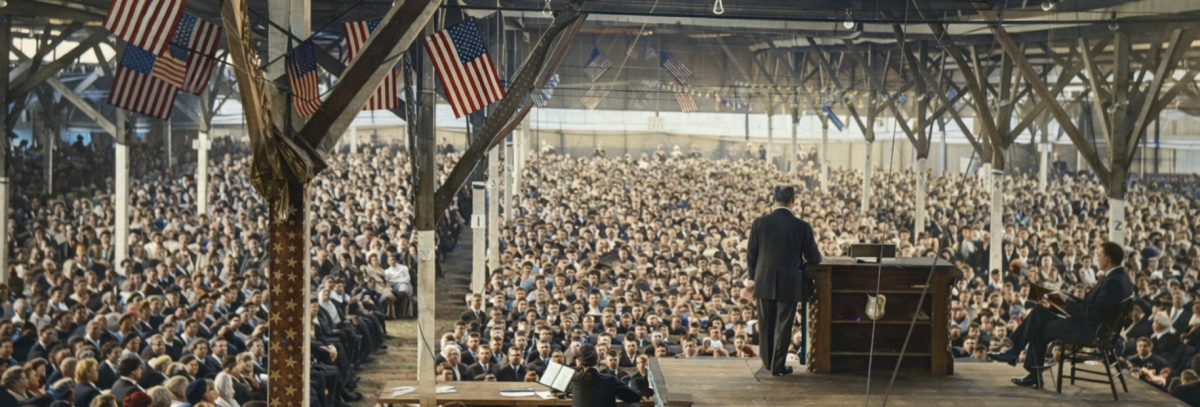
The picture below was taken in 1915 at the Polo Grounds (colorized with AI).

Billy Sunday’s Bible and Psalm 37

Many surviving signatures of Billy Sunday accompany and simple inscription to Psalm 37.

There is a KJV Scofield Bible, dated 1909, on the bed of Billy and Ma Sunday in their home in Winona Lake. This particular Bible was gifted to Billy in 1917 on Easter Sunday, in New York.

Permission granted by the Winona Lake History Center to photograph the Bible.