Rev. J. Wilbur Chapmain weighs in on Billy Sunday ministry while Sunday was serving in South Bend

DR. J. W. CHAPMAN IS VISITOR AT SERVICE

HE CALLS SUNDAY’S MINISTRY MARVELOUS ONE.

Citation: The South Bend Tribune. Wed, Jun 04, 1913 ·Page 11

Drives 100 Miles in Automobile to Hear Baseball Evangelist Preach—Gives Short Talk.

Dr. J. Wilbur Chapman, one of the most prominent evangelists in the country, who visited the Billy Sunday tabernacle last night, called Billy Sunday’s ministry one of the most notable of modern times. He said the baseball evangelist is doing a wonderful work, which is being felt throughout the country.

Dr. Chapman was accompanied by Mrs. Chapman and their daughter, Mrs. Bertha Goodwin. He had only just returned from Australia on his world tour in evangelistic work, and drove 100 miles in an automobile so that he could hear Sunday preach last night. Billy Sunday learned his trade, so he expressed it, under the other evangelist, and there was a warm greeting between the two when they met on the platform.

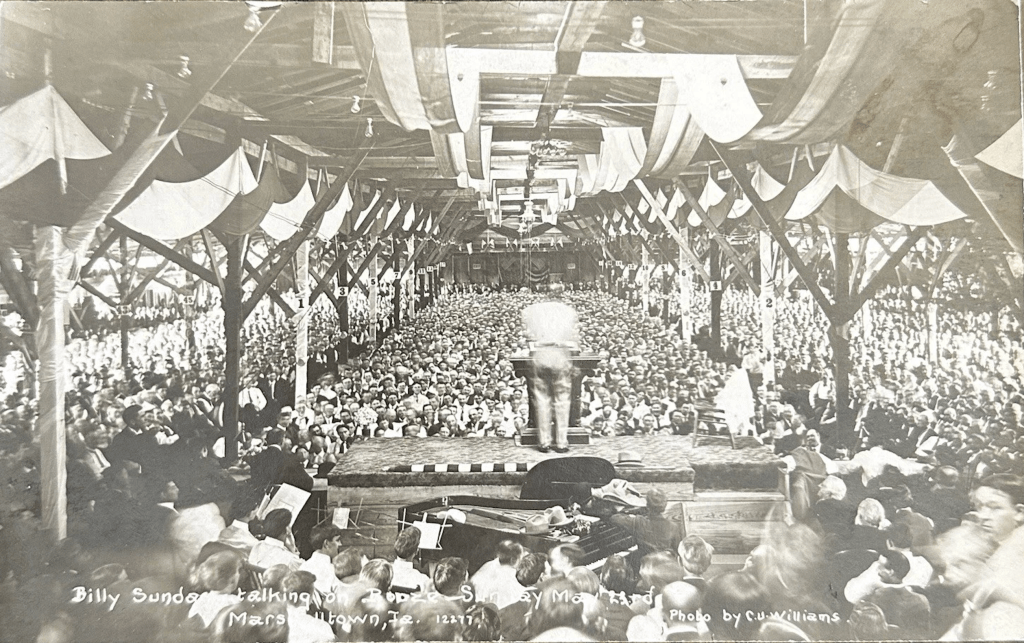
It was however, no less warm than that which was accorded Dr. Chapman when he became generally recognized by the crowd at the meeting. Those in the preachers’ section were the first to recognize hi mand they began the applause. Thousands in the throng joined in the ovation. The tabernacle became a great sea of waving handkerchiefs and the applause was deafening.

Dr. Chapman praised Sunday highly to the audience, then declared:

“Billy used to tell the people when he introduced me, that when he started out as an evangelist he used to use the outlines of some of my sermons. Let me tell you the sermons he is delivering now, are not my own. I have wished often I could claim some of them, however. They would be worth claiming.”

The South Bend Tribune. Wed, Jun 04, 1913 ·Page 11

Money to Billy is well spent, c. 1913

BY JOHN HERRING.

City Councilman, Wilkes-Barre, Pa.

[Note: Mr. Herring had applied for a saloon license but afterwards “hit the trail” in the Wilkes-Barre campaign.]

Citation: The South Bend Tribune. Tue, Jun 03, 1913 ·Page 8

From my own personal observation I do not hesitate to say that Wilkes-Barre and Wyoming valley has never enjoyed so much happiness as prevails at the present time as a result of the Billy Sunday campaign. The great change that has come over the community as a result of Mr. Sunday’s campaign is very noticeable and I believe that if the people of this city could have him they would ask Mr. Sunday to come back to our locality and stay another seven weeks.

Throughout our locality saloon-keepers do not deny that they have been badly affected by Mr. Sunday’s campaign. The faces which were very familiar in such places for many years are now absent. Men who for years have led a reckless life and neglected their families have been released from the influence of drink and are once more respected by their fellow men. A visit any night to the large hotels in the central part of our city is sufficient to prove that the patronage at these places is not nearly as great as before the revival. I believe it is safe to say that the amount of good done by Mr. Sunday in this vicinity cannot be measured.

Never in the history of our churches has the attendance been as large as during the past few weeks, or since Mr. Sunday left for South Bend. One church, the Central Methodist Episcopal has taken in nearly 800 new members to date and many more are expected. Another church, Westminster has taken in about 500 and several other churches have taken in like numbers. In fact, if the enthusiasm continues and I have every reason to believe it will, many of our congregations will have to enlarge their edifices. It is surprising to know the number of our influential citizens who for years have been out of the church now within the church and taking an active part in its affairs. Another feature of Mr. Sunday’s work is that men of high positions in life who were converted are now members of the Y. M. C. A. personal workers league and are out daily leading others to the cause of righteousness. The work that is being done by the personal workers is admirable. Employers can be found working hand in hand with their employees all working in the interest of Christ. So satisfactory have the results been that other cities have asked several of our young men to visit and tell the story of the great amount of good that has been accomplished. Only last Sunday one of our newspapermen went to Williamsport and so pleased were the people with his message that he was forced to repeat it at three different meetings.

The question has been asked as to whether the merchants of this vicinity have been benefitted by the Sunday revival. Every day one hears some merchant say that accounts which he had closed several years ago have been re-opened and are being settled by the people who contracted debts.

Judging from the activity among the ministers since Mr. Sunday’s visit it cannot be denied that the great evangelist has done a wonderful amount of good among the ministers of the gospel. The better work being done by the ministers in my estimation is due to the fact that they are now receiving the co-operation of their congregations, which was unusual heretofore.

Regarding the liquor traffic and the effect of the revival in surrounding towns, two of the saloon keepers, I have been informed, have quit the business. One was a resident of Parsons and the other of Edwardsville. Two pool rooms one, of which was to be replaced by a saloon, have been wiped out and have been replaced by a grocery store and confectionery.

An organization of railroad men at Ashley was disbanded after the officers were converted and the men are all doing personal work now. A club room at Plymouth, where men assembled on Sundays and did considerable drinking has been changed to a prayer meeting room, the sale of liquor having been discontinued.

In Wilkes-Barre several men who for several months had been gathering weekly in a garage and playing poker were converted and are now holding Bible classes instead.

A representative of the Bell Telephone company said a few days ago that since the revival the company’s receipts from saloon pay stations have fallen off a large per cent and the receipts from drug store stations have increased accordingly.

Although the grand jury of our county ignored several cases against “speakeasies” that were raided by Sheriff Kniffen, one of the converts, the religious organizations throughout the whole county have passed resolutions supporting the sheriff and his crusade and the Y. M. C. A. personal workers’ league plan in a few days to hold a big street demonstration approving the sheriff’s work.

In conclusion I would state that it is difficult to express the real situation existing in his locality as the result of the great evangelist’s good work.

That the change among the people is also being felt by our city officials was evidenced several days ago when the mayor of our city, Hon. John V. Kosek, caused every side room, where cabaret shows were held nightly and where women of questionable character congregated, to be closed. Hotels that for years were known to have been the meeting place of immoral men and women during the past week have been in darkness.

Billy Sunday was given over $23,000 by the people of this valley and I do not hesitate to say that if he had been given $100,000 he would not have been repaid for the good he accomplished.

The South Bend Tribune. Tue, Jun 03, 1913 ·Page 8

Personal Workers to Extend Revival

PERSONAL WORKERS TO EXTEND REVIVAL

WILL FILL SUNDAY’S PLACE ON HIS DEPARTURE.

ALWAYS DO GREAT WORK

Citation: The South Bend Tribune. Thu, May 29, 1913 · Page 7

Results at Wilkes-Barre and Columbus Show What South Bend Can Do in Important Branch of Campaign.

The recent organization of the personal worker’s league among the men of the city has brought many to believe that this body of men will be the means of making the Billy Sunday campaign a most productive one, permanently.

It is not the purpose of the personal workers’ league to work only during the few remaining weeks of the revival but the members propose to maintain the same spirit that pervades religious circles at the present for months to come. The league is designed to take the place of Billy Sunday after he leaves, carrying on the revival work in different places in South Bend and Mishawaka, and surrounding districts.

Is Important Factor.

In other cities, such as Columbus, O., and Wilkes-Barre, Pa., the personal workers’ league has been one of the most important factors during the closing weeks of the campaigns and of great assistance to the evangelist in his work. The men who belong to the league go among their associates, whether in the factory, in the office or in the stores, trying to persuade other men to become Christians. It has been found that this is a very effective way of bringing men to the tabernacle meetings and eventually to the altar as the proposition is put to them in a practical manner and appeals to the majority.

In Wilkes-Barre, where Mr. Sunday recently closed a campaign, the personal workers’ league is holding meetings throughout the city, in the towns and in the vicinity every day. Excellent results are being derived from these meetings and men are being converted almost every day. The league is credited in an effort to convert the whole Wyoming valley and have organized a perfect machine which is working the community systematically and thoroughly.

Much Interest Here.

Present indications point to the fact that South Bend will have even a greater personal workers’ league than that at Wilkes-Barre, as more men are taking an interest in the work from the very start. The members include many of the most prominent business and professional men of the city and all are using their influence in an effort to get their associates to ‘hit the trail.’

They are entering the work with a spirit of enthusiasm unknown in re-

Meet Each Noon.

The personal workers are to meet every noon at the Y. M. C. A. while the campaign is on, and frequently after it has closed. The first day, nearly 100 men were in attendance, and each day those present were urged to return the following day with a friend. The plan has accomplished good results and the membership of the organization is steadily increasing.

In case it is decided to begin the noon mass meetings downtown next week, the personal workers’ league will meet daily at the same place where the meeting is held. The business for the day will be transacted as soon as the men get together, then the meeting will be over in time that they would have an opportunity to listen to Billy Sunday speak and hear the sermon, if necessary.

The South Bend Tribune. Thu, May 29, 1913 · Page 7

Was Billy Sunday a different man off of platform?

BY THE OBSERVER.

Citation: The South Bend Tribune. Wed, May 28, 1913 ·Page 13

To those who know Billy Sunday it seems he has two almost distinctive personalities. This statement may seem odd inasmuch as it would lead one to think the evangelist is some such sort of a fellow as Dr. Jekell and Mr. Hyde but such an impression would be inequitable to Mr. Sunday. The personalities are not moral instead they are physical. Two distinct characters are noticed, one on the platform and the other off.

At home, on the street, coming down the aisle in the tabernacle, Billy Sunday appears to be a man slightly below the average in heighth, a bit stoop shouldered, chest somewhat sunken, with kindly eyes and an expression sympathetic on his face. But the moment he steps to the platform, takes off his hat, removes his overcoat and faces his audience he seems to be another man.

His strength of character appears to have grown tenfold. His chin seems more square, the lines of his face smooth out, and his eyes fill with the spirit of anticipation. The shoulders, which were but a moment before stooped, appear to straighten and broaden. His chest seems to fill out, and his whole body appears to have grown within the twinkling of an eye.

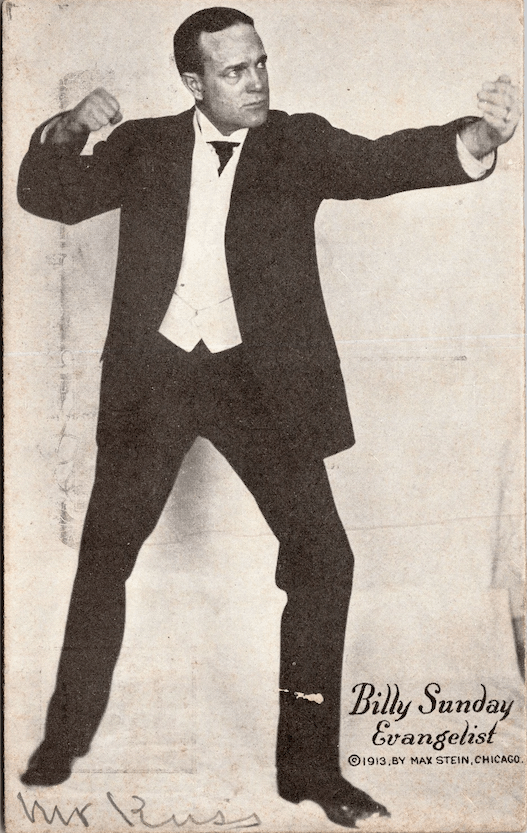
When speaking the evangelist has a way of impressing one with the fact he is wiry and has tremendous strength of body. And for a man of 50 years, Billy Sunday is of a fibre seldom equalled. This is due probably to his activeness on the platform, his utter disregard for the law of gravitation, as he whirls and balances now on one foot and then on the other.

When off the platform these things do not impress one. Sunday appears hardly more than the ordinary type of a man of unusual intelligence and his mysterious change of personality is a puzzle to many who have watched and studied him. Very few men make a better appearance on the platform, an appearance of ease, than does Billy Sunday and he seems more at home in the pulpit than anywhere else.

The South Bend Tribune. Wed, May 28, 1913 ·Page 13

Billy Sunday admitted he sometimes fails to give credit to a ‘source’ (c. 1913)

FREELY ADMITS HE TAKES SUGGESTIONS

BILLY SUNDAY EXPLAINS THAT OLD CHARGE OF STEALING.

OFTEN FAILS TO CREDIT

Citation: The South Bend Tribune. Wed, May 21, 1913 ·Page 11

Sometimes He Doesn’t Know Where Stuff Came From, Often He Forgets It, Baseball Evangelist Declares.

Ask Billy Sunday if he steals some of the material he uses in his sermons and perhaps he will frankly admit it.

That is, he will confess that he picks up hints, paragraphs, poems and anything else which will assist him in his work, only giving the creator of the things the credit when he happens to know their names, or when he thinks of it.

“The accusation in regard to my stealing the stuff for my sermons makes me tired,” said the evangelist when approached regarding the matter.

“There isn’t a public speaker today but what does the same thing. Every day I get poems and paragraphs and other knick-knacks through the mail from people I do not know, who suggest that I may have some use for them. I clip and save thousands of such things myself in the course of a year.

Doesn’t Know Author.

“Well, when I get ready to work them into my sermons, nine chances out of 10 I won’t know the name of the author. But I use them just the same, and give those who originated them credit when I can and when I remember it. But if I had to stop and give credit for every bit of outside material I work into the sermons, I wouldn’t have much time to say anything else.

“There are a dozen or 15 evangelists who are using my stuff every day they preach. Do I get any credit for it? Well, I guess not. They are free to use it if it will do any good without crediting it to me, so why should I go to the trouble of mentioning all these folks in my sermons.”

About Mothers’ Poem.

The evangelist told of an incident a few days ago in connection with his special Mothers’ Day address. He said he recited a poem during the sermon, which had been sent him by some anonymous letter writer. The poem was an excellent one and suited his purpose exactly. He quoted it word for word in his mothers’ sermon without giving any credit for it and a day or two later, discovered the name of the author while reading a magazine.

He has now noted down the name of the author and will give him credit for the work when he delivers the sermon again. The evangelist says if he is guilty of stealing literary stuff that every public speaker in the country could easily be convicted of the same offense.

Reads Everything.

The evangelist reads anything and everything worth reading, which is brought to his attention and by so doing he collects thousands of suggestions and hints for sermons and additions to sermons. He said he believed his clippings for his sermons in the course of a year, would fill an ordinary two horse wagon.

Sunday has a marvelous memory, which is also of great assistance in his work. In the preparation of a sermon, he writes only fragments of it out, depending on his faculty for remembering to carry him through it. A few notes, all of which have been typewritten, are all he has to show for the majority of his sermons, many of which have become famous and are generally regarded as masterpieces.

The sermon he will deliver to-night at the tabernacle, “The Second Coming of Christ,” has been heard by thousands, as one of the evangelist’s very best, is not in the mind of Sunday in full and probably never will be, unless he takes the trouble to clip it from some newspaper, which is printing detailed accounts of his talks.

Only Few Sentences.

Instead, it consists of only a few terse half completed sentences, which are set down in type written form to assist him in remembering the balance. In the majority of instances, the wonderful word painting in the sermons are simply noted in two or three words and a brief sentence may stand for two or three stories he tells during the talk.

The South Bend Tribune. Wed, May 21, 1913 ·Page 11

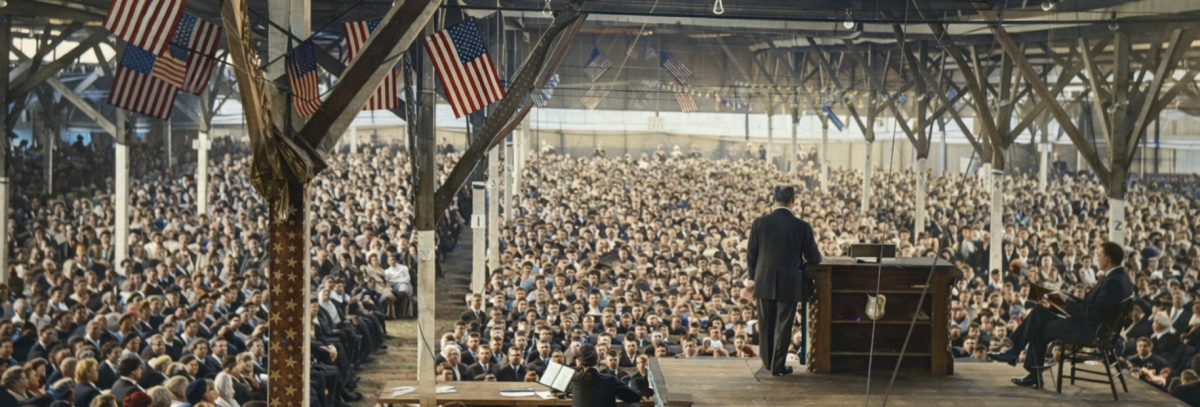
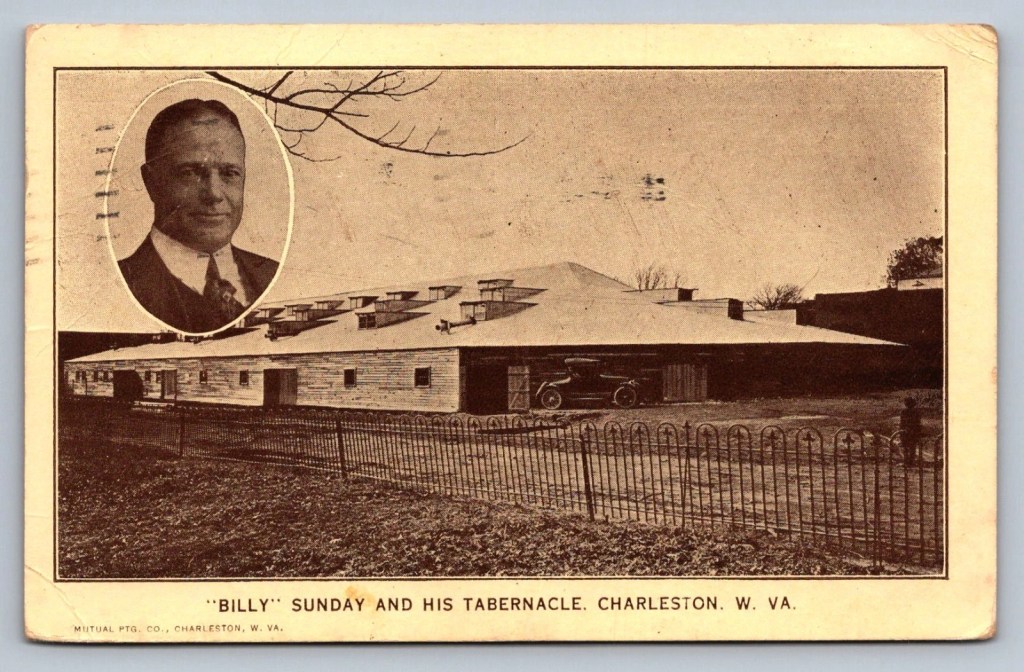
Picture of the Sunday tabernacle at South Bend, c. 1913

PORTION OF CROWD OF 9,000 PEOPLE SURGING FROM TABERNACLE AFTER MOTHERS’ MEETING

THOUSANDS LEAVING AFTER MOTHERS’ SERVICE.

Mothers’ day proved quite as great a success yesterday afternoon as did the initial men’s meeting of the campaign last Sunday afternoon. Nearly 9,000 men and women, the majority of them the latter, heard the evangelist deliver his wonderful sermon on ‘Mothers’ during the special service.

-By Staff Photographer.

Citation: The South Bend Tribune. Sat, May 17, 1913 ·Page 12

Winona Lake hosted a summer chatauqua assembly in the summer of 1913

Citation: The South Bend Tribune. Fri, May 16, 1913 ·Page 2

WINONA PLANS FOR GREATEST SUMMER

MANY CONVENTIONS ARRANGED FOR THE SEASON.

BIBLE SESSION FEATURE

William Jennings Bryan, David Lloyd George, Gipsy Smith, “Catch-My-Pal” Patterson and Others Will Speak at Gathering.

William Jennings Bryan. President of Winona Assembly. Winona Lake, Indiana.

The Tribune’s Special Service.

WARSAW, Ind., May 16.—Winona assembly, which will operate this season free from its load of debt, having arranged for the settlement of $300,000 claims by an agreement with the creditors, has prepared for a program of events that will establish a new record. One of the biggest events of the year will be the annual conference of the Church of the Brethren, which will start May 28 and continue until June 7. Between 40,000 to 75,000 churchmen are expected to attend.

The chautauqua program will start June 29 and will continue for 10 weeks. Among the spectacular offerings are the following: Ahasuerus, a sacred opera under the direction of William Dodd Cheney; “The Lost Princess,” under the direction of Mrs. Hortense R. Reynolds; Venetian night, and a great water carnival under the direction of Capt. J. R. Pine. Preparations for the latter event are already under way.

Will Hold Mission School.

Some very notable gatherings are booked to occur during the chautauqua season and at its close. Beginning June 19 and ending June 27, the summer school of missions will be in session. This will be held under the auspices of the interdenominational committee of the assembly. The summer conference of the Presbyterian young people will be held July 9 to 16. The annual meeting of the Ohio Farmers’ Insurance company will be held July 23 and 24. The Health and Happiness club with Mrs. Louise L. McIntyre and Miss Margaret Hall as directors, will be in session July 7 to 14.

The fourth annual conference of the Young Friends of America will be held during the assembly season. The fourth annual session of the international district training school for Sunday school workers will be held Aug. 11 to 21. The Kappa Sigma Pi, the new boys’ movement which was established in 1912 by Homer Rodeheaver, conductor of music for Rev. Billy Sunday, will be in session during July. W. M. Collisson will act as secretary and will be in charge.

Photographers Will Meet.

The 18th annual convention of the Indiana Association of Photographers will meet July 7 to 10. This will be held under the auspices of the National Reform Association. Among the speakers are Dr. James S. Martin, Dr. Lyman E. Davis, Dr. Grant W. Bower, Dr. James McGraw, Ng Poon Chew, of China, Dr. Merle de Aubing, of France, Dr. Armenag of Turkey, and Dr. R. J. Patterson, of Ireland.

One of the big events will be the annual Bible conference, which will be held Aug. 22 to 31. Dr. Sol C. Dickey will be director. He is already busy arranging for the meetings which will bring churchmen here from all parts of the world. Prof. E. O. Excell will have charge of the music and Rev. W. E. Biederwolf will be the assistant director. The opening address will be by Secretary of State William Jennings Bryan, who will also be president of the board of directors of Winona assembly to welcome the visitors. Among the other speakers already engaged are Rev. C. Campbell Morgan, of London; Rev. Gipsy Smith, of Connecticut; Rev. Robert (Catch-My-Pal) Patterson, of Belfast, Ireland, and Hon. David Lloyd-George, chancellor of the British parliament.

The South Bend Tribune. Fri, May 16, 1913 ·Page 2

Billy Sunday favored women’s suffrage.

BILLY SUNDAY IS FOR SUFFRAGE FIRST, LAST AND ALL THE TIME

Woman suffragists ought to like Billy Sunday.

“Do you favor woman suffrage?” he was asked the other day.

“Why not?” he hurled at the reporter just as though the latter were an “anti.”

“I don’t know,” murmured the representative of the press, in a tone measured to encourage Mr. Sunday to a further discussion of the subject. And Mr. Sunday was quite willing to talk about it. And talk he can on any subject.

He launched into one of the most picturesquely worded and one of the most emphatic indorsements of woman suffrage that its most ardent supporters could ever wish to have, “Why shouldn’t women have the franchise? They are as worthy of it as the men,” was the substance of what he said.

There are 6,000,000 women and girls working for a livelihood in this country, he statistically declared to the reporter.

He urged that the working woman fills an important place in the industrial and business life of the country.

“Take them out of the offices, mills, factories and stores, and you’ll miss them quickly enough.” These 6,000,000 women so engaged were advanced as one of Mr. Sunday’s reasons for granting the franchise to women.

All an interviewer of Mr. Sunday can hope to do is to get impressions. In answering one question he said enough interesting things on the equal suffrage question to fill a small volume. He invented enough aphorisms and sprung enough epigrams to make an issue of Elbert Hubbard’s Philistine look like a mere sample package.

If you go to interview Mr. Sunday take the best stenographer in the state with you. No, take two or three. Mr. Sunday uses words with exceeding celerity. He confessed that he could use as many as 350 a minute. The interviewer gained the impression that he was trying to break the speed limit yesterday.

“There’s only one stenographer I have known who could get my speeches in full,” he said, “and he missed one word in ten.”

The South Bend Tribune. Thu, May 15, 1913 ·Page 9

Poem: Hit the Trail

“HIT THE TRAIL.”

BY J. ANDREW BOYD,

Wilkes-Barre, Pa.

Mister Man, it’s up to you To “Hit the Trail;”

If you’d show that you are true,

Just “Hit the Trail,”

Some will laugh, and some will jeer,

Some will point at you and sneer,

But be brave and never fear,

Just “Hit the Trail.”

If you want to start out right,

Just “Hit the Trail,”

To fight the devil with your might,

Just “Hit the Trail,”

Walk up like a hero brave,

Prove your soul you want to save,

Let old Satan rant and rave,

Just “Hit the Trail.”

You will need a courage high

To “Hit the Trail”;

Say, “I’ll do it if I die,”

So, “Hit the Trail”;

Grasp the preacher by the hand,

For the right then take your stand,

Join the brave and happy band,

And “Hit the Trail.”

The South Bend Tribune. Thu, May 15, 1913 ·Page 8

Did Billy Sunday have more than one copy of his sermons?

TO HAVE SERMONS DEPOSITED IN VAULT

BILLY SUNDAY GOING TO TAKE PRECAUTION AGAINST FIRE.

Citation: The South Bend Tribune. Tue, May 13, 1913 ·Page 7

Just Now, Evangelist Has No Duplicate Copies of His Famous Addresses—Ackley Does Work.

“No, I have only the one copy of each of my sermons,” replied Billy Sunday to a question as to whether he had duplicates of his sermons.

“These sermons are not in full,” continued the evangelist, as he showed the books in which he keeps the addresses that sway so many thousands; “they are just mere skeletons of the sermon and no one else but myself can read them, or at least I don’t think that anyone else can.”

Mr. Sunday was asked if he could remember the sermons if they were stolen and he replied that he recalled the majority of the material that composed them. He says that he intends to have duplicates made of the sermons and have them put into a safety deposit vault so that if one is stolen or should be destroyed by fire or in some other manner, he will have a copy.

“I thought at first that I would be able to get them copied this summer,” he said, “but it don’t look like the work will be accomplished, as I have so much to do this year.”

B. D. Ackley, pianist of the Sunday party, and secretary to the evangelist, copies the sermons of Mr. Sunday. This work takes up quite a bit of the pianist’s time, as Mr. Sunday is continually adding and detracting from his sermons as he acquires new material from many different sources.

“I always let Ackley fix up the sermons. He has a knack for doing things up pretty and nice,” said Sunday, while talking of his work.

“Now, boss, just because we have company you don’t need to make fun of me to my very face. He knows that I can’t fix them right,” said Ackley, as he turned to the visitor.

“That is all right; you do it just to suit me,” replied Sunday.

It is probable that sometime within the next year or so the evangelist will have all his sermons duplicated and deposited in a safety deposit vault.

The South Bend Tribune. Tue, May 13, 1913 ·Page 7