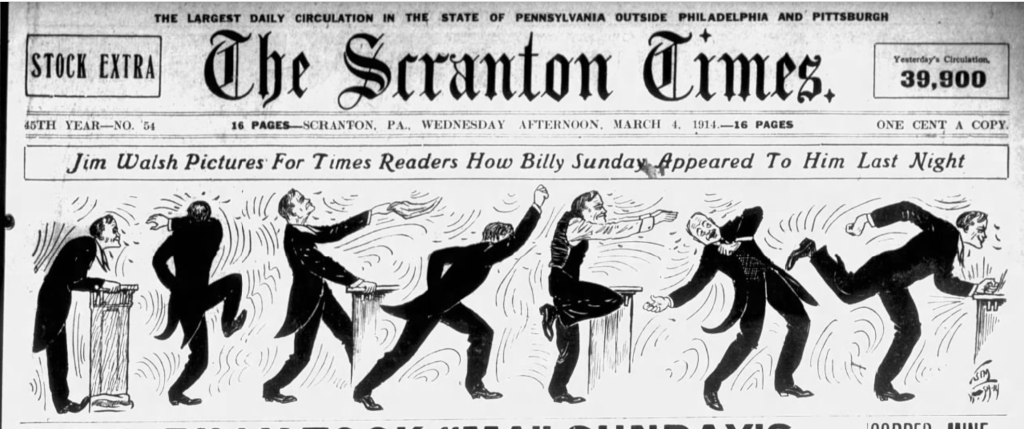
May 4 1914 Scranton paper
Evangelist Billy Sunday (1862-1935)
Former professional baseball player-turned urban evangelist. Follow this daily blog that chronicles the life and ministry of revivalist preacher William Ashley "Billy" Sunday (1862-1935)
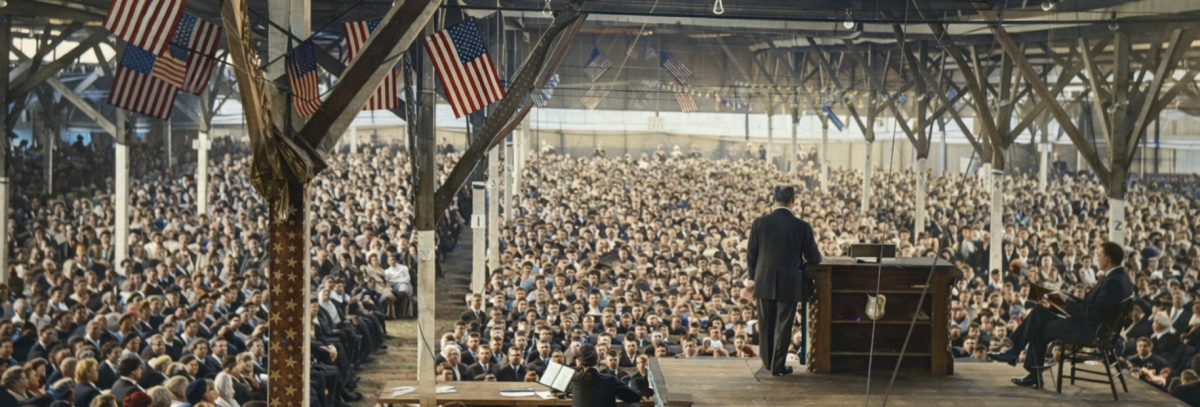
May 4 1914 Scranton paper
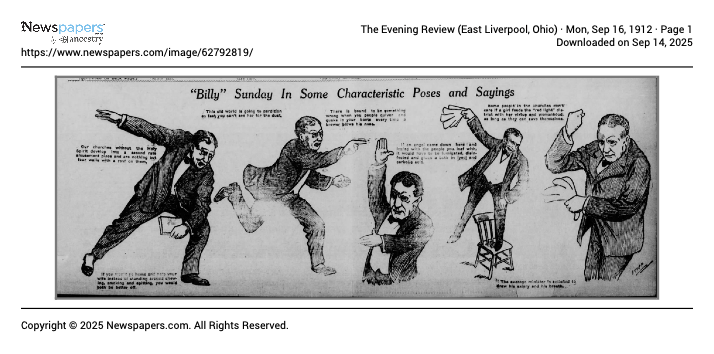
The Evening Review (East Liverpool, Ohio) · Mon, Sep 16, 1912 · Page 4
A Human Dynamo.
That is Billy Sunday in action—a human dynamo working for the cause of religion. No one could listen to the evangelist, yesterday, without absorbing some of his wonderful energy as he sent it out in great dynamic waves through the huge tabernacle. The air of the big structure was saturated with it.
Billy Sunday literally pumps religious enthusiasm into people. And no matter how much of it he pours out, the supply seems inexhaustible. It is almost incredible that one man could have such a lot of vim and vinegar stored up in his one little body and his brain.
Billy Sunday believes in a Christianity that does things, that is carried out into the lives of people, that accomplishes results, that “delivers the goods.” This is the core of his evangelism. This is why he is so vitriolic in his denunciation of the Christian who sits back and is satisfied with announcing that he believes in the Lord but does nothing for the Lord.
Nothing in oratory could be more impressive or effective than the evangelist’s word painting of histrionic scenes, especially those of the battlefield, and the application of some striking incident to the life and work of the soldier in the Christian army. It is the very essence and soul of eloquence.
The audiences that met yesterday to hear Sunday’s first three sermons, would have been most encouragingly large on the pleasantest of days. On a rainy day such as it was, they may well be regarded as remarkable, and as most auspicious.
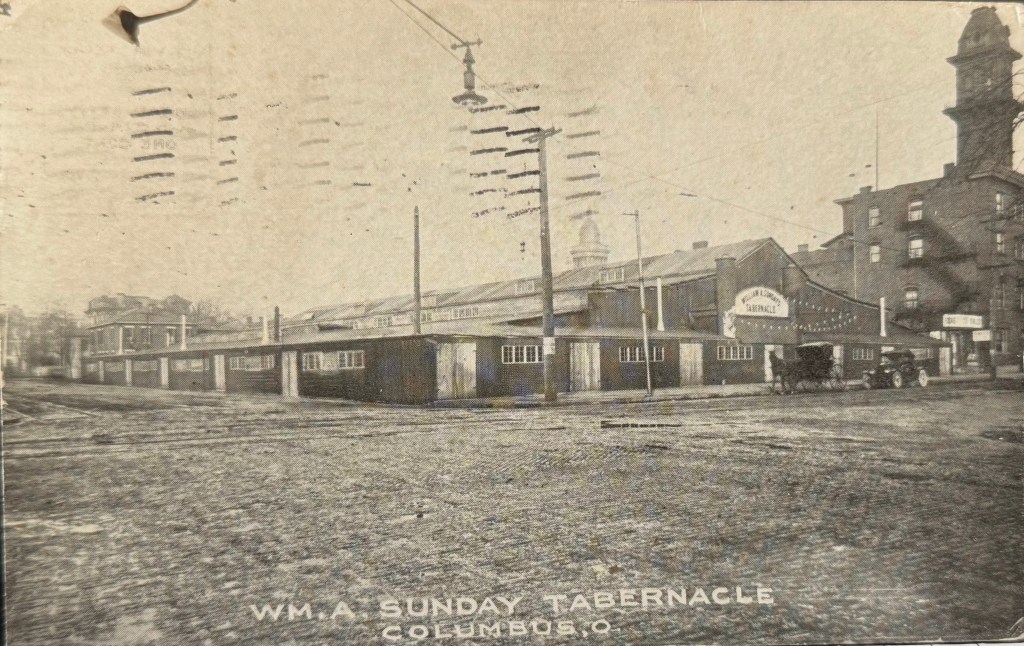
END OF SUNDAY CAMPAIGN.
Before another issue of the Times-Leader reaches its readers, Rev. Billy Sunday and his co-workers will have left. This community has been stirred up as never before. We desire at this time to reproduce an editorial of the Ohio State Journal published at Columbus, when Mr. Sunday conducted a campaign just previous to his visit here:
“As a result of his mission in Columbus, we should say there is a stronger moral sense in this community than there ever was before; and now the pressing question is, how to preserve it, how to make it vital in civic, religious and business life. He has made of religion a thoroughly practical matter, and has made the people feel it to be that way; and now it becomes the duty of every one who loves his neighbor and his city to put into practice in his own life the high lessons of duty, and honor, and faith, which Rev. Sunday has been preaching to us for the past seven weeks.”
That’s the correct summing up of the entire situation. Sunday has recruited the soldiers. The responsibilities and duties rest with those who remain here.
Source: Wilkes-Barre Times Leader. Sat, Apr 12, 1913 ·Page 6
“Atlanta, Jan. 1.—Ten thousand dollars raised within ten minutes by white citizens of Atlanta yesterday assures the negroes of this city success in completing their Y.M.C.A. building. The white people are pledged to raise another ten thousand if necessary. A fifty thousand dollar fund was needed to obtain the gift of $25,000 from Julius Rosenwald. C.W. McClure made a donation with the statement that the friendly relations between the whites and the negroes were better than ever since Billy Sunday preached to both.”
Jan 1 paper
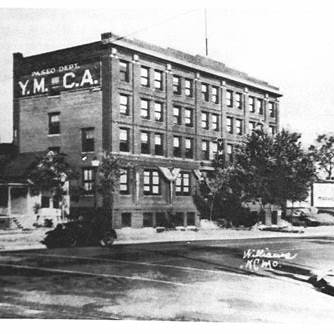
In the waning days of 1917, as Atlanta turned the page to a new year, a remarkable act of interracial philanthropy unfolded that would leave a lasting mark on the city’s history. Newspapers reported that ten thousand dollars had been raised in just ten minutes by white citizens of Atlanta to help fund a new YMCA building for the city’s Black community. The drive was part of a larger campaign to secure a matching gift of twenty-five thousand dollars from Julius Rosenwald, the Sears, Roebuck & Co. magnate whose generosity was transforming African American education and social life across the South. Local businessman C.W. McClure, who helped spearhead the effort, remarked that the relations between whites and Blacks in Atlanta had improved markedly since evangelist Billy Sunday had preached to both communities during his campaign there.
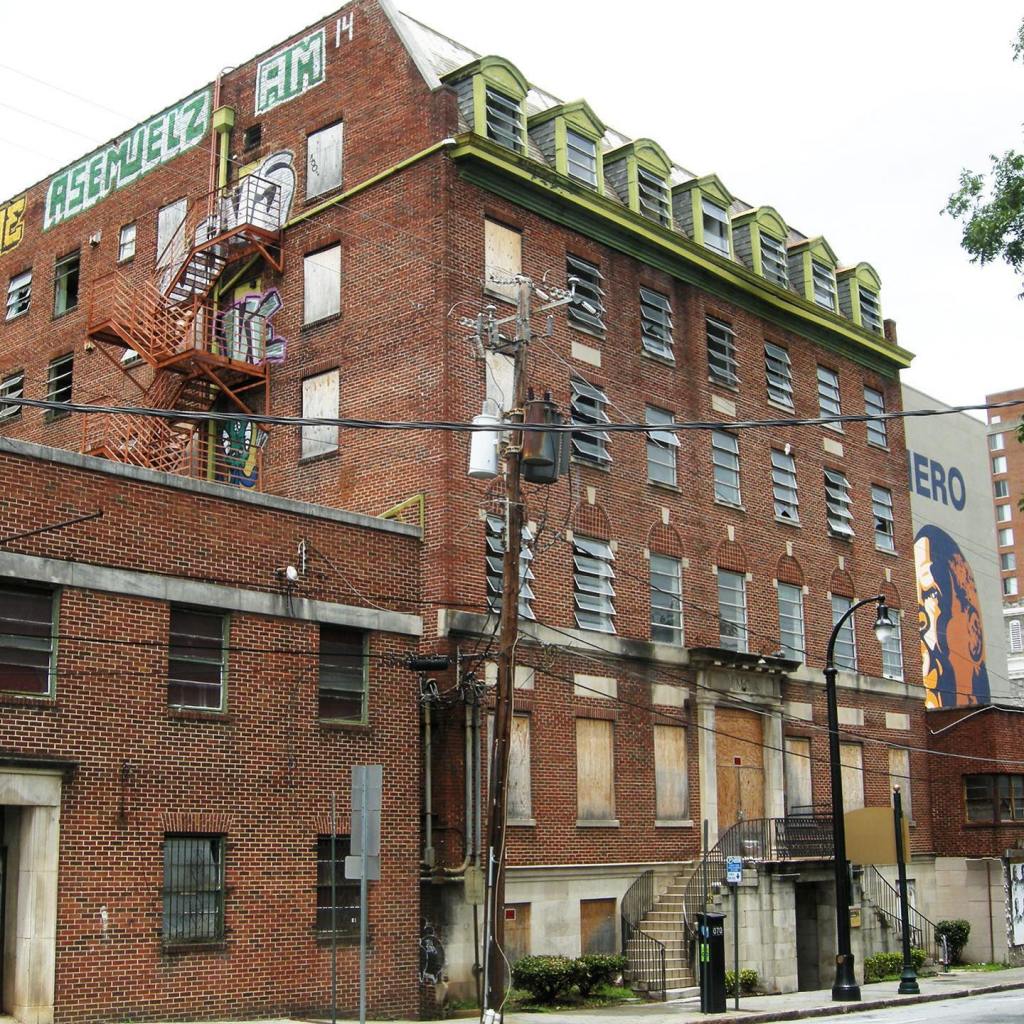
The fruits of that campaign materialized in the Butler Street YMCA—known in its day as the “Negro Y.” Built between 1918 and 1920, the new structure rose in the heart of the Sweet Auburn district, the beating center of Black enterprise and culture in Atlanta. The project followed Rosenwald’s signature pattern: a challenge grant that required local citizens—both white and Black—to raise the balance. The local enthusiasm kindled by Sunday’s revival evidently carried over into civic generosity, helping to meet the $50,000 goal needed to unlock Rosenwald’s contribution.
The Butler Street YMCA quickly became one of the South’s most important centers of African American life. Designed by the firm Hentz, Reid & Adler and built under the direction of Black contractor Alexander D. Hamilton, the facility was impressive for its time—three stories of brick and stone housing a swimming pool, gymnasium, dormitories, meeting halls, and classrooms. It provided a wholesome environment for young men seeking moral and social uplift in a city that offered them few such spaces.
More than a recreational facility, the Butler Street Y grew into a cornerstone of civic and spiritual leadership. Over the decades it came to be known as the “Black City Hall” of Atlanta, hosting meetings that shaped the course of civil rights and community advancement. Figures such as Martin Luther King Jr., Maynard Jackson, and Vernon Jordan would later pass through its doors. The Y stood as a living emblem of what cooperative goodwill and faith-inspired philanthropy could achieve during an era when segregation still divided the city.
The 1918 campaign that launched the Butler Street YMCA was more than a fundraising victory. It was a moment when revival energy turned outward—when the social conscience stirred by Billy Sunday’s preaching translated into practical generosity. In helping to fund the YMCA, the people of Atlanta built not only a structure but also a bridge between communities, one that carried forward the spirit of reform, service, and reconciliation that Sunday’s message had kindled. The Butler Street Y remained for nearly a century a monument to that brief but luminous cooperation—a place where faith met action and where the legacy of revival took tangible form in brick, mortar, and hope.
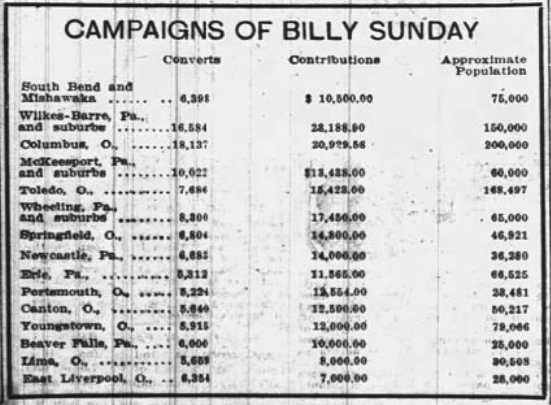
| Location South Bend & Mishawaka Wilkes-Barre, PA Columbus, OH McKeesport, PA Toledo, OH Whelling, PA Springfield, OH Newcastle, PA Erie, PA Porstmouth, OH Canton, OH Youngstown, OH Beaver Falls, PA Lima, OH East Liverpool, OH | Converts 6,391 16,584 18,137 10,022 7,684 8,300 6,804 6,683 5,312 5,224 5,640 5,915 6,000 5,669 6,354 | Contributions $ 10,500.00 $ 28,188.90 $ 20,929.58 $ 13,438.00 $ 15,423.00 $ 17,450.00 $ 14,800.00 $ 14,000.00 $ 11,565.00 $ 12,554.00 $ 12,500.00 $ 12,000.00 $ 10,000.00 $ 8,000.00 $ 7,000.00 | Approx. Pop. 75,000 150,000 200,000 60,000 163,497 65,000 46,921 36,380 66,525 23,481 50,217 79,066 25,000 30,508 25,000 |
South Bend Tribune. Mon, Jun 16, 1913 ·Page 12
Citation: The South Bend Tribune. Mon, Jun 16, 1913 ·Page 12
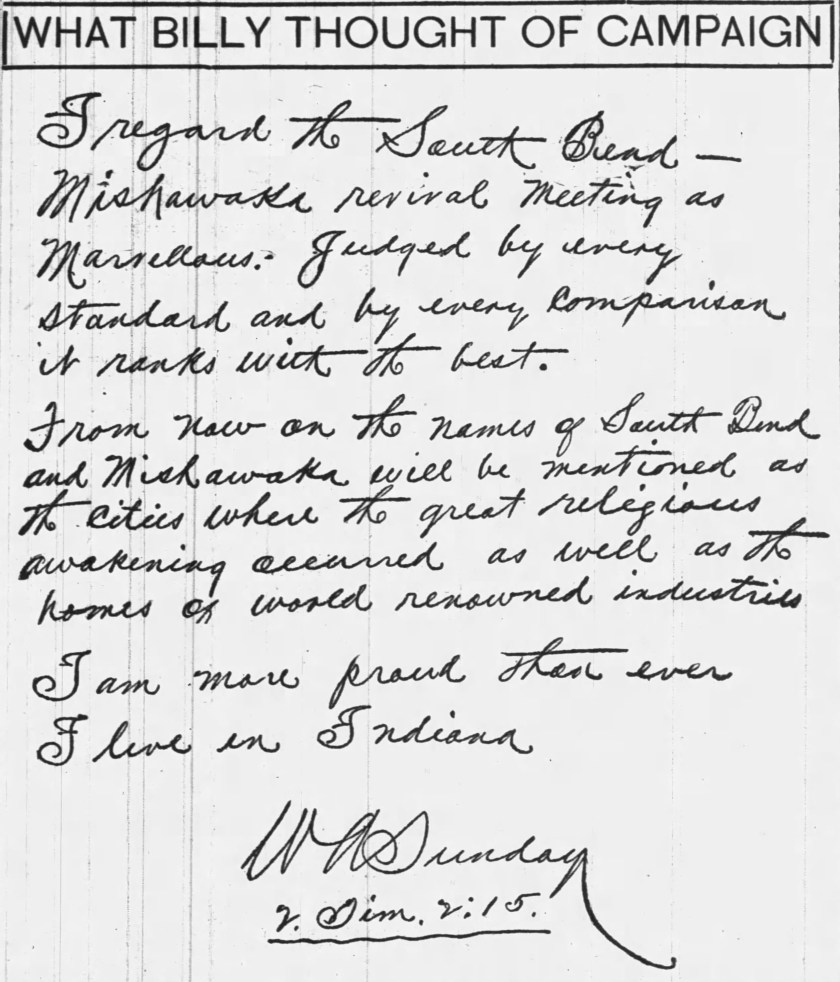
I regard the South Bend – Mishawaka revival Meeting as Marvelous. Judged by every standard and by every comparison it ranks with the best.
From now on the names of South Bend and Mishawaka will be mentioned as the cities where the great religious awakening occurred as well as the homes of world renowned industries.
I am more proud than ever I live in Indiana
Wm Sunday
2 Tim. v:15.
WHAT BILLY THOUGHT OF CAMPAIGN

Citation: The South Bend Tribune. Mon, Jun 16, 1913 ·Page 1
SOUTH BEND’S RELIGIOUS CAMPAIGN PROVES TO
BE MOST NOTABLE IN HISTORY OF ALL INDIANA
AIR OF SADNESS PREDOMINATES AT CLOSING MEETING OF BILLY SUNDAY’S BIG REVIVAL.
“BOSS” AND “MA” SAY THEIR LAST FAREWELL
Hundreds Cheer Evangelist and His Wife on Rear of Car as They Leave City—Other Thousands Disappointed by Early Departure—Last Day of Services Proves to be Remarkable One—Over 30,000 Present.
RESULTS IN BRIEF.
Conversions.
Previous conversions ………. 5,455
Saturday and Sunday ………. 943
Grand total ………. 6,398
Attendance.
Previous attendance ………. 519,550
Saturday and Sunday ………. 46,500
Grand total ………. 566,050
Collections.
Special offering for Billy Sunday ………. $10,500.00
Collections for local institutions ………. 737.98
Fund for campaign expenses ………. 18,500.00
Grand total ………. $24,737.98
The taking of the offering for Billy Sunday was one of the features of the closing day of the campaign. Seventeen or more different people and concerns of South Bend and Mishawaka gave donations of $100. The largest was $200, given by Samuel Murdock, of Lafayette, Ind., one of the owners of the Chicago, South Bend & Northern Indiana railway. The donations of $100, which have been recorded thus far, are from the following: South Bend and Mishawaka Ministerial association; Mrs. George Wyman; Mrs. M. V. Belser; citizens of Kingston, Pa.; by George L. Newell; Folding Paper Box company; Stephenson Underwear mills; E. G. Eberhart; Stephenson Manufacturing company; C. C. Shafer; Col. George M. Studebaker; Mr. Clement Studebaker; a friend; Clement Studebaker, Jr.; J. D. Oliver; Mrs. George Ford; C. A. Carlisle and the Mishawaka Woolen Manufacturing company. The $50 donations, which have been reported to those in charge of the campaign finances, are as follows: Mrs. J. C. Ellsworth; W. O. Davies; F. H. Badet; Mr. and Mrs. W. H. Thompson; J. C. Bowsher; McBrillan & Jackson; S. P. Studebaker and Mrs. Ida M. Stull, and the U. B. Memorial church.
Billy Sunday’s seven weeks’ fight against the devil in St. Joseph county became religious history to-day after the baseball evangelist had shown 6,393 people the road to salvation and approximately $10,500 had been raised for him.
The final curtain was rung down last night and the hard working little evangelist, with his wife, said goodbye to South Bend at 10 o’clock this morning. With a check for the $10,500 tucked away in an inside coat pocket, Billy boarded at 10 o’clock Northern Indiana Interurban car for his home at Winona.
A thousand people saw him off. Hundreds waved their hats and handkerchiefs at the evangelist, his wife, and Rev. William Asher, as the car moved out of the station and down Michigan street. All three stood on the rear platform bowing and smiling in response.
It is estimated a crowd of 8,000 or 10,000 people would have been at the car to say goodbye but the evangelist, leaving an hour earlier than he expected, disappointed many. The Northern Indiana company agreed to run the car through to Winona to insure the evangelist he would be able to eat lunch under his own roof.
State’s Greatest Revival.
With Sunday’s farewell prayer and a general handshaking all around at the tabernacle last night the meetings, which undoubtedly constituted Indiana’s greatest religious campaign, came to a close. The meetings ended quietly and with that heavy solemnity, which told plainer than words what it meant to the people to bid farewell to “Billy,” “Mr.” Ready, “Mac,” Ackley and all the rest.
Tears started in the eyes of many a man, and many a woman, as farewells were said on the platform. Hundreds crowded near the revival leaders to shake their hands and the number to about Homer Rodeheaver, director of the great chorus of 1,000 voices became so large, the people had to be formed in a line and were compelled to move rapidly as soon as they had said goodbye.
Completely worn out, Mr. and Mrs. Sunday were conducted from the tabernacle without notice to the eager thousands, who wanted one more glimpse last word of farewell. The evangelist was forced to permit, however, because of his weakened condition, to leave the building as soon as possible.
[Much more coverage in this issue.]
FINAL WEEK WILL BE GREATEST ONE
BIG PARADES ARE PLANNED FOR CLOSING HOURS.
Male Members of Sunday Schools Will March to Tabernacle on Tuesday Night.
The most significant period, from a religious standpoint, in the history of South Bend will open to-morrow. This period will close next Sunday night with the termination of the great Billy Sunday campaign in South Bend.
The program for the final days of the campaign indicates plainly it is to be the banner week of the campaign.
Important meetings have been planned for all hours of every remaining day, and there will be parades and similar celebrations galore.
Three big parades have already been arranged for. They are the men and boy members of the Sunday schools and the farmers of St. Joseph county, both of which will occur Tuesday night. The other, which may prove the largest parade of the campaign, will be made up of factory men and women. Thousands of the employees of the manufacturing institutions of South Bend and Mishawaka will make up the parade, which will take place Saturday night.
Both parades to-morrow night are expected to attract hundreds of men. It has been estimated that 1,000 men and boys will march as representatives of the Sunday schools of this city and Mishawaka.
Prominent Church men are working hard for a good turnout in the parade and every male member of every church in the Sunday movement will be expected to take an active part in the parade or explain the reason why. The church men and boys will assemble in front of the Y. M. C. A. at 7 o’clock and will march as a single delegation to the tabernacle.
The farmers will meet at the northeast corner of the courthouse yard at 9 o’clock and will march to the tabernacle with members of the Ancient Order of Gleaners at their head.
Every effort is to be made to make the factory parade on Saturday night the biggest event of the campaign. Every manufacturing institution in northern Indiana and southern Michigan will be asked to send delegations to take part in the parade. Albert Leisure, of the Studebaker corporation, was elected chairman and C. F. Rogers, secretary, of arrangements for the event, at a meeting of delegates at the Y. M. C. A. Saturday. These officials of the parade urge that the different institutions send representatives to a general meeting Tuesday night after the sermon, to make final arrangements for the parade.
The South Bend Tribune. Mon, Jun 09, 1913 ·Page 8
The movements and gestures of Billy Sunday have never failed to attract attention everywhere he goes. He is probably more active in the pulpit than any other preacher in the world to-day. Many try to imitate him, but none entirely successfully.
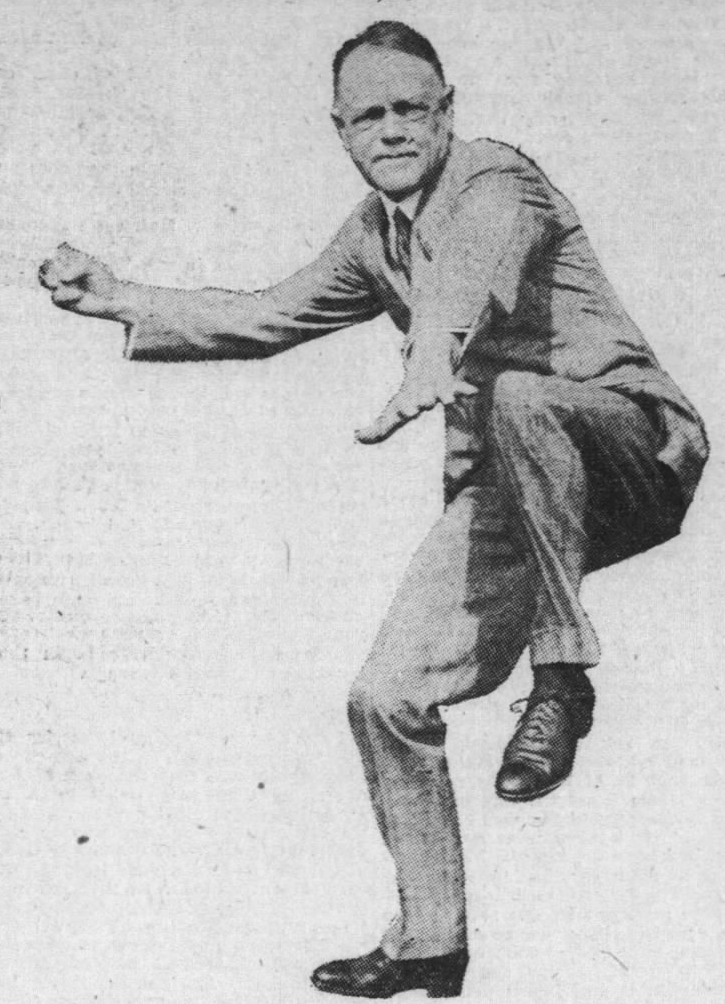
It has been figured the evangelist will make 1,700 or 1,800 moves in the ordinary sermon and in some of the longer ones, he moves 2,000 or 2,500 times, or even more.
In a recent sermon an effort was made to keep tally of every move the evangelist made. He gesticulated with one or both hands 884 times in less than one hour on that occasion, this being the most numerous movement of any one kind. He struck the pulpit in front of him with his clenched fist 826 times, and he swung from one side of the pulpit to the other exactly 229 times. On 121 different occasions, he paced from one end of the platform to the other, and 68 times he waved his handkerchief, either in the air or by his side.
The South Bend Tribune. Sat, Jun 07, 1913 ·Page 6

THIS IS HOW BILLY FINDS OUT IF YOU ARE GOING TO “TAKE THE COUNT”
BILLY SUNDAY IN UNUSUAL POSE.
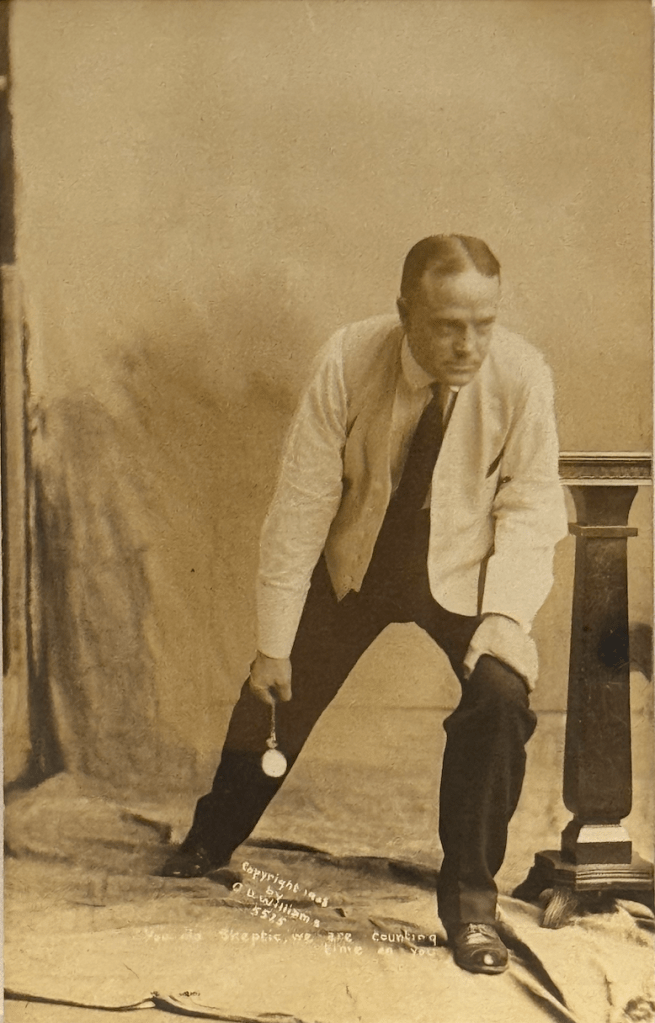
The above is a characteristic position for Billy Sunday to assume during one of his meetings for men only.
He bends over until his right knee nearly touches the floor of his platform; then he pulls out his watch and inquires if you are going to “take the count” for the devil.
Sunday’s sermons are filled with such unusual features as this, but they are never so plentiful as in the men’s sermons. There is no doubt about it the evangelist is at his best in these talks. He always bends every energy to the end of impressing his male audience with the truth of what he is saying, and in this he never fails.
The South Bend Tribune. Thu, Jun 05, 1913 ·Page 10
 Evangelist Billy Sunday (1862-1935)