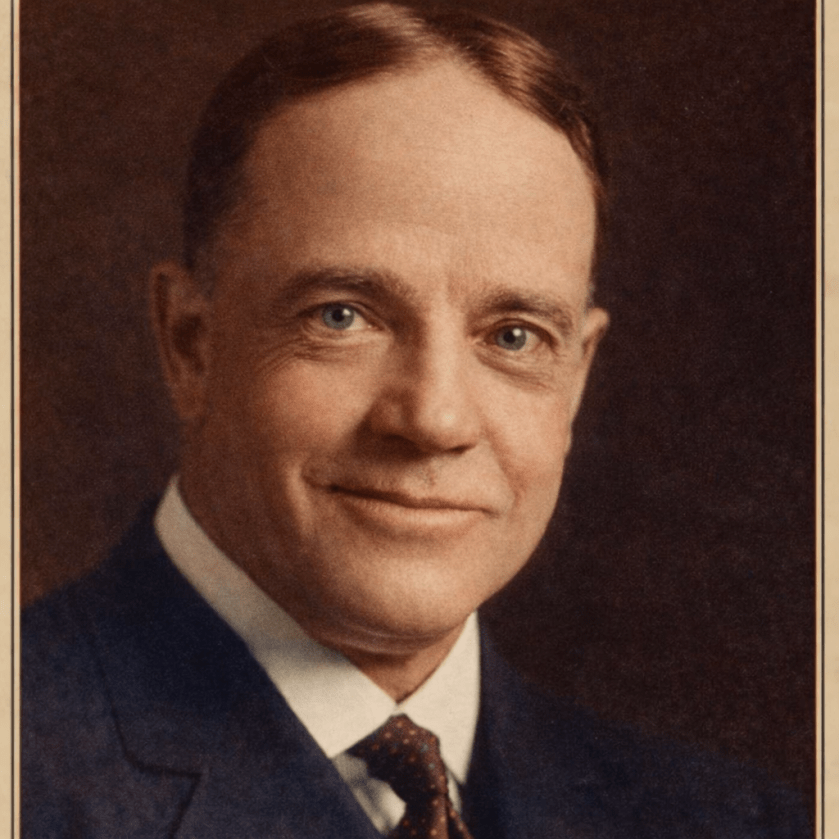
Former professional baseball player-turned urban evangelist. Follow this daily blog that chronicles the life and ministry of revivalist preacher William Ashley "Billy" Sunday (1862-1935)
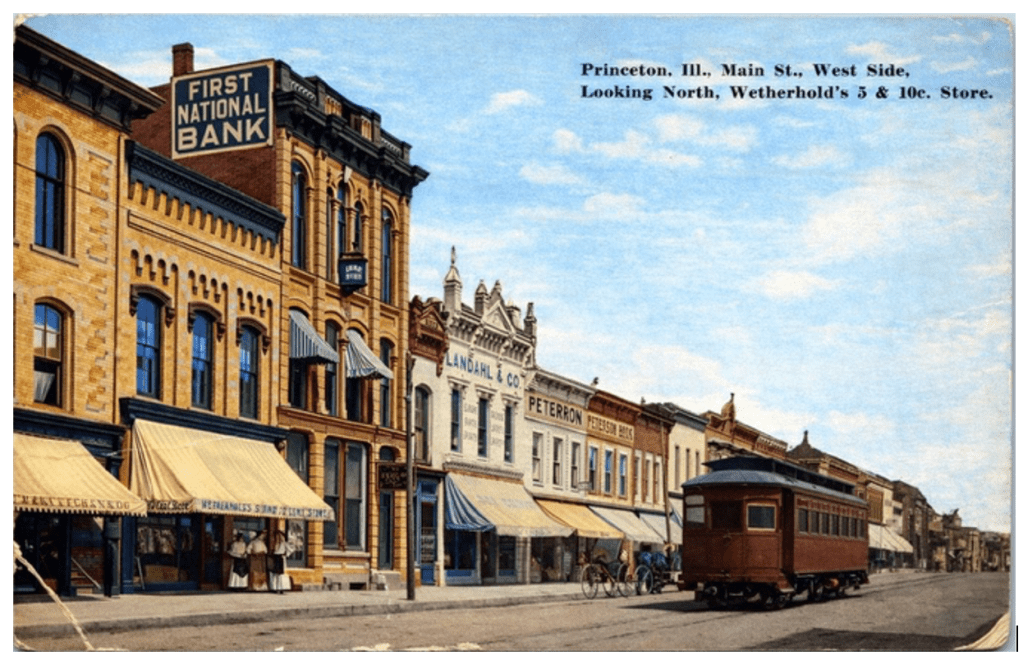
A person who witnessed Billy preaching at Princeton, Illinois, said this of the Evangelist’s preaching:
“When it comes to preaching Billy is a storm, a whirlwind, a cyclone, hurricane, a tornado, a-well, everything indicative of power. He preaches like his life depended upon it. He preaches like he had it to do.” Adding, “As long as Rev. William A. Sunday stays on track and labors to call men back to the old path – the gospel path – he should be allowed to work without opposition from Christian people, even if his methods are sensational and unique and his language at times is shocking.”
Bureau County Tribune (Princeton, Illinois) · Fri, Mar 9, 1906 · Page 3.
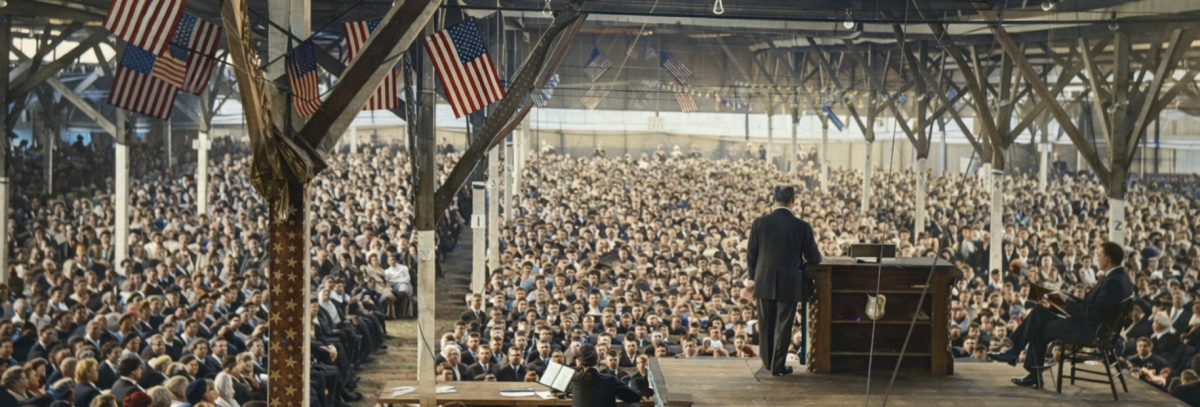
From February 11 to March 11, 1906, evangelist Billy Sunday conducted a major revival campaign in Princeton, drawing sustained crowds and producing significant conversion totals that reinforced his growing reputation as one of the most effective evangelists in the Midwest. A temporary tabernacle seating approximately 3,600 people was filled nightly, indicating the strong regional interest in Sunday’s preaching and the extensive cooperation of local churches.
The meetings quickly produced measurable results. One report noted 919 conversions in a single day on February 24, illustrating the intense response often seen at the height of Sunday’s campaigns. Despite severe winter weather—including one of the worst storms of the season on March 3—attendance and participation remained strong. By March 8, newspapers reported 1,298 converts, and by the close of the revival on March 11, the total number of recorded conversions had reached 2,325.
Contemporary observers described the atmosphere in Princeton as spiritually charged. A visiting pastor reported that the “city was aflame with the revival spirit,” while others praised Sunday’s dynamic preaching style, likening his delivery to a “storm” or “cyclone” in its intensity. His methods, though sometimes criticized as sensational, were widely regarded by supporters as effective in reaching large audiences—especially men—who might otherwise avoid church.
The Princeton campaign also contributed to Sunday’s rapidly expanding influence across the region. Shortly afterward, newspapers noted that since October 1905 he had reportedly received about $12,000 in offerings and recorded 9,000 conversions, with 20,000 conversions attributed to his work across the Rock River Valley of Illinois. The Princeton meetings thus formed a significant chapter in the early expansion of Sunday’s evangelistic career.
Sources: The Dixon Evening Telegraph, March 2, 1906, p. 5. Bureau County Tribune (Princeton, IL), March 9, 1906, p. 3. Freeport Journal-Standard (Freeport, IL), February 26, 1906, pp. 1, 5; March 8, 1906, p. 4. Journal Gazette and Times-Courier (Mattoon, IL), March 19, 1906, p. 1.
“It is impossible to describe William A. Sunday. He simply gets there. While he shocks some of the staid old deacons by his rough and ready way of putting things, the great throng stand on and applaud. He has a wonderful gift of street slang and he uses the choicest of it. He can preach using as fine English as any man in the country, but he is dreadfully lonesome doing it. He likes to employ language people best understand.
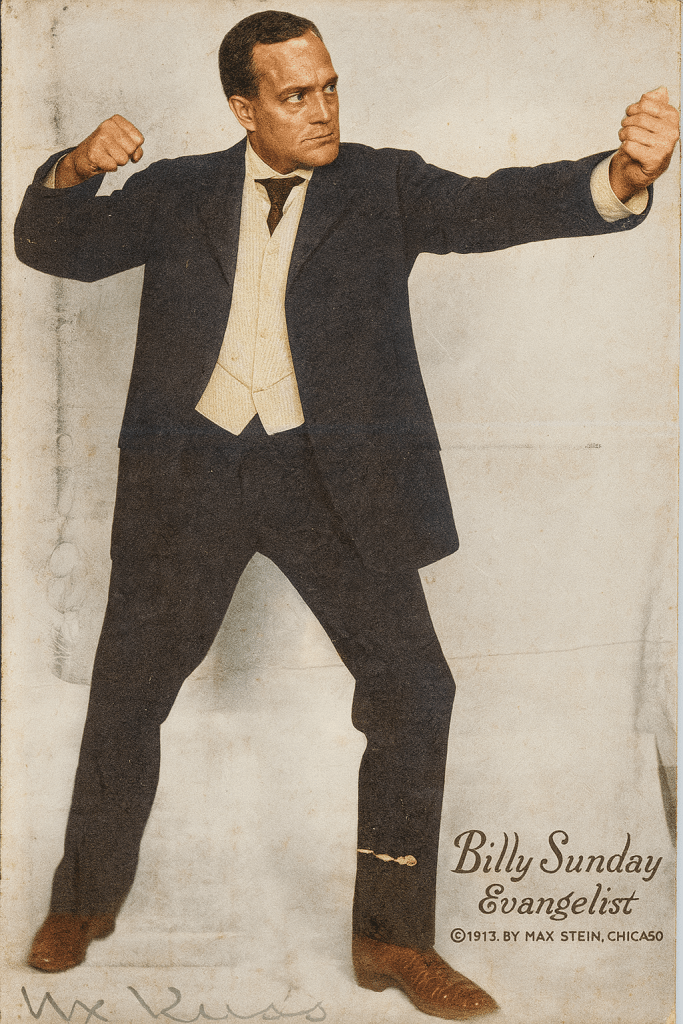
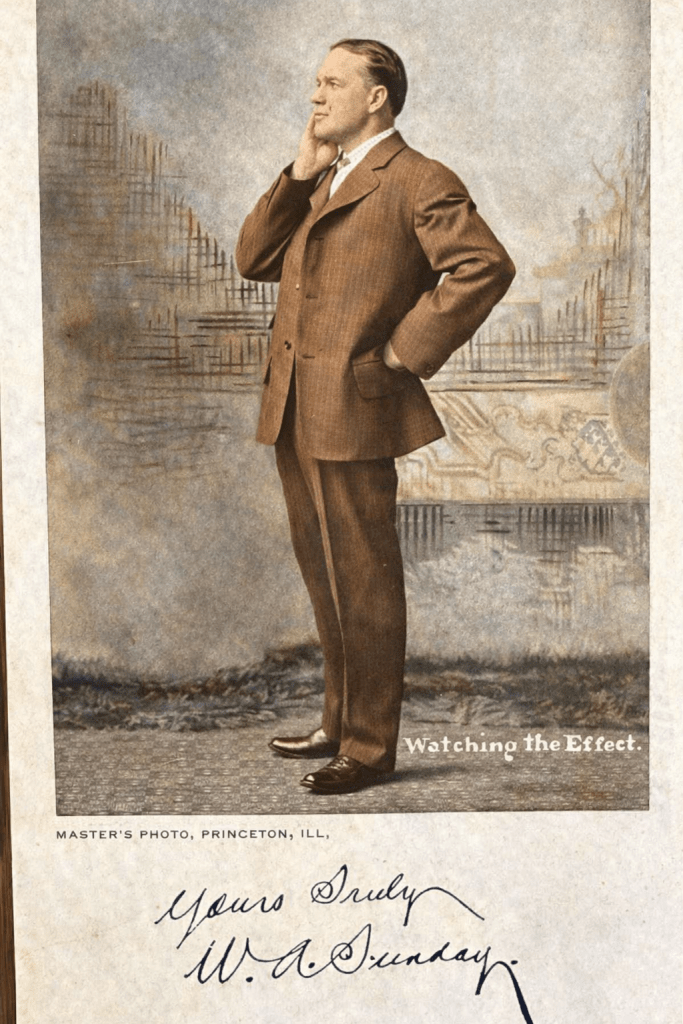
He is a slight man, weighing less than 140 pounds, but is wiry and as scienced as Jeffries. He is a bundle of nerves, and from the moment he throws a beautiful fur coat from his shoulders to the close of the meeting every nerve is put in play. Those who hear him go away stating that he cannot stand it long to work with the nerve force he does, but he has stood it for eight years and is as able today as he was in the beginning. He pleads, he entreats, he prays and weeps, and the crowd are with him. Few men have the power to sway crowds like Sunday. He can cause them to break out in peals of laughter and can make them weep copiously as he appeals to sympathy. He is great on storytelling and can embellish with all the facial expressions necessary. He is so agile on the stage that without any trouble at all he can lean over backward and touch his head to the floor, and, if occasion demanded, could turn a flip with the best of them.
It is this that undoubtedly arouses the curious and those who wish to be entertained. But it doesn’t end there. He can preach powerful sermons. If you go once you go twice and if you go twice, you will find that at the close of his month’s services you have been present at about every service.”
– The Sioux City Journal (Sioux City, Iowa) · Sun, Feb 26, 1905 · Page 9.
The following article excerpt was carried in several newspapers in mid August 1910.
MIDDLE WEST HAS A RELIGIOUS FERMENT
In Chicago Itself Other World Matters Have the Floor.
“The rest of the country can hardly realize the breadth and the depth and the fervor of the spiritual tumult which is stirring the Middle West with Chicago as its center. Chicago newspapers regularly carry columns of sermons in their paid advertising columns. In Chicago street cars are displayed glaring placards advertising the “Book of Mormon,” and 48,000 copies have been sold in the city during the past two or three years. Billboards are covered with big four-sheet posters in colors, calling upon the public to attend great free mass meetings in the Coliseum, with a gospel choir of 2000 voices as the special attraction. Every Sunday morning the Auditorium—the largest theater in the city—is packed with the congregation of Central Church, and every Sunday evening Orchestra Hall is filled with people attending the religious services, which are supported by a voluntary club of Chicago business men. And during the clement season of each recent year scores of Middle West towns, with populations of ten and twenty thousand people, have practically dropped all their ordinary occupations and given themselves over for weeks at a time to a strange, fanatical religious ecstasy, under the acrobatic ministrations of “Billy” Sunday, baseball evangelist. And these are only the more normal the more nearly orthodox manifestations of the spiritual unrest.”—Henry M. Hyde in Collier’s.
And Why the Offer Destroys the Claim That He Preached for Money
One of the most common criticisms leveled against evangelist Billy Sunday is that he preached for money.
Critics point to the generous love offerings that were sometimes taken at the close of his revival campaigns and conclude that Sunday must have been motivated by financial gain. It is an easy accusation to make. But historical evidence tells a very different story.
One remarkable document from 1917 puts the matter in perspective.
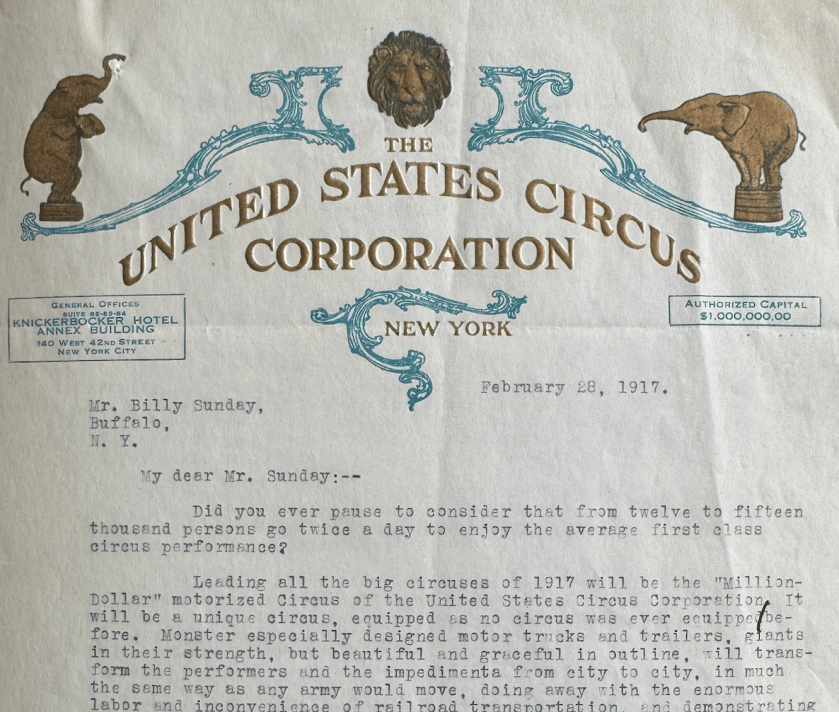
On February 28, 1917, Billy Sunday received an extraordinary letter from the president of the United States Circus Corporation. The proposal was simple, bold, and almost unbelievable.
The circus wanted Billy Sunday to join the show.
Original 1917 contract. Grace College. Morgan Library.
The letter opened by reminding Sunday of the enormous audiences that circuses attracted:
“Did you ever pause to consider that from twelve to fifteen thousand persons go twice a day to enjoy the average first class circus performance?”
The promoter explained that the company was launching what he called a “Million-Dollar” motorized circus, equipped with fleets of specially designed trucks and trailers that would carry the show from city to city.
The scale was enormous. Tens of thousands of people attended circus performances daily.
And the circus president believed Billy Sunday could preach to them.
Then came the offer.
“I… offer you a weekly salary of $14,000, or $2,000 a day, for as many weeks of the coming summer season as you can give.”
To grasp how staggering this proposal was, consider the numbers.
If Sunday had accepted the offer and worked for roughly ninety to one hundred days during the summer season, he would have earned between $180,000 and $200,000 in 1917.
Adjusted for inflation, that is roughly $4 million today.
In return, the circus would provide transportation, luxury touring cars for Sunday and his staff, and access to massive crowds across the country.
The promoter even suggested that Sunday hold revival meetings on Sundays as part of the circus program.
But here is the crucial point.
The proposal made no provision for Sunday to keep offerings from those meetings. In fact, the letter suggested that the proceeds from Sunday services could go largely or entirely to charity.
The circus wanted Billy Sunday not as a fundraiser—but as an attraction.
A headline act.
A revivalist who could preach to the largest audiences in America.
And yet Billy Sunday refused.
The Economics of Sunday’s Real Ministry
Now compare this circus offer to the income Sunday actually received during the same years.
During the summer Chautauqua season, Sunday could deliver 50 to 70 speaking engagements.
Typical speaking fees ranged from $250 to $500 per engagement.
That means a strong Chautauqua season might produce:
$12,500 on the low end
$35,000 on the high end
Even at the very top of that range, the circus contract would have paid five to six times more.
In other words, if Billy Sunday had been motivated primarily by money, the decision would have been obvious.
He could have become the highest-paid religious speaker in America simply by joining a circus.
Instead, he chose the sawdust trail.
He chose the revival tabernacle.
He chose the ministry that demanded months of exhausting preaching, travel, prayer meetings, counseling, and organization.
And he did it for far less money than the circus was willing to pay.
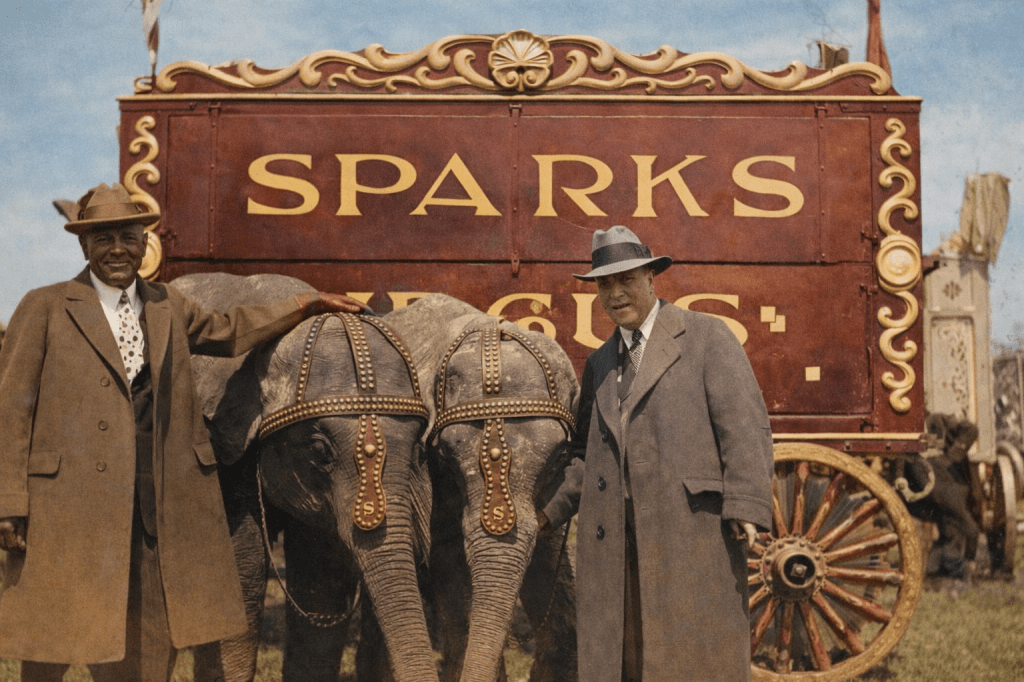
Rare original Sparks Bros Circus photograph showing evangelist Billy Sunday and Charles Sparks.
Why the Critics Miss the Point
Billy Sunday never pretended that money did not matter. Revival campaigns required large temporary tabernacles, choirs, staff members, and enormous logistical efforts.
But Sunday consistently refused opportunities that would have turned his preaching into entertainment.
The 1917 circus contract proves it.
The entertainment industry was willing to pay him millions in today’s dollars to headline the largest traveling show in America.
He said no.
The same evangelist who was accused of preaching for money walked away from a fortune.
And that fact should cause us to reconsider the narrative that Sunday’s critics often repeat.
Billy Sunday may have been many things—a fiery preacher, a former baseball player, a relentless evangelist—but the historical record shows that he was not in the ministry merely for the money.
If he had been, the circus would have had its star.
Instead, the revival fires continued to burn.
Did you know?
“It may not be generally known, but ‘Billy’ Sunday supports a mission on Van Buren street, Chicago, paying all the expenses of maintaining it out of his own pocket. He is also educating twenty boys and paying for it with his own money. These boys are waifs he has picked up out of the street. In this he is following the plan of the late Sam Jones, who in his lifetime educated hundreds of poor boys and made useful citizens out of them.”
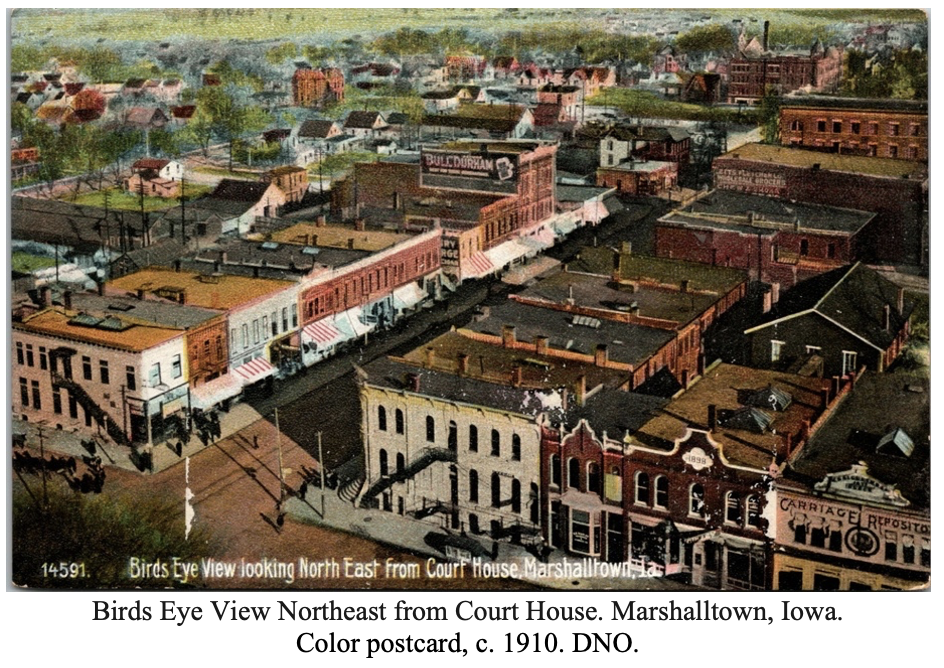
Fresh off a successful campaign in Springfield, Billy Sunday and his team rolled into Marshalltown in late April of 1909. This was not foreign soil. It was home turf.
Sunday had been raised in Iowa, shaped by its churches, and had even lived briefly in Marshalltown in the early 1890s while learning the mechanics of evangelistic work. By 1909 he returned not as an unknown ballplayer-turned-preacher, but as a nationally rising evangelist whose methods were becoming increasingly organized, efficient, and powerful.
Marshalltown was the right kind of proving ground. Large enough to sustain a six-week revival. Small enough to rally around one of its own.
The Setting: A City Poised for Revival
Marshalltown in 1910 had a population of 13,374—a fraction of Springfield’s 51,678. It was a growing industrial town, commercially strong, strategically located, and connected by rail. It was not metropolitan. But it was energetic.
A wooden tabernacle was erected at the corner of Third and Main, seating 5,000. The Sunday machine was now running at full stride.
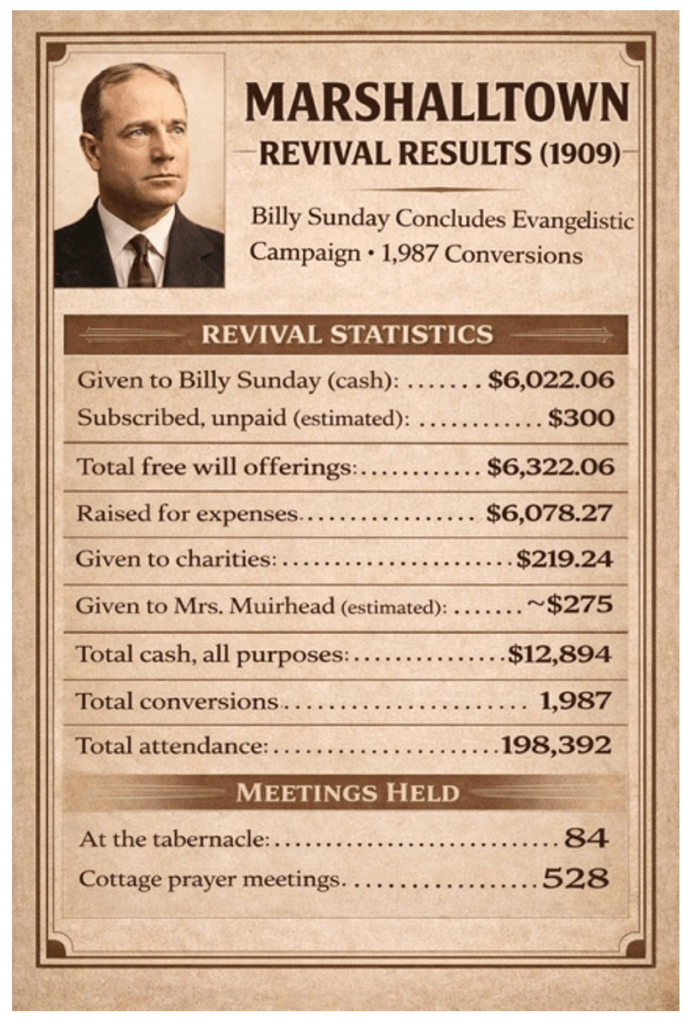
Opening night—April 25—saw over 12,000 people attend across all services. On the final day, June 6, Sunday preached to 13,200. In a town of just over 13,000 residents, that level of saturation is staggering.
By campaign’s end:
2,000 total conversions (125 on the final day)
84 tabernacle meetings
528 cottage prayer meetings
Nearly 200,000 in total attendance
For six weeks, Marshalltown was consumed by revival.
The Money and the Machine
The final purse for Sunday was $6,139. Total funds raised during the campaign reached $12,894.
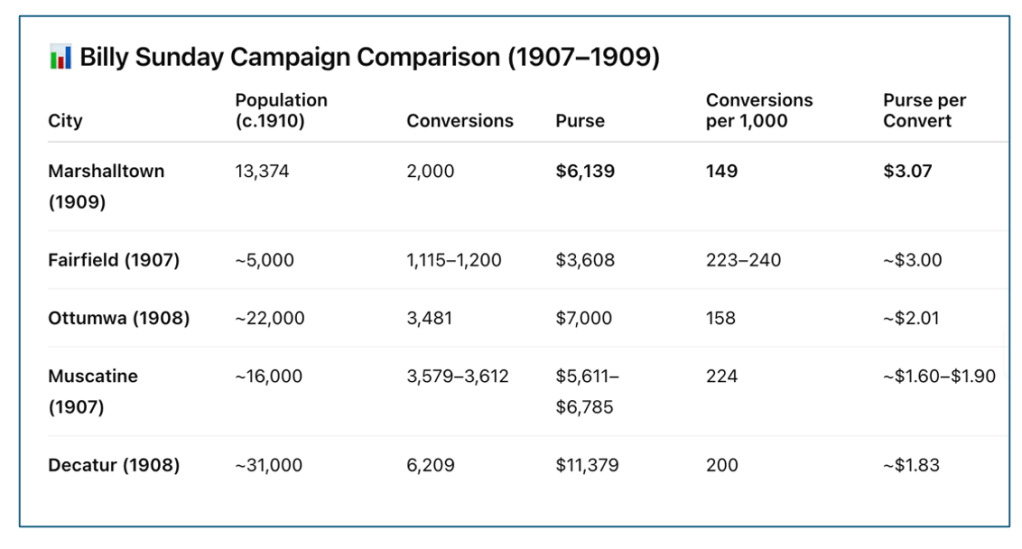
For comparison, that purse nearly matched Muscatine’s and approached Ottumwa’s from the previous year. Financially, Marshalltown demonstrated strong committee organization and enthusiastic backing. This was not a struggling campaign.
It was disciplined. Systematic. Mature.
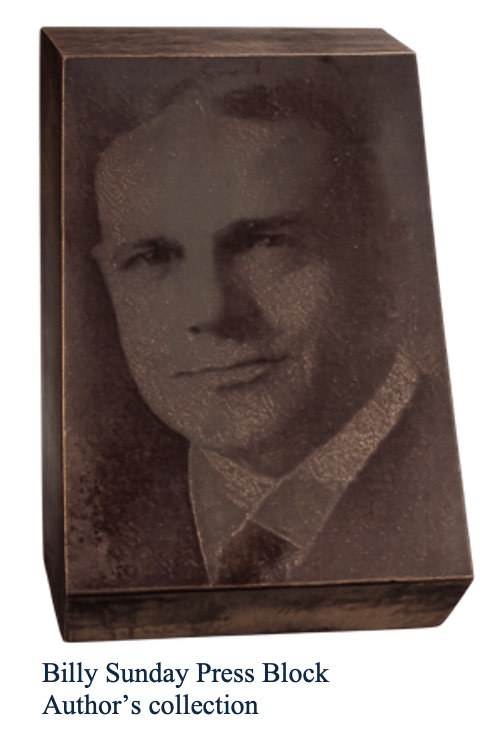
The press block used to print Sunday’s image during this period—now in my collection—reflects that growing sophistication. By 1909, Sunday was no longer improvising revivals. He was executing them.
Did Marshalltown “Underperform”?
One skeptical paper, the Davenport Weekly Democrat and Leader, suggested that Marshalltown’s results did not compare favorably with Fairfield, Ottumwa, Muscatine, and Decatur.
On the surface, that seems correct.
Measured per capita:
Marshalltown: ~149 converts per 1,000 residents
Fairfield: over 220 per 1,000
Muscatine: about 224 per 1,000
Decatur: around 200 per 1,000
Ottumwa: about 158 per 1,000
In raw totals, Marshalltown trailed Muscatine (3,579–3,612), Ottumwa (3,481), and especially Decatur (6,209).
So yes—the numbers were not dominant.
But numbers alone miss something important.
The Press: Praise and Pushback
The reaction was revealing.
The Audubon Republican declared the meetings closed in a “blaze of glory.” It reported over 500 cottage prayer meetings and said the town had been “thoroughly stirred up.”
The Marshalltown Evening Times-Republican went further, calling Sunday:
“One of the splendid prophets of the elder time…”
“One of the greatest revivalists in existence.”
“One of the plainest, simplest and happiest of men…”
Meanwhile, the skeptical Davenport Weekly Democrat and Leader offered sharper commentary. It described Sunday as a “contortionist of uncommon ability” with “remarkable versatility,” while acknowledging the “magnetic power of Mr. Sunday.”
Its most fascinating observation was psychological:
“The psychology of it all is that the people who are not regular attendants at churches must be reached not as individuals but in mass. They like to be moved by each other; and it is probable that this explains the success Mr. Sunday attains. He is helped greatly by the excitement and the enthusiasm of the crowds…”
That critique reads today like an astute analysis of mass evangelism. It wasn’t merely preaching. It was momentum. Atmosphere. Collective energy.
Sunday understood something about crowds that many pastors did not.
What Marshalltown Really Proved
Marshalltown was not Sunday’s most explosive campaign numerically.
But it demonstrated something perhaps more important in 1909:
Massive attendance penetration in a modest city
Financial stability and strong committee structure
Organizational maturity (over 600 total meetings)
National press attention—positive and critical
Marshalltown proved that Sunday could saturate an entire city.
Critics were talking. Admirers were praising. Nearly 200,000 attendances in six weeks ensured that no one in town was untouched by the revival’s presence.
He was no longer just holding meetings.
He was creating civic events.
A Blaze of Glory
The revival closed the way many Sunday campaigns did—intense, loud, emotional, decisive. A blaze of glory.
Marshalltown may not have produced the highest per-capita conversion rate of his Iowa stops. But it stands as a revealing moment in his rise.
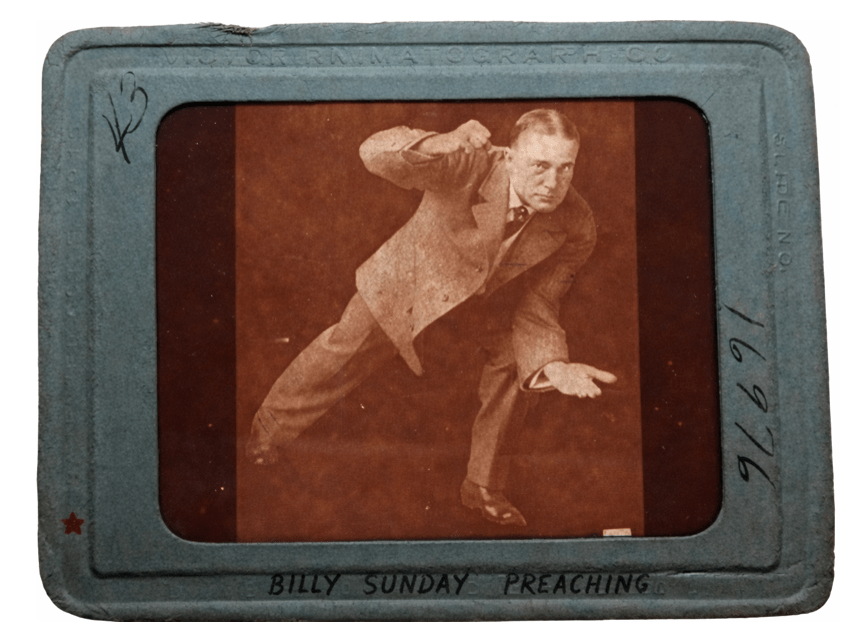
Magic lantern slide. Author’s collection.
By 1909, Billy Sunday was refining his method. The tabernacle system was humming. The prayer networks were mobilized. The press was watching closely.
And Iowa—his Iowa—was watching one of its own step onto a larger stage.
Marshalltown mattered because it showed that Sunday’s machine worked not just in isolated bursts, but in sustained, organized, city-wide saturation.
When the revival campaign of Billy Sunday reached Kansas City in 1916, observers could easily assume that the evangelist’s enormous crowds and national reputation had appeared overnight. But a reflective article in the The Kansas City Star reminded readers that Sunday’s success had actually grown slowly and deliberately over many years.
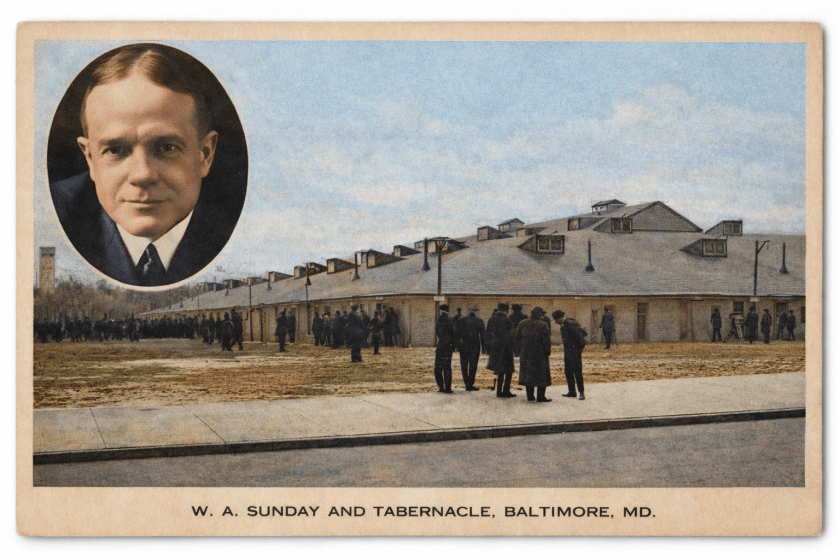
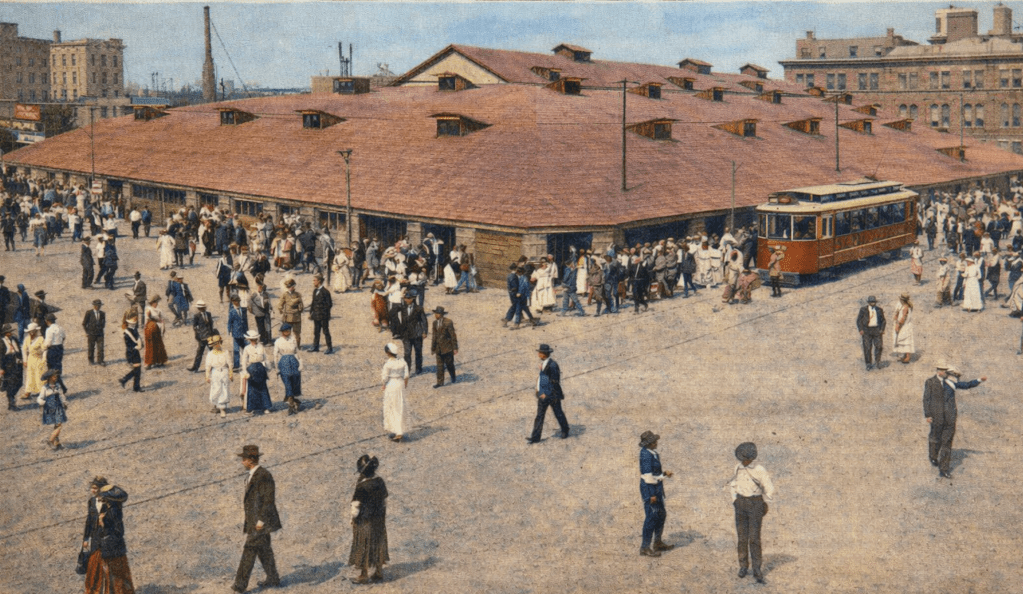
The Baltimore Tabernacle
The paper explained that there was nothing sudden or “mushroom-like” about the rise of the Sunday revivals.
“There is nothing ‘mushroom’ in the growth of the Billy Sunday meetings.”
Instead, the evangelist’s methods and audience steadily developed over time. In the early years, when Sunday first began holding revival meetings, his audiences often found little that seemed unusual.
“Early audiences found nothing spectacular in the sermons of the revivalist.”
Those early campaigns were also modest in scale. At first, Sunday and his team believed that smaller communities were the natural limit of their work.
“We used to think that the town of ten thousand population was our limit.”
As the years passed, however, confidence grew. The team gradually moved into larger towns and then into major cities. The article recalled how Sunday’s organization expanded step by step—building larger tabernacles and reaching larger crowds with each campaign.
“All the time we were gradually adding to our party and building larger tabernacles.”
By 1916, the scale had changed dramatically. Cities once thought far beyond reach were now the focus of massive campaigns.
“Here we are and New York City is in sight with a tabernacle seating twenty-five thousand.”
The article also emphasized that Sunday’s preaching style had developed its own distinctive character. His revival methods were not borrowed directly from older traditions but shaped by his own personality and experience.
The writer noted that Sunday had “thrown out the life line in a fashion distinctly unique.”
Another aspect of his ministry that caught the attention of reporters was the structure of the campaigns themselves. A typical revival lasted about a month, with the message unfolding gradually over time.
In the early weeks, Sunday often avoided direct appeals for conversion, instead using stories and humor to gain the attention of his audience. Only later did the preaching intensify.
By the third week, the article explained, Sunday would devote his sermons to confronting sin and pressing listeners toward repentance. The final week focused on urging people to make a decision.
Even the physical setting reflected Sunday’s distinctive approach. Unlike some revivalists, he rejected the traditional “mourner’s bench” used in earlier revival meetings. Instead, converts were invited to come forward and sit in chairs while he spoke with them personally.
The article also noted that Sunday was not closely tied to any one denomination. While he often expressed appreciation for various churches, his ministry remained broadly interdenominational.
By the time Kansas City hosted the campaign in 1916, Billy Sunday had become one of the most recognizable religious figures in America. Yet the newspaper’s reflection reminded readers that the movement had not been built in a single moment.
It had grown—campaign by campaign, city by city, and year by year.
And in the process, Billy Sunday had created a revival method that was unmistakably his own.
Page 2 of The Britt News, published in Britt, Iowa on Thursday, March 4th, 1909 Horsewhipped by Religious Zealot at Springfield.
Rev W. A. Sunday, better known as “Billy” Sunday, a former baseball player, who is now an evangelist, was horsewhipped Friday night by a religious fanatic at the Sunday tabernacle in Springfield, Ill., where, in the presence of 8,000 persons he was conducting the opening meeting of a religious revival.
The evangelist had just made his opening remarks and was leaning against the pulpit while a hymn was sung by Fischer and Butler, his choral leaders, when a powerful man who says his name is Sherman Potts ran forward with a buggy whip and struck Sunday several terrific blows.
Sunday leaped from the platform and dashed at his assailant, whom he knocked down. The audience was on the verge of a panic, with women weeping and children screaming while Potts and Sunday rolled and tumbled in the aisle.
Mr Fischer directed the choir and the audience to sing, and in a few moments the entire audience was calmed Several men seized Potts and held him until policemen came and took him to jail.
Mr Sunday suffered several painful bruises from the whip The prisoner said his home was near Lexington, Ill According to his statements at the jail he was once declared insane and committed to the Jacksonville asylum, whence after a brief confinement he was released.
He made the attack he said, in defense of the virtue of women which he declared had been criticized by the evangelist The police say that Potts is a religious fanatic.
Page 2 of The Britt News, published in Britt, Iowa on Thursday, March 4th, 1909.
A sensational threat upon the life of Evangelist Billy Sunday, conveyed through a crudely written “black-hand” letter, stirred the city yesterday but failed to interrupt the progress of the revival meetings at the great tabernacle.
The warning, received through the mails on Wednesday, declared that a bomb would be hurled into the tabernacle at 2 o’clock Thursday afternoon, September 23, and that Sunday would be killed unless he departed the city within ten days. The missive, scrawled in poor handwriting across ordinary note paper, bore at its lower corner the drawing of a black hand and a crude sketch of a bomb connected to a clock marking the fatal hour.
The Billy Sunday Tabernacle. Omaha, Nebraska.
Authorities were immediately notified. Chief of Police Dunn detailed detectives to trace the author of the threat, and a vigilant watch was ordered about the tabernacle grounds. Secretary Mathews, who first examined the letter, refrained from alarming the evangelist and quietly placed the matter in the hands of the police.
Despite the ominous warning, the Thursday afternoon meeting proceeded without incident. A squad of detectives, led by Sergeants Patsk Havey and Tom Donahue, mingled with the crowd, keeping careful surveillance in anticipation of any attempt upon Sunday’s life.
If the threat was intended to deter attendance, it met with mixed success. Many curious men flocked to the tabernacle, drawn by the sensational report, while the number of women present was noticeably reduced. Total attendance fell below the usual mark. Yet inside, the service moved forward undisturbed—save for the innocent crying of a baby, whose presence, smuggled past ushers, proved the only interruption to the evangelist’s address.
Thus, what promised to be a day of danger passed into one of quiet defiance. The bomb did not appear. The preacher remained. And the revival, under the watchful eye of the law, pressed on.
Adapted from: The Omaha Daily Bee, September 23 and 24, 1915
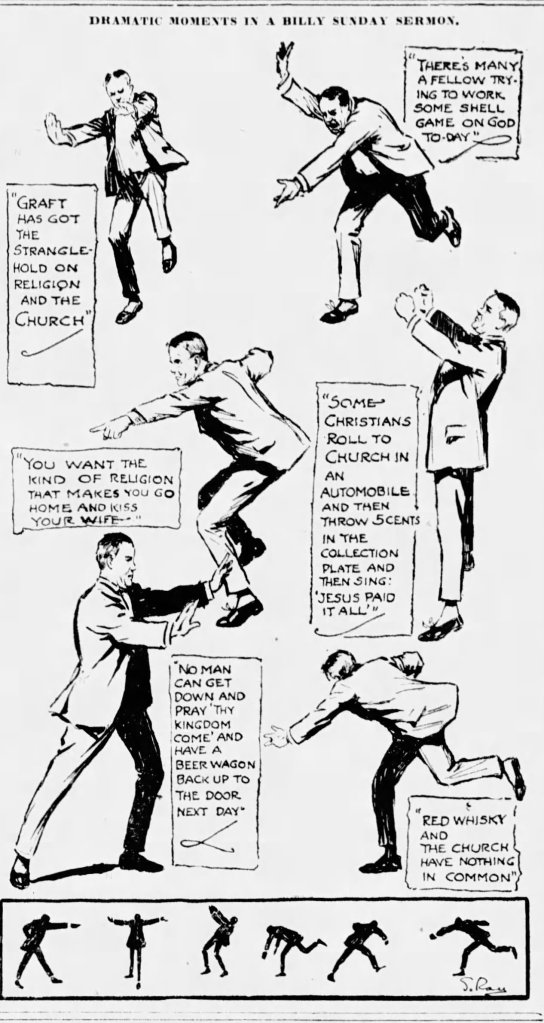
When Billy Sunday arrived in Kansas City during his 1916 revival campaign, reporters tried to explain what made his preaching so electrifying. One article in the The Kansas City Star offered an unusual perspective. Rather than describing Sunday simply as a preacher, the writer analyzed him as something closer to a dramatic performer.
The article was titled “Billy Sunday as an Actor,” and it attempted to dissect the evangelist’s method from a theatrical standpoint. What the reporter saw was not merely a sermon but a kind of living drama unfolding on the sawdust platform.
According to the writer, Sunday had the ability to bring invisible scenes vividly to life:
“Mr. Sunday, erect and eloquent, is addressing some jury which is corporeally invisible, but which instantly lives before the eyes.”
In other words, Sunday’s sermons created mental pictures so vivid that listeners could almost see the courtroom of heaven forming before them. The preacher might begin by placing his audience before the bar of divine judgment, describing the sinner standing before God.
But the sermon did not stay in one place for long. Sunday constantly shifted roles, turning the message into a dramatic sequence of scenes. One moment he might portray a bartender leaning over a counter; the next he was the drunken customer staggering through the gutter.
The article described these rapid transitions with striking clarity:
“Then he becomes a barkeeper… And in another instant he is the drunkard—‘a dirty rum guzzler’—cringing, broken, swaying to the gutter.”
Through pantomime, gestures, and changes in voice, Sunday acted out moral situations that his audience immediately recognized.
The reporter concluded that Sunday’s preaching relied heavily on what he called melodrama. But the word was not meant as criticism so much as explanation. Melodrama, the article observed, was easy for ordinary people to understand because it dealt in clear moral conflict.
“Melodrama has nothing to do with character and is easy to understand,” the writer noted. “It is the drama of situation.”
That description captures something essential about Billy Sunday’s preaching. His sermons did not revolve around abstract theological debates. Instead, they focused on recognizable human stories: the drunkard, the wandering son, the sinner facing judgment.
Another feature the reporter noticed was Sunday’s physical intensity. The evangelist rarely stood still. He ran, leaped, stamped his foot, pointed accusingly, and pounded the pulpit for emphasis. The effect, the article suggested, was almost like watching an athlete or dancer.
One colorful comparison even likened him to the famed ballet performer Vaslav Nijinsky—an extraordinary metaphor for a revival preacher.
Perhaps the most perceptive observation in the article concerned the simplicity of Sunday’s language. The reporter noted that his words were blunt, Anglo-Saxon, and forceful:
“Short, pungent… Saxon derivatives of English… packed full of powerful stimulus.”
This plainspoken style, filled with vivid phrases and sharp imagery, helped Sunday communicate with audiences drawn from every social class.
In the end, the Kansas City writer recognized something that many critics missed. Billy Sunday’s sermons were not merely lectures about religion. They were dramatic moral confrontations, staged in front of thousands of listeners each night.
On the bare platform of a temporary tabernacle, without scenery or props, Sunday created entire scenes through voice, motion, and imagination. His preaching was not simply heard—it was seen and felt.
And that, the reporter concluded, was the secret of his remarkable power over a crowd.
Adapted from: The Kansas City Star. May 4, 1916:2.

 Evangelist Billy Sunday (1862-1935)