Former professional baseball player-turned urban evangelist. Follow this daily blog that chronicles the life and ministry of revivalist preacher William Ashley "Billy" Sunday (1862-1935)
The first important thing was to get the whole Christian population of the city to praying for the success of the campaign. Prayer is the one great secret of Billy Sunday’s success, he says himself. He prays without ceasing. The members of his party pray always. Every difficulty that arises is a subject of prayer. If some preacher declines to take part in the revival they pray for him and keep on praying. They pray for little things and big things. Billy catches cold; the whole party prays for him. His voice gets husky; they all begin praying. There is indecision as to which city the next campaign would better be held in; Billy and his party begin praying to be led aright. It is prayer, prayer, prayer, constantly.
And so, great maps of New York were hung upon the wall at headquarters. Each church and school was marked with a tack, a redheaded tack denoting a Methodist church, a blue tack a Baptist church, and so on. Then all of Greater New York was divided into districts and the work of prayer began.
An executive committee was named with twenty-seven men on it, each one a hustler. John D. Rockefeller jr. and William Jay Schieffelin, two of the richest men in New York, are on the committee, and both are actively working.
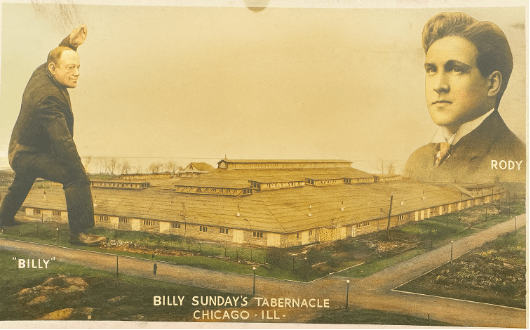
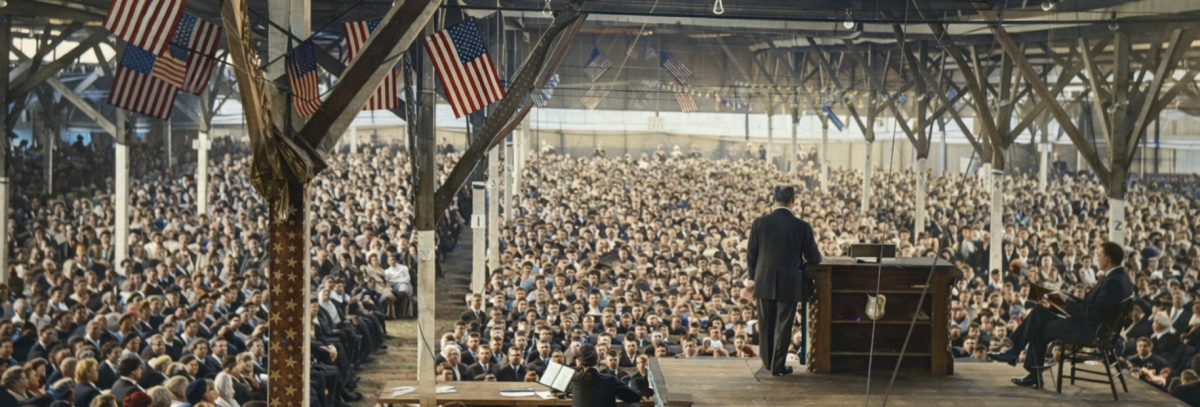
Billy Sunday told about 9,000 persons who attended his afternoon meeting in the Tabernacle how the “movie” people had offered him a cold $1,000,000 to pose for a film serial. And he told them how he had replied to their offer in this fashion:
“You can’t commercialize my mug for $10,000,000; you’re not going to get any help from me to make a circus of God’s religion. Not on your tintype.”
The “movie” reference was injected into Billy’s remarks through the presence of several “movie” cameramen at the Tabernacle just before he came into the building. They tried hard to “slip one over” on Billy and catch him as he got out of his limousine and started for the Tabernacle door. “Ma” Sunday, who was with Billy, protected the evangelist from the pointed cameras and pushed him inside the big building.
“Big Hand” for Billy.
The crowd cheered Billy to the echo. On the platform was Mrs. Marshall Field, widow of the noted Chicago merchant, with a party of friends from the Windy City. They, too, cheered Billy’s references to the “movie men.”
Billy’s afternoon sermon was chuck full of patriotic references and of slambang punches at “old Kaiser Bill.” And just before he finished it, he asked all those in the big audience who would pledge themselves to give undivided support to the national government in “its hour of need” to stand up. And the entire audience arose. Then he asked for a “Chautauqua salute,” and thousands of handkerchiefs waved over the great auditorium.
Billy took a hard slam at the “knocker,” who, he said, “is always going up and down the land, shouting that we are not prepared and that we should have done so and so long ago.”
“You folks ought to remember,” shouted Billy, “that we have a whale of a job on our hands. But we’ve got a whale of a country and we’re going to put it over. And we don’t propose to unsheath the sword until we have that gang on its knees pleading with Uncle Sam to call off the war.”
In his sermon Billy spoke of the drummer boy in Napoleon’s army who refused to beat a “retreat” when ordered by his commander. He looked squarely into the eyes of about 100 soldiers who were in the Tabernacle and declared loudly: “We don’t know how to beat a retreat either, do we boys? You bet your life we don’t! But we can beat a charge that can dig a grave so deep for that bunch of Kaiser Bill’s hot dogs that they won’t even hear the Angel Gabriel’s horn on the last day.”
The soldiers cheered Billy and the big crowd joined in. Billy emphasized that “we’ve got to scrap as well as play” and he declared that with such a fine army and such a navy as Uncle Sam boasts, there “isn’t a power anywhere in the world that can stand up against it, much less that bunch of cut-throats who would drag their Hohenzollern teachings into the land of the free.”
Billy took a hard rap at the Industrial Workers of the World and declared that if he had anything to do with “that bunch,” they all “would have faced the firing squad long ago.” His sermon was a likening of the Christian workers of the world to the grenadiers of old and the point he emphasized was that Christians everywhere are “fighters for the cause of Christ” in just as much the same sense as are the soldiers fighting now the cause of the allies.
In an age when “Christian” can mean many things, it’s worth listening to voices from earlier times who held convictions with clarity. Billy Sunday’s definition of a Christian, from a pamphlet circulated among his “trail hitters,” challenges brevity without compromise. Let’s consider what he said — and why it still matters..
Here is Billy Sunday’s definition of a Christian, given in a pamphlet presented to each of the “trail hitters” at the Tabernacle:
“A Christian is any man, woman or child who comes to God as a lost sinner, accepts the Lord Jesus Christ as his personal saviour; surrenders to Him as his Lord and Master; confesses Him as such before the world and strives to please Him in everything day by day.”
The pamphlet then gives these rules on “How to Make a Success of the Christian life:
“Study the Bible; pray much; win someone for Christ; shun evil companions; join some church; give to the support of the Lord’s work and don’t get discouraged.”
Extracted from a Chicago 1918 newspaper
Billy Sunday believed the term “Christian” should not be light nor vague. His concise, structured definition gives both challenge and invitation: a Christian is not just one who claims, but one who surrenders, confesses, strives. May we take his clarity as a prompt to examine not just what we call ourselves — but how deeply we follow.
I believe profoundly in Mr. Sunday, in the purity of his motive, in the truth of his purpose, the sincerity of his aim, and the transparency of his ambition. He undoubtedly has a divine commission to preach the gospel and the people hear him gladly. Mr. Sunday has a remarkable personality. It is one of his big assets. He is in possession of that undefinable something, the influence of which men feel but cannot explain.
I believe that in Chicago Mr. Sunday’s personality will count for more than in other cities because it has a fuller chance to come to the fore, coming back, as he does, to his home city, the city of so many pleasant associations and sacred memories.
Gathering of Winona Divines Rated With a Bunch of Bums.
BETTER BE COG WHEEL
And Stop Trying to Be a Whistle Is Sunday’s Advice to Them.
Lake, Ind., Aug. 22.—”I preach to this bunch just I do to a lot of bums, and I don’t see any difference in you. You ministers criticise me, but as long as God puts His mark of approval on my work it is up to you to keep your mouths shut. If God wants you to be a cog wheel you had better stop trying to be a whistle. Some people are all front door. Open it and you are in the back yard. Many a man goes to a seminary and is filled up with a lot of stuff that is of no more use to him than a crane’s legs would be to a setting hen.”
Such was the rhetoric and classical language in which the Rev. “Billy” Sunday the base ball evangelist, addressed the Bible conference at Winona Lake. He told gray-headed ministers how to succeed and grilled those who did not agree with his methods.
Called Rev. Smith “Gyp.”
He talked like a whirlwind and whisked up and down the gamut of Christian effort like a $25,000 limousine. He slapped the distinguished English evangelist, the Rev. Gypsy Smith on the back and called him “Gyp.” “Gyp” smiled a sour smile and looked as pleasant as he could.
While the message of Rev. Billy was as hot and peppery as chili sauce, it was received with fervent “amens” from over the auditorium and at the close “Gypsey” Smith gave his shoulder a pat of approval and Dr. Chapman smiled his approval.
Dr. Chapman said: “Unless a man is born with preach in him he will never get there. Too many preachers are more interested in drawing their salaries than in saving souls. Show me an earnest man and I will show you a man that is making the gang sit up and take notice. The earnest pastor does not sit around and wear out the seat of his pants waiting for something to turn up. The only thing that will turn up for him is the sod in the grave yard.”
By November 1917, America’s entry into World War I was still more promise than power. The nation had declared war on Germany in April, but its fighting strength was only beginning to take shape. The Selective Service Act had drafted millions, yet most soldiers were still training in sprawling new camps across the country. Only a few thousand “Doughboys” had reached France, and fewer still had seen combat.
At home, the United States was undergoing a massive transformation—industries retooled for war, Liberty Loan drives stirred patriotism, and propaganda urged unity behind President Wilson’s call to “make the world safe for democracy.” Yet beneath the flags and speeches, the mood was uneasy and uncertain. America was a nation of recent immigrants, many with ties to both sides of the conflict, and the sudden plunge into a distant European war left much of the public ambivalent, even anxious.
While the Navy was already active in convoy protection and anti-submarine patrols, the Army’s role remained largely preparatory. Reports from Europe reminded Americans of the staggering cost of trench warfare—the mud, gas, and mass casualties that had consumed Europe since 1914.
Thus, by late 1917, America stood on the threshold of full engagement, committed but not yet blooded, confident yet cautious. The war had only begun for the United States, and few could yet grasp how deeply it would change the nation—or the world.
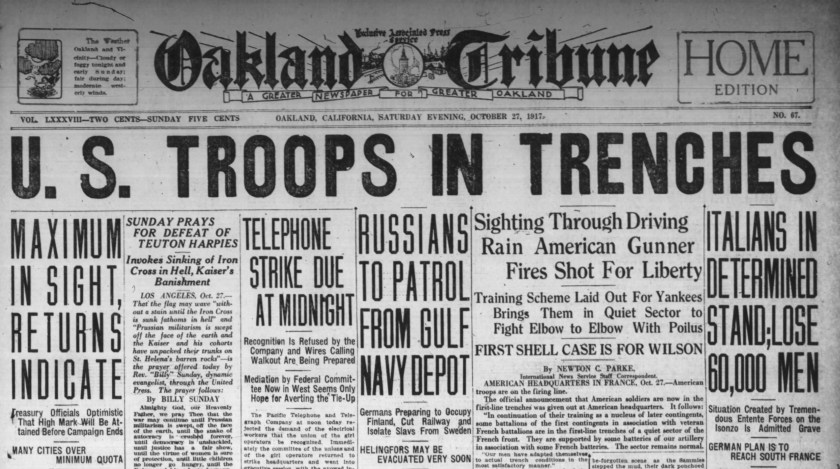
Just as the Atlanta Billy Sunday campaign was to begin, Billy’s prayer for U.S. forces in Europe was published in the press.
BILLY SUNDAY PRAYS FOR OUR VICTORY IN THE WAR
Los Angeles, Cal., Oct. 27.—”That the flag may wave without a stain until the iron cross is sunk fathoms in hell,” is the prayer offered today by Rev. “Billy” Sunday, evangelist, through the United Press for use on Sunday, proclaimed by President Wilson a day of prayer. The prayer follows:
“Almighty God, our Heavenly Father, we pray Thee that the war may continue until Prussian militarism is swept off the face of the earth, until the snake of autocracy is crushed forever, until democracy is unshackled, until justice has a fair show, until the virtue of woman is sure of protection, until little children no longer go hungry, until the Kaiser and his cohorts have unpacked their trunks on St. Helena’s barren rocks.
“And in the meantime give each one of us the fighting spirit that led the Crusaders to victory. If we do not fight with our hands in the trenches, help us to fight with sacrificing hearts at home.
“Thou knowest, oh, Lord, we have not entered this bloody war because of avarice or greed and we do not covet Germany’s gold or land. We have drawn the sword to defend our country against the most infamous, blood-thirsty horde of human harpies that ever disgraced the earth. They respect neither law nor religion; nothing is sacred if it stands in their path.
“Lord, bless the president; give him wisdom; bless all the councils of state and war. Keep us a united nation in fact and spirit.
“Bless the army and navy. Many of our brave boys already sleep somewhere in France or beneath the sea. Bring victory to our cause because we know it is Your cause. We have joined hands and hopes and hearts with our noble allies that this world may be a safe place in which to live.
“Thou knowest, Lord, that the tidal wave of sneering unbelief that has blighted the faith of millions and denied that Jesus is Thine only begotten Son, came from the beer mugs of that pretzel crowd across the sea. All this, together with the deluge of blood is enough to make hell laugh and heaven weep.
“Lord, Thou has never forsaken our flag. It waves without a stain. May it lead every step of the way until the iron cross is sunk fathoms in hell and the world rests once more bathed in the radiance of the Cross of Christ.
“All this we ask in the name of Jesus Christ, Thy Son, our Savior, Amen.”
I owe more to Dr. Chapman than to any other man that I ever became a preacher. I traveled with him for two years as an assistant. He picked me up out of the corn rows of Illinois. We went to a town up in Kansas one time to conduct a series of meetings. We were accustomed to have union meetings, but in that place, when we arrived on the scene, we found that they could have had a union meeting had it not been for a quarrel with the Presbyterian church. They had had a fuss and there were a few people live and awake, up-to-date, who said they’d withdraw. So they went down to the bank of the river and they built a church, they had a good live-wire preacher there who was going at a good gait all the time on high gear, while the other fellow had the brakes set.
The Atlanta Constitution. Wed, Nov 07, 1917 ·Page 12
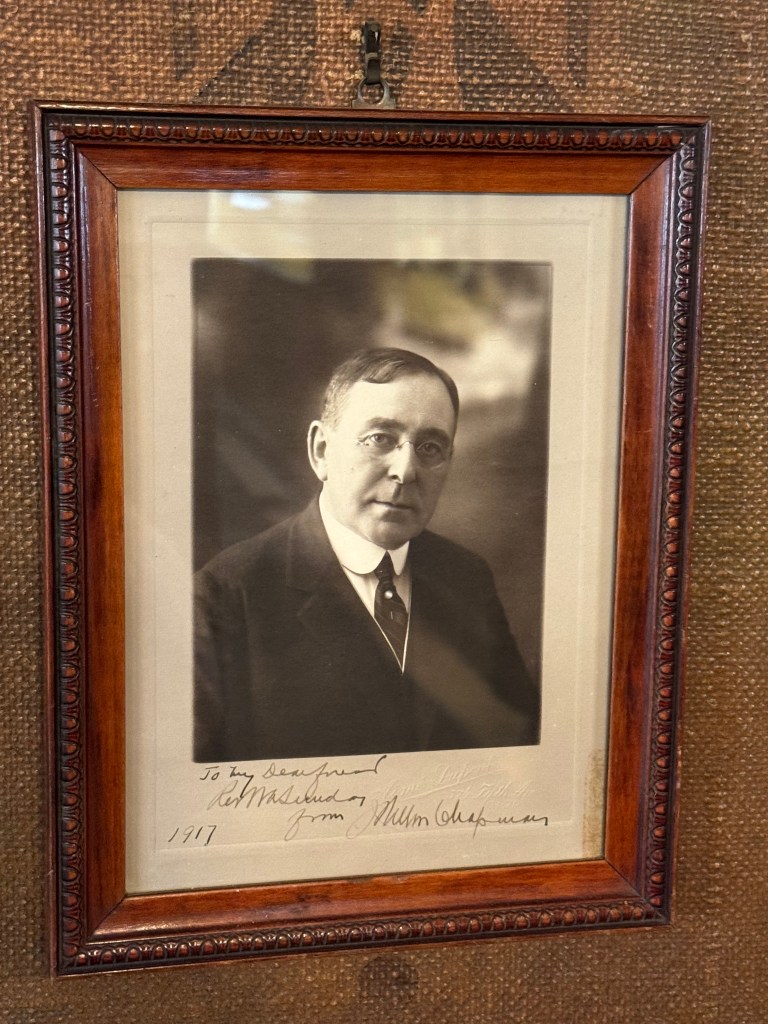
This picture of Chapman hangs on Billy’s wall in his Winona Lake home. It is inscribed with the date 1917.
Location of tabernacle—Second and Washington streets.
All hats must be removed within building.
Members of choir required to be in their places promptly.
Tabernacle may be entered from any side and ushers will look after all.
A section of reserved seats is provided in the front for those whose hearing is defective. Another block, in direct center, is for the children.
First to arrive have choice of seats, except those in the choir loft which are reserved by checks for members of that body.
No one is permitted to walk through the aisles of the tabernacle while Sunday is preaching. All are expected to refrain from talking or making other unnecessary noises during the services.
Those who attend services are expected to start early so as to not create a disturbance by entering late. Late comers are admitted, but are required to enter building from rear doors. The purpose is to make as little disturbance as possible.
Ushers, officers and firemen, detailed by police and fire departments, will be on duty at all services to prevent disorder or accidents.
Hand books of the campaign, giving detailed information concerning transportation facilities, telephones, committee headquarters, prayer meeting districts and many other important items of information are distributed gratuitous at the tabernacle.
Changes in the hour of holding services, or any other important development, will be given in the Evening Review.
‘I believe in the Bible, the book of God,’ he cried, ‘because it has delivered the goods, express prepaid, since the beginning of the world. When the consensus of opinion of the latest scholarship says one thing and the word of God says another, the consensus of opinion of the latest scholarship can go to hell!’
Lebanon (PA) Daily News. Wed, Jan 06, 1915 ·Page 10
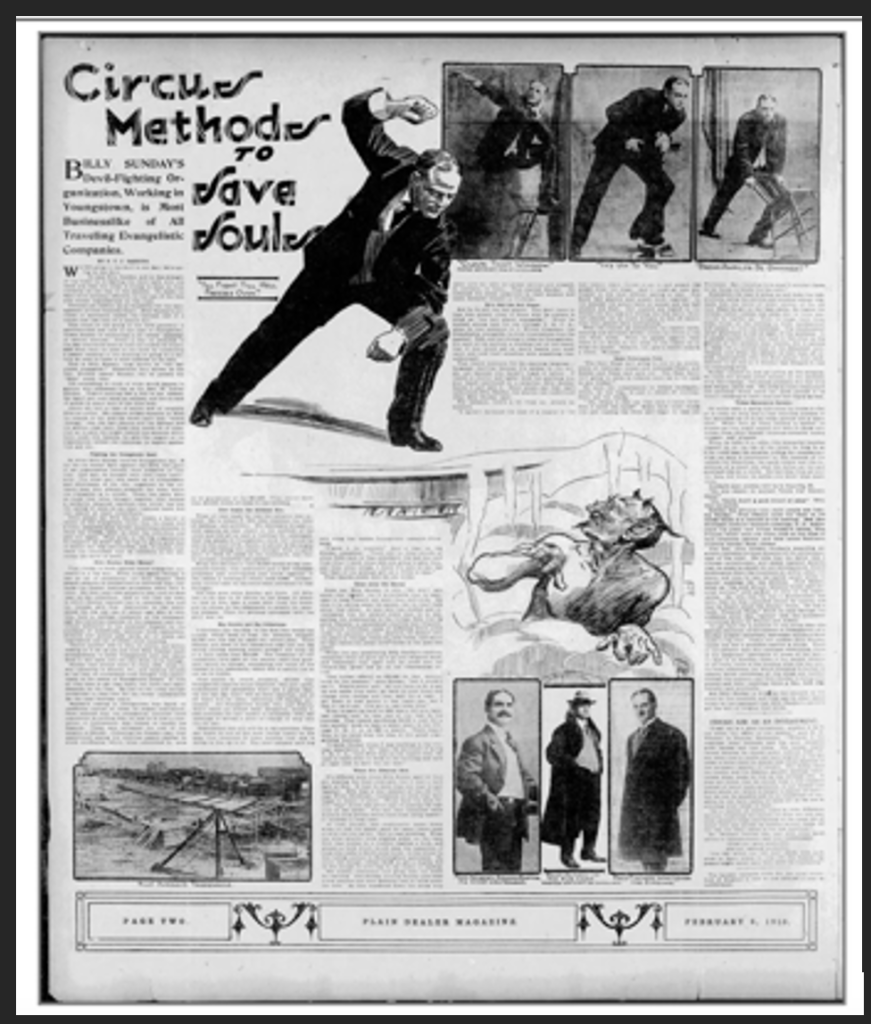
As published in the The Akron Beacon Journal. Sat, Jun 18, 1910 ·Page 3
Attorney W. S. Anderson of Youngstown, who defended Bert Petty, is a staunch supporter of “Billy” Sunday, the celebrated evangelist. He was one of Sunday’s many converts in Youngstown. Sunday spent six weeks in Youngstown this spring and Mr. Anderson says that the effect upon Youngstown was great and it has been lasting also.
“When I first went to hear him I was disgusted,” he said, “but I went several times more just out of curiosity and I grew to be a great admirer of his work. The first two weeks he spent in Youngstown he used a great deal of slang. This drew the crowds and when he had them coming he got down to work and his work was wonderful.”
Mr. Anderson says that all classes of people have been effected by Sunday’s work. “The lawyers are a pretty hard class of men to reach with religious services but Sunday did it. One night in his prayer he said, ‘Help the lawyers because we know they are a tough bunch.’ They were too, but many became followers of the evangelist.
“The work of Sunday can not be judged only by the number who came forward. It is the influence on all the people and their relations with one another.”
Mr. Anderson says Akron should get Billy Sunday here. “It will do the town a lot of good,” he said.