Did Billy Sunday have more than one copy of his sermons?

TO HAVE SERMONS DEPOSITED IN VAULT

BILLY SUNDAY GOING TO TAKE PRECAUTION AGAINST FIRE.

Citation: The South Bend Tribune. Tue, May 13, 1913 ·Page 7

Just Now, Evangelist Has No Duplicate Copies of His Famous Addresses—Ackley Does Work.

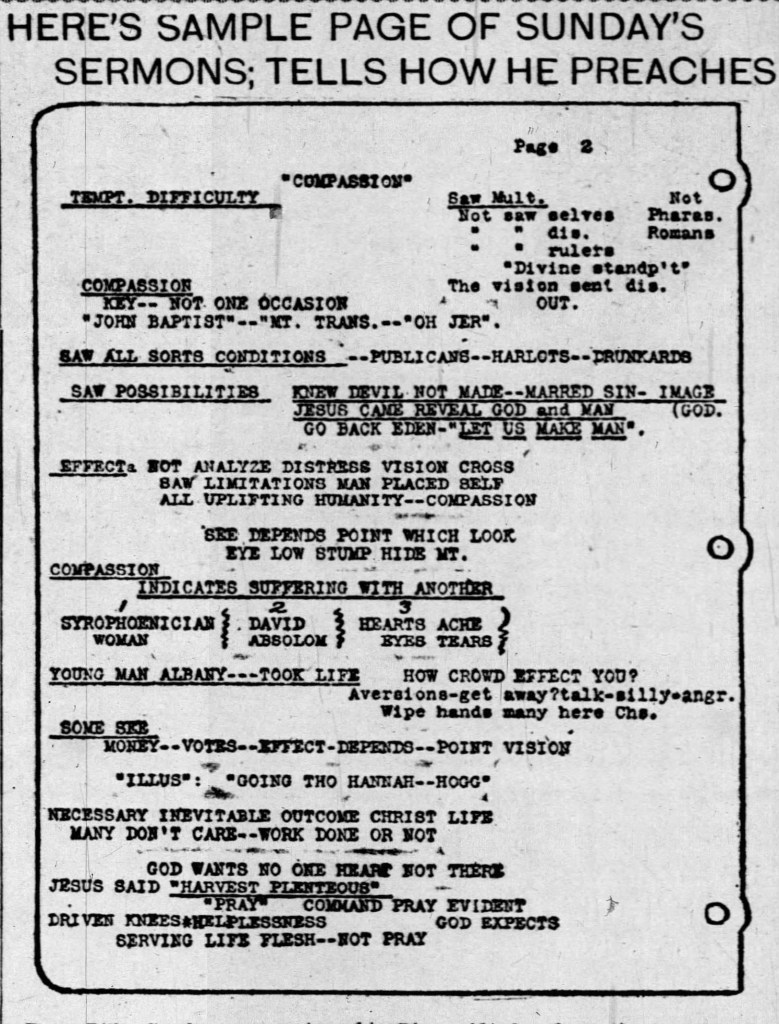
“No, I have only the one copy of each of my sermons,” replied Billy Sunday to a question as to whether he had duplicates of his sermons.

“These sermons are not in full,” continued the evangelist, as he showed the books in which he keeps the addresses that sway so many thousands; “they are just mere skeletons of the sermon and no one else but myself can read them, or at least I don’t think that anyone else can.”

Mr. Sunday was asked if he could remember the sermons if they were stolen and he replied that he recalled the majority of the material that composed them. He says that he intends to have duplicates made of the sermons and have them put into a safety deposit vault so that if one is stolen or should be destroyed by fire or in some other manner, he will have a copy.

“I thought at first that I would be able to get them copied this summer,” he said, “but it don’t look like the work will be accomplished, as I have so much to do this year.”

B. D. Ackley, pianist of the Sunday party, and secretary to the evangelist, copies the sermons of Mr. Sunday. This work takes up quite a bit of the pianist’s time, as Mr. Sunday is continually adding and detracting from his sermons as he acquires new material from many different sources.

“I always let Ackley fix up the sermons. He has a knack for doing things up pretty and nice,” said Sunday, while talking of his work.

“Now, boss, just because we have company you don’t need to make fun of me to my very face. He knows that I can’t fix them right,” said Ackley, as he turned to the visitor.

“That is all right; you do it just to suit me,” replied Sunday.

It is probable that sometime within the next year or so the evangelist will have all his sermons duplicated and deposited in a safety deposit vault.

The South Bend Tribune. Tue, May 13, 1913 ·Page 7

Revival and Collapse: Billy Sunday’s Fiery Campaign in Burlington, Iowa (1905)

By Kraig McNutt

From the moment he arrived in Burlington, Iowa, in November 1905, Rev. William “Billy” Sunday brought with him more than a revival campaign—he brought a storm. For six intense weeks, Sunday preached to thousands daily, confronted sin with his trademark “hammer and tongs” style, and called the city to spiritual awakening.

But the campaign didn’t just stir souls. It nearly cost him his life.


A Town on Fire—Spiritually Speaking

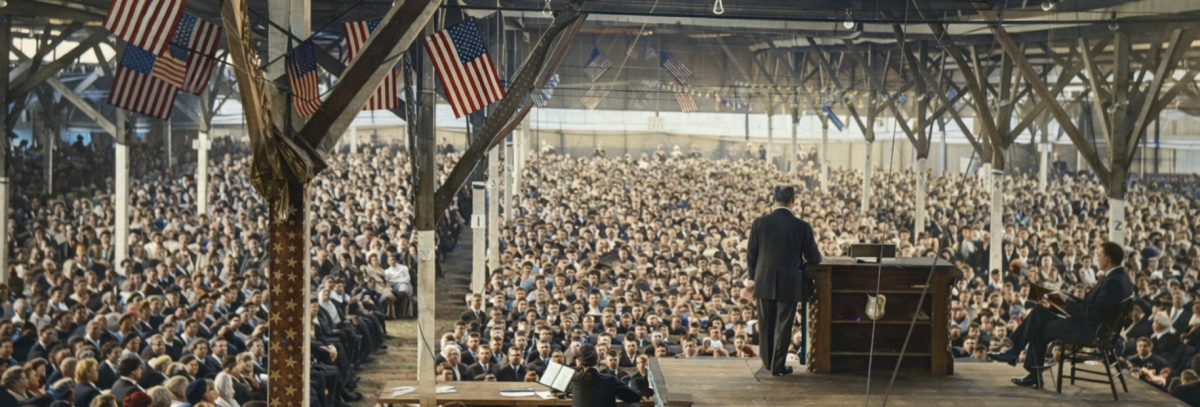
Sunday’s campaign in Burlington ran from November 9 to December 17, 1905. In that span, he preached to crowds of 6,000 to 10,000 in a massive wooden tabernacle built for the occasion. The energy was electric. At one point, over 1,279 converts had been counted, and by the end of the campaign, the total reached 2,484.

The Muscatine Journal described Sunday’s preaching as if “swaying a storm-beaten ocean.” In a men’s meeting alone, 112 responded to the call, with many more turned away due to overcrowding.

But Sunday’s sermons weren’t just altar calls—they were cultural critiques. He lambasted spiritual apathy, criticized parental neglect, and took direct aim at profanity, indifference, and moral complacency. In one memorable line, he warned:

“You say, ‘It is nobody’s business what I do.’ But hear me—it is everybody’s business what everybody does.”

His sermons were equal parts gospel and social conscience.


Revival or Overkill?

Not everyone was thrilled. A Cedar Rapids Gazette editorial warned that while Sunday was sincere, his tone could be offensive and even vulgar. Some churchgoers felt he used “language of the gutter” and painted humanity as far too depraved. They admired his passion but questioned his method:

“Offensiveness and vulgarity may emanate from the pulpit as well as from any other source… but ‘Billy’ Sunday is sincere, and sincerity is a virtue that is not to be despised.”

It was this very sincerity—his relentless, full-throttle commitment—that finally broke him.


The Collapse Heard Across the Midwest

On Monday, December 18, 1905, as Sunday prepared to preach to yet another crowd of 4,000, he suddenly collapsed on stage, fainting in front of the shocked audience. Reports soon circulated that his life was in danger, and that weeks of nonstop preaching had led to total physical and nervous exhaustion.

The Dixon Evening Telegraph wrote:

“He had been preaching steadily day and night for months and during the preceding week had not slept.”

While Sunday recovered and eventually continued his national ministry, the Burlington collapse marked a critical moment—a reminder that even spiritual giants are still human.


A Lasting Impact on Burlington

Despite the toll on Sunday’s health, the Burlington campaign left deep footprints in the city. By the time the tabernacle closed:

  • 2,500 had publicly confessed Christ
  • $4,000 had been raised in free-will offerings
  • The mayor ordered all saloons closed on Sundays
  • A Civic Reform League with 150 members formed to continue the moral reform efforts sparked by Sunday’s preaching

According to The Grand Rapids Press, the final night saw 7,000 people crammed inside, with 5,000 more unable to get in. It was one of the most dramatic and consequential campaigns of Sunday’s early career.


Legacy: The Revival That Cost Everything

The Burlington campaign reveals the paradox of Billy Sunday’s revivalism:

  • His methods were polarizing—but effective.
  • His energy was boundless—but not limitless.
  • His message stirred the masses—but came at personal cost.

Still, Sunday “played ball” in the pulpit the way he had on the baseball field: heart first, full speed, no reserve.

And in December 1905, Burlington, Iowa, witnessed both the brilliance—and the breaking—of a man determined to bring America back to God.

Burlington, Iowa (November 9 to December 17, 1905)

​Billy Sunday conducted his revival campaign in Burlington, Iowa, from November 9 to December 17, 1905. He saw 2,484 conversions and generated $4,000 in collections. A newspaper article tells how he fell ill and his very life was deemed threatened during the Burlington campaign.

Reported That Evangelist Sunday Was Taken Ill During Meetings.

It is reported that Rev. “Billy” Sunday, who has hundreds of friends in Dixon, has broken down from overwork and nervous strain and is dangerously sick at Burlington, Iowa. Friends here have heard nothing of this but the following item is published in an exchange:

“Billy” Sunday, the famous baseball evangelist, broke down at a revival near Burlington, Iowa, Monday, and his death is feared. Sunday started to preach to a crowd of 4,000 people when he toppled over on the platform in a dead faint. He had been preaching steadily day and night for months and during the preceding week had not slept.”

  • Dixon Evening Telegraph. Mon, Dec 18, 1905 ·Page 5

Additional related newspaper coverage of the Burlington, Iowa (1905) campaign

REV. “BILLY” SUNDAY.

Burlington is now in the throes of a religious awakening, engineered by that eminent and popular ex-baseball player who now is known as Rev. William A. Sunday, but whose numerous friends still love to call “Billy” Sunday. Sunday has been preaching the old gospel in his own inimitable style for several years, and has drawn to him the friendships of a great many people of all denominations, while he has also offended many good people by his “hammer and tongs” style of argument. He has also many friends among the people outside of all churches, for there is one thing of which “Billy” Sunday cannot be justly accused, and that is insincerity. He preaches just like he played ball—puts his whole heart into the work; in other words, he “plays ball” in his present profession. That he has done and is doing great good cannot be successfully denied, and Burlington will probably be better, for a time at least, for his coming; but he has many friends who do not believe it is necessary to use the language of the gutter in condemning evil, nor that everybody is quite as bad as Mr. Sunday would sometimes have his hearers believe.

Offensiveness and vulgarity may emanate from the pulpit as well as from any other source. And it is barely possible that a religious cathartic may not prove as effective in the long run as a less drastic and more constructive remedy.

Again, those who labor just as hard, year in and year out, and just as faithfully, in the noble calling, at a salary generally less per annum than Mr. Sunday receives in a fortnight, may be doing a more permanent work. But “Billy” Sunday is sincere, and sincerity is a virtue that is not to be despised.

  • The Cedar Rapids Gazette. Mon, Nov 13, 1905 ·Page 4

GREAT REVIVAL.

Evangelist “Billy” Sunday Stirs Up Burlington—Large Crowds.

Burlington, Ia., Nov. 28—The revival services conducted by Rev. William A. Sunday have already grown to be a remarkable thing for Burlington. They have been going on for two weeks, and the evangelist is now speaking to an average of 6,000 people daily. Sunday afternoon he held his first men’s meeting and was greeted by fully 6,000 men, old and young. He swayed this remarkable audience for an hour and a half like a storm beaten ocean and at the close 112 men responded to the call for converts, and it is estimated that 50 were turned away because of the crush in front of the evangelist. Including this number there have been a total of 602 converts since last Thursday night.

  • The Muscatine Journal. Tue, Nov 28, 1905 ·Page 1

SOME “BILLY’ SUNDAYISMS.

From Burlington papers: The indifference of many in the church is keeping back the kingdom of God.

Some of you are constantly breathing out in doing good to others, but do no breathing in; seldom or never give yourselves any time with God.

If you have done your neighbor in jury, go to him and confess it, and ask his forgiveness.

The greatest barrier to the advancement of God’s Kingdom to-day is the indifference and apathy of so many of our church members.

No wonder so many of our children go to the bad; they get no guidance, no inspiration, no help for good in the home.

There are hundreds here to-night who are convinced that Jesus Christ is the son of God, but have not back- bone enough to come down the aisle and confess it.

The historical Jesus? You may repudiate him as the son of God, but you still have the historical Jesus, and you could no more write the history of the world and leave Jesus out than you could write the history of this country and leave out George Washington.

Profanity damns and curses any man who indulges in it.

What would the world be were there no restraining influence? You say “it is nobody’s business what I do.” Bu’ hear me, it is everybody’s business what everybody does.

There are certain men who scoff at religion and at preachers, but when they come face to face with death and the fearful consequences of their dis- solute lives they begin to fear and tremble.

  • Muscatine News-Tribune. Tue, Dec 05, 1905 ·Page 6

Ten thousand people sought to hear “Billy” Sunday preach at Burlington last Sunday, 6,000 succeeding. Converts in his revival services in that city to date number 1,279.

  • Quad-City Times. Wed, Dec 13, 1905 ·Page 2

Closed by “Billy” Sunday.

Burlington, Ia., Dec. 20.—The wave of reform in Burlington, growing out of William A. Sunday’s revival meetings, resulted in the formation of the Civic Reform league of 150 members, and the issuance last night by Mayor Caster of an order closing all saloons on Sunday.

  • The Grand Rapids Press. Wed, Dec 20, 1905 ·Page 9

2,500 Converts

Secured by Rev. Billy Sunday in Burlington

Burlington, Ia., Dec. 19.—The Rev. William A. Sunday has closed his series of evangelistic meetings here. There were 7,000 people packed into the tabernacle, with at least 5,000 outside unable to get in, last night. The results of the meetings are 2,500 converts. The people of Burlington have given him a free-will offering of over $4,000.

  • Marion News-Tribune. Wed, Dec 20, 1905 ·Page 9

Billy Sunday campaigns 1904-1905

Here’s a blog-ready narrative reflecting on the 1904–1905 campaign data from Billy Sunday’s early revivals:


Billy Sunday’s Early Impact: What the 1904–1905 Campaign Numbers Reveal

By Kraig McNutt

Before Billy Sunday became a national sensation—packing tabernacles in Philadelphia and Pittsburgh—he cut his evangelistic teeth in smaller Midwestern towns. The data from his 1904–1905 revival campaigns offers a fascinating glimpse into the early momentum of a man who would become America’s most celebrated evangelist of the early 20th century.

Here’s what the numbers reveal.


Small Towns, Big Spiritual Response

Many of the towns on Sunday’s early itinerary were small agricultural or industrial communities scattered across Iowa, Illinois, Minnesota, and Colorado. Places like Exira, Iowa and Audubon, Iowa boasted modest populations—yet hundreds came forward to respond to Sunday’s message.

  • Centerville, Iowa (1905): 900 conversions
  • Sterling, Illinois (1904): 1,678 conversions
  • Macomb, Illinois (1905): 1,880 conversions
  • Dixon, Illinois (1905): 1,875 conversions

These numbers are especially impressive when viewed through the lens of population density. In many cases, Sunday was reaching 10–20% or more of the town’s residents. His message wasn’t simply heard—it reshaped the spiritual landscape of entire communities.


Collections: A Window into Support and Sustainability

While conversion data was consistently recorded, collections (monetary offerings) were only occasionally noted:

  • Centerville, Iowa: $1,500
  • Keokuk, Iowa: $2,200
  • Dixon, Illinois: $2,000
  • Macomb, Illinois: $3,100

These figures indicate that even in smaller towns, there was strong financial support for revival efforts. The money likely covered the costs of tabernacle construction, music, printed materials, and Sunday’s own ministry team.

These generous gifts also reflect the deep gratitude communities felt for the spiritual impact they experienced.


Consistent Fruit Across the Heartland

Across 22 cities recorded between 1904 and 1905, Sunday saw tens of thousands make public professions of faith. The median number of conversions hovers around 900–1,000 per town. For a relatively unknown evangelist in his early 40s, this marks a period of accelerating credibility and growing influence.

It was this consistency—town after town, soul after soul—that built the foundation for Billy Sunday’s national platform just a few years later.


A Revival Rooted in the Midwest

It’s no accident that Sunday’s early years focused on Iowa, Illinois, and Minnesota—regions that mirrored his own upbringing and values. These were towns where the church was central, alcohol was a public enemy, and personal salvation was not just a religious idea, but a community matter.

Sunday’s fiery oratory, moral clarity, and theatrical flair found fertile ground in these heartland soils.


Final Thought: The Humble Beginnings of a National Voice

The revival fires Billy Sunday lit in places like Bedford, Harlan, and Canon City were more than regional events—they were launchpads. These early campaigns showed that revival could still grip a town, change hearts, and reorder lives.

In 1904 and 1905, he wasn’t yet preaching to hundreds of thousands—but he was proving that he could.

And history shows—he would.


Enjoying this kind of historical insight? Subscribe to the blog or check out more posts at EvangelistBillySunday.com


Source: The Spectacular Career, p. 126.

CityConversionsCollections
Marshall, Minn.600
Sterling, Ill.1678
Rockford, Ill.1000
Elgin, Ill.800
Carthage, Ill.650
Pontiac, Ill.1100
Jefferson, Iowa900
Bedford, Iowa600
Seymour, Iowa600
Centerville, Iowa9001500.0
Corydon, Iowa500
Audubon, Iowa500
Atlantic, Iowa600
Harlan, Iowa400
Exira, Iowa400
Keokuk, Iowa10002200.0
Redwood Falls, Minn.600
Mason City, Iowa1000
Dixon, Ill.18752000.0
Canon City, Colo.950
Macomb, Ill.18803100.0
Canton, Ill.1120

Revival in the Rust Belt: What the Numbers Reveal About Billy Sunday’s Evangelistic Impact (1912-1915)

By Kraig McNutt

In the early 20th century, few public figures stirred the American soul quite like Billy Sunday. A former professional baseball player turned dynamic evangelist, Sunday launched revival campaigns that were part gospel meeting, part moral crusade, and entirely unforgettable.

But beyond the sawdust trails and thunderous preaching, what do the numbers tell us about his real impact?

Let’s dive into an analysis of over twenty of Sunday’s campaigns—spanning from the industrial sprawl of Philadelphia to the steel towns of Ohio and Pennsylvania—to find out.


Big Cities, Big Numbers

Unsurprisingly, the nation’s largest cities saw the highest total conversions:

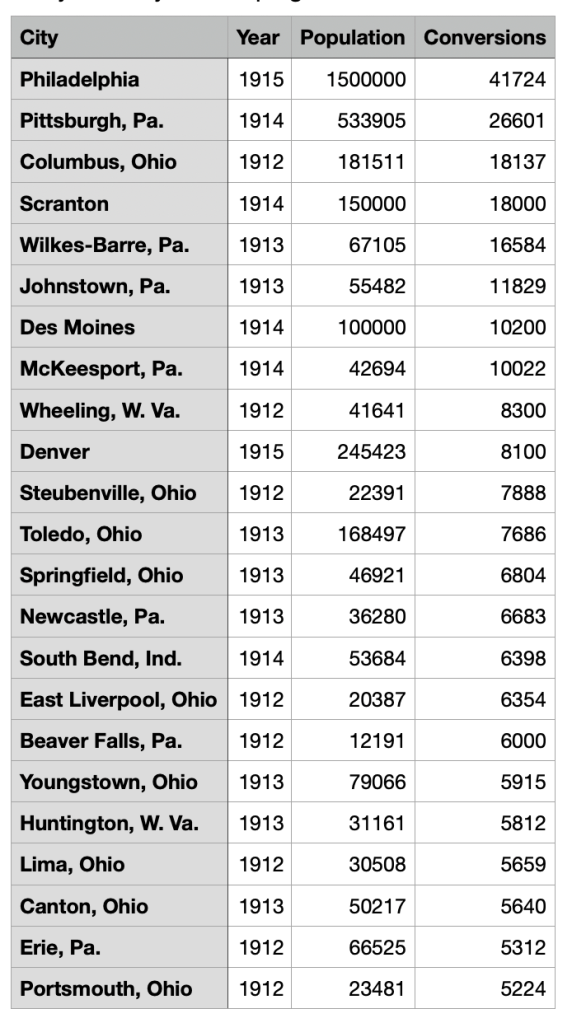
  • Philadelphia (1915): 41,724 conversions
  • Pittsburgh, PA (1914): 26,601 conversions
  • Columbus, OH (1912): 18,137 conversions

Impressive, no doubt. But when measured per capita, a surprising truth emerges…


The Real Revival Was in Small-Town America

Here’s where it gets fascinating:

  • Beaver Falls, PA (1912): 6,000 conversions in a city of 12,191 – nearly 49%!
  • East Liverpool, OH (1912): 6,354 conversions in a population of 20,387 – over 31%
  • Steubenville, OH (1912): 7,888 conversions out of 22,391 – over 35%

In these towns, Sunday didn’t just stir hearts—he helped reshape the entire community’s spiritual identity.


A Strategy Rooted in the Industrial Heartland

Most of Sunday’s campaigns concentrated in:

  • Pennsylvania
  • Ohio
  • West Virginia
  • Indiana

Why here?

These regions were filled with working-class cities grappling with the social challenges of industrialization: alcoholism, labor unrest, poverty, and moral uncertainty.

Sunday’s sermons, full of vivid illustrations and uncompromising moral appeals, landed powerfully in these settings. He spoke their language, addressed their fears, and challenged their habits.


His Peak Impact Years: 1912–1914

Many of the most spiritually responsive campaigns occurred just before World War I:

  • Scranton (1914)
  • Wilkes-Barre (1913)
  • McKeesport (1914)
  • Des Moines (1914)
  • Johnstown (1913)

This was Sunday’s sweet spot—a season where both momentum and message aligned. Before the war brought cultural upheaval, Sunday’s campaigns offered a moral anchor to cities teetering on the edge of change.


The Bottom Line: Revival by the Numbers

Across 23 cities analyzed:

  • Total population: 3,559,070
  • Total conversions: 250,872
  • Average conversion rate: ~7.05%

That’s 1 in every 14 people making a spiritual decision.

But the real story is this: Sunday’s numerical reach was greatest in big cities, but his transformational impact was most profound in smaller towns where community bonds were tighter, distractions were fewer, and the message spread like wildfire.


Final Thoughts: When Revival Was a Shared Story

Billy Sunday didn’t have Instagram reels or livestream sermons. He had sawdust floors, a voice like thunder, and a message about Jesus that could shake a city.

And in towns like Beaver Falls, East Liverpool, and Steubenville, it did more than shake—it changed lives. Not in abstract theological terms, but in the daily rhythms of work, family, and community.

In these places, revival wasn’t just a moment. It was a movement.


Want more historical insights like this? Subscribe to my newsletter or explore more at https://evangelistbillysunday.com/


Total population 3,559,070
Total conversions 250,872

Data from The Man and His Message, Ellis

1906 Evangelistic campaigns Billy Sunday hosted?

Kewanee, Illinois, 1906

JANUARY

Freeport Journal-Standard. Thu, Jan 25, 1906 ·Page 1

  • Tabernacle to be built:
    • 90×120 feet
    • Will seat 2,000
    • Costs: $2,500 for lumber
    • Located at Jackson and Walnut in Freeport, ILL
  • Lumber, lighting and labor to cost $6,900
    • Freeport Journal-Standard. Tue, May 15, 1906 ·Page 1

FEBRUARY

  • Feb 17th newspaper article:
    • “Revival Wave Sweeps State”Freeport Daily Bulletin. Sat, Feb 17, 1906 ·Page 7 Refers to the upcoming April revival w Billy Sunday

MARCH

  • Freeport Daily Bulletin. Fri, Mar 16, 1906 ·Page 4
  • Sunday just finished his campaign in Princeton, ILL.
  • 1,890 conversions of a population of 5,000.
  • March 26th
    • Freeport Daily Bulletin. Mon, Mar 26, 1906 ·Page 5
    • Churches agree to NOT meet on dates of Sunday revivals

APRIL

  • Finished tabernacle by Hamlyn Brothers
  • Freeport Journal-Standard. Wed, Apr 04, 1906 ·Page 1

Initial Dates for Freeport revival set:

  • April 28 – May 11 (every night)
  • Freeport Daily Bulletin. Sat, May 12, 1906 ·Page 1

MAY

After the initial last night of May 11th, the revival was extended.

The Freeport Bulletin (May 24) says…..

  • His campaign in the city will end June 3rd.
  • Freeport Tabernacle the largest (at this point)
  • From May 11 – May 22nd, 490 conversions are reported

JUNE

Last date for Freeport Revival is June 3rd

JULY

Post Freeport campaign Freeport Journal-Standard. Thu, Jul 05, 1906 ·Page 5

  • Billy preached at Prophetstown, ILL

The 1906 Billy Sunday Revival in Freeport, Illinois: A City Shaken

In early 1906, the city of Freeport, Illinois, began to prepare for what would become one of the most talked-about spiritual events in its history: a full-scale revival campaign led by the former professional baseball player turned evangelist, Billy Sunday.

The Tabernacle and the Build-Up

As early as January 25, the Freeport Journal-Standard announced the ambitious plans for a massive temporary tabernacle to be constructed at the corner of Jackson and Walnut Streets. Measuring 90 by 120 feet and designed to seat 2,000 people, the structure reflected both the scale of Sunday’s influence and the expectations for a large crowd. With $2,500 allocated for lumber and a total projected cost of $6,900 for lighting, labor, and construction, the city made a significant investment in preparing for the revival.

By February, anticipation was spreading beyond Freeport. A February 17 Freeport Daily Bulletin article declared that a “revival wave [was] sweeping the state,” pointing to the upcoming April arrival of Sunday as a major contributor. Just weeks earlier, Sunday had concluded a powerful campaign in Princeton, Illinois, resulting in nearly 1,900 conversions out of a town of just 5,000—numbers that generated buzz and raised expectations for Freeport.

As March turned to April, preparations intensified. Local churches agreed not to hold their own services during the revival campaign, recognizing the potential for unity and focus. The Hamlyn Brothers completed the tabernacle by early April, just in time for the set launch date of April 28.

Revival Unleashed: April 28 – June 3

The revival began on April 28 and was initially scheduled to last just two weeks, ending May 11. But as nightly crowds filled the tabernacle and the number of conversions grew, the campaign was extended through June 3. By May 24, reports in the Freeport Bulletin indicated that 490 conversions had taken place just between May 11 and May 22. Momentum was building.

The Freeport tabernacle became, at that time, the largest such structure Sunday had used. Thousands streamed in nightly to hear his fast-talking, energetic sermons that combined homespun stories, baseball metaphors, and unflinching moral appeals. He denounced sin with the fervor of a prophet and the flair of a showman, and the people of Freeport couldn’t get enough. The revival stirred the city so thoroughly that even local skeptics had to admit its impact.

Aftermath and Legacy

The meetings formally ended on Sunday, June 3. Though exact figures for total conversions are not available in your data, the revival left a lasting impression. Just a month later, Sunday was preaching in Prophetstown, Illinois (Freeport Journal-Standard, July 5), continuing his revival circuit—but the spiritual spark he had ignited in Freeport still lingered.

The 1906 campaign marked a pivotal moment in Sunday’s early evangelistic career. Freeport, known for its beer and pretzels, had experienced a spiritual shake-up. Though some converts would later drift away—as often happens after revival—the consensus, even among critics, was that Sunday’s visit had made Freeport a better, more sober, more spiritually awakened city.

Billy Sunday 1907 Revival Campaigns

Worthington, MN – Began Dec 9, 1906. Ended Jan 5th, after four weeks.

Kankakee, ILL – Began January 6th, ending Feb 20th.

Murphysboro, ILL – Began Feb 23, 1907, ended March 31st.

Fairfield, IA – Began April 4th til May 6th.

Knoxville, IA

Gibson City, ILL – Began 9 June thru July 14th

Galesburg, ILL – Began 28 Sept thru 4 Nov 1907

Muscatine, IA – Began 10 Nov thru 15 Dec, 1907.

Above data cited in In Rare Form, Firstenberger: 121-22.

Also:

  • The Minneapolis Journal. Sat, Nov 24, 1906 ·Page 11
  • Gibson City Courier. Fri, Jul 19, 1907 ·Page 9
  • The Baltimore Sun. Sat, Oct 26, 1907 ·Page 11(“Billy” Sunday’s Way: Converted Ballplayer Converts 100,000 People)
  • The La Crosse Tribune. Thu, Jan 10, 1907 ·Page 1
  • Mattoon, ILL: Journal Gazette and Times-Courier. Tue, Jan 01, 1907 ·Page 7
  • Illinois: Cooksville Enterprise. Fri, Feb 22, 1907 ·Page 1
  • St. Joseph, MO: St. Joseph News-Press. Wed, Mar 27, 1907 ·Page 6
  • Joplin, MO: Joplin News-Herald. Wed, Apr 03, 1907 ·Page 4
  • Freeport, ILL: The Daily Journal. Tue, Jun 19, 1906 ·Page 5
  • The Muscatine Journal. Tue, Mar 05, 1907 ·Page 6
  • The Muscatine Journal. Fri, Apr 05, 1907 ·Page 1
  • Gibson City Courier. Fri, Jun 07, 1907 ·Page 4
  • Ottumwa Semi-Weekly Courier, Tue, Apr 30, 1907 ·Page 5

“The Town of Beer and Pretzels Shaken Awake”: Billy Sunday’s 1906 Revival in Freeport, Illinois

By Kraig McNutt

In the spring of 1906, the city of Freeport, Illinois—nicknamed by some as the “town of beer and pretzels”—became the unlikely stage for one of the most memorable revivals in early 20th-century American evangelicalism. It was led by none other than Rev. William Ashley “Billy” Sunday, the baseball-star-turned-evangelist whose fiery sermons and athletic stage presence would eventually captivate audiences across the country. But in Freeport, his gospel campaign left an impression still remembered more than a century later.


A Tabernacle Rises

On January 25, The Freeport Journal-Standard announced plans for a wooden tabernacle to be built at the corner of Jackson and Walnut Streets—a temporary structure, 90 by 120 feet, with seating for 2,000. The project, including lumber, lighting, and labor, came with a hefty price tag of nearly $7,000, a bold investment for a campaign that hadn’t even begun.

But the momentum was building. By February, reports described a “revival wave sweeping the state” (Freeport Daily Bulletin, February 17), with Sunday’s campaign seen as the crest of that spiritual tide. Sunday had just completed a campaign in Princeton, Illinois, where 1,890 people—over one-third of the town’s population—had responded to his call for conversion.

Anticipation spread quickly in Freeport. On March 26, area churches agreed not to hold their own meetings during the revival, uniting in support of the citywide effort. By April 4, the Hamlyn Brothers had completed the tabernacle—just in time.


“Hit the Trail!”: Revival Fire Ignites

The meetings began on April 28 and were originally scheduled to conclude May 11. But it didn’t take long before city leaders and church officials realized something extraordinary was happening. The campaign was extended through June 3.

Night after night, thousands packed into the tabernacle to hear Sunday thunder against sin and call the city to repentance. By May 22, just eleven days after the originally scheduled end date, 490 conversions had been recorded. Local papers declared the Freeport tabernacle the largest Sunday had ever used at that point in his ministry.

He preached with unmatched energy—sometimes leaping onto the pulpit or running across the stage—and wielded everyday language that even the most skeptical workingman could understand. Sunday brought the gospel to life with baseball metaphors, streetwise illustrations, and all the force of a man who believed eternity was at stake.


“A Lasting Benefit to the City”

The campaign officially ended on Sunday, June 3. Though complete statistics remain elusive, the revival had clearly left its mark. One local newspaper would later reflect that Sunday’s campaign had done “more good than we thought it would” and credited it with producing “better citizens, law-abiding and self-respecting men.”

The same article pointed out that even those who didn’t remain in the church long after the revival had still taken a meaningful step: they had responded, they had come forward, they had heard. “A step in the right direction,” it noted, “builds character.”

Sunday himself moved on to Prophetstown by early July (Freeport Journal-Standard, July 5), but in Freeport, something remained. The revival had galvanized the churches, stirred the consciences of many, and sparked conversations about faith, morality, and public life that would reverberate for months to come.

Beyond Freeport: Sunday’s 1906 Trail of Revival

The Freeport campaign was not the end of Billy Sunday’s evangelistic fire for the year—far from it. Fresh off the sawdust trail in northern Illinois, Sunday continued his whirlwind revival circuit, reaching small towns and stirring hearts across the Midwest and beyond.

Just a month after concluding in Freeport, Sunday preached in Prophetstown, Illinois, in July 1906, continuing to draw crowds eager for his message of repentance and salvation. By fall, he had moved westward to Salida, Colorado, where an unexpected snowstorm destroyed his revival tent. That loss became a turning point in his method: from that point forward, Sunday transitioned away from using large tents and instead began constructing permanent wooden tabernacles—just like the one used in Freeport.

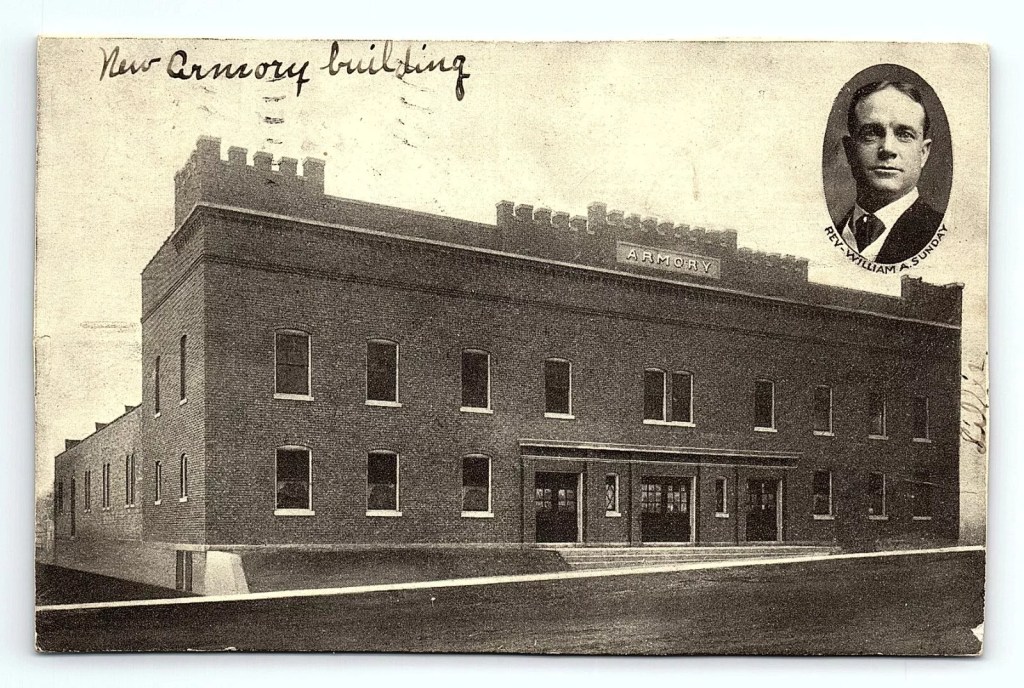
But it was Kewanee, Illinois, in late October through early December of 1906, that demonstrated just how rapidly his influence was growing. Holding a five-week revival in the newly built National Guard Armory, Sunday drew crowds of 2,000 to 4,000 each night, with a staggering 200,000 total attendees reported. So many people flocked to hear him that some had to be turned away at the doors.

Each campaign added to Sunday’s legend, but in many ways, Freeport stood as the hinge moment—a city that proved how a local revival could shake not just individuals but an entire community. And as Sunday’s trail moved on from town to town, the echoes of his voice still lingered in the tabernacle on Jackson and Walnut, where for a few electric weeks in the spring of 1906, revival fire had burned hot in the town of beer and pretzels.

Legacy

Billy Sunday’s Freeport revival was, in many ways, a preview of what was to come. He would go on to preach to millions, become the most prominent evangelist of his era, and leave behind a complex legacy that combined bold preaching with theatrical flair. But in the spring of 1906, before national headlines, before the surge of prohibition politics and radio broadcasts, he stood in a sawdust-covered tabernacle in northern Illinois and offered one simple message: “Choose you this day whom ye will serve.”

Results from Freeport, ILL revival?

The Pantagraph. Sat, Jan 25, 1908 ·Page 5

[Refers to previous year’s campaign in Freeport.]

AFTERMATH OF SUNDAY’S WORK IN FREEPORT

SITUATION NINE MONTHS AFTER REVIVAL.

How Many of the Converts Have “Stuck” —General Effect on Some of the City—Bloomington Men to the Front.

(By Staff Correspondent.)

Freeport, Ill., Jan. 23.—Less than a year ago Rev. William Sunday, who is now holding forth in union revival meetings in Bloomington, waged war on sin and unrighteousness in this city, nicknamed the town of beer and pretzels. How have the converts stuck? Have they remained true to the public confession made when they stepped forward and gave Billy Sunday a shake of the hand? The answer must be yes or no. This is true of all revivals and the meetings conducted by the great evangelist named above are no exception. His converts remain steadfast or backslide just as those of other leaders, great or small, have in the many years gone by.

A Benefit Certainly.

No matter what the critics may say of Billy Sunday the man, or of his methods, the results of his protracted meetings are beneficial to a city. It has helped Freeport and it will likewise benefit the city of Bloomington. The fact that he has made some men in this city better citizens, law-abiding and self-respecting men, cannot be denied and the city is now much more the gainer by their residence here.

Are Marked Men.

Walk down Stephenson street, the principal business and residence thoroughfare, in company with a Freeporter, and mention the name of Billy Sunday and he will, in nine cases out of ten, raise his finger and point out a convert won by this evangelist. They are marked men, and one hears this remark often: “There goes one of Billy’s converts.” He won for Christ men and women in all walks of life, many of whom united with the church, all denominations adding to the membership roll. Some remained true but a short time, yet even so, the step they took was in the right direction and indicated a previous good thought and good thoughts build up and make character.

A Good Judge.

Perhaps there is no one in a city who knows the people, their history and life better than the newspaper man. A local newspaper writer said: “Billy Sunday did more good in this town than I thought he could and it seems to be a lasting benefit. While, of course, many backslide, some as soon as the evangelist departed, others have remained true to their vow and have become leaders in church work. Really more “stuck” by far than I expected.

It is said one of the leading business men of the town, who used to go on periodical sprees, after hearing Billy Sunday’s sermon on “Booze” became converted and his friends have been congratulating him on his stick-to-it-tive-ness.

About Usual Number.

Another resident said as the result of the meetings conducted here last year about the average number of converts are continuing steadfast. The pastors, following Mr. Sunday’s departure, put their shoulders to the wheel and took up the work where the evangelist left off.

They got young people into the church and put them to work, so on the whole it must be admitted that Freeport was made a better city by the religious awakening under the leadership of the man who is arousing such interest in things religious in Bloomington.

A Comparison.

This city has a population of 20,000 in round numbers and, being the center of 26,000,000 people, all within 400 miles, had a good territory from which to draw the crowds to hear Mr. Sunday, whose meetings continued from April 28 to June 4 of last year. Yet the attendance was small compared to that in Bloomington. The tabernacle was not quite so large and the crowds were not so immense. The people did not hang from rafters and almost by the eyebrows as is the case in Bloomington. In fact, the record shows an average attendance of only 2200 at a meeting, while the 5000 mark was only reached one evening, on June 3.

It took over three weeks to raise the amount needed for the expenses of running the meetings, about an equal sum as required in Bloomington. The Rev. Mr. Sunday called the people here, who are chiefly Germans, the “stingy Dutch,” but before his meetings closed the purse strings were loosened like they had not been in years past. The people of this city did well by Mr. Sunday. He on one occasion declared the curse of Freeport to be “the set of infidels who live here.”

Amount Paid Mr. Sunday.

The first converts were secured May 11, when sixteen went forward, and the largest number at any one time 184, on May 30, the total number of converts being 1365. Up to January 28 in Bloomington the total number of converts was 2,000, with a total attendance on that date of 20,000. The people of Freeport gave Billy Sunday $3064.38 for his services, extending over a period of five weeks and three days.

Helped Y.M.C.A.

Mr. Sunday remained over one day to help the Y. M. C. A., which had a debt of $11,500 hanging over it. Secretary Ralph Smedley, of the local Y. M. C. A., formerly of Bloomington, had just assumed charge at this time and had secured, with the assistance of others, some $9000 in pledges. Mr. Sunday at his farewell meeting raised $2000 and all pledges were announced at this meeting, showing a sum total of $12,000 secured by the Y. M. C. A., placing the association on a substantial footing.

Bloomington Men to the Front.

Heading two of the most important institutions which go to make any city are two Bloomington young men, Mr. Ralph Smedley, secretary of the Y. M. C. A., and Mr. Wilbur Coons, secretary of the Freeport Business Men’s Association. So successful has been Mr. Smedley in his work that the committee in search of a secretary for the Business Men’s Association made straight for Bloomington to find their man. And if the town needs others there are plenty more at home like these. No lack of material in the Evergreen City. Mr. Smedley received his training in the work while educational secretary of the Bloomington Y. M. C. A. and is making good progress. Under his leadership all departments of work have taken on new life and the membership is steadily growing. The register now shows 432 and they are passing toward the 500 mark.

Secretary Coons, who was a member of the Bloomington Bulletin editorial staff and a first-class newspaper man, has only recently taken up his new duties here. He has just issued a new circular setting forth the advantages of this city which is growing rapidly. It is largely a manufacturing town, several very large establishments being located here. Here are also the largest windmill factories in the world. The Business Men’s Association has over 150 members and owns fine factory sites. There are over thirty miles of paved streets, nine of these are of brick laid since 1902, and twenty-one of macadam.