The Youngstown, Ohio (early 1910) Sunday-revival

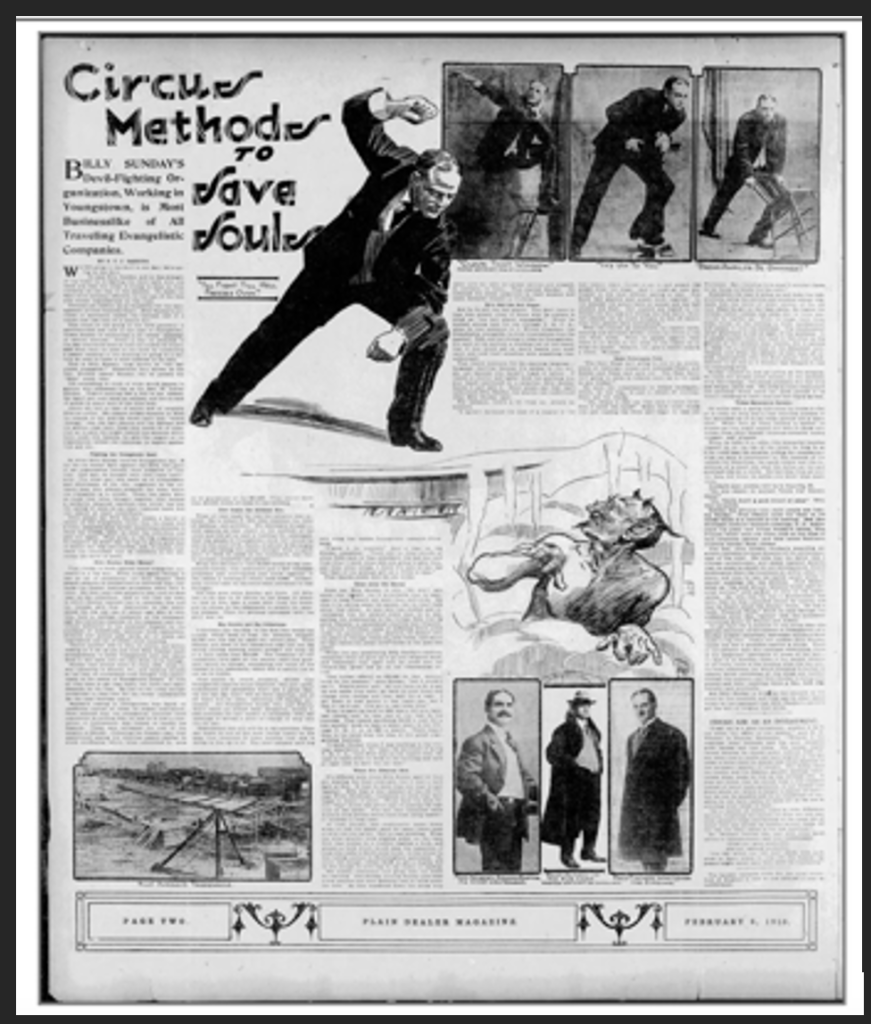
The Cleveland Plain Dealer. Feb 6, 1910  

Billy Sunday Comes to Youngstown: A City on Fire (January–February 1910)

When Billy Sunday rolled into Youngstown, Ohio, in January 1910, he did not arrive quietly—and Youngstown did not receive him quietly either.

From the very first night, it was clear that this industrial city, filled with steel mills, rail yards, immigrants, laborers, and restless energy, was primed for revival. Sunday began his campaign on January 8, 1910, and within hours it was obvious that this would be no ordinary meeting.

A city floods the tabernacle

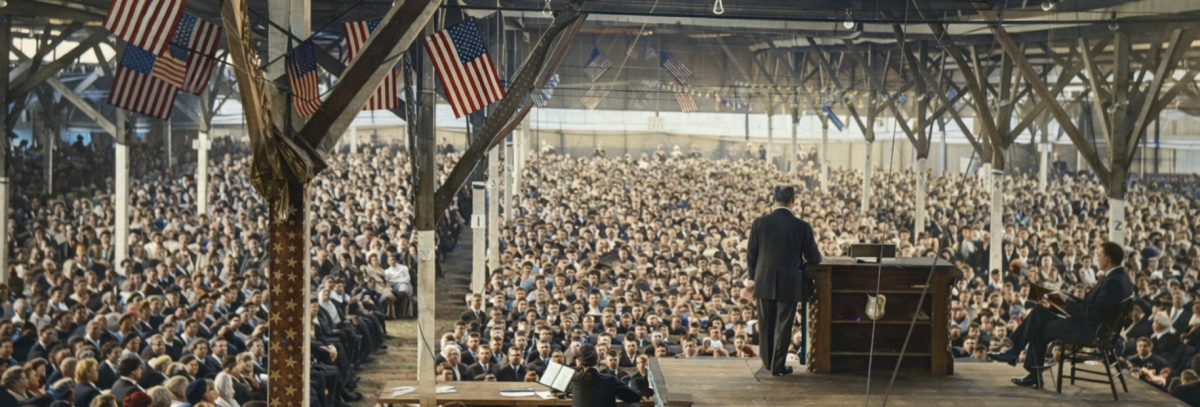
On opening night, 5,000 people packed the tabernacle, according to the New Castle News (Jan. 10, 1910). The very next evening, crowds swelled to 7,000, as reported by The Pittsburgh Post (Jan. 10, 1910). The word had spread fast: Billy Sunday was in town, and Youngstown wanted in.

As the weeks unfolded, the numbers only grew more astonishing.

By February 4, the campaign had already recorded 2,221 conversions. That same night, 15,000 people attempted to crowd into a tabernacle that could seat only 7,000—a vivid picture of spiritual hunger and civic excitement. The Cleveland Press marveled at the scene, noting the crush of humanity trying simply to hear Sunday preach.

Youngstown had become a revival city.

The dramatic final Sunday

The campaign reached its crescendo on February 20, 1910.

That final day, 10,000 people attended, while 6,000 more were turned away for lack of space. The Marion Daily Star reported that 5,900 total conversions had been recorded over the course of the meetings, including 970 decisions on the closing day alone.

It was a stunning finish—one of those great climactic Sundays that made Sunday’s name synonymous with American revivalism.

At the conclusion of the campaign, Sunday received his customary purse of 10,000 dollars, a significant sum in 1910 and a sign both of the city’s appreciation and of the scale of the event.

What Youngstown reveals about Billy Sunday

The Youngstown campaign illustrates several hallmarks of Billy Sunday’s ministry:

  • mass appeal: from night one, thousands came. This was not a slow build—it was a tidal wave.
  • urban impact: Youngstown, a gritty industrial center, responded with remarkable intensity, showing that Sunday’s message resonated far beyond small towns or rural communities.
  • public spectacle and spiritual urgency: the overflow crowds on multiple occasions suggest that this was as much a civic event as a religious one.
  • measured results: newspapers tracked conversions closely, giving us concrete numbers that help modern historians gauge the scope of the revival.

Most of all, Youngstown demonstrates why Sunday was “the man for the moment.” In an era of rapid industrial change, social tension, and moral anxiety, he spoke with clarity, fire, and confidence—and cities like Youngstown listened.

More than a century later, the Youngstown campaign stands as one of the great urban revivals of Sunday’s early career. The numbers are impressive, but the deeper story is about a city temporarily transformed—its people stirred, challenged, and moved to decision.

J. Wilbur Chapman on Billy Sunday

Writing just days after the Youngstown campaign ended, J. Wilbur Chapman offered this striking tribute to Sunday in The Dayton Herald (Feb. 23, 1910):

“Some of the sermons he preaches now are not mine. I love him. I know his sincerity and passion for Jesus. I thank God for his ministry. Most of us are too dignified. Let rules of grammar and conventionality be broken if souls can be saved. As soon as he begins to speak the doors will be closed so you can’t get out. You’ve got to take your dose for once. If ever a man was called to preach; if ever a man had the seal of God’s approval on his ministry, that man is Sunday. I take off my hat to any man that can turn men to Jesus Christ.”
Billy Sunday and the YMCA: The Crucible of a Calling

In a culture where faith often stays behind closed doors, Billy Sunday’s early formation in the YMCA reminds us that calling is not just a private conviction — it’s forged in public discipline, community, and visible work. Let’s see how his “seminary without walls” shaped him — and what that might teach us today.

The YMCA as Bridge Between the Diamond and the Pulpit

Before the sawdust trail and the tabernacle crowds, Billy Sunday’s call to preach was forged in the YMCA.

From 1889 to 1894, the Young Men’s Christian Association was his classroom, pulpit, and proving ground—where athletic vigor met moral conviction.

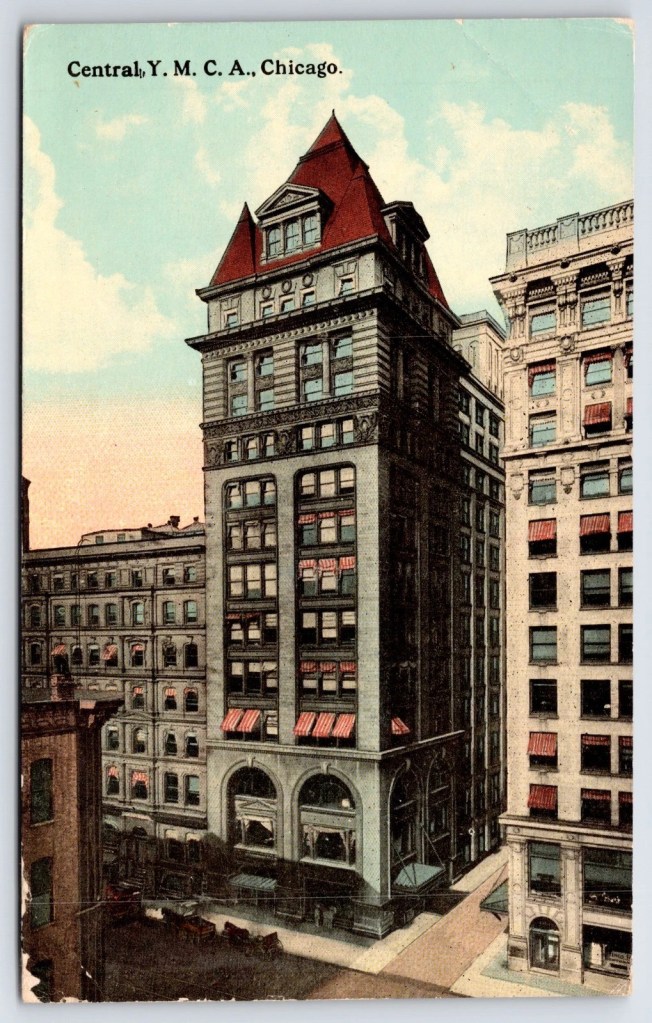
Central YMCA Chicago (built in 1893)

From Ballplayer to Brotherhood

After his 1886 conversion through the Pacific Garden Mission, Sunday joined Chicago’s First Presbyterian Church and quickly connected with the YMCA. His first sermon—“Striking Out Satan” (Feb. 14, 1889)—sponsored by the YMCA, drew hundreds and led to 48 conversions. Newspapers from Chicago to Quebec reported on the ‘baseball evangelist,’ giving Sunday his first taste of national attention.

A Training Ground for Discipline and Leadership

Hired in 1890 as Assistant Secretary of the Chicago YMCA ($83/month), Sunday learned to run meetings, lead Bible studies, and recruit men to the faith. The YMCA’s ethos of “muscular Christianity”—combining physical strength, moral purity, and social reform—shaped his lifelong view that faith should be active, public, and manly. His preaching style—energetic, physical, direct—mirrored the YMCA gymnasium more than the traditional pulpit.

“He jumped after the devil as he once jumped after a fly ball.”

Platform and Network

Speaking regularly in YMCA halls from Cincinnati to Freeport, Sunday developed his reputation as a lay preacher for working men. These circles introduced him to Dr. J. Wilbur Chapman, who later invited him to
join his national evangelistic team in 1894. Even after resigning from the YMCA, Sunday continued to preach in its auditoriums—Chicago (1896), Cedar Rapids (1895), Dubuque (1899).

The Model That Endured

Summary Insight

The YMCA was Billy Sunday’s seminary without walls. It taught him how to lead, how to speak, and how to live out faith in public. Within its walls, the ex-ballplayer became an evangelist. Without it, the “Baseball Evangelist” might never have found his swing.

The YMCA wasn’t merely a stepping stone for Billy Sunday — it was formative, foundational, and catalytic. It taught him leadership, public engagement, spiritual discipline, and the courage to preach in everyday venues.

Legacy & Invitation: Calling is seldom revealed in isolation. It’s often forged through community, service, and visible responsibility. For us today, the question is: Where is your YMCA? Where might God be shaping your calling right now in your everyday context?

May we not despise the small openings, the local venues, the places of habit and service — for they may be the very grounds where our faith is tested, refined, and sent out into greater mission.

Billy’s debt to J. Wilbur Chapman, in his own words

I owe more to Dr. Chapman than to any other man that I ever became a preacher. I traveled with him for two years as an assistant. He picked me up out of the corn rows of Illinois. We went to a town up in Kansas one time to conduct a series of meetings. We were accustomed to have union meetings, but in that place, when we arrived on the scene, we found that they could have had a union meeting had it not been for a quarrel with the Presbyterian church. They had had a fuss and there were a few people live and awake, up-to-date, who said they’d withdraw. So they went down to the bank of the river and they built a church, they had a good live-wire preacher there who was going at a good gait all the time on high gear, while the other fellow had the brakes set.

The Atlanta Constitution. Wed, Nov 07, 1917 ·Page 12

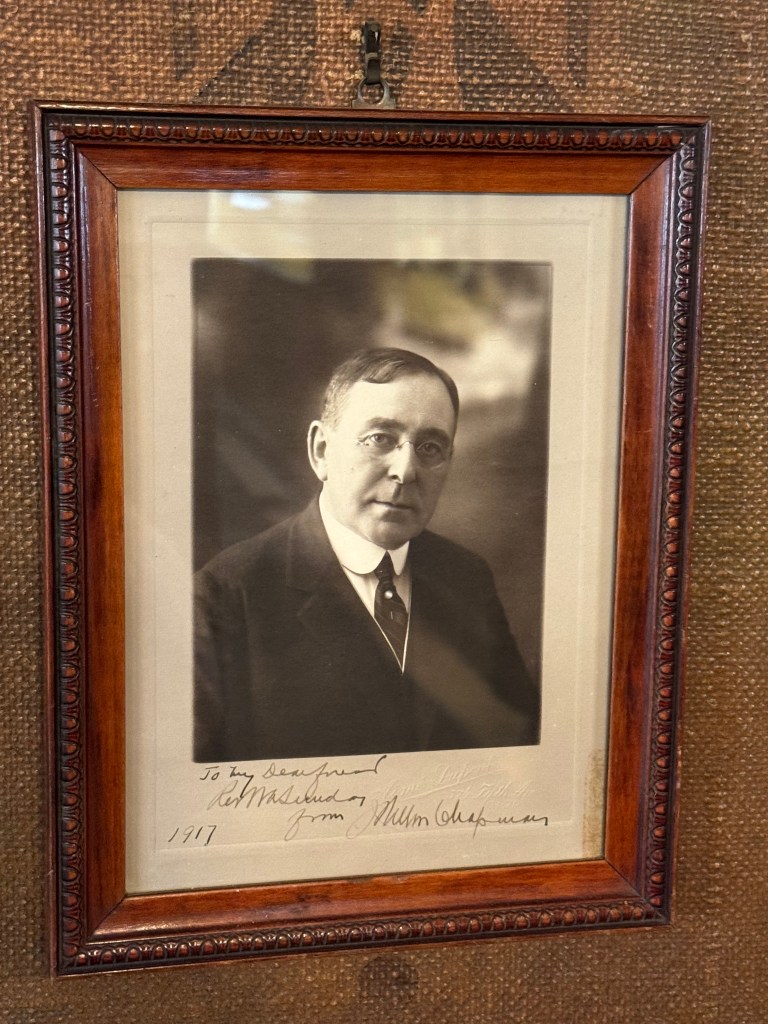
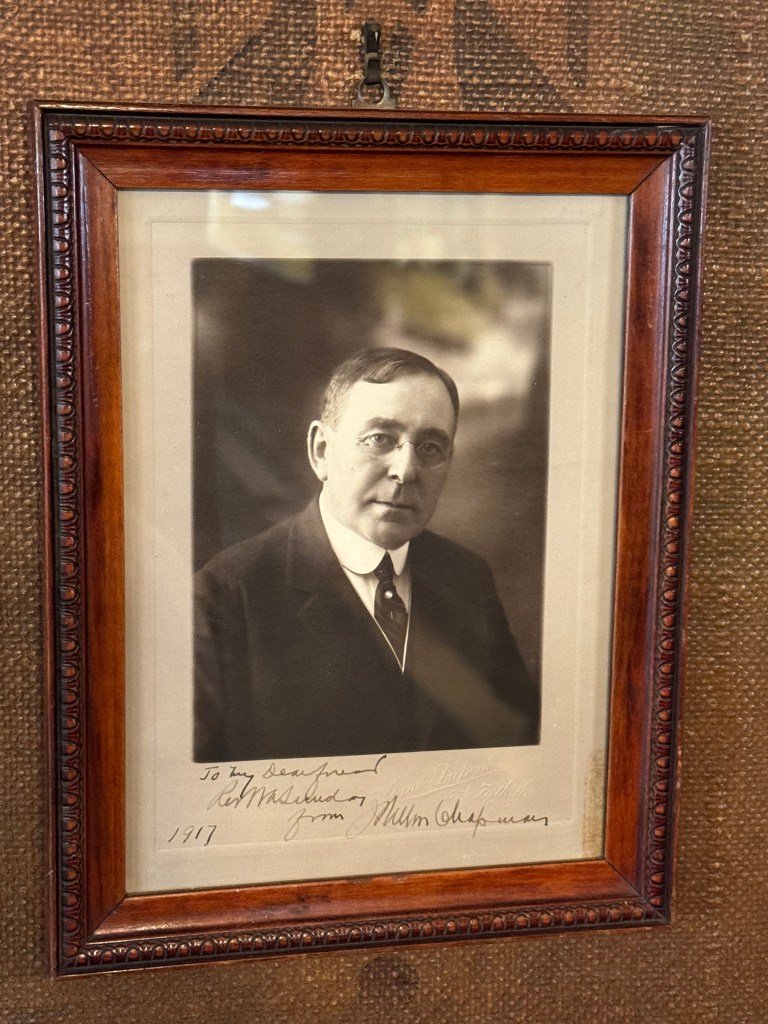
This picture of Chapman hangs on Billy’s wall in his Winona Lake home. It is inscribed with the date 1917.

The Forgotten Mentor: Rev. Rhys Rees Lloyd and the Making of Billy Sunday

“All I am under God, I owe to the Rev. Mr. Chapman and to Prof. R. R. Lloyd of Berkeley, California, with whom I privately studied.”
– Cynon Valley Leader. Sat, Dec 27, 1924 ·Page 2

When historians tell the story of Billy Sunday—the baseball-player-turned-revivalist who shook America from 1900 to 1925—certain names always rise to the surface: William and Nell Sunday, Wilbur Chapman, perhaps John Wilbur Chapman’s evangelistic team.

Yet tucked in old newspaper columns and long-out-of-print yearbooks lies the story of a man whose quiet influence helped shape Sunday’s fiery ministry: Rev. Rhys Rees Lloyd, D.D.

Rev. Rhys Rees Lloyd’s quiet investment in Sunday reminds us that God often does His greatest work through those content to remain unseen.

A Welsh Beginning

Rhys Rees Lloyd was a full-blooded Welshman, born in North Wales to a distinguished minister father and a mother, Miss Williams, from the mining village of Hirwaun, Glamorgan.

His family history read like a hymn to Welsh Nonconformity: his grandfather helped found the local chapel where young Rhys grew in the faith, and the family remained pillars of that congregation for generations.

The old Welsh anthem he loved to quote—Mae hen wlad fy nhadau yn anwyl i mi (“The land of my fathers is dear to me”)—captured a devotion to heritage that he never lost.

Educated at the University of Wales, Lloyd excelled in the classical and biblical studies that would become the foundation of a lifelong ministry of preaching, teaching, and mentoring.

Across the Atlantic

In the 1870s Lloyd crossed the ocean, newly married, and settled in Chicago.
There he entered the Chicago Theological Seminary while simultaneously pastoring a city church.

His five and a half years in that pulpit were so fruitful that fellow ministers urged him to train future pastors.

He heeded the call, completing a two-year postgraduate program in New Testament studies.

Before long the West beckoned: Lloyd accepted a chair as Professor of New Testament Greek and Interpretation at Pacific Theological Seminary in Berkeley, California.

For ten years he combined academic rigor with an itinerant ministry of preaching and lecturing that took him across the United States.

A Providential Meeting in Chicago

Meanwhile, in 1886, a young Chicago White Stockings outfielder named Billy Sunday had an encounter that would change his life.

After a street-corner gospel team stirred memories of his devout mother, Billy walked into the Pacific Garden Mission and trusted Christ as Savior.

The next morning, as Sunday headed to the YMCA to begin work as Religious Director, a mutual friend introduced him to Rev. Rhys Lloyd.

The two men could hardly have been more different—one a rough-edged ballplayer with little formal schooling, the other a classically trained theologian steeped in Greek and Hebrew.

Yet in that brief conversation Lloyd quietly offered to help the new believer “whenever he desired.”

Billy accepted.

For more than a decade, usually in the margins of busy schedules, Lloyd tutored Sunday in Scripture, doctrine, and the art of interpretation.

He even helped him with Greek so that Sunday could wrestle directly with the New Testament.

Lloyd asked that the arrangement remain private during his lifetime, but Sunday, brimming with gratitude, often told the story anyway.

More Than a Footnote

A 1914 Scranton Truth article already recognized Lloyd as one of Sunday’s “religious preceptors,” but a richer picture emerged a decade later in a 1924 Cynon Valley Leader profile.

That account celebrated Lloyd’s Welsh roots and confirmed that Billy “spoke of it often and forcibly,” crediting the professor’s ten-year investment in his biblical education.

The article also revealed a life of broad influence:

  • friendships with prominent figures such as General Charles G. Dawes (later U.S. Vice President),
  • lectures across the nation on the results of his biblical research,
  • and quiet philanthropy—helping at least twenty-five young men secure an education.

Mentor of the Evangelist

Lloyd’s mentorship offers a pattern modern ministry often forgets: growth through relationship, formation before fame, discipleship before platform.

It would be easy to blur the lines and call Lloyd “the man who converted Billy Sunday,” as some hometown admirers claimed.

But history is clear: Billy’s conversion took place at the Pacific Garden Mission.
Lloyd’s gift was different and no less vital: he discipled and educated the man who would become America’s most famous evangelist.

Through Rhys Lloyd’s steady hand, Billy Sunday gained:

  • Doctrinal Stability – a grounding in Reformed theology and confidence in the authority of Scripture.
  • Biblical Literacy – enough Greek and interpretive skill to handle Scripture faithfully despite scant formal schooling.
  • Spiritual Example – a model of integrity and intellectual devotion that shaped Sunday’s own passion for the Bible.

A Legacy Worth Remembering

By the early 1920s Lloyd was semi-retired in Chicago, recovering from a long illness, still working on publishing the results of his lifelong biblical studies.
He never sought fame, but his imprint is indelible.

Every time Billy Sunday thundered a sermon before thousands, the careful tutelage of a Welsh professor echoed beneath the sawdust trail.

In the grand narrative of American revivalism, Rev. Rhys Rees Lloyd remains largely unsung—a scholar-pastor whose quiet faithfulness equipped a headline evangelist to shake a nation.

History rarely celebrates the mentors whose quiet faithfulness builds the giants. Yet Lloyd’s story invites us to ask: who shaped us? And who might we be called to shape? Every generation needs its unseen professors who teach others to thunder for God.

Sources: 1914 Scranton Truth, May 4, 1914, p.2; 1924 Cynon Valley Leader, Dec 27, 1924, p.2; contemporary Presbyterian records and Billy Sunday’s own reminiscences.*

Billy Sunday was mentored by J. Wilbur Chapman

The following (1917) signed picture of J. Wilbur Chapman, in the Billy Sunday home in Winona Lake, attests to the massive influence Chapman had on Sunday.


When the Apprentice Met the Evangelist: How J. Wilbur Chapman Shaped Billy Sunday’s Early Ministry

Before the tabernacles were packed, before the crowds surged forward by the thousands, before the name “Billy Sunday” echoed across the country like a revivalist’s thunderclap—he was simply a former ballplayer, freshly converted, and hungry to make his life count for Christ.

That’s when J. Wilbur Chapman stepped into the picture.

It was 1893. Chapman, already an established evangelist with a Presbyterian pedigree and a knack for drawing the spiritually curious, needed an assistant—someone to handle logistics, rally local churches, and stir up enthusiasm before his campaigns. Billy Sunday had the energy and the zeal. Chapman had the method and the message.

For two critical years—1893 to 1895—Sunday shadowed Chapman like a student to his rabbi. He wasn’t yet preaching, but he was watching. Learning. Absorbing. Chapman’s campaigns weren’t just events—they were carefully orchestrated spiritual operations. Inquiry rooms. Personal follow-ups. Gospel invitations that were both clear and convicting. Sunday took it all in.

But it wasn’t just technique that Chapman passed on—it was a vision. A way of doing evangelism that held fast to the truth of Scripture while reaching real people in real places. Sunday saw in Chapman a man who carried both conviction and compassion. And though their styles couldn’t have been more different—Chapman, the dignified clergyman; Sunday, the kinetic whirlwind—it worked. Like iron sharpening iron.

In 1895, Chapman surprised many by stepping back from itinerant preaching to take a pastorate in New York. The pulpit reclaimed him. But for Billy Sunday, it was a release—a gentle push from the nest. With his mentor’s example still fresh, Sunday stepped onto his own stage. He started small—tiny Iowa towns, rough-hewn tabernacles, handfuls of seekers. But something was forming. Something bold.

It’s hard to overstate what those two years meant. Without Chapman, Sunday might’ve remained a sideshow curiosity—a saved athlete giving testimonies. But with Chapman’s imprint, he became an evangelist. A revivalist. A force.

And though their paths diverged, Sunday never forgot the man who shaped his earliest steps. He took Chapman’s gospel framework, set it ablaze with his own personality, and carried it farther than either man probably imagined.

Chapman taught him how to build the fire. Sunday learned how to preach like it mattered.