Former professional baseball player-turned urban evangelist. Follow this daily blog that chronicles the life and ministry of revivalist preacher William Ashley "Billy" Sunday (1862-1935)
“First, he is natural, never tries to be another, is never affected. The champion of the diamond is in action for God. Second, he uses the word of God, knows it, believes it, and preaches it with consummate skill and commanding power. Third, he knows the heart of man, and helps every hearer to find and see one’s self. In papers, parts of his sermons may appear to be jokes, but they are no joke to the one whose soul is uncovered by them. A friend said Saturday, ‘I can’t laugh at the jokes, they are too awfully true.’ Another said, ‘Billy’s ‘darns’ aren’t nearly so large when you hear them as they appear to be in the press.” Mr. Sunday shows us the dead body of sin to which we are chained until we loath it and groan to be delivered from it.
Fourth, best and most important of all, he believes in and depends upon the Holy Spirit; who is here working in, working for, and working with Mr. Sunday, and every consecrated follower of God. Just so sure as these things be true, we shall see a great work in Scranton. Every lover of God and man ought to pray most earnestly that this may be fact as well as prophecy. We ought not to judge until we see and hear. Come to the tabernacle and you will wish that all of your family and friends were with you. Mr. Sunday is more than a man working with human skill. He is a man of God being used to help men. Years hence we shall regret it if we fail to hear Billy Sunday now.”
“Billy Sunday is an American Product – Where methods differ
More Lasting Good.
The old school of revivalists were of the itinerant class, moving rapidly through the country, their evangelism seemed sudden in its effect and I am afraid somewhat evanescent in its general results. It is just here that Mr. Sunday’s campaign gives promise of more lasting good. His coming has been carefully prepared for, his meeting place is undenominational in character. It is a movement conducted with great business acumen and sound common sense. He trains the ministers and church workers in such a way as to make them capable of caring for the harvest when it comes. Like a good farmer, he prunes the fruit trees with vigor cuts out all the dead wood and sprays them well to get rid of moths, beetles and canker worms, so that when the new fruit shall ripen it will be sound and beneficial. And the leaves of the trees shall be for the healing of the nations. Mr. Sunday is a man endowed with a great faith, He prays for the blessing, he prepares for the blessing, he is sure of getting it and it is therefore no surprise that he is so eminently successful.”
[Note: Mr. Herring had applied for a saloon license but afterwards “hit the trail” in the Wilkes-Barre campaign.]
Citation: The South Bend Tribune. Tue, Jun 03, 1913 ·Page 8
From my own personal observation I do not hesitate to say that Wilkes-Barre and Wyoming valley has never enjoyed so much happiness as prevails at the present time as a result of the Billy Sunday campaign. The great change that has come over the community as a result of Mr. Sunday’s campaign is very noticeable and I believe that if the people of this city could have him they would ask Mr. Sunday to come back to our locality and stay another seven weeks.
Throughout our locality saloon-keepers do not deny that they have been badly affected by Mr. Sunday’s campaign. The faces which were very familiar in such places for many years are now absent. Men who for years have led a reckless life and neglected their families have been released from the influence of drink and are once more respected by their fellow men. A visit any night to the large hotels in the central part of our city is sufficient to prove that the patronage at these places is not nearly as great as before the revival. I believe it is safe to say that the amount of good done by Mr. Sunday in this vicinity cannot be measured.
Never in the history of our churches has the attendance been as large as during the past few weeks, or since Mr. Sunday left for South Bend. One church, the Central Methodist Episcopal has taken in nearly 800 new members to date and many more are expected. Another church, Westminster has taken in about 500 and several other churches have taken in like numbers. In fact, if the enthusiasm continues and I have every reason to believe it will, many of our congregations will have to enlarge their edifices. It is surprising to know the number of our influential citizens who for years have been out of the church now within the church and taking an active part in its affairs. Another feature of Mr. Sunday’s work is that men of high positions in life who were converted are now members of the Y. M. C. A. personal workers league and are out daily leading others to the cause of righteousness. The work that is being done by the personal workers is admirable. Employers can be found working hand in hand with their employees all working in the interest of Christ. So satisfactory have the results been that other cities have asked several of our young men to visit and tell the story of the great amount of good that has been accomplished. Only last Sunday one of our newspapermen went to Williamsport and so pleased were the people with his message that he was forced to repeat it at three different meetings.
The question has been asked as to whether the merchants of this vicinity have been benefitted by the Sunday revival. Every day one hears some merchant say that accounts which he had closed several years ago have been re-opened and are being settled by the people who contracted debts.
Judging from the activity among the ministers since Mr. Sunday’s visit it cannot be denied that the great evangelist has done a wonderful amount of good among the ministers of the gospel. The better work being done by the ministers in my estimation is due to the fact that they are now receiving the co-operation of their congregations, which was unusual heretofore.
Regarding the liquor traffic and the effect of the revival in surrounding towns, two of the saloon keepers, I have been informed, have quit the business. One was a resident of Parsons and the other of Edwardsville. Two pool rooms one, of which was to be replaced by a saloon, have been wiped out and have been replaced by a grocery store and confectionery.
An organization of railroad men at Ashley was disbanded after the officers were converted and the men are all doing personal work now. A club room at Plymouth, where men assembled on Sundays and did considerable drinking has been changed to a prayer meeting room, the sale of liquor having been discontinued.
In Wilkes-Barre several men who for several months had been gathering weekly in a garage and playing poker were converted and are now holding Bible classes instead.
A representative of the Bell Telephone company said a few days ago that since the revival the company’s receipts from saloon pay stations have fallen off a large per cent and the receipts from drug store stations have increased accordingly.
Although the grand jury of our county ignored several cases against “speakeasies” that were raided by Sheriff Kniffen, one of the converts, the religious organizations throughout the whole county have passed resolutions supporting the sheriff and his crusade and the Y. M. C. A. personal workers’ league plan in a few days to hold a big street demonstration approving the sheriff’s work.
In conclusion I would state that it is difficult to express the real situation existing in his locality as the result of the great evangelist’s good work.
That the change among the people is also being felt by our city officials was evidenced several days ago when the mayor of our city, Hon. John V. Kosek, caused every side room, where cabaret shows were held nightly and where women of questionable character congregated, to be closed. Hotels that for years were known to have been the meeting place of immoral men and women during the past week have been in darkness.
Billy Sunday was given over $23,000 by the people of this valley and I do not hesitate to say that if he had been given $100,000 he would not have been repaid for the good he accomplished.
BILLY SUNDAY EXPLAINS THAT OLD CHARGE OF STEALING.
OFTEN FAILS TO CREDIT
Citation: The South Bend Tribune. Wed, May 21, 1913 ·Page 11
Sometimes He Doesn’t Know Where Stuff Came From, Often He Forgets It, Baseball Evangelist Declares.
Ask Billy Sunday if he steals some of the material he uses in his sermons and perhaps he will frankly admit it.
That is, he will confess that he picks up hints, paragraphs, poems and anything else which will assist him in his work, only giving the creator of the things the credit when he happens to know their names, or when he thinks of it.
“The accusation in regard to my stealing the stuff for my sermons makes me tired,” said the evangelist when approached regarding the matter.
“There isn’t a public speaker today but what does the same thing. Every day I get poems and paragraphs and other knick-knacks through the mail from people I do not know, who suggest that I may have some use for them. I clip and save thousands of such things myself in the course of a year.
Doesn’t Know Author.
“Well, when I get ready to work them into my sermons, nine chances out of 10 I won’t know the name of the author. But I use them just the same, and give those who originated them credit when I can and when I remember it. But if I had to stop and give credit for every bit of outside material I work into the sermons, I wouldn’t have much time to say anything else.
“There are a dozen or 15 evangelists who are using my stuff every day they preach. Do I get any credit for it? Well, I guess not. They are free to use it if it will do any good without crediting it to me, so why should I go to the trouble of mentioning all these folks in my sermons.”
About Mothers’ Poem.
The evangelist told of an incident a few days ago in connection with his special Mothers’ Day address. He said he recited a poem during the sermon, which had been sent him by some anonymous letter writer. The poem was an excellent one and suited his purpose exactly. He quoted it word for word in his mothers’ sermon without giving any credit for it and a day or two later, discovered the name of the author while reading a magazine.
He has now noted down the name of the author and will give him credit for the work when he delivers the sermon again. The evangelist says if he is guilty of stealing literary stuff that every public speaker in the country could easily be convicted of the same offense.
Reads Everything.
The evangelist reads anything and everything worth reading, which is brought to his attention and by so doing he collects thousands of suggestions and hints for sermons and additions to sermons. He said he believed his clippings for his sermons in the course of a year, would fill an ordinary two horse wagon.
Sunday has a marvelous memory, which is also of great assistance in his work. In the preparation of a sermon, he writes only fragments of it out, depending on his faculty for remembering to carry him through it. A few notes, all of which have been typewritten, are all he has to show for the majority of his sermons, many of which have become famous and are generally regarded as masterpieces.
The sermon he will deliver to-night at the tabernacle, “The Second Coming of Christ,” has been heard by thousands, as one of the evangelist’s very best, is not in the mind of Sunday in full and probably never will be, unless he takes the trouble to clip it from some newspaper, which is printing detailed accounts of his talks.
Only Few Sentences.
Instead, it consists of only a few terse half completed sentences, which are set down in type written form to assist him in remembering the balance. In the majority of instances, the wonderful word painting in the sermons are simply noted in two or three words and a brief sentence may stand for two or three stories he tells during the talk.
The South Bend Tribune. Wed, May 21, 1913 ·Page 11
EVANGELIST IS DISCUSSED BY WILKES-BARRE, PA., MAN.
COMPARED WITH OTHERS
Billy Sunday, 1908. Author’s Collection.
Writer in Newspaper Compares Former Baseball Player With Famous Evangelist of Few Year Ago—Does Much Good.
The Tribune’s Special Service.
WILKES-BARRE, Pa., May 9.—Rev. William A. Sunday and his methods have been reviewed from so many angles that it seems difficult even for a veteran to add anything to the sum total of knowledge of this wonderful evangelist, says “G. A. E.” writing for the Wilkes-Barre Record.
Continuing “G. A. E.” who made a careful study of the evangelist while he was conducting his campaign here, says:
“However, as the preachers say, ‘firstly, secondly, thirdly and one word more,’ and this may be ‘finally and in conclusion.’
“Billy Sunday, as we now familiarly term him, stands in a class by himself, and if I compare him with evangelists of other days it is not for disparaging comment or odious comparison. He is peculiarly an American product and becomes immediately at faith with his audiences because of his intense patriotism, his love of the starry flag and his intense belief in the present and future greatness of the United States. He is a paladin of defense.
Sunday Protector.
“No, siree, the devil shall never capture this country so long as Billy Sunday can put up his dukes or raise his voice in protest.
“I have been privileged to hear many great pulpit orators and revivalists both in this country and abroad, among the latter, Weaver, Spurgeon, Booth (before his Salvation army days) Moody, Torrey. Of these for keenness of argument, beauty of diction, fierceness of invective and charm of pathos. I would place Rev. Charles H. Spurgeon in first place, with Gen. W. Booth in the next. But from speech of my mother and grandparents even these giants could not compare with Whitfield, Williams O’Wern, Charles Wesley, Christmas Evans and Rowland Hill. The men I have named were all different in their method, none of them staying long in one place, and their work was largely denominational in character. These men were all successful and their trumpet calls led many to a newness of life.
Orthodox Gospel.
“The story they told and the gospel they preached was the old orthodox one, ‘He that believeth shall be saved, and he that believeth not shall be damned.’ Sunday’s success is in proportion as he sticks to the old doxv and the old ‘Thus saith the Lord,’ but it is worth noting that while the old exhorters emphasized ‘hell fire,’ and ‘fire and brimstone,’ Billy does not add to the agony of those consigned to the place prepared for unbelievers by using those words.
“Mr. Sunday, like Spurgeon and many other successful exhorters, is a voluminous speaker, but not a profound thinker. He has read for dramatic effect, he has skimmed the literature of the English race for illustrations, and is endowed with a slang vocabulary that is simply astounding. He uses his knowledge with such marvelous effect that all who come ‘to scoff return to pray.’ His earnestness, his transparent honesty, carries all his hearers with him and his slang solecisms are all forgotten in his clarion call for repentance, his denunciation of all that is bad, vile and wicked and in his praise of God, home and country.
More Lasting Good.
“The old school of revivalists were of the itinerant class, moving rapidly through the country, their evangelism seemed sudden in its effect and I am afraid somewhat evanescent in its general results. It is just here that Mr. Sunday’s campaign gives promise of more lasting good. His coming has been carefully prepared for, his meeting place is undenominational in character. It is a movement conducted with great business acumen and sound common sense. He trains the ministers and church workers in such a way as to make them capable of caring for the harvest when it comes. Like a good farmer, he prunes the fruit trees with vigor, cuts out all the dead wood and sprays them well to get rid of moths, beetles and canker worms, so that when the new fruit shall ripen it will be sound and beneficial. ‘And the leaves of the trees shall be for the healing of the nations.’ Mr. Sunday is a man endowed with a great faith. He prays for the blessing, he prepares for the blessing, he is sure of getting it and it is therefore no surprise that he is so eminently successful.
Campaign Well Conducted.
“The late revival in Wales was a marvelous spontaneous outburst of religious fervor and roused large sections of the community. It was conducted by a young man named Roberts, who was ill fitted both mentally and physically and he subsequently broke down. Want of well directed effort, want of unity on the part of the churches to look after and care for the converts robbed the movement of much of its success. The converts were left to the mercy of the world, flesh and the devil, and thus the promise of a great and last revival petered out.
“The Sunday campaign is conducted vastly different. It is an old evangel, presented in racy Americanesque speech and run upon up-to-date business principles. The evangelical churches are a unit. It has been aided by the enterprise of the daily newspapers and publicity is given to the religious movement unknown to our fathers. Despite a few doubting Thomases the spirit of success is in the air, for the Wyoming valley is realized that the ‘hour and the man’ glorious religious revival has just passed and the effects of it are to continue.”
Excerpt from: The South Bend Tribune. Sat, Apr 19, 1913 · Page 1
The character of Billy Sunday as an evangelist is well known generally. His methods although they do not conform to the ideas of many people, are energetic and forceful, and have proven to be productive. His fearlessness in denouncing evil and his portrayal of the sins of the world are his strongest assets on the platform. In nearly every city in which Billy Sunday campaigns he receives threatening letters from fanatics and from persons opposed to his almost militant methods. Wilkes-Barre, Pa., where he has just closed a very successful campaign was one of the exceptions to this, much to the surprise of Sunday and his party. It is not known as yet whether there will be any such persons brought from under cover in South Bend but the religious people here hope not.
In Columbus, O., a woman threatened to “cut his heart out”. She was laboring under the impression that Sunday had seriously harmed her. It is to protect himself from scandal that Mr. Sunday never allows women to call upon him and he never calls at a person’s house unless accompanied by some member of his party.
Evangelist Explains Why He Uses Language of Streets In His Sermons
“Richmond ministers are dead right when they declare that if they said in their own pulpits some of the things I say in mine, it would sound ridiculous,” Billy Sunday admitted yesterday.
“There is a time and a place for all things,” continued Sunday. “Staid old church people, reared in Sunday schools, prayer meetings and churches and familiar with elegant phraseology, do not need to have things told them in the plain language of the street in order to comprehend them. Richmond ministers preach to about the same crowd every Sunday and they understand them perfectly.
Short Over Heads.
“But I speak to multitudes whose fathers never darken a church door. If I put them to the usual pulpit terms it would be clouds over their heads. Some of my hearers never went to school, never received church training. Their vocabulary is often limited to 500 words—many of them idioms of the street and slang, and some of them bordering on cuss words. Now I do not use cuss words, but I use the slang or phrase of the street that I know they will understand and respond to—and they do.
“I saw a man seated in front of me in the tabernacle whose dress and appearance showed he was a sport. He was plainly no church-goer. When I said in my sermon, ‘Don’t pass the buck!’ his face lighted up immediately. He was all smiles and he quickly got the idea I was trying to convey. Had I used highfalutin terms they would have been wasted on him.
Never So.
“When Lincoln used the word ‘sugar coated’ in one of his messages, Secretary of State Seward said he would never do—it was not refined enough.
“All right, you put in a better word,” Lincoln told Seward. Next day Seward came back and said he couldn’t find a better word, and ‘sugar-coated’ remained in the message.
Lincoln said there never would come a time when the American people would not know what ‘sugar-coated’ meant.
The apostle said: ‘By their works ye shall know them’—and when I put it: ‘Show me! I’m from Missouri,’ the man of the street not used to going to church gets the idea in a jiffy.”
Cited in: The Richmond Item. Sun, May 07, 1922 ·Page 6
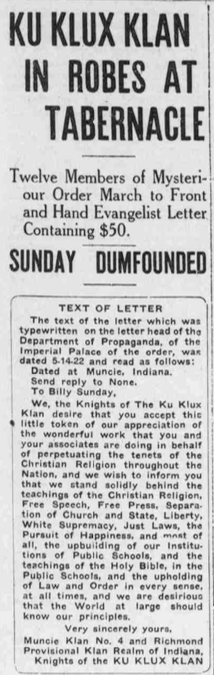
On May 14, 1922, during one of the revival meetings, twelve robed and masked members of the Ku Klux Klan entered the tabernacle, marched down the center aisle.
May 15, 1922. Palladium.
KU KLUX KLAN IN ROBES AT TABERNACLE
Twelve Members of Mysterious Order March to Front and Hand Evangelist Letter Containing $50.
SUNDAY DUMFOUNDED
TEXT OF LETTER
The text of the letter which was typewritten on the letter head of the Department of Propaganda, of the Imperial Palace of the order, was dated 5-14-22 and read as follows:
Dated at Muncie, Indiana.
Send reply to None.
To Billy Sunday.
We, the Knights of The Ku Klux Klan desire that you accept this little token of our appreciation of your wonderful work in the interest of the American people and for perpetuating the tenets of the Christian Religion throughout the Nation, and we wish you to know that we stand solidly behind the teachings of the Christian Religion, Free Speech, Free Press, and Separation of Church and State.
While supremacy, Just Laws, the Pursuit of Happiness, Liberty, and Justice, the Public School, and the thoughts of the Boy Scout in the teachings of the Bible, and in the love of the flag of our country, and in the word of every sense, that we, and we alone, should stand for these large and wholesome principles.
Very sincerely yours,
Muncie Klan No. 4 and Richmond Provincial Klan Realm of Indiana, Knights of the KU KLUX KLAN
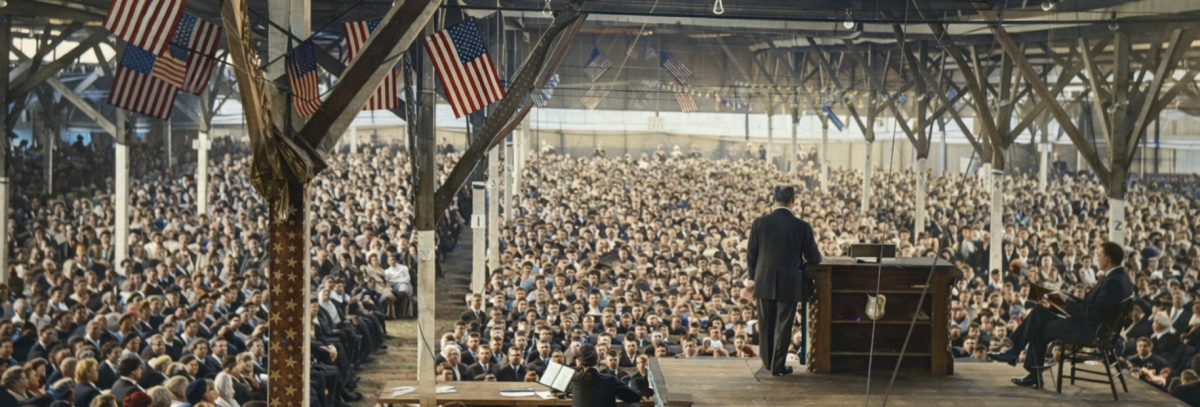
Five thousand men and women sat spellbound in the tabernacle Sunday night while 12 masked members of the Ku Klux Klan, unopposed and fearless- ly, interrupted the service long enough to hand the Rev. W. A. Sunday an envelope containing a message of commendation and $50 in bills.
Their mission executed, their identity successfully cloaked, the twelve men marched out of the tabernacle, entered automobiles and disappeared as silently and quickly as they had made their entrance.
Members of the Sunday party had been informed of the proposed visit, however, so that some of them were prepared for the Klansmen, one of the chief ushers said.
While no clue to the identity of the men could be found, a man whose name could not be learned was found in the front of the tabernacle after the meeting, commenting on the amount of publicity which the spectacular entry would get, and asking how soon the Associated Press would get the news.
Not First Experience
This is not the first experience of Mr. Sunday with the Ku Klux Klan.
The klan has made a present to Mr. Sunday in every city he has been in during the last year, said Bob Matthews secretary to Mr. Sunday. Even the Klan in Sioux City did the same thing.
At Charleston four members of the Klan appeared, and presented Mr. Sun- day a similar communication, inclosing $200, while at Spartanburg, S. C., the Klan presented Mr. Sunday with $50.
An attempt of the reporters at the Charleston meeting to follow the Klan members and find out who they were was frustrated, the secretary said. There seemed to be an agreement among the ushers at the meeting that no one was to follow the men, and when the reporters started there seemed to be conspiracy to have them waylaid.
First Appearance
It was the first time in the history of Richmond that the Ku Klux Klan had appeared in public, according to Mr. Sunday, although he said the Klansmen were known to have met there.
The letter which they gave to Mr. Sunday bore the address of the United Klan No. 4 and Richmond Provincial Klan.
Just as Billy Sunday was beginning his sermon the twelve white clad men, wearing high pointed head gears, draped in robes that came to their feet, with flowing wide sleeves and white masks, were seen marching silently down the aisle, single file.
Sunday paused in the middle of his announcement, and stared down at them, while a hush fell over the audience, as the 12 figures lined up before the platform, and two of them mounted to the platform.
Suppressed giggles and hysterical snickers broke the stillness faintly, but for the most part, the audience was awed into immobility, except on the edges where men and women stood on chairs and benches to see what was going on.
At a grunt of command, the only sound made by the group during the entire visit, and in unison with their leader, the men lined up facing Sunday, while the other two, at the same unspoken command, turned and walked to the platform and presented the letter containing the money.
The men and women on the stairs parted for the ghost like men, whose audible footfalls could not be heard, their costumes revealing only blue eyes and black leather shoes.
It was not known what Mr. Sunday said until the visitors had marched out and the tabernacle had settled down. Then he turned and faced the audience and said firmly, “I am not afraid of anybody. I have had my car and automobiles and driver attacked, but I am not afraid. I will stand to be checked on my work.”
Sunday ceased to speak, while the men filed from the tabernacle. “I am not a member of the Ku Klux Klan, of the Masons, of the Odd Fellows, or any other secret order, but I’ve learned more about them to night than I ever knew before.
“So I guess if you behave yourself they won’t bother you,” Sunday said.
“A Hint to Others”
“Now you Masons, Odd Fellows, or any of you other fellows, if you want to give something to Winona you just come ahead,” Mr. Sunday said after he announced that the letter contained $50 in bills, which he said would be used to pay the expenses of the Winona Lake tabernacle.
“The $50 comes from the Muncie branch,” Mr. Sunday started to say in telling of the money in the envelope, when Fred Rupp interrupted to say that Richmond was also mentioned.
Fumbling with the letter for a moment, Sunday reread the closing words and corrected himself: “It comes also from the provisional Richmond klan.” After a little pause Sunday added to the audience: “Well, you seemed to sit right; they didn’t take you.” Denouncing the liberal wing of the Baptist church which is forcing a contest within that denomination, Mr. Sunday called them the “God-forsaken liberal wing,” and declared that “they ought to be in Hell.”
Denounces Liberalism.
“It’s the liberal bunch that don’t like me, and I don’t want their backing. The Baptists were the last bulwark of orthodoxy,” he said, “and now they’ve got a fight on their hands.” “There never was a greater God-forsaken liberal wing of the church, that seeks ethical death of Christ. Its the
Near the end of the sermon, but before the audience arose, Sunday called on those that wanted to make a public confession of Christ to walk down in front.
“I want to see your faces as you come,” he said. “I don’t know how you feel about it, but I want to see you come.”
“I haven’t asked for that a long time,” he added, “but I had a feeling that maybe some of you fellows would come that way.”
For a time no one moved, but a slight movement in the rear of the audience was seen. Mr. Sunday made mention of it.
“There were ten here now,” About the time it looked as if there would be plenty of room for Mr. Sunday to come down and take their hands.
63 Come Forward
After the audience stood, and the personal workers had scattered among them, more gathered at the front until 63 “trail hitters” had come forward as signed pledges of belief in Christ. The opening prayer was offered by Rev. E. Gage of the Third Methodist church, while the meeting was closed by prayer by Louis Jones, minister of the South Eighth Street Friends meeting.
The collection, as at the other meetings of the day, was taken for the Bible School, Chautauqua, and other summer meetings held at Winona Lake, Indiana.
Afternoon Service
Coatless, perspiring until he removed his collar and necktie, Billy Sunday called on the packed tabernacle Sunday afternoon to give their lives to Christ, and from an audience of 6,000, more than 300 persons came forward to shake his hand, while several hundred signed cards pledging themselves to accept Jesus Christ as their personal savior.
It was an audience composed almost entirely of out-of-town people. On a show of hands it had seemed as if there were no Richmond people present, but a rising demonstration of Richmond and of visitors showed that only a fifth were local residents.
The huge crowd gathered early, by noon the tabernacle was filled and the music began. Just before the sermon Mr. Rodeheaver called for the show of hands to account for the local poor fifth of the audience.
Calls for City
As the huge out-of-town audience stood, cries of “Richmond” Richmond” came from the ministerial section, and Mr. Rodeheaver called for the local people to stand. They were the poor fifth of the audience.
The great tabernacle of Richmond, they say, has stayed Mr. Sunday’s people could not have had the great success they have had without it. All the more, when you realize that all the people in the audience are not Richmond people, but they are the people who regularly do better than that.
Takes Off Coat
As Mr. Sunday appeared on the platform he took off his coat, and several men in the audience stood up and took theirs off. Later on invitation of Mr. Sunday, a number of others followed suit.
“In the 27 years that I have been preaching I have never seen such a small number of people from the community, in proportion to its size, as here at Richmond. I feel like I had fooled away six weeks of my time, one sixth of all that I have to give in a year, by coming here, when I had to turn down 25 other cities to do it.”
“It is not,” he added, “that you people are not welcome to come, but I do think that the community where I preach should be represented at the meetings.”
Man Who Wrote Book for Him Sues for $100,000 for Breach of Contract.
The Rev. William A. Sunday, the evangelist, was sued in the New York City Supreme Court last Wednesday by Hugh C. Weir of New Rochelle to recover $100,000 for breach of a contract, under which Weir alleges he wrote the series of “Great Love Stories of the Bible,” which appeared with Billy Sunday’s name as the author. Weir also alleges that under the agreement with Sunday he was to write “Billy Sunday’s Own Story,” and another series based on the Bible.
Weir says that he was to get 50 per cent. of the royalties on all the books except “Great Love Stories of the Bible,” for which Sunday got 60 per cent., out of which he was to pay 10 per cent. to a Bible historical authority for proofreading. Sunday was to advance $5,000 to Weir and collect out of the latter’s share of the royalties. The plaintiff also alleges that Sunday agreed to arrange for the sale of the books at all his meetings.
The complaint alleges that although a contract has been made with a reputable house for the publication of the books the evangelist has repudiated his agreement in all respects.
Mr. Sunday has served his answer in the suit, in which he admits that Weir collaborated with him in writing “Great Love Stories of the Bible,” but denies that he has broken any agreement made with Weir
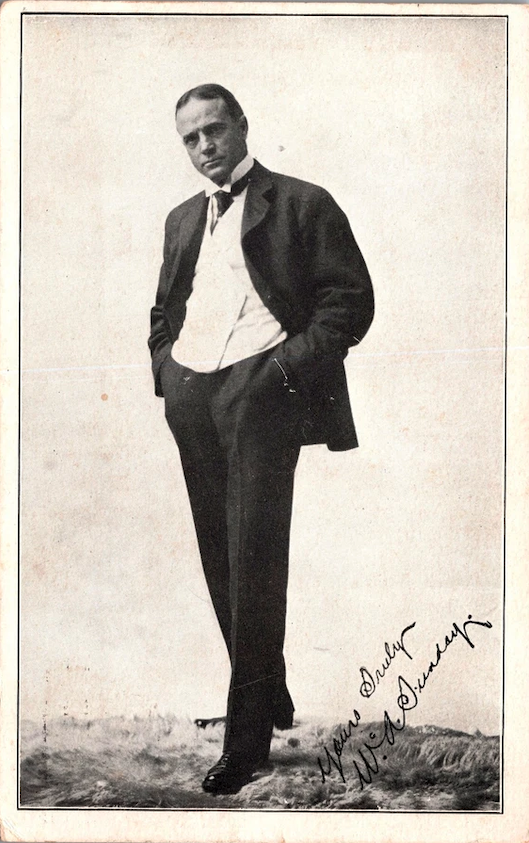

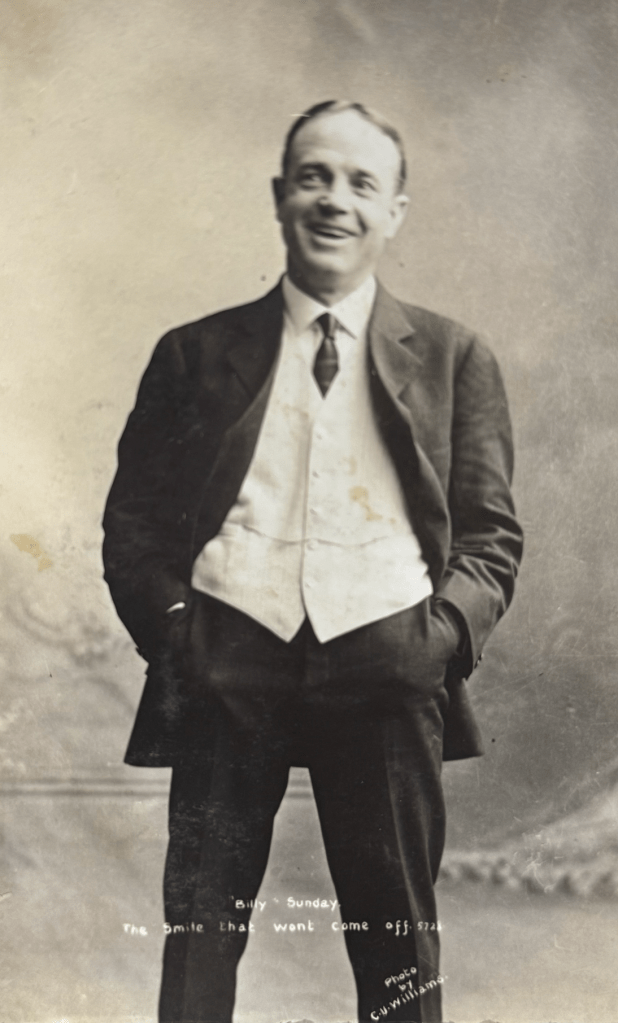


 Evangelist Billy Sunday (1862-1935)