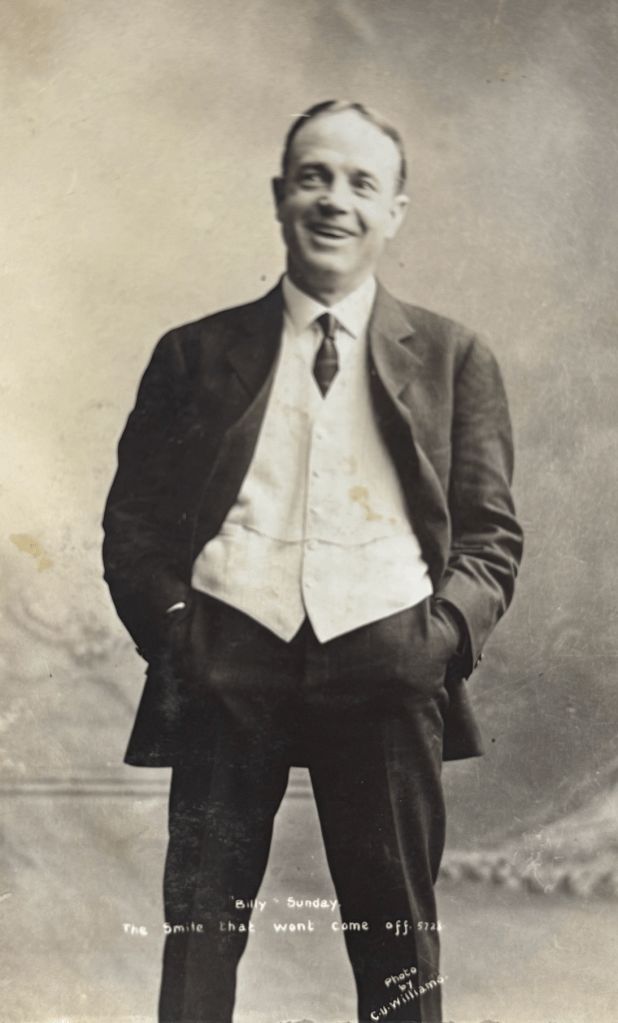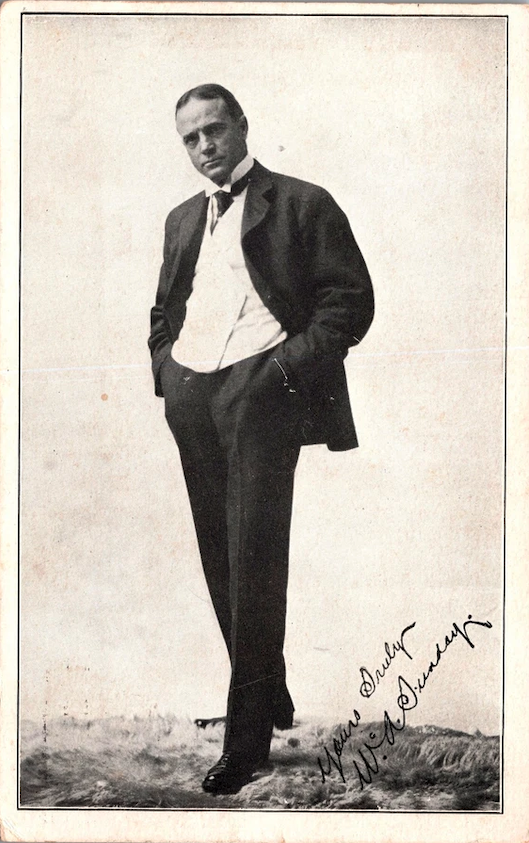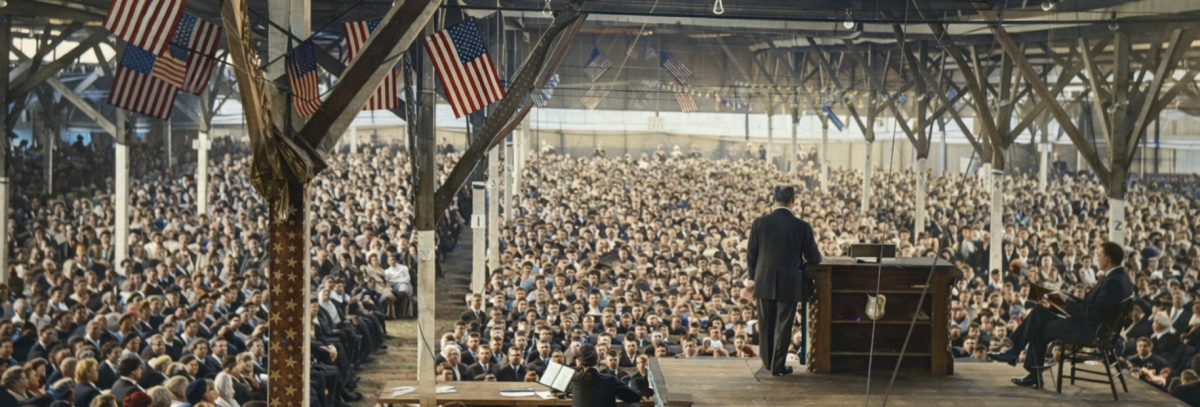
Trail hitters remain firm, say converts. Circa 1918.

When revival calls crowds to the aisle, a critical question follows: “Will that decision endure?” In 1918, after Billy Sunday’s campaigns, journalists followed up with converts and organizers to ask whether the spiritual fervor survived time. The answers—preserved in this article—offer rare insight into how revival might seed long-term change. Read on to see what those trail hitters said, and what it teaches us about lasting faith.

The Washington Herald. Tue, Jan 29, 1918 ·Page 8

TRAIL HITTERS REMAIN FIRM, SAY CONVERTS

Effect of Sunday Revivals in Other Cities Has Been Permanent.

BY ARTHUR JOYCE.

Does ‘trail hitting’ at Billy Sunday campaign meetings show any permanent results? Are those persons who walk the sawdust aisles over at the Tabernacle interested only in formally shaking the hand of the evangelist – or is there something definite behind it all?
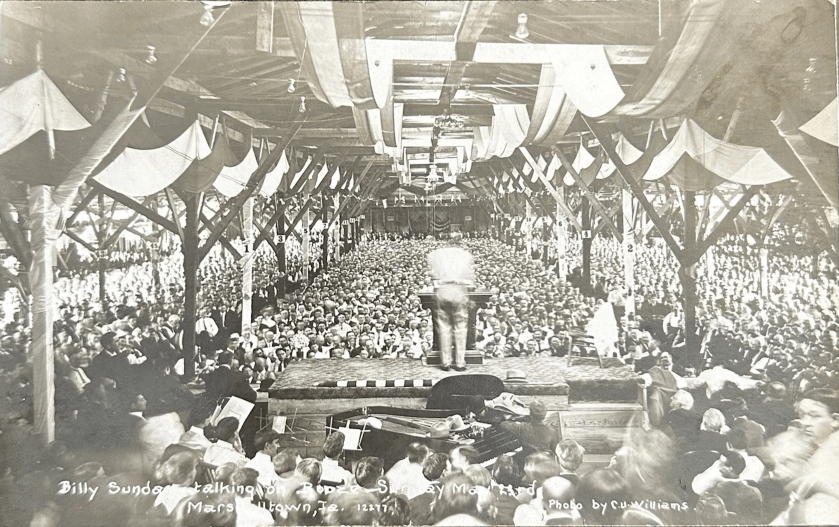
Thousands who have seen approximately 6,000 persons ‘hit the trail’ at the Tabernacle in this city are asking these questions. And about the only way in which they can be answered with any degree of accuracy is to look over the field where the evangelist has campaigned and see what’s the situation a year or two following the campaigns.

I recently had a talk with two influential representatives of cities in which Billy has campaigned and I put the questions to each of them. One is Gen. C. Edward Murray, quartermaster general of New Jersey, the other is Lucius L. Jeddy, head of the Merchants National Bank, of Syracuse, N.Y. Both were Billy Sunday ‘trail hitters’ – Gen. Murray in Trenton, N.J., and Mr. Eddy in Syracuse.

Big Sunday Club.

Gen. Murray is president of the Billy Sunday Club, of Trenton, an organization of ‘trail hitters’ formed after the evangelist’s Trenton campaign. That club now has a big membership and every member in it is personally interested in leading others to Christ.

‘The campaign in Trenton,’ said Gen. Murray, ‘awakened a remarkable interest in Christian work, especially among the men and women who ‘hit the trail.’ Churches have increased their membership to a remarkable extent; booze joints that keeled over; Sunday schools are crowded and everywhere there is shown a wonderful interest in things religious. I know many noted men who have passed up the cigars and joined the church and I know of one politician who formerly represented the booze interests, who has been converted and is now an active election on an anti-booze ticket.

‘On the whole, I should say that the Sunday campaign in Trenton has done more to evangelize the city than any other one happening in recent years. And I’m satisfied that the men who ‘hit the trail’ are still going right with the Lord and are doing their best to lead the aisles for Christ.’

Mr. Eddy told of the workings of the Billy Sunday Club in Syracuse. Every member of the organization was a ‘trail hitter’ and in the last two years, he said, they have led more than 20,000 men to Christian lives.

‘The ‘trail hitters’ not only themselves ‘stuck to their declarations to stand on God’s side,’ said Mr. Eddy, ‘but they’ve inaugurated an active campaign to bring others into the fold. And if that doesn’t show the permanency of ‘trail hitting’ I’ve lost my guess.’

Senator Vardaman, of Mississippi, made the statement that if the evangelist shall win only one person to Christ in his Washington campaign, ‘we will have been well repaid for our efforts in the revival cause here.’

In Philadelphia – three years after the Sunday campaign – there is a ‘trail-hitting’ organization in virtually every church where the evangelist assisted in the revival. There are probably 7,000 members enrolled in these organizations, and they’re campaigning every day to bring others to the church.

In Scranton, Pa., one church added 2,000 members to its rolls within six months after the Sunday campaign. Another Scranton church increased its enrollment by 1,000 in a year following the campaign. The same is true of the churches in Wilkes-Barre, Pa., and in Carbondale, Pa., churches.

In Wichita, Kan., three men of national reputation have been converted who call ‘gospel teams.’ These ‘teams’ go about the country and work in the Middle West to preach the gospel and tell of the wonderful work Billy Sunday did in their campaigns. Out of these teams has been formed a National Federation of Gospel Teams’ which are made up of leading men throughout the country – all of whom are either ‘trail hitters’ at Sunday meetings or are in the church as a result of the work of ‘trail-hitters’ who have taken up personal work. These teams have a record of 11,000 conversions to their credit.

Don’t All Stay.

Detroit has a ‘trail-hitters’ club’ of nearly 1,000 members; Los Angeles has one with about 500 men on its rolls; Atlanta has just finished organization of a Billy Sunday Club with several hundred members. And in virtually every city and town where the evangelist has campaigned there are similar organizations continuing the work Billy began. Nearly every ‘trail hitter’ in these places has associated himself with these clubs.

Of course, every person who ‘hits the trail’ isn’t a sticker. But records made by Sunday party experience year after Billy’s campaigns in leading cities show that approximately 85 per cent of those who ‘walk the aisles’ represent permanent converts.

The object of the ‘trail hitting’ is not only to bring to the ‘front’ in a public confession of faith those who have been more before taken any stand in the matter. Billy’s ‘invitations’ are intended to induce the church members to ‘reconsecrate’ themselves and ask to be more earnest Christian life from those who have already ‘accepted’ Christianity.


Legacy & What It Means
This article offers more than historical curiosity: it reveals Sunday’s conviction that conversion must stick. His method didn’t end with a call to the front — it extended into communities, clubs, and networks of believers committed to nurturing change.

Application for Today
In contemporary ministries, it’s easy to emphasize decisions without long-term follow-through. What lessons does Sunday’s model offer us? Perhaps this: revival without discipleship is incomplete.

Reflection & Invitation
If “trail hitters” in 1918 were expected to keep walking, not wander off, who in your context needs that same encouragement today? How will the faith you ignite be sustained, multiplied, and anchored in life?
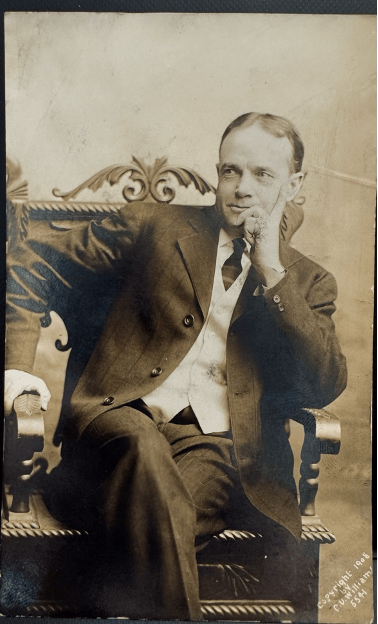
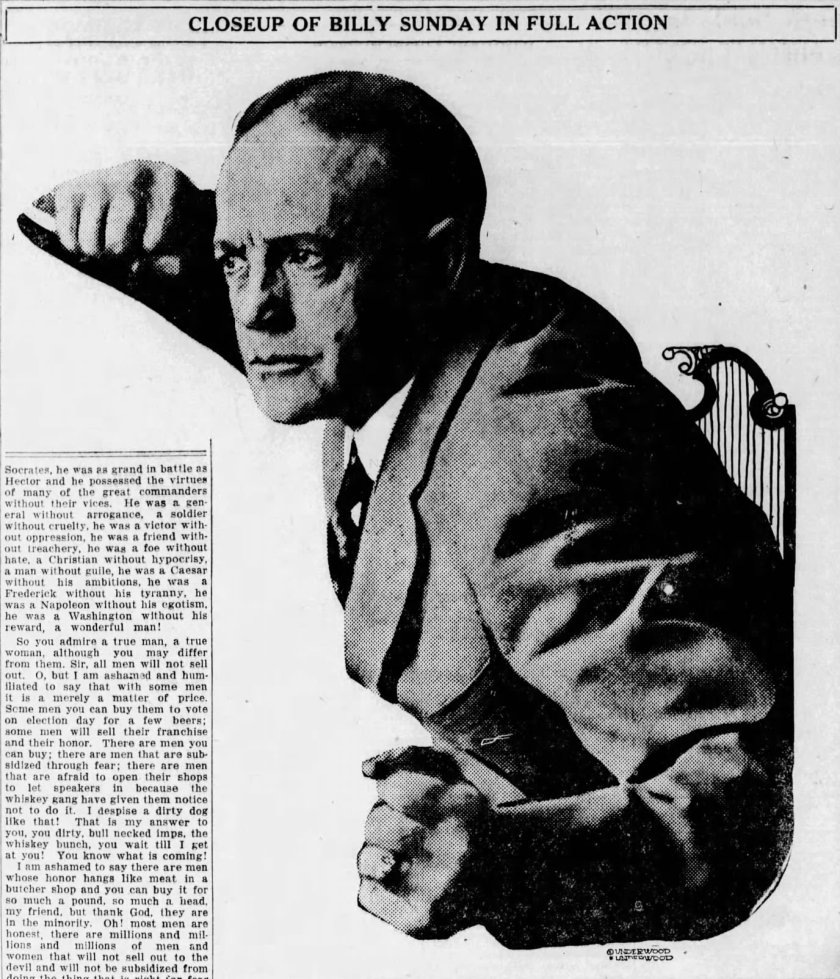
Rev. Billy Sunday grills ministers, 1908

A Richmond, Indiana newspaper (1908)

Gathering of Winona Divines Rated With a Bunch of Bums.

BETTER BE COG WHEEL

And Stop Trying to Be a Whistle Is Sunday’s Advice to Them.

Lake, Ind., Aug. 22.—”I preach to this bunch just I do to a lot of bums, and I don’t see any difference in you. You ministers criticise me, but as long as God puts His mark of approval on my work it is up to you to keep your mouths shut. If God wants you to be a cog wheel you had better stop trying to be a whistle. Some people are all front door. Open it and you are in the back yard. Many a man goes to a seminary and is filled up with a lot of stuff that is of no more use to him than a crane’s legs would be to a setting hen.”

Such was the rhetoric and classical language in which the Rev. “Billy” Sunday the base ball evangelist, addressed the Bible conference at Winona Lake. He told gray-headed ministers how to succeed and grilled those who did not agree with his methods.

Called Rev. Smith “Gyp.”

He talked like a whirlwind and whisked up and down the gamut of Christian effort like a $25,000 limousine. He slapped the distinguished English evangelist, the Rev. Gypsy Smith on the back and called him “Gyp.” “Gyp” smiled a sour smile and looked as pleasant as he could.

While the message of Rev. Billy was as hot and peppery as chili sauce, it was received with fervent “amens” from over the auditorium and at the close “Gypsey” Smith gave his shoulder a pat of approval and Dr. Chapman smiled his approval.

Dr. Chapman said: “Unless a man is born with preach in him he will never get there. Too many preachers are more interested in drawing their salaries than in saving souls. Show me an earnest man and I will show you a man that is making the gang sit up and take notice. The earnest pastor does not sit around and wear out the seat of his pants waiting for something to turn up. The only thing that will turn up for him is the sod in the grave yard.”

The Richmond Item. Sat, Aug 22, 1908 ·Page 2

YOUNGSTOWN ATTORNEY HAS HIGH PRAISE FOR EVANGELIST SUNDAY, 1910

As published in the The Akron Beacon Journal. Sat, Jun 18, 1910 ·Page 3

Attorney W. S. Anderson of Youngstown, who defended Bert Petty, is a staunch supporter of “Billy” Sunday, the celebrated evangelist. He was one of Sunday’s many converts in Youngstown. Sunday spent six weeks in Youngstown this spring and Mr. Anderson says that the effect upon Youngstown was great and it has been lasting also.

“When I first went to hear him I was disgusted,” he said, “but I went several times more just out of curiosity and I grew to be a great admirer of his work. The first two weeks he spent in Youngstown he used a great deal of slang. This drew the crowds and when he had them coming he got down to work and his work was wonderful.”

Mr. Anderson says that all classes of people have been effected by Sunday’s work. “The lawyers are a pretty hard class of men to reach with religious services but Sunday did it. One night in his prayer he said, ‘Help the lawyers because we know they are a tough bunch.’ They were too, but many became followers of the evangelist.

“The work of Sunday can not be judged only by the number who came forward. It is the influence on all the people and their relations with one another.”

Mr. Anderson says Akron should get Billy Sunday here. “It will do the town a lot of good,” he said.

The impact of the Bellingham campaign (April 1910) on the local church membership?

The Bellingham Herald. Mon, Jun 13, 1910 ·Page 1

The church membership of Bellingham has been practically doubled as the result of the Rev. W. A. Sunday evangelistic campaign.

The meeting was fully attended, and perhaps the most remarkable feature of the session, was the enthusiasm with which the work of Rev.

W. A. Sunday in this city was referred to. Practically all of the pastors stated that their church membership had doubled, and in some cases almost trebled, while there is yet no sign of any cessation of the additions.

It is claimed now that the actual campaign itself has been but the start of a religious movement which is crystalizing in the different churches in a manner far beyond the highest expectation of the association.”

Billy himself defends his free-will offerings he was given, 1909

The Canton Press-News. Fri, Aug 13, 1909 ·Page 1

Billy Sunday’s Defense.

The one evangelist who has shaken half a dozen lowa cities more than any other is popularly called Sunday, for that is his name, ‘Billy’ Sunday. He is often scored severely for bis antics on the stage and for the way be rounded up the money on leaving the town he has excited to a high pitch. In his latest interview Sunday makes a defense of his style of getting the currency. He points to Jeffries, Bat Nelsons and the other fighters, and says: “But these fellows can get the money and nobody accuses them of graft. But let a preacher get together a few dollars and he is immediately called a grafter.”

He is not a quitter and announces the fact this way: “I expect to stay in the game as long as 1 have the physical and mental strength.

I have amassed a few dollars but it all came from free-will offerings.

I gave up ball playing and turned down offer of $12,000 a year to take up Y. M. C. A. work. Why during July and August of this year I could have made $20,000 on the chautauqua platform from the offer I have had, but I turned them down. I did it for the reason that I need all my strength for preaching. I don’t know no more about theology than a jackrabbit know about ping pong, but I preach as hard as I can.”

Mr. Sunday is booked for years ahead. -[Davenport Times.]

The Canton Press-News

What did preachers think about Billy Sunday, c. 1914?

“First, he is natural, never tries to be another, is never affected. The champion of the diamond is in action for God. Second, he uses the word of God, knows it, believes it, and preaches it with consummate skill and commanding power. Third, he knows the heart of man, and helps every hearer to find and see one’s self. In papers, parts of his sermons may appear to be jokes, but they are no joke to the one whose soul is uncovered by them. A friend said Saturday, ‘I can’t laugh at the jokes, they are too awfully true.’ Another said, ‘Billy’s ‘darns’ aren’t nearly so large when you hear them as they appear to be in the press.” Mr. Sunday shows us the dead body of sin to which we are chained until we loath it and groan to be delivered from it.

Fourth, best and most important of all, he believes in and depends upon the Holy Spirit; who is here working in, working for, and working with Mr. Sunday, and every consecrated follower of God. Just so sure as these things be true, we shall see a great work in Scranton. Every lover of God and man ought to pray most earnestly that this may be fact as well as prophecy. We ought not to judge until we see and hear. Come to the tabernacle and you will wish that all of your family and friends were with you. Mr. Sunday is more than a man working with human skill. He is a man of God being used to help men. Years hence we shall regret it if we fail to hear Billy Sunday now.”

Tribune-Republican. Tue, Mar 10, 1914 ·Page 10

Billy Sunday’s methods? An American Product

“Billy Sunday is an American Product – Where methods differ

More Lasting Good.

The old school of revivalists were of the itinerant class, moving rapidly through the country, their evangelism seemed sudden in its effect and I am afraid somewhat evanescent in its general results. It is just here that Mr. Sunday’s campaign gives promise of more lasting good. His coming has been carefully prepared for, his meeting place is undenominational in character. It is a movement conducted with great business acumen and sound common sense. He trains the ministers and church workers in such a way as to make them capable of caring for the harvest when it comes. Like a good farmer, he prunes the fruit trees with vigor cuts out all the dead wood and sprays them well to get rid of moths, beetles and canker worms, so that when the new fruit shall ripen it will be sound and beneficial. And the leaves of the trees shall be for the healing of the nations. Mr. Sunday is a man endowed with a great faith, He prays for the blessing, he prepares for the blessing, he is sure of getting it and it is therefore no surprise that he is so eminently successful.”

Time-Republican. Thur, Mar 05, 1914 ·Page 10

Money to Billy is well spent, c. 1913

BY JOHN HERRING.

City Councilman, Wilkes-Barre, Pa.

[Note: Mr. Herring had applied for a saloon license but afterwards “hit the trail” in the Wilkes-Barre campaign.]

Citation: The South Bend Tribune. Tue, Jun 03, 1913 ·Page 8

From my own personal observation I do not hesitate to say that Wilkes-Barre and Wyoming valley has never enjoyed so much happiness as prevails at the present time as a result of the Billy Sunday campaign. The great change that has come over the community as a result of Mr. Sunday’s campaign is very noticeable and I believe that if the people of this city could have him they would ask Mr. Sunday to come back to our locality and stay another seven weeks.

Throughout our locality saloon-keepers do not deny that they have been badly affected by Mr. Sunday’s campaign. The faces which were very familiar in such places for many years are now absent. Men who for years have led a reckless life and neglected their families have been released from the influence of drink and are once more respected by their fellow men. A visit any night to the large hotels in the central part of our city is sufficient to prove that the patronage at these places is not nearly as great as before the revival. I believe it is safe to say that the amount of good done by Mr. Sunday in this vicinity cannot be measured.

Never in the history of our churches has the attendance been as large as during the past few weeks, or since Mr. Sunday left for South Bend. One church, the Central Methodist Episcopal has taken in nearly 800 new members to date and many more are expected. Another church, Westminster has taken in about 500 and several other churches have taken in like numbers. In fact, if the enthusiasm continues and I have every reason to believe it will, many of our congregations will have to enlarge their edifices. It is surprising to know the number of our influential citizens who for years have been out of the church now within the church and taking an active part in its affairs. Another feature of Mr. Sunday’s work is that men of high positions in life who were converted are now members of the Y. M. C. A. personal workers league and are out daily leading others to the cause of righteousness. The work that is being done by the personal workers is admirable. Employers can be found working hand in hand with their employees all working in the interest of Christ. So satisfactory have the results been that other cities have asked several of our young men to visit and tell the story of the great amount of good that has been accomplished. Only last Sunday one of our newspapermen went to Williamsport and so pleased were the people with his message that he was forced to repeat it at three different meetings.

The question has been asked as to whether the merchants of this vicinity have been benefitted by the Sunday revival. Every day one hears some merchant say that accounts which he had closed several years ago have been re-opened and are being settled by the people who contracted debts.

Judging from the activity among the ministers since Mr. Sunday’s visit it cannot be denied that the great evangelist has done a wonderful amount of good among the ministers of the gospel. The better work being done by the ministers in my estimation is due to the fact that they are now receiving the co-operation of their congregations, which was unusual heretofore.

Regarding the liquor traffic and the effect of the revival in surrounding towns, two of the saloon keepers, I have been informed, have quit the business. One was a resident of Parsons and the other of Edwardsville. Two pool rooms one, of which was to be replaced by a saloon, have been wiped out and have been replaced by a grocery store and confectionery.

An organization of railroad men at Ashley was disbanded after the officers were converted and the men are all doing personal work now. A club room at Plymouth, where men assembled on Sundays and did considerable drinking has been changed to a prayer meeting room, the sale of liquor having been discontinued.

In Wilkes-Barre several men who for several months had been gathering weekly in a garage and playing poker were converted and are now holding Bible classes instead.

A representative of the Bell Telephone company said a few days ago that since the revival the company’s receipts from saloon pay stations have fallen off a large per cent and the receipts from drug store stations have increased accordingly.

Although the grand jury of our county ignored several cases against “speakeasies” that were raided by Sheriff Kniffen, one of the converts, the religious organizations throughout the whole county have passed resolutions supporting the sheriff and his crusade and the Y. M. C. A. personal workers’ league plan in a few days to hold a big street demonstration approving the sheriff’s work.

In conclusion I would state that it is difficult to express the real situation existing in his locality as the result of the great evangelist’s good work.

That the change among the people is also being felt by our city officials was evidenced several days ago when the mayor of our city, Hon. John V. Kosek, caused every side room, where cabaret shows were held nightly and where women of questionable character congregated, to be closed. Hotels that for years were known to have been the meeting place of immoral men and women during the past week have been in darkness.

Billy Sunday was given over $23,000 by the people of this valley and I do not hesitate to say that if he had been given $100,000 he would not have been repaid for the good he accomplished.

The South Bend Tribune. Tue, Jun 03, 1913 ·Page 8

Billy Sunday admitted he sometimes fails to give credit to a ‘source’ (c. 1913)

FREELY ADMITS HE TAKES SUGGESTIONS

BILLY SUNDAY EXPLAINS THAT OLD CHARGE OF STEALING.

OFTEN FAILS TO CREDIT

Citation: The South Bend Tribune. Wed, May 21, 1913 ·Page 11

Sometimes He Doesn’t Know Where Stuff Came From, Often He Forgets It, Baseball Evangelist Declares.

Ask Billy Sunday if he steals some of the material he uses in his sermons and perhaps he will frankly admit it.

That is, he will confess that he picks up hints, paragraphs, poems and anything else which will assist him in his work, only giving the creator of the things the credit when he happens to know their names, or when he thinks of it.

“The accusation in regard to my stealing the stuff for my sermons makes me tired,” said the evangelist when approached regarding the matter.

“There isn’t a public speaker today but what does the same thing. Every day I get poems and paragraphs and other knick-knacks through the mail from people I do not know, who suggest that I may have some use for them. I clip and save thousands of such things myself in the course of a year.

Doesn’t Know Author.

“Well, when I get ready to work them into my sermons, nine chances out of 10 I won’t know the name of the author. But I use them just the same, and give those who originated them credit when I can and when I remember it. But if I had to stop and give credit for every bit of outside material I work into the sermons, I wouldn’t have much time to say anything else.

“There are a dozen or 15 evangelists who are using my stuff every day they preach. Do I get any credit for it? Well, I guess not. They are free to use it if it will do any good without crediting it to me, so why should I go to the trouble of mentioning all these folks in my sermons.”

About Mothers’ Poem.

The evangelist told of an incident a few days ago in connection with his special Mothers’ Day address. He said he recited a poem during the sermon, which had been sent him by some anonymous letter writer. The poem was an excellent one and suited his purpose exactly. He quoted it word for word in his mothers’ sermon without giving any credit for it and a day or two later, discovered the name of the author while reading a magazine.

He has now noted down the name of the author and will give him credit for the work when he delivers the sermon again. The evangelist says if he is guilty of stealing literary stuff that every public speaker in the country could easily be convicted of the same offense.

Reads Everything.

The evangelist reads anything and everything worth reading, which is brought to his attention and by so doing he collects thousands of suggestions and hints for sermons and additions to sermons. He said he believed his clippings for his sermons in the course of a year, would fill an ordinary two horse wagon.

Sunday has a marvelous memory, which is also of great assistance in his work. In the preparation of a sermon, he writes only fragments of it out, depending on his faculty for remembering to carry him through it. A few notes, all of which have been typewritten, are all he has to show for the majority of his sermons, many of which have become famous and are generally regarded as masterpieces.

The sermon he will deliver to-night at the tabernacle, “The Second Coming of Christ,” has been heard by thousands, as one of the evangelist’s very best, is not in the mind of Sunday in full and probably never will be, unless he takes the trouble to clip it from some newspaper, which is printing detailed accounts of his talks.

Only Few Sentences.

Instead, it consists of only a few terse half completed sentences, which are set down in type written form to assist him in remembering the balance. In the majority of instances, the wonderful word painting in the sermons are simply noted in two or three words and a brief sentence may stand for two or three stories he tells during the talk.

The South Bend Tribune. Wed, May 21, 1913 ·Page 11

South Bend Tribune labels Billy Sunday as the ‘Real American Product.’

BILLY SUNDAY REAL AMERICAN PRODUCT

EVANGELIST IS DISCUSSED BY WILKES-BARRE, PA., MAN.

COMPARED WITH OTHERS

Billy Sunday, 1908. Author’s Collection.

Writer in Newspaper Compares Former Baseball Player With Famous Evangelist of Few Year Ago—Does Much Good.

The Tribune’s Special Service.

WILKES-BARRE, Pa., May 9.—Rev. William A. Sunday and his methods have been reviewed from so many angles that it seems difficult even for a veteran to add anything to the sum total of knowledge of this wonderful evangelist, says “G. A. E.” writing for the Wilkes-Barre Record.

Continuing “G. A. E.” who made a careful study of the evangelist while he was conducting his campaign here, says:

“However, as the preachers say, ‘firstly, secondly, thirdly and one word more,’ and this may be ‘finally and in conclusion.’

“Billy Sunday, as we now familiarly term him, stands in a class by himself, and if I compare him with evangelists of other days it is not for disparaging comment or odious comparison. He is peculiarly an American product and becomes immediately at faith with his audiences because of his intense patriotism, his love of the starry flag and his intense belief in the present and future greatness of the United States. He is a paladin of defense.

Sunday Protector.

“No, siree, the devil shall never capture this country so long as Billy Sunday can put up his dukes or raise his voice in protest.

“I have been privileged to hear many great pulpit orators and revivalists both in this country and abroad, among the latter, Weaver, Spurgeon, Booth (before his Salvation army days) Moody, Torrey. Of these for keenness of argument, beauty of diction, fierceness of invective and charm of pathos. I would place Rev. Charles H. Spurgeon in first place, with Gen. W. Booth in the next. But from speech of my mother and grandparents even these giants could not compare with Whitfield, Williams O’Wern, Charles Wesley, Christmas Evans and Rowland Hill. The men I have named were all different in their method, none of them staying long in one place, and their work was largely denominational in character. These men were all successful and their trumpet calls led many to a newness of life.

Orthodox Gospel.

“The story they told and the gospel they preached was the old orthodox one, ‘He that believeth shall be saved, and he that believeth not shall be damned.’ Sunday’s success is in proportion as he sticks to the old doxv and the old ‘Thus saith the Lord,’ but it is worth noting that while the old exhorters emphasized ‘hell fire,’ and ‘fire and brimstone,’ Billy does not add to the agony of those consigned to the place prepared for unbelievers by using those words.

“Mr. Sunday, like Spurgeon and many other successful exhorters, is a voluminous speaker, but not a profound thinker. He has read for dramatic effect, he has skimmed the literature of the English race for illustrations, and is endowed with a slang vocabulary that is simply astounding. He uses his knowledge with such marvelous effect that all who come ‘to scoff return to pray.’ His earnestness, his transparent honesty, carries all his hearers with him and his slang solecisms are all forgotten in his clarion call for repentance, his denunciation of all that is bad, vile and wicked and in his praise of God, home and country.

More Lasting Good.

“The old school of revivalists were of the itinerant class, moving rapidly through the country, their evangelism seemed sudden in its effect and I am afraid somewhat evanescent in its general results. It is just here that Mr. Sunday’s campaign gives promise of more lasting good. His coming has been carefully prepared for, his meeting place is undenominational in character. It is a movement conducted with great business acumen and sound common sense. He trains the ministers and church workers in such a way as to make them capable of caring for the harvest when it comes. Like a good farmer, he prunes the fruit trees with vigor, cuts out all the dead wood and sprays them well to get rid of moths, beetles and canker worms, so that when the new fruit shall ripen it will be sound and beneficial. ‘And the leaves of the trees shall be for the healing of the nations.’ Mr. Sunday is a man endowed with a great faith. He prays for the blessing, he prepares for the blessing, he is sure of getting it and it is therefore no surprise that he is so eminently successful.

Campaign Well Conducted.

“The late revival in Wales was a marvelous spontaneous outburst of religious fervor and roused large sections of the community. It was conducted by a young man named Roberts, who was ill fitted both mentally and physically and he subsequently broke down. Want of well directed effort, want of unity on the part of the churches to look after and care for the converts robbed the movement of much of its success. The converts were left to the mercy of the world, flesh and the devil, and thus the promise of a great and last revival petered out.

“The Sunday campaign is conducted vastly different. It is an old evangel, presented in racy Americanesque speech and run upon up-to-date business principles. The evangelical churches are a unit. It has been aided by the enterprise of the daily newspapers and publicity is given to the religious movement unknown to our fathers. Despite a few doubting Thomases the spirit of success is in the air, for the Wyoming valley is realized that the ‘hour and the man’ glorious religious revival has just passed and the effects of it are to continue.”

The South Bend Tribune. Fri, May 09, 1913 ·Page 7