Faith in the Efficacy of Prayer, April 1917 – importance of prayer

The Kansas City Star. Sun, Apr 01, 1917 ·Page 41

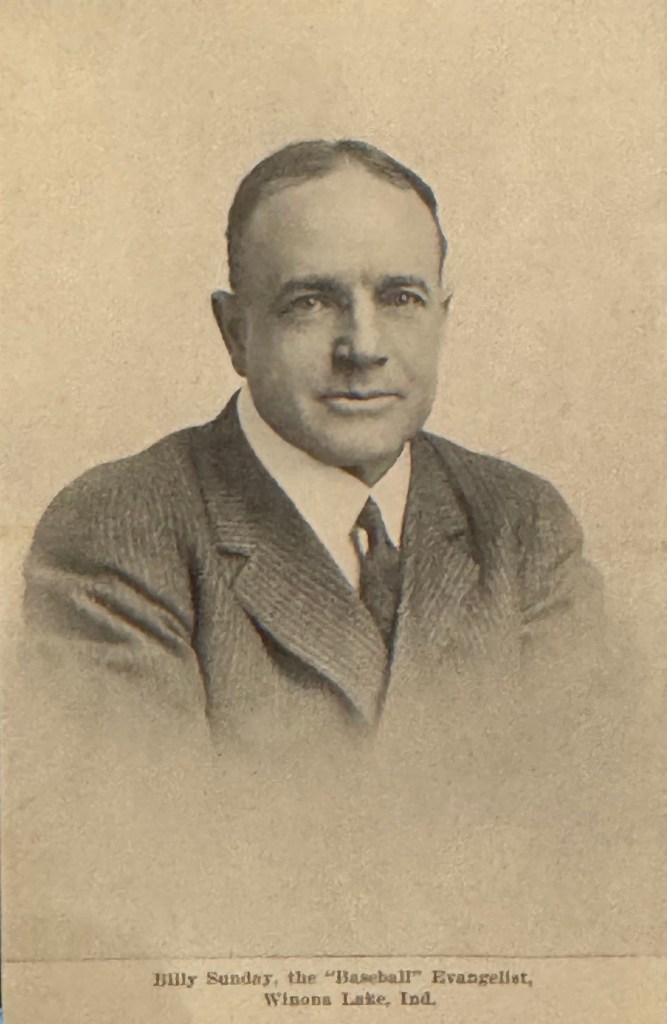
The first important thing was to get the whole Christian population of the city to praying for the success of the campaign. Prayer is the one great secret of Billy Sunday’s success, he says himself. He prays without ceasing. The members of his party pray always. Every difficulty that arises is a subject of prayer. If some preacher declines to take part in the revival they pray for him and keep on praying. They pray for little things and big things. Billy catches cold; the whole party prays for him. His voice gets husky; they all begin praying. There is indecision as to which city the next campaign would better be held in; Billy and his party begin praying to be led aright. It is prayer, prayer, prayer, constantly.

And so, great maps of New York were hung upon the wall at headquarters. Each church and school was marked with a tack, a redheaded tack denoting a Methodist church, a blue tack a Baptist church, and so on. Then all of Greater New York was divided into districts and the work of prayer began.

An executive committee was named with twenty-seven men on it, each one a hustler. John D. Rockefeller jr. and William Jay Schieffelin, two of the richest men in New York, are on the committee, and both are actively working.

Billy Refuses to Help “Make Circus of Religion”

The Washington Herald. January 7, 1918

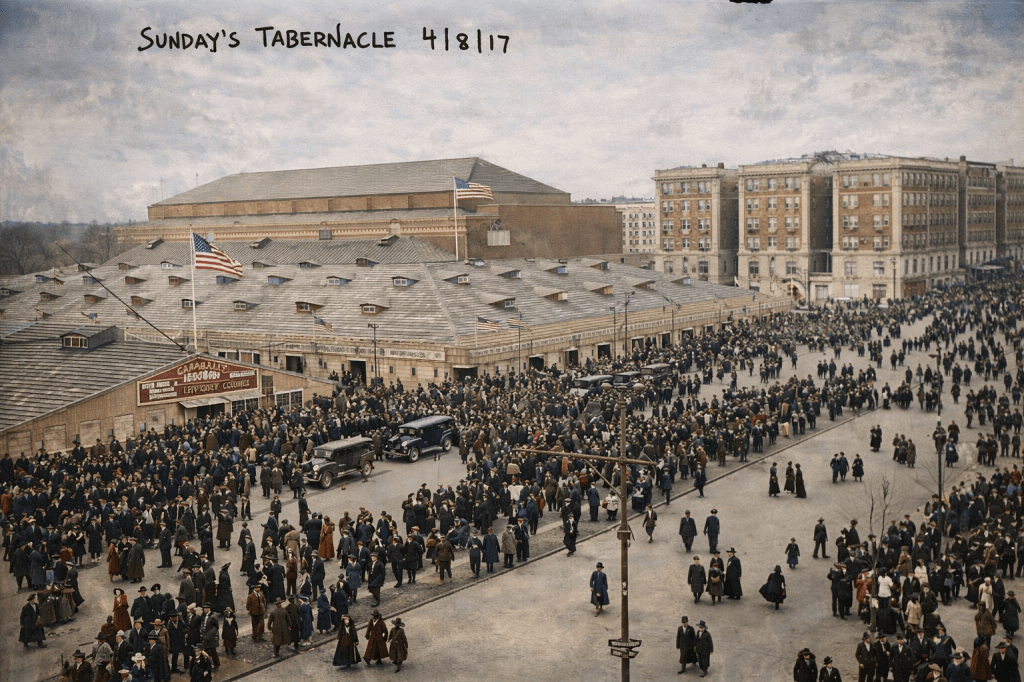
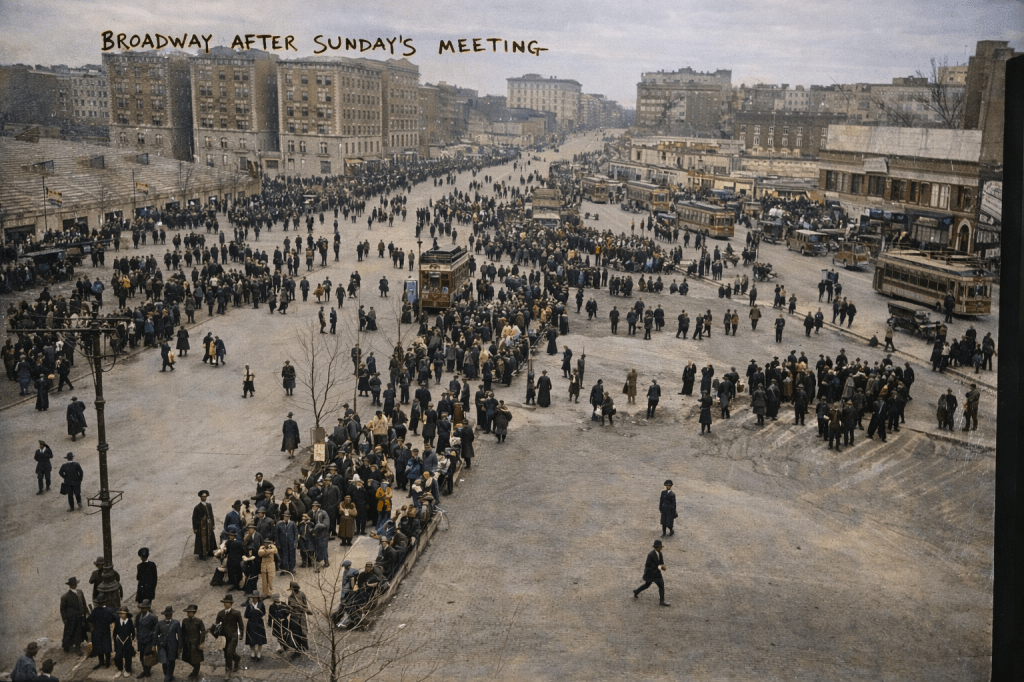
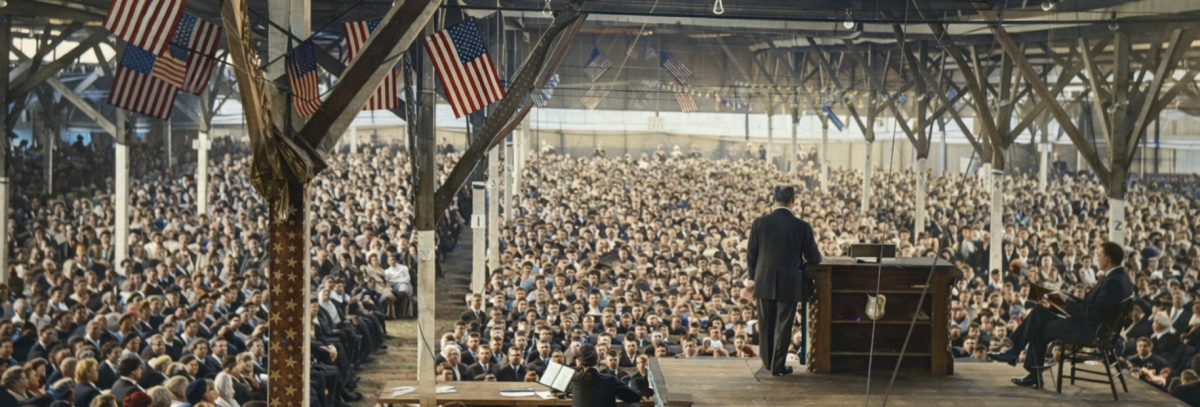
Billy Sunday told about 9,000 persons who attended his afternoon meeting in the Tabernacle how the “movie” people had offered him a cold $1,000,000 to pose for a film serial. And he told them how he had replied to their offer in this fashion:

“You can’t commercialize my mug for $10,000,000; you’re not going to get any help from me to make a circus of God’s religion. Not on your tintype.”

The “movie” reference was injected into Billy’s remarks through the presence of several “movie” cameramen at the Tabernacle just before he came into the building. They tried hard to “slip one over” on Billy and catch him as he got out of his limousine and started for the Tabernacle door. “Ma” Sunday, who was with Billy, protected the evangelist from the pointed cameras and pushed him inside the big building.

“Big Hand” for Billy.

The crowd cheered Billy to the echo. On the platform was Mrs. Marshall Field, widow of the noted Chicago merchant, with a party of friends from the Windy City. They, too, cheered Billy’s references to the “movie men.”

Billy’s afternoon sermon was chuck full of patriotic references and of slambang punches at “old Kaiser Bill.” And just before he finished it, he asked all those in the big audience who would pledge themselves to give undivided support to the national government in “its hour of need” to stand up. And the entire audience arose. Then he asked for a “Chautauqua salute,” and thousands of handkerchiefs waved over the great auditorium.

Billy took a hard slam at the “knocker,” who, he said, “is always going up and down the land, shouting that we are not prepared and that we should have done so and so long ago.”

“You folks ought to remember,” shouted Billy, “that we have a whale of a job on our hands. But we’ve got a whale of a country and we’re going to put it over. And we don’t propose to unsheath the sword until we have that gang on its knees pleading with Uncle Sam to call off the war.”

In his sermon Billy spoke of the drummer boy in Napoleon’s army who refused to beat a “retreat” when ordered by his commander. He looked squarely into the eyes of about 100 soldiers who were in the Tabernacle and declared loudly: “We don’t know how to beat a retreat either, do we boys? You bet your life we don’t! But we can beat a charge that can dig a grave so deep for that bunch of Kaiser Bill’s hot dogs that they won’t even hear the Angel Gabriel’s horn on the last day.”

The soldiers cheered Billy and the big crowd joined in. Billy emphasized that “we’ve got to scrap as well as play” and he declared that with such a fine army and such a navy as Uncle Sam boasts, there “isn’t a power anywhere in the world that can stand up against it, much less that bunch of cut-throats who would drag their Hohenzollern teachings into the land of the free.”

Billy took a hard rap at the Industrial Workers of the World and declared that if he had anything to do with “that bunch,” they all “would have faced the firing squad long ago.” His sermon was a likening of the Christian workers of the world to the grenadiers of old and the point he emphasized was that Christians everywhere are “fighters for the cause of Christ” in just as much the same sense as are the soldiers fighting now the cause of the allies.

Billy is for the women; sure, give them a vote, 1918

In 1918, Billy Sunday stepped into one of America’s most divisive debates — women’s suffrage. What drove him? What can we learn from that boldness?

A century later, his words still challenge us to consider what moral courage looks like in public life today.

This original 1918 newspaper article captures Billy Sunday’s public support for women’s right to vote. At a time when the nation was debating suffrage, Sunday’s words reveal both his moral clarity and his ability to speak into civic life with conviction and wit.

The Washington Herald. Jan 9

Evangelist Says He Favored Proposition Long Before It Became a Fad. To Open Suffrage Session With Prayer.

With the vote on the suffrage amendment coming tomorrow, Rev. William A. Sunday is another prominent individual who is taking the opportunity to reiterate his faith in “votes for women.”

In a signed statement which “Billy” Sunday gave Mrs. Lawrence Lewis, of the National Woman’s Party, last night, the evangelist says:

“It is nothing new for me to favor woman suffrage. I have been advocating it for years, even before it became popular. We are living today in a new era. If she is good enough to be our mother and our wife, good enough to preside over our home, to care for us in times of sickness and to share our joys and our sorrows, why should she be denied the privilege of voting?

“Today, more nearly than ever before, she bears equally with men the world’s burdens. What would the nations of the earth do without her aid, either in times of peace or war? Women are sharing equally with men the burdens and the sacrifices of this war.

“They are in the munitions factories and in the fields of agriculture and in all other departments of war service. Without their co-operation the war could not be waged to a successful conclusion. As they share in the burdens they should also share in the responsibilities of government.

“I see no reason why the men and women of the nation should not walk side by side in the matters of law enactment as well as in the home and social life.”

Mr. Sunday will offer the prayer at the opening of the House tomorrow when the suffrage vote is take.

<End of newspaper article>

Sunday’s endorsement came just months before Congress passed the 19th Amendment in 1919. His statement offers a glimpse into how revivalists connected moral reform with public policy—a reminder that faith and social conscience have always been intertwined in the American story.

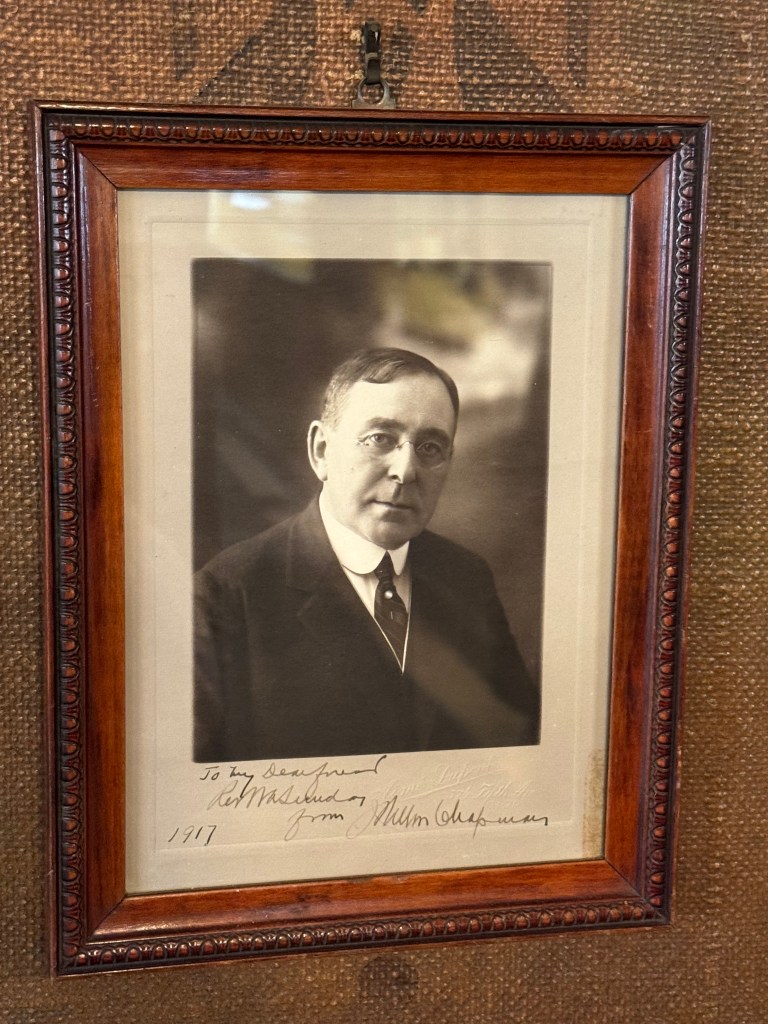
Billy’s debt to J. Wilbur Chapman, in his own words

I owe more to Dr. Chapman than to any other man that I ever became a preacher. I traveled with him for two years as an assistant. He picked me up out of the corn rows of Illinois. We went to a town up in Kansas one time to conduct a series of meetings. We were accustomed to have union meetings, but in that place, when we arrived on the scene, we found that they could have had a union meeting had it not been for a quarrel with the Presbyterian church. They had had a fuss and there were a few people live and awake, up-to-date, who said they’d withdraw. So they went down to the bank of the river and they built a church, they had a good live-wire preacher there who was going at a good gait all the time on high gear, while the other fellow had the brakes set.

The Atlanta Constitution. Wed, Nov 07, 1917 ·Page 12

This picture of Chapman hangs on Billy’s wall in his Winona Lake home. It is inscribed with the date 1917.

The Forgotten Mentor: Rev. Rhys Rees Lloyd and the Making of Billy Sunday

“All I am under God, I owe to the Rev. Mr. Chapman and to Prof. R. R. Lloyd of Berkeley, California, with whom I privately studied.”
– Cynon Valley Leader. Sat, Dec 27, 1924 ·Page 2

When historians tell the story of Billy Sunday—the baseball-player-turned-revivalist who shook America from 1900 to 1925—certain names always rise to the surface: William and Nell Sunday, Wilbur Chapman, perhaps John Wilbur Chapman’s evangelistic team.

Yet tucked in old newspaper columns and long-out-of-print yearbooks lies the story of a man whose quiet influence helped shape Sunday’s fiery ministry: Rev. Rhys Rees Lloyd, D.D.

Rev. Rhys Rees Lloyd’s quiet investment in Sunday reminds us that God often does His greatest work through those content to remain unseen.

A Welsh Beginning

Rhys Rees Lloyd was a full-blooded Welshman, born in North Wales to a distinguished minister father and a mother, Miss Williams, from the mining village of Hirwaun, Glamorgan.

His family history read like a hymn to Welsh Nonconformity: his grandfather helped found the local chapel where young Rhys grew in the faith, and the family remained pillars of that congregation for generations.

The old Welsh anthem he loved to quote—Mae hen wlad fy nhadau yn anwyl i mi (“The land of my fathers is dear to me”)—captured a devotion to heritage that he never lost.

Educated at the University of Wales, Lloyd excelled in the classical and biblical studies that would become the foundation of a lifelong ministry of preaching, teaching, and mentoring.

Across the Atlantic

In the 1870s Lloyd crossed the ocean, newly married, and settled in Chicago.
There he entered the Chicago Theological Seminary while simultaneously pastoring a city church.

His five and a half years in that pulpit were so fruitful that fellow ministers urged him to train future pastors.

He heeded the call, completing a two-year postgraduate program in New Testament studies.

Before long the West beckoned: Lloyd accepted a chair as Professor of New Testament Greek and Interpretation at Pacific Theological Seminary in Berkeley, California.

For ten years he combined academic rigor with an itinerant ministry of preaching and lecturing that took him across the United States.

A Providential Meeting in Chicago

Meanwhile, in 1886, a young Chicago White Stockings outfielder named Billy Sunday had an encounter that would change his life.

After a street-corner gospel team stirred memories of his devout mother, Billy walked into the Pacific Garden Mission and trusted Christ as Savior.

The next morning, as Sunday headed to the YMCA to begin work as Religious Director, a mutual friend introduced him to Rev. Rhys Lloyd.

The two men could hardly have been more different—one a rough-edged ballplayer with little formal schooling, the other a classically trained theologian steeped in Greek and Hebrew.

Yet in that brief conversation Lloyd quietly offered to help the new believer “whenever he desired.”

Billy accepted.

For more than a decade, usually in the margins of busy schedules, Lloyd tutored Sunday in Scripture, doctrine, and the art of interpretation.

He even helped him with Greek so that Sunday could wrestle directly with the New Testament.

Lloyd asked that the arrangement remain private during his lifetime, but Sunday, brimming with gratitude, often told the story anyway.

More Than a Footnote

A 1914 Scranton Truth article already recognized Lloyd as one of Sunday’s “religious preceptors,” but a richer picture emerged a decade later in a 1924 Cynon Valley Leader profile.

That account celebrated Lloyd’s Welsh roots and confirmed that Billy “spoke of it often and forcibly,” crediting the professor’s ten-year investment in his biblical education.

The article also revealed a life of broad influence:

  • friendships with prominent figures such as General Charles G. Dawes (later U.S. Vice President),
  • lectures across the nation on the results of his biblical research,
  • and quiet philanthropy—helping at least twenty-five young men secure an education.

Mentor of the Evangelist

Lloyd’s mentorship offers a pattern modern ministry often forgets: growth through relationship, formation before fame, discipleship before platform.

It would be easy to blur the lines and call Lloyd “the man who converted Billy Sunday,” as some hometown admirers claimed.

But history is clear: Billy’s conversion took place at the Pacific Garden Mission.
Lloyd’s gift was different and no less vital: he discipled and educated the man who would become America’s most famous evangelist.

Through Rhys Lloyd’s steady hand, Billy Sunday gained:

  • Doctrinal Stability – a grounding in Reformed theology and confidence in the authority of Scripture.
  • Biblical Literacy – enough Greek and interpretive skill to handle Scripture faithfully despite scant formal schooling.
  • Spiritual Example – a model of integrity and intellectual devotion that shaped Sunday’s own passion for the Bible.

A Legacy Worth Remembering

By the early 1920s Lloyd was semi-retired in Chicago, recovering from a long illness, still working on publishing the results of his lifelong biblical studies.
He never sought fame, but his imprint is indelible.

Every time Billy Sunday thundered a sermon before thousands, the careful tutelage of a Welsh professor echoed beneath the sawdust trail.

In the grand narrative of American revivalism, Rev. Rhys Rees Lloyd remains largely unsung—a scholar-pastor whose quiet faithfulness equipped a headline evangelist to shake a nation.

History rarely celebrates the mentors whose quiet faithfulness builds the giants. Yet Lloyd’s story invites us to ask: who shaped us? And who might we be called to shape? Every generation needs its unseen professors who teach others to thunder for God.

Sources: 1914 Scranton Truth, May 4, 1914, p.2; 1924 Cynon Valley Leader, Dec 27, 1924, p.2; contemporary Presbyterian records and Billy Sunday’s own reminiscences.*

“BILLY” SUNDAY FLIES IN AIRSHIP, 1911

“BILLY” SUNDAY FLIES IN AIRSHIP

EVANGELIST TAKES TWO-MILE RIDE OVER WINONA LAKE WITH CURTIS

Warsaw, Ind., July 14.-“Billy” Sunday and Glen H. Curtiss, two of the world’s greatest sky pflots, few tagether in the Curtiss hydro-aero. plane on Winona lake today. The evangelist, who is spending, a few days at his Winona home, accepted the aviator’s invitation at the last moment. ” He didn’t flinch as the big air craft sped over the lake a distance of at least two miles. More than 15,000 people saw the three successful flights that were – made by Curtiss.

Billy himself defends his free-will offerings he was given, 1909

The Canton Press-News. Fri, Aug 13, 1909 ·Page 1

Billy Sunday’s Defense.

The one evangelist who has shaken half a dozen lowa cities more than any other is popularly called Sunday, for that is his name, ‘Billy’ Sunday. He is often scored severely for bis antics on the stage and for the way be rounded up the money on leaving the town he has excited to a high pitch. In his latest interview Sunday makes a defense of his style of getting the currency. He points to Jeffries, Bat Nelsons and the other fighters, and says: “But these fellows can get the money and nobody accuses them of graft. But let a preacher get together a few dollars and he is immediately called a grafter.”

He is not a quitter and announces the fact this way: “I expect to stay in the game as long as 1 have the physical and mental strength.

I have amassed a few dollars but it all came from free-will offerings.

I gave up ball playing and turned down offer of $12,000 a year to take up Y. M. C. A. work. Why during July and August of this year I could have made $20,000 on the chautauqua platform from the offer I have had, but I turned them down. I did it for the reason that I need all my strength for preaching. I don’t know no more about theology than a jackrabbit know about ping pong, but I preach as hard as I can.”

Mr. Sunday is booked for years ahead. -[Davenport Times.]

The Canton Press-News

Billy Sunday family c. 1902

This image was likely take around 1902 because the oldest boy, George was born in 1892. He looks around 8-9 years old here. The other child must be Billy, Jr., born in 1901. The older woman is Helen’s mother. I colorized the image.

“Striking Out” Satan (February 18, 1889) Chicago Tribune.

“STRIKING OUT” SATAN.

BILLY SUNDAY, THE NOTED BALL TOSSER, TURNS EVANGELIST.

The Famous Centre-Fielder Addresses a Large Crowd at Farwell Hall – He Didn’t Even Allow the “Father of Sin” to Reach First Base – Advising His Hearers to Watch Their “Error Columns” – Forty-eight Converts Made.

Centre Fielder Billy Sunday made a three-base hit at Farwell Hall last night. There is no other way of expressing the success that accompanied his first appearance in Chicago as an evangelist.

Young men who dodged the boys distributing pamphlets at the door of the hall were confronted with these words blazing in scarlet letters on the big bulletin board:

“William A. Sunday, the base-ball player.”

And about 500 of them who didn’t know much about Billy’s talents as an evangelist, but could remember him galloping to second base with his cap in his hand, went inside. They heard a rattling fifteen minutes’ talk.

Mr. Sunday, who has grown a red mustache since his marriage, appeared in a becoming black suit and looked a little shy. It was his first public appearance here as an evangelist. In private he had often tried to do quiet work among the ball players, but, after dulling his weapons on the adamantine surface of “Silver” Flint’s moral character, he gave up the task, and for several winters has been preparing for a public trial of his skill in saving souls.

His talk last night was the most successful of the year. He aimed straight at the young men in front of him, giving them the truth in plain, earnest language, and when he finished forty-eight youths raised their hands to show that they had been converted. Sunday looked as pleased as a man who has stolen third.

AT THE BAT.

His talk was from the text: “Is the Young Man Safe?”

“Is he safe?” said Mr. Sunday. “Do you think he is safe, boys – do you think he is safe? I answer no. This is a big city. It is full of temptations. No young man is safe in it without Christ. With Him there is security. Without Him – O! think of the pitfalls and iniquity that drag young men down to sin and death.”

The little ball player walked across the stage with the springing gait of an athlete, and turned suddenly on his audience: “There are a great many questions of vast importance to us as individuals and as a Nation—questions that call for men of keen intellect and for thought—such questions as the tariff and labor. Vast and important as these are, they sink to oblivion when compared to the question of your soul’s future home. Ah! my boy, that is the big question. Christ calls across a chasm of 1,800 years: ‘Son, give me thine heart.’ Today the seat of war is confined to no one nation or battlefield. It rages all over this earth, on the Hudson, on the Mississippi, on the Nile, on the Danube. It is the battle against sin. Ever since Cain slew Abel in the Garden of Eden that battle has been raging, and it will rage so long as the earth stands. What side are you on?

“Think of the thousands that fall in the battle of life, no hope, no home, no heaven. Look at it right, boys. Satan doesn’t want to get a young man who after a while may dispute with him the realm of everlasting meanness. You bet he doesn’t. It is the generous young man, the warm-hearted young man, the ardent young man, the sociable young man who is in danger, my friends. He’s the fellow that Satan behind the bat wants to catch napping. He’s the chap that the Devil in the box wants to pull on with a snake curve. Hold your base. Wait for your ball.”

“WATCH THE ERROR COLUMN.”

Sunday was in earnest. He grew eloquent. “Say to yourself, O my friends, God helping me, I will take my Bible, light for all darkness, balm for all wounds, grand, glorious, the best book you ever owned. If you haven’t got a Bible now, my lads, get one. It will show you the paths of safety and warn you of the danger of the paths of sin: ‘Whoso putteth his trust in the Lord shall be safe.’

“Is there a voice within you saying: ‘What did you do that for? Why did you go there? What did you mean by that?’ Is there a memory in your soul that makes you tremble—is there such a memory, fellows? God only knows all our hearts. He is familiar with the catalogues of our sins. How many hits have you made and where do you stand in the error column?”

Mr. Sunday then led the audience in singing the hymn:

Safe in the arms of Jesus,

Safe from corroding care,

Safe from the world’s temptation,

Sin cannot harm me there.

Forty-eight persons acknowledged the effect of Mr. Sunday’s manly and earnest talk—the best showing made at a Farwell Hall Sunday night service in a year. After the regular meeting an experience meeting was held in the rear of the hall, where Mr. Sunday led in prayer and shook hands with the converts.

“I wish Anson were here,” he said. “What an evangelist the old man would make. No, I’m glad I didn’t take the long trip. I can do more good here bringing souls to Christ. I will play in Pittsburg next summer.”

“Say, how he did line old Satan’s delivery out of the lot,” said a young man at the door. “He hit the ball on the nose every time.”

A Human Dynamo

The Evening Review (East Liverpool, Ohio) · Mon, Sep 16, 1912 · Page 4

A Human Dynamo.

That is Billy Sunday in action—a human dynamo working for the cause of religion. No one could listen to the evangelist, yesterday, without absorbing some of his wonderful energy as he sent it out in great dynamic waves through the huge tabernacle. The air of the big structure was saturated with it.

Billy Sunday literally pumps religious enthusiasm into people. And no matter how much of it he pours out, the supply seems inexhaustible. It is almost incredible that one man could have such a lot of vim and vinegar stored up in his one little body and his brain.

Billy Sunday believes in a Christianity that does things, that is carried out into the lives of people, that accomplishes results, that “delivers the goods.” This is the core of his evangelism. This is why he is so vitriolic in his denunciation of the Christian who sits back and is satisfied with announcing that he believes in the Lord but does nothing for the Lord.

Nothing in oratory could be more impressive or effective than the evangelist’s word painting of histrionic scenes, especially those of the battlefield, and the application of some striking incident to the life and work of the soldier in the Christian army. It is the very essence and soul of eloquence.

The audiences that met yesterday to hear Sunday’s first three sermons, would have been most encouragingly large on the pleasantest of days. On a rainy day such as it was, they may well be regarded as remarkable, and as most auspicious.