What is in this collection?
Newspaper clippings, bulletins, counselor training materials, promotional pieces, correspondence, audio tapes, photographs, postcards, scrapbooks, films and other materials gathered by the Archives from varied sources, all of which relate to the Billy and/or Helen Sunday lives and evangelistic ministry. These records had no existence as a unit until they were put together by the Archives staff. Hence they are called “ephemera” as opposed to a collection of Billy and Helen Sunday materials created and maintained by the Sundays, which would be called their “papers.”
Notes: Newspaper Scrapbooks and newspaper and magazine clippings: The collection has many scrapbooks and collections of clippings for Sunday campaigns in individual cities. Usually the newspaper stories include day by day reprints of verbatim or near verbatim transcripts of Sunday’s sermons as well as stories and pictures of the campaign. Sometimes the scrapbooks contain information on more than one campaign or on other subjects than the Sunday campaign. Among the campaigns are Springfield (Illinois) in 1909 (folders 5-3, 6-7), Everett (Washington) in 1910 (folder 6-9), Omaha in 1915 (folder 6-6), Philadelphia in 1915 (folders 3-2, 4-6, 5-2, OS 36), Paterson (New Jersey) in 1915 (folder 5-2), Kansas City in 1916 (folder 5-1), Baltimore in 1916 (folder 6-2), Boston in 1916 (folders 2-10, 6-3), New York City in 1917 (folder 1-4: these articles tell how the 1917 New York City campaign was organized and details crusade finances, while other articles relate anti-Sunday sentiments from Catholics, accuse Sunday of coercion and religious bankruptcy, and mention Al Saunders, a “second Sunday.”), Cincinnati in 1921 (folder 4-1) Bluefield (West Virginia) in 1921 (folder 1-6), Columbia (South Carolina) in 1923 (folder 6-4), Memphis in 1924 (folder 6-5), Portland (Oregon) in 1925 (folder 2-8), St. Louis in 1928 (folders 1-9 through 1-26), and Iola (Kansas) in 1928 (folder 1-7). Attached to one page of clippings (folder 6-2) are four tickets to Sunday meetings in Baltimore (1916). Folder 5-3 also contains a booklet about the 1909 Springfield campaign put out immediately afterwards. It includes excerpts from Sunday’s sermons, list of his pithy sayings, biographical data on his principal helpers, endorsements from local clergy, a statement on conversions and several photos.
Microfilm reel 2 consists of a collection from the Library of Congress of materials by William L. Daley. Daley is identified by the Library as Sunday’s press agent, but if he did hold any such position, he did not hold it very long. Daley appears to have been a reporter or press agent. The microfilm contains several pages of clippings about Billy Sunday campaigns and what appear to be some notes, either of a Sunday sermon or of an article about Sunday by Daley. There are also some postcards of Billy and Helen Sunday, their associates and their evangelistic campaigns. However much, perhaps most of the material on the microfilm has no relation to Sunday, such as articles about the Teapot Dome scandal or a celebration of the anniversary of the Monroe Doctrine. Most of the Sunday materials appears to date from 1915-1917. Among the Sunday campaigns for which there is some, often very fragmentary materials, are Philadelphia (1915), Syracuse (1915), Trenton (1916), Kansas City (1916), Boston (1916-1917), Buffalo (1917), and New York City (1917).
Several scrapbook pages in folder 1-5 contains information about Sunday and other evangelists, such as Rodney “Gipsy” Smith, Charles Taylor, Percy Crawford, Bob Ingersoll (cousin of the famous orator), Laurie Taylor, and Walter Kallenback. Folder 1-5 has a clipping about Annie Mac Laren, a solist during some of Sunday’s meetings. Folder 6-8 has several columns of “Sundayisms,” pithy sayings culled from Billy’s sermons which newspapers often printed daily during his meetings.
Folder 3-1 contains a collection of Sunday’s obituaries from newspapers all around the country. A booklet containing a transcript of his November 9, 1935, memorial service at Moody Church in Chicago (including the sermon by H. A. Ironside and comments by Harry Clarke and Homer Rodeheaver) is in folder 4-7.
An article by John Reed, a social activist, journalist, and the author of Ten Days That Shook the World, offered a colorful account of a Sunday crusade in Philadelphia for the Metropolitan (folder 1-3). “Ma” Sunday is portrayed as the “boss” as Reed describes her attempts to thwart an interview with Sunday. Reed also criticized the Sunday campaign as an attempt to divert the attention of the lower classes away from their problems.
Correspondence: Correspondence by or about the evangelist is found in folders 2-3 through 2-5 and 4-4. Folder 4-4 includes notes that Billy wrote to Helen, describing his preparation for the 1911 Toledo meetings. Folder 2-3 contains a letter from Sunday to a ministerial association planning a Sunday campaign which reveals some of the principles Sunday followed in his campaign planning. Folder 4-4 has xeroxes of letters from Billy Sunday to Edward Mullins on teaching evolution in schools; to Kenesaw Mountain Landis about reforming baseball; and many letters written to Sunday from well wishers in 1924 when he had to go to Mayo Clinic for treatment. The folder also contains two brief notes by Helen Sunday in the 1950s, one just a short time before her death. The other is a postcard from her to Billy Graham’s business manager, George M. Wilson. One undated letter (ca. 1921) by Helen Sunday to Mrs. Amanda H. Mann thanking her for a “basketful of flowers.” There is also in folder 4-4 a photocopy of a letter from Mrs. Sunday to Frank J. Stroner in which she talks about the death of her children and Billy Sunday’s history.Folder 2-4 contains letters from W. B. Millar and folder 2-5 has miscellaneous letters with stories and information about the evangelist written after his death. There is a manuscript by Frederick Cramer about Billy’s connections with Hood River, Oregon, and those of his brother Ed (Harold Edward) and Ed’s grandson Harry Ashley Sunday.
Miscellaneous: The collection also includes sermons (folder 3-6) written after her husband’s death by Helen Sunday, a prolific speaker and teacher in her own right. Other materials about Sunday (folder 3-3) include a ticket to a Sunday speech sponsored by a temperance society in July of 1931, a small handbill recording Sunday’s endorsement of Wheaton College, a newsprint flyer, published in New Jersey, in which Sunday promotes women’s suffrage circa 1915, a souvenir booklet describing in some detail the 1909 Spokane campaign, and picture postcards (in the photo file, see photograph location record). There is also a photocopy from a hymn book about Sunday associate Florence Kinney. Several pages of loose-leaf sheet music, Billy Sunday’s Victory March, (ca. 1913) by Herbert S. Frank are in folder 6-10.
Several folders contain publicity materials concerning Sunday and his song leader, Homer Rodeheaver. A handbill advertising the Sunday Youngstown (Ohio) campaign held in January and February, 1910, is found in folder 2-7. Promotional material for Billy Sunday: The Man and His Message by William Ellis is contained in folder 1-2. Several copies of The Y.W.C.A. Bulletin in folder 3-4 contain news of Sunday’s New York campaign and folder 1-4 includes a special promotion of the New York American at the price of $1.50 for three months featuring complete coverage of the New York meetings.
Especially interesting, in view of the common criticism that Sunday did not work with converts after they had responded to his sermon, are the tracts in folder 2-2 which outline the Sunday method of evangelism, counseling, and follow-up. There is also a copy of the brochure given to converts on how to live the Christian life. The same folder contains other forms used during campaigns. For example, shares were sold during Sunday’s campaigns to raise money to build the wooden tabernacle. After the meetings, the lumber would be sold and the money divided among the shareholders. One of these certificates for the Paterson, New Jersey, campaign is in the folder, as are the blank check forms that were used for the offering for Sunday which was traditionally taken at the last service of the campaign. There are also two items from the 1924 Charlotte campaign.
Series: Audio/Visual materials
Arrangement: Numerically by item number assigned by the Archives
Date Range: 1920-1965; n.d.
Volume: 0.34 Cubic Feet
Geographic coverage: United States
Type of documents: 2 audio tapes, 1 film, 1 phonograph record, 1 video
Notes: The individual items are described on their location records. The film Billy Sunday (F1, V1) is a documentary on his life and work; it contains newsreel footage of Sunday’s meetings and preaching and includes an appearance by Homer Rodeheaver telling anecdotes about Sunday.
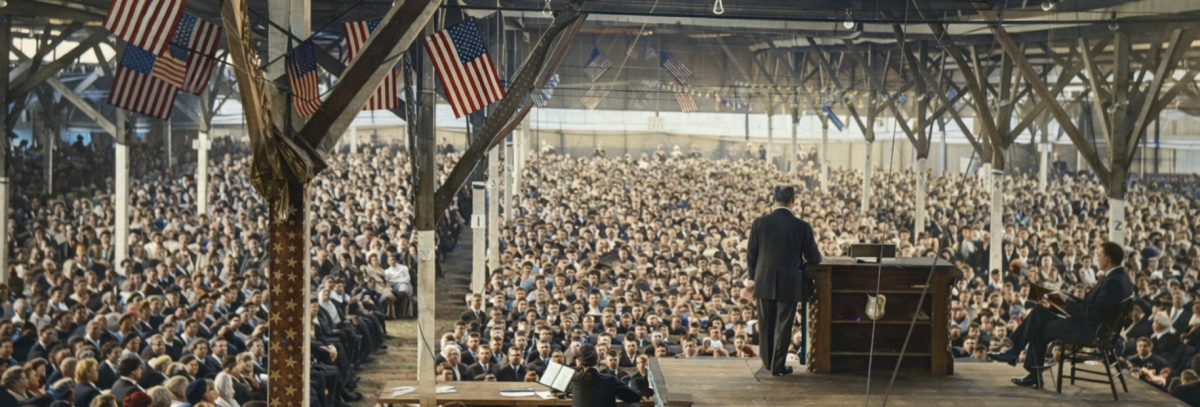
 Evangelist Billy Sunday (1862-1935)