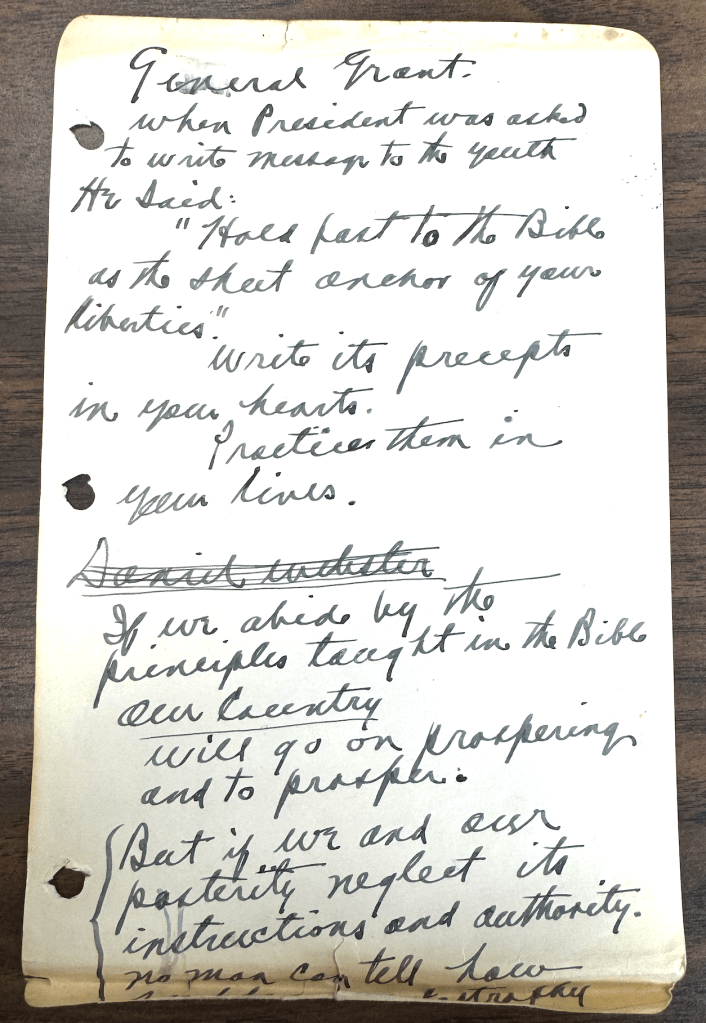
The following is attributed to U.S. Grant and Billy Sunday wrote this into sermon notes labeled “Science.” No date. Morgan Library, Grace College.
“Hold fast to the Bible as the sheet anchor of your liberties.”
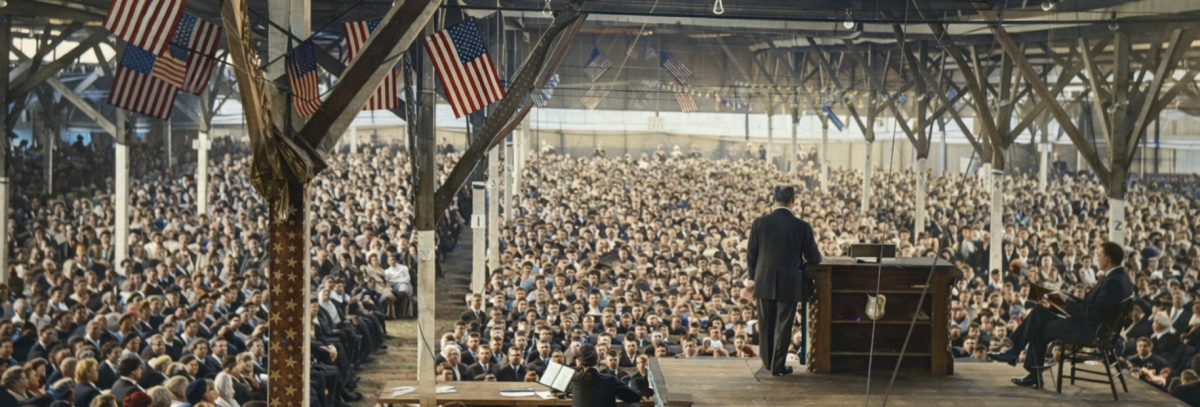
Evangelist Billy Sunday (1862-1935)
Former professional baseball player-turned urban evangelist. Follow this daily blog that chronicles the life and ministry of revivalist preacher William Ashley "Billy" Sunday (1862-1935)
“Atlanta, Jan. 1.—Ten thousand dollars raised within ten minutes by white citizens of Atlanta yesterday assures the negroes of this city success in completing their Y.M.C.A. building. The white people are pledged to raise another ten thousand if necessary. A fifty thousand dollar fund was needed to obtain the gift of $25,000 from Julius Rosenwald. C.W. McClure made a donation with the statement that the friendly relations between the whites and the negroes were better than ever since Billy Sunday preached to both.”
Jan 1 paper
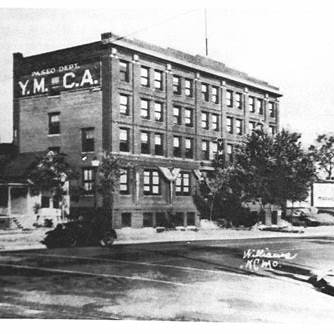
In the waning days of 1917, as Atlanta turned the page to a new year, a remarkable act of interracial philanthropy unfolded that would leave a lasting mark on the city’s history. Newspapers reported that ten thousand dollars had been raised in just ten minutes by white citizens of Atlanta to help fund a new YMCA building for the city’s Black community. The drive was part of a larger campaign to secure a matching gift of twenty-five thousand dollars from Julius Rosenwald, the Sears, Roebuck & Co. magnate whose generosity was transforming African American education and social life across the South. Local businessman C.W. McClure, who helped spearhead the effort, remarked that the relations between whites and Blacks in Atlanta had improved markedly since evangelist Billy Sunday had preached to both communities during his campaign there.
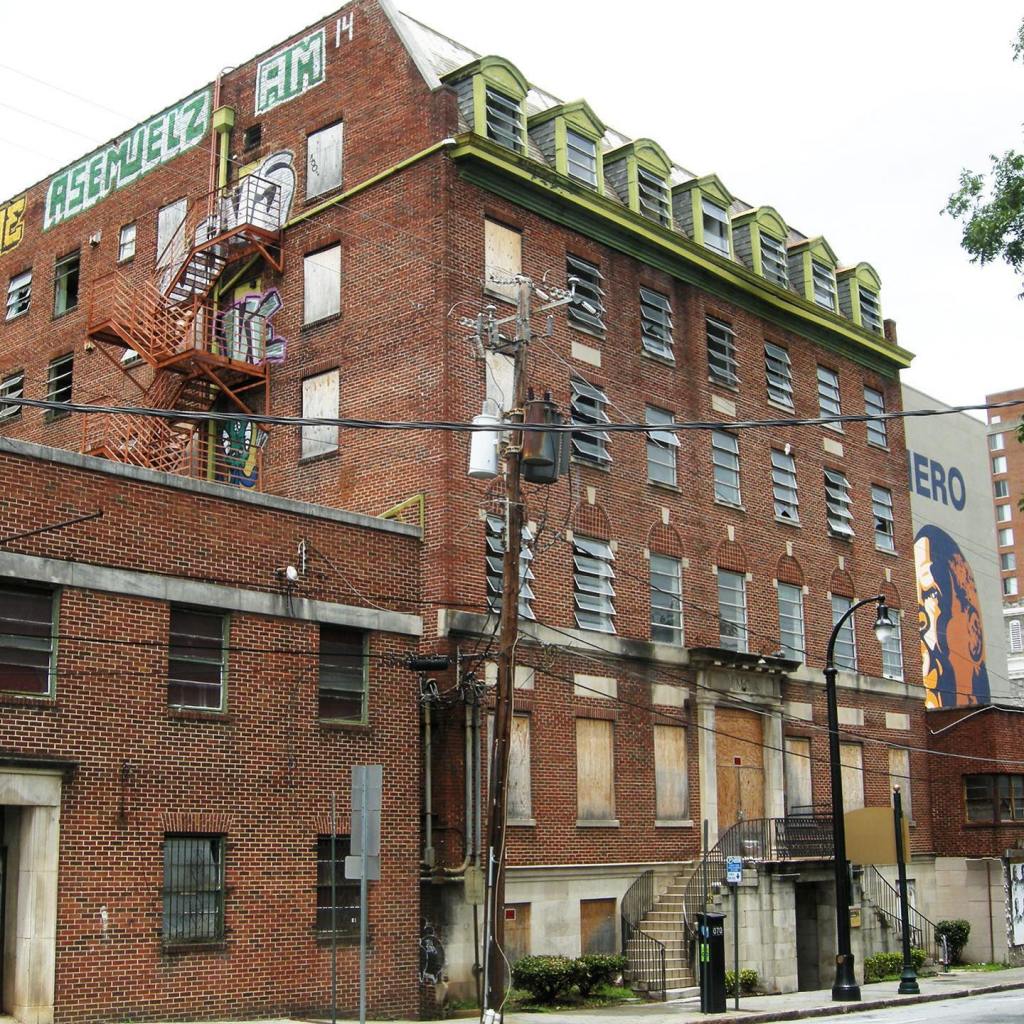
The fruits of that campaign materialized in the Butler Street YMCA—known in its day as the “Negro Y.” Built between 1918 and 1920, the new structure rose in the heart of the Sweet Auburn district, the beating center of Black enterprise and culture in Atlanta. The project followed Rosenwald’s signature pattern: a challenge grant that required local citizens—both white and Black—to raise the balance. The local enthusiasm kindled by Sunday’s revival evidently carried over into civic generosity, helping to meet the $50,000 goal needed to unlock Rosenwald’s contribution.
The Butler Street YMCA quickly became one of the South’s most important centers of African American life. Designed by the firm Hentz, Reid & Adler and built under the direction of Black contractor Alexander D. Hamilton, the facility was impressive for its time—three stories of brick and stone housing a swimming pool, gymnasium, dormitories, meeting halls, and classrooms. It provided a wholesome environment for young men seeking moral and social uplift in a city that offered them few such spaces.
More than a recreational facility, the Butler Street Y grew into a cornerstone of civic and spiritual leadership. Over the decades it came to be known as the “Black City Hall” of Atlanta, hosting meetings that shaped the course of civil rights and community advancement. Figures such as Martin Luther King Jr., Maynard Jackson, and Vernon Jordan would later pass through its doors. The Y stood as a living emblem of what cooperative goodwill and faith-inspired philanthropy could achieve during an era when segregation still divided the city.
The 1918 campaign that launched the Butler Street YMCA was more than a fundraising victory. It was a moment when revival energy turned outward—when the social conscience stirred by Billy Sunday’s preaching translated into practical generosity. In helping to fund the YMCA, the people of Atlanta built not only a structure but also a bridge between communities, one that carried forward the spirit of reform, service, and reconciliation that Sunday’s message had kindled. The Butler Street Y remained for nearly a century a monument to that brief but luminous cooperation—a place where faith met action and where the legacy of revival took tangible form in brick, mortar, and hope.
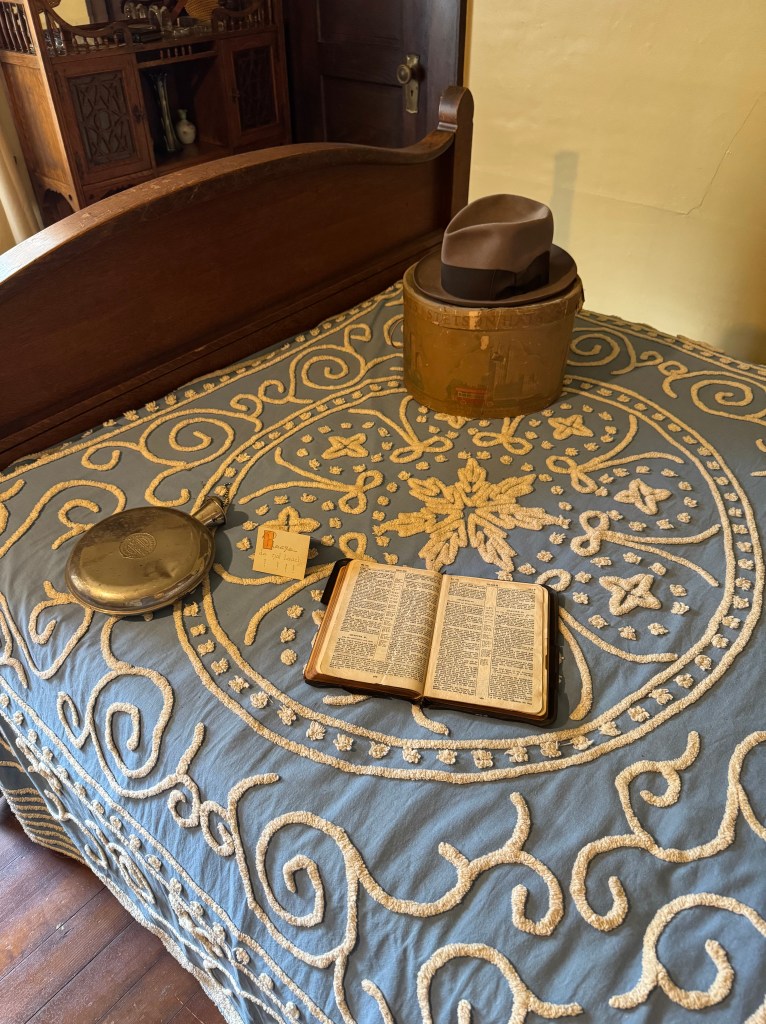
Here is the bed of Billy and Ma Sunday in their former Winona Lake home. The accompany picture (probably 1930s) of the famous couple is placed on the headboard.

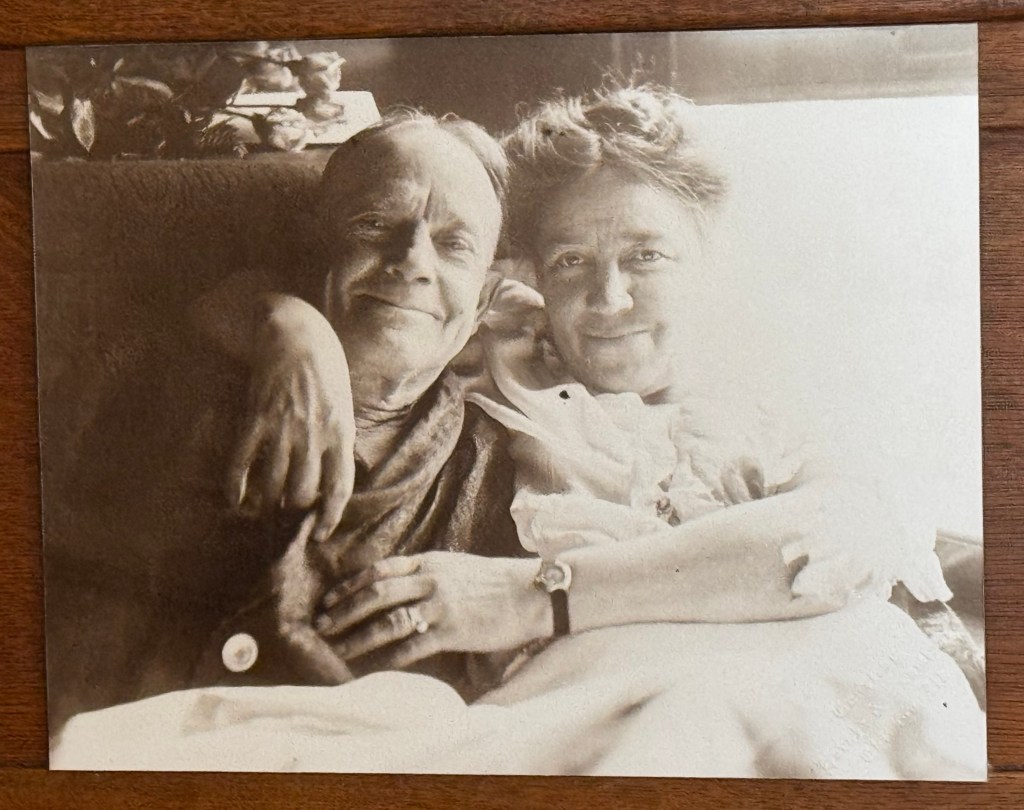
A colorized version.

Photography permission granted by the Winona Lake History Center.
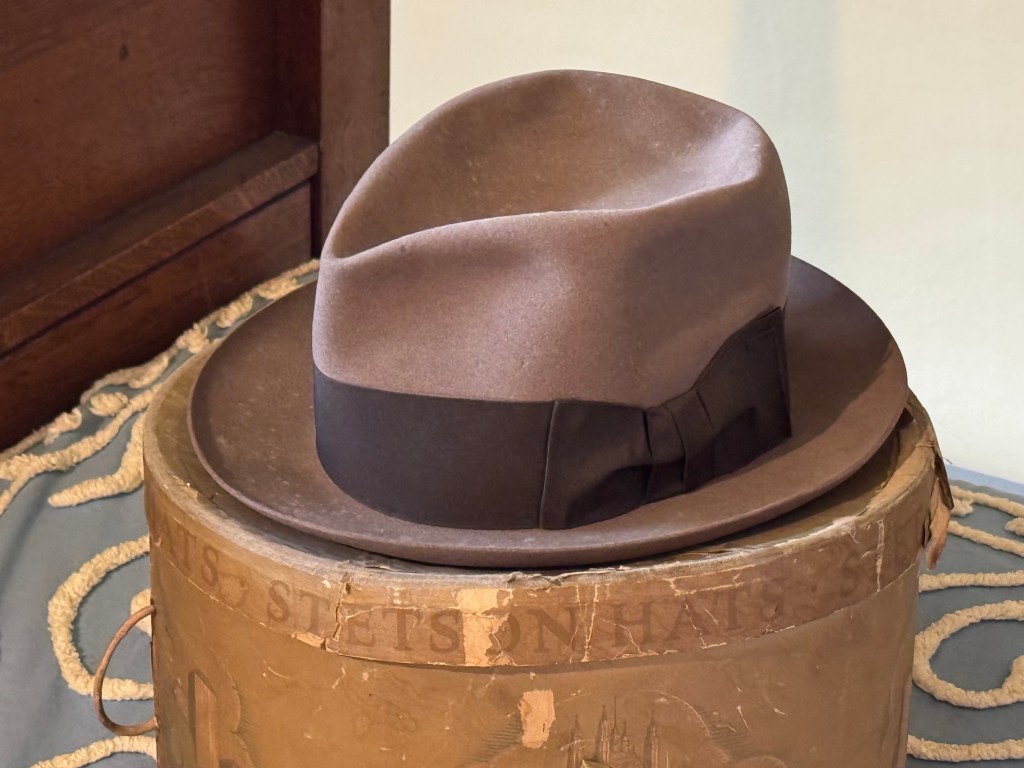
Billy was often photographed in this hat, which now resides on the bed in his former Winona Lake home. Permission to photograph was granted by the Winona Lake History Center.
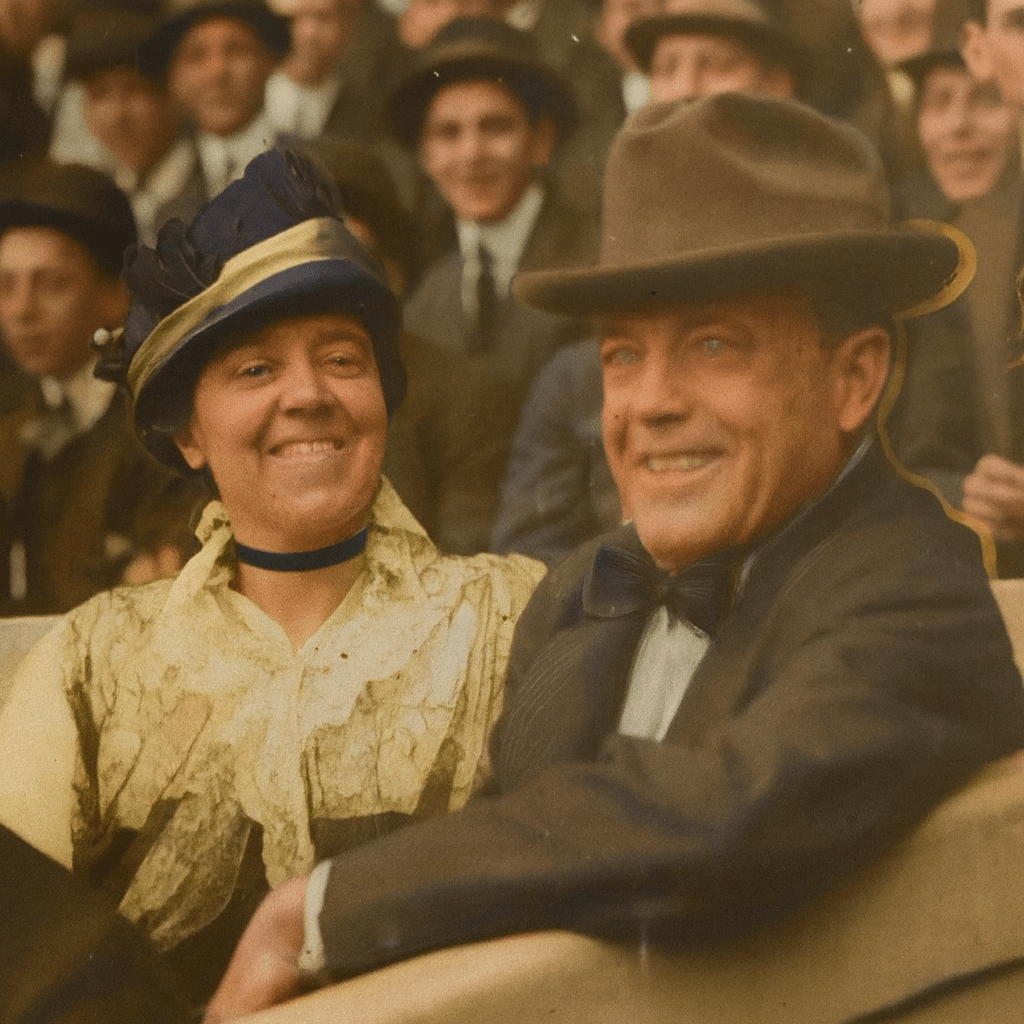
The picture below was taken in 1915 at the Polo Grounds (colorized with AI).
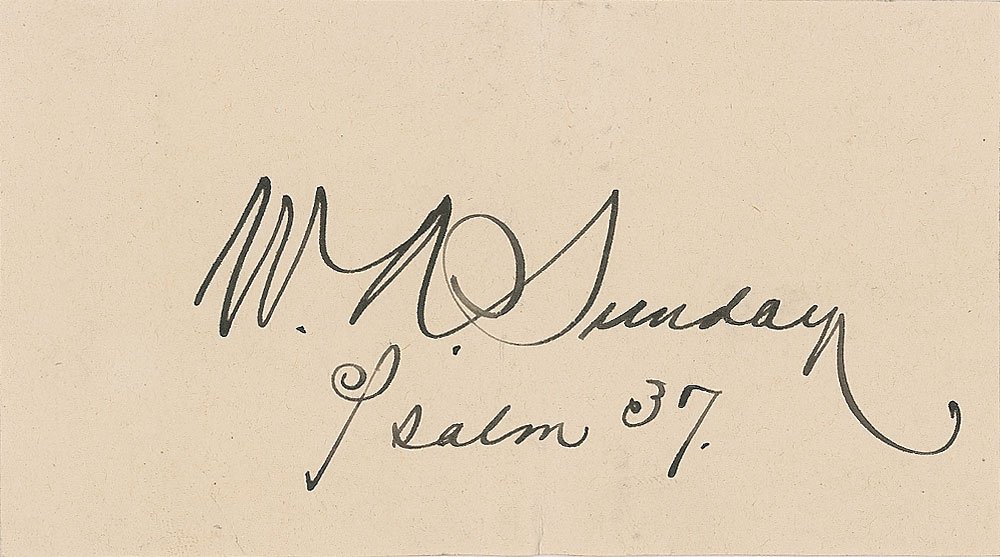
Many surviving signatures of Billy Sunday accompany and simple inscription to Psalm 37.
There is a KJV Scofield Bible, dated 1909, on the bed of Billy and Ma Sunday in their home in Winona Lake. This particular Bible was gifted to Billy in 1917 on Easter Sunday, in New York.
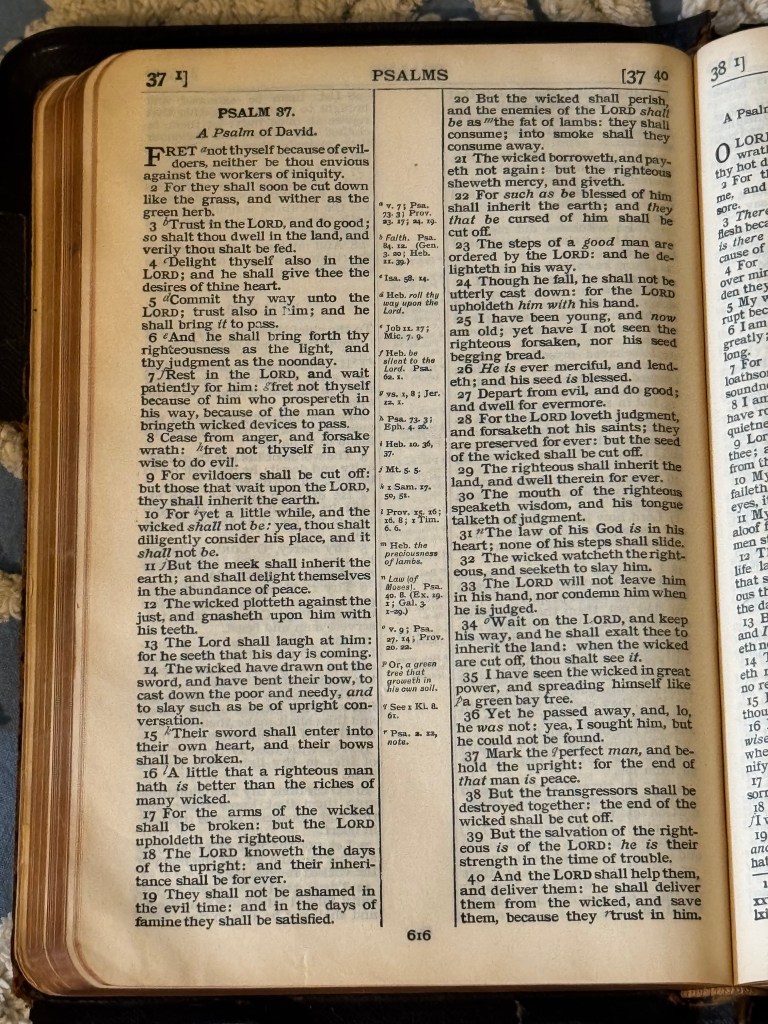
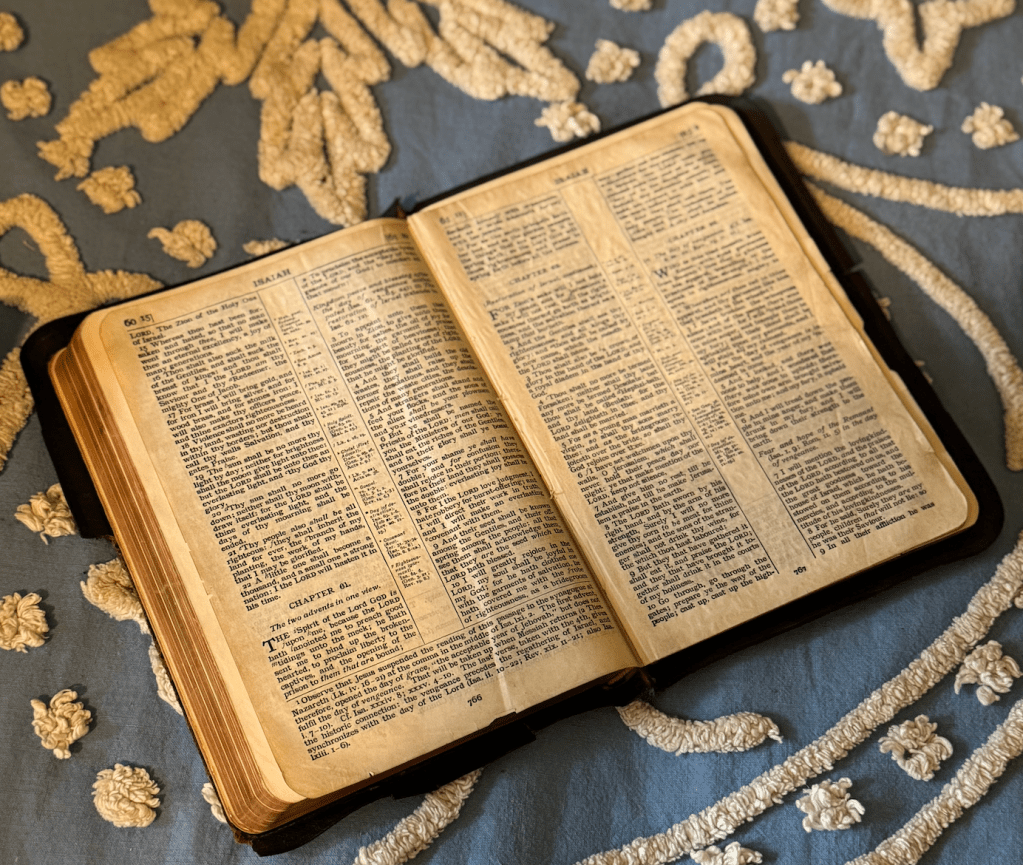
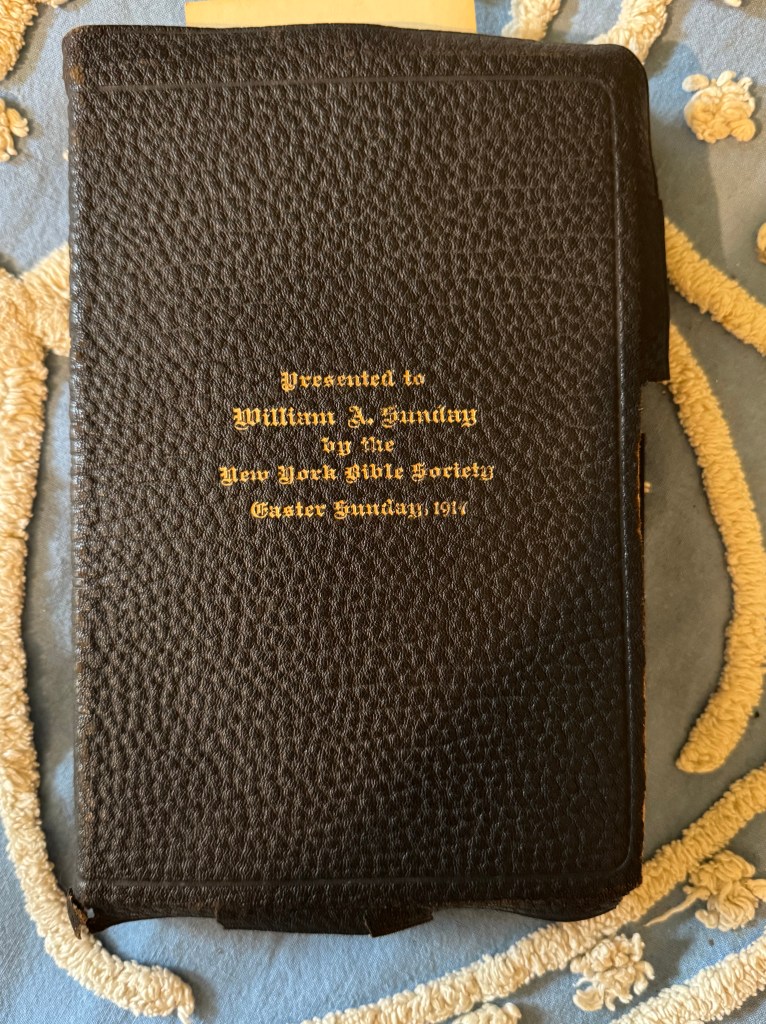
Permission granted by the Winona Lake History Center to photograph the Bible.
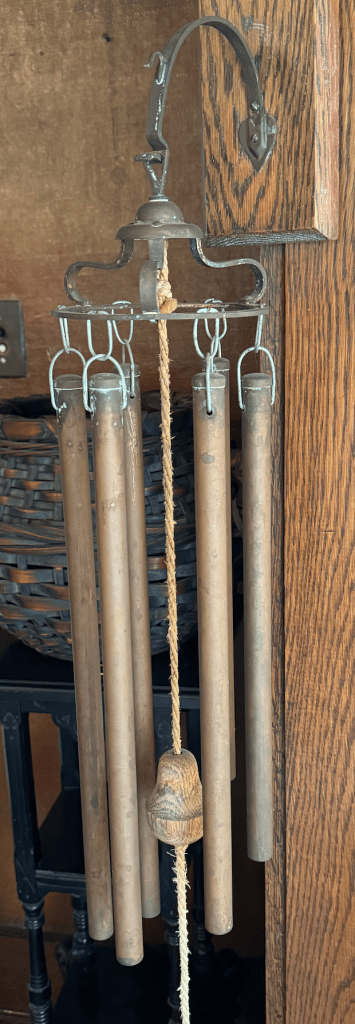
The docent at the Billy Sunday home in Winona Lake, Indiana says that these chimes were purchased by Billy. They hang in the dining room.
Billy and Ma Sunday displayed a beautiful Victorian clock on their mantel in their home in Winona Lake. The characters are Pizarro & Cortez. The clock was made by the Ansonia Clock Company and this model was patented in 1891. One could only conjecture why this piece inspired Billy or Ma Sunday.
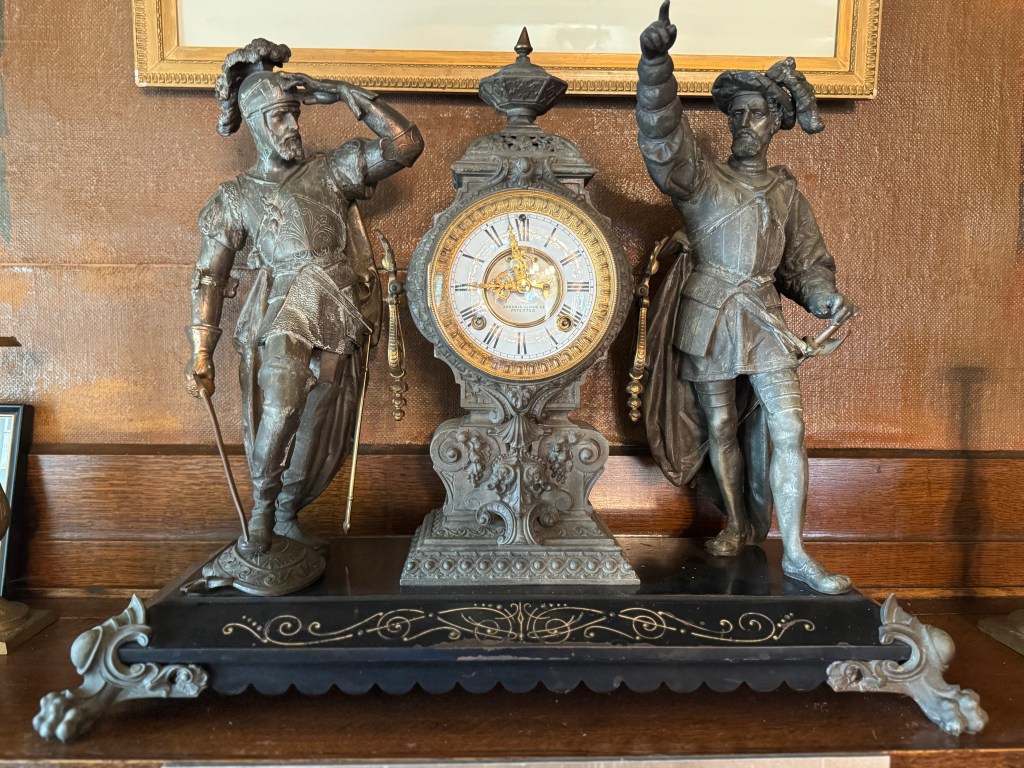
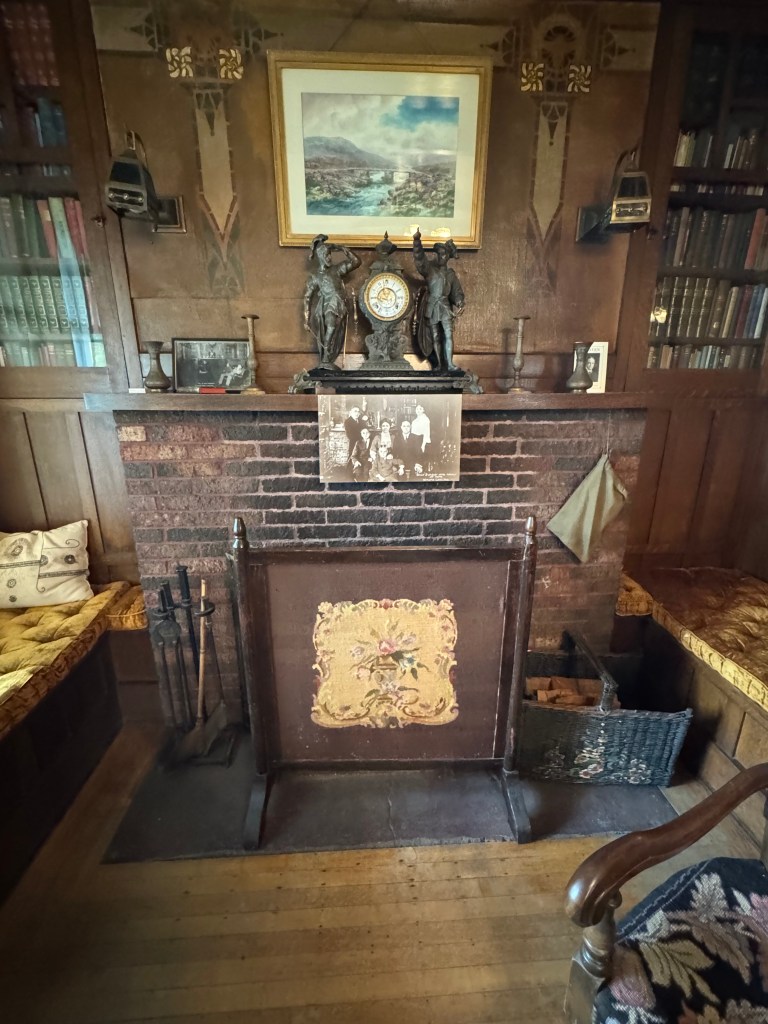
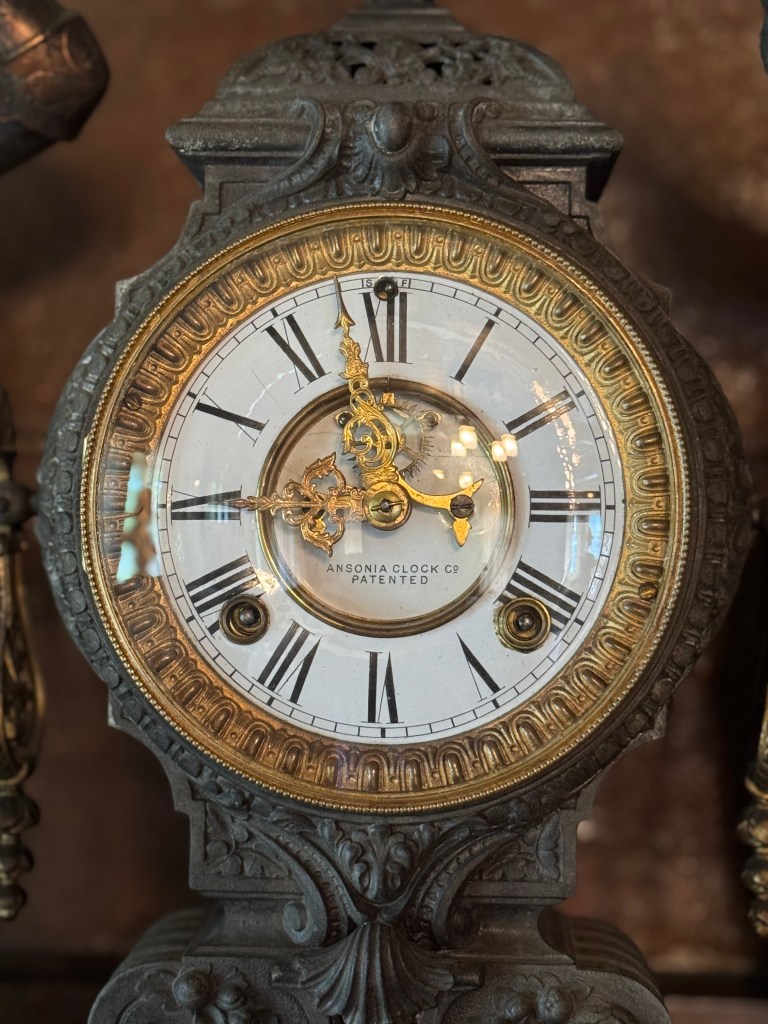
Image captured upon permission from the Winona Lake History Center.
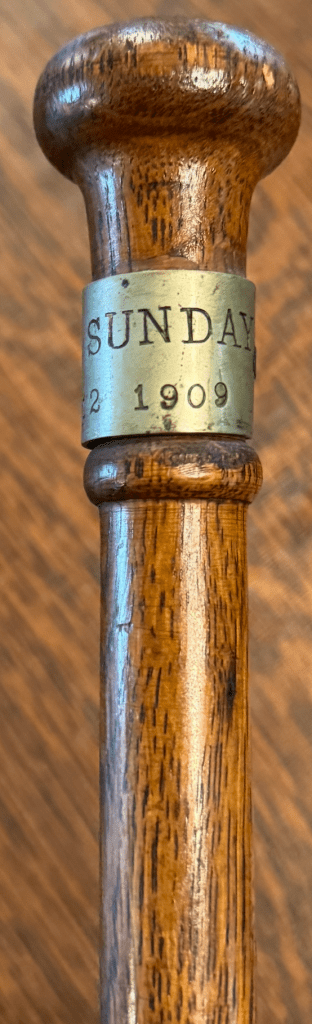
Permission to photograph granted by the Winona Lake History Center.
For other blogposts dated 1909, click here. He spoke at Boulder, Cedar Rapids, and Springfield, Illinois in 1909.
The following (1917) signed picture of J. Wilbur Chapman, in the Billy Sunday home in Winona Lake, attests to the massive influence Chapman had on Sunday.
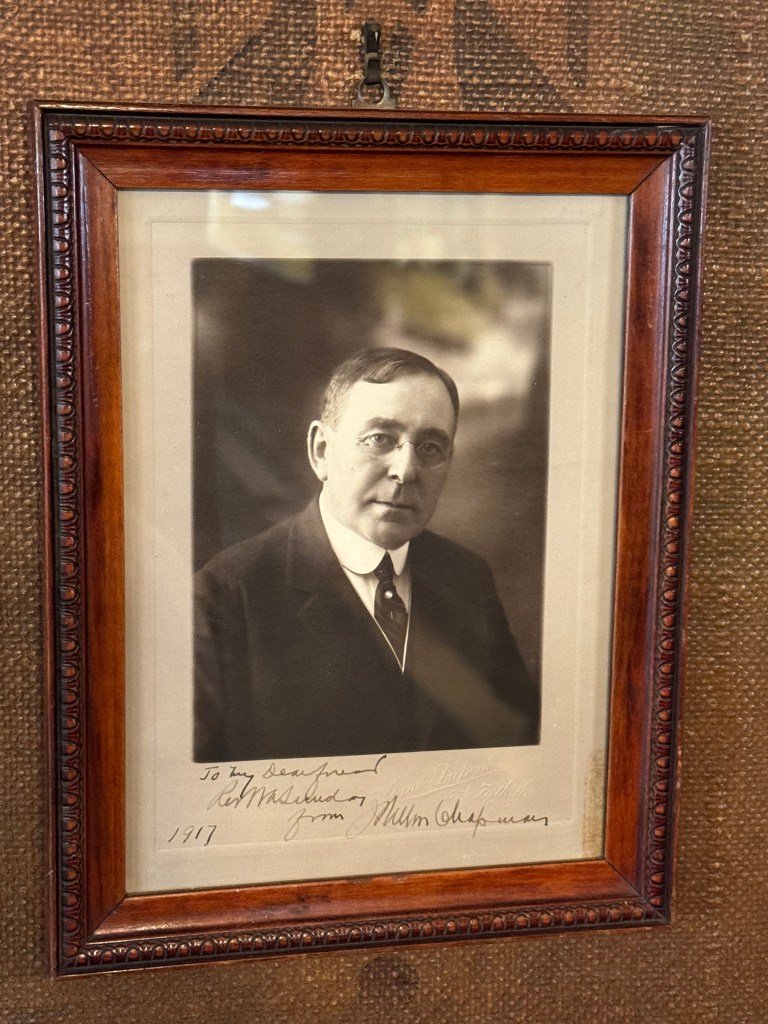
When the Apprentice Met the Evangelist: How J. Wilbur Chapman Shaped Billy Sunday’s Early Ministry
Before the tabernacles were packed, before the crowds surged forward by the thousands, before the name “Billy Sunday” echoed across the country like a revivalist’s thunderclap—he was simply a former ballplayer, freshly converted, and hungry to make his life count for Christ.
That’s when J. Wilbur Chapman stepped into the picture.
It was 1893. Chapman, already an established evangelist with a Presbyterian pedigree and a knack for drawing the spiritually curious, needed an assistant—someone to handle logistics, rally local churches, and stir up enthusiasm before his campaigns. Billy Sunday had the energy and the zeal. Chapman had the method and the message.
For two critical years—1893 to 1895—Sunday shadowed Chapman like a student to his rabbi. He wasn’t yet preaching, but he was watching. Learning. Absorbing. Chapman’s campaigns weren’t just events—they were carefully orchestrated spiritual operations. Inquiry rooms. Personal follow-ups. Gospel invitations that were both clear and convicting. Sunday took it all in.
But it wasn’t just technique that Chapman passed on—it was a vision. A way of doing evangelism that held fast to the truth of Scripture while reaching real people in real places. Sunday saw in Chapman a man who carried both conviction and compassion. And though their styles couldn’t have been more different—Chapman, the dignified clergyman; Sunday, the kinetic whirlwind—it worked. Like iron sharpening iron.
In 1895, Chapman surprised many by stepping back from itinerant preaching to take a pastorate in New York. The pulpit reclaimed him. But for Billy Sunday, it was a release—a gentle push from the nest. With his mentor’s example still fresh, Sunday stepped onto his own stage. He started small—tiny Iowa towns, rough-hewn tabernacles, handfuls of seekers. But something was forming. Something bold.
It’s hard to overstate what those two years meant. Without Chapman, Sunday might’ve remained a sideshow curiosity—a saved athlete giving testimonies. But with Chapman’s imprint, he became an evangelist. A revivalist. A force.
And though their paths diverged, Sunday never forgot the man who shaped his earliest steps. He took Chapman’s gospel framework, set it ablaze with his own personality, and carried it farther than either man probably imagined.
Chapman taught him how to build the fire. Sunday learned how to preach like it mattered.
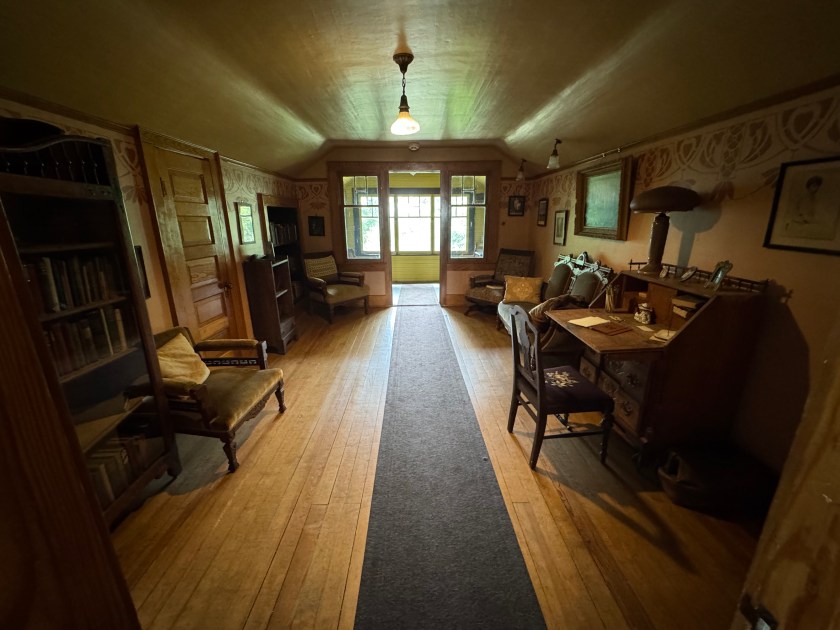
Ma Sunday’s desk is on the right. Photo permission granted by the Winona Lake History Center.
 Evangelist Billy Sunday (1862-1935)