Curated from original Omaha Daily Bee newspaper
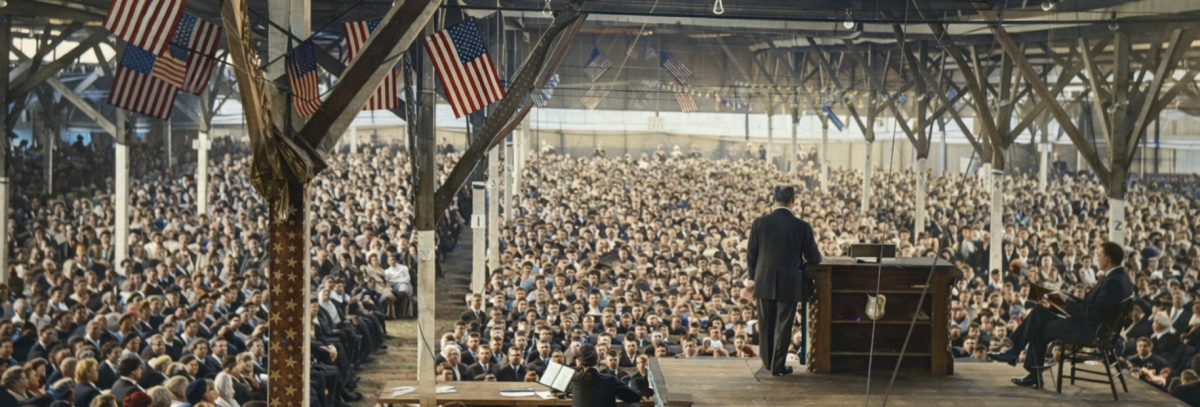
A sensational threat upon the life of Evangelist Billy Sunday, conveyed through a crudely written “black-hand” letter, stirred the city yesterday but failed to interrupt the progress of the revival meetings at the great tabernacle.
The warning, received through the mails on Wednesday, declared that a bomb would be hurled into the tabernacle at 2 o’clock Thursday afternoon, September 23, and that Sunday would be killed unless he departed the city within ten days. The missive, scrawled in poor handwriting across ordinary note paper, bore at its lower corner the drawing of a black hand and a crude sketch of a bomb connected to a clock marking the fatal hour.
Authorities were immediately notified. Chief of Police Dunn detailed detectives to trace the author of the threat, and a vigilant watch was ordered about the tabernacle grounds. Secretary Mathews, who first examined the letter, refrained from alarming the evangelist and quietly placed the matter in the hands of the police.
Despite the ominous warning, the Thursday afternoon meeting proceeded without incident. A squad of detectives, led by Sergeants Patsk Havey and Tom Donahue, mingled with the crowd, keeping careful surveillance in anticipation of any attempt upon Sunday’s life.
If the threat was intended to deter attendance, it met with mixed success. Many curious men flocked to the tabernacle, drawn by the sensational report, while the number of women present was noticeably reduced. Total attendance fell below the usual mark. Yet inside, the service moved forward undisturbed—save for the innocent crying of a baby, whose presence, smuggled past ushers, proved the only interruption to the evangelist’s address.
Thus, what promised to be a day of danger passed into one of quiet defiance. The bomb did not appear. The preacher remained. And the revival, under the watchful eye of the law, pressed on.
Adapted from: The Omaha Daily Bee, September 23 and 24, 1915
 Evangelist Billy Sunday (1862-1935)