Billy Sunday and the YMCA: The Crucible of a Calling

In a culture where faith often stays behind closed doors, Billy Sunday’s early formation in the YMCA reminds us that calling is not just a private conviction — it’s forged in public discipline, community, and visible work. Let’s see how his “seminary without walls” shaped him — and what that might teach us today.

The YMCA as Bridge Between the Diamond and the Pulpit

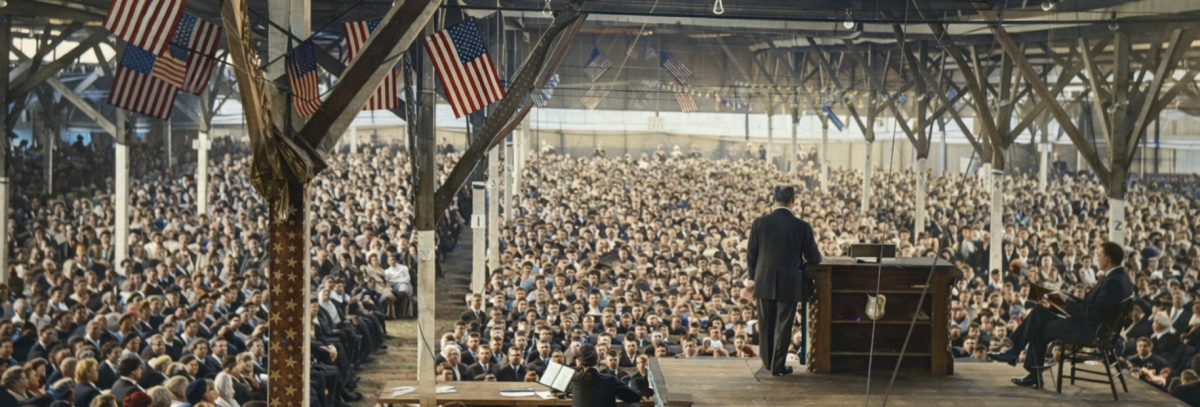
Before the sawdust trail and the tabernacle crowds, Billy Sunday’s call to preach was forged in the YMCA.

From 1889 to 1894, the Young Men’s Christian Association was his classroom, pulpit, and proving ground—where athletic vigor met moral conviction.
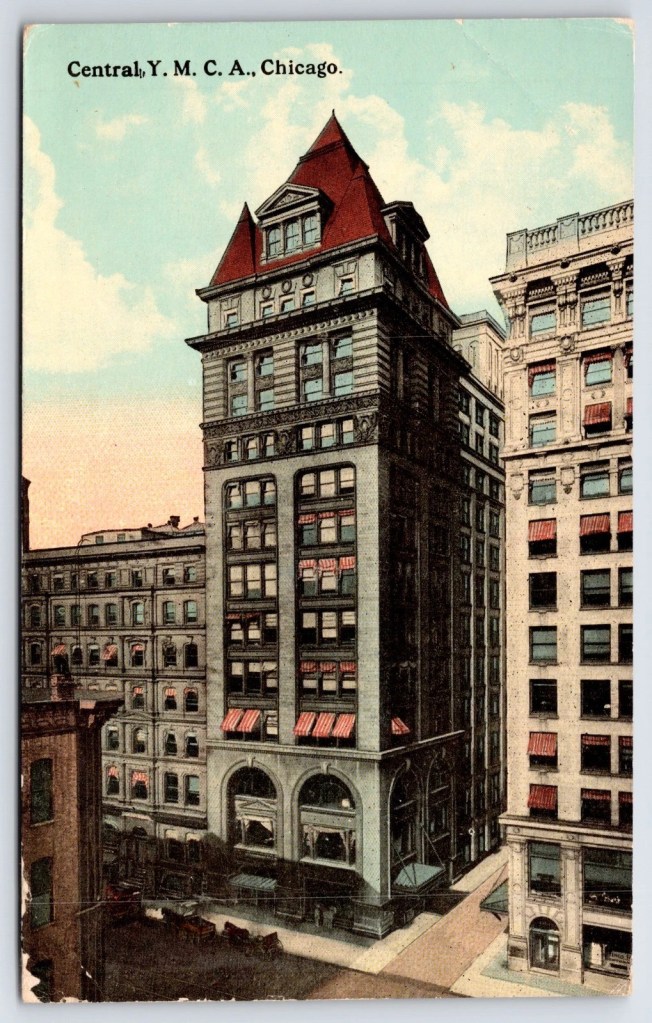
Central YMCA Chicago (built in 1893)

From Ballplayer to Brotherhood

After his 1886 conversion through the Pacific Garden Mission, Sunday joined Chicago’s First Presbyterian Church and quickly connected with the YMCA. His first sermon—“Striking Out Satan” (Feb. 14, 1889)—sponsored by the YMCA, drew hundreds and led to 48 conversions. Newspapers from Chicago to Quebec reported on the ‘baseball evangelist,’ giving Sunday his first taste of national attention.

A Training Ground for Discipline and Leadership

Hired in 1890 as Assistant Secretary of the Chicago YMCA ($83/month), Sunday learned to run meetings, lead Bible studies, and recruit men to the faith. The YMCA’s ethos of “muscular Christianity”—combining physical strength, moral purity, and social reform—shaped his lifelong view that faith should be active, public, and manly. His preaching style—energetic, physical, direct—mirrored the YMCA gymnasium more than the traditional pulpit.

“He jumped after the devil as he once jumped after a fly ball.”

Platform and Network

Speaking regularly in YMCA halls from Cincinnati to Freeport, Sunday developed his reputation as a lay preacher for working men. These circles introduced him to Dr. J. Wilbur Chapman, who later invited him to
join his national evangelistic team in 1894. Even after resigning from the YMCA, Sunday continued to preach in its auditoriums—Chicago (1896), Cedar Rapids (1895), Dubuque (1899).

The Model That Endured

Summary Insight

The YMCA was Billy Sunday’s seminary without walls. It taught him how to lead, how to speak, and how to live out faith in public. Within its walls, the ex-ballplayer became an evangelist. Without it, the “Baseball Evangelist” might never have found his swing.

The YMCA wasn’t merely a stepping stone for Billy Sunday — it was formative, foundational, and catalytic. It taught him leadership, public engagement, spiritual discipline, and the courage to preach in everyday venues.

Legacy & Invitation: Calling is seldom revealed in isolation. It’s often forged through community, service, and visible responsibility. For us today, the question is: Where is your YMCA? Where might God be shaping your calling right now in your everyday context?

May we not despise the small openings, the local venues, the places of habit and service — for they may be the very grounds where our faith is tested, refined, and sent out into greater mission.

Billy Sunday believed (c 1913) that the Y.M.C.A. was drifting from its core mission

Y. M. C. A. Drifting Away.

“They are fighting and talking about the needs of an institutional church, they are having gymnasiums and socials. But don’t forget the fact that salvation is the prime end of everything. I don’t object to the gymnasium and all such things if they make them a means to an end. But remember that salvation of the soul is the end which we need. That is what is the matter with the church to-day, she is losing sight of that one fact. The Y. M. C. A. is drifting away from what it used to do for the people. I don’t object to the Y. M. C. A. I don’t object to gymnasiums. I do object when they make that the prime thing, putting in pool tables and such things. The church and the Y. M. C. A. and the Salvation Army are getting away from the fact that the salvation of the soul is the supreme end. I want to see the salvation of the soul the supreme end of the world.”

Citation: The South Bend Tribune. Sat, May 03, 1913 ·Page 12

Billy Sunday donated the equivalent of almost $4 million to Pacific Garden Mission, the Y.M.C.A, and the Red Cross.

As reported by The Richmond Item. Fri, May 26, 1922 ·Page 7.

SUNDAY DONATES SUM OF $120,485

Then on Top of That he Gives $65,000 to Pacific Garden Mission of Chicago

Those who call Billy Sunday a grafter were asked yesterday afternoon to hear a little of some past donations of the evangelist. He told his tabernacle audience that when he was in New York City (c. 1917) he told the people coming to the tabernacle to give him all they were able to and he would give it all to the Red Cross and the Y. M. C. A., for their war work.

New York City gave me $120,485, Mr. Sunday said, and I turned over every cent for the work that I had said I would. I went to Chicago and the city gave me $65,000 and I gave the sum to the Pacific garden mission. I give away a tenth of my income. And that is all right. I do not advertise all the things I do with my money. I do not tell all the world the things that I pay off. You follow me around, some of you, and I will make you dizzy with the money I give away. But I don’t have to tell anyone. It is written down above so that is all that matters.

No Guarantee

When Mr. Sunday promised to come to Richmond, he was guaranteed nothing, and all that was to go to him was the free-will offerings the last day of the campaign. He exclaimed, I wonder whether any circus would come to your city on that basis just take up a collection. I wonder whether your county or city officials would collect its taxes on that basis take up a collection. I wonder whether they would let you go to the movies and then take up a collection. No collection for Dempsey when he stood ten minutes in the ring and received $300,000. Oh! no. If I got some of you pay more for your gasoline each year than you do for your church. Oh. it makes me mad when I see you putting God on a five and ten cent basis.

Little

Like one old bird who was always at prayer meeting giving testimony and telling of all he did when he had more on tobacco than he gave to the church in 13 years.

Mr. Sunday preached on God So Loved the World. The Rev. Alford of Columbus, O., made opening prayer. Messrs Mathews and Rodeheaver sang a duet. Mr. Rodeheaver sang My Wonderful Dream. following the sermon, Mr. Sunday gave the invitation and six persons responded.

had found the sheep that was lost. He took her tenderly, and in his shepherd’s plaid he carried her to the fold. One, two, three, four, five, six ninety-six, ninety-seven, ninety-eight, ninety-nine and one hundred. He locked the fold and entered the cabin and she had fallen exhausted on the floor.

She was lying there panting and at the sound of his voice and footsteps she staggered to her knees, reeling and fell dead.

That Jesus Christ should come to this old world to give us a chance to be saved, to try and find us, cursed and scarred and bruised with sin. That is God’s message to us. He so loved the world, that he gave his only Begotten Son, that whosoever believeth in him should not perish, but have everlasting life.

Once, years ago in New York I was told there lived a wealthy Christian merchant. He married a beautiful woman, gave her a bank account and unknown to him she drank. She used to go away and visit friends on pretence of visiting relatives. She kept it up and at last fell into a life of sin and shame.

One night he came home and found a note telling him that she had gone away never to return. That her life could not merit his true, Christian character and life. He hired detectives and they searched every where and they could not find her.

Copies of her pictures were left with the police and with undertakers around the country and he said, If you run across her body, use the best clothes that money can buy, buy the finest casket, etc.; bank it with flowers and send for me.

Three years went by when the phone rang and a voice said, We have found her.

And he went to the undertaking establishment and as he looked through the glass upon her face, he cried, Oh, Mary, if you only knew how I loved you, you would have come back.

He stood weeping as if his heart would break and he said, Bury her.

And he erected a costly monument and said to the undertaker, Put on it one word: Forgiven.

That is God’s message to us. He forgives our transgressions, and I am glad that I have a God and that I have a Salvation like that to preach to you.