Former professional baseball player-turned urban evangelist. Follow this daily blog that chronicles the life and ministry of revivalist preacher William Ashley "Billy" Sunday (1862-1935)
“Billy Sunday is an American Product – Where methods differ
More Lasting Good.
The old school of revivalists were of the itinerant class, moving rapidly through the country, their evangelism seemed sudden in its effect and I am afraid somewhat evanescent in its general results. It is just here that Mr. Sunday’s campaign gives promise of more lasting good. His coming has been carefully prepared for, his meeting place is undenominational in character. It is a movement conducted with great business acumen and sound common sense. He trains the ministers and church workers in such a way as to make them capable of caring for the harvest when it comes. Like a good farmer, he prunes the fruit trees with vigor cuts out all the dead wood and sprays them well to get rid of moths, beetles and canker worms, so that when the new fruit shall ripen it will be sound and beneficial. And the leaves of the trees shall be for the healing of the nations. Mr. Sunday is a man endowed with a great faith, He prays for the blessing, he prepares for the blessing, he is sure of getting it and it is therefore no surprise that he is so eminently successful.”
You’ve got to work in harmony with God, or you can’t eat a potato. Try to plant your crop in the winter time.
A revival is the return of the church from her backsliding. Judgment must begin in the House of God.
There is as much sense in talking of a worldly Christian as there is in talking about a heavenly devil.
What would you say of the members of a fire company who kept playing cards and gossiping instead of answering the alarm.
We have so many denominations now that it gives a man brain fever to keep track of them. Somebody gets a new idea of truth, founds a new sect, and takes refuge under the Thirteenth Amendment to the Constitution. There is as much need of more denominations as there is for a cat with more tails.
The average preacher stakes his claim on Jupiter and talks on—God knows what, I don’t.
The slaves would not be free men today if men had not gone on the firing line for $13 a month.
An Iowa preacher asked me: “Why don’t you preach the way I do?” “If I did,” I told him, “I wouldn’t be worth any more than you are.”
Some preachers would rather have people go to hell than preach anything except their sixteenth century religion. My mother used to wear hoops, but she doesn’t now, because there’s a different style.
Too many people windjam with their lips, but they don’t deliver the goods.
No wonder children of today grow up like asses’ colts!
You allow your daughters to go around with fellows whose character
would make a black mark on a piece of tar paper.
If you are not living to stir the devil, then you are a cipher and a
nonentity.
The church hasn’t smelled gunpowder for 150 years. It would do her
good. When she has grown rich, she has become independent of God
Almighty.
Some people think the more they look like a hedgehog the more pious
they are. They’d get to heaven a great deal quicker if they went to the
barber and dentist more often.
If you can’t own an automobile, take a trolley ride for a nickel. Ain’t it
fierce?
If some of you devils were to go a whole day without cussing your wife,
she’d think you were sick and send for the doctor, although she’d rather
send for the undertaker.
If there is any one person in this world that I despise with every atom
of my being, it is the weasel-eyed, lantern-jawed, knock-kneed, stiff-necked,
cadaverous, crooked-nosed, old neighborhood gossip, who can see more
through a keyhole seven blocks away than a decent woman could through
an open door right at her elbow.
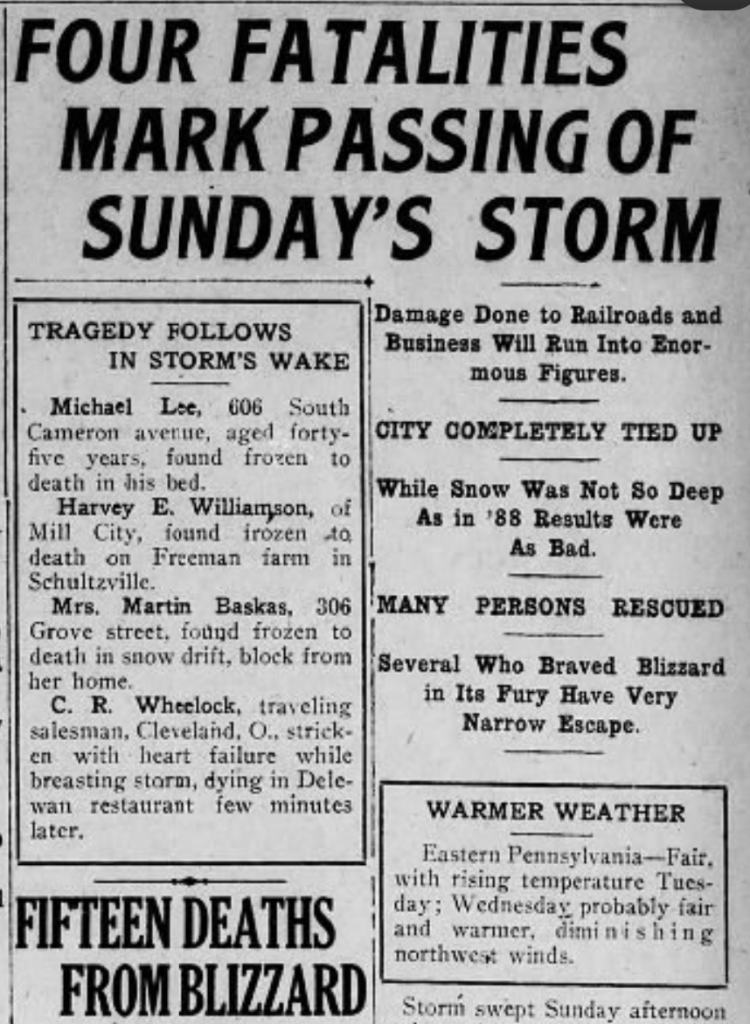
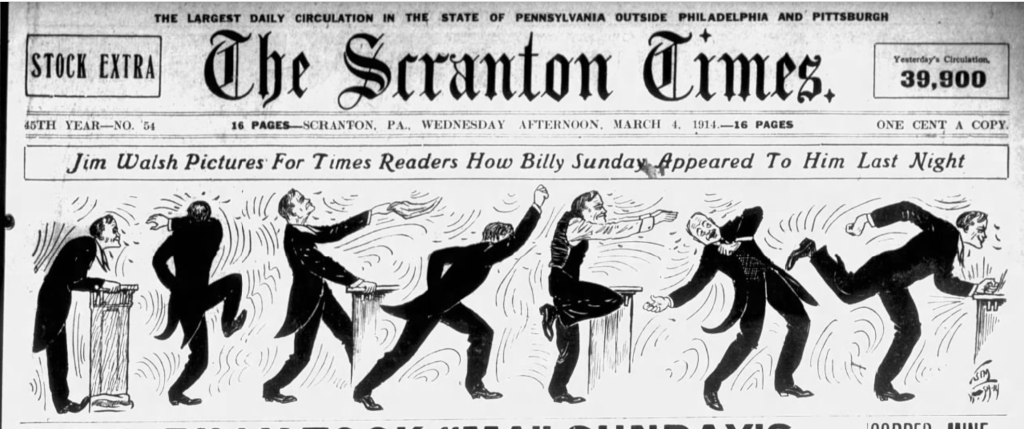
The Tribune-Republican. Wed, Mar 04, 1914 ·Page 10
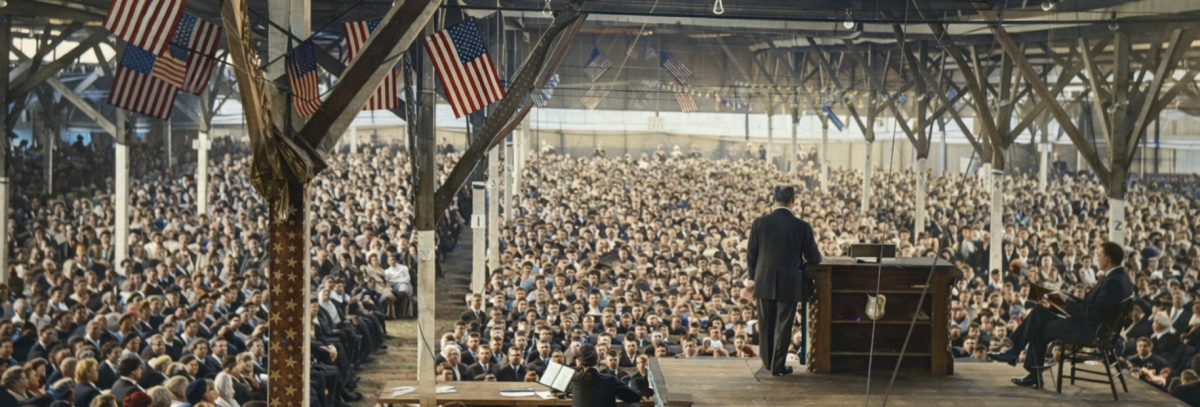
Despite one of the worst storms in recent memory for Scrantonites (March 1, 1914), 4,000 people showed up at the tabernacle, Unfortunately, about 1,500 could not get home. Over 100 trains were delayed or stopped running.
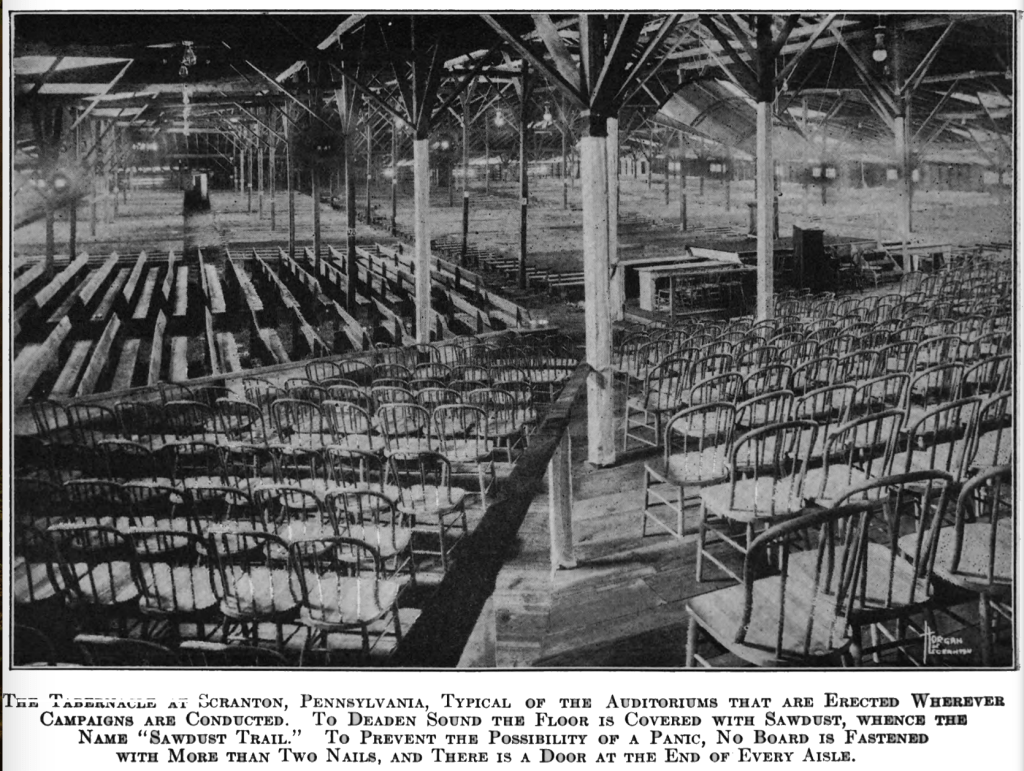
On the evening of March 1, 1914, a fierce winter storm swept into Scranton, Pennsylvania, just as evangelist Billy Sunday opened his long-anticipated revival campaign. Snow began falling heavily and, by night’s end, roughly 14 inches blanketed the city. Winds howled at nearly 45 miles perhour, rattling the enormous wooden tabernacle built for the meetings and at times drowning out Sunday’s booming voice.
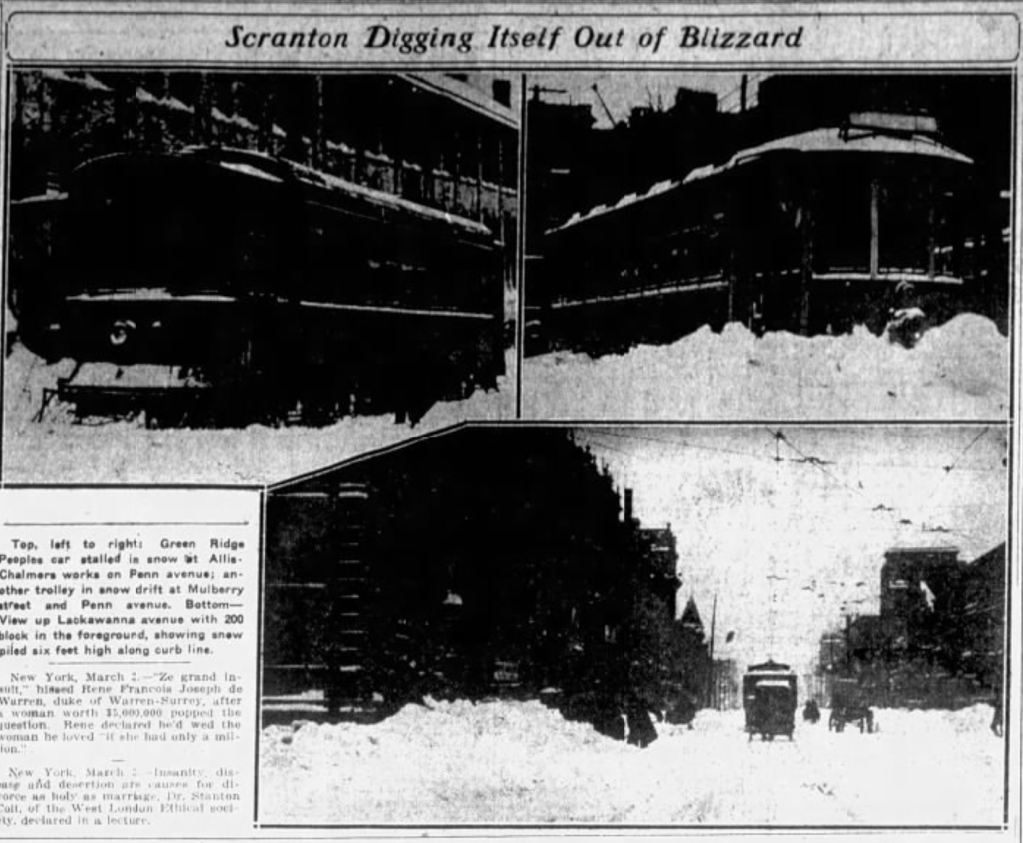
Outside, the storm piled drifts as high as ten feet, choking off roads and halting the streetcars that normally ferried worshipers home. Inside the tabernacle, about 2,500 attendees quickly realized they were stranded. With travel impossible, they settled in for the night, huddling around pot-bellied stoves, brewing coffee, sharing whatever food they had carried, and making the best of their unexpected vigil.
Times-Republican, Tue, Mar 03, 1914 ·Page 1
By the next morning, Scranton lay silent under a white barricade. Billy Sunday canceled Monday’s services so people could rest and dig out. Local volunteers soon arrived with wagons and supplies, helping the weary congregation back to their homes.
The episode became known as the “Billy Sunday Snowstorm,” a dramatic blend of nature’s power and religious fervor that locals remembered for years as the night a revival meeting turned into an impromptu winter encampment.
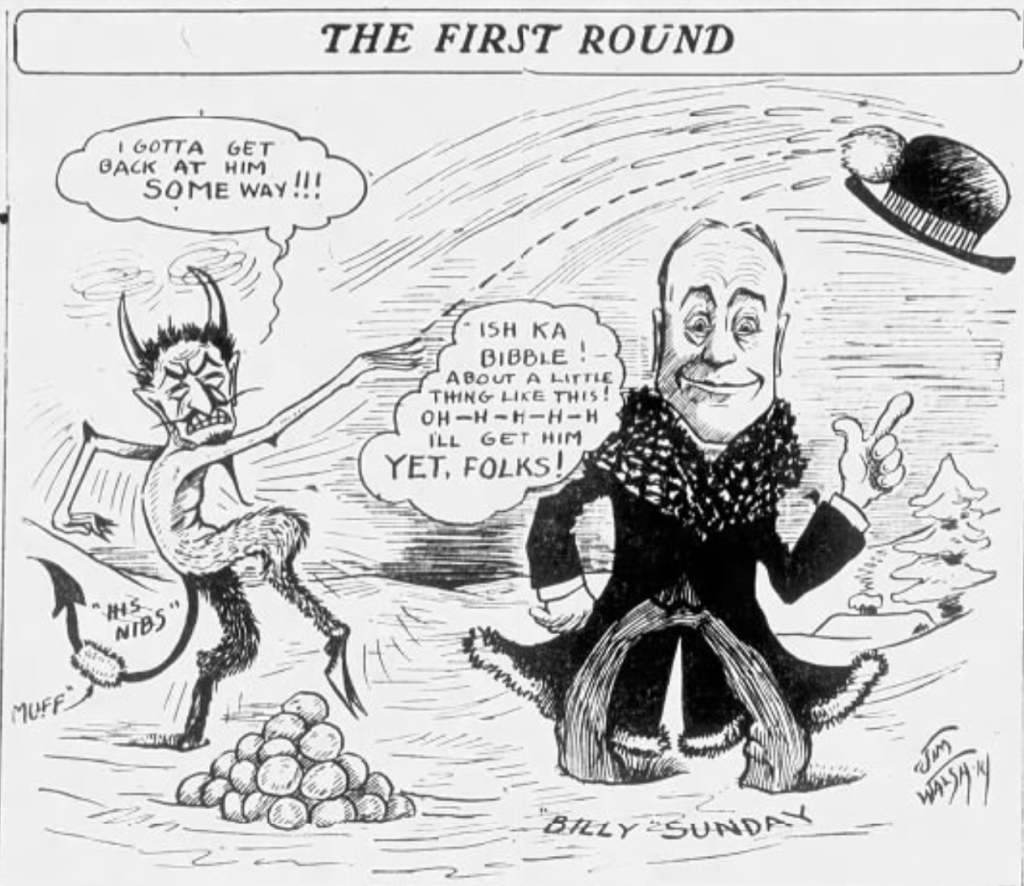
The Pittsburgh Press (Pittsburgh, Pennsylvania) · Mon, Mar 2, 1914 · Page 1.
Billy Sunday conducted his Scranton, Pennsylvania revival campaign from March 29 to May 17, 1914.
Billy Sunday’s 1915 revival campaign in Syracuse was held in a massive tabernacle specially constructed on the grounds of the old Scranton Driving Park, a former racetrack near the intersection of Providence Road and Green Ridge Street. The venue, built to accommodate the large crowds drawn by Sunday’s fiery preaching, held around 8,000 people at full capacity.
Over the course of the campaign, tens of thousands streamed into the tabernacle, with some estimates suggesting that more than 100,000 people in total heard Sunday preach during the weeks-long revival. The response was overwhelming—not just in attendance but in impact. Reports from the time estimate that between 13,000 and 15,000 individuals made public decisions for Christ, “hitting the sawdust trail” as they came forward to commit their lives to faith. The scale and energy of the campaign made it one of the more memorable revivals of Sunday’s career, leaving a significant spiritual and cultural imprint on the city of Syracuse.
The Scranton campaign was notable for its massive local organization, media coverage, and impact on surrounding cities. It was one of his early high-profile campaigns in the northeast, setting the stage for later revivals in Boston (1916), New York (1917), and elsewhere.
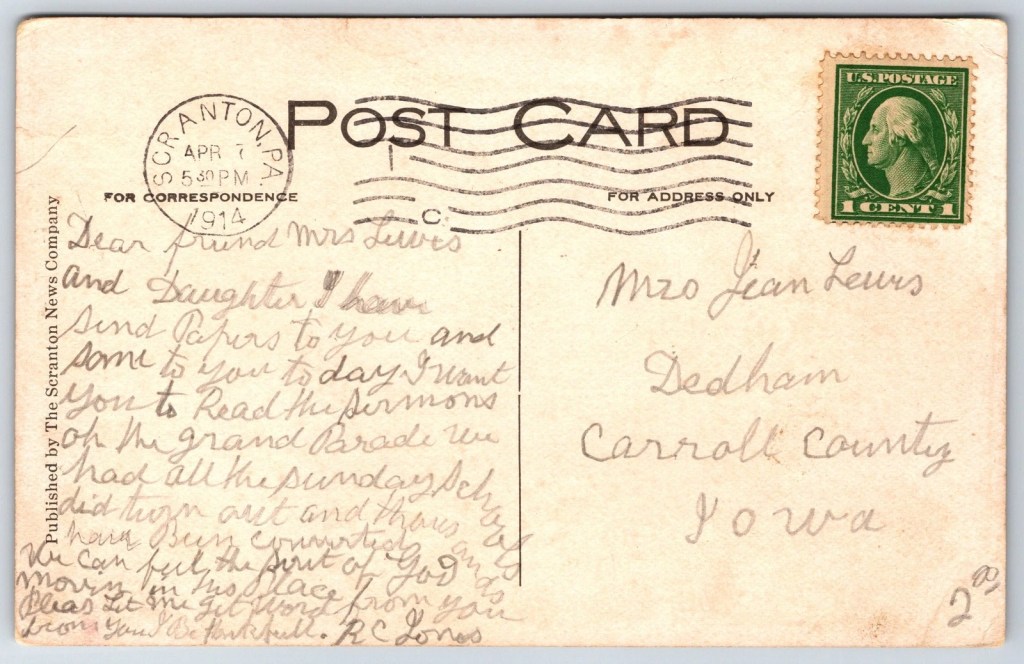
Here is the detail on the postcard and the handwritten message.
Postmarked 7 April (7:30 pm) from Scranton, PA
Dear Friend Mrs Lewis and Daughter
I have send papers to you and some to you to day. I want you to Read the sermons. Oh the grand Parade we had. All the Sunday’s school did turn out and those have been converted. We can feel the spirit of God in this place. Please let get word from you. I’d be thankful. RC Jones
Billy Sunday commenced his seven-week evangelistic campaign in Scranton, Pennsylvania, on March 1, 1914. The opening day was marked by a significant snowstorm, later referred to as the “Billy Sunday Snowstorm,” which resulted in approximately 2,500 attendees being stranded overnight in the temporary tabernacle constructed for the revival. The campaign concluded in mid-April 1914.



 Evangelist Billy Sunday (1862-1935)