Former professional baseball player-turned urban evangelist. Follow this daily blog that chronicles the life and ministry of revivalist preacher William Ashley "Billy" Sunday (1862-1935)
In 1918, Billy Sunday stepped into one of America’s most divisive debates — women’s suffrage. What drove him? What can we learn from that boldness?
A century later, his words still challenge us to consider what moral courage looks like in public life today.
This original 1918 newspaper article captures Billy Sunday’s public support for women’s right to vote. At a time when the nation was debating suffrage, Sunday’s words reveal both his moral clarity and his ability to speak into civic life with conviction and wit.
Evangelist Says He Favored Proposition Long Before It Became a Fad. To Open Suffrage Session With Prayer.
With the vote on the suffrage amendment coming tomorrow, Rev. William A. Sunday is another prominent individual who is taking the opportunity to reiterate his faith in “votes for women.”
In a signed statement which “Billy” Sunday gave Mrs. Lawrence Lewis, of the National Woman’s Party, last night, the evangelist says:
“It is nothing new for me to favor woman suffrage. I have been advocating it for years, even before it became popular. We are living today in a new era. If she is good enough to be our mother and our wife, good enough to preside over our home, to care for us in times of sickness and to share our joys and our sorrows, why should she be denied the privilege of voting?
“Today, more nearly than ever before, she bears equally with men the world’s burdens. What would the nations of the earth do without her aid, either in times of peace or war? Women are sharing equally with men the burdens and the sacrifices of this war.
“They are in the munitions factories and in the fields of agriculture and in all other departments of war service. Without their co-operation the war could not be waged to a successful conclusion. As they share in the burdens they should also share in the responsibilities of government.
“I see no reason why the men and women of the nation should not walk side by side in the matters of law enactment as well as in the home and social life.”
Mr. Sunday will offer the prayer at the opening of the House tomorrow when the suffrage vote is take.
<End of newspaper article>
Sunday’s endorsement came just months before Congress passed the 19th Amendment in 1919. His statement offers a glimpse into how revivalists connected moral reform with public policy—a reminder that faith and social conscience have always been intertwined in the American story.
In an age when “Christian” can mean many things, it’s worth listening to voices from earlier times who held convictions with clarity. Billy Sunday’s definition of a Christian, from a pamphlet circulated among his “trail hitters,” challenges brevity without compromise. Let’s consider what he said — and why it still matters..
Here is Billy Sunday’s definition of a Christian, given in a pamphlet presented to each of the “trail hitters” at the Tabernacle:
“A Christian is any man, woman or child who comes to God as a lost sinner, accepts the Lord Jesus Christ as his personal saviour; surrenders to Him as his Lord and Master; confesses Him as such before the world and strives to please Him in everything day by day.”
The pamphlet then gives these rules on “How to Make a Success of the Christian life:
“Study the Bible; pray much; win someone for Christ; shun evil companions; join some church; give to the support of the Lord’s work and don’t get discouraged.”
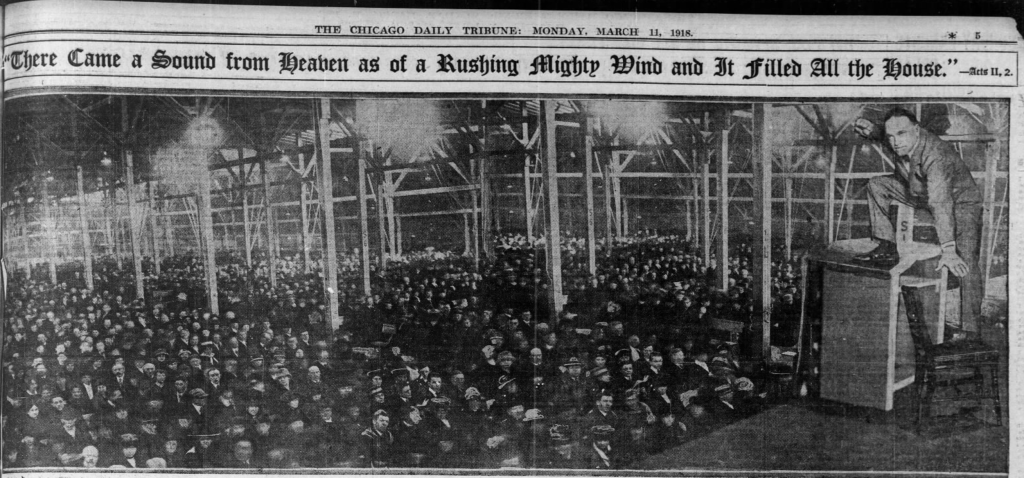
Extracted from a Chicago 1918 newspaper
Billy Sunday believed the term “Christian” should not be light nor vague. His concise, structured definition gives both challenge and invitation: a Christian is not just one who claims, but one who surrenders, confesses, strives. May we take his clarity as a prompt to examine not just what we call ourselves — but how deeply we follow.
In a culture where faith often stays behind closed doors, Billy Sunday’s early formation in the YMCA reminds us that calling is not just a private conviction — it’s forged in public discipline, community, and visible work. Let’s see how his “seminary without walls” shaped him — and what that might teach us today.
The YMCA as Bridge Between the Diamond and the Pulpit
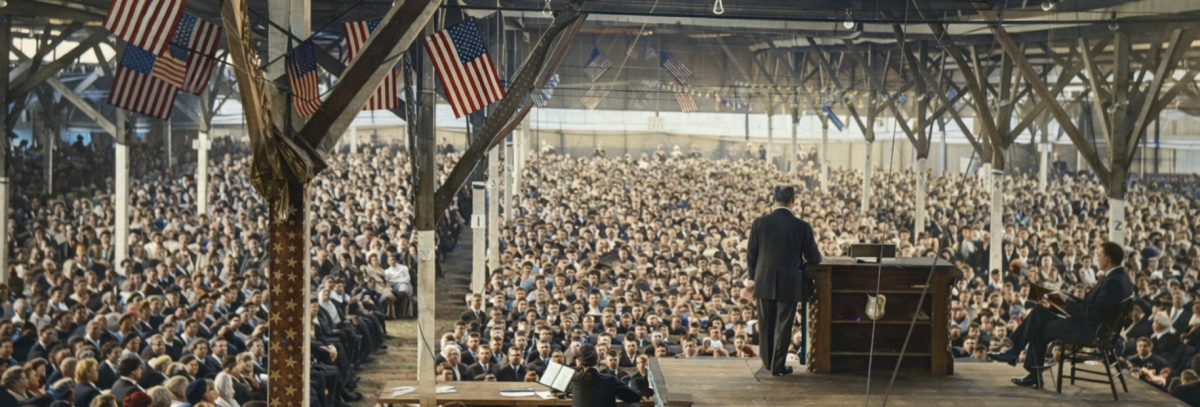
Before the sawdust trail and the tabernacle crowds, Billy Sunday’s call to preach was forged in the YMCA.
From 1889 to 1894, the Young Men’s Christian Association was his classroom, pulpit, and proving ground—where athletic vigor met moral conviction.
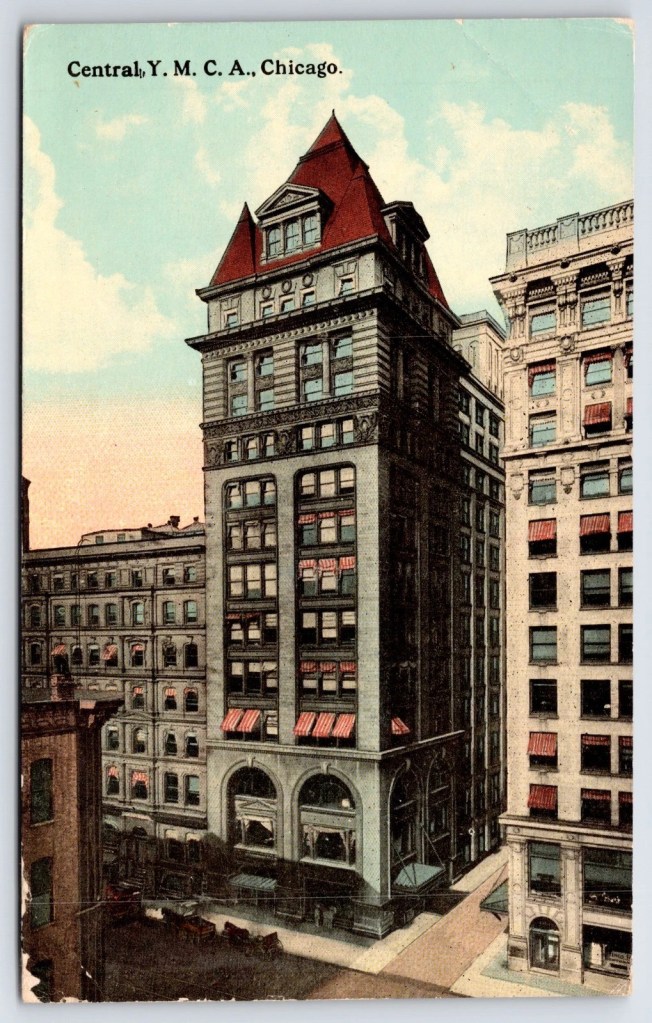
Central YMCA Chicago (built in 1893)
From Ballplayer to Brotherhood
After his 1886 conversion through the Pacific Garden Mission, Sunday joined Chicago’s First Presbyterian Church and quickly connected with the YMCA. His first sermon—“Striking Out Satan” (Feb. 14, 1889)—sponsored by the YMCA, drew hundreds and led to 48 conversions. Newspapers from Chicago to Quebec reported on the ‘baseball evangelist,’ giving Sunday his first taste of national attention.
A Training Ground for Discipline and Leadership
Hired in 1890 as Assistant Secretary of the Chicago YMCA ($83/month), Sunday learned to run meetings, lead Bible studies, and recruit men to the faith. The YMCA’s ethos of “muscular Christianity”—combining physical strength, moral purity, and social reform—shaped his lifelong view that faith should be active, public, and manly. His preaching style—energetic, physical, direct—mirrored the YMCA gymnasium more than the traditional pulpit.
“He jumped after the devil as he once jumped after a fly ball.”
Platform and Network
Speaking regularly in YMCA halls from Cincinnati to Freeport, Sunday developed his reputation as a lay preacher for working men. These circles introduced him to Dr. J. Wilbur Chapman, who later invited him to join his national evangelistic team in 1894. Even after resigning from the YMCA, Sunday continued to preach in its auditoriums—Chicago (1896), Cedar Rapids (1895), Dubuque (1899).
The Model That Endured
Summary Insight
The YMCA was Billy Sunday’s seminary without walls. It taught him how to lead, how to speak, and how to live out faith in public. Within its walls, the ex-ballplayer became an evangelist. Without it, the “Baseball Evangelist” might never have found his swing.
The YMCA wasn’t merely a stepping stone for Billy Sunday — it was formative, foundational, and catalytic. It taught him leadership, public engagement, spiritual discipline, and the courage to preach in everyday venues.
Legacy & Invitation: Calling is seldom revealed in isolation. It’s often forged through community, service, and visible responsibility. For us today, the question is: Where is your YMCA? Where might God be shaping your calling right now in your everyday context?
May we not despise the small openings, the local venues, the places of habit and service — for they may be the very grounds where our faith is tested, refined, and sent out into greater mission.
When revival calls crowds to the aisle, a critical question follows: “Will that decision endure?” In 1918, after Billy Sunday’s campaigns, journalists followed up with converts and organizers to ask whether the spiritual fervor survived time. The answers—preserved in this article—offer rare insight into how revival might seed long-term change. Read on to see what those trail hitters said, and what it teaches us about lasting faith.
Effect of Sunday Revivals in Other Cities Has Been Permanent.
BY ARTHUR JOYCE.
Does ‘trail hitting’ at Billy Sunday campaign meetings show any permanent results? Are those persons who walk the sawdust aisles over at the Tabernacle interested only in formally shaking the hand of the evangelist – or is there something definite behind it all?
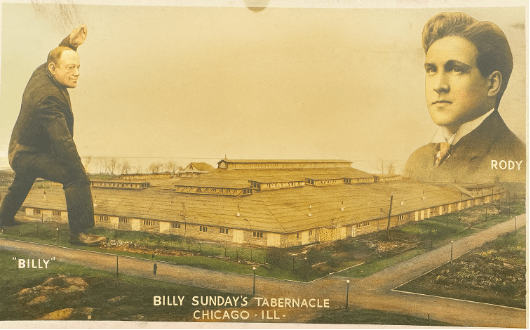
Thousands who have seen approximately 6,000 persons ‘hit the trail’ at the Tabernacle in this city are asking these questions. And about the only way in which they can be answered with any degree of accuracy is to look over the field where the evangelist has campaigned and see what’s the situation a year or two following the campaigns.
I recently had a talk with two influential representatives of cities in which Billy has campaigned and I put the questions to each of them. One is Gen. C. Edward Murray, quartermaster general of New Jersey, the other is Lucius L. Jeddy, head of the Merchants National Bank, of Syracuse, N.Y. Both were Billy Sunday ‘trail hitters’ – Gen. Murray in Trenton, N.J., and Mr. Eddy in Syracuse.
Big Sunday Club.
Gen. Murray is president of the Billy Sunday Club, of Trenton, an organization of ‘trail hitters’ formed after the evangelist’s Trenton campaign. That club now has a big membership and every member in it is personally interested in leading others to Christ.
‘The campaign in Trenton,’ said Gen. Murray, ‘awakened a remarkable interest in Christian work, especially among the men and women who ‘hit the trail.’ Churches have increased their membership to a remarkable extent; booze joints that keeled over; Sunday schools are crowded and everywhere there is shown a wonderful interest in things religious. I know many noted men who have passed up the cigars and joined the church and I know of one politician who formerly represented the booze interests, who has been converted and is now an active election on an anti-booze ticket.
‘On the whole, I should say that the Sunday campaign in Trenton has done more to evangelize the city than any other one happening in recent years. And I’m satisfied that the men who ‘hit the trail’ are still going right with the Lord and are doing their best to lead the aisles for Christ.’
Mr. Eddy told of the workings of the Billy Sunday Club in Syracuse. Every member of the organization was a ‘trail hitter’ and in the last two years, he said, they have led more than 20,000 men to Christian lives.
‘The ‘trail hitters’ not only themselves ‘stuck to their declarations to stand on God’s side,’ said Mr. Eddy, ‘but they’ve inaugurated an active campaign to bring others into the fold. And if that doesn’t show the permanency of ‘trail hitting’ I’ve lost my guess.’
Senator Vardaman, of Mississippi, made the statement that if the evangelist shall win only one person to Christ in his Washington campaign, ‘we will have been well repaid for our efforts in the revival cause here.’
In Philadelphia – three years after the Sunday campaign – there is a ‘trail-hitting’ organization in virtually every church where the evangelist assisted in the revival. There are probably 7,000 members enrolled in these organizations, and they’re campaigning every day to bring others to the church.
In Scranton, Pa., one church added 2,000 members to its rolls within six months after the Sunday campaign. Another Scranton church increased its enrollment by 1,000 in a year following the campaign. The same is true of the churches in Wilkes-Barre, Pa., and in Carbondale, Pa., churches.
In Wichita, Kan., three men of national reputation have been converted who call ‘gospel teams.’ These ‘teams’ go about the country and work in the Middle West to preach the gospel and tell of the wonderful work Billy Sunday did in their campaigns. Out of these teams has been formed a National Federation of Gospel Teams’ which are made up of leading men throughout the country – all of whom are either ‘trail hitters’ at Sunday meetings or are in the church as a result of the work of ‘trail-hitters’ who have taken up personal work. These teams have a record of 11,000 conversions to their credit.
Don’t All Stay.
Detroit has a ‘trail-hitters’ club’ of nearly 1,000 members; Los Angeles has one with about 500 men on its rolls; Atlanta has just finished organization of a Billy Sunday Club with several hundred members. And in virtually every city and town where the evangelist has campaigned there are similar organizations continuing the work Billy began. Nearly every ‘trail hitter’ in these places has associated himself with these clubs.
Of course, every person who ‘hits the trail’ isn’t a sticker. But records made by Sunday party experience year after Billy’s campaigns in leading cities show that approximately 85 per cent of those who ‘walk the aisles’ represent permanent converts.
The object of the ‘trail hitting’ is not only to bring to the ‘front’ in a public confession of faith those who have been more before taken any stand in the matter. Billy’s ‘invitations’ are intended to induce the church members to ‘reconsecrate’ themselves and ask to be more earnest Christian life from those who have already ‘accepted’ Christianity.
Legacy & What It Means This article offers more than historical curiosity: it reveals Sunday’s conviction that conversion must stick. His method didn’t end with a call to the front — it extended into communities, clubs, and networks of believers committed to nurturing change.
Application for Today In contemporary ministries, it’s easy to emphasize decisions without long-term follow-through. What lessons does Sunday’s model offer us? Perhaps this: revival without discipleship is incomplete.
Reflection & Invitation If “trail hitters” in 1918 were expected to keep walking, not wander off, who in your context needs that same encouragement today? How will the faith you ignite be sustained, multiplied, and anchored in life?
I believe profoundly in Mr. Sunday, in the purity of his motive, in the truth of his purpose, the sincerity of his aim, and the transparency of his ambition. He undoubtedly has a divine commission to preach the gospel and the people hear him gladly. Mr. Sunday has a remarkable personality. It is one of his big assets. He is in possession of that undefinable something, the influence of which men feel but cannot explain.
I believe that in Chicago Mr. Sunday’s personality will count for more than in other cities because it has a fuller chance to come to the fore, coming back, as he does, to his home city, the city of so many pleasant associations and sacred memories.
Gathering of Winona Divines Rated With a Bunch of Bums.
BETTER BE COG WHEEL
And Stop Trying to Be a Whistle Is Sunday’s Advice to Them.
Lake, Ind., Aug. 22.—”I preach to this bunch just I do to a lot of bums, and I don’t see any difference in you. You ministers criticise me, but as long as God puts His mark of approval on my work it is up to you to keep your mouths shut. If God wants you to be a cog wheel you had better stop trying to be a whistle. Some people are all front door. Open it and you are in the back yard. Many a man goes to a seminary and is filled up with a lot of stuff that is of no more use to him than a crane’s legs would be to a setting hen.”
Such was the rhetoric and classical language in which the Rev. “Billy” Sunday the base ball evangelist, addressed the Bible conference at Winona Lake. He told gray-headed ministers how to succeed and grilled those who did not agree with his methods.
Called Rev. Smith “Gyp.”
He talked like a whirlwind and whisked up and down the gamut of Christian effort like a $25,000 limousine. He slapped the distinguished English evangelist, the Rev. Gypsy Smith on the back and called him “Gyp.” “Gyp” smiled a sour smile and looked as pleasant as he could.
While the message of Rev. Billy was as hot and peppery as chili sauce, it was received with fervent “amens” from over the auditorium and at the close “Gypsey” Smith gave his shoulder a pat of approval and Dr. Chapman smiled his approval.
Dr. Chapman said: “Unless a man is born with preach in him he will never get there. Too many preachers are more interested in drawing their salaries than in saving souls. Show me an earnest man and I will show you a man that is making the gang sit up and take notice. The earnest pastor does not sit around and wear out the seat of his pants waiting for something to turn up. The only thing that will turn up for him is the sod in the grave yard.”
Thomas E. Green, well known to Chautauqua audiences published in the June 1910 issue of Hampton’s Magazine, an article on “Revivals and Revivalists.” The whole article is full of interest. Chautauqua Committees who have booked Billy Sunday will do well to secure it, as it furnishes splendid material for publicity. He quotes the following estimates of Sunday’s work in places where he has held meetings: The leading pastor in the converted city, a man of ripe judgment, said: “I looked forward to this thing with a great deal of anxiety. When the evangelist came he quite captured me. He is unique. There is only one of his class, and probably it is well that it is so, but he showed himself sincere and honest. There were 736 conversions, and in addition about 1,500 have united with the churches.”
A very hard-headed banker told me: “The cost to the city was something over $16,000. The evangelist got over $7,000, but he earned every cent of it. If a lot of preachers in this country would do as much in five years as he did in five weeks, and work half as hard, they might be entitled to as much return.”
A leading editor said: “His sermon on ‘booze’ was I believe, the greatest individual effort I ever heard from the platform. He talked to six thousand men, and held them as in the hollow of his hand. Up in our bindery I understand all the boys and girls were converted and they are sure a happy bunch.”
I know of one mid-Western manufacturing city in which a fervid revival was held by one of the greatest revivalists of the day. It was not a “bad town” in the beginning. It was a “river town,” however—a “liberal town.” The saloons had never been officially closed even under state law of the stringent anti-saloon sort. For a city of 25,000 people it was what is called “wide open.” The revivalist came, and for six weeks his work went on. At the next city election, as a direct result of the revival, the people voted out a “liberal” administration, and voted in a “closed town” administration. The saloons were closed, and the town is so well pleased they are likely to remain closed, for a long time.
I have known Billy Sunday ever since the days when he came to the old Chicago Ball Club, the days when with my athletic ardor yet unabated I was “Chaplain” of the League.
Billy played rattling good ball, championship form, and he has kept the same standard during a phenomenal career. His meetings are enormous in size and results. His “thank offerings” are the largest any evangelist has ever received.
“Drunkenness, gambling, adultery, theatre going, dancing, and card playing are damning America, and nothing can save it from ruin but a revival of religion,’ says Billy Sunday.
“You think, then, that our popular amusements and recreations are wrong?”
I know it. Dancing is nothing but a hugging match set to music. It’s the hotbed of licentiousness whether in a fashionable parlor or in a dive. More girls are ruined by it than by all other things combined. Talk about the poetry of motion! It’s just a devilish snare of souls. Let men dance with men and women with women, and the thing wouldn’t last fifteen minutes. The slum dance is better than the club dance, because they wear more clothes at it.”
“Sow bridge whist and you reap gamblers. The man who sits at a table and bets a thousand on a jack pot is no more a gambler than the society belle who plays bridge for a prize.”
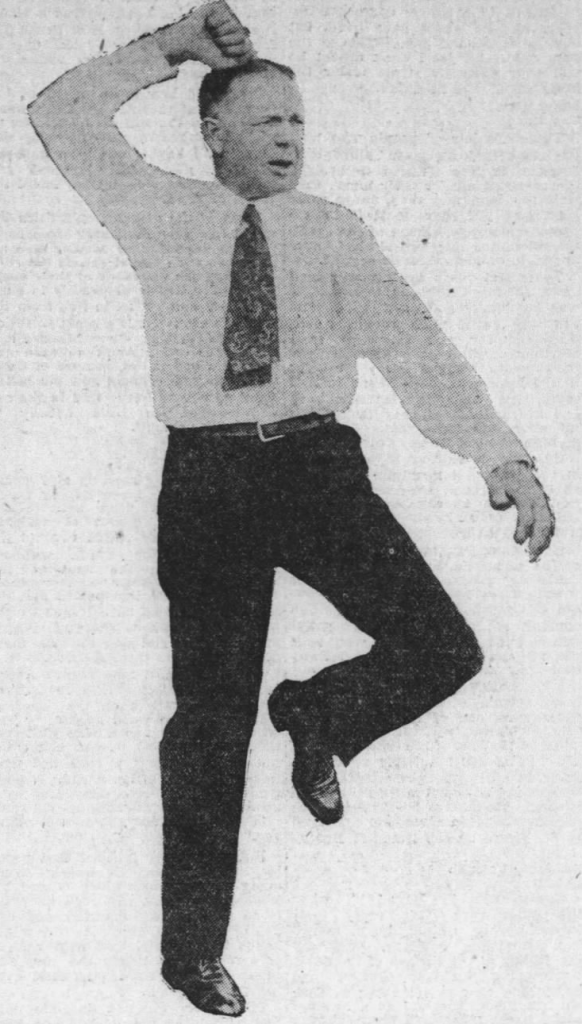
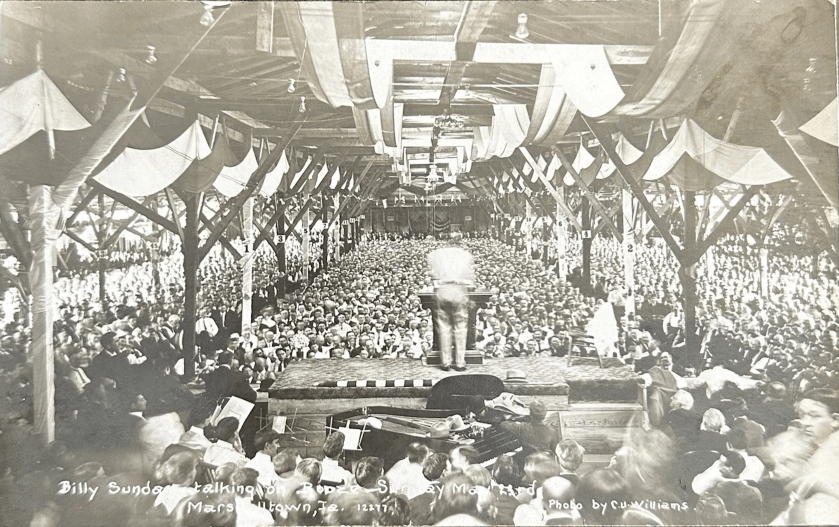
That’s Billy Sunday, America’s greatest evangelist. On the platform he “plays ball.” Attitude, gestures, method—he crouches, rushes, whirls, bangs his message out, as if he were at the bat in the last inning, with two men out and the bases full. And he can go into any city in America and for six weeks talk to six thousand people twice a day, and simply turn that community inside out.
I owe more to Dr. Chapman than to any other man that I ever became a preacher. I traveled with him for two years as an assistant. He picked me up out of the corn rows of Illinois. We went to a town up in Kansas one time to conduct a series of meetings. We were accustomed to have union meetings, but in that place, when we arrived on the scene, we found that they could have had a union meeting had it not been for a quarrel with the Presbyterian church. They had had a fuss and there were a few people live and awake, up-to-date, who said they’d withdraw. So they went down to the bank of the river and they built a church, they had a good live-wire preacher there who was going at a good gait all the time on high gear, while the other fellow had the brakes set.
The Atlanta Constitution. Wed, Nov 07, 1917 ·Page 12
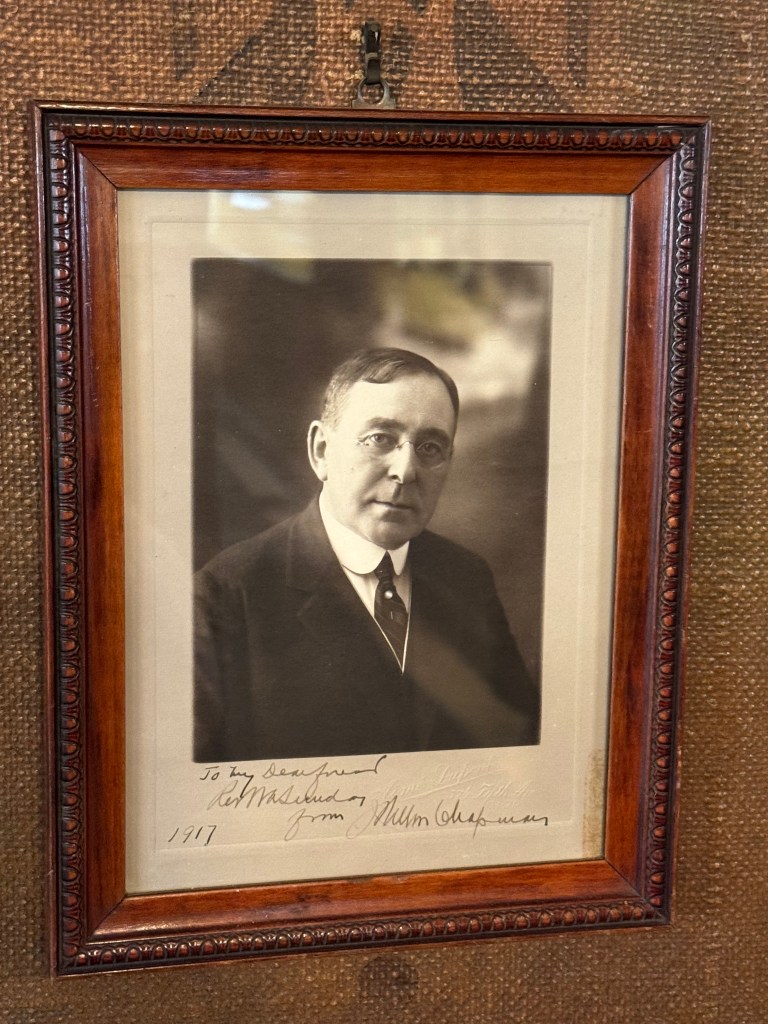
This picture of Chapman hangs on Billy’s wall in his Winona Lake home. It is inscribed with the date 1917.
Source – the author of this article is probably the wife to Evangelist M.B. Williams.
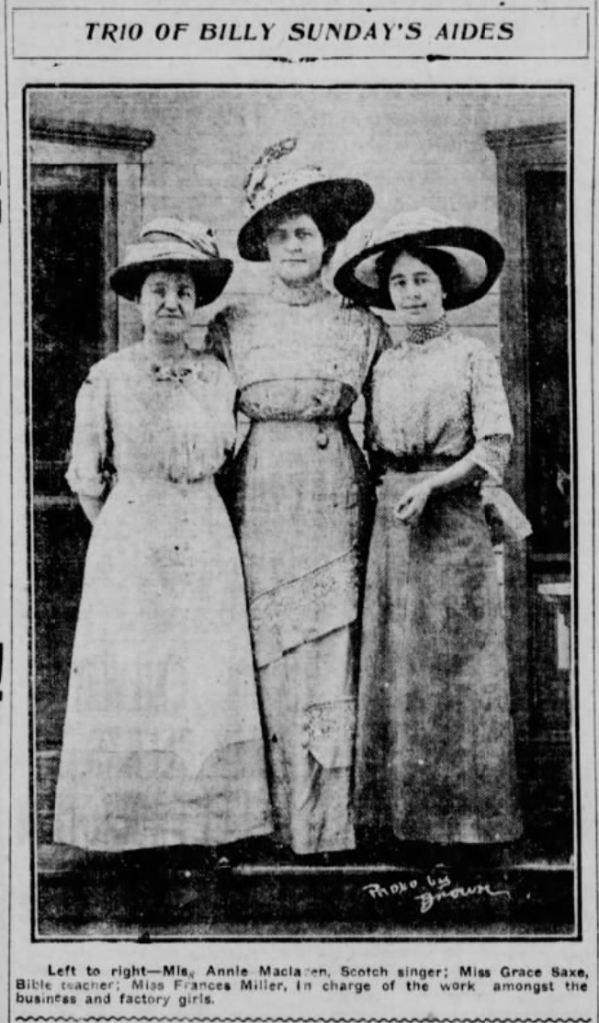
Grace Sax joined the Sunday team in February 191. She immediately assumed the leader of the cottage prayer meetings, as well as Bible teaching and training local churches to handle the fruit of the Sunday revivals.
The Liverpool Evening Review. Wed. Sept 18, 1912:1. Grace is in the center.
This article in a 1911 newspaper gives a glimpse of the importance of prayer to Grace.
Miss Saxe then held up little blank book which is called “Answered Prayer.”
She calls it, “A Record of the Footsteps of a Prayer Hearing and Prayer Answering God.” It is divided into four blank columns headed. First, date of asking; second, the request; third, the special promise pleaded; fourth, date when answered.
In this record she puts only the prayers which to man’s eyes it seem impossible to have answered. All of her prayers, she says, have not been answered thus far—many of them have however been answered fully.
“There are conditions to fulfill if prayers are to be answered.” These seven conditions she has in the back of her “Answered Prayer”
1. Personal condition, Psalm 66:18,
2. Forgiving Spirit, Mark 11:25,
3. Spiritual Motive, James 4:3.
4. Asking, Matthew 7:7,
5. Asking in Faith, Mark 11:24,
6. Asking according to God’s will (not to interfere with His plans) 1 John 5:14,
7. Asking in Jesus name, John 16:23. “Pray so that if it were written we could ask Jesus to sign it.”
In our prayers Miss Saxe suggests that the following should be the form of approach to God: Adoration, Confession, Thanksgiving, Supplication.
Taking the first letters of these words in order, we spell the word Acts. In Genesis 32:9-12 we find that order observed in Jacob’s prayer. In conclusion Miss Saxe suggested the reading of Andrew Murray’s ‘With Christ in the School of Prayer.’—Mrs. A. R. Williams.
Source – the author of this article is probably the wife to Evangelist M.B. Williams.
The following story was printed in a paper on March 3rd, 1915:
“One of the special features of the meeting yesterday afternoon came when Miss Grace Saxe, of Sunday’s party, rushed from the platform and threw her arms around the shoulders of a woman trail hitter. Miss Saxe later explained that the woman was a relative, living in this city, and that she has been praying for her to come to the front since the opening of the campaign.”

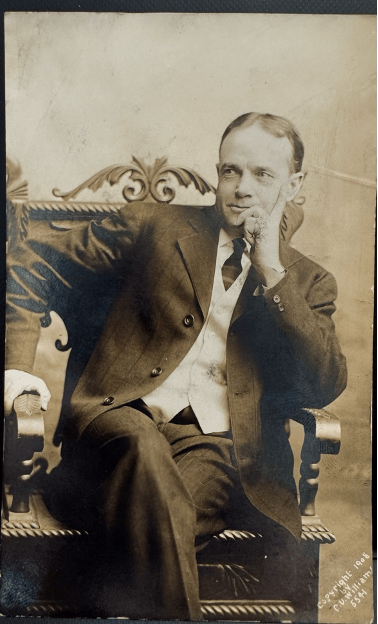
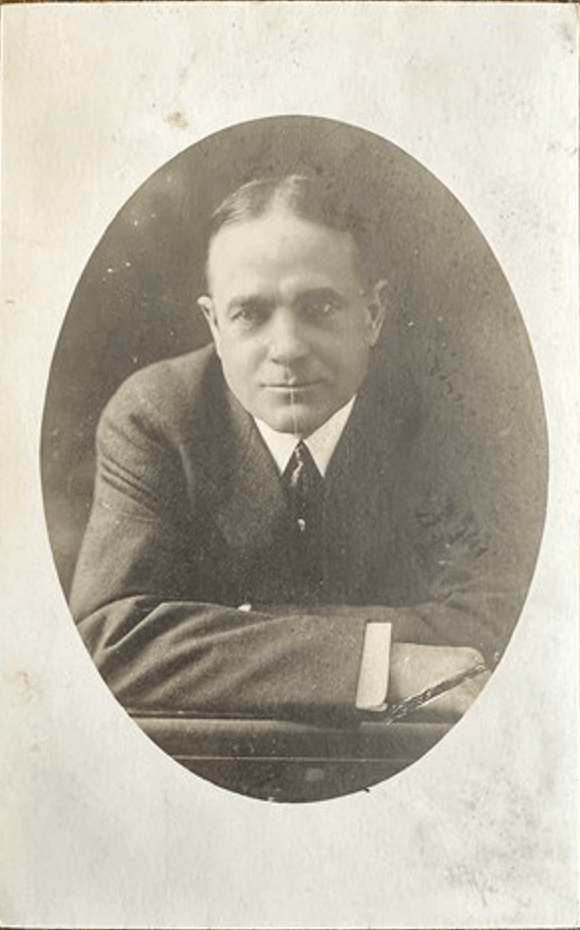

 Evangelist Billy Sunday (1862-1935)