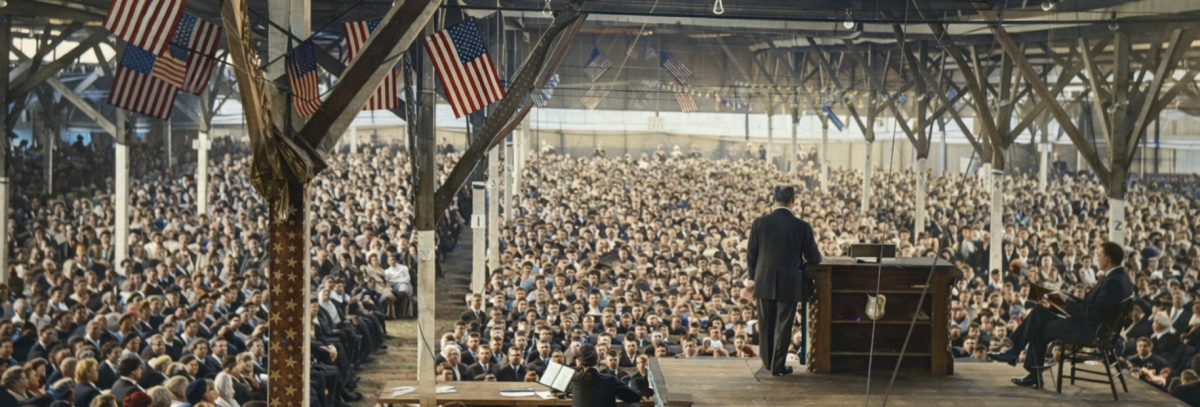
Springfield, Illinois (early 1909)

Billy Sunday Comes to Springfield, Illinois (February–April 1909)
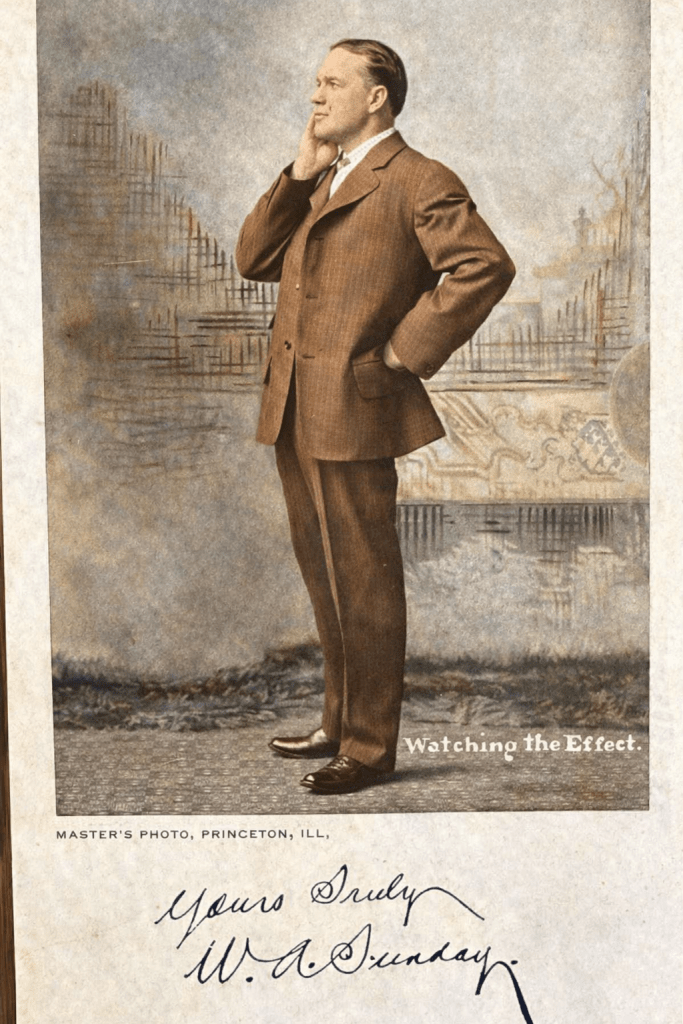
From February 26 to April 11, 1909, Springfield, Illinois became the center of one of Billy Sunday’s most significant early urban revivals.

This campaign followed a string of highly successful meetings in 1908, including his powerful revival in Bloomington, Illinois. By the time Sunday arrived in Springfield, he was already becoming a nationally recognized figure — a former baseball star turned evangelist whose name drew crowds, controversy, and intense public attention wherever he preached.

For six weeks, a massive wooden tabernacle dominated 2nd Street between Monroe and Capitol. Built specifically for the meetings, the structure was simple in design but enormous in scale, capable of holding thousands of people at a time. Night after night, it filled with hymn singing, prayer, and Sunday’s unmistakable blend of humor, blunt moral challenge, and urgent appeals for personal decision.

Tens of thousands attended over the course of the campaign. Families came together, churches cooperated, and people traveled from surrounding towns to hear the most famous preacher in America.

By the end of the revival, newspapers and church leaders reported that 4,729 people had made public commitments to Christ. These were not just momentary emotional responses; many went on to join local congregations and participate in community life.

One of the most lasting outcomes of the Springfield meetings was the founding of Washington Street Mission. Born out of the spiritual energy of Sunday’s campaign, the mission was created to serve the poor, hungry, and vulnerable in the city — and it continues that work to this day, more than a century later.

The timing of the revival made it especially meaningful.

Only a few months earlier, Springfield had been shaken by the 1908 Race Riot, one of the most violent racial conflicts in Illinois history. Tensions still lingered when Sunday arrived. His sermons, which emphasized repentance, moral reform, and personal responsibility, resonated deeply in a city searching for healing and stability.
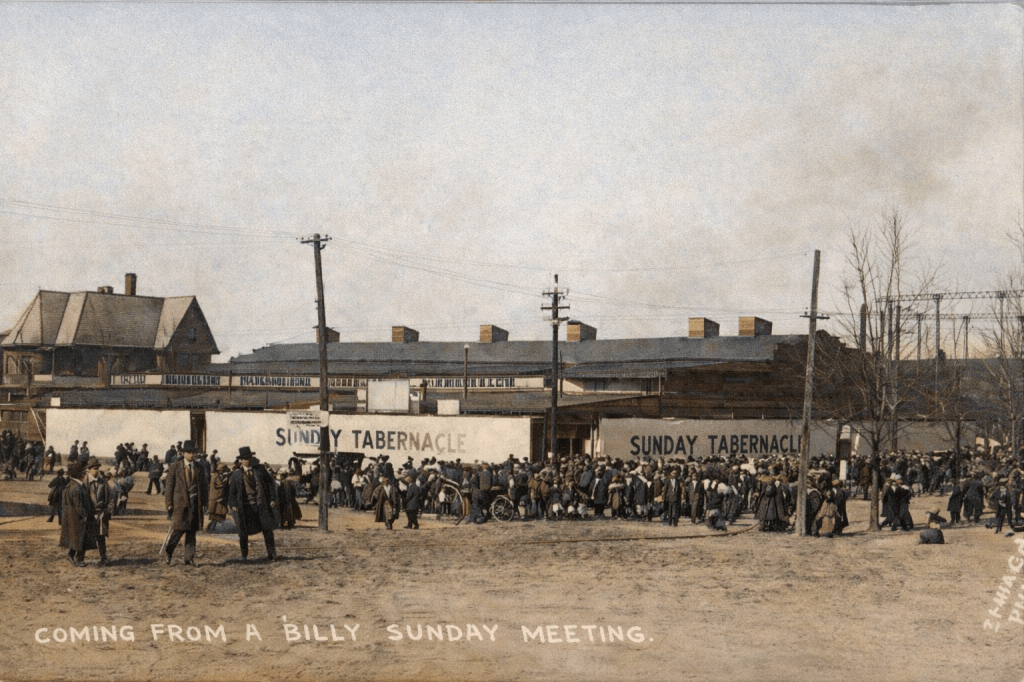
While Sunday did not directly address political or racial issues in the modern sense, his call for transformed lives and renewed community carried special weight in a town still recovering from turmoil.

The Springfield campaign marked a turning point in Billy Sunday’s ministry. It was one of his first major city-wide revivals and helped launch a decade in which he would preach in America’s largest urban centers — from New York to Los Angeles.

More than just a revival, Springfield in 1909 was a milestone. It showed that Sunday could move beyond small towns and regional fame to shape the moral conversation of the entire nation.

For six weeks that spring, Springfield was not just the capital of Illinois — it was the pulpit of America.
Post-Wilkes-Barre campaign results (published May 1913 in The South Bend Tribune)

WHAT SUNDAY DID AT WILKES-BARRE [February 23-April 13, 1913]

OFFICIAL OF CAMPAIGN MAKES STATEMENT ON RESULTS.

CITY BETTER GENERALLY

Business Was Improved, Politics Was Elevated and Social Life Was Raised to Higher Standard Says Man in Interview.

The Tribune’s Special Service.

WILKES-BARRE, Pa., May 6.

The Sunday party has gone from Wilkes-Barre to South Bend, Ind.

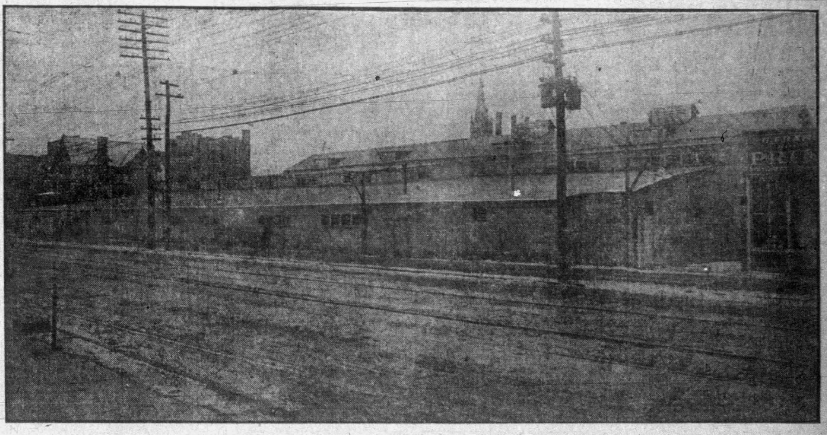
Exterior view of the Billy Sunday Tabernacle.
Wilkes-Barre Times Leader. Friday, February 21, 1913.

The tabernacle is being torn down day by day. The thousands who gathered beneath its roof to hear the greatest winner of souls in this generation have scattered and gone about doing the duties of their individual lives, but Wilkes-Barre and the Wyoming Valley will never be the same as it was a few months ago, before Billy Sunday came to this city. The moral and social life of the community has been given a new moral tone to the extent of which cannot be estimated for years.

This is the statement of Rev. J. W. Parkin, chairman of the Wilkes-Barre Ministerial Evangelistic committee, which had charge of the recent campaign in this city.

Moral Awakening.

“The most conservative,” he declared, “will admit that there has been a moral awakening the like of which has never been experienced here before. It is absolutely impossible to measure the immense amount of good that was accomplished, but I am sure that there is not one that regrets the hours and time and even money spent in planning for this campaign.”

“What,” he was asked, “do you consider the result of this visit on business here? You know it was prophesied that he would injure business.”

“An honest business could not have received greater help than came through the Sunday campaign,” was Mr. Parkhurst’s opinion. “A moral awakening such as we have had could not help but improve business. This has been evidenced in many ways, but particularly in the fact that people now realize more keenly than ever their obligations to each other and to the community. Hundreds of merchants have stated that accounts which they had considered closed because of inability to collect have been paid. There is a greater feeling of mutual respect now between employers and employes.

Politics Elevated.

“And politics; what about that? Do you think the campaign will have any influence on the politics of the country?”

“Well, I’m not much of a politician,” said the campaign leader, “but it seems reasonable to me to suppose that when a man finds himself in the position of a candidate for office he will be more careful in the future than ever before that there will not be any question about his private or business life.

There are many men in this city who have never been heavy drinkers for years who have bound themselves to abstinence. Hundreds of others who have been more or less indifferent or lukewarm in their opinion of intemperance have been aroused to a more active interest.”

“The moral wave,” he declared, “has been given a refining influence that is going to raise the standard of the community. Wilkes-Barre needed just such an indictment to make it realize where it was leading. I know hundreds of young people who have ‘cleaned house’ since Mr. Sunday came here.

‘You consider then that the people who criticized Mr. Sunday and his methods have been answered by the results which have been attained?’ was asked.

‘The critics have had nothing to offer that will accomplish the same amount of good that has been accomplished by Mr. Sunday.’

February 22, 1913


“Immediately following Columbus, Mr. Sunday opened a series of meetings at Wilkes-Barre, Pa., the farthest east of any district in which he had ever worked. The campaign opened on Washington’s Birthday—February 22—1913. Rev. W. M. Randles, pastor of the Bethesda Congregational church, gives the number of converts as 16,348, and the free-will offering as $23,527.66. In only this one respect did the Wilkes-Barre campaign exceed that of Columbus.”

  • Frankenberg, 1917: p. 132.