What is revival? Billy Sunday answers

Part of his sermon, Revival Methods Defended.

What is a revival?

It is a campaign in the name of God against the world, the flesh and the devil, and against a revival you will find every brewer …. every whiskey seller in this valley; every blackleg gambler in this valley; every sham madame of the red-light district; every man and woman that feeds and fattens and gormandizes upon the virtue of men and women, so if you want to line up with a bunch like that, God pity you; that is the best compliment on God’s earth.

Men say the day of the revival is over. Fellows harp on that in the Methodist conference, in the Presbyterian meetings, in the Baptist associations, in the Congregational associations—the day of the revival is over. No, it is not. No, only with the fellow who vomits out the sentiment; but it is not over with God. The day of the revival is over. God Almighty leaned over the battlements of heaven and looked down into the coal mines of Wales and said, “Oh. Roberts!” and out of the depths of the coal mine came that grimy, soiled man, with dirty face, with a little lamp in his cap, and he said, “What is it, God?” And God said, “I want you to go and shake up Wales,” and he gave Wales the greatest revival that ever swept over that land since the days of Pentecost. There was not a college professor or preacher in Wales that God would trust with the job.

The Tribune-Republican. Wed, Mar 04, 1914 ·Page 10

Are you gonna ‘take the count to the Devil’ asks Billy?

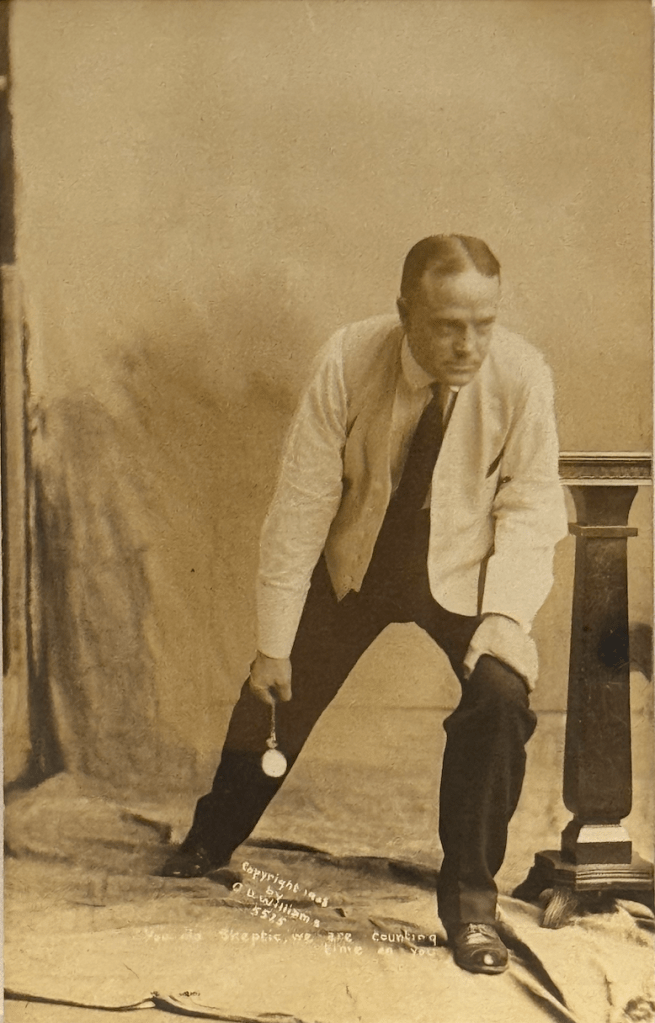
THIS IS HOW BILLY FINDS OUT IF YOU ARE GOING TO “TAKE THE COUNT”

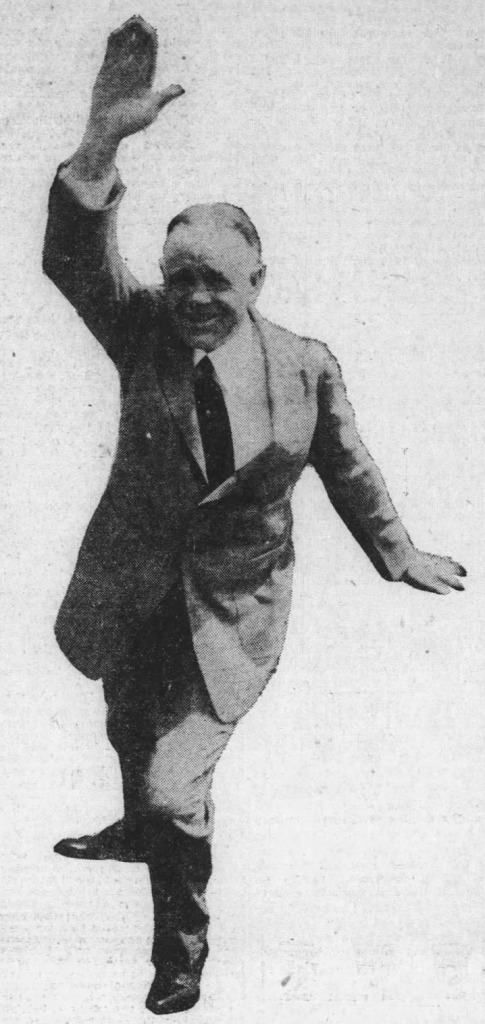
BILLY SUNDAY IN UNUSUAL POSE.

Billy Sunday in a famous pose.
C. 1908. Author’s Collection.

The above is a characteristic position for Billy Sunday to assume during one of his meetings for men only.

He bends over until his right knee nearly touches the floor of his platform; then he pulls out his watch and inquires if you are going to “take the count” for the devil.

Sunday’s sermons are filled with such unusual features as this, but they are never so plentiful as in the men’s sermons. There is no doubt about it the evangelist is at his best in these talks. He always bends every energy to the end of impressing his male audience with the truth of what he is saying, and in this he never fails.

The South Bend Tribune. Thu, Jun 05, 1913 ·Page 10

Did Billy Sunday have more than one copy of his sermons?

TO HAVE SERMONS DEPOSITED IN VAULT

BILLY SUNDAY GOING TO TAKE PRECAUTION AGAINST FIRE.

Citation: The South Bend Tribune. Tue, May 13, 1913 ·Page 7

Just Now, Evangelist Has No Duplicate Copies of His Famous Addresses—Ackley Does Work.

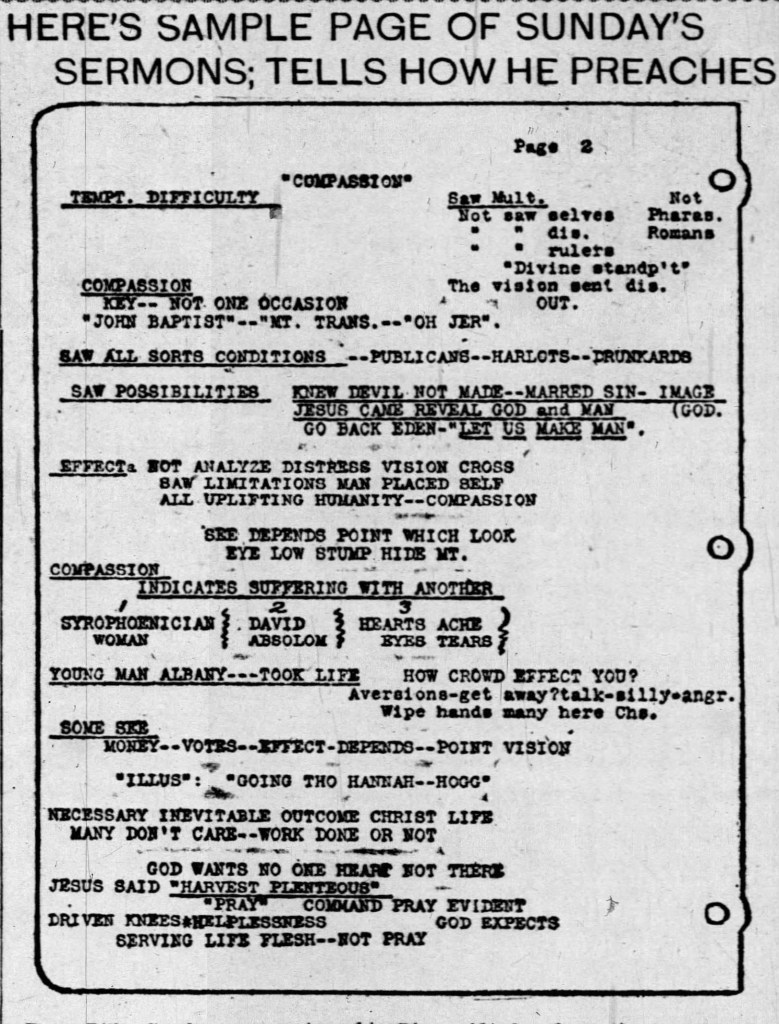
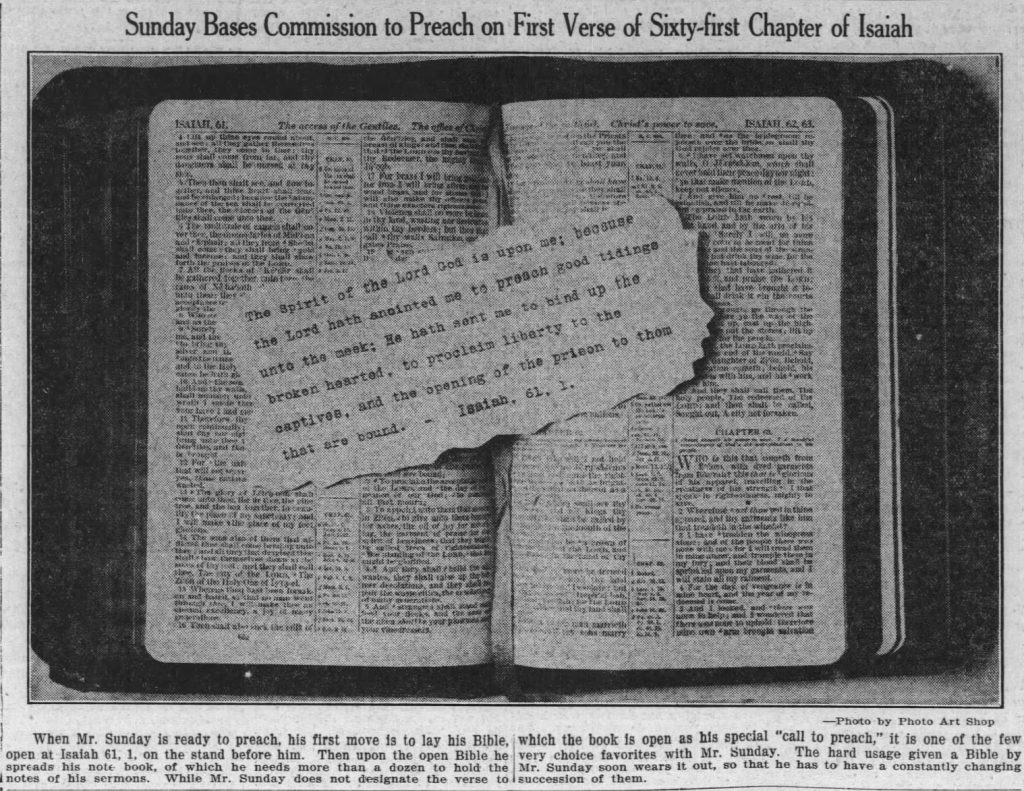
“No, I have only the one copy of each of my sermons,” replied Billy Sunday to a question as to whether he had duplicates of his sermons.

“These sermons are not in full,” continued the evangelist, as he showed the books in which he keeps the addresses that sway so many thousands; “they are just mere skeletons of the sermon and no one else but myself can read them, or at least I don’t think that anyone else can.”

Mr. Sunday was asked if he could remember the sermons if they were stolen and he replied that he recalled the majority of the material that composed them. He says that he intends to have duplicates made of the sermons and have them put into a safety deposit vault so that if one is stolen or should be destroyed by fire or in some other manner, he will have a copy.

“I thought at first that I would be able to get them copied this summer,” he said, “but it don’t look like the work will be accomplished, as I have so much to do this year.”

B. D. Ackley, pianist of the Sunday party, and secretary to the evangelist, copies the sermons of Mr. Sunday. This work takes up quite a bit of the pianist’s time, as Mr. Sunday is continually adding and detracting from his sermons as he acquires new material from many different sources.

“I always let Ackley fix up the sermons. He has a knack for doing things up pretty and nice,” said Sunday, while talking of his work.

“Now, boss, just because we have company you don’t need to make fun of me to my very face. He knows that I can’t fix them right,” said Ackley, as he turned to the visitor.

“That is all right; you do it just to suit me,” replied Sunday.

It is probable that sometime within the next year or so the evangelist will have all his sermons duplicated and deposited in a safety deposit vault.

The South Bend Tribune. Tue, May 13, 1913 ·Page 7

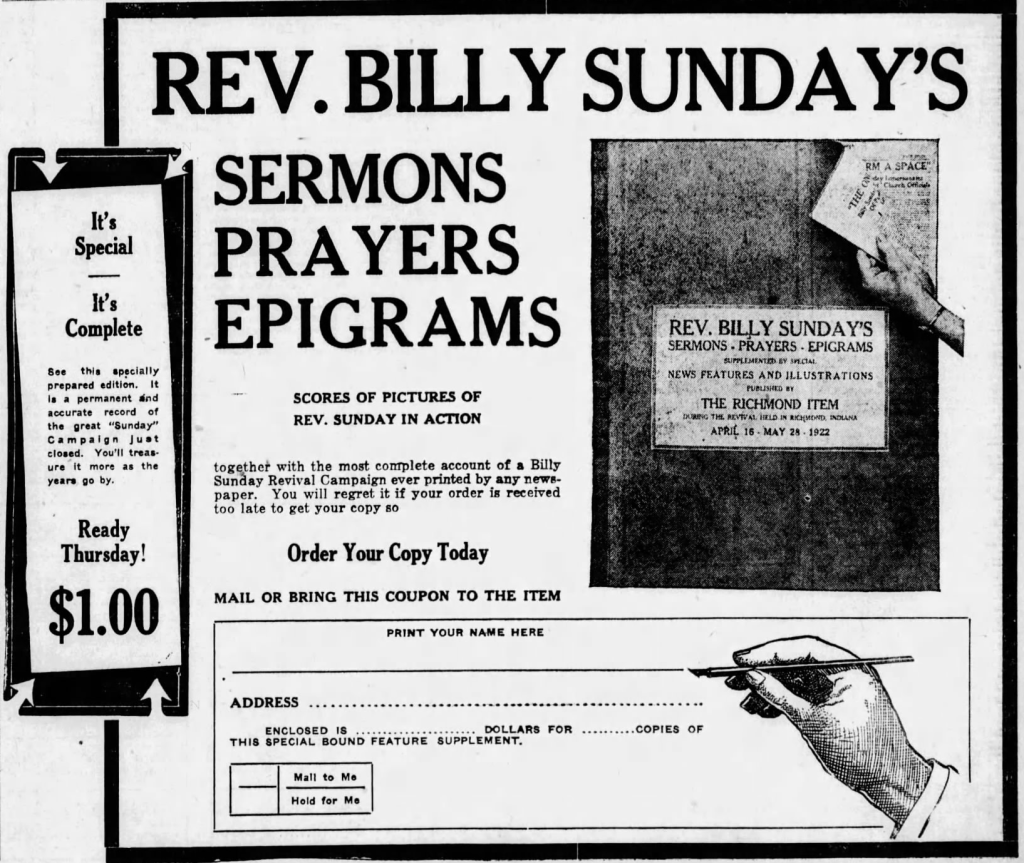
Billy Sunday preached 95 times during his Richmond, Indiana campaign in 1922

Billy Sunday preached 75 times in the tabernacle during the six weeks of his Richmond campaign (April 16 – June 4), and at least another 15 times outside the tabernacle, in surrounding towns close to Richmond. He sometimes preached four times in one day.

As reported in The Richmond Item. Sun, May 28, 1922 · age 7:

NINETY SERMONS TO LAST NIGHT

Old Man Statistics Gives Some Interesting Figures to The Item Reporters

Old Man Statistics dropped into The Item press box, yesterday, and when the reporters were not there, left a bundle of facts. He said Billy Sunday would preach his ninetieth sermon Saturday night, since the day he arrived at Richmond.

That seemed rather too many for the reporter who checked up on it. Yep! Old Man Statistics was all right, it appeared. With the sermon last night Mr. Sunday, has preached 90 at the tabernacle, if one counted the afternoon that Mr. Sunday spoke to the children when the Sunday school convention was held there.

To bring the total to 90, Old Man Statistics, mentioned two sermons at the country club, others at the high school, Earlham college or at the Pennsylvania shops. Then came trips to Portland, Anderson, Greenville, Bradford, O., and the morning sermons each day this week, at Liberty, Hagerstown, Spiceland and Cambridge City.

First sermon preached at Richmond, Indiana (1922)?

Full text as it appeared in the. Transcribed by AI. Errors may exist.

“Why Call Me Lord, Lord? Asks Billy Sunday as He Hits Hypocrites and Religious Shams. Palladium-Item. Mon, Apr 17, 1922 ·Page 7

Text: Luke 6:46

Christianity Can Save the World, Says Evangelist in Sunday Night Sermon—Some Stingy People Can’t Give Away 10 Cents Without Singing, “God Be With You Till We Meet Again.”

The Text—”Why call ye me Lord,

Lord, and do not the things I say?”

Luke 6th chapter, 46th verse.

Billy Sunday delivered the following sermon on Easter Sunday night in the tabernacle:

Why call yourself a Democrat and then vote the Republican ticket?

Why call yourself honest and then lie?

Why say that you are pure and then live in sin?

“Why call ye me Lord, Lord, and do not the things which I say?”

What did Jesus mean? Do you believe he meant the things that are recorded that he said, or do you believe that he said one thing and meant another? Do you believe that he uttered things that were impractical and impossible for us to carry into effect and then told us he’d damn us if we did not live up to it? I don’t believe you are fool enough to charge him with that, and if you are it doesn’t justify the fact that you are a fool if you do it.

Is the Standard High?

Not for Christianity.

Did he put the standard too high for human attainment and then tell us he’d damn us if we didn’t reach it? No!

I read where a Bishop of the English church said that the teachings of Jesus Christ should be regarded as ideal and were never intended to be carried into effect or lived.

I knew of a Y. M. C. A. that had a debating society, and it just decided that under social, political, economical conditions, that the teachings of Jesus should be regarded as ideal and were not intended to be lived, yet they both had the audacity to call themselves Christians.

Another man said Christianity had failed. He lied!

I will admit that Christianity has fallen away beneath love as the original standard. Love is the dominant principle of the world; love can never be defeated. Love may be checked; love may be prevented, for the time being, in accomplishing its aim, but love will drill a tunnel through all the mountains of opposition and reach the goal of a touchdown. Love—it’s the mightiest thing in the world! And the world is starving today for the manifestation of the love of God in the hearts of men and women.

Christ’s Power Will Drive Out Hatred.

I always had a good deal of sympathy with a hobo that went up to the back door of a professing Christian woman’s home and panhandled her for a cup of coffee and mooched her for a flapjack and after much persuasion she came across with a tract on the bread of life, and he began to tear the tract up and curse and mutter. I have no sympathy with his oaths but I have a good deal of sympathy with the feelings that possessed him. What that fellow needed then was a piece of meat with two pieces of bread under it. The shortest course into that fellow’s heart was by the way of his stomach. It was the quickest way to land him there.

I believe that there is no prejudice existing between man and men, between masses and classes, between capital and labor, that can’t be driven from the world by the principles of Jesus Christ manifested in the lives of man and men, masses and classes, capital and labor.

I read of a Scotchman who learned just enough of the French language to say, “God loves you,” and he walked the streets of gay, sinful Paris with the tears trickling down his cheeks and his arms outstretched, crying the words in French. It struck conviction to the hearts of the people until out of that the great All Mission work in Paris was started.

Story Shows How Christianity Works.

I heard of a professor who was a Christian. He had a brother-in-law, a doctor, who was an infidel and this doctor said the reason that all Christians didn’t sin was because they weren’t sufficiently tempted. Somebody challenged the statement, and said, “What’s the matter with your brother-in-law, the Professor?” He said, “He’s like the rest of the bunch, and I’ll bet you ten bucks that I can make him mad.”

The wager was made. These two men had a business transaction and the doctor purposely falsified the count in order to test the religion of his brother-in-law, the professor, and in response to some question that the doctor knew was a lie (for he was trying to sting him and put one over on him, and the professor knew it was) the professor jumped to his feet and said,

“You’re a liar. Get out of my house.”

And he drove him out. And his brother-in-law, the doctor, took up his hat and went, somewhat chagfallen to think that so great and good a man had sidestepped, but he couldn’t think he had rightly interpreted human nature and was a ten in the hole.

So they went to their homes and retired. Soon the old dog was humming off like a Twin-Six, and the old professor was rolling and tossing as if he troubled a troubled mind. But at two o’clock in the morning he dressed, walked four miles across the city and knocked on his brother-in-law’s door. His brother-in-law opened it and he said.

“Yesterday I called you a liar. I am sorry I did it. I have come to ask you to forgive me.”

And he drew him in and said, “If that’s religion, that’s the brand I’m looking for, and I think I’d better take a good old hypodermic injection of the good old-time, worth-dying for religion.

Christ’s Opinion on World Problems.

What did Jesus Christ say? I haven’t time if you had the disposition to hear all that he had to say, but listen! Jesus Christ said, Forgive your debtors.” And the world says, “Sue them for

their dough.”

Jesus Christ said, “It’s more blessed to give than to receive.” The world says, “Get all you can and then can all you get.” Jesus said, “Give to him that asketh of thee, him that would borrow of thee turn not away.”

The world says, “Go to the Associated Charities, I subscribe.” Jesus Christ said, “You can’t serve God and mammon.” The world says, “God on Sunday, mammon through the rest of the week.”

Jesus said, “Love your neighbor as yourself.”

The world says, “First come I, then you.”

Jesus Christ said, “Him that smiteth thee on one cheek turn to him the other also.”

The world says, “Call a cop.”

Jesus Christ said, “Let him that is among you without sin cast the first stone.”

The world says, “Choose judges that know the law and will give a decision in your favor if you put them there.”

Jesus Christ said, “Whosoever would be great among you, let him be servant of all.” The world says, “If you want to

be some pumpkins, you must keep a valet.”

Jesus Christ said, ‘What God hath joined together let not man put asunder.’

The world says, “I will divorce you and marry another woman and that will not be sin.”

You lie!

The only Scriptural grounds for divorce is adultery. When it comes to the divorce question I am a Roman Catholic from the top of my head to the bottom of my feet. I believe the Bible teaches that you have no right, my friend, to get a divorce for any reason, but you never have a right to re-marry as long as the man or woman you are divorced from is alive.

Never Would Marry Divorced Person.

I am an ordained minister of the gospel, and help me God I shall never prostitute my position as a minister to enable calling to unite in marriage any man or woman who has been divorced for any reason, as long as the man or woman from whom he or she is divorced is alive!

One day in Chicago a fellow came up and rang the door-bell, and oh, he was dressed fit to kill! Had on a silk lid, he had a diamond in his shirt front as big as a hickory nut, patent leather shoes, a Prince Albert coat, silk-lined, hung below his knees.

And there was a girl about eighteen years of age—a peach of a girl—one

of these kind of girls you’d involuntarily turn and look at twice if you saw her on the street—standing by his side.

So he tipped his lid and said, “Does the Reverend Mr. Sunday live here?”

I said, “I am he.”

He said, “Will you officiate at our wedding?”I said, “Have you the marriage license?”

He said, “Sure Mike!”

I said, “I’m from Missouri, come across.”

So he pulled it out and I looked at it and I said, “That looks good to me.”

I said, “Have either of you been married before?”

He said, “Not the young lady; I have.”

I said, “Your wife living or dead?”

He said, “She’s alive.”

I said, “Beat it—twenty-three for you, old scout.”

He said, “What do you mean?”

I said, “I mean according to my interpretation of the Bible I haven’t any right to hook you up to that girl.

He said, “I have a license here from the county clerk.”

I said, “Some things that are legally right are morally rotten. That’s one of them.”

I said, “Perhaps the fellow that engineers the brick-cheese box around the corner will fix you up for a ten-spot but not your Uncle Fuller.

A man comes to me and says, “I have been married and divorced living unhappily—what will I do?”

I said, “I would go home and get down on my knees and say, ‘Look here, Lord, I’ve sinned against you, transgressed your laws, forgive me. Get up and trot square and go decently.’ That’s the best advice I can give you under the circumstances.”

Now listen! “Why call ye me Lord, Lord, and do not the things I say.”

The Real Essence of Christian Charity.

In the works of benevolence? How much do you give away? I don’t want to do anything to despise scientific charity. I don’t care to do anything of that sort, but listen! That doesn’t mean that if a fellow meets you on the street and asks you for your clothes that you’ve got to yank them off and give them to him and go home clothed in sunshine.

That doesn’t mean if some lazy wop that never worked in his life asks you to get out of your automobile that you climb out and let him get in and drive away and you hot-hoof it.

That doesn’t mean if you work and save your money and build your home that you’ve got to move and give it to somebody—no! Listen!

A Jew wouldn’t speak to a Samaritan, a Samaritan wouldn’t speak to a Jew; a Jew wouldn’t loan to a Samaritan, neither would a Samaritan loan to a Jew. Not at all! Jesus Christ went into Samaria. There he sat on the well-curb—hungry, dust-covered. Out came that woman and he asked her for a drink of water. She said,

“Not on your life, you’re a Jew, I’m a Samaritan. We have no dealings one with the other.”

“Now,” Jesus said, “look here, if you become my disciple you’ve got to loan to a Samaritan if he asks you, the same as a Jew. Give to him that asketh of you and him that would borrow of you turn not away.”

If a Samaritan came to borrow from a Jew, he gave him the cold-shoulder, and vice-versa, but Jesus said,

“Here, if you become my disciple you’ve got to give to him that asks you whether he’s a Jew or a Gentile.”

It doesn’t make any difference sumed annually. Thirty million men and boys smoke. Allowing it takes ten minutes to consume a cigarette, it would take an army of two million six hundred thousand men, smoking ten hours a day, to consume the annual output of the United States. I have heard keen, shrewd men say that they would about as soon their boy would drink as smoke cigarettes. Oh, if you keep on smoking cigarettes the way you are doing you’ll wake up some morning when your brain has run out on the pillow.

It’s almost certain to lead to drink, they say. It grinds a man’s will in to powder, racks his nerves, ruins his heart, deadens his sensibilities. You see him going up the street with a million dollars for dogs. Well, I like a good dog. My favorite is an Airedale. But I don’t like to see a fool woman hugging and kissing a pug-nosed dog. A woman must love something but I don’t call a pug dog something. Perhaps that’s one reason why your husband isn’t more affectionate. Any man with good rich, red blood in his veins don’t care to play second fiddle to a bow-legged

bull dog.

Last year we spent eight hundred million dollars for jewelry. All right! I love to see nice jewelry if you can afford it. I love to see it.

Last year we spent six hundred million dollars for autos. I wish everybody could afford an auto. I think it is one of the grandest inventions for the comfort, the happiness, of the American people. It makes a man forget. He spins out into the country in the motor and forgets his cares. I wish we all could afford it.

We spent three hundred million dollars last year for candy; thirty-six million dollars for soda-water; twenty-six million dollars for chewing gum; we spent more money for gum than we give for missions of all churches of all denominations. Why? “Why call ye me Lord, Lord, and do not the things I say?”

Personal Conduct Is Final Proof.

Is Final Proof.

“Why call ye me Lord, Lord, and do not the things I say”—in your personal conduct? I believe the law of Moses was the best law ever given. The law of Moses said, “An eye for an eye and a tooth for a tooth; limb for limb; the man that sheds blood, by man shall his blood be shed.”

Jesus Christ in his teachings did not abrogate the law of Moses. He said, “Love your neighbor as yourself,” and if you did there’d be no “eye for eye, tooth for tooth, or limb for limb.”

If everybody loved God and served him, what a happy place this old world would be, and if everybody could do the will of God! Everybody, my friends, has some verse in the Bible that’s hard for you. Here’s the hardest verse in the Bible for me to live up to—honest confession is good for the soul—“Resist not evil. If a man smite thee on one cheek, turn to him the other also.” I don’t know whether I have gotten down to that one cheek basis or not. If a fellow would swat me on one cheek, I think I’d clear for action like a battleship.

“Love your enemies. Bless them that curse you and do good to them that hate you and pray for them that despitefully use and persecute you.”

If you think that’s easy try it out. I’m trying my level best to live up to it. I’ve got a combative nature. I’ve got a temper like a sheet-iron stove—a bunch of shavings and a bundle of paper and a match will make it red hot in two minutes.

I want to think I’m making a little headway. Ask Mrs. Sunday—she’s lived with me nearly thirty years, and see if I’ve changed. If I should happen to get on a two hundred and fifty pound pressure and head out of the yard without orders and run by every danger signal and blow out a cylinder head, break a side-rod and throw a tire and go into the ditch, I’d feel worse about it than you do, but if you think its easy, you get out and take and pray for some old weasel-eyed, hatchet-faced, grim-visaged, cadaverous, lantern-jawed neighborhood gossiper that’s assasi-

nating your character and peddling a ot of lies up and down the neighborhood, get down on your knees, and say–“Now Lord –.”

No Disgrace in Upholding Principle.

Suppose you did turn the right cheek. There isn’t one fellow in a thousand that would eat you, but suppose he would. Suppose he knocked you down, suppose he loosened a molar. Jesus Christ could have had twelve legions of angels to come and fight for him but he didn’t call.

I was preaching in a town in Iowa and I was stopping at a hotel, and the phone rang, wanted me to come to the phone. I went and found a woman’s voice at the other end. She said,

“Mr. Sunday?”

“Yes, mom.”

“Will you please come up to my house? I want to see you.”

“No, mom. I’ll not. I’ve been preaching for twenty years and I’ve never yet crossed the threshold of any man’s home alone.” I’m not afraid of any skirt on God’s dirt, or anybody else. No, sir!

But I want to serve notice on you and the dirty, stinking, black-hearted degenerate, whiskey gang, if I don’t live what I preach I’ll leave the platform and I have never allowed a woman to come and see me alone.

A woman said, “Mr. Sunday, I want to see you alone.”

“I don’t see anybody but Mrs. Sunday alone. If you’ve got anything you want to talk to me about, sis, you do it right out here.”

I said, “I will come up,” she begged so hard, “but I will bring somebody with me.”

I turned to a friend and said, “Let’s go up, and see what’s the matter.” So we went up and she had no phone. Her neighbor had a phone. We went in and found a woman bruised, mutilated, print of a man’s hand upon her cheek, hair disheveled, clothing torn, and I said,

Severe Trials Test Out Our Virtues.

Your virtues are best discerned when subjected to the severest trials. The hammer displays the excellence of the diamond and the furnace ascertains the purity of the gold. Meekness is a dormant quality until injuries call it out.

You let your character be blasted; you let your interests be ruined; then it will appear how far these qualities govern and control you. Remember Christianity is a cross as well as a crown; it is martyrdom as well as coronation; it is exile as well as home; it is tears and partings as well as reunions.

“Why call ye me Lord, Lord and do not the things I say,” my friends, in your home and in your family life?

What motive animated your marriage? Was it the basis of mutual attraction? Why did you marry that girl? Because she was a good looker and could get herself up attractively?

Why did you marry that young fellow? Because you thought that when the old man kicks off and the

(Continued on Next Page)

will is probated that he’d get something that he hasn’t the ability to earn? Why did you marry him?

Now, whenever a girl gets too proud to marry a young fellow with a hundred and sixty acres of land and a hundred red hogs and a lot of cows, because he can’t tell a tango from a load of hay—say, you put it down, will you, as a lead-pipe cinch that she’ll either die an old maid or she’ll marry some fellow on ten per with one pair of Hole-proofs.

Girls, if I were you I’d rather marry a man who is man enough to wear a pair of forty-nine cent overalls than to hook up to some Cuthbert who can play the mandolin or the ukelele and smoke Turkish cigarettes and live off the old man’s pension. That’s good dope.

Moral Requisites Needed for Marriage.

If I had the power to enact my convictions into law, I would require and compel that the prospective husband be able to show something more than the mere price of a marriage license. He’d have to show an ability and a disposition to maintain a home; he’d have to show himself sound in mind, sound in body and sound in morals.

I want to tell you, generations yet unborn have the inherent right to be well-born.

The three plagues of modern times are tuberculosis, alcoholism and venereal diseases. The first is subject to some sanitation—tuberculosis. The second, the saloon, alcoholism, is supposed to be restricted by the law, while the third has no control other than the whims and the fancies, the directions and the passions and the lusts of lustful men and of women.

Like produces like—in horses, hogs, cats, dogs, canary birds and human beings. These are days when the farmers of this country are spending millions of dollars to develop the highest, purest strain of blood in animals all over our land. They have learned, my friend, that blood tells. Blood tells.

Somebody has said the hand that rocks the cradle moves the world. The child gets his notion of God or the devil largely from his mother, and the devil finds no fault with the mother who sends her children to play in the street for fear they will wear out the carpet if they stay in the house, and by trying to shine in society she has no light for her own home, and by spinning society yarns a mother helps to make the rope that hangs her own boy.

Mother’s Influence On Child Noticed.

They say that Phidias, erecting a statue of Minerva, so inwrought his image in her shield that it was forever impossible to remove the image without effacing the statue,—so the mother ineffaceably imprints her characteristics upon her child.

They say of Lord Byron that his mother was beautiful, haughty, intolerably proud, and in Lord Byron we have the very essence of those characteristics.

Oh, what a crown awaits for the mother of the Wesleys! I’d rather be old Susanna Wesley, with John and Charles and that brood of kids than to have been Queen Victoria with her Prince of Wales and the crowned

A friend of mine riding on a train out in Iowa—a fellow sitting right behind him reached over and touched him on the shoulder and said, “Say, pard, do you believe in a woman’s love?” My friend said, “Yes.”

“Well, I used to but I changed my mind about all of them but one,” and he put his hand in his pocket, pulled out a piece of paper, unrolled it—a photograph—and leaning over he shoved it in front of my friend and he said, “That’s my mother.”

He said, “I was married. The tongues of gossip started; they told my wife I was false—it was all a lie. She believed them, got a divorce, married. Home broken up,” but he said,

“That woman’s mother. She would follow me across the country and if I were condemned she would have a rope put around her neck or sit down in the electric chair, and die for me, sir.”

Young Men Needed In American Church.

You don’t miss them until they are gone. There are fifteen million young men in this country between the ages of sixteen and thirty-five.

Fourteen million of them are not members of any church. Seven million of them attend occasionally.

Nine million never darken a church door. Church memberships increased one and one-half percent last year.

The population increased three percent. Crime increased nineteen percent and seventy percent of our criminals are young men under twenty-one years of age.

“Why call ye me Lord, Lord, and do not the things I say?”—in your home and in your family life and in society?

Wait a minute! I have no quarrel with society—only against the sinful usages of society. I believe in society with both hands up but I believe the most God-forsaken, good-for-nothing, useless women on earth, in an American society, woman whose life is frappes and there is nothing, my friends, to her but a frame upon which to hang fashionable clothes, and a digestive apparatus to digest highly seasoned foods.

Oh, genius and talent are choked by the insane desire to mould ourselves according to the social demands until we become infamous nonentities in the world! And if you only knew the inner life of many of the wealthier class you’d know how unhappy and dissatisfied these social butterflies are with their life and with the emptiness of it all and the way they live.

Right Kind of Society is Approved.

I believe in parties. Jesus Christ didn’t say, “When you have a party simply invite in your friends.” No!

He said, “Go get the poor, the maim- ed, the halt, the blind, the lame; they can’t return the compliment, so there’d be no recompense.” You apply the gospel and it will abolish the sins of society; it will drive them out.

We’ve got today the severest retribution against the impurity that lurks in the alley and in the cellar and in the fan tan, the opium joints and the coke joints, my friends, and all that —the stale beer joints—and we cry against it; we hurl the indignation of the law against it but we become

lenient as impurity arises in affluence, high social standing, and finally we are disposed to palliate if not apologize for their cussedness.

Hags of uncleanness today, they walk our streets, they ride in their limousines, sail in their private yachts, they look from behind French plate-glass and hide behind rich tapestries, they walk over Persian rugs, sit beneath the flash of the candelabra of wealth and they quaff their wine from gold or silver tankard and they eat from Haviland or hand-painted china. And society today is fast hastening to the judgment that overtook Pompeii, Herculaneum, and Sodom and Gomorrah, when God Almighty made old Mount Vesuvius vomit and puke in a hemorrhage of lava until he buried Pompeii fifty feet deep beneath the red-hot cinders and ashes where their vileness was sculptured on the wall and on the pillars of their temples.

I don’t know, people of Richmond, I don’t know how God Almighty will purify, whether he will start with a fire or with a flood or with a famine or with a pestilence or with a war, but he will do something. You can’t defy God all your days and lift your puny, infinitesimal, mediocre, pigmy selves up in defiance of the omnipotent and omnipresent God. No! No!

Here is a bunch, my friends, of high rollers, down in some palatial home; all of them dressed decollete (that means their collar around their waist) and there they have a retinue of servants to wait on them and they are hitting the booze. They are playing bridge to see who will lug home the cream pitcher, my friends, or the diamond or a pair of dancing pumps or silk hose.

“Why call ye me Lord, Lord?”

There seems to be no occasion to use brains in many of our society women. Oh, if you can join gracefully in the inanities of a dinner you will pass muster but if you happen to be familiar with anything that the real men in this country are doing, and happen to show familiarity with it, you will be looked upon as a frightful bore; they will wish that you were out.

Oh, some of our women are selfish, they are piggish, they are content, with comfortable living quarters, a good dinner, polo, bridge, auto, fine clothes, box at the opera. They will play bridge all night and all morning; they will go to a matinee in the afternoon; they will hire a taxi to take them home and then borrow twenty-five cents from the hired girl to start the gas meter.

Oh, many of them are empty shells; they are meaningless, accomplish nothing. The horizon of their lives seems to be bounded by visions and dreams of booze and of flesh-pots.

This Man Did Not Know When to Quit.

Like a fellow out in Iowa. He was the champion hot biscuit and buck-wheat pancake eater in the county– hot flapjacks and sausage with little sage in it would disappear down his old esophagus like flies down the throat of an alligator. One day he undertook the contract of disposing of a large slice of old-fashioned, hickory-curved ham and it scraped its rebellious way down his esophagus for about two inches and it lodged as tight as a bullet in a rusty gun and he hove and hove, like a ship in a storm but it wouldn’t move. His old eyes rolled like two buckeyes in a bowl of clabber but it didn’t move, and his old trombone neck lengthened and shortened in turn but it didn’t budge.

He got up careened across the floor like a horse with the blind staggers, but it didn’t budge, sir, and then his host said to him,

“Bill, you get down on all fours” and he went out and got a clapboard (they used to shingle houses with them when I was a boy) about that wide and about that long made out of hickory or oak. They’d stay on for twenty or thirty years and so he went out and got an old-fashioned hickory clapboard.

“You get down on all fours and when I hit, you swaller.” And he wound himself up like a calf player and he swung round a he swatted Bill on both hemispheres.

He jumped up and he said, “My Gosh! It’s gone.” So you people are being choked to death trying to gulp down the forbidden things of the world. It may take some of the good hard clapboard raps of the gospel to dislodge it but I have come as your friend to help you and I hope I might, lest it choke out every spark of manhood and womanhood in the world.

Many of our young men will spoutter, splurge, spend their daddy’s fortune, engage in four years of convention and never utter a sensible sentence, spend their money on fast women and wine, haven’t brains enough to amuse and entertain a playful kitten, and many of our girls—oh, they will flirt and they will paint, if you would kiss one of them you’d die of painter’s colic. When a little sissy comes in with a dress six inches above her shoe-tops and you meet one of these with a rig like that and have prayer-meeting thoughts. No, Sir!

Oh, the painted-faced, manicured- fingered, pencil-browed, fudge-eating, gum-chewing, rag-time, singing, jazzing, whizzing, giggling, nutting, frazzled-haired sissies that sling the batter all over the kitchen —they will sit down at the piano and sing, “Oh, does the spearmint lose its flavor on the bedpost over night?”

It’s a good deal harder to marry off a girl that has been pawed over by every yap in the community than it is to fatten a sheep on baked shavings or pineapple ice. You can’t goldbrick a sharp-eyed suitor any easier than you can fasten a pair of pajamas on a billy goat. And by Joe, I’d give more for one good, God-fearing, pant-patching, sock-darning, bread-making, praying mother in Israel than I would for a whole trainload of these little frizzle-headed sissies of our day, my friends, and the way they are living and how they are going. “Why call ye me Lord, Lord, and do not the things which I say”—in business?

Wait a minute! I believe God call men to business; I believe that righteousness in business will lead not only to the success of that business but to a tremendous influence upon moral character in the community, as well. You never can separate your manhood from your business and when you divorce your business from religion God Almighty will divorce himself from you.

Some Business Practices Condemned.

Too often business consists in getting all you can and keeping out of the penitentiary. A multimillionaire once asked by a friend of mine, “How many men have you known who reached great wealth, the possession of riches, that not injured their character?”

And he replied, “Not one.”

“Oh, if I don’t sell the sensational papers,” said a newspaper friend to me, “my competitor will.”

And said a barber, “If I don’t keep my shop open on the Sabbath, my neighbor will.”

Jenny Lind, the Swedish nightingale was commanded by the king of Sweden to appear in the palace and sing for the entertainment of visiting royalty one Sabbath. She refused to go, saying, “I can not.”

And when the king commanded her presence, she refused.

He jumped into the carriage of state and was driven to her home, and as her liege Lord, commanded her to come and entertain the visiting royalty. She arose and said:

“I owe my loyalty and my allegiance to a greater and higher and mightier monarch than thou—Jesus Christ—and I will not go.”

Bluntly put, my friends, I think this: The trouble with America is the lack of moral principle. New moral statues may be needed but statutes cannot put morals where morals do not exist.

I tell you men of Richmond tonight, the thoughtful business men all over this land are awakening to the perils that threaten our cities and our civilization in the wide-spread disregard for the old-time principles of integrity, honesty and manhood and business men everywhere are recognizing as never before that if civic righteousness prevails, if graft in high places is overthrown, if the great avalanche of vice that threatens our nation is stopped, if the tidal wave of intemperance and dissipation that threatens the young manhood of our land and imperils our destiny as a nation — if these evil forces are going to be defeated it will be done by and through the religion of Jesus Christ. That’s the only religion.

“Why call ye me Lord, Lord, and do not the things I say—” in politics?I am not a partisan. I believe in the man instead of the party. Al- though I am a Republican, anti-sa- loon Republican, I vote for a Demo- crat if he is a better man than the Republican. I didn’t vote for Wilson, but I’ll back him to the last ditch, because he’s a great man.

“Why call ye me Lord, Lord, and do not the things I say—” in politics?

The trouble is, my friend, that the Lincoln, the Clay, the Webster, the Sumner, the Calhoun and the Doug- las type of American statesman have been supplanted by the good-for-no- thing, God-forsaken, rat-hole, tin- horn, weasel-eyed, peanut grafting politicians of our day and yet the day of politicians of that kind and of that brand is over with; they are through with that type of politicians in America. We are getting through with that class of fellows.

The trouble is we have no God in American politics; we’ve got a gang of devils. We’ve got the devil of of- fice-seeking, we’ve got the devil of fraud, we’ve got the devil of graft, we’ve got the devil in justice, we’ve got the devil of wastefulness; we’ve got no God; we’ve got plenty of rum, we’ve got plenty of rye, we’ve got plenty of beer, we’ve got plenty of pork barrels, we’ve got plenty of city, plenty of state, plenty of nat- ional frauds—no God.

I do not believe in the union of church and of state. No, sir! And you never can unite, sir, and dictate and run this government by any ecclesiastical power on God Almighty’s dirt. Never! Never!

We will swim our horses, my friends, in blood to their bridles first.

I don’t believe in the union of church and of state, but I’d like to see a party recognize open and above board, without disguise, without can- the God in whose name Columbus discovered America, the God in whose name George Washington and the Continental Army won our victory in the dark days of ’76.

I’d like to see them come out openly and acknowledge the God who protected our armies of ’76, of 1812, of 1848, of 1861, of 1898, and the God who hovered over the Stars and Stripes in the conflict of the world

the God of our happy homes, the God of our virtuous men and the God of our virtuous women, the God of our little children and the God of our bountiful harvests, the God of our prosperous nation.

God to be Recognized In All Walks of Life.

“Oh,” said a fellow to me in Illi- nois, “Bill, it wouldn’t be fair to put in the plank of a political party the recognition of a God when we’ve got a lot of people in this country that don’t believe in a God.”

Oh, we’ve got a lot of mutts that don’t believe in virtue; we’ve got people that don’t believe in the sanctity of the marriage ties; we’ve got people who don’t believe in property rights; we’ve got people who want to rob, who want to steal; we’ve got people that want to rape; we’ve got panderers, white slavers that want to seduce and sell the flower of our girlhood into slavery; we’ve got men that want to burn; we’ve got men that want to kill; we’ve got men that want to stick a gun under your nose.

Would you refuse to make laws against the criminal element because we have got an element that don’t believe in God, don’t believe in decency, don’t believe in Jesus Christ?

Atonement Through the Blood of Jesus – a sermon by Billy Sunday

Billy Sunday preached “Atonement Through the Blood of Jesus” as part of his core doctrinal sermons, often reserved for Sunday evenings or major campaign nights. While the exact first delivery date is unclear (since Sunday didn’t publish a formal collected works), this sermon was prominently featured during several of his middle and later campaigns, including: 1916 Boston campaign – Multiple newspapers noted a stirring sermon on the blood of Christ and substitutionary atonement, delivered to tens of thousands in the tabernacle built on Huntington Avenue.

Atonement Through the Blood of Jesus by Evangelist Billy Sunday

“For if the blood of bulls and of goats and the ashes of an heifer sprinkling the unclean, sanctifieth to the purifying of the flesh” – Paul argued in his letter to the Hebrews “how much more shall the blood of Christ, who through the eternal Spirit offered himself without spot to God, purge your conscience from dead works to serve the living God.” (Heb. 9:13-14) No more of this turtle-dove business, no more offering the blood of bullocks and heifers to cleanse from sin. The atoning blood of Jesus Christ – that is the thing about which all else centers. I believe that more logical, illogical, idiotic, religious and irreligious arguments have been fought over this than all others. Now and then when a man gets a new idea of it, he goes out and starts a new denomination. He has a perfect right to do this under the thirteenth amendment, but he doesn’t stop here. He makes war on all of the other denominations that do not interpret as he does. Our denominations have multiplied by this method until it would give one brain fever to try to count them all. The atoning blood! And as I think it over I am reminded of a man who goes to England and advertises that he will throw pictures on the screen of the Atlantic coast of America. So he gets a crowd and throws pictures on the screen of high bluffs and rocky coasts and waves dashing against them, until a man comes out of the audience and brands him a liar and says that he is obtaining money under false pretense, as he has seen America and the Atlantic coast and what the other man is showing is not America at all. The men almost come to blows and then the other man says that, if the people will come tomorrow, he will show them real pictures of the coast. So the audience comes back to see what he will show, and he flashes on the screen pictures of a low coast line, with palmetto trees and banana trees and tropical foliage and he apologizes to the audience, but says these are the pictures of America. The first man calls him a liar and the people don’t know which to believe. What was the matter with them? They were both right and they were both wrong, paradoxical as it may seem. They were both right as far as they went, but neither went far enough. The first showed the coast line from New England to Cape Hatteras, while the second showed the coast line from Hatteras to Yucatan. They neither could show it all in one panoramic view, for it is so varied it could not be taken in one picture.  God never intended to give you a picture of the world in one panoramic view. From the time of Adam and Eve down to the time Jesus Christ hung on the cross he was unfolding his views. When I see Moses leading the people out of bondage where they for years had bared their backs to the taskmaster’s lash; when I see the lowing herds and the high priest standing before the altar severing the jugular vein of the rams and the bullocks; on until Christ cried out from the cross, “It is finished,” (John 19:30) God was preparing the picture for the consummation of it in the atoning blood of Jesus Christ. A sinner has no standing with God. He forfeits his standing when he commits sin and the only way he can get back is to repent and accept the atoning blood of Jesus Christ. I have sometimes thought that Adam and Eve didn’t understand as fully as we do when the Lord said; “Eat and you shall surely die.” (Gen. 2:17) They had never seen any one die. They might have thought it simply meant a separation from God. But no sooner had they eaten and seen their nakedness than they sought to cover themselves, and it is the same today. When man sees himself in his sins, uncovered, he tries to cover himself in philosophy or some fake. But God looked through the fig leaves and the foliage and God walked out in the field and slew the beasts and took their skins and wrapped them around Adam and Eve, and from that day to this when a man has been a sinner and has covered himself, it has been by and through faith in the shed blood of Jesus Christ. Every Jew covered his sins and received pardon through the blood of the rams and bullocks and the doves. An old infidel said to me once, “But I don’t believe in atonement by blood. It doesn’t come up to my ideas of what is right.” I said, “To perdition with your ideas of what is right. Do you think God is coming down here to consult you with your great intellect and wonderful brain, and find out what you think is right before he does it? ” My, but you make me sick. You think that because you don’t believe it that it isn’t true. I have read a great deal – not everything, mind you, for a man would go crazy if he tried to read everything – but I have read a great deal that has been written against the atonement from the infidel standpoint – Voltaire, Huxley, Spencer, Diderot, Bradlaugh, Paine, on down to Bob Ingersoll – and I have never found an argument that would stand the test of common sense and common reasoning. And if anyone tells me he has tossed on the scrap heap the plan of atonement by blood, I say, “What have you to offer that is better?” and until he can show me something that is better I’ll nail my hopes to the cross. Suffering for the Guilty You say you don’t believe in the innocent suffering for the guilty. Then I say to you, you haven’t seen life as I have seen it up and down the country. The innocent suffer with the guilty, by the guilty and for the guilty. Look at that old mother waiting with trembling heart for the son she has brought into the world. And see him come staggering in and reeling and staggering to bed while his mother prays and weeps and soaks the pillow with her tears over her godless boy. Who suffers most? The mother or that godless, maudlin [drunk] bum? You have only to be the mother of a boy like that to know who suffers most. Then you won’t say anything about the plan of redemption and of Jesus Christ suffering for the guilty. Look at that young wife, waiting for the man whose name she bears, and whose face is woven in the fiber of her heart, the man she loves. She waits for him in fright and when he comes, reeking from the stench of the breaking of his marriage vows, from the arms of infamy, who suffers most? That poor, dirty, triple extract of vice and sin? You have only to be the wife of a husband like that to know whether the innocent suffers for the guilty or not. I have the sympathy of those who know right now. This happened in Chicago in a police court. A letter was introduced as evidence for a criminal there for vagrancy. It read, “I hope you won’t have to hunt long to find work. Tom is sick and baby is sick. Lucy has no shoes and we have no money for the doctor or to buy any clothes. I manage to make a little taking in washing, but we are living in one room in a basement. I hope you won’t have to look long for work,” and so on, just the kind of a letter a wife would write to her husband. And before it was finished men cried and policemen with hearts of adamant were crying and fled from the room. The judge wiped the tears from his eyes and said: “You see, no man lives to himself alone. If he sins others suffer. I have no alternative. I sympathize with them, as does every one of you, but I have no alternative. I must send this man to Bridewell [house of correction].” Who suffers most, that woman manicuring her nails over a washboard to keep the little brood together or that drunken bum in Bridewell getting his just deserts from his acts? You have only to be the wife of a man like that to know whether or not the innocent suffer with the guilty. So when you don’t like the plan of redemption because the innocent suffer with the guilty, I say you don’t know what is going on. It’s the plan of life everywhere. From the fall of Adam and Eve till now it has always been the rule that the innocent suffer with the guilty. It’s the plan of all and unless you are an idiot, an imbecile and a jackass, and gross flatterer at that, you’ll see it. Jesus’ Atoning Blood Jesus gave his life on the cross for any who will believe. We’re not redeemed by silver or gold. Jesus paid for it with his blood (1 Peter 1:18). When some one tells you that your religion is a bloody religion and the Bible is a bloody book, tell them yes, Christianity is a bloody religion; the gospel is a bloody gospel; the Bible is a bloody book; the plan of redemption is bloody. It is. You take the blood of Jesus Christ out of Christianity and that book isn’t worth the paper it is written on. It would be worth no more than your body with the blood taken out. Take the blood of Jesus Christ out and it would be a meaningless jargon and jumble of words. If it weren’t for the atoning blood you might as well rip the roofs off the churches and burn them down. They aren’t worth anything. But as long as the blood is on the mercy seat (Lev. 16:14), the sinner can return, and by no other way. There is nothing else. It stands for the redemption. You are not redeemed by silver or gold, but by the blood of Jesus Christ. Though a man says to read good books, do good deeds, live a good life and you’ll be saved, you’ll be damned. That’s what you will. All the books in the world won’t keep you out of hell without the atoning blood of Jesus Christ. It’s Jesus Christ or nothing for every sinner on God’s earth. Without it not a sinner will ever be saved. Jesus has paid for your sins with his blood. The doctrine of universal salvation is a lie. I wish every one would be saved, but they won’t. You will never be saved if you reject the blood. I remember when I was in the Y.M.C.A. in Chicago I was going down Madison Street and had just crossed Dearborn Street when I saw a newsboy with a young sparrow in his hand. I said: “Let that little bird go.” He said, “Aw, g’wan with you, you big mutt.” I said, “I’ll give you a penny for it,” and he answered, “Not on your tintype.” “I’ll give you a nickel for it,” and he answered, “Boss, I’m from Missouri; come across with the dough.” I offered it to him, but he said, “Give it to that guy there,” and I gave it to the boy he indicated and took the sparrow. I held it for a moment and then it fluttered and struggled and finally reached the window ledge in a second story across the street. And other birds fluttered around over my head and seemed to say in bird language, “Thank you, Bill.” The kid looked at me in wonder and said: “Say, boss, why didn’t you chuck that nickel in the sewer?” I told him that he was just like that bird. He was in the grip of the devil, and the devil was too strong for him just as he was too strong for the sparrow, and just as I could do with the sparrow what I wanted to, after I had paid for it, because it was mine. God paid a price for him far greater than I had for the sparrow, for he had paid it with the blood of his Son, and he wanted to set him free. No Argument Against Sin So, my friend, if I had paid for some property from you with a price, I could command you, and if you wouldn’t give it to me I could go into court and make you yield. Why do you want to be a sinner and refuse to yield? You are withholding from God what he paid for on the cross. When you refuse you are not giving God a square deal. I’ll tell you another. It stands for God’s hatred of sin. Sin is something you can’t deny. You can’t argue against sin. A skilful man can frame an argument against the validity of religion, but he can’t frame an argument against sin. I’ll tell you something that may surprise you. If I hadn’t had four years of instruction in the Bible from Genesis to Revelation, before I saw Bob Ingersoll’s book, and I don’t want to take any credit from that big intelligent brain of his, I would be preaching infidelity instead of Christianity. Thank the Lord I saw the Bible first. I have taken his lectures and placed them by the side of the Bible, and said, “You didn’t say it from your knowledge of the Bible.” And I have never considered him honest, for he could not have been so wise in other things and such a fool about the plan of redemption. So I say I don’t think he was entirely honest. But you can’t argue against the existence of sin, simply because it is an open fact, the word of God. You can argue against Jesus being the Son of God. You can argue about there being a heaven and a hell, but you can’t argue against sin. It is in the world and men and women are blighted and mildewed by it. Some years ago I turned a corner in Chicago and stood in front of a police station. As I stood there a patrol dashed up and three women were taken from some drunken debauch, and they were dirty and blear-eyed, and as they were taken out they started a flood of profanity that seemed to turn the very air blue. I said, “There is sin.” And as I stood there up dashed another patrol and out of it they took four men, drunken and ragged and bloated, and I said, “There is sin.” You can’t argue against the fact of sin. It is in the world and blights men and women. But Jesus came to the world to save all who accept him. “How Long, O God?” It was out in the Y.M.C.A. in Chicago. “What is your name and what do you want?” I asked. “I’m from Cork, Ireland,” said he, “and my name is James O’Toole.” Here is a letter of introduction.” I read it and it said he was a good Christian young man and an energetic young fellow. I said, “Well, Jim, my name is Mr. Sunday. I’ll tell you where there are some good Christian boarding houses and you let me know which one you pick out.” He told me afterwards that he had one on the North Side. I sent him an invitation to a meeting to be held at the Y.M.C.A., and he had it when he and some companions went bathing in Lake Michigan. He dived from the pier just as the water receded unexpectedly and he struck the bottom and broke his neck. He was taken to the morgue and the police found my letter in his clothes, and told me to come and claim it or it would be sent to a medical college. I went and they had the body on a slab, but I told them I would send a cablegram to his folks and asked them to hold it. They put it in a glass case and turned on the cold air, by which they freeze bodies by chemical processes, as they freeze ice, and said they would save it for two months, and if I wanted it longer they would stretch the rules a little and keep it three. I was just thinking of what sorrow that cablegram would cause his old mother in Cork when they brought in the body of a woman. She would have been a fit model of Phidias [ancient Greek sculptor], she had such symmetry of form. Her fingers were manicured. She was dressed in the height of fashion and her hands were covered with jewels and as I looked at her, the water trickling down her face, I saw the mute evidence of illicit affection. I did not say lust, I did not say passion, I did not say brute instincts. I said, “Sin.” Sin had caused her to throw herself from that bridge and seek repose in a suicide’s grave. And as I looked, from the saloon, the fantan rooms, the gambling hells, the opium dens, the red lights, there arose one endless cry of “How long, O God, how long shall hell prevail?” (Psa. 74:10) You can’t argue against sin. It’s here. Then listen to me as I try to help you. When the Standard Oil Company was trying to refine petroleum there was a substance that they couldn’t dispose of. It was a dark, black, sticky substance and they couldn’t bury it, couldn’t burn it because it made such a stench; they couldn’t run it in the river because it killed the fish, so they offered a big reward to any chemist who would solve the problem. Chemists took it and worked long over the problem, and one day there walked into the office of John D. Rockefeller, a chemist and laid down a pure white substance which we since know as paraffine [paraffin wax]. You can be as black as that substance and yet Jesus Christ can make you white as snow. “Though your sins be as scarlet they shall be as white as snow.” (Isa. 1:18)

Backsliding – a sermon by Billy Sunday

Billy Sunday’s sermon titled “Backsliding” was part of his standard preaching repertoire and was delivered repeatedly throughout his evangelistic campaigns, especially in the 1910s and 1920s. While it’s difficult to pinpoint a single first occurrence, several documented instances include:

1915 Syracuse, NY Campaign – He preached “Backsliding” to a large crowd, with newspapers reporting on its vivid imagery and sharp rebukes against nominal Christians and social sins.

Backsliding
by Billy Sunday  (1862-1935)

“Thy own wickedness shall correct thee. Thy backsliding shall reprove thee. Know therefore and see that it is an evil thing and bitter that thou hast forsaken the Lord thy God, and that my fear is not in thee, saith the Lord God of Hosts.” Jeremiah 11:19.

Many start the voyage of the Christian life under sending skies and upon smooth waters, but as they sail out of the harbor the sky becomes dark and the craft of their religion crashes upon the rocks. At first they are careful to obey the command of God, but after the revival they neglect their duties and finally come to wreck.

God speaks much of the sin of backsliding, and in the Bible has spoken of it in many places. There are all kinds of backsliding.

First, there is the careless kind. The invitation is never given at the revival but there are those who will respond to it, and for a time will live as Christians should. Then, when the revival is over and the routine of everyday life begins, they slip gradually back into their former ways. They become negligent and drift back to the old haunts and the old gang.

Oh, it is easy to think of things divine when the revival is on and there is inspiration on every side and the bands are playing and the crowds are marching.

I’ve sometimes thought, almost, that it might be a Godsend to many a community if it could only be swept by typhoid fever or pneumonia or scarlet fever just after a good revival and before the people have a chance to slide back.

The second class of backsliders is the class that started soberly and seriously, but not seriously enough. They do not make a complete surrender. If you secure a balloon with 100 ropes and cut 99 of them, the balloon will still be held, but don’t cut the shore lines, they have failed to cut loose from sin, and it is drawing them back.

A friend of mine holding a meeting, asked how many who were present had been Christians, but were now backsliders. Finally forty fessed up. Then he asked them for the reasons for their falling away. Finally a man got up and said he backslid through believing that he could be a Christian and keep his store open on Sundays.

A young lady arose and said that she backslid because of cards. A friend had given a card party and she had to give one in reciprocity. She said she had invited a young man to attend, but that he didn’t know what kind of a party it was to be. He came, but when he found out he said he was sorry, but he must go, for he could not stay there. “I admired him for his loyalty to his religion, he made me feel that I wasn’t worthy to have my name as a church member,” the young lady said.

Another man stood up and said: “I backslid when I voted for the saloon.” You bet he did or he would not have voted for the dirty, rotten thing. Why, he backslid before he voted that ticket, or he wouldn’t have voted it.

A young lady said: “I thought I could be a member of the church and dance.” Sure she could. You can be a member of the church and a burglar too, but not a member of the body of Christ. She said, “I attended a dance and found my desire to pray diminishing. I attended another and I found my desire to pray had become nebulous. And then,” she said, “my desire to pray disappeared.”

I tell you I never saw a drinking, dancing, card playing Christian who amounted to anything. The dance is a quagmire of wreckage. It’s as rotten as hell. You wait until I get at it.

I believe more people in the church backslide because of the dance, card playing and theater gadding then through the saloons. But hold on there, don’t you think for a minute that I’m in favor of the dirty, stinking, rotting saloons.

I’m against a lot of amusements popular among church members, as you people are going to find out before I am through in Boston. I don’t give that (snapping his fingers) whether you like my preaching or not. Understand? It’s a question of whether you are interested in decency. If you live wrong you can’t die right. Emerson said: “What you are speaks so loudly that I cannot hear what you say.

This is an age of incompleteness of unfinished things. Life is full of half done things. Education is begun and abandoned. Obedience to the law of God is begun – and given up. People start in business – and fail. They attempt to learn a trade – and don’t do it thoroughly. A hound once started running after a stag and after running for a while it saw a fox and turned after it. A little farther along it saw a rabbit and ran after that, and finally wound up holing a field mouse. So it is with so many who enter the Christian life. They started to hunt and compromised on a glass of booze. They enter a royal race, but compromised on a glass of beer or on some little gain through dishonesty.

Not every backslider is an apostate, but every apostate is a backslider. Peter was a backslider, but he came back and preached that sermon at Pentecost. Judas was a backslider, and what he did so preyed upon his mind that he did not want it. He went out but he never came back.

I have never tabooed but two towns in my life and one of them was a little town in Iowa, where I once held a meeting before I really became an evangelist. That town had an infidel club of 150 members. There were only two church members in the place, and there was an interrogation point after them at that. They could have started a founding asylum of their own in that community. My life was not safe there – they threw stones at me in the streets.

A storekeeper there told me he was going to sell out and leave the town for purely moral reasons, at a loss of about $8000.00. He said that he had daughters and that there wasn’t a young man in the town that he would trust with them. He said that any young man in that town were to call on any of his daughters he wouldn’t go upstairs to bed unless he had a Gattling gun he could train on the visitor at a moments notice. It is not only for here and now, it is not only for a time, but it is for eternity. It is one of the great things. All other things are incidents.

The leader of that God – forsaken, iniquitous gang was a man named Dickson, who ran a one – horse country grocery business in a place about as big as a boxcar. He had been a Christian – used to be a classleader in a Methodist church. He kept a store. I used to pass the store as I went to preach, and I would see the bunch, as many as 40 sometimes, sitting around in the little store.

Whenever a new preacher came they would assemble to talk him over, and if old Dickson gave consent, they would go to church to hear him. I remember one old brush rat. He had bushy whiskers with a dirty brown streak down the middle, and he could spit 30 yards and hit a fly. I’ll bet my life he could hit a post down there. He used to come in late, with one pant leg tucked in his boot, no coat or vest, no galoshes – just a rope around his paunch – the old son of perdition.

He’d sit down and turn the hose on the wall. He looked to me as if he had had only one bath in his life and that one when he was born. He came clattering down the aisle – old hair and beard twisted – looked like a cows tail. He started as a backslider, ended in apostasy, just as disease ends in death if not checked.

In business life, crises come unforeseen. Hard times come. When they do, you may be able to get away with a overdraft at the bank if the cashier knows you too well. At the bank of heaven no checks on God’s mercy, when signed by God’s loyal followers have ever been turned down. If you come with honest heart God will honor the appeal if your hands are red with blood.

In a campaign like this, for some little thing many men will sell out. There are men whose honor hang like meat in butcher shop, for sale for so much a pound. I thank God though, that most men are honest and most women are virtuous, and that even the minority can be made to yield when you preach the gospel right.

I ask about a man. “Has he reached the burning bush?” They answer, “Yes, and got past it.” I ask, “Is he a K. of P.?” They say he is. I ask, “Has he jumped?” They say, “Yes.” I don’t know what it means to jump, for I am not a K. of P. I heard a couple of K. of P.’s talking, though ? they didn’t leak. I suppose it has something to do with the initiation. I ask. “Is he an Odd Fellow?” “Yes” They tell me he will share his last dollar with a needy person, die for the widow or the orphan, put his head on the track ahead of the Black Diamond or allow himself to be shot to pieces before he would be false to the vows he took amid the scent of the orange blossoms.

That sounds like a good man, but there are lots of men who will be true in all these things, and false to Jesus Christ. They will go to church and partake of the communion, then will line up in front of some bar and tell smutty stories. True in business, true to lodge, true in society, true in the home, but a perjurer in the sight of God. If you are such a man you are a backslider – a backslider, sir, and a liar.

If I were to go to a man and say: “They say you’re an old liar.” Would he say, “Well, Bill, I suppose I am, but you mustn’t put the standard too high for poor, weak humanity, and I’m only human.” If I were to say to him, “They say you are an old thief and that they have to hide everything when you come around.” Would he say he supposed it was true, but I mustn’t set the standard too high for poor human nature? If I say, “They tell me that you are a rotten old libertine and that you have ruined many innocent girls, that you would crush a woman’s virtue as quickly as a snake beneath your foot.” Would he say he supposed it was true, but I mustn’t set the standard too high for poor human nature?

No sir. If he were anything of a man at all he would say, “I demand, sir, that you prove your charges.” But that’s not what a man does when you charge him with being a backslider or to say that he is a liar. Oh, for the Presbyterian or Baptist or Episcopal backslider who stands up and talks about poor human nature – yet to say a man is a backslider is to say that he is a liar. Of, for power to come to you and show what you ought to be.

I can imagine a man being untrue in business. I can imagine him being untrue in politics. I can even – but it is difficult – imagine him being untrue to the vows made at the altar – but to be untrue to God! Be untrue to God and you will lose heaven and lose all. Be true to God and you will lose hell. I pray that God will so work upon the consciences of you backsliders who hear me that you will cry salt tears and turn and roll upon your pillows when you go home tonight and seek a dry spot that he may reproach you until you have been stung into a return to the God to whom you have been false.

A heathen woman named Panathea was famous for her great beauty, and King Cyrus wanted her for his harem. He sent his representatives to her and offered her money and jewels to come, but she repulsed them and spurned their advances. Again he sent them, this time with offers more generous and tempting; but again she sent them away with scorn. A third time she said “Nay.” Then King Cyrus went in person to see her and he doubled and tripled and quadrupled the offers his men had made, but still she would not go. She told him that she was a wife, and that she was true to her husband.

He said “Panathea, where dwellest thee?”

“In the arms and on the breast of my husband.” She said.

“Take her away.” Said Cyrus. “She is of no use to me.”

Then he put her husband in command of the charioteers and sent him into battle at the head of the troops. Panathea knew what this meant – that her husband had been sent in that he might be killed.

She waited while the battle raged and when the field was cleared she shouted his name and searched for him and finally found him wounded and dying. She knelt and clasped him in her arms, and as they kissed, his lamp of life went out forever.

King Cyrus heard of the mans death and came to the field. Panathea saw him coming, careening on his camel like a ship in a storm. She called, “Oh, husband! He comes – he shall not have me. I was true to you in life and will be true to you in death.” And she drew her dead husband’s poniard from its sheath, drove it into her own breast and fell dead across his body.

King Cyrus came up and dismounted. He removed his turban and knelt By the dead husband and wife and thanked his God that he had found in his kingdom one true and virtuous woman that his money could not buy nor his power intimidate.

A person of Boston, preachers, the problem of this century is the problem of the first century. We must win the world for God and we will win the world for God just as soon as we have men and woman who will be faithful to God and will not lie and will not sell out to the devil. 

Booze – a sermon by Billy Sunday

Billy Sunday’s most famous and widely covered sermon on “Booze” was first preached to major national attention in 1907 during his campaign in Decatur, Illinois—but it gained explosive press coverage during his Pittsburgh campaign in 1914, when the sermon on alcohol—often titled simply “Booze” or “Get on the Water Wagon”—became one of his most iconic addresses.

Booze
by Evangelist Billy Sunday

Here we have one of the strangest scenes in all the Gospels. Two men, possessed of devils, confront Jesus, and while the devils are crying out for Jesus to leave them, he commands the devils to come out, and the devils obey the command of Jesus. The devils ask permission to enter into a herd of swine feeding on the hillside. This is the only record we have of Jesus ever granting the petition of devils, and he did it for the salvation of men.

Then the fellows that kept the hogs went back to town and told the peanut-brained, weasel-eyed, hog-jowled, beetle- browed, bull-necked lobsters that owned the hogs, that “a long-haired fanatic from Nazareth, named Jesus, has driven the devils out of some men and the devils have gone into the hogs, and the hogs into the sea, and the sea into the hogs, and the whole bunch is dead.”

And then the fat, fussy old fellows came out to see Jesus and said that he was hurting their business. A fellow says to me, “I don’t think Jesus Christ did a nice thing.”

You don’t know what you are talking about.

Down in Nashville, Tennessee, I saw four wagons going down the street, and they were loaded with stills, and kettles, and pipes.

“What’s this?” I said.

“United States revenue officers, and they have been in the moonshine district and confiscated the illicit stills, and they are taking them down to the government scrap heap.”

Jesus Christ was God’s revenue officer. Now the Jews were forbidden to eat pork, but Jesus Christ came and found that crowd buying and selling and dealing in pork, and confiscated the whole business, and he kept within the limits of the law when he did it. Then the fellows ran back to those who owned the hogs to tell what had befallen them and those hog- owners said to Jesus: “Take your helpers and hike. You are hurting our business.” And they looked into the sea and the hogs were bottom side up, but Jesus said, “What is the matter?” And they answered,” Leave our hogs and go.” A fellow says it is rather a strange request for the devils to make, to ask permission to enter into hogs. I don’t know, if I was a devil I would rather live in a good, decent hog than in lots of men. If you will drive the hog out you won’t have to carry slop to him, so I will try to help you get rid of the hog.

And they told Jesus to leave the country. They said:

“You are hurting our business.”

Interest in Manhood

“Have you no interest in manhood?”

“We have no interest in that; just take your disciples and leave, for you are hurting our business.”That is the attitude of the liquor traffic toward the Church, and State, and Government, and the preacher that has the backbone to fight the most damnable, corrupt institution that ever wriggled out of hell and fastened itself on the public.

I am a temperance Republican down to my toes. Who is the man that fights the whisky business in the South? It is the Democrats! They have driven the business from Kansas, they have driven it from Georgia, and Maine and Mississippi and

North Carolina and North Dakota and Oklahoma and Tennessee and West Virginia. And they have driven it out of 1,756 counties. And it is the rock-ribbed Democratic South that is fighting the saloon. They started this fight that is sweeping like fire over the “United States. You might as well try and dam Niagara Falls with toothpicks as to stop the reform wave sweeping our land. The Democratic party of Florida has put a temperance plank in its platform and the Republican party of every state would nail that plank in their platform if they thought it would carry the election. It is simply a matter of decency and manhood, irrespective of politics. It is prosperity against poverty, sobriety against drunkenness, honesty against thieving, heaven against hell. Don’t you want to see men sober? Brutal, staggering men transformed into respectable citizens? “No,” said a saloonkeeper, “to hell with men. We are interested in our business, we have no interest in humanity.”

After all is said that can be said upon the liquor traffic, its influence is degrading upon the individual, the family, politics and business, and upon everything that you touch in this old world. For the time has long gone by when there is any ground for arguments as to its ill effects. All are agreed on that point. There is just one prime reason why the saloon has not been knocked into hell, and that is the false statement that “the saloons are needed to help lighten the taxes.” The saloon business has never paid, and it has cost fifty times more than the revenue derived from it.

Does the Saloon Help Business?

I challenge you to show me where the saloon has ever helped business, education, church, morals or anything we hold dear.

The wholesale and retail trade in Iowa pays every year at least $500,000 in licenses. Then if there were no drawback it ought to reduce the taxation twenty-five cents per capita. If the saloon is necessary to pay the taxes, and if they pay $500,000 in taxes, it ought to reduce them twenty-five cents a head. But no, the whisky business has increased taxes $1,000,000 instead of reducing them, and I defy any whisky man on God’s dirt to show me one town that has the saloon where the taxes are lower than where they do not have the saloon. I defy you to show me an instance.

Listen! Seventy-five per cent of our idiots come from intemperate parents; eighty per cent of the paupers, eighty-two per cent of the crime is committed by men under the influence of liquor; ninety per cent of the adult criminals are whisky- made. The Chicago Tribune kept track for ten years and found that 53,556 murders were committed by men under the influence of liquor.

Archbishop Ireland, the famous Roman Catholic, of St. Paul, said of social crime today, that “seventy-five per cent is caused by drink, and eighty per cent of the poverty.”

I go to a family and it is broken up, and I say, “What caused this?” Drink! I step up to a young man on the scaffold and say, “What brought you here?” Drink! Whence all the misery and sorrow and corruption? Invariably it is drink.

Five Points, in New York, was a spot as near like hell as any spot on earth. There are five streets that run to this point, and right in the middle was an old brewery and the streets on either side were lined with grog shops. The newspapers turned a searchlight on the district, and the first thing they had to do was to buy the old brewery and turn it into a mission.

The Parent of Crimes

The saloon is the sum of all villanies. It is worse than war or pestilence. It is the crime of crimes. It is the parent of crimes and the mother of sins. It is the appalling source of misery and crime in the land. And to license such an incarnate fiend of hell is the dirtiest, low-down, damnable business on top of this old earth. There is nothing to be compared to it.

The legislature of Illinois appropriated $6,000,000 in 1908 to take care of the insane people in the state, and the whisky business produces seventy-five per cent of the insane. That is what you go down in your pockets for to help support. Do away with the saloons and you will close these institutions. The saloons make them necessary, and they make the poverty and fill the jails and the penitentiaries. Who has to pay the bills? The landlord who doesn’t get the rent because the money

goes for whisky; the butcher and the grocer and the charitable person who takes pity on the children of drunkards, and the taxpayer who supports the insane asylums and other institutions, ” at the whisky business keeps full of human wrecks.

Do away with the cursed business and you will not have to put up to support them. Who gets the money? The saloonkeepers and the brewers, and the distillers, while the whisky fills the land with misery, and poverty, and wretchedness, and disease, and death, and damnation, and it is being authorized by the will of the sovereign people.

You say that “people will drink anyway.” Not by my vote. You say, “Men will murder their wives anyway.” Not by my vote. “They will steal anyway.” Not by my vote. You are the sovereign people, and what are you going to do about it?

Let me assemble before your minds the bodies of the drunken dead, who crawl away “into the jaws of death, into the mouth of hell,” and then out of the valley of the shadow of the drink let me call the appertaining motherhood, and wifehood, and childhood, and let their tears rain down upon their purple faces. Do you think that would stop the curse of the liquor traffic? No! No!

In these days when the question of saloon or no saloon is at the fore in almost every community, one hears a good deal about what is called “personal liberty.” These are fine, large, mouth-filling words, and they certainly do sound first rate; but when you get right down and analyze them in the light of common old horse-sense, you will discover that in their application to the present controversy they mean just about this: ” Personal liberty” is for the man who, if he has the inclination and the price, can stand up at a bar and fill his hide so full of red liquor that he is transformed for the time being into an irresponsible, dangerous, evil-smelling brute. But “personal liberty” is not for his patient, long-suffering wife, who has to endure with what fortitude she may his blows and curses; nor is it for his children, who, if they escape his insane rage, are yet robbed of every known joy and privilege of childhood, and too often grow up neglected, uncared for and vicious as the result of their surroundings and the example before them. “Personal liberty” is not for the sober, industrious citizen who from the proceeds of honest toil and orderly living, has to pay, willingly or not, the tax bills which pile up as a direct result of drunkenness, disorder and poverty, the items of which are written in the records of every police court and poorhouse in the land; nor is” personal liberty ” for the good woman who goes abroad in the town only at the risk of being shot down by some drink-crazed creature. This rant about “personal liberty” as an argument has no leg to stand upon.

The Economic Side

Now, in 1913 the corn crop was 2,373,000,000 bushels, and it was valued at $1,660,000,000. Secretary Wilson says that the breweries use less than two per cent; I will say that they use two per cent. That would make 47,000,000 bushels, and at seventy cents a bushel that would be about $33,000,000. How many people are there in the United States? Ninety millions. Very well, then, that is thirty-six cents per capita. Then we sold out to the whisky business for thirty-six cents apiece – the price of a dozen eggs or a pound of butter. We are the cheapest gang this side of hell if we will do that kind of business.

Now listen! Last year the income of the United States government, and the cities and towns and counties, from the whisky business was $350,000,000. That is putting it liberally. You say that’s a lot of money. Well, last year the workingmen spent $2,000,000,000 for drink, and it cost $1,200,000,000 to care for the judicial machinery. In other words, the whisky business cost us last year $3,400,000,000. I will subtract from that the dirty $350,000,000 which we got, and it leaves $3,050,000,000 in favor of knocking the whisky business out on purely a money basis. And listen, we spend $6,000,000,000 a year for our paupers and criminals insane, orphans, feeble-minded, etc., and eighty-two per cent of our criminals are whisky-made, and seventy-five per cent of the paupers are whisky-made. The average factory hand earns $450 a year, and it costs us $1,200 a year to support each of our whisky criminals. There are 326,000 enrolled criminals in the United States and 80,000 in jails and penitentiaries. Three-fourths were sent there because of drink, and then they have the audacity to say the saloon is needed for money revenue. Never was there a baser he. “But,” says the whisky fellow, “we would lose trade; I heard my friend ex-Governor Hanly, of Indiana, use the following illustrations:

“Oh, but,” they say, “Governor, there is another danger to the local option, because it means a loss of market to the farmer.

We are consumers of large quantities of grain in the manufacture of our products. If you drive us out of business you
strike down that market and it will create a money panic in this country, such as you have never seen, if you do that.” I might answer it by saying that less than two per cent of the grain produced in this country is used for that purpose, but I pass that by. I want to debate the merit of the statement itself, and I think I can demonstrate in ten minutes to any thoughtful man, to any farmer, that the brewer who furnishes him a market for a bushel of corn is not his benefactor, or
the benefactor of any man, from an economic standpoint. Let us see. A farmer brings to the brewer a bushel of corn. He finds a market for it. He gets fifty cents and goes his way, with the statement of the brewer ringing in his ears, that the brewer is the benefactor. But you haven’t got all the factors in the problem, Mr. Brewer, and you cannot get a correct solution of a problem without all the factors in the problem. You take the farmer’s bushel of corn, brewer or distiller, and you brew and distill from it four and one-half gallons of spirits. I don’t know how much he dilutes them before he puts them on the market. Only the brewer, the distiller and God know. The man who drinks it doesn’t, but if he doesn’t dilute it at all, he puts on the market four and a half gallons of intoxicating liquor, thirty-six pints. I am not going to trace the thirty- six pints. It will take too long. But I want to trace three of them and I will give you no imaginary stories plucked from the brain of an excited orator. I will take instances from the judicial pages of the Supreme Court and the Circuit Court judges’ reports in Indiana and in Illinois to make my case.

Several years ago in the city of Chicago a young man of good parents, good character, one Sunday crossed the street and entered a saloon, open against the law. He found there boon companions. There were laughter, song and jest and much drinking. After awhile, drunk, insanely drunk, his money gone, he was kicked into the street. He found his way across to his mother’s home. He importuned her for money to buy more drink. She refused him. He seized from the sideboard a revolver and ran out into the street and with the expressed determination of entering the saloon and getting more drink, money or no money. His fond mother followed him into the street. She put her hand upon turn in a loving restraint. He struck it from him in anger, and then his sister came and added her entreaty in vain. And then a neighbor, whom he knew, trusted and respected, came and put his hand on him in gentleness and friendly kindness, but in an insanity of drunken rage he raised the revolver and shot his friend dead in his blood upon the street. There was a trial; he was found guilty of murder. He was sentenced to life imprisonment, and when the little mother heard the verdict – a frail little bit of a woman – she threw up her hands and fell in a swoon. In three hours she was dead.

In the streets of Freeport, Illinois, a young man of good family became involved in a controversy with a lewd woman of the town. He went in a drunken frenzy to his father’s home, armed himself with a deadly weapon and set out for the city in search of the woman with whom he had quarreled. The first person he met upon the public square in the city, in the daylight, in a place where she had a right to be, was one of the most refined and cultured women of Freeport. She carried in her arms her babe, motherhood and babyhood, upon the streets of Freeport in the day time, where they had a right to be, but this young man in his drunken insanity mistook her for the woman he sought and shot her dead upon the streets with her babe in her arms. He was tried and Judge Ferand, in sentencing him to life imprisonment said: “You are the seventh man in two years to be sentenced for murder while intoxicated.”

In the city of Anderson, you remember the tragedy in the Blake home. A young man came home intoxicated, demanding money of his mother. She refused it. He seized from the wood box a hatchet and killed his mother and then robbed her. You remember he fled. The officer of the law pursued him and brought him back. An indictment was read to him charging him with the murder of the mother who had given him his birth, of her who had gone down into the valley of the shadow of death to give him life, of her who had looked down into his blue eyes and thanked God for his life. And he said, “I am guilty; I did it all.” And Judge McClure sentenced him to life imprisonment.

Now I have followed probably three of the thirty-six pints of the farmer’s product of a bushel of corn and the three of them have struck down seven lives, the three boys who committed the murders, the three persons who were killed and the little mother who died of a broken heart. And now, I want to know, my farmer friend, if this has been a good commercial transaction for you? You sold a bushel of corn; you found a market; you got fifty cents; but a fraction of this product struck down seven lives, all of whom would have been consumers of your products for their life expectancy. And do you mean to say that is a good economic transaction to you? That disposes of the market question until it is answered; let no man argue further.

More Economics

And say, my friends, New York City’s annual drink bill is $365,000,000 a year, $1,000,000 a day. Listen a minute. That is four times the annual output of gold, and six times the value of all the silver mined in the United States. And in New York there is one saloon for every thirty families. The money spent in New York by the working people for drink in ten years would buy every working man in New York a beautiful home, allowing $3,500 for house and lot. It would take fifty persons one year to count the money in $1 bills, and they would cover 10,000 acres of ground. That is what the people in New York dump into the whisky hole in one year. And then you wonder why there is poverty and crime, and that the country is not more prosperous.

The whisky gang is circulating a circular about Kansas City, Kansas. I defy you to prove a statement in it. Kansas City is a town of 100,000 population, and temperance went into effect July 1, 1905. Then they had 250 saloons, 200 gambling hells and 60 houses of ill fame. The population was largely foreign, and inquiries have come from Germany, Sweden and Norway, asking the influence of . the enforcement of the prohibitory law.

At the end of one year the president of one of the largest banks in that city, a man who protested against the enforcement of the prohibitory law on the ground that it would hurt business, found that his bank deposits had increased $1,700,000, and seventy-two per cent of the deposits were from men who had never saved a cent before, and forty-two per cent came from men who never had a dollar in the bank, but because the saloons were driven out they had a chance to save, and the people who objected on the grounds that it would injure business found an increase of 209 per cent in building operations; and, furthermore, there were three times as many more people seeking investment, and court expenses decreased $25,000 in one year.

Who pays to feed and keep the gang you have in jail? Why, you go down in your sock and pay for what the saloon has dumped in there. They don’t do it. Mr. Whisky Man, why don’t you go down and take a picture of wrecked and blighted homes, and of insane asylums, with gibbering idiots. Why don’t you take a picture of that?

At Kansas City, Kansas, before the saloons were closed, they were getting ready to build an addition to the jail. Now the doors swing idly on the hinges and there is nobody to lock in the jails. And the commissioner of the Poor Farm says there is a wonderful falling off of old men and women coming to the Poor House, because their sons and daughters are saving their money and have quit spending it for drink. And they had to employ eighteen new school teachers for 600 boys and girls, between the ages of twelve and eighteen, that had never gone to school before because they had to help a drunken father support the family. And they have just set aside $200,000 to build a new school house, and the bonded indebtedness was reduced $245,000 in one year without the saloon revenue. And don’t you know another thing: In 1906, when they had the saloon, the population, according to the directory, was 89,655. According to the census of 1907 the population was 100,835, or an increase of twelve per cent in one year, without the grogshop. In two years the bank deposits increased $3,930,000.

You say, drive out the saloon and you kill business – Ha! Ha! “Blessed are the dead that die in the Lord.”

I tell you, gentlemen, the American home is the dearest heritage of the people, for the people, and by the people, and when a man can go from home in the morning with the kisses of wife and children on his lips, and come back at night with an empty dinner bucket to a happy home, that man is a better man, whether white or black. Whatever takes away the comforts of home, whatever degrades that man or woman, whatever invades the sanctity of the home, is the deadliest foe to the home, to church, to state and school, and the saloon is the deadliest foe to the home, the church and the state, on top of God Almighty’s dirt. And if all the combined forces of hell should assemble in conclave, and with them all the men on earth that hate and despise God, and purity, and virtue, if all the scum of the earth could mingle with the denizens of hell to try to think of the deadliest institution to home, to church and state, I tell you, sir, the combined hellish intelligence could not conceive of or bring an institution that could touch the hem of the garment of the open licensed saloon to damn the home and manhood, and womanhood, and business and every other good thing on God’s earth.

In the Island of Jamaica the rats increased so that they destroyed the crops, and they introduced a mongoose, which is a species of the coon. They have three breeding seasons a year and there are twelve to fifteen in each brood, and they are deadly enemies of the rats. The result was that the rats disappeared and there was nothing more for the mongoose to feed upon, so they attacked the snakes, and the frogs, and the lizards that fed upon the insects, with the result that the insects increased and they stripped the gardens, eating up the onions and the lettuce and then the mongoose attacked the sheep and the cats, and the puppies, and the calves and the geese. Now Jamaica is spending hundreds of thousands of dollars to get rid of the mongoose.

The American Mongoose

The American mongoose is the open licensed saloon. It eats the carpets off the floor and the clothes from off your back, your money out of the bank, and it eats up character, and it goes on until at last it leaves a stranded wreck in the home, a skeleton of what was once brightness and happiness.

There were some men playing cards on a railroad train, and one fellow pulled out a whisky flask and passed it about, and when it came to the drummer he said, “No.” “What,” they said, “have you got on the water wagon?” and they all laughed at him- He said, “You can laugh if you want to, but I was born with an appetite for drink, and for years I have taken from five to ten glasses per day, but I was at; home in Chicago not long ago and I have a friend who has a pawn shop there. I was in there when in came a young fellow with ashen cheeks and a wild look on his face. He came up trembling, threw down a little package and said, ‘Give me ten cents.’ And what do you think was in that package? It was a pair of baby shoes.

“My friend said, ‘No, I cannot take them. ”But, he said, ‘give me a dime. I must have a drink.’ “‘No, take them back home, your baby will need them.’ “And the poor fellow said,’ My baby is dead, and I want a drink.’ “

Boys, I don’t blame you for the lump that comes up in your throat. There is no law, divine or human, that the saloon respects. Lincoln said, “If slavery is not wrong, nothing is wrong.” I say, if the saloon, with its train of diseases, crime and misery, is not wrong, then nothing on earth is wrong. If the fight is to be won we need men – men that will fight – the Church, Catholic and Protestant, must fight it or run away, and thank God she will not run away, but fight to the last ditch.

Who works the hardest for his money, the saloon man or you?

Who has the most money Sunday morning, the saloon man or you?

The saloon comes as near being a rat hole for a wage-earner to dump his wages in as anything you can find. The only interest it pays is red eyes and foul breath,’and the loss of health. You can go in with money and you come out with empty pockets. You go in with character and you come out ruined. You go in with a good position and you lose it. You lose your position m the bank, or in the cab of tile locomotive. And it pays nothing back but disease and damnation and gives an extra dividend in delirium. tremens and a free pass to hell. And then it will let you, wife be buried in the potter’s field, and your children go to the asylum, and yet you walk out and say the saloon is a good institution, when it is the dirtiest thing on earth. It hasn’t one leg to stand on and has nothing to commend it to a decent man, not one thing.

“But,” you say, “we will regulate it by high license.” Regulate what by high license? You might as well try and regulate a powder mill in hell. Do you want to pay taxes in boys, or dirty money? A man that will sell out to that dirty business I have no use for. See how absurd their arguments are. If you drink Bourbon in a saloon that pays $1,000 a year license, will it eat your stomach less than if you drink it in a saloon that pays $500 license? Is it going to have any different effect on you, whether the gang pays $500 or $1,000 license? No. It will make no difference whether you drink it over a mahogany counter or a pine counter, it will have the same effect on you; it will damn you. So there is no use talking about it.

In some insane asylums, do you know what they do? When they want to test some patient to see whether he has recovered his reason, they have a room with a faucet m in, and a cement floor, and they give the patient a mop and tell him to mop

up the floor. And if he has sense enough to turn off the faucet and mop up the floor they will parole him, but should he let the faucet run, they know that he is crazy.

Well, that is what you are trying to do. You are trying to mop it up with taxes and insane asylums and jails and Keeley cures, and reformatories. The only thing to do is to shut off the source of supply.

A man was delivering a temperance address at a fair grounds and a fellow came up to him and said: “Are you the fellow that gave a talk on temperance?” “Yes.”

“Well, I think that the managers did a dirty piece of business to let you give a lecture on temperance. You have hurt my business and my business is a legal one.”

“You are right there,” said the lecturer, “they did do a mean trick; I would complain to the officers.” And he took up a premium list and said: “By the way, I see there is a premium of so much offered for the best horse and cow and butter. What business are you in?”

“I’m in the liquor business.”

“Well, I don’t see that they offer any premium for your business. You ought t(? go down and compel them to offer a premium for your business and they ought to offer on the list $25 for the best wrecked home, $15 for the best bloated bum that you can show, and $10 for the finest specimen of broken-hearted wife, and they ought to give $25 for the finest specimens of thieves and gamblers you can trot out. You can bring out the finest looking criminals. If you have something that is good trot it out. You ought to come in competition with the farmer, with his stock, and the fancy work, and the canned fruit.”

The Saloon a Coward

As Dr. Howard said: “I tell you that the saloon is a coward. It hides itself behind stained-glass doors and opaque windows, and sneaks its customers in at a blind door, and it keeps a sentinel to guard the door from the officers of the law, and it marks its wares with false bills-of-lading, and offers to ship green goods to you and marks them with the name of wholesome articles of food so people won’t know what is being sent to you. And so vile did that business get that the legislature of Indiana passed a law forbidding a saloon to ship goods without being properly labeled. And the United States Congress passed a law forbidding them to send whisky through the mails.

I tell you it strikes in the night. It fights under cover of darkness and assassinates the characters that it cannot damn, and it lies about you. It attacks defenseless womanhood and childhood. The saloon is a coward. It is a thief; it is not an ordinary court offender that steals your money, but it robs you of manhood and leaves you in rags and takes away your friends, and it robs your family It impoverishes your children and it brings insanity and suicide. It will take the shirt off your back and it will steal the coffin from a dead child and yank the last crust of bread out of the hand of the starving child; it will take the last bucket of coal out of your cellar, and the last cent out of your pocket, and will send you home bleary-eyed and staggering to your wife and children. It will steal the milk from the breast of the mother and leave her with nothing with which to feed her infant. It will take the virtue from your daughter. It is the dirtiest, most low-down, damnable business that ever crawled out of the pit of hell. It is a sneak, and a thief and a coward.

It is an infidel. It has no faith in God; has no religion. It would close every church in the land. It would hang its beer signs on the abandoned altars. It would close every public school. It respects the thief and it esteems the blasphemer; it fills the prisons and the penitentiaries. It despises heaven, hates love, scorns virtue. It tempts the passions. Its music is the song of a siren. Its sermons are a collection of lewd, vile stories. It wraps a mantle about the hope of this world and that to come. Its tables are full of the vilest literature. It is the moral clearing house for rot, and damnation, and poverty, and insanity, and it wrecks homes and blights lives today.

God’s Worst Enemy

The saloon is a liar. It promises good cheer and sends sorrow. It promises health and causes disease. It promises prosperity and sends adversity. It promises happiness and sends misery. Yes, it sends the husband home with a lie on his lips to his wife; and the boy home with a lie on his lips to his mother; and it causes the employee to lie to his employer. It degrades. It is God’s worst enemy and the devil’s best friend. . It spares neither youth nor old age. It is waiting with a dirty blanket for the baby to crawl into the world. It lies in wait for the unborn.

It cocks the highwayman’s pistol. It puts the rope in the hands of the mob. It is the anarchist of the world and its dirty red flag is dyed with the blood of women and children. It sent the bullet through the body of Lincoln; it nerved the arm that sent the bullets through Garfield and William McKinley. Yes, it is a murderer. Every plot that was ever hatched against the government and law, was born and bred, and crawled out of the grog-shop to damn this country.

I tell you that the curse of God Almighty is on the saloon. Legislatures are legislating against it. Decent society is barring it out. The fraternal brotherhoods are knocking it out. The Masons and Odd Fellows, and the Knights of Pythias and the A. O. U. W. are closing their doors to the whisky sellers. They don’t want you wriggling your carcass in their lodges. Yes, sir, I tell you, the curse of God is on it. It is on the down grade. It is headed for hell, and, by the grace of God, I am going to give it a push, with a whoop, for all I know how. Listen to me. I am going to show you how we burn up our money. It costs twenty cents to make a gallon of whisky; sold over the counter at ten cents a glass, it will bring four dollars.

“But,” said the saloonkeeper, “Bill, you must figure on the strychnine and the cochineal, arid other stuff they put in it, and it will bring nearer eight dollars.”

Yes; it increases the heart beat thirty times more in a minute, when you consider the licorice and potash and logwood and other poisons that are put in. I believe one cause for the unprecedented increase of crime is due to the poison put in the stuff nowadays to make it go as far as they can.

I am indebted to my friend, George B. Stuart, for some of the following points:

I will show you how your money is burned up. It costs twenty cents to make a gallon of whisky, sold over the counter at ten cents a glass, which brings four dollars. Listen, where does it go? Who gets the twenty cents? The farmer for his corn or rye. Who gets the rest? The United States government for collecting revenue, and the big corporations, and part is used to pave our streets and pay our > police. I’ll show you. I’m going to show you how it is burned up, and you don’t need half sense to catch on, and if you don’t understand just keep still and nobody will know the difference.

I say, “Hey, Colonel Politics, what is the matter with the country?”

He swells up like a poisoned pup and says to me, “Bill, why the silver bugbear. That’s what is the matter with the country.”

The total value of the silver produced in this country in 1912 was $39,000,000. Hear me! In 1912 the total value of the gold produced in this country was $93,000,000, and we dumped thirty-six times that much in the whisky hole and didn’t fill it. What is the matter? The total value of all the gold and silver produced in 1912 was $132,000,000, and we dumped twenty-five times that amount in the whisky hole and didn’t fill it.

What is the matter with the country, Colonel Politics? He swells up and says, “Mr. Sunday, Standpatism, sir.”

I say, “You are an old windbag.”

“Oh,” says another, “revision of the tariff.” Another man says, “Free trade; open the doors at the ports and let them pour the products in and we will put the trusts on the sidetrack.”

Say, you come with me to every port of entry. Listen! In 1912 the total value of all the imports was $1,812,000,000, and we dumped that much m the whisky hole in twelve months and did not fill it.

“Oh,” says a man, “let us court South America and Europe to sell our products. That’s what is the matter; we are not exporting enough.”

Last year the total value of all the exports was $2,362,000,000, and we dumped that amount in the whisky hole in one year and didn’t fill it.

One time I was down in Washington and went to the United States treasury and said: “I wish you would let me go where you don’t let the general public.” And they took us around on the inside and we walked into a room about twenty feet long and fifteen feet wide and as many feet high, and I said, “What is this?”

“This is the vault that contains all of the national bank stock in the United States.”

I said, “How much is here?”

They said, “$578,000,000.”

And we dumped nearly four times the value of the national bank stock in the United States into the whisky hole last year, and we didn’t fill the hole up at that. What is the matter? Say, whenever the day comes that all the Catholic and Protestant churches, just when the day comes when you will say to the whisky business: “You go to hell,” that day the whisky business will go to hell. But you sit there, you old whisky-voting elder and deacon and vestryman, and you wouldn’t strike your hands together on the proposition. It would stamp you an old hypocrite and you know it.

Say, hold on a bit. Have you got a silver dollar? I am going to show you how it is burned up. We have in this country 250,000 saloons, and allowing fifty feet frontage for each saloon it makes a street from New York to Chicago, and 5,000,000 men, women and children go daily into the saloon for drink. And marching twenty miles a day it would take thirty days to pass this building, and marching five abreast they would reach 590 miles. There they go; look at them!

On the first day of January, 500,000 of the young men of our nation entered the grog-shop and began a public career hellward, and on the 31st of December I will come back here and summon you people, and ring the bell and raise the curtain and say to the saloon and breweries: “On the first day of January, I gave you 500,000 of the brain and muscle of our land, and I want them back and have come in the name of the home and church and school; father mother, sister, sweetheart; give me back what I gave you. March out.”

I count, and 165,000 have lost their appetites and have become muttering, bleary-eyed drunkards, wallowing in their own excrement, and I say, “What is it I hear, a funeral dirge?” What is that procession? A funeral procession 3,000 miles long and 110,000 hearses in the procession. One hundred and ten thousand men die drunkards in the land of the free and home of the brave. Listen! In an hour twelve men die drunkards, 300 a day and 110,000 a year. One man will leap in front of a train, another will plunge from the dock into a lake, another will throw his hands to his head and life will end. Another will cry, “Mother,” and his life will go out like a burnt match.

I stand in front of the jails and count the whisky criminals. They say, “Yes, Bill, I fired the bullet.” “Yes, I backed my wife into the corner and beat her life out. I am waiting for the scaffold; I am waiting.” “I am waiting,” says another, “to slip into hell.” On, on, it goes. Say, let me summon the wifehood, and the motherhood, and the childhood and see the tears rain down the upturned faces. People, tears are too weak for that hellish business. Tears are only salty backwater that well up at the bidding of an occult power, and I will tell you there are 865,000 whisky orphan children in the United States, enough in the world to belt the globe three times around, punctured at every fifth point by a drunkard’s widow.

Like Hamilcar of old, who swore young Hannibal to eternal enmity against Rome, so I propose to perpetuate this feud against the liquor traffic until the white-winged dove of temperance builds her nest on the dome of the capitol of ‘Washington and spreads her wings of peace, sobriety and joy over our land which I love with ail my heart.

What Will a Dollar Buy?

I hold a silver dollar in my hand. Come on, we are going to a saloon. We will go into a saloon and spend that dollar for a quart. It takes twenty cents to make a gallon of whisky and a dollar will buy a quart. You say to the saloonkeeper, “Give me a quart.” I will show you, if you wait a minute, how she is burned up. Here I am John, an old drunken bum, with a wife and six kids. (Thank God, it’s all a lie.) Come on, I will go down to a saloon and throw down my dollar. It costs twenty cents to make a gallon of whisky. A nickel will make a quart. My dollar will buy a quart of booze. Who gets the nickel? The farmer, for corn and apples. Who gets the ninety-five cents? The United States government, the big distillers, the big corporations. I am John, a drunken bum, and I will spend my dollar. I have worked a week and got my pay. I go into a grog-shop and throw down my dollar. The saloonkeeper gets my dollar and I get a quart of booze. Come home with me. I stagger, and reel, and spew in my ‘wife’s presence, and she says:

“Hello, John, what did you bring home?”

“A quart.”

What will a quart do? It will burn up my happiness and my home and fill my home with squalor and want. So there is the dollar. The saloonkeeper has it. Here is my quart. There you get the whisky end, of it. Here you get the workingman’s end of the saloon.

But come on; I will go to a store and spend the dollar for a pair of shoes. I want them for my son, and he puts them on his feet, and with the shoes to protect his feet he goes out and earns another dollar, and my dollar becomes a silver thread in the woof and warp of happiness and joy, and the man that owns the building gets some, and the clerk that sold the shoes gets some, and the merchant, and the traveling man, and the wholesale house gets some, and the factory, and the man that made the shoes, and the man that tanned the hide, and the butcher that bought the calf, and the little colored fellow that shined the shoes, and my dollar spread itself and nobody is made worse for spending the money.

I join the Booster Club for business and prosperity. A man said, “I will tell you what is the matter with the country: it’s overproduction.” You lie, it is under consumption.

Say, wife, the bread that ought to be in your stomach to satisfy the cravings of hunger is down yonder in the grocery store, and your husband hasn’t money enough to carry it home. The meat that ought to satisfy your hunger hangs in the butcher shop. Your husband hasn’t any money to buy it. The cloth for a dress is lying on the shelf in the store, but your husband hasn’t the money to buy it. The whisky gang has his money.

What is the matter with our country? I would like to do this. I would like to see every booze-fighter get on the water wagon. I would like to summon all the drunkards in America and say: “Boys, let’s cut her out and spend the money for flour, meat and calico; what do you say?” Say I $500,000,000 will buy all the flour in the United States; $500,000,000 will buy all the beef cattle, and $500,000,000 will buy all the cotton at $50 a bale. But we dumped more money than that in the whisky hole last year, and we didn’t fill it. Come on; I’m going to line up the drunkards. Everybody fall in. Come on, ready, forward, march. Right, left, here I come with all the drunkards. We will line up in front of a butcher shop. The butcher says, “What do you want, a piece of neck?”

“No; how much do I owe you?” “Three dollars.” “Here’s your dough. Now give me a porterhouse steak and a sirloin roast.”

“Where did you get all that money?”

“Went to hear Bill and climbed on the water wagon.” “Hello! What do you want?” “Beefsteak.”

“What do you want?” “Beefsteak.”

We empty the shop and the butcher runs to the telephone. “Hey, Central, give me the slaughter house. Have you got any beef, any pork, any mutton?”

They strip the slaughter house, and then telephone to Swift, and Armour, and Nelson Morris, and Cudahy, to send down trainloads of beefsteaks.

“The whole ,bunch has got on the water wagon.”

And Swift and the other big packers in Chicago say to their salesmen: “Buy beef, pork and mutton.”

The farmer sees the price of cattle and sheep jump up to three times their value. Let me take the money you dump into the whisky hole and buy beefsteaks with it. I will show what is the matter with America. I think the liquor business is the dirtiest, rottenest business this side of hell.

Come on, are you ready? Fall in! We line up in front of a grocery store.

“What do you want?”

“Why, I want flour. What do you want? Flour.”

“What do you want?”

“Flour.”

“Pillsbury, Minneapolis, ‘Sleepy Eye’?”

“Yes, ship in trainloads of flour; send on fast mail schedule, with an engine in front, one behind and a Mogul in the middle.”

“What’s the matter?”

“Why, the workingmen have stopped spending their money for booze and have begun to buy flour.”

They tell their men to buy wheat and the farmers see the price jump to over $2 per bushel. What’s the matter with the country? Why, the whisky gang has your money and you have an empty stomach, and yet you will walk up and vote for the dirty booze.

Come on, a blow.

Come on,

“What do

” Calico.”

“What do

“Calico.”

“What do

“Calico.”

cut out the booze, boys. Get on the water wagon; get on for the sake of your wife and babies, and hit the booze

ready, forward, march! Eight, left, halt! We are in front of a dry goods store.

you want?”

you want?”

you want?”

“Calico; all right, come on.” The stores are stripped. Marshall Field, Carson, Pirie, Scott & Co., J. V. Farreu, send down calico. The whole bunch has voted out the saloons and we have such a demand for calico we don’t know what to do. And

the big stores telegraph to Fall River to ship calico, and the factories telegraph to buy cotton, and they tell their salesmen to buy cotton, and the cotton plantation man sees cotton jump up to $150 a bale. What is the matter? Your children are going naked and the whisky gang has got your money. That’s what’s the matter with you. Don’t listen to those old whisky- soaked politicians who say “stand pat on the saloon.”

Come with me. Now, remember, we have the whole bunch of booze fighters on the water wagon, and I’m going home now. Over there I was John, the drunken bum, The whisky gang got my dollar and I got the quart. Over here I am John on the water wagon. The merchant got my dollar and I have his meat, flour and calico, and I’m going home now. “Be it ever so humble, there’s no place like home without booze.”

“Two porterhouse steaks, Sally.”

“What’s that bundle, Pa?”

“Clothes to make you a new dress, Sis. Your mother has fixed your old one so often, it looks like a crazy quilt.”

“And what have you there?”

“That’s a pair of shoes for you, Tom; and here is some cloth to make you a pair of pants. Your mother has patched the old ones so often, they look like the map of United States.”

What’s the matter with the country? We have been dumping into the whisky hole the money that ought to have been spent for flour, beef and calico, and we haven’t the hole filled up yet.

A man comes along and says: “Are you a drunkard?”

“Yes, I’m a drunkard.”

“Where are you going?”

“I am going to hell.”

“Why?’

“Because the Good Book says: ‘No drunkard shall inherit the kingdom of God,’ so I am going to hell.”

Another man comes along and I say: “Are you a church member?”

“Yes, I am a church member.”

“Where are you going?”

“I am going to heaven.”

“Did you vote for the saloon?”

“Yes.”

“Then you shall go to hell.”

Say, if the man that drinks the whisky goes to hell, the man that votes for the saloon that sold the whisky to him will go to hell. If the man that drinks the whisky goes to hell, and the man that sold the whisky to the men that drank it, goes to heaven, then the poor drunkard will have the right to stand on the brink of eternal damnation and put his arms around the pillar of justice, shake his fist in the face of the Almighty and say, “Unjust! Unjust!” If you vote for the dirty business you

ought to go to hell as sure as you live, and I would like to fire the furnace while you are there. Some fellow says, “Drive the saloon out and the buildings will be empty.” Which would you rather have, empty buildings or empty jails, penitentiaries and insane asylums? You drink the stuff and what have you to say? You that vote for it, and you that sell it? Look at them painted on the canvas of your recollection.

The Gin Mill

“Hello, there, what kind of a mill are you?”

“A sawmill.”

“And what do you make?”

“We make boards out of logs.”

“Is the finished product worth more than the raw material?”

“Yes.”

” We will make laws for you. We must have lumber for houses.”

He goes up to another mill and says:

“Hey, what kind of a mill are you?”

“A grist mill.”

“What

“Flour

“Is the

“Yes.”

“Then

do you make?”

and meal out of wheat and corn.”

finished product worth more than the raw material?”

come on. We will make laws for you. We will protect you.”

He goes up to another mill and says:

“What kind of a mill are you?” “A paper mill.” “What do you make paper out of?” “Straw and rags.”

“Well, we will make laws for you. We must have paper on which to write notes and mortgages.”

He goes up to another mill and says:

“Hey, what land of a mill are you?”

“A gin mill.”

“I don’t like the looks nor the smell of you. A gin mill; what do you make? What kind of a mill are you?”

“A gin mill.”

“What is your raw material?”

“The boys of America.”

The gin mills of this country must have 2,000,000 boys or shut up shop. Say, walk down your streets, count the homes and every fifth home has to furnish a boy for a drunkard. Have you furnished yours? No. Then I have to furnish two to make up.

“What is your raw material?”

“American boys.”

“Then I will pick up the boys and give them to you.”

A man says, “Hold on, not that boy, he is mine.”

Then I will say to you what a saloonkeeper said to me when I protested, “I am not interested in boys; to hell with your boys.”

“Say, saloon gin mill, what is your finished product?”

“Bleary-eyed, low-down, staggering men and the scum of God’s dirt.”

Go to the jails, go to the insane asylums and the penitentiaries, and the homes for feeble-minded. There you will find the finished product for their dirty business. I tell you it is the worst business this side of hell, and you know it.

Listen! Here is an extract from the Saturday Evening Post of November 9, 1907, taken from a paper read by a brewer. You will say that a man didn’t say it: “It appears from these facts that the success of our business lies in the creation of appetite among the boys. Men who have formed the habit scarcely ever reform, but they, like others, will die, and unless there are recruits made to take their places, our coffers will be empty, and I recommend to you that money spent in the creation of appetite will return in dollars to your tills after the habit is formed.”

What is your raw material, saloons? American boys. Say, I would not give one boy for all the distilleries and saloons this side of hell. And they have to have 2,000,000 boys every generation. And then you tell me you are a man when you will vote for an institution like that. What do you want to do, pay taxes in money or in boys?

I feel like an old fellow in Tennessee who made his living by catching rattlesnakes. He caught one with fourteen rattles and put it in a box with a glass top. One day when he was sawing wood his little five-year old boy;

Jim, took the lid off and the rattler wriggled out and struck him in the cheek. He ran to his father and said, “The rattler has bit me.” The father ran and chopped the rattler to pieces, and with his jackknife he cut a chunk from the boy’s cheek and then sucked and sucked at the wound to draw out the poison. -He looked at little Jim, watched the pupils of his eyes dilate and watched him swell to three times his normal size, watched his lips become parched and cracked, and eyes roll, and little Jim gasped and died.

The father took him in his arms, carried him over by the side of the rattler, got on his knees and said, “0 God, I would not give little Jim for all [the rattlers that ever crawled over the Blue Ridge mountains.”

And I would not give one boy for every dirty dollar you get from the hell-soaked liquor business or from every brewery and distillery this side of hell.

In a Northwest city a preacher sat at his breakfast table one Sunday morning. The doorbell rang; he answered it; and there stood a little boy, twelve years of age. He was on crutches, right leg off at the knee, shivering, and he said, “Please, sir, will you come up to the jail and talk and pray with papa? He murdered mamma. Papa was good and kind, but whisky did it, and I have to support my three little sisters. I sell newspapers and black boots. Will you go up and talk and pray with

papa? And will you come home and be with us when they bring him back? The governor says we can have his body after they hang him.”

The preacher hurried to the jail and talked and prayed with the man. He had no knowledge of what he had done. He said, “I don’t blame the law, but it breaks my heart to think that my children must be left in a cold and heartless world. Oh, sir, whisky did it.”

The preacher was at the little hut when up drove the undertaker’s wagon and they carried out the pine coffin. They led the little boy up to the coffin, he leaned over and kissed his father and sobbed, and said to his sister, “Come on, sister, kiss papa’s cheeks before they grow cold.” And the little hungry, ragged, whisky orphans hurried to the coffin, shrieking in agony. Police, whose hearts were adamant, buried their faces in their hands and rushed from the house, and the preacher fell on his knees and lifted his clenched fist and tear-stained face and took an oath before God, and before the whisky orphans, that he would fight the cursed business until the undertaker carried him out in a coffin.

A Chance for Manhood

You men have a chance to show your manhood. Then in the name of your pure mother, in the name of your manhood, in the name of your wife and the poor innocent children that climb up on your lap and put their arms around your neck, in the name of all that is good and noble, fight the curse. Shall you men, who hold in your hands the ballot, and in that ballot held the destiny of womanhood and childhood and manhood, shall you, the sovereign power, refuse to rally in the name of the defenseless men and women and native land? No.

I want every man to say, “God, you can count on me to protect my wife, my home, my mother and my children and the manhood of America.”

By the mercy of God, which has given to you the unshaken and unshakable confidence of her you love, I beseech you, make a fight for the women who wait until the saloons spew out their husbands and their sons, and send them home maudlin, brutish, devilish, stinking, blear-eyed, bloated-faced drunkards.

You say you can’t prohibit men from drinking. Why, if Jesus Christ were here today some of you would keep on in sin just the same. But the law can be enforced against whisky just the same as it can be enforced against anything else, if you have honest officials to enforce it. Of course it doesn’t prohibit. There isn’t a law on the books of the state that prohibits. We have laws against murder. Do they prohibit? We have laws against burglary. Do they prohibit? We have laws against arson, rape, but they do not prohibit. Would you introduce a bill to repeal all the laws that do not prohibit? Any law will prohibit to a certain extent if honest officials enforce it. But no law will absolutely prohibit. We can make a law against liquor prohibit as much as any law prohibits.

Or would you introduce a bill saying, if you pay $1,000 a year you can kill any one you don’t like; or by paying $500 a year you can attack any girl you want to; or by paying $100 a year you can steal anything that suits you? That’s what you do with the dirtiest, rottenest gang this side of hell. You say for so much a year you can have a license to make staggering, reeling, drunken sots, murderers and thieves and vagabonds. You say, “Bill, you’re too hard on the whisky.” I don’t agree. Not on your life. There was a fellow going along the pike and a farmer’s dog ran snapping at him. He tried to drive it back with a pitchfork he carried, and failing to do so he pinned it to the ground with the prongs. Out came the farmer: “Hey, why don’t you use the other end of that fork?” He answered “Why didn’t the dog come at me with the other end?”

Personal Liberty

Personal liberty is not personal license. I dare not exercise personal liberty if it infringes on the liberty of others. Our forefathers did not fight and die for personal license but for personal liberty bounded by laws. Personal liberty is the liberty of a murderer, a burglar, a seducer, or a wolf that wants to remain in a sheep fold, or the weasel in a hen roost. You have no right to vote for an institution that is going to drag your sons and daughters to hell.

If you were the only persons in this city you would have a perfect right to drive your horse down the street at breakneck speed; you would have a right to make a race track out of the streets for your auto; you could build a slaughter house in the public square; you could build a glue factory in the public square. But when the population increases from one to 600,000 you can’t do it. You say, “Why can’t I run my auto? I own it. Why can’t I run my horse? I own it. Why can’t I build the slaughter house? I own the lot.” Yes, but there are 600,000 people here now and other people have rights.

So law stands between you and personal liberty, you miserable dog. You can’t build a slaughter house in your front yard, because the law says you can’t. As long as I am standing here on this platform I have personal liberty. I can swing my arms at will. But the minute any one else steps on the platform my personal liberty ceases. It stops just one inch from the other fellow’s nose.

When you come staggering home, cussing right and left and spewing and spitting, your wife suffers, your children suffer. Don’t think that you are the only one that suffers. A man that goes to the penitentiary makes his wife and children suffer just as much as he does. You’re placing a shame on your wife and children. If you’re a dirty, low-down, filthy, drunken, whisky-soaked bum you’ll affect all with whom you come in contact. If you’re a God-fearing man you will influence all with whom you come in contact. You can’t live by yourself with my business?”

If I heard a man beating his wife and heard her shrieks and the children’s cries and my wife would tell me to go and see what was the matter, and I went in and found a great big, broad-shouldered, whisky-soaked, hog-jowled, weasel-eyed brute dragging a little woman around by the hair, and two children in the comer unconscious from his kicks and the others yelling in abject terror, and he said, “What are you coming in to interfere with my personal liberty for? Isn’t this my wife, didn’t I pay for the license to wed her?” You ought, or you’re a bigamist. “Aren’t these my children; didn’t I pay the doctor to bring them into the world?” You ought to, or you’re a thief. “If I want to beat them, what is that your business, aren’t they mine?” Would I apologize? Never! I’d knock seven kinds of pork out of that old hog.

The Moderate Drinker

I remember when I was secretary of the Y. M. C. A. in Chicago, I had the saloon route. I had to go around and give tickets inviting men to come to the Y. M. C. A. services. And one day I was told to count the men going into a certain saloon. Not the ones already in, but just those going in. In sixty-two minutes I could count just 1,004 men going in there. I went in then and met a fellow who used to be my side-kicker out in Iowa, and he threw down a mint julep while I stood there, and I asked him what he was doing.

” Oh, just come down to the theater,” he said, “and came over for a drink between acts.”

I said to my friend, “George, do you see that old drunken bum, down and out? There was a time when he was just like you. No drunkard ever intended to be a drunkard. Every drunkard intended to be a moderate drinker.”

“Oh, you’re unduly excited over my welfare,” he said. “I never expect to get that far.”

“Neither did that bum,” I answered. I was standing on another corner less than eight months afterward and I saw a bum coming along with head down, his eyes bloodshot, his face bloated, and he panhandled me for a flapjack before I recognized him. It was George. He had lost his job and was on the toboggan slide hitting it for hell. I say if sin weren’t so deceitful it wouldn’t be so attractive. Every added drink makes it harder.

Some just live for booze. Some say, “I need it. It keeps me warm in winter.” Another says, “It keeps me cool in summer.” Well, if it keeps you warm in winter and cool in summer, why is it that out of those who freeze to death and are sun-struck the greater part of them are booze-hoisters? Every one takes it for the alcohol there is in it. Take that out and you would as soon drink dish water.

I can buy a can of good beef extract and dip the point of my knife in the can and get more nourishment on the point of that knife than in 800 gallons of the best beer. If the brewers of this land today were making their beer in Germany, ninety per

cent of them would be in jail. The extract on the point of the knife represents one and three-quarter pounds of good beefsteak. Just think, you have to make a swill barrel out of your bellies and a sewer if you want to get that much nourishment out of beer and run 800 gallons through. Oh, go ahead, if you want to, but I’ll try to help you just the same.

Every man has blood corpuscles and their object is to take the impurities out of your system. Perspiration is for the same thing. Every time you work or I preach the impurities come out. Every time you sweat there is a destroying power going on inside. The blood goes through the heart every seventeen seconds. Oh, we have a marvelous system. In some spots there are 4,000 pores to the square inch and a grain of sand will cover 150 of them. I can strip you and cover you with shellac and you’ll be dead in forty-eight hours. Oh, we are fearfully and wonderfully made.

Alcohol knocks the blood corpuscles out of business so that it takes eight to ten to do what one ought to do. There’s a man who drinks. Here’s a fellow who drives a beer wagon. Look how pussy he is. He’s full of rotten tissue. He says he’s healthy. Smell his breath. You punch your finger in that healthy flesh he talks about and the dent will be there a half an hour afterwards. You look like you don’t believe it. Try it when you go to bed tonight. Pneumonia has a first mortgage on a booze-hoister.

Take a fellow with good, healthy muscles, and you punch them and they bound out like a rubber band. The first thing about a crushed strawberry stomach is a crushed strawberry nose. Nature lets the public on the outside know what is going on inside. If I could just take the stomach of a moderate drinker and turn it wrong side out for you, it would be all the temperance lecture you would need. You knew what alcohol does to the white of an egg. It will cook it in a few minutes. Well, alcohol does the same thing to the nerves as to the white of an egg. That’s why some men can’t walk. They stagger because their nerves are partly paralyzed.

The liver is the largest organ of the body. It takes all of the blood in the body and purifies it and takes out the poisons and passes them on to the gall and from there they go to the intestines and act as oil does on machinery. When a man drinks the liver becomes covered with hob nails, and then refuses to do the work, and the poisons stay in the blood. Then the victim begins to turn yellow. He has the jaundice. The kidneys take what is left and purify that. The booze that a man drinks turns them hard.

That’s what booze is doing for you. Isn’t it tune you went red hot after the enemy? I’m trying to help you. I’m trying to put a carpet on your floor, pull the pillows out of the window, give you and your children and wife good clothes. I’m trying to get you to save your money instead of buying a machine for the saloonkeeper while you have to foot it.

By the grace of God I have strength enough to pass the open saloon, but some of you can’t, so I owe it to you to help you.

I’ve stood for more sneers and scoffs and insults and had my life threatened from one end of the land to the other by this God-forsaken gang of thugs and cutthroats because I have come out uncompromisingly against them. I’ve taken more dirty, vile insults from this low-down bunch than from any one on earth, but there is no one that will reach down lower, or reach higher up or wider, to help you out of the pits of drunkenness than I.