Former professional baseball player-turned urban evangelist. Follow this daily blog that chronicles the life and ministry of revivalist preacher William Ashley "Billy" Sunday (1862-1935)
‘I believe in the Bible, the book of God,’ he cried, ‘because it has delivered the goods, express prepaid, since the beginning of the world. When the consensus of opinion of the latest scholarship says one thing and the word of God says another, the consensus of opinion of the latest scholarship can go to hell!’
Lebanon (PA) Daily News. Wed, Jan 06, 1915 ·Page 10
As published in the The Akron Beacon Journal. Sat, Jun 18, 1910 ·Page 3
Attorney W. S. Anderson of Youngstown, who defended Bert Petty, is a staunch supporter of “Billy” Sunday, the celebrated evangelist. He was one of Sunday’s many converts in Youngstown. Sunday spent six weeks in Youngstown this spring and Mr. Anderson says that the effect upon Youngstown was great and it has been lasting also.
“When I first went to hear him I was disgusted,” he said, “but I went several times more just out of curiosity and I grew to be a great admirer of his work. The first two weeks he spent in Youngstown he used a great deal of slang. This drew the crowds and when he had them coming he got down to work and his work was wonderful.”
Mr. Anderson says that all classes of people have been effected by Sunday’s work. “The lawyers are a pretty hard class of men to reach with religious services but Sunday did it. One night in his prayer he said, ‘Help the lawyers because we know they are a tough bunch.’ They were too, but many became followers of the evangelist.
“The work of Sunday can not be judged only by the number who came forward. It is the influence on all the people and their relations with one another.”
Mr. Anderson says Akron should get Billy Sunday here. “It will do the town a lot of good,” he said.
The church membership of Bellingham has been practically doubled as the result of the Rev. W. A. Sunday evangelistic campaign.
The meeting was fully attended, and perhaps the most remarkable feature of the session, was the enthusiasm with which the work of Rev.
W. A. Sunday in this city was referred to. Practically all of the pastors stated that their church membership had doubled, and in some cases almost trebled, while there is yet no sign of any cessation of the additions.
It is claimed now that the actual campaign itself has been but the start of a religious movement which is crystalizing in the different churches in a manner far beyond the highest expectation of the association.”
The one evangelist who has shaken half a dozen lowa cities more than any other is popularly called Sunday, for that is his name, ‘Billy’ Sunday. He is often scored severely for bis antics on the stage and for the way be rounded up the money on leaving the town he has excited to a high pitch. In his latest interview Sunday makes a defense of his style of getting the currency. He points to Jeffries, Bat Nelsons and the other fighters, and says: “But these fellows can get the money and nobody accuses them of graft. But let a preacher get together a few dollars and he is immediately called a grafter.”
He is not a quitter and announces the fact this way: “I expect to stay in the game as long as 1 have the physical and mental strength.
I have amassed a few dollars but it all came from free-will offerings.
I gave up ball playing and turned down offer of $12,000 a year to take up Y. M. C. A. work. Why during July and August of this year I could have made $20,000 on the chautauqua platform from the offer I have had, but I turned them down. I did it for the reason that I need all my strength for preaching. I don’t know no more about theology than a jackrabbit know about ping pong, but I preach as hard as I can.”
Mr. Sunday is booked for years ahead. -[Davenport Times.]
The following appeared in The Times (Streator, Illinois) · Sat, Jan 26, 1907 · Page 2
REV. BILLY SUNDAY DEFINES WHAT HE TERMS SOCIETY OF THE PRESENT DAY.
In one of his series of revival sermons at Kankakee Rev. William Sunday paid his respects to present day “society.” Following are a few spitballs that he tossed over the plate:
“I believe in Christian society, but nine-tenths of society is on the road to perdition.
Society’s going to hell at a rate that’s dazzling. Where will you find the sheriff or judges who dare arraign the rich law breaker?
What is the reason they, don’t? Damnable politics. Society is hastening to the judgment that overtook Pompeii and Herculaneum, and some time may be buried in cinders and ashes thirty feet deep. I don’t know what method God will use to purify society, whether it will be fire or pestilence or famine. The only law some people will recognize; is the law of their desires.
“If you people don’t turn from your cussedness, God will do something to stagger you. He’s done it before and don’t think that He won’t do it again.” Sunday then drew a lurid word pie-ture of a brilliant drawing room in which a number of society dames were drawn about, a card table playing progressive euchre, while a waiter served them frappe.
On the other hand he pictured the back room of a stale beer joint, where four blear eyed, vermin covered old soaks, without clothing enough on their backs to flag a hand car, played penny ante for a jack pot of a few greasy old pennies.
“I fear that cursed gang of society more than I do all the town loafers in that beer joint.” shouted the speaker.
“There’s where your boy matriculates.
Here’s where he graduates. There’s where he backs out of the yard.
Here’s where his ticket is punched on the last division to hell.
“Society’s all right, lodges are all right, clubs are all right; but don’t think that’s all. I pity those whose visions are bounded by soups, frappes, and their Falstaffian appetites. I respect more one God-fearing, sox, darning old mother in Israel than a train load of good for nothing, gum chewing fudge eating, sizzle headed eissies who sit down and play rag time all day.”
And here the speaker gave a side-rending interpretation of a rendition of two popular rags.
“What America needs is not more railway extension and a lower tariff and a bigger wheat crop, but a baptism of the oldtime religion.”
The Times (Streator, Illinois) · Sat, Jan 26, 1907 · Page 2
“First, he is natural, never tries to be another, is never affected. The champion of the diamond is in action for God. Second, he uses the word of God, knows it, believes it, and preaches it with consummate skill and commanding power. Third, he knows the heart of man, and helps every hearer to find and see one’s self. In papers, parts of his sermons may appear to be jokes, but they are no joke to the one whose soul is uncovered by them. A friend said Saturday, ‘I can’t laugh at the jokes, they are too awfully true.’ Another said, ‘Billy’s ‘darns’ aren’t nearly so large when you hear them as they appear to be in the press.” Mr. Sunday shows us the dead body of sin to which we are chained until we loath it and groan to be delivered from it.
Fourth, best and most important of all, he believes in and depends upon the Holy Spirit; who is here working in, working for, and working with Mr. Sunday, and every consecrated follower of God. Just so sure as these things be true, we shall see a great work in Scranton. Every lover of God and man ought to pray most earnestly that this may be fact as well as prophecy. We ought not to judge until we see and hear. Come to the tabernacle and you will wish that all of your family and friends were with you. Mr. Sunday is more than a man working with human skill. He is a man of God being used to help men. Years hence we shall regret it if we fail to hear Billy Sunday now.”
“Billy Sunday is an American Product – Where methods differ
More Lasting Good.
The old school of revivalists were of the itinerant class, moving rapidly through the country, their evangelism seemed sudden in its effect and I am afraid somewhat evanescent in its general results. It is just here that Mr. Sunday’s campaign gives promise of more lasting good. His coming has been carefully prepared for, his meeting place is undenominational in character. It is a movement conducted with great business acumen and sound common sense. He trains the ministers and church workers in such a way as to make them capable of caring for the harvest when it comes. Like a good farmer, he prunes the fruit trees with vigor cuts out all the dead wood and sprays them well to get rid of moths, beetles and canker worms, so that when the new fruit shall ripen it will be sound and beneficial. And the leaves of the trees shall be for the healing of the nations. Mr. Sunday is a man endowed with a great faith, He prays for the blessing, he prepares for the blessing, he is sure of getting it and it is therefore no surprise that he is so eminently successful.”
It is a campaign in the name of God against the world, the flesh and the devil, and against a revival you will find every brewer …. every whiskey seller in this valley; every blackleg gambler in this valley; every sham madame of the red-light district; every man and woman that feeds and fattens and gormandizes upon the virtue of men and women, so if you want to line up with a bunch like that, God pity you; that is the best compliment on God’s earth.
Men say the day of the revival is over. Fellows harp on that in the Methodist conference, in the Presbyterian meetings, in the Baptist associations, in the Congregational associations—the day of the revival is over. No, it is not. No, only with the fellow who vomits out the sentiment; but it is not over with God. The day of the revival is over. God Almighty leaned over the battlements of heaven and looked down into the coal mines of Wales and said, “Oh. Roberts!” and out of the depths of the coal mine came that grimy, soiled man, with dirty face, with a little lamp in his cap, and he said, “What is it, God?” And God said, “I want you to go and shake up Wales,” and he gave Wales the greatest revival that ever swept over that land since the days of Pentecost. There was not a college professor or preacher in Wales that God would trust with the job.
The Tribune-Republican. Wed, Mar 04, 1914 ·Page 10
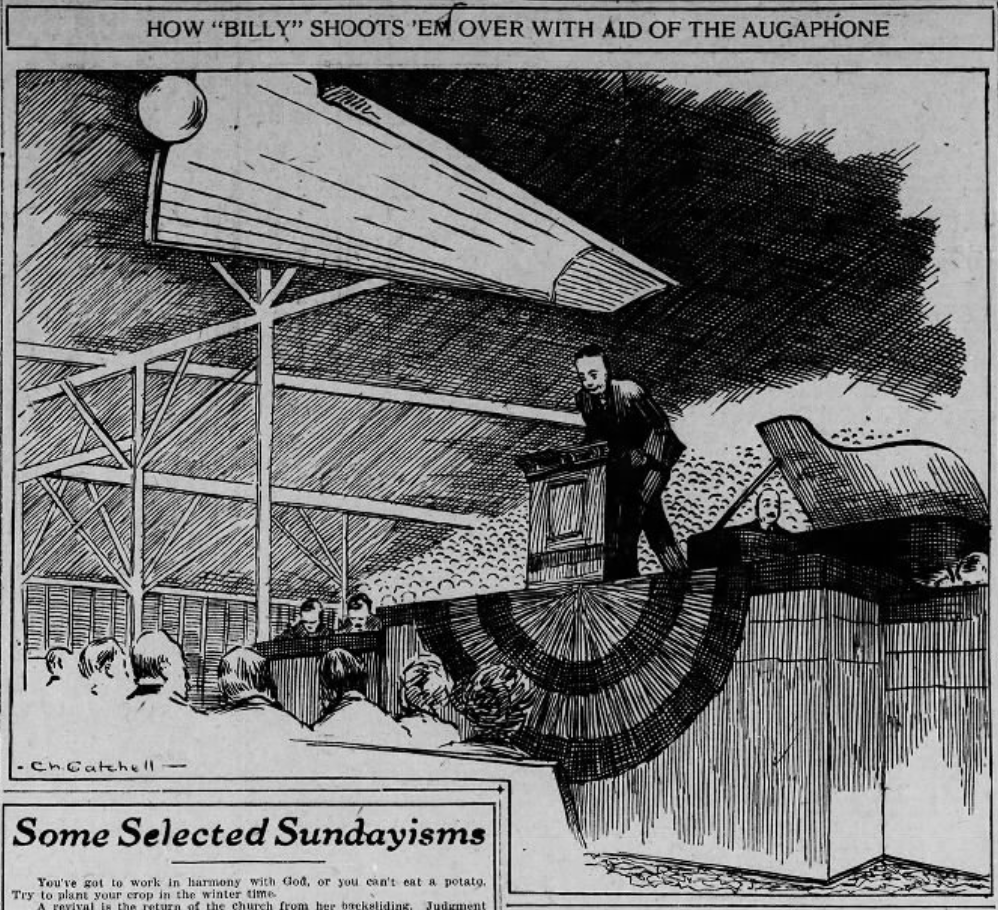
You’ve got to work in harmony with God, or you can’t eat a potato. Try to plant your crop in the winter time.
A revival is the return of the church from her backsliding. Judgment must begin in the House of God.
There is as much sense in talking of a worldly Christian as there is in talking about a heavenly devil.
What would you say of the members of a fire company who kept playing cards and gossiping instead of answering the alarm.
We have so many denominations now that it gives a man brain fever to keep track of them. Somebody gets a new idea of truth, founds a new sect, and takes refuge under the Thirteenth Amendment to the Constitution. There is as much need of more denominations as there is for a cat with more tails.
The average preacher stakes his claim on Jupiter and talks on—God knows what, I don’t.
The slaves would not be free men today if men had not gone on the firing line for $13 a month.
An Iowa preacher asked me: “Why don’t you preach the way I do?” “If I did,” I told him, “I wouldn’t be worth any more than you are.”
Some preachers would rather have people go to hell than preach anything except their sixteenth century religion. My mother used to wear hoops, but she doesn’t now, because there’s a different style.
Too many people windjam with their lips, but they don’t deliver the goods.
No wonder children of today grow up like asses’ colts!
You allow your daughters to go around with fellows whose character
would make a black mark on a piece of tar paper.
If you are not living to stir the devil, then you are a cipher and a
nonentity.
The church hasn’t smelled gunpowder for 150 years. It would do her
good. When she has grown rich, she has become independent of God
Almighty.
Some people think the more they look like a hedgehog the more pious
they are. They’d get to heaven a great deal quicker if they went to the
barber and dentist more often.
If you can’t own an automobile, take a trolley ride for a nickel. Ain’t it
fierce?
If some of you devils were to go a whole day without cussing your wife,
she’d think you were sick and send for the doctor, although she’d rather
send for the undertaker.
If there is any one person in this world that I despise with every atom
of my being, it is the weasel-eyed, lantern-jawed, knock-kneed, stiff-necked,
cadaverous, crooked-nosed, old neighborhood gossip, who can see more
through a keyhole seven blocks away than a decent woman could through
an open door right at her elbow.
The Tribune-Republican. Wed, Mar 04, 1914 ·Page 10
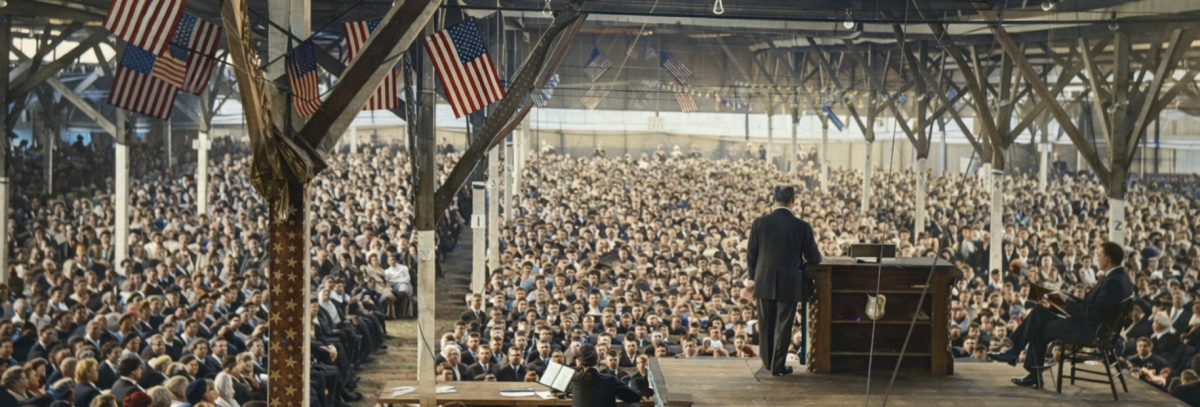
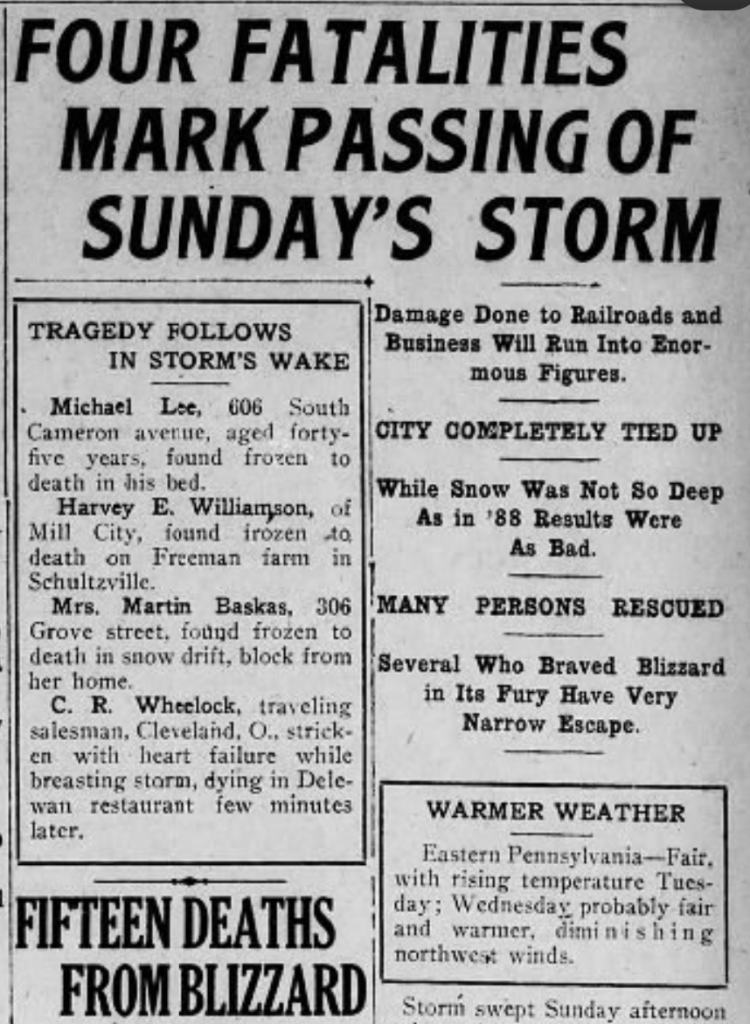
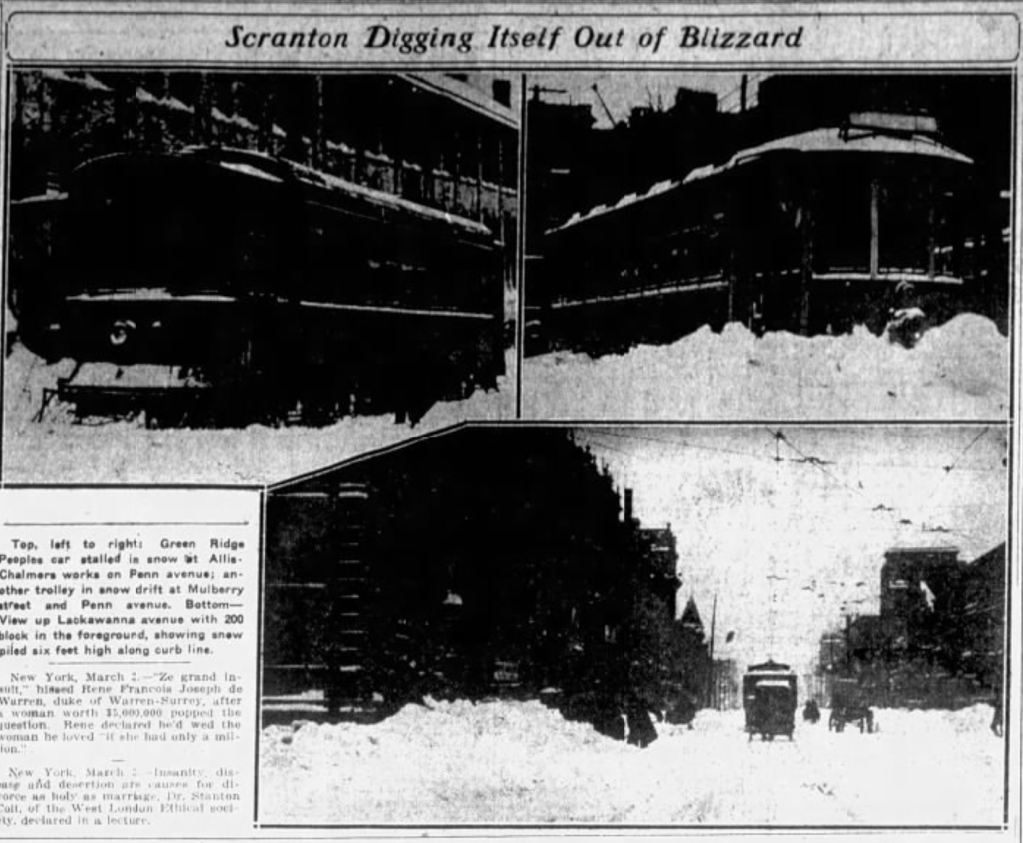
Despite one of the worst storms in recent memory for Scrantonites (March 1, 1914), 4,000 people showed up at the tabernacle, Unfortunately, about 1,500 could not get home. Over 100 trains were delayed or stopped running.
On the evening of March 1, 1914, a fierce winter storm swept into Scranton, Pennsylvania, just as evangelist Billy Sunday opened his long-anticipated revival campaign. Snow began falling heavily and, by night’s end, roughly 14 inches blanketed the city. Winds howled at nearly 45 miles perhour, rattling the enormous wooden tabernacle built for the meetings and at times drowning out Sunday’s booming voice.
Outside, the storm piled drifts as high as ten feet, choking off roads and halting the streetcars that normally ferried worshipers home. Inside the tabernacle, about 2,500 attendees quickly realized they were stranded. With travel impossible, they settled in for the night, huddling around pot-bellied stoves, brewing coffee, sharing whatever food they had carried, and making the best of their unexpected vigil.
Times-Republican, Tue, Mar 03, 1914 ·Page 1
By the next morning, Scranton lay silent under a white barricade. Billy Sunday canceled Monday’s services so people could rest and dig out. Local volunteers soon arrived with wagons and supplies, helping the weary congregation back to their homes.
The episode became known as the “Billy Sunday Snowstorm,” a dramatic blend of nature’s power and religious fervor that locals remembered for years as the night a revival meeting turned into an impromptu winter encampment.
The Pittsburgh Press (Pittsburgh, Pennsylvania) · Mon, Mar 2, 1914 · Page 1.
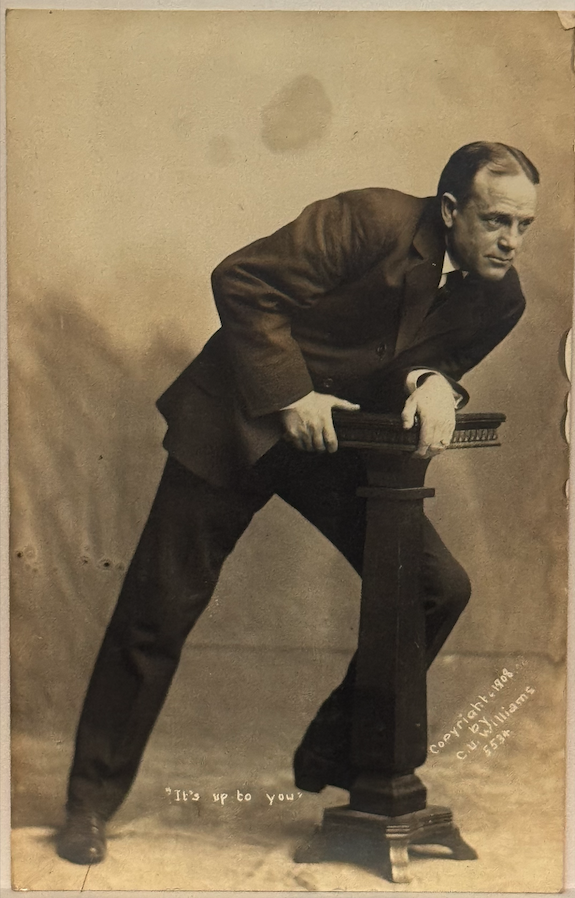
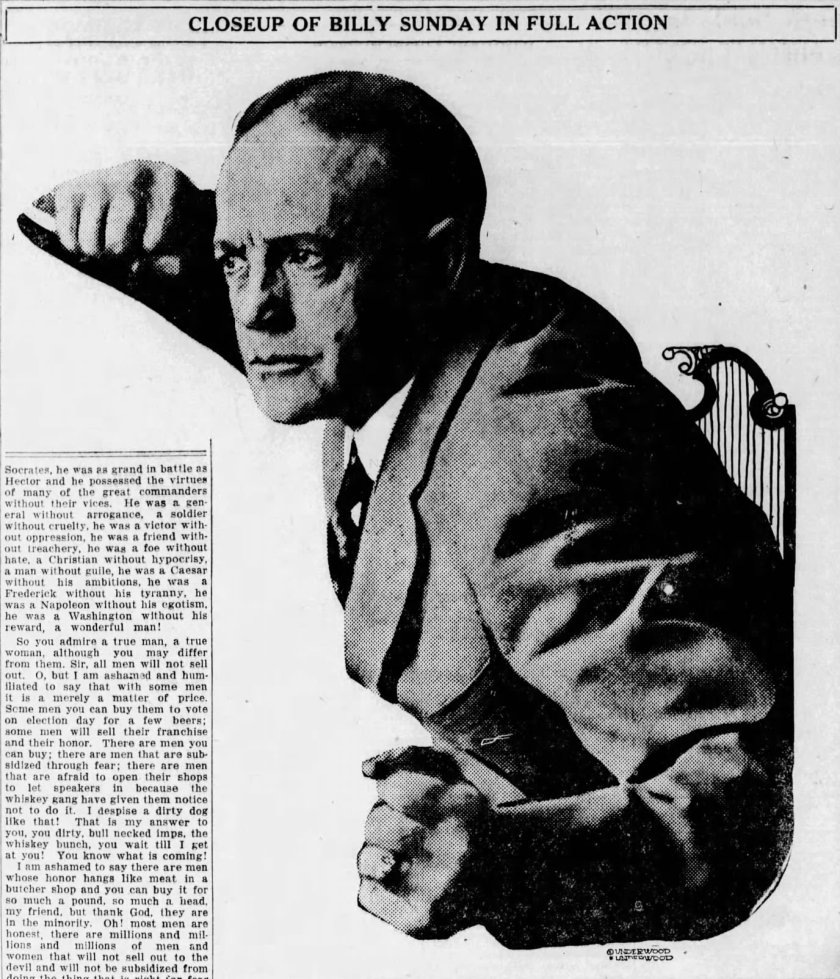
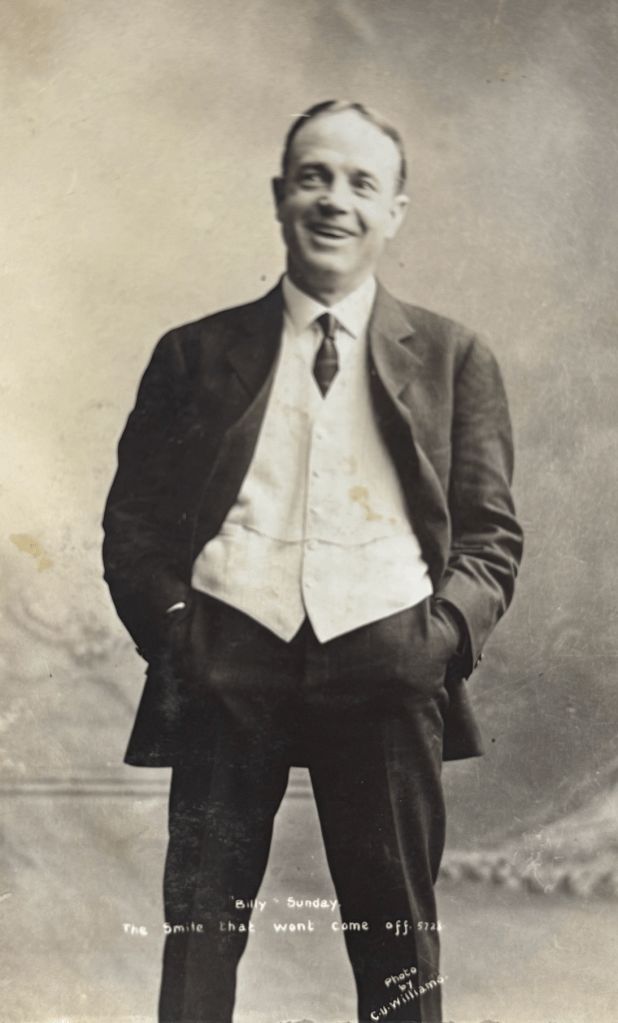
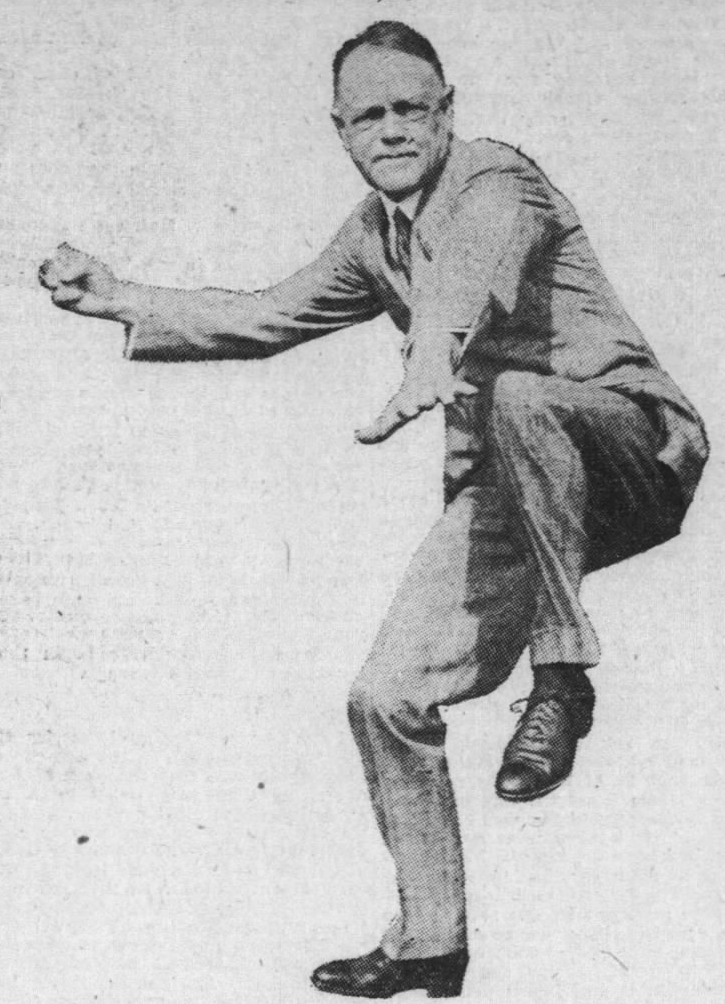
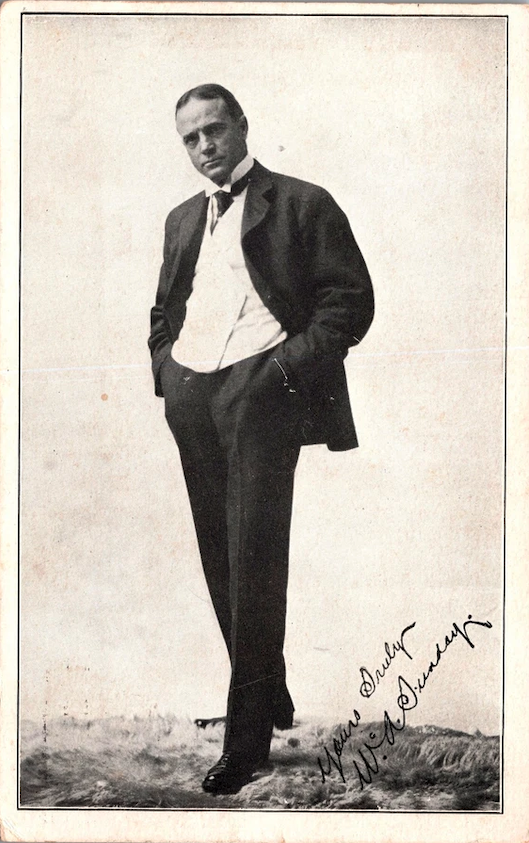


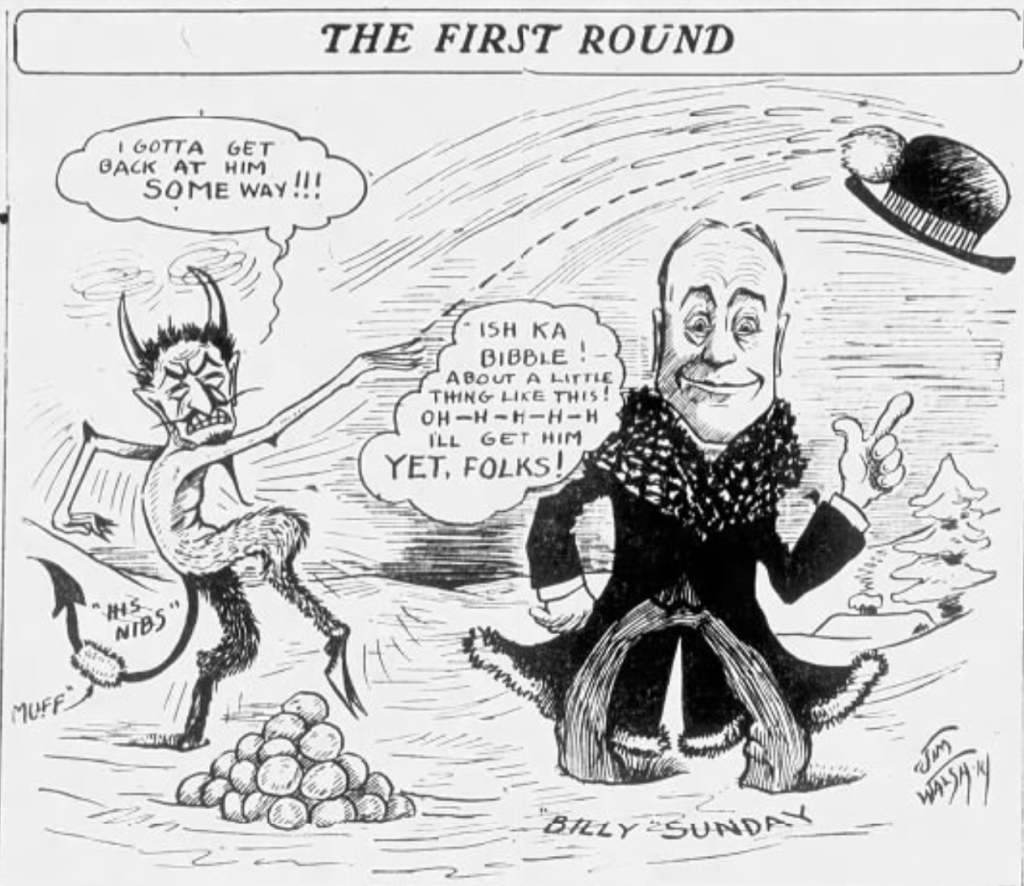
 Evangelist Billy Sunday (1862-1935)