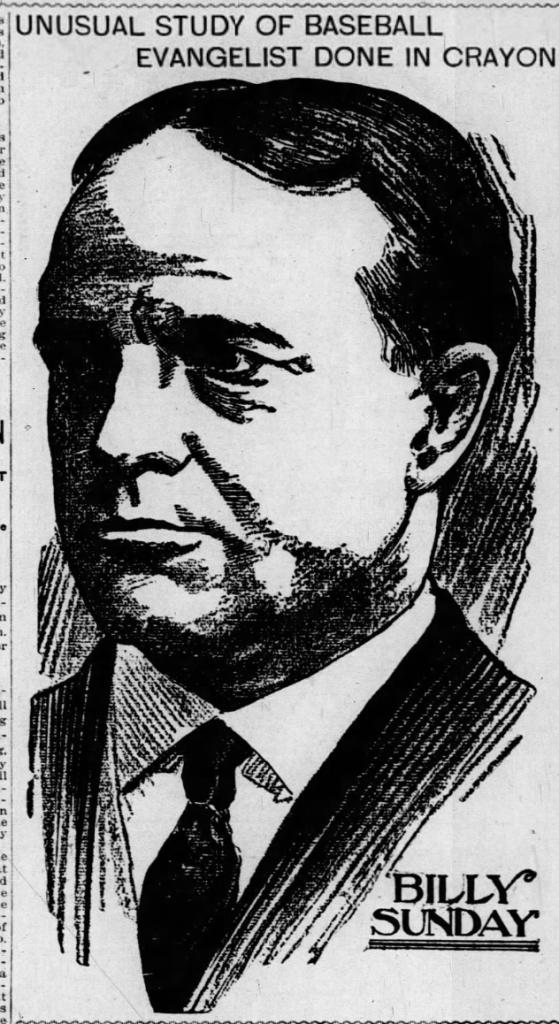
What’s a Christian? – Billy Sunday’s answer

In an age when “Christian” can mean many things, it’s worth listening to voices from earlier times who held convictions with clarity. Billy Sunday’s definition of a Christian, from a pamphlet circulated among his “trail hitters,” challenges brevity without compromise. Let’s consider what he said — and why it still matters..

Here is Billy Sunday’s definition of a Christian, given in a pamphlet presented to each of the “trail hitters” at the Tabernacle:

“A Christian is any man, woman or child who comes to God as a lost sinner, accepts the Lord Jesus Christ as his personal saviour; surrenders to Him as his Lord and Master; confesses Him as such before the world and strives to please Him in everything day by day.”

The pamphlet then gives these rules on “How to Make a Success of the Christian life:

“Study the Bible; pray much; win someone for Christ; shun evil companions; join some church; give to the support of the Lord’s work and don’t get discouraged.”

  • Extracted from a Chicago 1918 newspaper

Billy Sunday believed the term “Christian” should not be light nor vague. His concise, structured definition gives both challenge and invitation: a Christian is not just one who claims, but one who surrenders, confesses, strives. May we take his clarity as a prompt to examine not just what we call ourselves — but how deeply we follow.

What is revival? Billy Sunday answers

Part of his sermon, Revival Methods Defended.

What is a revival?

It is a campaign in the name of God against the world, the flesh and the devil, and against a revival you will find every brewer …. every whiskey seller in this valley; every blackleg gambler in this valley; every sham madame of the red-light district; every man and woman that feeds and fattens and gormandizes upon the virtue of men and women, so if you want to line up with a bunch like that, God pity you; that is the best compliment on God’s earth.

Men say the day of the revival is over. Fellows harp on that in the Methodist conference, in the Presbyterian meetings, in the Baptist associations, in the Congregational associations—the day of the revival is over. No, it is not. No, only with the fellow who vomits out the sentiment; but it is not over with God. The day of the revival is over. God Almighty leaned over the battlements of heaven and looked down into the coal mines of Wales and said, “Oh. Roberts!” and out of the depths of the coal mine came that grimy, soiled man, with dirty face, with a little lamp in his cap, and he said, “What is it, God?” And God said, “I want you to go and shake up Wales,” and he gave Wales the greatest revival that ever swept over that land since the days of Pentecost. There was not a college professor or preacher in Wales that God would trust with the job.

The Tribune-Republican. Wed, Mar 04, 1914 ·Page 10

A churchless community?

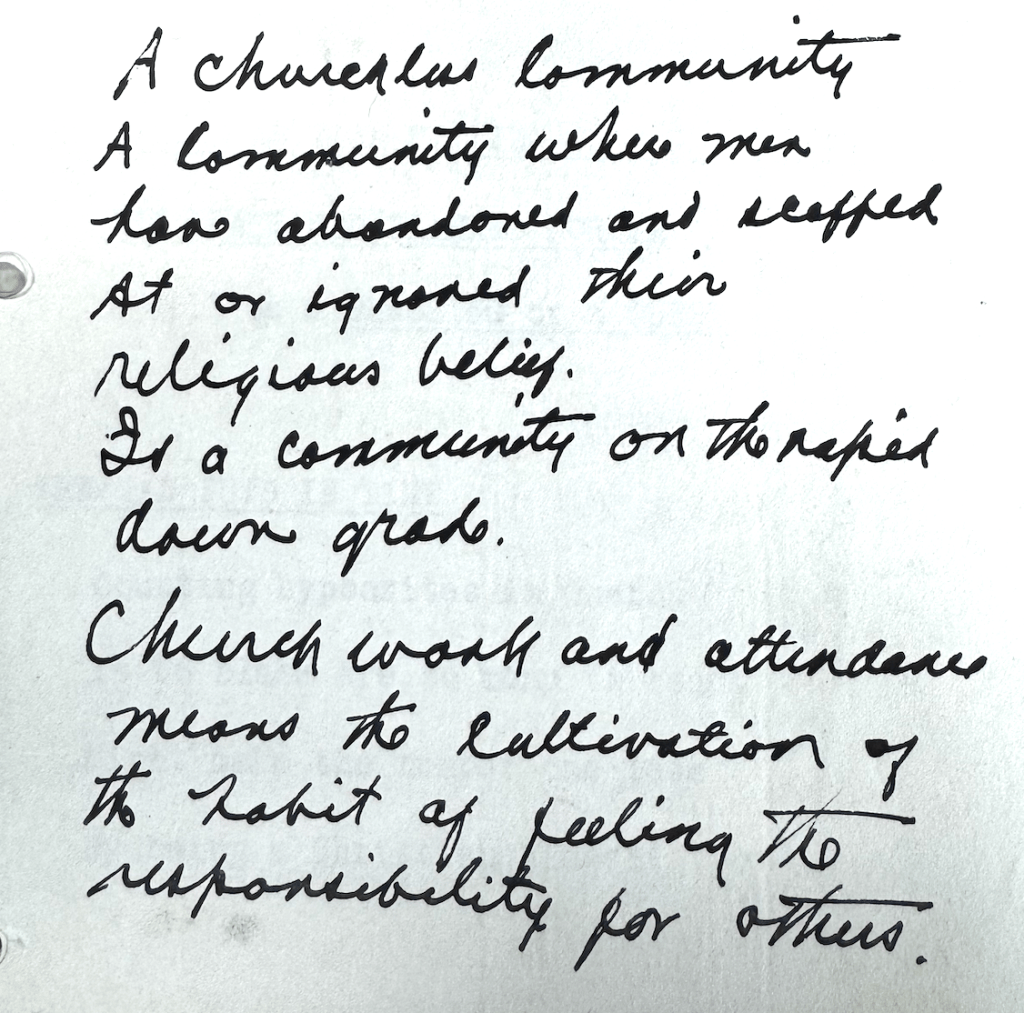
Here’s what Billy Sunday personally wrote in a sermon note about a churchless community.

“A churchless community is a community where men have abandoned and scoffed at or ignored their religious belief. It is a community on the rapid down grade. Church work and attendance means a cultivation of the habit of feeling the responsibility for others.” – not dated but likely 1934. Grace College. Morgan Library.

U.S. Grant’s advice to young people?

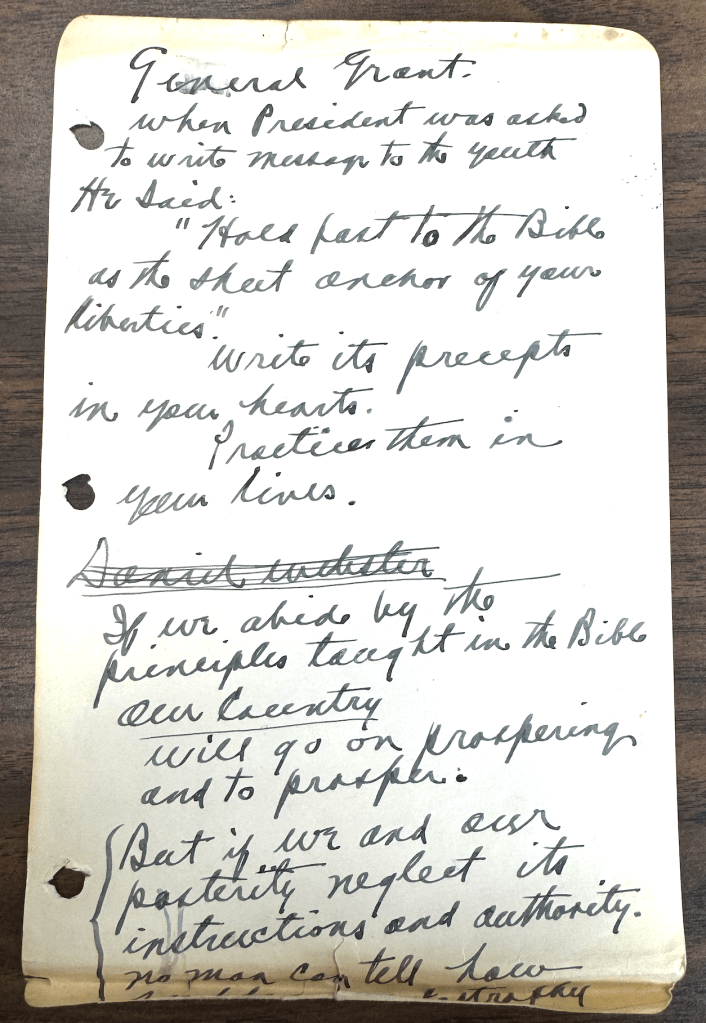
The following is attributed to U.S. Grant and Billy Sunday wrote this into sermon notes labeled “Science.” No date. Morgan Library, Grace College.

“Hold fast to the Bible as the sheet anchor of your liberties.”

Did Billy Sunday have more than one copy of his sermons?

TO HAVE SERMONS DEPOSITED IN VAULT

BILLY SUNDAY GOING TO TAKE PRECAUTION AGAINST FIRE.

Citation: The South Bend Tribune. Tue, May 13, 1913 ·Page 7

Just Now, Evangelist Has No Duplicate Copies of His Famous Addresses—Ackley Does Work.

“No, I have only the one copy of each of my sermons,” replied Billy Sunday to a question as to whether he had duplicates of his sermons.

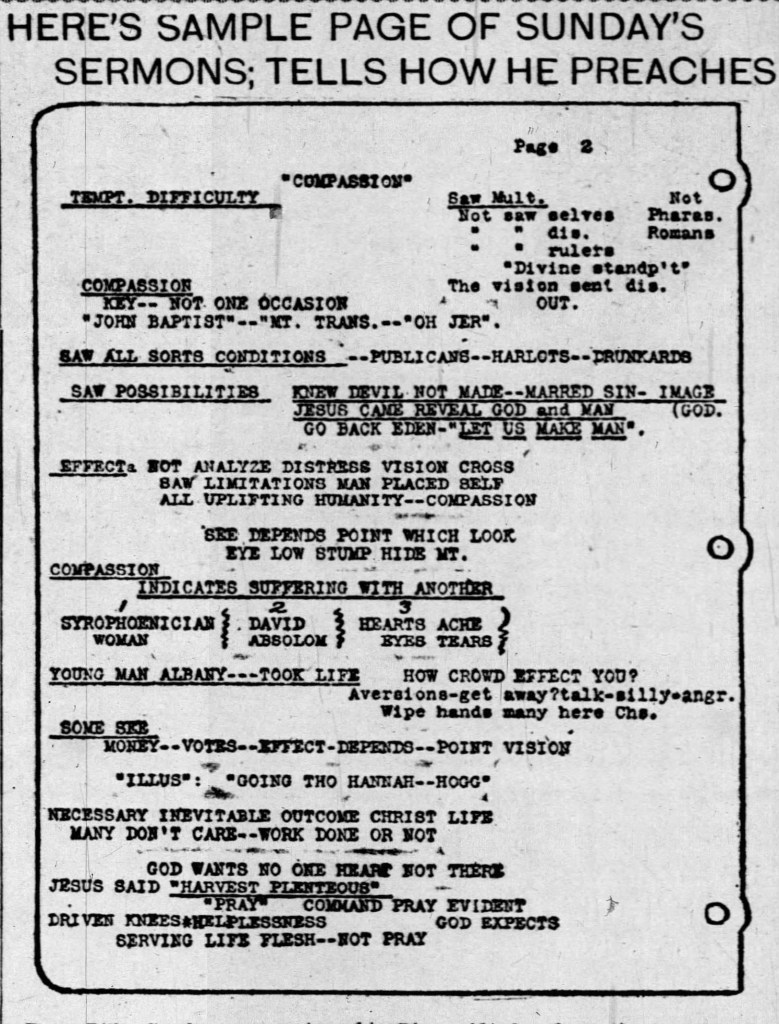
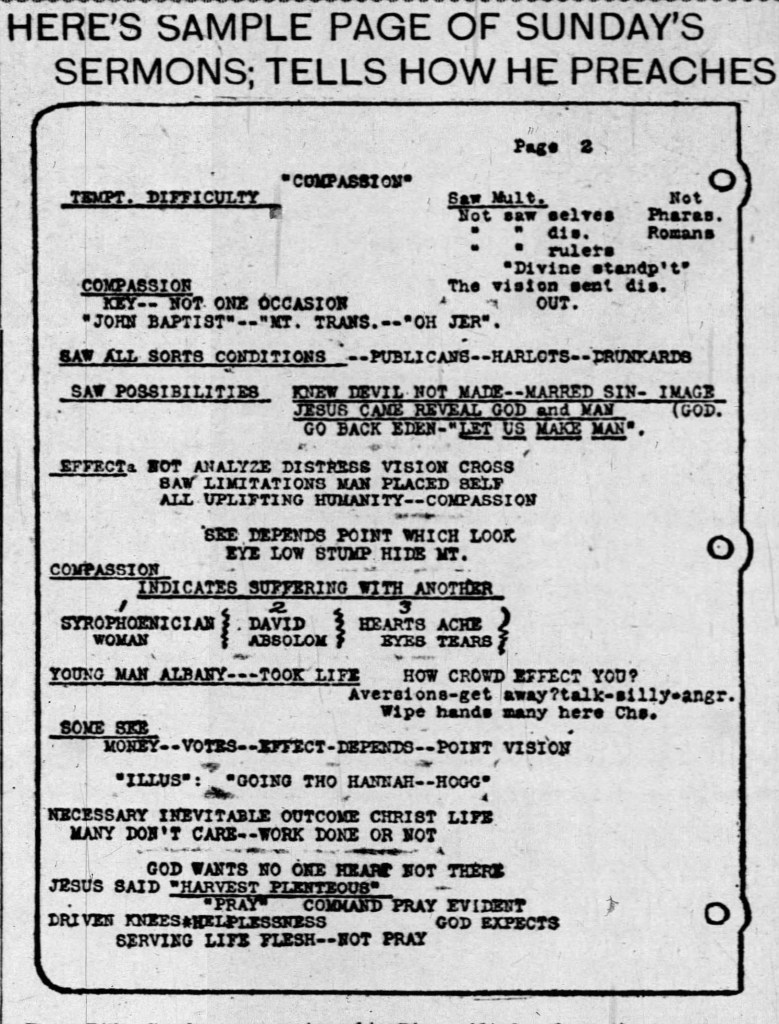
“These sermons are not in full,” continued the evangelist, as he showed the books in which he keeps the addresses that sway so many thousands; “they are just mere skeletons of the sermon and no one else but myself can read them, or at least I don’t think that anyone else can.”

Mr. Sunday was asked if he could remember the sermons if they were stolen and he replied that he recalled the majority of the material that composed them. He says that he intends to have duplicates made of the sermons and have them put into a safety deposit vault so that if one is stolen or should be destroyed by fire or in some other manner, he will have a copy.

“I thought at first that I would be able to get them copied this summer,” he said, “but it don’t look like the work will be accomplished, as I have so much to do this year.”

B. D. Ackley, pianist of the Sunday party, and secretary to the evangelist, copies the sermons of Mr. Sunday. This work takes up quite a bit of the pianist’s time, as Mr. Sunday is continually adding and detracting from his sermons as he acquires new material from many different sources.

“I always let Ackley fix up the sermons. He has a knack for doing things up pretty and nice,” said Sunday, while talking of his work.

“Now, boss, just because we have company you don’t need to make fun of me to my very face. He knows that I can’t fix them right,” said Ackley, as he turned to the visitor.

“That is all right; you do it just to suit me,” replied Sunday.

It is probable that sometime within the next year or so the evangelist will have all his sermons duplicated and deposited in a safety deposit vault.

The South Bend Tribune. Tue, May 13, 1913 ·Page 7

Billy Sunday on ‘Revivals’? c. 1913

What of Revival?

So what’s the nature of a revival? He was praying for a revival. As a nation we are facing the danger of the dominance of the material over the spiritual; we are commercially drunk. Take a bushel of nickels and walk down the street of the average town and you can lead the bunch so close to hell that you can smell the sulphur fumes as it belches from the inferno below.

The biggest coward in America today, the biggest coward we have in the profession of christian religion, who is afraid to come out and declare himself in a campaign like this, is the business man. He is afraid that some saloon keeper, some brewer, some black-leg gambler, some madame of the red light district and others of that kind—they’re afraid they’ll lose their trade by it, and by the eternal God they ought to be punished before the moon changes.

[Cont.]

All Kinds of Revivals.

Listen to me. In the economy of nature God provides for an occasional copious downpour of rain. You would be a fool to growl because it didn’t rain all the time. God has arranged His spiritual kingdom so that He has a copious downpour of spiritual blessings. God is rolling in spiritual wealth as well as material. It is not thought unwise to have a revival in business, oh, no—every town has its commercial club. It is not thought unwise to have a revival in politics—on, no.

Some people are scared to death that somebody might be saved from hell by out-of-the-ordinary methods.

Political leaders will hire leaders, newspaper editors, publishers, and will spend money for voters—in order to get those who are indifferent to the political situation interested—that is nothing under heaven but a political revival and you don’t hear anybody growl about it—you didn’t hear anybody growl about it this last election—that is, nobody but the republicans. Well, I am one myself.

In the business world, listen. In the business world men must make the market as well as the goods for the market. He must make the goods, then he goes into the market. He’s got to do both. You’ve got Chambers of Commerce, you’ve got all these institutions to create a demand for the product—these are business revivals—you have auto shows, they are auto revivals—you have county fairs which are nothing but revivals where they show cows, pigs, chickens, bread, butter, horses, and all the products of the farm. Then what the revival is to business, what the election is to politics, the revival is to religion; what health is to the individual the revival is to religion. Martin Luther saved Europe—a spiritual revival under Martin Luther was the cause of the reformation, nothing, but a revival, and why any Lutheran will snap, snarl, growl about a revival when his church was born of a revival I don’t know.

When Revival is Needed.

A revival is needed when the worldly spirit is in the church of God. It isn’t necessary to do something grossly inconsistent. A ship is all right in the sea, but all wrong when the sea is in her. The church of God is all right in the world, but all wrong when the world is in the church. Some people come to church on Sunday morning and on Monday morning they take a header into the world and the church never sees them again until Sunday morning. They squat and take up a little space in the pew and stay there and put a little money on the plate, but you never see them again until Sunday morning. I tell you, I believe half of the church members could die and the church wouldn’t lose anything of its spiritual force; it would lose them in numbers, but it wouldn’t lose anything in spiritual power. I tell you, my friends, we need a panic in religion, the world don’t need informing, it needs reforming. We are going to the devil over culture clubs, as if the world needed informing. It don’t need anything of the kind. There are people who go to church and go to a certain denomination because their wife goes there. They got their religion and their property in their name. They go to that church.

Must Have Revival.

“I want to say if a public school teacher knew no more about the work and methods of teaching than the average Sunday school teacher knows about the will of God, she would not be on the pay roll 16 minutes.

“Go down to the dance halls, the nickelodeans, the picture shows, the cheap-skate dance halls — there you will find young girls with dresses to their shoe tops. I ask you, why? I’ll tell you: the spiritual destitution of the multitude. Thousands never darken the church doors. A revival is needed when sinners are careless, licentious. * * * A general revival of religion has got to sweep over this country or it will mean the dissolution of the church, the home and of the nation. I don’t care a rap how you fortify your shores; how many ships you build; America has got to have a revival or it means the end of your religion. Wealth and culture never saved Rome, Babylon or Nineveh, and if you have the sins of Babylon, you will have the judgment of Babylon.

“What is a revival? It is a campaign in the name of God against the world, the flesh, and the devil, and against a revival you will find every brewer in this valley; every whiskey seller in this valley; every saloon-keeper in this valley; every black-leg gambler in this valley; every she madam of the red light district; every man and woman that feeds and fattens and gormandizes upon the virtue of men and women so if you want to line up with a bunch like that, God pity you; that is the best compliment on God’s earth.

“Men say the day of the revival is over. Fellows harp on that in the Methodist conferences, in the Presbyterian meetings, in the Baptist associations. In the Congregational associations,—the day of the revival is over. No, it is not. No, only with the fellow who vomits out the sentiment; but it is not over with God.

The day of the revival is over. God Almighty leaned over the battlements of heaven and looked down into the coal mines of Wales and said, ‘Oh, Roberts!’ and out of the depths of the coal mine came that grimy, soiled man, with dirty face, with a little lamp in his cap, and he said, ‘what is it, God?’ And God said, ‘I want you to go and shake up Wales,’ and he gave Wales the greatest revival that ever swept over this land since the days of Pentecost. There was not a college professor or preacher in Wales that God would trust with the job.

Citation (excerpted): The South Bend Tribune. Wed, Apr 30, 1913 ·Page 14, 16
Billy Sunday’s view of Abraham Lincoln?

WHAT SUNDAY HAS TO SAY OF LINCOLN

THIS ARTICLE BY EVANGELIST ATTRACTED ATTENTION.

“Angels Hid Rail Splitter Where He Was Undiscovered for Years,” Says Leader of Revivals.

Billy Sunday has written many beautiful things which have attracted widespread attention, among them being his tribute to Abraham Lincoln. This was written and published for the first time about a year ago.

The tribute follows:

“The angels said, ‘Let us hide Abraham Lincoln where the world will never find him,’ and they hid his big kind, generous, humanitarian, sympathetic God-fearing soul in that long, lean, lank, homely, gaunt, ungainly body. They bronzed his cheeks until he looked like an Indian. They hardened his hands with toil. For employment they gave him common work, like poling a flatboat on the Ohio river and clerking in a country store.

“But, while drifting down the stream he was solving problems that would help him up the stream. And while clerking in the country store he was learning whole chapters from the book of human experience which became golden rounds in the ladder of fame up which he climbed to the top.

“For parents, they gave him common people whose names were unknown five miles away for a home, a log cabin in the wilderness. The battle would grow hard. He would grit his teeth, buckle up his yarn galluses a little tighter and determine that he would be somebody, anyway. He would spread the ashes thin on the dirt floor of his log cabin home and, with a hickory log in the fireplace for a light and a hickory stick for a pencil, he solved problems from Euclid and read the life of Washington and other great men.

“Finally, the angels could keep him hid no longer, and so one morning this old sleepy, dreamy, drowsy world rolled out of bed, rubbed her eyes and started on a still hunt for a great man. She struck a new scent and a new trail that led out through the woods into the wilderness and up a hill to a log cabin. She rapped at the door and Lincoln arose—so big, so high, so tall that the logs rolled down the roof and fell off and he stepped forth—a giant among men. Fame has placed him upon a pinnacle so lofty that he looks down upon all who attempt to reach his side.”

The South Bend Tribune. Tue, Apr 29, 1913 ·Page 7

Billy Sunday preached 95 times during his Richmond, Indiana campaign in 1922

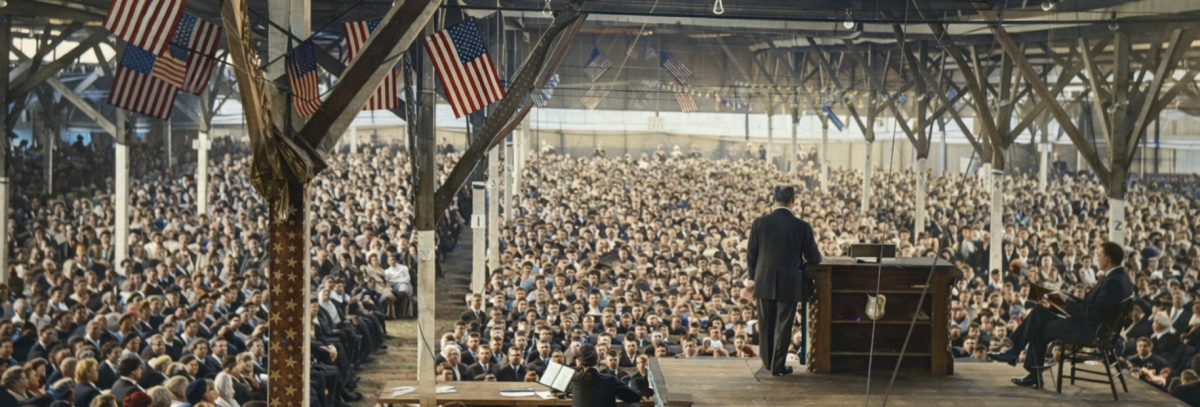
Billy Sunday preached 75 times in the tabernacle during the six weeks of his Richmond campaign (April 16 – June 4), and at least another 15 times outside the tabernacle, in surrounding towns close to Richmond. He sometimes preached four times in one day.

As reported in The Richmond Item. Sun, May 28, 1922 · age 7:

NINETY SERMONS TO LAST NIGHT

Old Man Statistics Gives Some Interesting Figures to The Item Reporters

Old Man Statistics dropped into The Item press box, yesterday, and when the reporters were not there, left a bundle of facts. He said Billy Sunday would preach his ninetieth sermon Saturday night, since the day he arrived at Richmond.

That seemed rather too many for the reporter who checked up on it. Yep! Old Man Statistics was all right, it appeared. With the sermon last night Mr. Sunday, has preached 90 at the tabernacle, if one counted the afternoon that Mr. Sunday spoke to the children when the Sunday school convention was held there.

To bring the total to 90, Old Man Statistics, mentioned two sermons at the country club, others at the high school, Earlham college or at the Pennsylvania shops. Then came trips to Portland, Anderson, Greenville, Bradford, O., and the morning sermons each day this week, at Liberty, Hagerstown, Spiceland and Cambridge City.