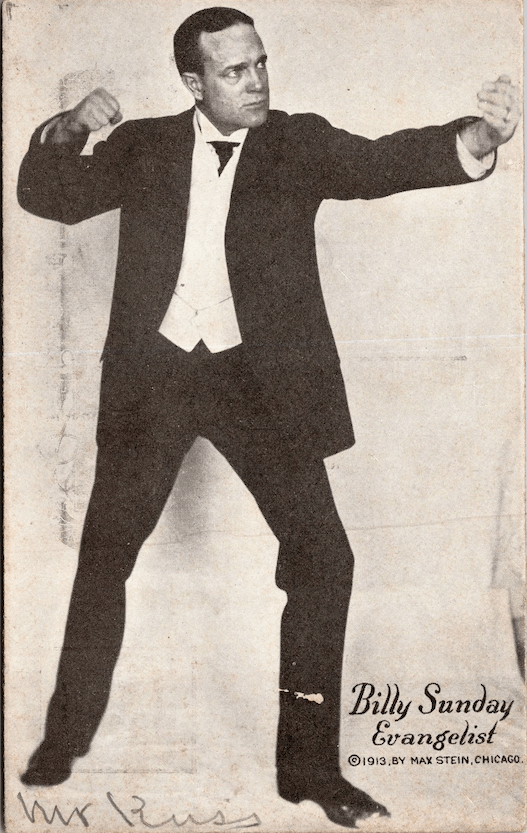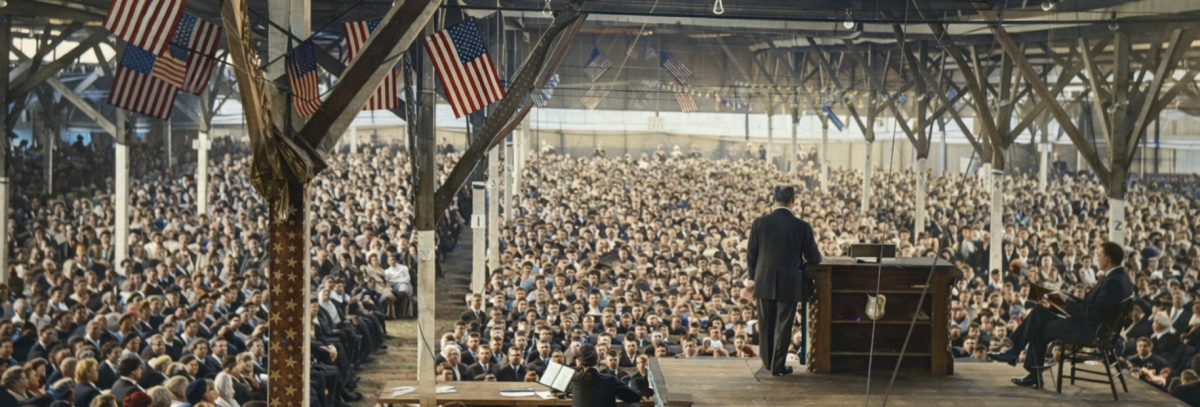
Billy Refuses to Help “Make Circus of Religion”

The Washington Herald. January 7, 1918

Billy Sunday told about 9,000 persons who attended his afternoon meeting in the Tabernacle how the “movie” people had offered him a cold $1,000,000 to pose for a film serial. And he told them how he had replied to their offer in this fashion:

“You can’t commercialize my mug for $10,000,000; you’re not going to get any help from me to make a circus of God’s religion. Not on your tintype.”
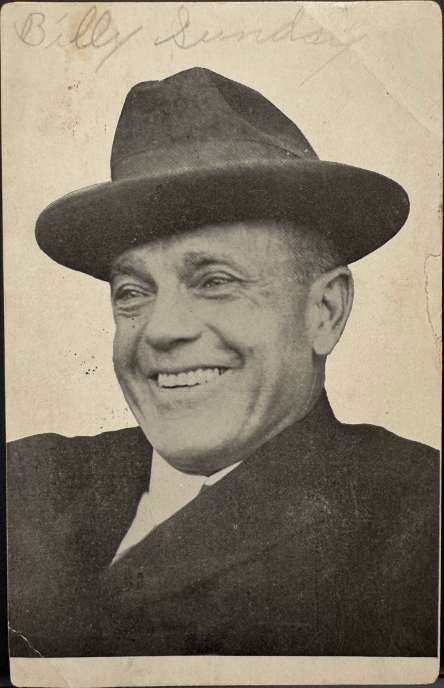
The “movie” reference was injected into Billy’s remarks through the presence of several “movie” cameramen at the Tabernacle just before he came into the building. They tried hard to “slip one over” on Billy and catch him as he got out of his limousine and started for the Tabernacle door. “Ma” Sunday, who was with Billy, protected the evangelist from the pointed cameras and pushed him inside the big building.

“Big Hand” for Billy.

The crowd cheered Billy to the echo. On the platform was Mrs. Marshall Field, widow of the noted Chicago merchant, with a party of friends from the Windy City. They, too, cheered Billy’s references to the “movie men.”

Billy’s afternoon sermon was chuck full of patriotic references and of slambang punches at “old Kaiser Bill.” And just before he finished it, he asked all those in the big audience who would pledge themselves to give undivided support to the national government in “its hour of need” to stand up. And the entire audience arose. Then he asked for a “Chautauqua salute,” and thousands of handkerchiefs waved over the great auditorium.

Billy took a hard slam at the “knocker,” who, he said, “is always going up and down the land, shouting that we are not prepared and that we should have done so and so long ago.”

“You folks ought to remember,” shouted Billy, “that we have a whale of a job on our hands. But we’ve got a whale of a country and we’re going to put it over. And we don’t propose to unsheath the sword until we have that gang on its knees pleading with Uncle Sam to call off the war.”

In his sermon Billy spoke of the drummer boy in Napoleon’s army who refused to beat a “retreat” when ordered by his commander. He looked squarely into the eyes of about 100 soldiers who were in the Tabernacle and declared loudly: “We don’t know how to beat a retreat either, do we boys? You bet your life we don’t! But we can beat a charge that can dig a grave so deep for that bunch of Kaiser Bill’s hot dogs that they won’t even hear the Angel Gabriel’s horn on the last day.”

The soldiers cheered Billy and the big crowd joined in. Billy emphasized that “we’ve got to scrap as well as play” and he declared that with such a fine army and such a navy as Uncle Sam boasts, there “isn’t a power anywhere in the world that can stand up against it, much less that bunch of cut-throats who would drag their Hohenzollern teachings into the land of the free.”

Billy took a hard rap at the Industrial Workers of the World and declared that if he had anything to do with “that bunch,” they all “would have faced the firing squad long ago.” His sermon was a likening of the Christian workers of the world to the grenadiers of old and the point he emphasized was that Christians everywhere are “fighters for the cause of Christ” in just as much the same sense as are the soldiers fighting now the cause of the allies.
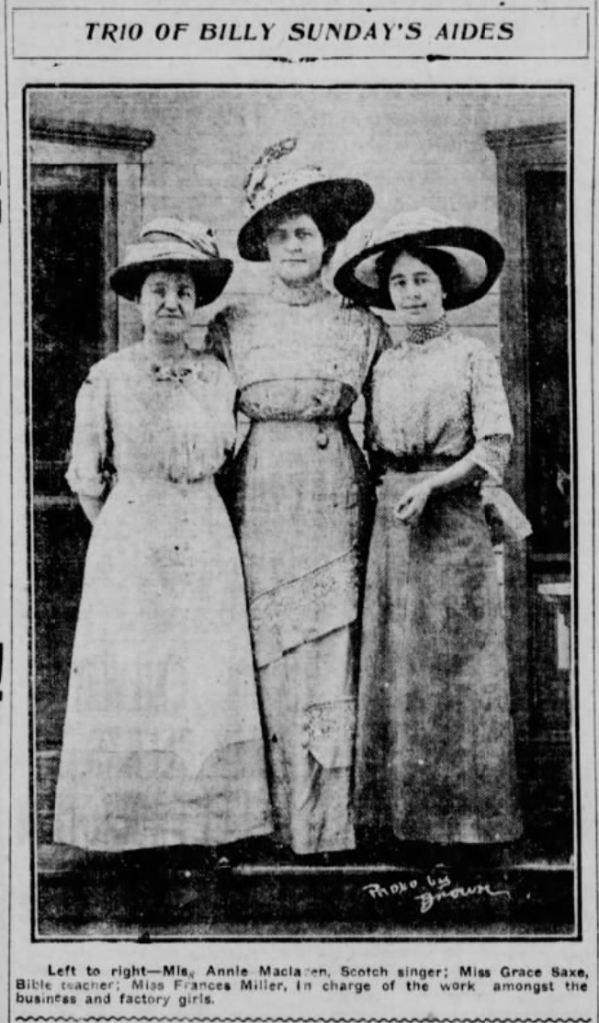
Billy is for the women; sure, give them a vote, 1918

In 1918, Billy Sunday stepped into one of America’s most divisive debates — women’s suffrage. What drove him? What can we learn from that boldness?

A century later, his words still challenge us to consider what moral courage looks like in public life today.

This original 1918 newspaper article captures Billy Sunday’s public support for women’s right to vote. At a time when the nation was debating suffrage, Sunday’s words reveal both his moral clarity and his ability to speak into civic life with conviction and wit.

The Washington Herald. Jan 9

Evangelist Says He Favored Proposition Long Before It Became a Fad. To Open Suffrage Session With Prayer.

With the vote on the suffrage amendment coming tomorrow, Rev. William A. Sunday is another prominent individual who is taking the opportunity to reiterate his faith in “votes for women.”

In a signed statement which “Billy” Sunday gave Mrs. Lawrence Lewis, of the National Woman’s Party, last night, the evangelist says:

“It is nothing new for me to favor woman suffrage. I have been advocating it for years, even before it became popular. We are living today in a new era. If she is good enough to be our mother and our wife, good enough to preside over our home, to care for us in times of sickness and to share our joys and our sorrows, why should she be denied the privilege of voting?

“Today, more nearly than ever before, she bears equally with men the world’s burdens. What would the nations of the earth do without her aid, either in times of peace or war? Women are sharing equally with men the burdens and the sacrifices of this war.

“They are in the munitions factories and in the fields of agriculture and in all other departments of war service. Without their co-operation the war could not be waged to a successful conclusion. As they share in the burdens they should also share in the responsibilities of government.

“I see no reason why the men and women of the nation should not walk side by side in the matters of law enactment as well as in the home and social life.”

Mr. Sunday will offer the prayer at the opening of the House tomorrow when the suffrage vote is take.

<End of newspaper article>

Sunday’s endorsement came just months before Congress passed the 19th Amendment in 1919. His statement offers a glimpse into how revivalists connected moral reform with public policy—a reminder that faith and social conscience have always been intertwined in the American story.

Billy Sunday prays for the U.S. involvement in World War I in late October, 1917. Complete text.

By November 1917, America’s entry into World War I was still more promise than power. The nation had declared war on Germany in April, but its fighting strength was only beginning to take shape. The Selective Service Act had drafted millions, yet most soldiers were still training in sprawling new camps across the country. Only a few thousand “Doughboys” had reached France, and fewer still had seen combat.

At home, the United States was undergoing a massive transformation—industries retooled for war, Liberty Loan drives stirred patriotism, and propaganda urged unity behind President Wilson’s call to “make the world safe for democracy.” Yet beneath the flags and speeches, the mood was uneasy and uncertain. America was a nation of recent immigrants, many with ties to both sides of the conflict, and the sudden plunge into a distant European war left much of the public ambivalent, even anxious.

While the Navy was already active in convoy protection and anti-submarine patrols, the Army’s role remained largely preparatory. Reports from Europe reminded Americans of the staggering cost of trench warfare—the mud, gas, and mass casualties that had consumed Europe since 1914.

Thus, by late 1917, America stood on the threshold of full engagement, committed but not yet blooded, confident yet cautious. The war had only begun for the United States, and few could yet grasp how deeply it would change the nation—or the world.

Paper source

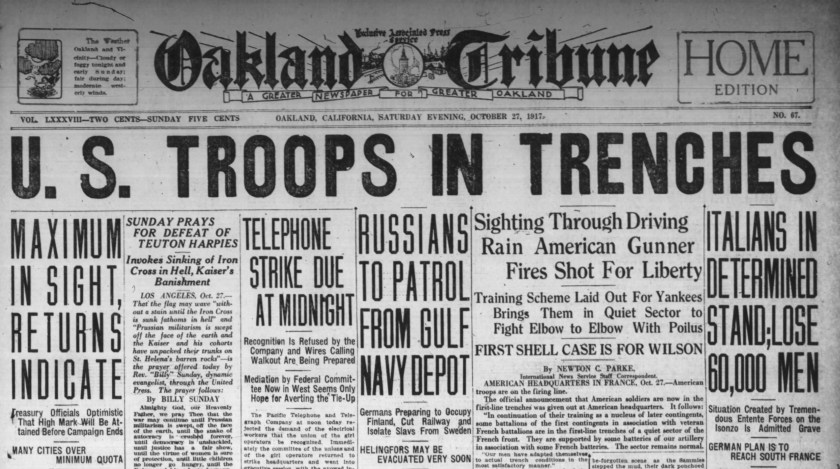
Just as the Atlanta Billy Sunday campaign was to begin, Billy’s prayer for U.S. forces in Europe was published in the press.

BILLY SUNDAY PRAYS FOR OUR VICTORY IN THE WAR

Los Angeles, Cal., Oct. 27.—”That the flag may wave without a stain until the iron cross is sunk fathoms in hell,” is the prayer offered today by Rev. “Billy” Sunday, evangelist, through the United Press for use on Sunday, proclaimed by President Wilson a day of prayer. The prayer follows:

“Almighty God, our Heavenly Father, we pray Thee that the war may continue until Prussian militarism is swept off the face of the earth, until the snake of autocracy is crushed forever, until democracy is unshackled, until justice has a fair show, until the virtue of woman is sure of protection, until little children no longer go hungry, until the Kaiser and his cohorts have unpacked their trunks on St. Helena’s barren rocks.

“And in the meantime give each one of us the fighting spirit that led the Crusaders to victory. If we do not fight with our hands in the trenches, help us to fight with sacrificing hearts at home.

“Thou knowest, oh, Lord, we have not entered this bloody war because of avarice or greed and we do not covet Germany’s gold or land. We have drawn the sword to defend our country against the most infamous, blood-thirsty horde of human harpies that ever disgraced the earth. They respect neither law nor religion; nothing is sacred if it stands in their path.

“Lord, bless the president; give him wisdom; bless all the councils of state and war. Keep us a united nation in fact and spirit.

“Bless the army and navy. Many of our brave boys already sleep somewhere in France or beneath the sea. Bring victory to our cause because we know it is Your cause. We have joined hands and hopes and hearts with our noble allies that this world may be a safe place in which to live.

“Thou knowest, Lord, that the tidal wave of sneering unbelief that has blighted the faith of millions and denied that Jesus is Thine only begotten Son, came from the beer mugs of that pretzel crowd across the sea. All this, together with the deluge of blood is enough to make hell laugh and heaven weep.

“Lord, Thou has never forsaken our flag. It waves without a stain. May it lead every step of the way until the iron cross is sunk fathoms in hell and the world rests once more bathed in the radiance of the Cross of Christ.

“All this we ask in the name of Jesus Christ, Thy Son, our Savior, Amen.”

Sunday answered the ‘cultural cry’ of his age


Part 1: A Nation in Turmoil and Transition

How Industrialization, Urbanization, and Moral Upheaval Set the Stage for Revival

When Billy Sunday’s voice rang out across America’s wooden tabernacles, he wasn’t just preaching sermons—he was answering a cultural cry. From 1900 to the early 1920s, the United States was spinning in the whirlwind of transformation. Old institutions were cracking, new cities were rising, and the American soul was searching for an anchor. Into that spiritual vacuum stepped Sunday—a preacher who didn’t just understand the moment; he embodied it.

By the early 20th century, America was moving from farm to factory. In 1870, only 25% of the population lived in cities. By 1920, over 50% did. The dizzying shift from rural life to urban sprawl left many disoriented. Long-standing community structures—churches, front porches, family farms—were being replaced by crowded tenements, anonymous factory work, and the fast pace of modern life. People needed clarity, direction, and moral certainty.

Sunday gave it to them—loudly, plainly, and with baseball-player bravado.

The U.S. was also undergoing its greatest wave of immigration, with over 14 million new arrivals between 1900 and 1920. While these immigrants enriched the nation’s culture, they also stoked fears among native-born Protestants about identity, religion, and national character. Sunday’s revivals, though not overtly anti-immigrant, often appealed to a kind of nostalgic Protestant Americanism that comforted people who felt their world slipping away.

Meanwhile, the Industrial Revolution was rewriting the rules of labor and wealth. Robber barons rose; workers organized. Socialist ideas were gaining traction. Against this backdrop, Sunday didn’t call for revolution—he called for regeneration. He told workers to repent, not revolt. He urged bosses to clean up their lives, not just their payrolls. In an age when ideologies were competing to explain human brokenness, Sunday offered the most American answer imaginable: personal repentance and individual transformation.

And of course, moral reform movements were gaining steam—chiefly the push for Prohibition. The saloon had become a symbol of urban vice, immigrant excess, and male irresponsibility. Billy Sunday didn’t just preach against alcohol—he declared war on it. His famous line, “I’m against the saloon with all the power I’ve got,” wasn’t just rhetoric; it helped catalyze a national movement that led to the 18th Amendment.

So why did Billy Sunday rise when he did?

Because he stepped into a nation off balance, morally confused, spiritually hungry, and socially uprooted. He didn’t just ride the wave—he harnessed it. His sermons shouted what many Americans were whispering: that the old truths still mattered, that the Bible still had authority, and that one man’s conviction could still move a crowd.

In an age of massive upheaval, Billy Sunday stood like a lightning rod—conducting fear, hope, outrage, and repentance into one electrifying movement.