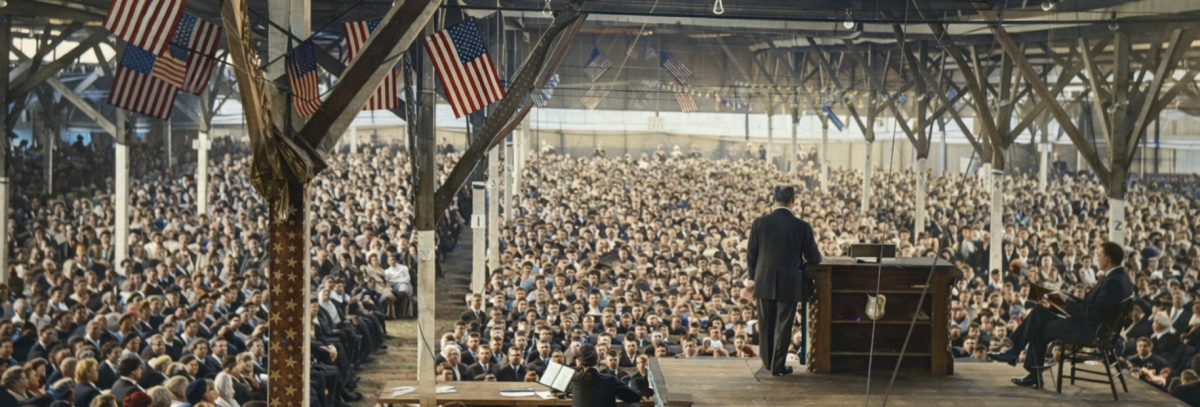
When revival calls crowds to the aisle, a critical question follows: “Will that decision endure?” In 1918, after Billy Sunday’s campaigns, journalists followed up with converts and organizers to ask whether the spiritual fervor survived time. The answers—preserved in this article—offer rare insight into how revival might seed long-term change. Read on to see what those trail hitters said, and what it teaches us about lasting faith.
The Washington Herald. Tue, Jan 29, 1918 ·Page 8
TRAIL HITTERS REMAIN FIRM, SAY CONVERTS
Effect of Sunday Revivals in Other Cities Has Been Permanent.
BY ARTHUR JOYCE.
Does ‘trail hitting’ at Billy Sunday campaign meetings show any permanent results? Are those persons who walk the sawdust aisles over at the Tabernacle interested only in formally shaking the hand of the evangelist – or is there something definite behind it all?
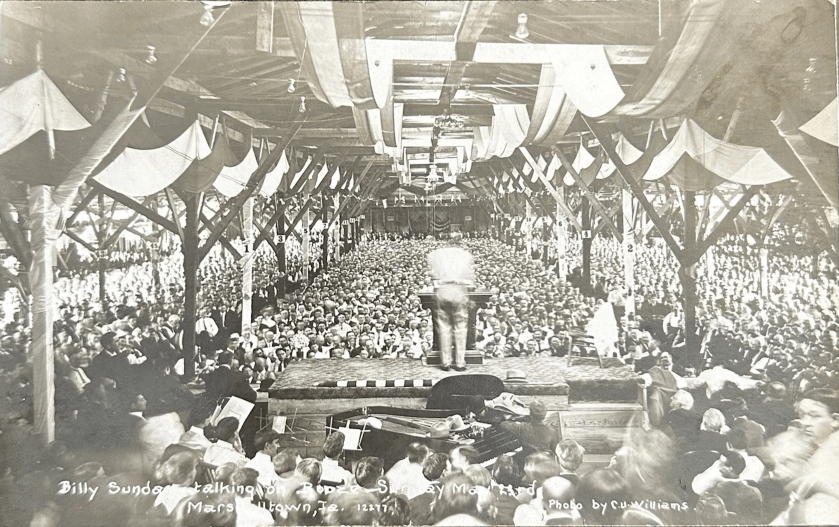
Thousands who have seen approximately 6,000 persons ‘hit the trail’ at the Tabernacle in this city are asking these questions. And about the only way in which they can be answered with any degree of accuracy is to look over the field where the evangelist has campaigned and see what’s the situation a year or two following the campaigns.
I recently had a talk with two influential representatives of cities in which Billy has campaigned and I put the questions to each of them. One is Gen. C. Edward Murray, quartermaster general of New Jersey, the other is Lucius L. Jeddy, head of the Merchants National Bank, of Syracuse, N.Y. Both were Billy Sunday ‘trail hitters’ – Gen. Murray in Trenton, N.J., and Mr. Eddy in Syracuse.
Big Sunday Club.
Gen. Murray is president of the Billy Sunday Club, of Trenton, an organization of ‘trail hitters’ formed after the evangelist’s Trenton campaign. That club now has a big membership and every member in it is personally interested in leading others to Christ.
‘The campaign in Trenton,’ said Gen. Murray, ‘awakened a remarkable interest in Christian work, especially among the men and women who ‘hit the trail.’ Churches have increased their membership to a remarkable extent; booze joints that keeled over; Sunday schools are crowded and everywhere there is shown a wonderful interest in things religious. I know many noted men who have passed up the cigars and joined the church and I know of one politician who formerly represented the booze interests, who has been converted and is now an active election on an anti-booze ticket.
‘On the whole, I should say that the Sunday campaign in Trenton has done more to evangelize the city than any other one happening in recent years. And I’m satisfied that the men who ‘hit the trail’ are still going right with the Lord and are doing their best to lead the aisles for Christ.’
Mr. Eddy told of the workings of the Billy Sunday Club in Syracuse. Every member of the organization was a ‘trail hitter’ and in the last two years, he said, they have led more than 20,000 men to Christian lives.
‘The ‘trail hitters’ not only themselves ‘stuck to their declarations to stand on God’s side,’ said Mr. Eddy, ‘but they’ve inaugurated an active campaign to bring others into the fold. And if that doesn’t show the permanency of ‘trail hitting’ I’ve lost my guess.’
Senator Vardaman, of Mississippi, made the statement that if the evangelist shall win only one person to Christ in his Washington campaign, ‘we will have been well repaid for our efforts in the revival cause here.’
In Philadelphia – three years after the Sunday campaign – there is a ‘trail-hitting’ organization in virtually every church where the evangelist assisted in the revival. There are probably 7,000 members enrolled in these organizations, and they’re campaigning every day to bring others to the church.
In Scranton, Pa., one church added 2,000 members to its rolls within six months after the Sunday campaign. Another Scranton church increased its enrollment by 1,000 in a year following the campaign. The same is true of the churches in Wilkes-Barre, Pa., and in Carbondale, Pa., churches.
In Wichita, Kan., three men of national reputation have been converted who call ‘gospel teams.’ These ‘teams’ go about the country and work in the Middle West to preach the gospel and tell of the wonderful work Billy Sunday did in their campaigns. Out of these teams has been formed a National Federation of Gospel Teams’ which are made up of leading men throughout the country – all of whom are either ‘trail hitters’ at Sunday meetings or are in the church as a result of the work of ‘trail-hitters’ who have taken up personal work. These teams have a record of 11,000 conversions to their credit.
Don’t All Stay.
Detroit has a ‘trail-hitters’ club’ of nearly 1,000 members; Los Angeles has one with about 500 men on its rolls; Atlanta has just finished organization of a Billy Sunday Club with several hundred members. And in virtually every city and town where the evangelist has campaigned there are similar organizations continuing the work Billy began. Nearly every ‘trail hitter’ in these places has associated himself with these clubs.
Of course, every person who ‘hits the trail’ isn’t a sticker. But records made by Sunday party experience year after Billy’s campaigns in leading cities show that approximately 85 per cent of those who ‘walk the aisles’ represent permanent converts.
The object of the ‘trail hitting’ is not only to bring to the ‘front’ in a public confession of faith those who have been more before taken any stand in the matter. Billy’s ‘invitations’ are intended to induce the church members to ‘reconsecrate’ themselves and ask to be more earnest Christian life from those who have already ‘accepted’ Christianity.
Legacy & What It Means
This article offers more than historical curiosity: it reveals Sunday’s conviction that conversion must stick. His method didn’t end with a call to the front — it extended into communities, clubs, and networks of believers committed to nurturing change.
Application for Today
In contemporary ministries, it’s easy to emphasize decisions without long-term follow-through. What lessons does Sunday’s model offer us? Perhaps this: revival without discipleship is incomplete.
Reflection & Invitation
If “trail hitters” in 1918 were expected to keep walking, not wander off, who in your context needs that same encouragement today? How will the faith you ignite be sustained, multiplied, and anchored in life?
 Evangelist Billy Sunday (1862-1935)