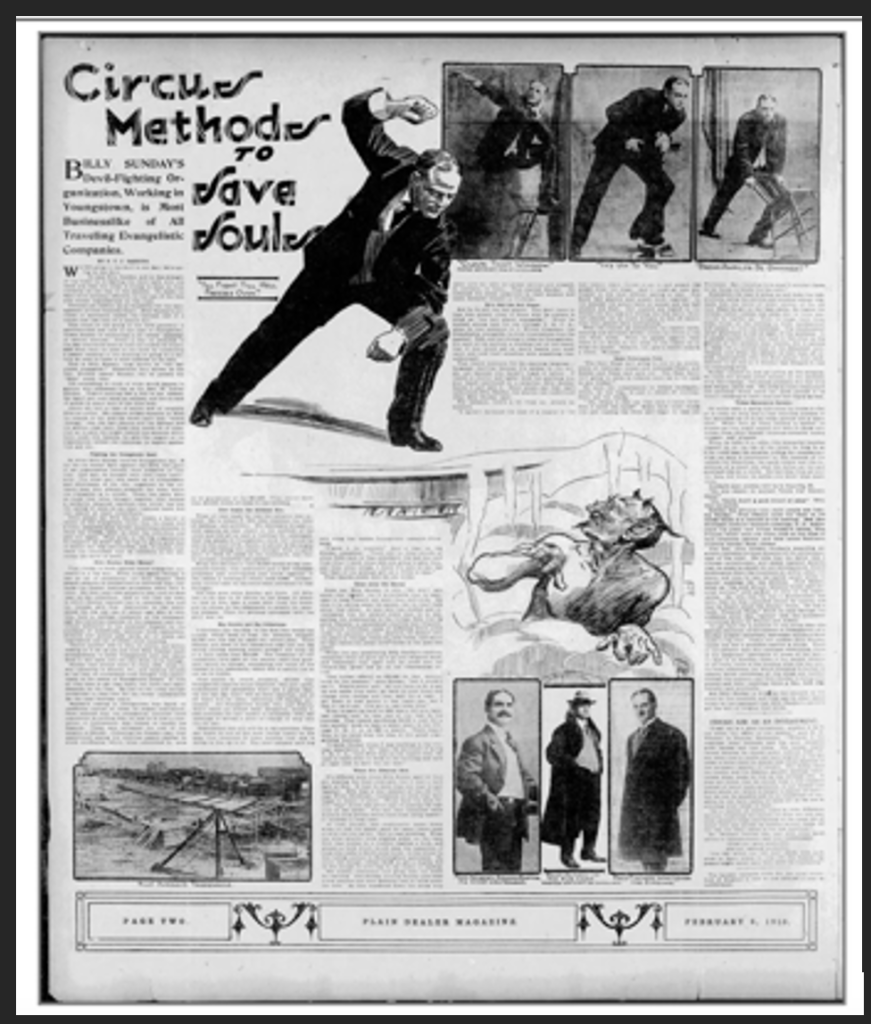
Billy Sunday Comes to Youngstown: A City on Fire (January–February 1910)
When Billy Sunday rolled into Youngstown, Ohio, in January 1910, he did not arrive quietly—and Youngstown did not receive him quietly either.
From the very first night, it was clear that this industrial city, filled with steel mills, rail yards, immigrants, laborers, and restless energy, was primed for revival. Sunday began his campaign on January 8, 1910, and within hours it was obvious that this would be no ordinary meeting.
A city floods the tabernacle
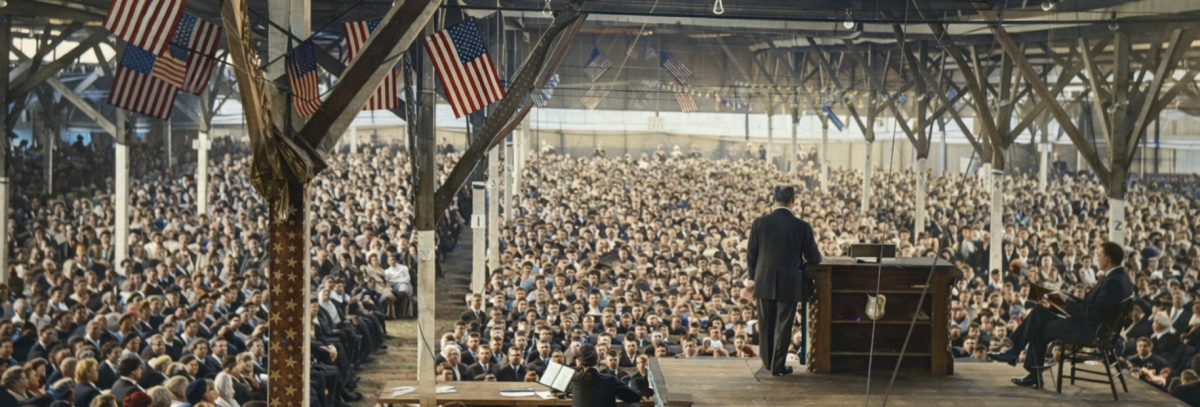
On opening night, 5,000 people packed the tabernacle, according to the New Castle News (Jan. 10, 1910). The very next evening, crowds swelled to 7,000, as reported by The Pittsburgh Post (Jan. 10, 1910). The word had spread fast: Billy Sunday was in town, and Youngstown wanted in.
As the weeks unfolded, the numbers only grew more astonishing.
By February 4, the campaign had already recorded 2,221 conversions. That same night, 15,000 people attempted to crowd into a tabernacle that could seat only 7,000—a vivid picture of spiritual hunger and civic excitement. The Cleveland Press marveled at the scene, noting the crush of humanity trying simply to hear Sunday preach.
Youngstown had become a revival city.
The dramatic final Sunday
The campaign reached its crescendo on February 20, 1910.
That final day, 10,000 people attended, while 6,000 more were turned away for lack of space. The Marion Daily Star reported that 5,900 total conversions had been recorded over the course of the meetings, including 970 decisions on the closing day alone.
It was a stunning finish—one of those great climactic Sundays that made Sunday’s name synonymous with American revivalism.
At the conclusion of the campaign, Sunday received his customary purse of 10,000 dollars, a significant sum in 1910 and a sign both of the city’s appreciation and of the scale of the event.
What Youngstown reveals about Billy Sunday
The Youngstown campaign illustrates several hallmarks of Billy Sunday’s ministry:
- mass appeal: from night one, thousands came. This was not a slow build—it was a tidal wave.
- urban impact: Youngstown, a gritty industrial center, responded with remarkable intensity, showing that Sunday’s message resonated far beyond small towns or rural communities.
- public spectacle and spiritual urgency: the overflow crowds on multiple occasions suggest that this was as much a civic event as a religious one.
- measured results: newspapers tracked conversions closely, giving us concrete numbers that help modern historians gauge the scope of the revival.
Most of all, Youngstown demonstrates why Sunday was “the man for the moment.” In an era of rapid industrial change, social tension, and moral anxiety, he spoke with clarity, fire, and confidence—and cities like Youngstown listened.
More than a century later, the Youngstown campaign stands as one of the great urban revivals of Sunday’s early career. The numbers are impressive, but the deeper story is about a city temporarily transformed—its people stirred, challenged, and moved to decision.
J. Wilbur Chapman on Billy Sunday
Writing just days after the Youngstown campaign ended, J. Wilbur Chapman offered this striking tribute to Sunday in The Dayton Herald (Feb. 23, 1910):
“Some of the sermons he preaches now are not mine. I love him. I know his sincerity and passion for Jesus. I thank God for his ministry. Most of us are too dignified. Let rules of grammar and conventionality be broken if souls can be saved. As soon as he begins to speak the doors will be closed so you can’t get out. You’ve got to take your dose for once. If ever a man was called to preach; if ever a man had the seal of God’s approval on his ministry, that man is Sunday. I take off my hat to any man that can turn men to Jesus Christ.”
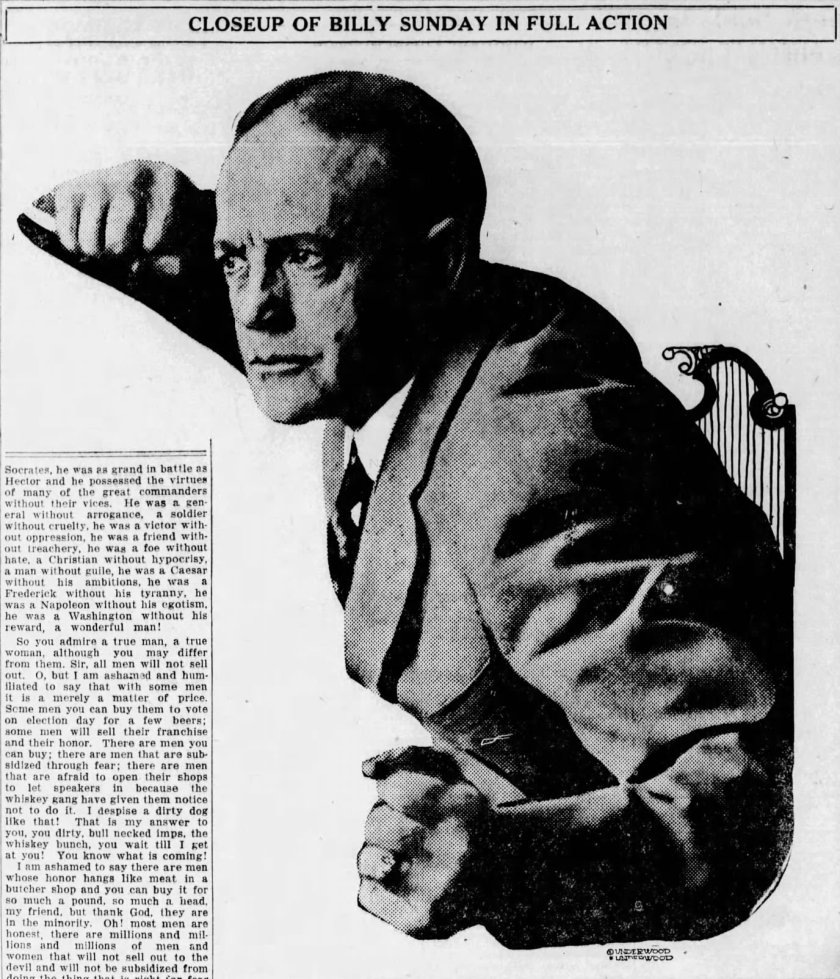
 Evangelist Billy Sunday (1862-1935)