Former professional baseball player-turned urban evangelist. Follow this daily blog that chronicles the life and ministry of revivalist preacher William Ashley "Billy" Sunday (1862-1935)
Citation: reported in The South Bend Tribune. Thu, May 01, 1913 ·Page 11
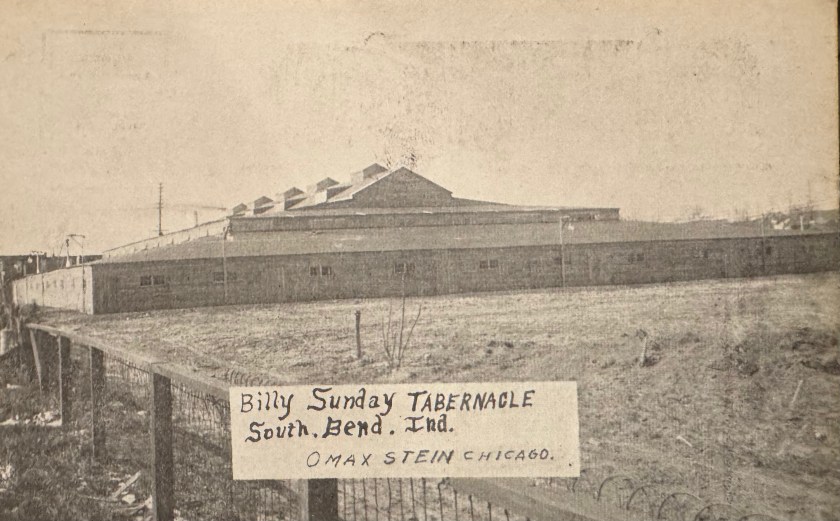
TABERNACLE MAY BECOME MARKET
PERMANENT RETENTION OF BUILDING IS URGED.
Disposition of Large Structure When Sunday Campaign Ends, Causes Speculation Among People.
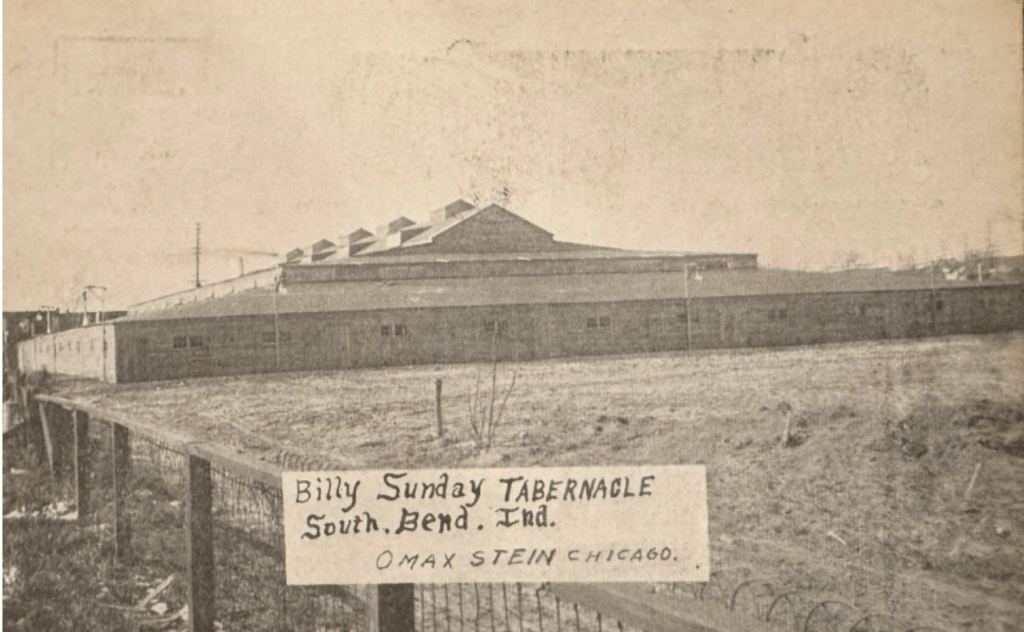
Author’s Collection
The permanent retention of the Billy Sunday Tabernacle as a public market house is one of the latest suggestions made relative to the future of that very large structure.
South Bend has been experimenting for some time with a public market and the interest which it has created makes many feel confident a permanent market in good quarters ought to be established. Those who favor the use of the tabernacle believe that while the location may not be the best, it is probably the best that can be found at the price and under existing conditions. Surrounding the tabernacle is sufficient space for a hay market, while the interior of the building is large enough to accommodate an indoor market for many years to come.
This is only one of a number of suggestions that have been made for utilizing the tabernacle when the Sunday workers are through with it. The possession of a structure as large as this is beginning to be regarded as a great advantage to the city and it is not impossible that before the Sunday campaign ends a movement may be started that will result in the retention of the building for a market or some other purpose.
The South Bend Tribune. Thu, May 01, 1913 ·Page 11
TABERNACLE MAY BE LEASED FOR SUMMER
Business Men Believe Building Can Be Left Standing for Time.
Business men and members of the different political parties in South Bend are still in favor of securing the Billy Sunday tabernacle here at the end of the campaign and using it for public meetings this summer and fall. As a rule the tabernacles are torn down at the end of a campaign but it is thought that if a combined effort is made the building may be left standing for a time at least. The tabernacle belongs to the St. Joseph County Evangelical association and it is probable that some overtures will be made for securing the building for public purposes before Billy Sunday leaves South Bend.
The South Bend Tribune. Wed, May 28, 1913 ·Page 12
So what’s the nature of a revival? He was praying for a revival. As a nation we are facing the danger of the dominance of the material over the spiritual; we are commercially drunk. Take a bushel of nickels and walk down the street of the average town and you can lead the bunch so close to hell that you can smell the sulphur fumes as it belches from the inferno below.
The biggest coward in America today, the biggest coward we have in the profession of christian religion, who is afraid to come out and declare himself in a campaign like this, is the business man. He is afraid that some saloon keeper, some brewer, some black-leg gambler, some madame of the red light district and others of that kind—they’re afraid they’ll lose their trade by it, and by the eternal God they ought to be punished before the moon changes.
[Cont.]
All Kinds of Revivals.
Listen to me. In the economy of nature God provides for an occasional copious downpour of rain. You would be a fool to growl because it didn’t rain all the time. God has arranged His spiritual kingdom so that He has a copious downpour of spiritual blessings. God is rolling in spiritual wealth as well as material. It is not thought unwise to have a revival in business, oh, no—every town has its commercial club. It is not thought unwise to have a revival in politics—on, no.
Some people are scared to death that somebody might be saved from hell by out-of-the-ordinary methods.
Political leaders will hire leaders, newspaper editors, publishers, and will spend money for voters—in order to get those who are indifferent to the political situation interested—that is nothing under heaven but a political revival and you don’t hear anybody growl about it—you didn’t hear anybody growl about it this last election—that is, nobody but the republicans. Well, I am one myself.
In the business world, listen. In the business world men must make the market as well as the goods for the market. He must make the goods, then he goes into the market. He’s got to do both. You’ve got Chambers of Commerce, you’ve got all these institutions to create a demand for the product—these are business revivals—you have auto shows, they are auto revivals—you have county fairs which are nothing but revivals where they show cows, pigs, chickens, bread, butter, horses, and all the products of the farm. Then what the revival is to business, what the election is to politics, the revival is to religion; what health is to the individual the revival is to religion. Martin Luther saved Europe—a spiritual revival under Martin Luther was the cause of the reformation, nothing, but a revival, and why any Lutheran will snap, snarl, growl about a revival when his church was born of a revival I don’t know.
When Revival is Needed.
A revival is needed when the worldly spirit is in the church of God. It isn’t necessary to do something grossly inconsistent. A ship is all right in the sea, but all wrong when the sea is in her. The church of God is all right in the world, but all wrong when the world is in the church. Some people come to church on Sunday morning and on Monday morning they take a header into the world and the church never sees them again until Sunday morning. They squat and take up a little space in the pew and stay there and put a little money on the plate, but you never see them again until Sunday morning. I tell you, I believe half of the church members could die and the church wouldn’t lose anything of its spiritual force; it would lose them in numbers, but it wouldn’t lose anything in spiritual power. I tell you, my friends, we need a panic in religion, the world don’t need informing, it needs reforming. We are going to the devil over culture clubs, as if the world needed informing. It don’t need anything of the kind. There are people who go to church and go to a certain denomination because their wife goes there. They got their religion and their property in their name. They go to that church.
Must Have Revival.
“I want to say if a public school teacher knew no more about the work and methods of teaching than the average Sunday school teacher knows about the will of God, she would not be on the pay roll 16 minutes.
“Go down to the dance halls, the nickelodeans, the picture shows, the cheap-skate dance halls — there you will find young girls with dresses to their shoe tops. I ask you, why? I’ll tell you: the spiritual destitution of the multitude. Thousands never darken the church doors. A revival is needed when sinners are careless, licentious. * * * A general revival of religion has got to sweep over this country or it will mean the dissolution of the church, the home and of the nation. I don’t care a rap how you fortify your shores; how many ships you build; America has got to have a revival or it means the end of your religion. Wealth and culture never saved Rome, Babylon or Nineveh, and if you have the sins of Babylon, you will have the judgment of Babylon.
“What is a revival? It is a campaign in the name of God against the world, the flesh, and the devil, and against a revival you will find every brewer in this valley; every whiskey seller in this valley; every saloon-keeper in this valley; every black-leg gambler in this valley; every she madam of the red light district; every man and woman that feeds and fattens and gormandizes upon the virtue of men and women so if you want to line up with a bunch like that, God pity you; that is the best compliment on God’s earth.
“Men say the day of the revival is over. Fellows harp on that in the Methodist conferences, in the Presbyterian meetings, in the Baptist associations. In the Congregational associations,—the day of the revival is over. No, it is not. No, only with the fellow who vomits out the sentiment; but it is not over with God.
The day of the revival is over. God Almighty leaned over the battlements of heaven and looked down into the coal mines of Wales and said, ‘Oh, Roberts!’ and out of the depths of the coal mine came that grimy, soiled man, with dirty face, with a little lamp in his cap, and he said, ‘what is it, God?’ And God said, ‘I want you to go and shake up Wales,’ and he gave Wales the greatest revival that ever swept over this land since the days of Pentecost. There was not a college professor or preacher in Wales that God would trust with the job.
Citation (excerpted): The South Bend Tribune. Wed, Apr 30, 1913 ·Page 14, 16
The South Bend Tribune. Wed, Apr 30, 1913 ·Page 14
FEW HOME RUNS BY BILLY
“You always get what you’re looking for in this world.”
“Gossips have tongues so long that they can sit in the parlor and lick skillets in the kitchen.”
“Lots of people join church for the same motive that a man blows a safe, for what they can get out of it.”
“If I should start with a wagon load of Bibles to-day and offer one to every person I met, who would quote for me 10 verses of scripture and tell me where they were in the Bible I would have a big bunch of the books left when I got to New York.”
“The ordinances of the church don’t save anybody.”
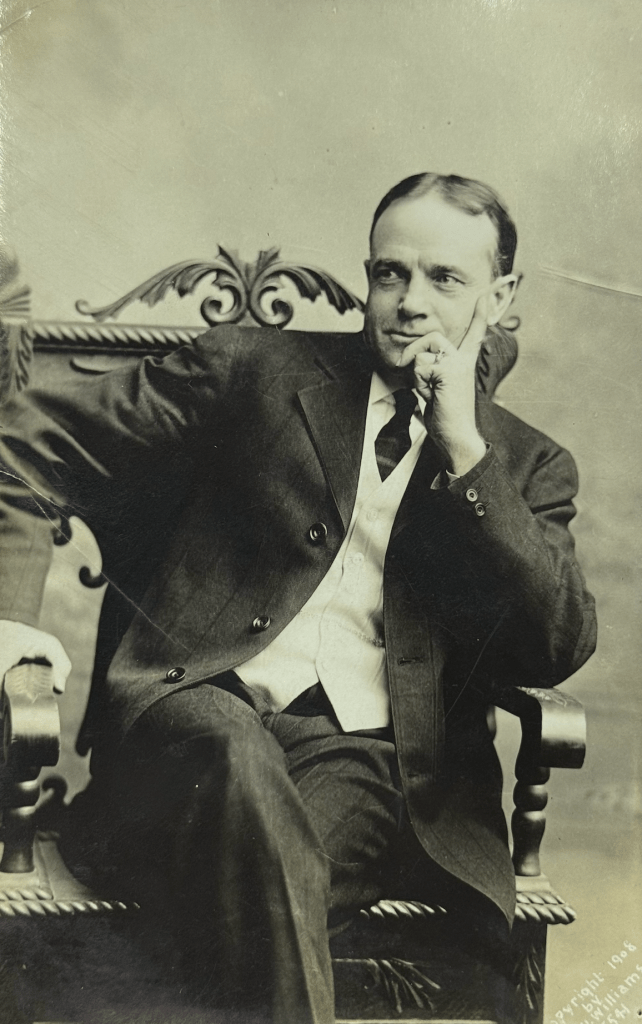
C 1908. Author’s Collection.
“I don’t believe that half the people in the churches of South Bend have been converted.”
“I thank God for the mutts in this world that hate me.”
“I have more good, true, loyal friends and more loyal enemies than any man that ever came to South Bend.”
“Some of you people go to church on Sunday morning; go to a ball game in the afternoon; and keep a case of beer in your cellar that the booze man slips in while your neighbors are away.”
“Some ministers say that I am too sensational. Well, I would be anything to save souls.”
“Every denomination today has a clique that bosses the minister.”
“Some people carry all their piety in their collar, plug hat and their cane.”
“If there is any one in the world that I pity it is the pastor of the average church.”
“You ring the church bell on Sunday morning, put a duffer up to a little stunt and all the time the old world is going straight to hell so fast that it is breaking the speed limit.”
“You back the church of God in on a siding, lock the switch, and let hell come rushing down the main line.”
“The man who seduces a girl should be shot and if I was on the jury in his trial he would never get away unless the ants should carry him through the keyhole.”
“I have as much respect for the man who knocks revivals as I would have if he should spit in the face of Jesus Christ.”
“One reason why the world doesn’t join the church is because the church has joined the world.”
“I have as much respect for the man who knocks revivals as I would have if he should spit in the face of Jesus Christ.”
“You come up here and prove the things that are said about me and I will go to the penitentiary. But if you come up here and can’t prove them you go to the penitentiary.”
“If you want to elevate people then have got to live better than they do. Away with this 20th century doctrine of living as they do.”
“The difference between a grave and a rut is that a grave is a little deeper. There are two gangs in every church, the ruts and the anti-ruts.”
“I despise men who trim their sails to catch the passing breeze of popularity.”
“A boy can throw stones and break a window, but it takes a skilled mechanic to make one. Any fool can sneer at a revival—and you’re a fool if you do.”
“You might as well expect a mummy to bear children, and the children of hell to sing hymns, as to expect an awakening that doesn’t begin in the church.”
“The measure of preparedness determines your success.”
“Half the members of almost any church could die and the church not lose any of its spiritual force.”
“We are going daffy over culture clubs. The world doesn’t need informing, but reforming.”
“The less brains a man has the greater trouble he exercises to show what he has got.”
“You can not scald a hog in ice water.”
The South Bend Tribune. Wed, Apr 30, 1913 ·Page 14
“Angels Hid Rail Splitter Where He Was Undiscovered for Years,” Says Leader of Revivals.
Billy Sunday has written many beautiful things which have attracted widespread attention, among them being his tribute to Abraham Lincoln. This was written and published for the first time about a year ago.
The tribute follows:
“The angels said, ‘Let us hide Abraham Lincoln where the world will never find him,’ and they hid his big kind, generous, humanitarian, sympathetic God-fearing soul in that long, lean, lank, homely, gaunt, ungainly body. They bronzed his cheeks until he looked like an Indian. They hardened his hands with toil. For employment they gave him common work, like poling a flatboat on the Ohio river and clerking in a country store.
“But, while drifting down the stream he was solving problems that would help him up the stream. And while clerking in the country store he was learning whole chapters from the book of human experience which became golden rounds in the ladder of fame up which he climbed to the top.
“For parents, they gave him common people whose names were unknown five miles away for a home, a log cabin in the wilderness. The battle would grow hard. He would grit his teeth, buckle up his yarn galluses a little tighter and determine that he would be somebody, anyway. He would spread the ashes thin on the dirt floor of his log cabin home and, with a hickory log in the fireplace for a light and a hickory stick for a pencil, he solved problems from Euclid and read the life of Washington and other great men.
“Finally, the angels could keep him hid no longer, and so one morning this old sleepy, dreamy, drowsy world rolled out of bed, rubbed her eyes and started on a still hunt for a great man. She struck a new scent and a new trail that led out through the woods into the wilderness and up a hill to a log cabin. She rapped at the door and Lincoln arose—so big, so high, so tall that the logs rolled down the roof and fell off and he stepped forth—a giant among men. Fame has placed him upon a pinnacle so lofty that he looks down upon all who attempt to reach his side.”
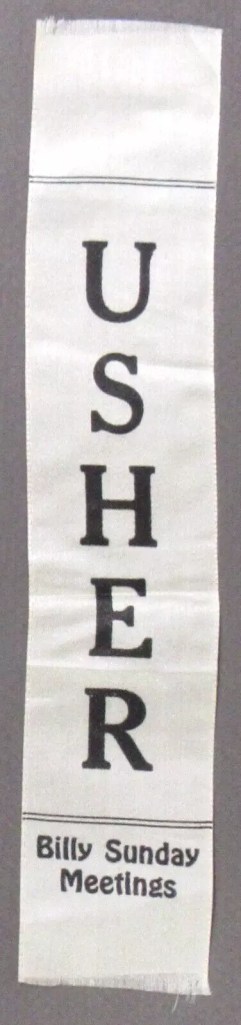
The South Bend Tribune published the following about the role of ushers at the South Bend revival. (The South Bend Tribune. Mon, Apr 28, 1913 ·Page 9)
An authentic Billy Sunday usher lapel flag.
The work of the ushers in the South Bend campaign is to be under the direction of Col. Charles Arthur Carlisle, chairman of that committee, and W. Raymond Smith, chief usher, together with C. B. Alberts, of Mishawaka, vice chairman of the committee.
Do not think for a minute that this phase of the campaign is not thoroughly mapped out and systematically, cared for.
The following list of instructions have been put in the hands of each of the 250 men who will be on duty in this city and must be carried out to the very letter.
List of Instructions.
Ushers will enter the tabernacle by the east door of the building near northeast corner.
Upon entering report immediately at the chief usher’s desk and receive assignment.
Upon assignment proceed at once to the section to which assigned, and report to chief of section, securing also the seat reserved for him.
The front seats will be filled first, and as soon as the front section are occupied, then the next in rear will be filled; so on to the rear of the building. As soon as a section is occupied, ushers will not permit any in charge, to pass their station, except by permission of the chief usher.
5. When reservations are made, special instructions will be given in each case.
6. In taking collections or distributing cards, ushers will work from the front toward the rear of their respective sections.
7. As soon as the usher has completed the collection he will return to his station, face toward the center of the aisle and remain standing until he had delivered his collection to the general collector. He will then take his seat and remain there throughout the service.
8. Ushers will keep watch over their sections, and should any person be overcome or faint, they will quietly be removed by the usher to a place provided.
9. Ushers must see that the aisles are kept clear of chairs, and no person will be allowed to sit or stand in the aisles. (This is against the state law, and subjects the offender to a fine of $1,000).
10. Ushers in charge of exits will remain constantly at the exit during the service and at its close will see that the doors are properly thrown open. In case of fire or panic, the doors will be at once thrown open.
11. When all seats are occupied, the entrance doors will be closed, and no person will be allowed to enter the building thereafter except by special permission.
12. Should any usher desire to retire, he will report to his chief of section, delivering to him his card for
13. All ushers, whether on duty or not, are requested to wear their badge during the service. This is necessary so that they may be recognized at once if needed for any duty or assistance or overflow meetings.
Assigned by Card.
14. Ushers will be assigned by card for each service. They will receive their assignment cards at the chief usher’s desk. The first come will be first served, until all stations are filled.
15. Each ushers will have a seat reserved for himself and one other person, and in no case will he give up his seat to any person for any reason whatever.
16. Chiefs of sections will see that these provisions are carried out in their respective sections.
17. The committee on ushers from each church are requested to arrange to have at least 40 per cent of those named by them as ushers present at each service.
18. Ushers will return their assignment card and badge at the close of each meeting to chief usher.
19. Ushers are enjoined to be firm in the enforcement of rules, but will refrain from any controversy with anyone; yet they will quietly insist upon all persons obeying the rules.
The division ushers, those in charge of the various sections into which the large tabernacle has been divided, who will serve during the local campaign and who started their duties yesterday morning include the following:
O. G. Huff, L. B. Finch, G. M. Urey; I. Jackson, H. I. Reddick, Fred Sweitzer, M. C. Price, Harry H. Weiss, Rollo E. Bunce, W. M. Knell, Edward Schubert, George Koenig, William G. Garten, A. D. Young, W. T. Anders, H. L. Kingsley, W. S. Bassett, William H. Swintz, Frank Boone, H. A. Thulka, Oscar Wise, Albert M. Stamm, E. H. Cornish, J. A. McEndorfer, Wesley Miller, E. B. Zehring, Myron Campbell, E. S. Webster.
The South Bend Tribune Tue, Apr 29, 1913 ·Page 7
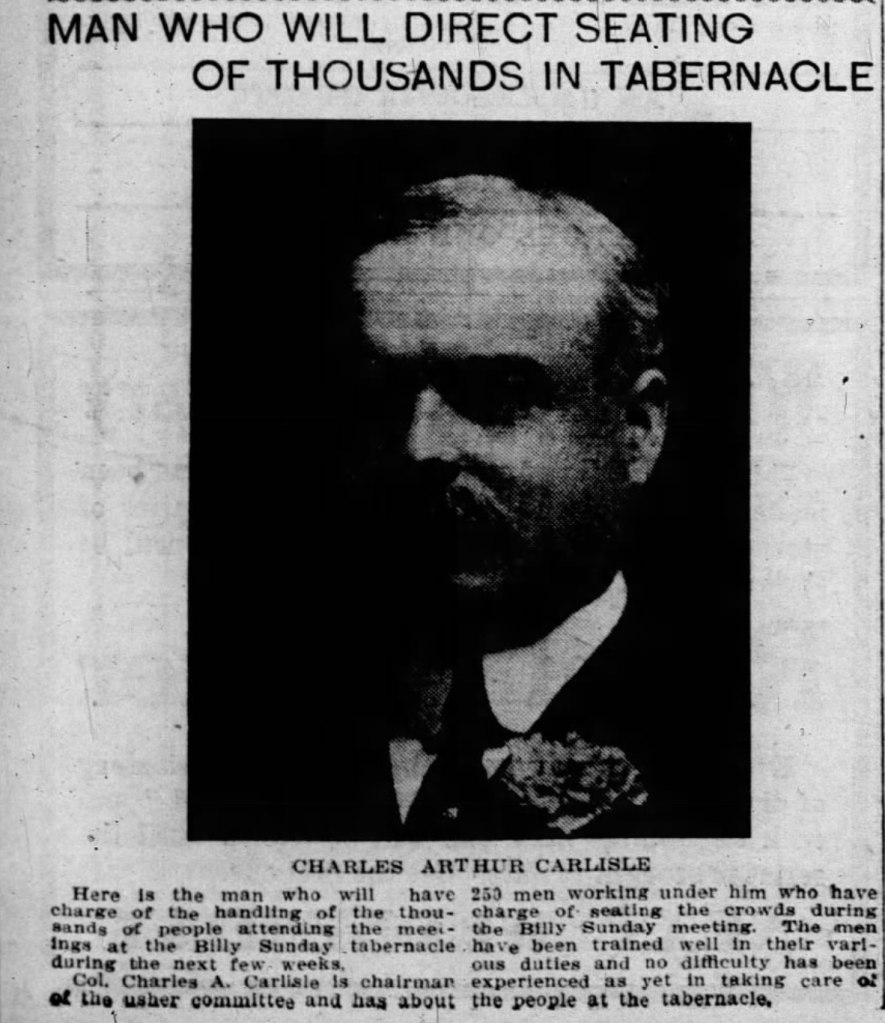
MAN WHO WILL DIRECT SEATING OF THOUSANDS IN TABERNACLE CHARLES ARTHUR CARLISLE
Here is the man who will have charge of the handling of the thousands of people attending the meetings at the Billy Sunday tabernacle during the next few weeks.
Col. Charles A. Carlisle is chairman of the usher committee and has about 250 men working under him who have charge of seating the crowds during the Billy Sunday meeting. The men have been trained well in their various duties and no difficulty has been experienced as yet in taking care of the people at the tabernacle,
Individual contributions to the collections at the Sunday tabernacle yesterday were rather meager, comparing them with those of the usual opening Sundays of the evangelist’s meetings. There was not a coin of a larger denomination than $1 in the collection, which ranged all the way down to pennies.
It was estimated by “Joe” Spiece, the tabernacle builder, 19,000 people attended the three meetings yesterday. A collection of $421.51 was contributed, making an average of 2.2 cents per capita for the entire day.
Source: The South Bend Tribune. Mon, Apr 28, 1913 ·Page 1
Excerpt from: The South Bend Tribune. Sat, Apr 19, 1913 · Page 1
The character of Billy Sunday as an evangelist is well known generally. His methods although they do not conform to the ideas of many people, are energetic and forceful, and have proven to be productive. His fearlessness in denouncing evil and his portrayal of the sins of the world are his strongest assets on the platform. In nearly every city in which Billy Sunday campaigns he receives threatening letters from fanatics and from persons opposed to his almost militant methods. Wilkes-Barre, Pa., where he has just closed a very successful campaign was one of the exceptions to this, much to the surprise of Sunday and his party. It is not known as yet whether there will be any such persons brought from under cover in South Bend but the religious people here hope not.
In Columbus, O., a woman threatened to “cut his heart out”. She was laboring under the impression that Sunday had seriously harmed her. It is to protect himself from scandal that Mr. Sunday never allows women to call upon him and he never calls at a person’s house unless accompanied by some member of his party.
As originally published in The South Bend Tribune. June 16, 1913. Transcriptions by AI and might contain errors.
REVIVAL CLOSES WITH 6,398 CONVERTED; SUNDAY GETS $10,500
SOUTH BEND’S RELIGIOUS CAMPAIGN PROVES TO BE MOST NOTABLE IN HISTORY OF ALL INDIANA
AIR OF SADNESS PREDOMINATES AT CLOSING MEETING OF BILLY SUNDAY’S BIG REVIVAL.
“BOSS” AND “MA” SAY THEIR LAST FAREWELL
Hundreds Cheer Evangelist and His Wife on Rear of Car as They Leave City—Other Thousands Disappointed by Early Departure—Last Day of Services Proves to be Remarkable One—Over 30,000 Present.
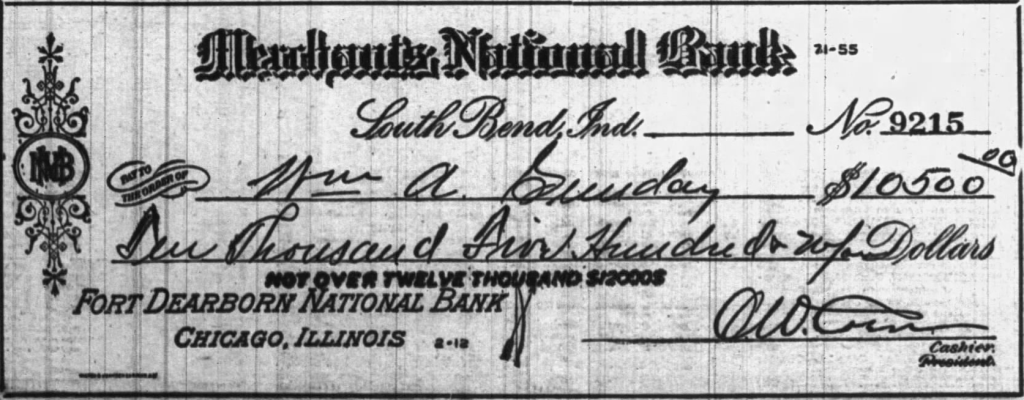
Billy Sunday’s seven weeks’ fight against the devil in St. Joseph county became religious history to-day after the baseball evangelist had shown 6,- 395 people the road to salvation and approximately $10,500 had been raised for him.
The final curtain was rung down last night and the hard working little evangelist, with his wife, said good- bye to South Bend at 10 o’clock this morning. With a check for the $10,500 tucked away in an inside coat pocket, Billy boarded at 10 o’clock Northern Indiana Interurban car for his home at Winona.
A thousand people saw him off. Hundreds waved their hats and hand- kerchiefs at the evangelist, his wife, and Rev. William Asher, as the car moved out of the station and south on Michigan street. All three stood on the rear platform bowing and smiling in response.
It was estimated a crowd of 8,000 or 10,000 people would have been at the station to see the evangelist off, but the hour was earlier than many had expected, disappointed many. The Northern Indiana Interurban car which carried the party through to Winona is the same car the evangelist had used to eat lunch under his own roof.
State’s Greatest Revival.
With Sunday’s farewell prayer and general handshaking all around at the tabernacle last night the meet- ings, which undoubtedly constituted Indiana’s greatest religious revival, came to a close. The meetings end- ed quietly and with that heavy sol- emnity, which told plainer than words what it meant to the people to bid farewell to “Billy,” “Ma,” “Rody,” “Mac,” Ackley and all the rest.
Tears started in the eyes of many a woman, and many a sob and fare- wells were said on the platform. Hun- dreds crowded near the revival lead- er to shake their hands, and the num- ber about Homer Rodeheaver, di- rector of the music, and Mrs. Sun- day became so large, the people were formed in lines and then compelled to move rapidly as soon as they had said goodbye.
Completely worn out, Mr. and Mrs. Sunday were conducted from the tabernacle to the automobile to es- cape thousands, who wanted to say their last word of farewell. The evan- gelist feared to permit, however, be- cause of his weakened condition and the heat of the tabernacle.
Satisfied With Results.
The campaign in South Bend and Mishawaka was satisfactory to all and the evangelist is glad to leave. The evangelist had hoped for a some- what larger number of converts but days before the close, it was plain to be seen the population of the two cities, South Bend and Mishawaka, was not sufficient to hope for a larger number at the close. The amount of the special collection met the approval of all.
The baseball evangelist expressed himself as deeply thankful for the amount, which was given him as some estimate of how the people appreciat- ed his efforts in the St. Joe valley. Although neither the number of con- verts or the amount of offerings was a record breaker, South Bend’s standing was generally regarded as an excellent one in comparison with the population of other cities where Sun- day worked, it ranked very favorably with the highest.
As High in Comparison.
The number of converts was much lower than at Columbus, O., and WilkesBarre, Pa., as was also the offering, but the population of both cities and their suburbs is much larger than that of South Bend. Wilkes-Barre and its suburbs has a population of considerably more than 150,000 people, it is estimated, while Columbus has 200,000 population within its corporate limits.
Wilkes-Barre had 16,584 conversions and Columbus 18,137, which number is little larger than the figures for the South Bend revival, when the questions of the comparisons are considered.
Was Remarkable Day.
Beyond a doubt the final day of the revival was the most notable of the seven weeks despite the fact it was the hottest day thus far of the summer, and a portion of the time the great tabernacle on Vitulus avenue, was so warm that it was almost unbearable.
It was estimated 32,000 or 33,000 people attended the three meetings of the day, with another 1,500 coming next morning after two services for them were held. It was the largest daily attendance of the campaign and there can be no doubt but the number of converts would have been increased to 35,- 000 or 40,000 but for the terrible heat.
Eleven thousand people packed the tabernacle in the morning, 8,000 then went there in the afternoon, and last night a crowd estimated at 12,000 filled the great tabernacle space, while thousands beside lining the streets and filling the structures on the opposite side of the street, and the river bank.
Some There at 9 O’clock.
As was expected, the crowd began arriving at the tabernacle in the morning almost as soon as the meeting was up. Several men were pounding for admission at 6 o’clock in the morning, and the crowd had increased to nearly 100 men, women and children by 7 o’clock. An hour later the tabernacle had begun to fill rapidly and people were scrambling for seats by 9 o’clock. When 10 o’clock came, it was hard to buy seats in the building, although a few men and women did succeed in purchasing tickets a few minutes before the hour.
A great number of men remained in the tabernacle from the morning until the afternoon service, and there was a crowd of 500 people clamoring for admission to the tabernacle when the men’s meeting closed about 3 o’clock. There were few desirable seats left in the building at 6 o’clock 700 Converts in Day.
Practically 700 people accepted christianity in response to the evangelist’s earnest pleas during the day. One hundred and ninety men responded to the invitation at the morning service; 173 men went forward to grasp the evangelist’s hand in the afternoon, and the largest number of the day responded at the night service.
The final meeting for men only was held at 3 o’clock in the afternoon. He responded to one of the most stirring sermons of the campaign, which was preached from the text, “He Said To-Morrow.” Much of the evangelist’s voice was so filled with emotion he appeared to choke over his words. The tears in his eyes were not confined to those in his audience and he closed in a touching farewell prayer, which appeared to make a deep impression.
He prayed earnestly for people in all walks in life in South Bend and Mishawaka, naming the various bodies and institutions which had helped to make his campaign here so successful one.
Sunday’s Final Prayer.
In his prayer he said: “Jesus I don’t like to pray, because I know it will be the last prayer I’ll ever make in South Bend in connection with these meetings. I don’t like to pray, but it useless to keep the meetings going longer. I’ve remained three times now than I intended. I’m glad I did, Lord. But now Lord, we’re going to close these meetings.
I want you to take care of the salvation. What more can we, Jesus, give you? You know it is the desire of my soul that no one can say that I ever said anything to injure Your cause. I love You and the people of South Bend. I have never had but one motive, and that is to see the city filled with people seeking after Jesus. I feel especially drawn close to the people of this city, Lord, because I love the individuals. We’re not so far away, Lord, but we could be heard if we were to speak.
Asks Blessing.
“God bless South Bend and Mishawaka, the newspapers, the choir, Lord, and the ushers; the police and all that have come to Christ during these meetings.
“And now, Lord, we must say good bye.” “Lord, speak to us and the people that they will press down these aisles. Speak to them Lord, that they will not say as the old king did, ‘To-mor- row.’ Don’t say ‘To-morrow.’ Speak In South Bend to-night. Say ‘I Will.’ And who will.”
Hundreds of people responded to the beautiful prayer and the brilliant sermon. A demonstration similar to that on the night he preached the sermon on “The Unpardonable Sin” followed. Men and women of all ages, and in every walk of life, came down the aisles, all apparently eager to take their places among the converts.
Women Bother Him.
One convert, a woman, came forward screaming hysterically, and supported on the arm of a woman friend. The antics of this woman appeared to annoy the evangelist not a little and he requested her to be seated. In a husky voice to her and he said he would promise the platform if possible. Many prominent men and women were among the number of converts yesterday.
Taking the Collections.
The taking of the collection for Billy Sunday proved one of the most important features of the Sunday services. The largest collection reported at Billy Sunday in any of the three meetings was that of the men’s meeting in the afternoon. The subscriptions amounting to $1,500 in cash and pledges of $1,500 additional. The men’s meeting in the afternoon also was contributed to the collection. The small subscriptions of the women and children contributed to the total. The collection of the women and children amounted to $1,000. The Auditors announced the total subscriptions amounted to $4,000. The subscriptions at the First Presbyterian church were announced and Rev. Charles Arganbright, pastor Charles W. Goheen, Hon. Marvin Campbell, E. C. Williams and others who worked untiringly from the time the meeting opened yesterday morning until long after the close of the service last night, counting the money that was contributed and straightening out the affairs of the association. A report was made before the people left the tabernacles. Even then it was necessary for the men to work late into the night and this morning until a few minutes before the evangelist left South Bend to make a correct count of the finances on hand.
People Show Appreciation.
Everywhere throughout the final hours of the revival was displayed indications of the popularity South Bend and Mishawaka people felt for Billy Sunday and the members of his party.
Mr. and Mrs. Sunday were greeted with thunderous applause every time they entered the building during the day and they were frequently cheered while the meetings were in progress. Just before the opening of last night’s services, Homer Rodeheaver, the leader of the great tabernacle chorus, was greeted with a magnificent shower of roses, which was thrown by the nearly 1,000 members of the great aggregation. For five minutes the shower continued, much to the embarrassment of both Mr. Rodeheaver and Pianist B. D. Ackley.
Farewell songs were sung by singers with the Sunday party and a quartet from the South Bend Conservatory of Music.
“And He Said To-Morrow.”
Sunday made an impressive appeal in his farewell sermon last night to the people of South Bend and Mishawaka who are not Christians to fall into rank before it is too late. “And He Said To-Morrow” were the words of the text taken by the evangelist and he told of the results of procrastination and delay both in religion and other things.
“When I think that this is the last service of this great effort on the part of God and the Holy Spirit to bring you men and women to repentance,” cried Sunday, his voice choking with emotion, “I tell you my heart nearly breaks. You may think you listen! I am going to make you listen! Think of the sermons you have heard since you were old enough to attend Sunday school until you sit here to-night.
Continued on Page Five.
RESULTS IN BRIEF
Conversions
Previous conversions ………. 5,400
Saturday and Sunday ………. 983
Grand total ………. 6,383
Attendance
Previous attendance ………. 519,550
Saturday and Sunday ………. 46,050
Grand total ………. 566,053
Collections
Special offering for Billy Sunday ………. $10,500.00
Collections for local institutions ………. 737.98
Fund for campaign expenses ………. 18,500.00
Grand total ………. $24,737.98
The taking of the offering for Billy Sunday was one of the features of the closing day of the campaign. Seventeen or more different people and concerns of South Bend and Mishawaka gave donations of $100. The largest was $200, given by Samuel Murdock, of Lafayette, Ind., one of the owners of the Chicago, South Bend & Northern Indiana railway. The donations of $100, which have been recorded thus far, are from the following: South Bend and Mishawaka Ministerial association; Mrs. George Wyman; Mrs. M. V. Belser, citizen of Kingston, Pa., by George L. Newell; Folding Paper Box company; Stephenson Underwear mills; E. B. Eberhart; Stephenson Manufacturing company; C. C. Shafer; Col. George W. Studebaker; Mrs. Clement Studebaker; J. Friend; Clement Studebaker, Jr.; J. D. Oliver; Mrs. George Ford; C. A. Carlisle and the Mishawaka Woolen Manufacturing company. The $50 donations which have been reported thus far to those in charge of the campaign, are from the following: Mrs. C. C. Billworth; W. O. Davies; F. H. Badet, Mr. and Mrs. H. A. Thompson; J. O. Bowher; McFarlin & Jackson; S. P. Stults and Mrs. Ida M. Stull, and the U. B. Memorial church.
The following article appeared in The South Bend Tribune. November 7, 1935.
Sunday Heard by Big Crowds Here in 1913
Rev. William Ashley Sunday, who died suddenly Wednesday evening in the home of a friend in Rogers Park, a suburb of Chicago, conducted in South Bend in 1913 what probably was the greatest series of evangelistic meetings ever held in Indiana. His campaign began Sunday, April 27, and continued for seven weeks.
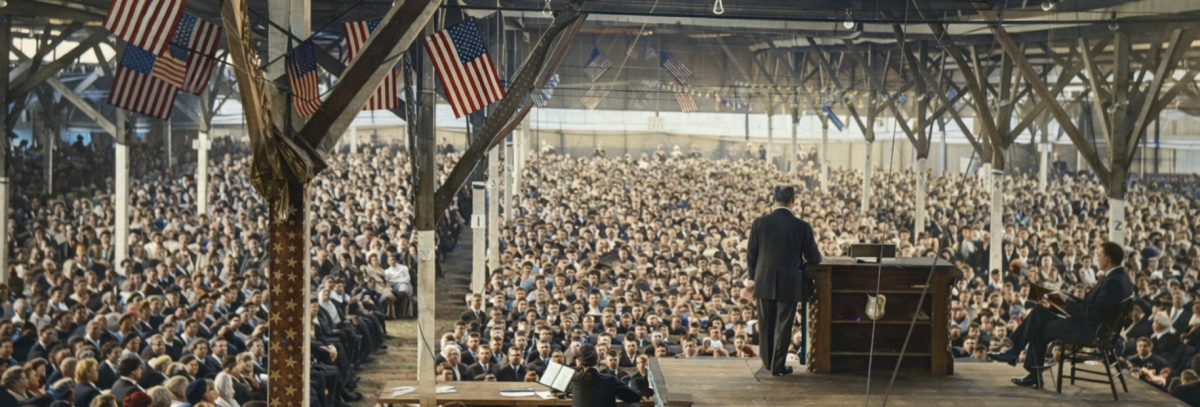
For two months before the famous Billy Sunday opened his meetings in South Bend workmen were engaged in the construction of one of the largest buildings ever erected in the city which became known as the tabernacle. It was built of wood on vacant land between Vistula avenue, now Lincoln Way East, and the St. Joseph river, with Monroe street on the north and South street on the south. The tabernacle had a seating capacity of about 10,000. Reservations were made for the largest musical organization ever assembled in the city, a chorus of more than 1,000 voices. The ground floor was covered with sawdust and fine shavings, making a soft, thick carpet and the outstanding celebrated sawdust trail.
4,000 at Dedication.
Mr. Sunday and his party were quartered in three houses at 515, 517 and 519 South Carroll street. His housekeeper, Mrs. J. W. Foults, of Cleveland, O., had charge of the households. The tabernacle was under the supervision of Fred Seitz, a close friend of the evangelist, who had charge of his tabernacles in the various places where services were held.
The tabernacle was dedicated on Sunday evening, April 20, more than 4,000 persons presenting many denominations in South Bend and elsewhere being present. Rev. Dr. Henry L. Davis, pastor of the First M. E. church, chairman of the tabernacle building committee, presided. He then introduced to E. C. Miller, chairman of the executive committee for the St. Joseph County Evangelistic association, which was largely instrumental in bringing Mr. Sunday to the city. Mr. Miller told of the purpose for which the tabernacle was built. The invocation was by Rev. Peter Moredyke, pastor of the First Reformed church, now out of existence.
Rev. C. V. Mull, pastor of the United Brethren church, led the responsive reading. The scripture lesson was read by Rev. J. C. Tomes, pastor of the Christian Church, of Mishawaka. Rev. Thomas W. Powell, pastor of the Quincy Baptist church, preached, his subject being “Divine Urgency.” Rev. A. C. Ormond, pastor of the Presbyterian church in Mishawaka, spoke on “God’s Victories,” praising Mr. Sunday’s work and saying that if Christian people could operate 40,000 souls in South Bend and Mishawaka could be saved. The benediction was by Rev. Dr. C. A. Lippincott, pastor of the First Presbyterian church.
Nursery Provided.
Marvin Campbell, chairman of the finance committee, announced that in addition to this the association would pay half of the salaries of Mr. Sunday’s co-workers. Mr. Sunday was not to receive anything until the last Sunday of the services when the entire collection was to go to him. Rev. C. A. Decker, pastor of the First Baptist church, told of preparations for handling the big crowds.
A nursery where parents left their children while the parents attended the meetings was situated near the tabernacle and was in charge of Miss Babcock, head of the city’s kindergarten training schools. Children under five years of age were not allowed to attend the services.
Before the tabernacle was completed South Bend business men began the erection of large and small billboards near the entrances to the tabernacle. This aroused the indignation of religious people to a point of battle and vigorous protests were made against the signs.
Nearly 20,000 Listen.
Members of the Sunday party arrived in South Bend previous to
The_South_Bend_Tribune_1935_11_07_1
SUNDAY SPOKE IN CITY IN 1913
Continued from Page One.
Saturday, April 26, and prepared for the great Sunday opening. Mr. and Mrs. Sunday arrived Saturday afternoon and the evangelistic services began the following day. The great evangelist’s first utterances were made before an enormous gathering. Hour after hour on the opening day nearly 20,000 upturned faces watched and listened in the great tabernacle. The morning crowd was estimated at 7,000, the afternoon at 4,000 and the evening at 8,000. Favorable weather, leaders of the movement believed, would have swelled the crowd to nearly 25,000. The morning collection amounted to $184, the afternoon to $70.28 and the night to $167.93, making a total for the day of $425.51. From the first meeting to the last seven weeks later Mr. Sunday had great crowds.
The great evangelist’s services closed on Sunday, June 15. On that day the collection amounted to approximately $10,000. The collection was given to Mr. Sunday. The total of collections for the seven weeks was $24,227.98, the total attendance was 600,050 and the total conversions 6,389. The taking of the offering for Mr. Sunday was one of the features of the closing day of his great campaign. A number of persons in South Bend and Mishawaka contributed $100 each. The largest individual contribution was $200 given by Samuel Murdock, of Lafayette, Ind., a well known and devout Catholic and one of the owners of the Chicago, South Bend & Northern Indiana railway of South Bend.
After Rev. Mr. Sunday completed his services and left the city the great frame tabernacle was torn down and the lumber was removed. The site is now covered by some of the best residences in South Bend and is known as Edgewater place.
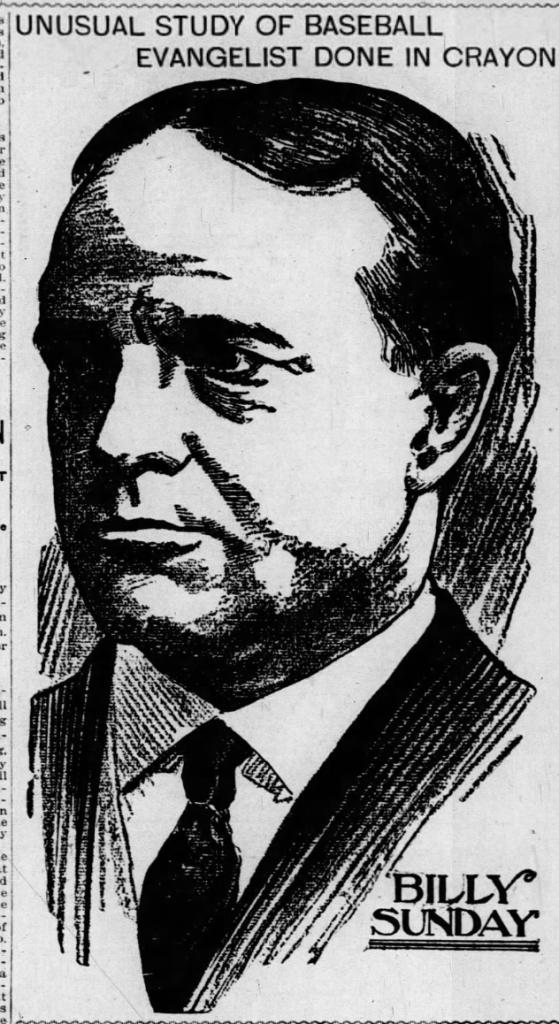
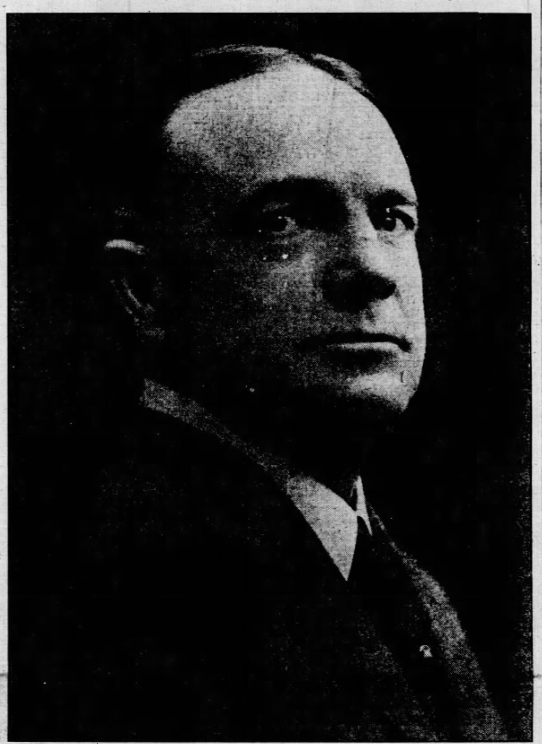


 Evangelist Billy Sunday (1862-1935)