South Bend Tribune headline for final day of campaign

Citation: The South Bend Tribune. Mon, Jun 16, 1913 ·Page 1

SOUTH BEND’S RELIGIOUS CAMPAIGN PROVES TO

BE MOST NOTABLE IN HISTORY OF ALL INDIANA

AIR OF SADNESS PREDOMINATES AT CLOSING MEETING OF BILLY SUNDAY’S BIG REVIVAL.

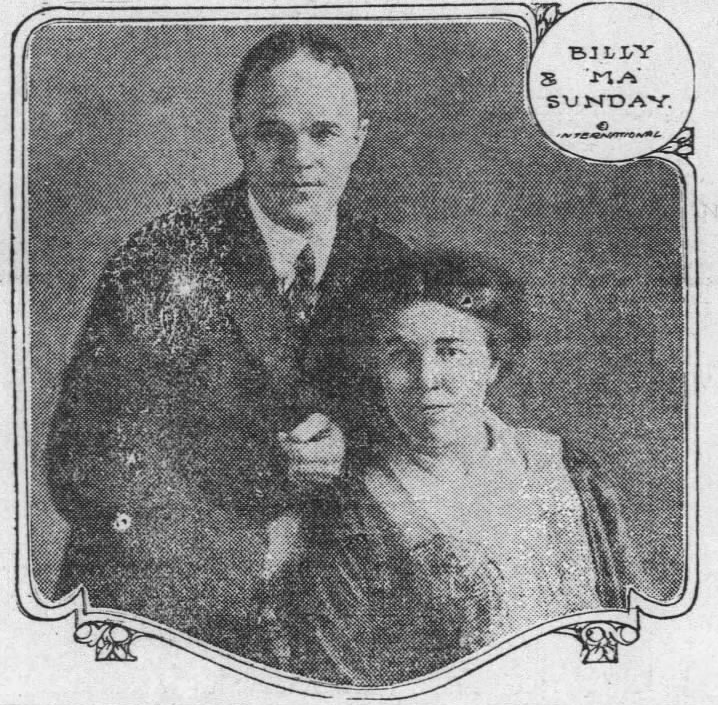
“BOSS” AND “MA” SAY THEIR LAST FAREWELL

Hundreds Cheer Evangelist and His Wife on Rear of Car as They Leave City—Other Thousands Disappointed by Early Departure—Last Day of Services Proves to be Remarkable One—Over 30,000 Present.

RESULTS IN BRIEF.

Conversions.

Previous conversions ………. 5,455

Saturday and Sunday ………. 943

Grand total ………. 6,398

Attendance.

Previous attendance ………. 519,550

Saturday and Sunday ………. 46,500

Grand total ………. 566,050

Collections.

Special offering for Billy Sunday ………. $10,500.00

Collections for local institutions ………. 737.98

Fund for campaign expenses ………. 18,500.00

Grand total ………. $24,737.98

The taking of the offering for Billy Sunday was one of the features of the closing day of the campaign. Seventeen or more different people and concerns of South Bend and Mishawaka gave donations of $100. The largest was $200, given by Samuel Murdock, of Lafayette, Ind., one of the owners of the Chicago, South Bend & Northern Indiana railway. The donations of $100, which have been recorded thus far, are from the following: South Bend and Mishawaka Ministerial association; Mrs. George Wyman; Mrs. M. V. Belser; citizens of Kingston, Pa.; by George L. Newell; Folding Paper Box company; Stephenson Underwear mills; E. G. Eberhart; Stephenson Manufacturing company; C. C. Shafer; Col. George M. Studebaker; Mr. Clement Studebaker; a friend; Clement Studebaker, Jr.; J. D. Oliver; Mrs. George Ford; C. A. Carlisle and the Mishawaka Woolen Manufacturing company. The $50 donations, which have been reported to those in charge of the campaign finances, are as follows: Mrs. J. C. Ellsworth; W. O. Davies; F. H. Badet; Mr. and Mrs. W. H. Thompson; J. C. Bowsher; McBrillan & Jackson; S. P. Studebaker and Mrs. Ida M. Stull, and the U. B. Memorial church.

Billy Sunday’s seven weeks’ fight against the devil in St. Joseph county became religious history to-day after the baseball evangelist had shown 6,393 people the road to salvation and approximately $10,500 had been raised for him.

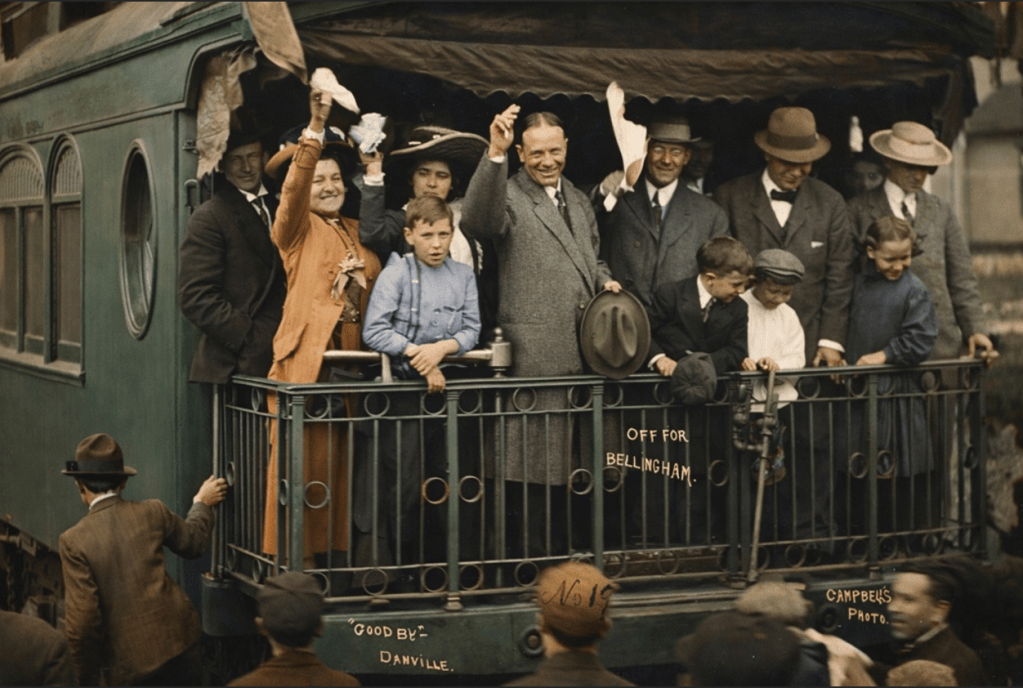
The final curtain was rung down last night and the hard working little evangelist, with his wife, said goodbye to South Bend at 10 o’clock this morning. With a check for the $10,500 tucked away in an inside coat pocket, Billy boarded at 10 o’clock Northern Indiana Interurban car for his home at Winona.

A thousand people saw him off. Hundreds waved their hats and handkerchiefs at the evangelist, his wife, and Rev. William Asher, as the car moved out of the station and down Michigan street. All three stood on the rear platform bowing and smiling in response.

It is estimated a crowd of 8,000 or 10,000 people would have been at the car to say goodbye but the evangelist, leaving an hour earlier than he expected, disappointed many. The Northern Indiana company agreed to run the car through to Winona to insure the evangelist he would be able to eat lunch under his own roof.

State’s Greatest Revival.

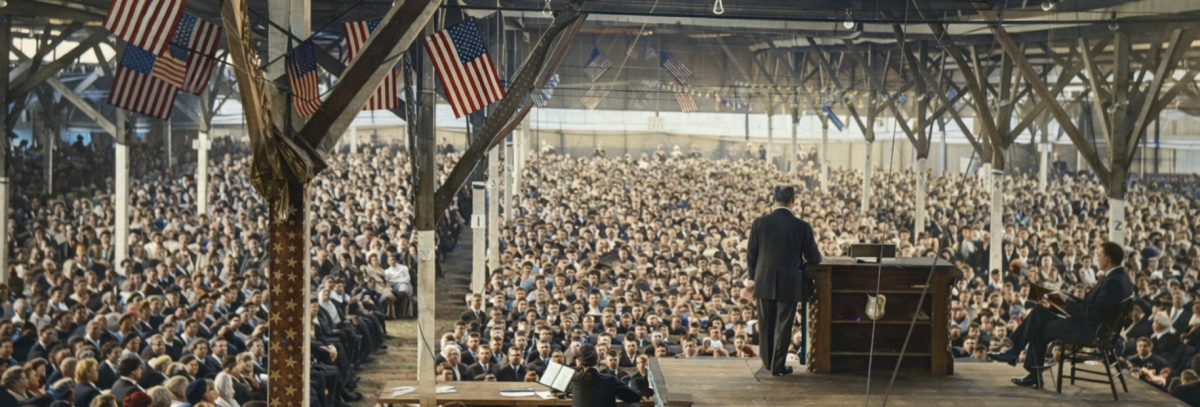
With Sunday’s farewell prayer and a general handshaking all around at the tabernacle last night the meetings, which undoubtedly constituted Indiana’s greatest religious campaign, came to a close. The meetings ended quietly and with that heavy solemnity, which told plainer than words what it meant to the people to bid farewell to “Billy,” “Mr.” Ready, “Mac,” Ackley and all the rest.

Tears started in the eyes of many a man, and many a woman, as farewells were said on the platform. Hundreds crowded near the revival leaders to shake their hands and the number to about Homer Rodeheaver, director of the great chorus of 1,000 voices became so large, the people had to be formed in a line and were compelled to move rapidly as soon as they had said goodbye.

Completely worn out, Mr. and Mrs. Sunday were conducted from the tabernacle without notice to the eager thousands, who wanted one more glimpse last word of farewell. The evangelist was forced to permit, however, because of his weakened condition, to leave the building as soon as possible.

[Much more coverage in this issue.]

Contributions and Converts 1910-1913 for Billy Sunday?

ContributionsConverts
Wilkes-Barre, PAFeb 1913
$22,138.9016,584
Columbus, OHDec 12 (1912) – Feb 1913
$20,929.5318,127
McKeesport, PANovember 3-December 14, 1912
$13,438.0010,024
Toledo, OHApril 9-May 21, 1911
$15,423.007,686
Wheeling, WVFebruary 18-March 31, 1912
$17,450.008,300
Springfield, O.September 24-November 5, 1911
$14,800.006,804
New Castle, Pa.September 18-October 31, 1910
$14,000.006,683
Erie, PAMay 28-July 9, 1911
$11,565.005,312
Portsmouth, OHJanuary-February, 1911
$12,554.006,224
CantonDecember 31, 1911-February 11, 1912
$12,500.005,640
YoungstownJanuary-February, 1910
$12,000.005,915
Beaver Falls, Pa.May 16-June 24, 1912
$10,000.006,000
Lima, OHFebruary 11-March 25, 1911
$8,000.005,659
East LiverpoolEast Liverpool – September 15-October 27, 1912
$7,000.006,351

Source: The South Bend Tribune. Tue, Apr 29, 1913 ·Page 7

Sunday kicks off his campaign in South Bend to nearly 20,000 people

FACTS OF OPENING DAY.

Attendance.

Morning 7,000

Afternoon 4,000

Night 8,000

Total 19,000

Collections

Morning $184.00

Afternoon 70.28

Night 167.23

Total $425.51

Individual contributions to the collections at the Sunday tabernacle yesterday were rather meager, comparing them with those of the usual opening Sundays of the evangelist’s meetings. There was not a coin of a larger denomination than $1 in the collection, which ranged all the way down to pennies.

It was estimated by “Joe” Spiece, the tabernacle builder, 19,000 people attended the three meetings yesterday. A collection of $421.51 was contributed, making an average of 2.2 cents per capita for the entire day.

Source: The South Bend Tribune. Mon, Apr 28, 1913 ·Page 1

The final numbers of the Richmond, Indiana, 1922 campaign?

As reported below in the Palladium-Item. Mon, May 29, 1922 ·Page 1

GIVE SUNDAY $10,718 ON FINAL NIGHT

“Fine, That’s Dandy, You Did Great” Evangelist Declares as Total Amount Is Read by Chairman.

5,007 ARE CONVERTED

REVIVAL DATA

Sunday’s offering $10,718.04

Campaign expenses $17,000.00

Trail Hitters 5,876

Attendance 247,250

Tabernacle sermons 75

Total sermons 76

Prayer meetings 352

Richmond presented Billy Sunday with $10,718.04 as a result of the final collections on Sunday, and the donations were received during the week from persons who did not expect to be in Richmond on Sunday.

“Fine, that’s dandy, you did great,” Sunday said as the total amount was read by Ed Wilson, treasurer of the campaign, who handed a draft for that amount to Mr. Sunday.

“I saw more tears tonight than I ever seen in any town for a long time, and if we could just continue for two weeks more we could just more than make things hum” Sunday said.

On the last Sunday in Charleston, the collections were announced as $34,658.

“The papers in this town have done better in covering this campaign from every angle than any other city I have been in.” – Billy Sunday

Thanks Local People

Thanks for the services of the men and women who had taken part in the campaign, were given before and after the sermon.

“If the other people had stood behind the campaign here with the enthusiasm and loyalty that the newspapers have shown and the committees have taken their part, the campaign here would have been a big success,” Rev. E. Howard Brown, pastor of the East Main Street Friends meetings, said in asking for the envelopes.

“I have envelopes here showing that most of the different churches did not get in their reports, and we have a number of men and women who came forward and signed cards saying that they accepted Jesus as their personal savior, and the denominations probably have their records.”

Creates Big Racquet

Will Romey, junior, on behalf of the boys who had been singing in the choir, presented Mr. Sunday with a record the chorus leader with a record of the boys’ singing, and the audience applauded.

Before the sermon all of the members of the party were called to the platform to say goodbye to the audience. Only Albert Peterson was absent, he having left last Wednesday to attend the funeral of his grandmother at Ottumwa, Iowa. “Pete’s all right, pure gold,” Sunday declared.

As the members of the party were leaving the platform Mrs. Sunday placed her hand on Mr. Sunday’s shoulder, and said, “If you see the members of the party are pure gold too, from here down through the list.”

The audience applauded.

Thanks Newspapers

Mr. Sunday said, “The papers in this town have done better in covering this campaign from every angle than any other city I have been in.”

He continued, “If it hadn’t been for the automobiles that they loaned to the party during the campaign, Mrs. Asher, George Sunday, and Bob Matthews, sang their final punctuating melodies, and the audience joined in singing the last hymn of the other musical number of greatest interest was Mr. Brown’s singing of “I Am Praying for You.”

The chorus sang the first and second phrases while the big, long floor of the tabernacle sang the second and last phrases. The music that echoed down the longer stretches of the tabernacle, was like a choir in a huge cathedral, and the music seemed to chance to carry through long rows of columns.

Post-Wilkes-Barre campaign results (published May 1913 in The South Bend Tribune)

WHAT SUNDAY DID AT WILKES-BARRE [February 23-April 13, 1913]

OFFICIAL OF CAMPAIGN MAKES STATEMENT ON RESULTS.

CITY BETTER GENERALLY

Business Was Improved, Politics Was Elevated and Social Life Was Raised to Higher Standard Says Man in Interview.

The Tribune’s Special Service.

WILKES-BARRE, Pa., May 6.

The Sunday party has gone from Wilkes-Barre to South Bend, Ind.

Exterior view of the Billy Sunday Tabernacle.
Wilkes-Barre Times Leader. Friday, February 21, 1913.

The tabernacle is being torn down day by day. The thousands who gathered beneath its roof to hear the greatest winner of souls in this generation have scattered and gone about doing the duties of their individual lives, but Wilkes-Barre and the Wyoming Valley will never be the same as it was a few months ago, before Billy Sunday came to this city. The moral and social life of the community has been given a new moral tone to the extent of which cannot be estimated for years.

This is the statement of Rev. J. W. Parkin, chairman of the Wilkes-Barre Ministerial Evangelistic committee, which had charge of the recent campaign in this city.

Moral Awakening.

“The most conservative,” he declared, “will admit that there has been a moral awakening the like of which has never been experienced here before. It is absolutely impossible to measure the immense amount of good that was accomplished, but I am sure that there is not one that regrets the hours and time and even money spent in planning for this campaign.”

“What,” he was asked, “do you consider the result of this visit on business here? You know it was prophesied that he would injure business.”

“An honest business could not have received greater help than came through the Sunday campaign,” was Mr. Parkhurst’s opinion. “A moral awakening such as we have had could not help but improve business. This has been evidenced in many ways, but particularly in the fact that people now realize more keenly than ever their obligations to each other and to the community. Hundreds of merchants have stated that accounts which they had considered closed because of inability to collect have been paid. There is a greater feeling of mutual respect now between employers and employes.

Politics Elevated.

“And politics; what about that? Do you think the campaign will have any influence on the politics of the country?”

“Well, I’m not much of a politician,” said the campaign leader, “but it seems reasonable to me to suppose that when a man finds himself in the position of a candidate for office he will be more careful in the future than ever before that there will not be any question about his private or business life.

There are many men in this city who have never been heavy drinkers for years who have bound themselves to abstinence. Hundreds of others who have been more or less indifferent or lukewarm in their opinion of intemperance have been aroused to a more active interest.”

“The moral wave,” he declared, “has been given a refining influence that is going to raise the standard of the community. Wilkes-Barre needed just such an indictment to make it realize where it was leading. I know hundreds of young people who have ‘cleaned house’ since Mr. Sunday came here.

‘You consider then that the people who criticized Mr. Sunday and his methods have been answered by the results which have been attained?’ was asked.

‘The critics have had nothing to offer that will accomplish the same amount of good that has been accomplished by Mr. Sunday.’

February 22, 1913


“Immediately following Columbus, Mr. Sunday opened a series of meetings at Wilkes-Barre, Pa., the farthest east of any district in which he had ever worked. The campaign opened on Washington’s Birthday—February 22—1913. Rev. W. M. Randles, pastor of the Bethesda Congregational church, gives the number of converts as 16,348, and the free-will offering as $23,527.66. In only this one respect did the Wilkes-Barre campaign exceed that of Columbus.”

  • Frankenberg, 1917: p. 132.