Former professional baseball player-turned urban evangelist. Follow this daily blog that chronicles the life and ministry of revivalist preacher William Ashley "Billy" Sunday (1862-1935)
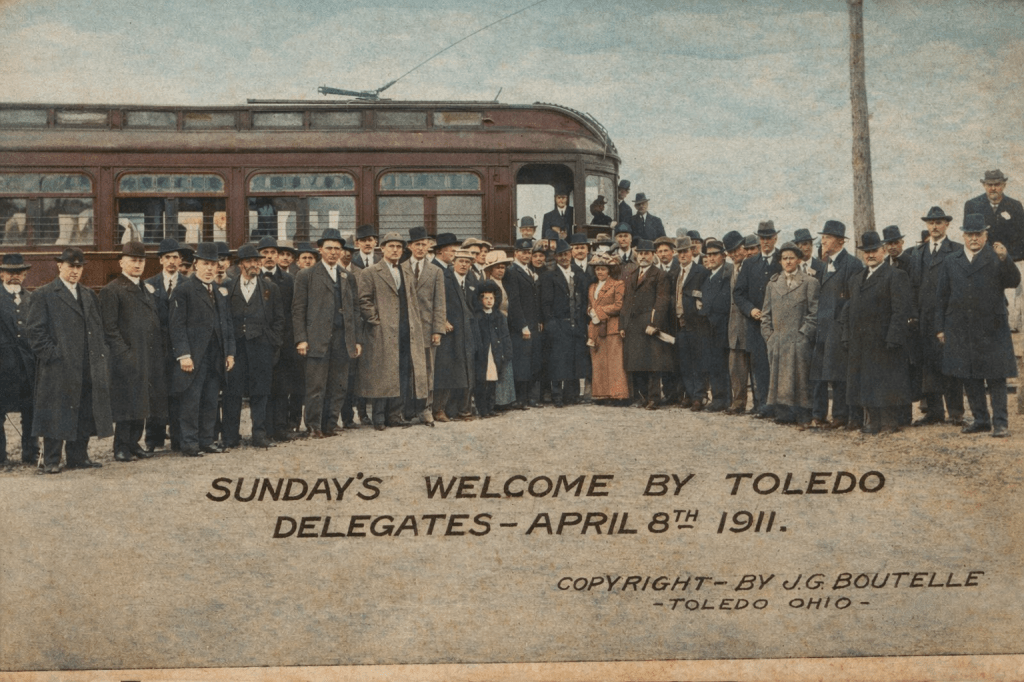
Billy Sunday’s Toledo Campaign (April 9 – May 21, 1911)
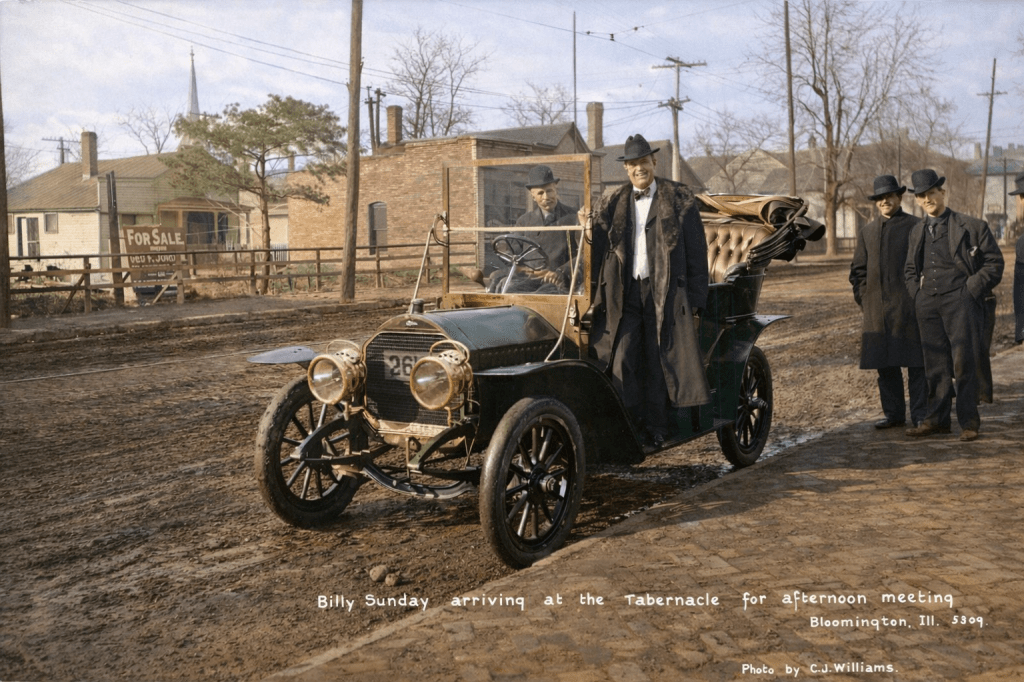
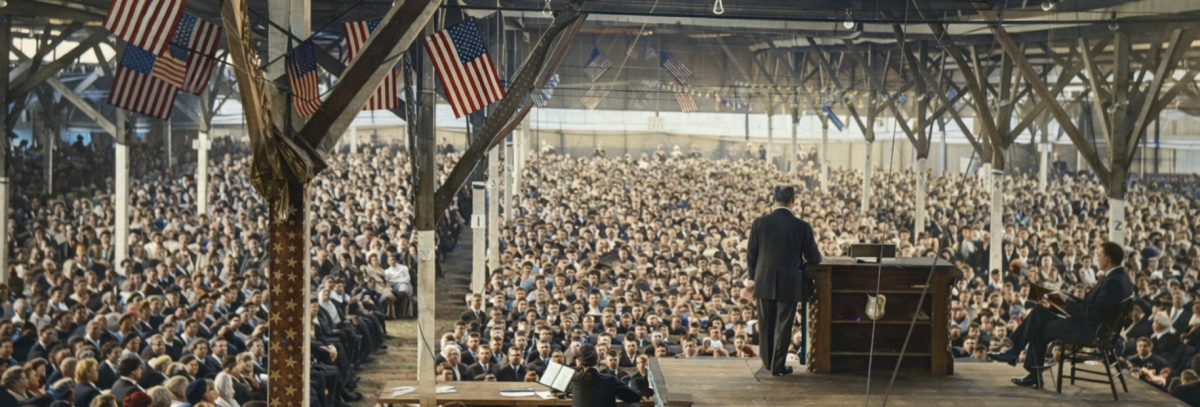
Billy Sunday’s 1911 revival in Toledo, Ohio, was one of the most anticipated evangelistic events the city had ever seen. Running for six intense weeks—from April 9 to May 21—the campaign opened with extraordinary momentum. On opening Sunday alone, more than 30,000 people attended three services, immediately signaling the citywide interest and spiritual hunger surrounding Sunday’s arrival.
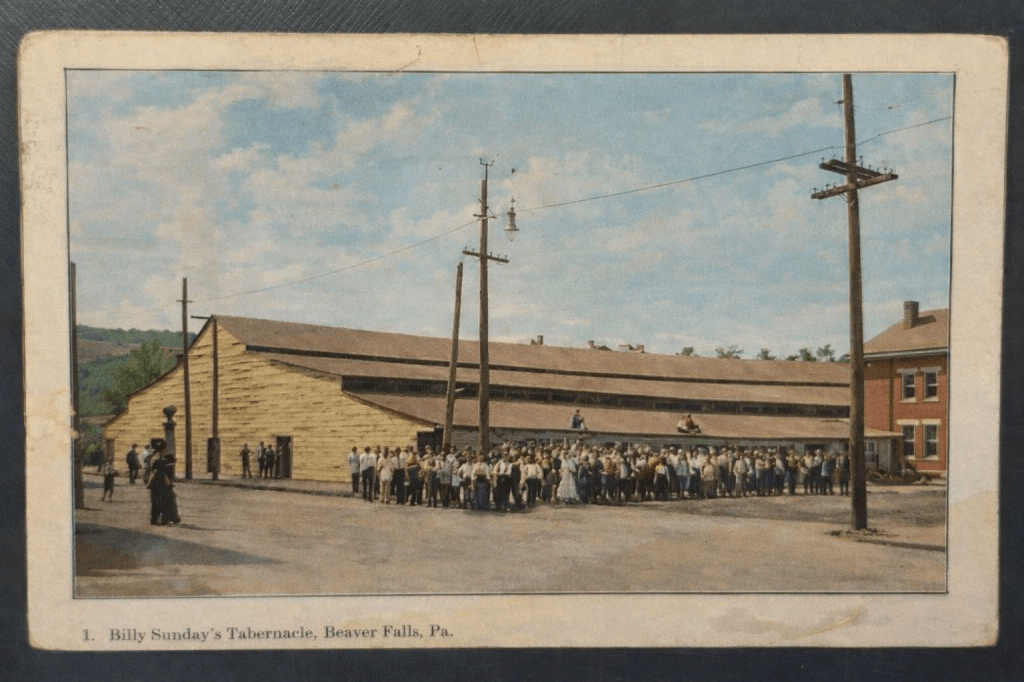
The revival was held in a massive temporary tabernacle measuring 160 by 220 feet, with seating for 7,000 people, plus an additional 1,000 seats in the choir loft. Night after night, the structure filled with working men and women, families, and curious onlookers drawn by Sunday’s reputation for plainspoken preaching, moral urgency, and energetic delivery.
Organizers initially hoped for 20,000 conversions, a figure reflecting Toledo’s size and the scale of the meetings. While that expectation proved optimistic, the final results were still remarkable: 7,323 people publicly professed conversion, surpassing Sunday’s previous record at New Castle. The response confirmed Toledo as one of the strongest campaigns of his early national prominence.
Financial support from the city was equally notable. Total offerings reached $14,423.58, breaking Sunday’s earlier giving record of $10,000 at New Castle. Newspapers emphasized that these contributions came largely from people of ordinary means, underscoring the grassroots character of Sunday’s appeal and the broad civic buy-in to the revival.
By the time the campaign concluded in late May, Toledo had experienced weeks of sustained attention on spiritual renewal, personal reform, and public morality. Though it fell short of early conversion projections, the Toledo campaign stood as a record-setting and influential moment in Billy Sunday’s rise as America’s most prominent evangelist of the Progressive Era.
THIS IS HOW BILLY FINDS OUT IF YOU ARE GOING TO “TAKE THE COUNT”
BILLY SUNDAY IN UNUSUAL POSE.
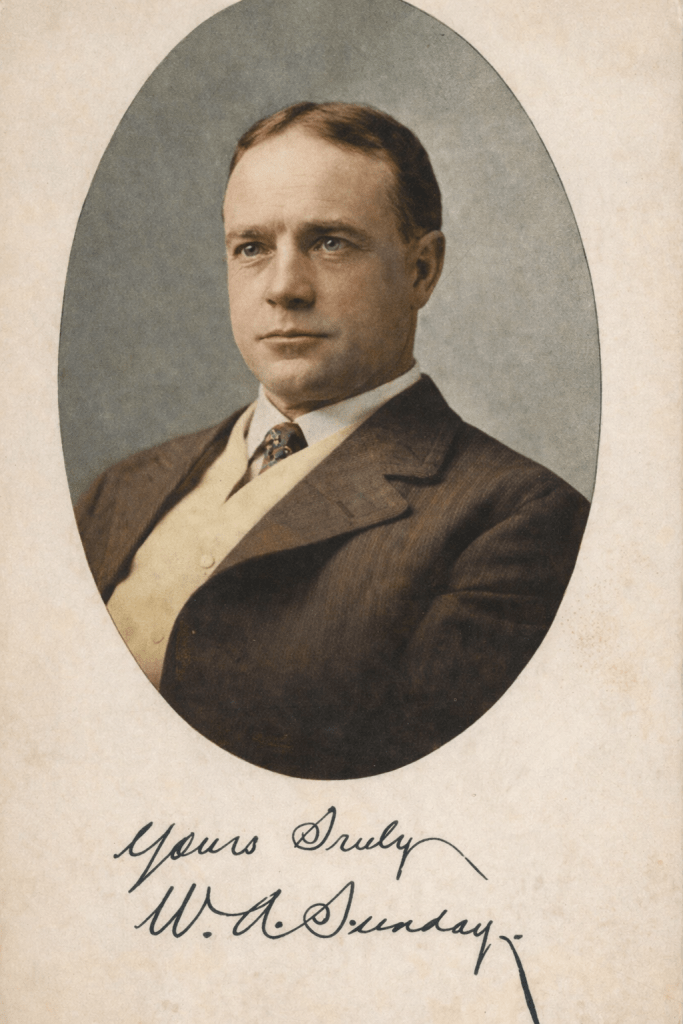
Billy Sunday in a famous pose. C. 1908. Author’s Collection.
The above is a characteristic position for Billy Sunday to assume during one of his meetings for men only.
He bends over until his right knee nearly touches the floor of his platform; then he pulls out his watch and inquires if you are going to “take the count” for the devil.
Sunday’s sermons are filled with such unusual features as this, but they are never so plentiful as in the men’s sermons. There is no doubt about it the evangelist is at his best in these talks. He always bends every energy to the end of impressing his male audience with the truth of what he is saying, and in this he never fails.
The South Bend Tribune. Thu, Jun 05, 1913 ·Page 10
Citation: The South Bend Tribune. Fri, May 16, 1913 ·Page 2
WINONA PLANS FOR GREATEST SUMMER
MANY CONVENTIONS ARRANGED FOR THE SEASON.
BIBLE SESSION FEATURE
William Jennings Bryan, David Lloyd George, Gipsy Smith, “Catch-My-Pal” Patterson and Others Will Speak at Gathering.
William Jennings Bryan. President of Winona Assembly. Winona Lake, Indiana.
The Tribune’s Special Service.
WARSAW, Ind., May 16.—Winona assembly, which will operate this season free from its load of debt, having arranged for the settlement of $300,000 claims by an agreement with the creditors, has prepared for a program of events that will establish a new record. One of the biggest events of the year will be the annual conference of the Church of the Brethren, which will start May 28 and continue until June 7. Between 40,000 to 75,000 churchmen are expected to attend.
The chautauqua program will start June 29 and will continue for 10 weeks. Among the spectacular offerings are the following: Ahasuerus, a sacred opera under the direction of William Dodd Cheney; “The Lost Princess,” under the direction of Mrs. Hortense R. Reynolds; Venetian night, and a great water carnival under the direction of Capt. J. R. Pine. Preparations for the latter event are already under way.
Will Hold Mission School.
Some very notable gatherings are booked to occur during the chautauqua season and at its close. Beginning June 19 and ending June 27, the summer school of missions will be in session. This will be held under the auspices of the interdenominational committee of the assembly. The summer conference of the Presbyterian young people will be held July 9 to 16. The annual meeting of the Ohio Farmers’ Insurance company will be held July 23 and 24. The Health and Happiness club with Mrs. Louise L. McIntyre and Miss Margaret Hall as directors, will be in session July 7 to 14.
The fourth annual conference of the Young Friends of America will be held during the assembly season. The fourth annual session of the international district training school for Sunday school workers will be held Aug. 11 to 21. The Kappa Sigma Pi, the new boys’ movement which was established in 1912 by Homer Rodeheaver, conductor of music for Rev. Billy Sunday, will be in session during July. W. M. Collisson will act as secretary and will be in charge.
Photographers Will Meet.
The 18th annual convention of the Indiana Association of Photographers will meet July 7 to 10. This will be held under the auspices of the National Reform Association. Among the speakers are Dr. James S. Martin, Dr. Lyman E. Davis, Dr. Grant W. Bower, Dr. James McGraw, Ng Poon Chew, of China, Dr. Merle de Aubing, of France, Dr. Armenag of Turkey, and Dr. R. J. Patterson, of Ireland.
One of the big events will be the annual Bible conference, which will be held Aug. 22 to 31. Dr. Sol C. Dickey will be director. He is already busy arranging for the meetings which will bring churchmen here from all parts of the world. Prof. E. O. Excell will have charge of the music and Rev. W. E. Biederwolf will be the assistant director. The opening address will be by Secretary of State William Jennings Bryan, who will also be president of the board of directors of Winona assembly to welcome the visitors. Among the other speakers already engaged are Rev. C. Campbell Morgan, of London; Rev. Gipsy Smith, of Connecticut; Rev. Robert (Catch-My-Pal) Patterson, of Belfast, Ireland, and Hon. David Lloyd-George, chancellor of the British parliament.
Billy’s Fearlessness and Independence Would be Bound to Win Masses if He Was Out for Office.
BY THE POLITICAL WRITER.
It may be said safely that a good percentage of the men and women who sat in open mouthed amazement at the tabernacle yesterday and saw Billy Sunday sway thousands by his magnetism, hypnotism and Lord-knows-what-ism afterward asked themselves the question: ‘Why didn’t he go into politics?’
Billy Sunday’s most bitter enemies must admit that he is a leader of the natural-born species. His characteristics, his personality, his impulsiveness, his methods and that seductive ‘come-on-I’ve-got-you’ smile make him a power whether it be in evangelistic work or in a ‘swat the fly’ campaign.
Could Get Votes.
Billy Sunday, c. 1908. Author’s Collection
On the political stump Billy Sunday could get votes. It is idle to deny that fearlessness and vote-getting go hand in hand. They are so closely interlocked that there has never been a great vote-getter who was not brave and courageous in saying what he wanted to say regardless of the fear of adverse criticism. That’s just Billy Sunday’s line. To him a liar is a liar, a hypocrite is a hypocrite, a man is a man and a woman is a woman. He calls a spade a spade and does it from the housetops.
Billy Sunday undoubtedly would achieve as much success in politics as in a religious movement. Perhaps the latter critics are possibly more charitable in the belief that this gives the one under the acid test a greater opportunity to show his good. Billy Sunday does not seek charity or consideration, but rather goes after his auditors hammer-and-tongs.
Like a Fighter.
In politics that would result in delivery of the goods the same as in religion. All men like a fighter and Billy Sunday yesterday demonstrated that he can scrap from the drop of the hat. Such an individual would have followers in politics, followers of all kinds and description from curbstone heelers to nation wide statesmen.
Under a convention system Billy Sunday would shine. Any man who can double himself into a knot, hit the floor and ceiling alternately, chase from one side of a platform to the other, shake his fist at a packed auditorium, telling all of them that they are doing wrong and telling some of them that they are quite on the direct route to hell—any man who can do so much in one breath and get away with it would have no trouble in turning a political convention into his way of thinking. If Billy Sunday appeared at an old time county convention and made a speech as dramatic, as fiery and as spectacular as he did yesterday, the delegates would be fairly falling over one another trying to get aboard his political band wagon.
“A Real Dandy.”
Asked what he thought of Billy Sunday, Gov. Tener, of Pennsylvania, who played ball against him back in the nineties, made answer in his semi-soliloquy and semi-quiz fashion: “Wouldn’t he make a dandy in politics?”
Those who know something of politics and who have heard Sunday quite agree with Pennsylvania’s chief executive.
The South Bend Tribune. Sat, May 03, 1913 ·Page 13
In the same edition of the newspaper, this story was also posted.
SUNDAY WOULD LIKE ONE POLITICAL JOB
EVANGELIST LETS OUT SECRET OF AN AMBITION.
Billy Pines to Get on School Board Some Time so He Can Raise Salaries.
Billy Sunday let his audience in on a nice little secret ambition of his, during his talk at the tabernacle last night. Mr. Sunday does not particularly aspire to the job, but if he ever gets into politics he wants to be a member of the schoolboard. This he confided to the crowd during his eloquent discussion of home problems.
The evangelist gave his reason for wanting the job, in the following manner:
“I would like to be on a school board so I could double the pay and arrange 12 months work a year for every school teacher under my jurisdiction. It is a disgrace, the wages we pay ministers and school teachers. Raise teachers’ salaries and we would have better influence for good among the scholars as a result.”
Billy halted his speech for a moment, then added:
“There is one thing I would do if I was a member of a school board and that is I would give back to the teacher the right to lick our boys and girls. It was one of the greatest mistakes of the nation in depriving them of this right.”
As originally published in The South Bend Tribune. June 16, 1913. Transcriptions by AI and might contain errors.
REVIVAL CLOSES WITH 6,398 CONVERTED; SUNDAY GETS $10,500
SOUTH BEND’S RELIGIOUS CAMPAIGN PROVES TO BE MOST NOTABLE IN HISTORY OF ALL INDIANA
AIR OF SADNESS PREDOMINATES AT CLOSING MEETING OF BILLY SUNDAY’S BIG REVIVAL.
“BOSS” AND “MA” SAY THEIR LAST FAREWELL
Hundreds Cheer Evangelist and His Wife on Rear of Car as They Leave City—Other Thousands Disappointed by Early Departure—Last Day of Services Proves to be Remarkable One—Over 30,000 Present.
Billy Sunday’s seven weeks’ fight against the devil in St. Joseph county became religious history to-day after the baseball evangelist had shown 6,- 395 people the road to salvation and approximately $10,500 had been raised for him.
The final curtain was rung down last night and the hard working little evangelist, with his wife, said good- bye to South Bend at 10 o’clock this morning. With a check for the $10,500 tucked away in an inside coat pocket, Billy boarded at 10 o’clock Northern Indiana Interurban car for his home at Winona.
A thousand people saw him off. Hundreds waved their hats and hand- kerchiefs at the evangelist, his wife, and Rev. William Asher, as the car moved out of the station and south on Michigan street. All three stood on the rear platform bowing and smiling in response.
It was estimated a crowd of 8,000 or 10,000 people would have been at the station to see the evangelist off, but the hour was earlier than many had expected, disappointed many. The Northern Indiana Interurban car which carried the party through to Winona is the same car the evangelist had used to eat lunch under his own roof.
State’s Greatest Revival.
With Sunday’s farewell prayer and general handshaking all around at the tabernacle last night the meet- ings, which undoubtedly constituted Indiana’s greatest religious revival, came to a close. The meetings end- ed quietly and with that heavy sol- emnity, which told plainer than words what it meant to the people to bid farewell to “Billy,” “Ma,” “Rody,” “Mac,” Ackley and all the rest.
Tears started in the eyes of many a woman, and many a sob and fare- wells were said on the platform. Hun- dreds crowded near the revival lead- er to shake their hands, and the num- ber about Homer Rodeheaver, di- rector of the music, and Mrs. Sun- day became so large, the people were formed in lines and then compelled to move rapidly as soon as they had said goodbye.
Completely worn out, Mr. and Mrs. Sunday were conducted from the tabernacle to the automobile to es- cape thousands, who wanted to say their last word of farewell. The evan- gelist feared to permit, however, be- cause of his weakened condition and the heat of the tabernacle.
Satisfied With Results.
The campaign in South Bend and Mishawaka was satisfactory to all and the evangelist is glad to leave. The evangelist had hoped for a some- what larger number of converts but days before the close, it was plain to be seen the population of the two cities, South Bend and Mishawaka, was not sufficient to hope for a larger number at the close. The amount of the special collection met the approval of all.
The baseball evangelist expressed himself as deeply thankful for the amount, which was given him as some estimate of how the people appreciat- ed his efforts in the St. Joe valley. Although neither the number of con- verts or the amount of offerings was a record breaker, South Bend’s standing was generally regarded as an excellent one in comparison with the population of other cities where Sun- day worked, it ranked very favorably with the highest.
As High in Comparison.
The number of converts was much lower than at Columbus, O., and WilkesBarre, Pa., as was also the offering, but the population of both cities and their suburbs is much larger than that of South Bend. Wilkes-Barre and its suburbs has a population of considerably more than 150,000 people, it is estimated, while Columbus has 200,000 population within its corporate limits.
Wilkes-Barre had 16,584 conversions and Columbus 18,137, which number is little larger than the figures for the South Bend revival, when the questions of the comparisons are considered.
Was Remarkable Day.
Beyond a doubt the final day of the revival was the most notable of the seven weeks despite the fact it was the hottest day thus far of the summer, and a portion of the time the great tabernacle on Vitulus avenue, was so warm that it was almost unbearable.
It was estimated 32,000 or 33,000 people attended the three meetings of the day, with another 1,500 coming next morning after two services for them were held. It was the largest daily attendance of the campaign and there can be no doubt but the number of converts would have been increased to 35,- 000 or 40,000 but for the terrible heat.
Eleven thousand people packed the tabernacle in the morning, 8,000 then went there in the afternoon, and last night a crowd estimated at 12,000 filled the great tabernacle space, while thousands beside lining the streets and filling the structures on the opposite side of the street, and the river bank.
Some There at 9 O’clock.
As was expected, the crowd began arriving at the tabernacle in the morning almost as soon as the meeting was up. Several men were pounding for admission at 6 o’clock in the morning, and the crowd had increased to nearly 100 men, women and children by 7 o’clock. An hour later the tabernacle had begun to fill rapidly and people were scrambling for seats by 9 o’clock. When 10 o’clock came, it was hard to buy seats in the building, although a few men and women did succeed in purchasing tickets a few minutes before the hour.
A great number of men remained in the tabernacle from the morning until the afternoon service, and there was a crowd of 500 people clamoring for admission to the tabernacle when the men’s meeting closed about 3 o’clock. There were few desirable seats left in the building at 6 o’clock 700 Converts in Day.
Practically 700 people accepted christianity in response to the evangelist’s earnest pleas during the day. One hundred and ninety men responded to the invitation at the morning service; 173 men went forward to grasp the evangelist’s hand in the afternoon, and the largest number of the day responded at the night service.
The final meeting for men only was held at 3 o’clock in the afternoon. He responded to one of the most stirring sermons of the campaign, which was preached from the text, “He Said To-Morrow.” Much of the evangelist’s voice was so filled with emotion he appeared to choke over his words. The tears in his eyes were not confined to those in his audience and he closed in a touching farewell prayer, which appeared to make a deep impression.
He prayed earnestly for people in all walks in life in South Bend and Mishawaka, naming the various bodies and institutions which had helped to make his campaign here so successful one.
Sunday’s Final Prayer.
In his prayer he said: “Jesus I don’t like to pray, because I know it will be the last prayer I’ll ever make in South Bend in connection with these meetings. I don’t like to pray, but it useless to keep the meetings going longer. I’ve remained three times now than I intended. I’m glad I did, Lord. But now Lord, we’re going to close these meetings.
I want you to take care of the salvation. What more can we, Jesus, give you? You know it is the desire of my soul that no one can say that I ever said anything to injure Your cause. I love You and the people of South Bend. I have never had but one motive, and that is to see the city filled with people seeking after Jesus. I feel especially drawn close to the people of this city, Lord, because I love the individuals. We’re not so far away, Lord, but we could be heard if we were to speak.
Asks Blessing.
“God bless South Bend and Mishawaka, the newspapers, the choir, Lord, and the ushers; the police and all that have come to Christ during these meetings.
“And now, Lord, we must say good bye.” “Lord, speak to us and the people that they will press down these aisles. Speak to them Lord, that they will not say as the old king did, ‘To-mor- row.’ Don’t say ‘To-morrow.’ Speak In South Bend to-night. Say ‘I Will.’ And who will.”
Hundreds of people responded to the beautiful prayer and the brilliant sermon. A demonstration similar to that on the night he preached the sermon on “The Unpardonable Sin” followed. Men and women of all ages, and in every walk of life, came down the aisles, all apparently eager to take their places among the converts.
Women Bother Him.
One convert, a woman, came forward screaming hysterically, and supported on the arm of a woman friend. The antics of this woman appeared to annoy the evangelist not a little and he requested her to be seated. In a husky voice to her and he said he would promise the platform if possible. Many prominent men and women were among the number of converts yesterday.
Taking the Collections.
The taking of the collection for Billy Sunday proved one of the most important features of the Sunday services. The largest collection reported at Billy Sunday in any of the three meetings was that of the men’s meeting in the afternoon. The subscriptions amounting to $1,500 in cash and pledges of $1,500 additional. The men’s meeting in the afternoon also was contributed to the collection. The small subscriptions of the women and children contributed to the total. The collection of the women and children amounted to $1,000. The Auditors announced the total subscriptions amounted to $4,000. The subscriptions at the First Presbyterian church were announced and Rev. Charles Arganbright, pastor Charles W. Goheen, Hon. Marvin Campbell, E. C. Williams and others who worked untiringly from the time the meeting opened yesterday morning until long after the close of the service last night, counting the money that was contributed and straightening out the affairs of the association. A report was made before the people left the tabernacles. Even then it was necessary for the men to work late into the night and this morning until a few minutes before the evangelist left South Bend to make a correct count of the finances on hand.
People Show Appreciation.
Everywhere throughout the final hours of the revival was displayed indications of the popularity South Bend and Mishawaka people felt for Billy Sunday and the members of his party.
Mr. and Mrs. Sunday were greeted with thunderous applause every time they entered the building during the day and they were frequently cheered while the meetings were in progress. Just before the opening of last night’s services, Homer Rodeheaver, the leader of the great tabernacle chorus, was greeted with a magnificent shower of roses, which was thrown by the nearly 1,000 members of the great aggregation. For five minutes the shower continued, much to the embarrassment of both Mr. Rodeheaver and Pianist B. D. Ackley.
Farewell songs were sung by singers with the Sunday party and a quartet from the South Bend Conservatory of Music.
“And He Said To-Morrow.”
Sunday made an impressive appeal in his farewell sermon last night to the people of South Bend and Mishawaka who are not Christians to fall into rank before it is too late. “And He Said To-Morrow” were the words of the text taken by the evangelist and he told of the results of procrastination and delay both in religion and other things.
“When I think that this is the last service of this great effort on the part of God and the Holy Spirit to bring you men and women to repentance,” cried Sunday, his voice choking with emotion, “I tell you my heart nearly breaks. You may think you listen! I am going to make you listen! Think of the sermons you have heard since you were old enough to attend Sunday school until you sit here to-night.
Continued on Page Five.
RESULTS IN BRIEF
Conversions
Previous conversions ………. 5,400
Saturday and Sunday ………. 983
Grand total ………. 6,383
Attendance
Previous attendance ………. 519,550
Saturday and Sunday ………. 46,050
Grand total ………. 566,053
Collections
Special offering for Billy Sunday ………. $10,500.00
Collections for local institutions ………. 737.98
Fund for campaign expenses ………. 18,500.00
Grand total ………. $24,737.98
The taking of the offering for Billy Sunday was one of the features of the closing day of the campaign. Seventeen or more different people and concerns of South Bend and Mishawaka gave donations of $100. The largest was $200, given by Samuel Murdock, of Lafayette, Ind., one of the owners of the Chicago, South Bend & Northern Indiana railway. The donations of $100, which have been recorded thus far, are from the following: South Bend and Mishawaka Ministerial association; Mrs. George Wyman; Mrs. M. V. Belser, citizen of Kingston, Pa., by George L. Newell; Folding Paper Box company; Stephenson Underwear mills; E. B. Eberhart; Stephenson Manufacturing company; C. C. Shafer; Col. George W. Studebaker; Mrs. Clement Studebaker; J. Friend; Clement Studebaker, Jr.; J. D. Oliver; Mrs. George Ford; C. A. Carlisle and the Mishawaka Woolen Manufacturing company. The $50 donations which have been reported thus far to those in charge of the campaign, are from the following: Mrs. C. C. Billworth; W. O. Davies; F. H. Badet, Mr. and Mrs. H. A. Thompson; J. O. Bowher; McFarlin & Jackson; S. P. Stults and Mrs. Ida M. Stull, and the U. B. Memorial church.
Billy Sunday worked closely with two key musical assistants: Fred G. Fischer and Charles Butler, both of whom played significant roles in his evangelistic campaigns.
Fred G. Fischer – Choir Leader and Soloist
Fred G. Fischer was among Sunday’s earliest and most trusted collaborators. Serving as both choir leader and soloist, Fischer was instrumental in organizing and directing the musical components of Sunday’s revival meetings. His tenure with Sunday spanned approximately from 1900 to 1910, during which he helped cultivate the energetic and participatory musical atmosphere that became a hallmark of Sunday’s campaigns.
Charles Butler – Soloist
Charles Butler served as a soloist in Billy Sunday’s team, contributing to the musical aspects of the revival meetings. His role involved performing solo pieces that complemented the choir’s performances and supported the overall worship experience. Butler’s involvement with Sunday’s campaigns was notably during the years 1907–1908.
Both Fischer and Butler were integral to the musical dimension of Billy Sunday’s revival meetings, enhancing the emotional and spiritual resonance of the events through their leadership and performances.
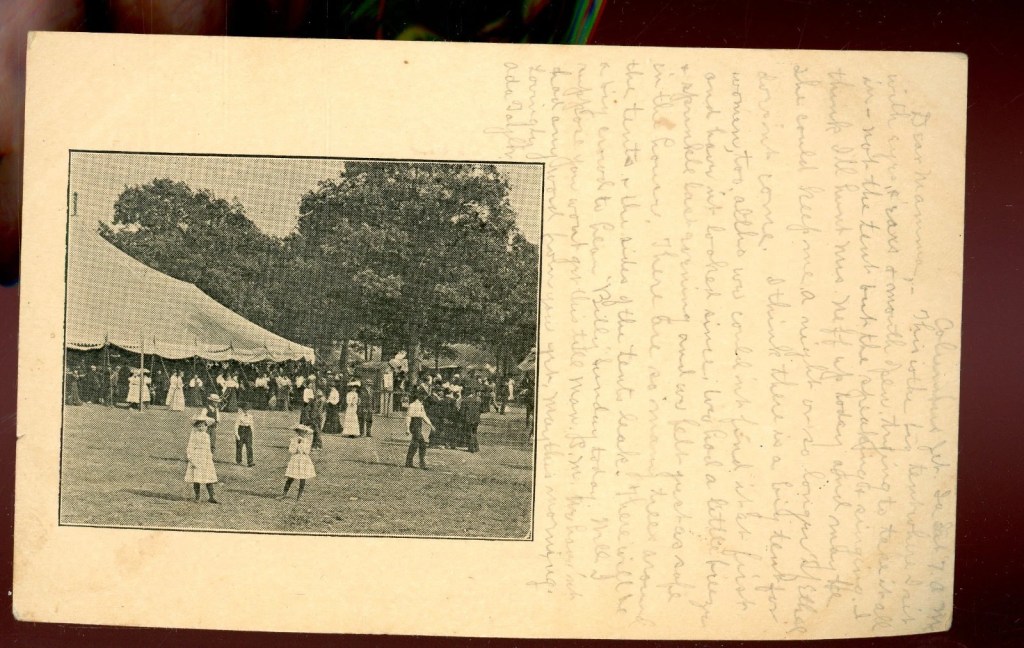
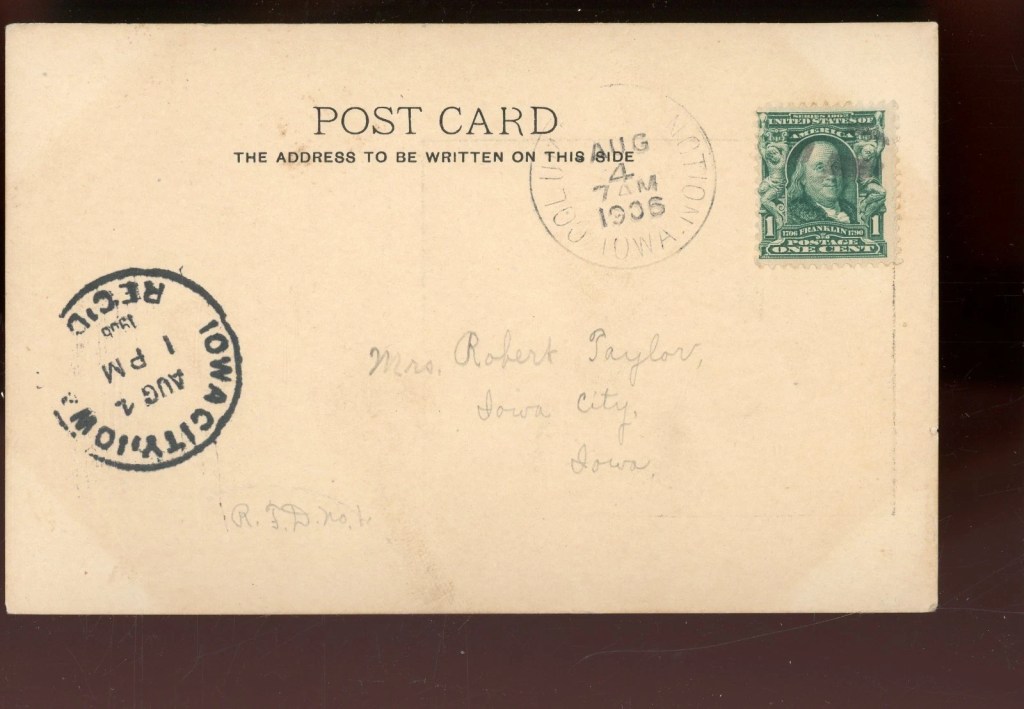
A postcard postmarked November 23, 1909, recently sold on eBay with the following handwritten message by the sender.
[This text is legally in public domain.]
Dear Mother & Father,
Am sending you this of “Billy Sunday” if anyone ever says anything against him tell them they don’t know a thing about him he is a sincere Christian he doesn’t go around the bush for any one he is out spoken and some people can’t stand that. are all well hope you are the same.
Billy Sunday conducted his Scranton, Pennsylvania revival campaign from March 29 to May 17, 1914.
Billy Sunday’s 1915 revival campaign in Syracuse was held in a massive tabernacle specially constructed on the grounds of the old Scranton Driving Park, a former racetrack near the intersection of Providence Road and Green Ridge Street. The venue, built to accommodate the large crowds drawn by Sunday’s fiery preaching, held around 8,000 people at full capacity.
Over the course of the campaign, tens of thousands streamed into the tabernacle, with some estimates suggesting that more than 100,000 people in total heard Sunday preach during the weeks-long revival. The response was overwhelming—not just in attendance but in impact. Reports from the time estimate that between 13,000 and 15,000 individuals made public decisions for Christ, “hitting the sawdust trail” as they came forward to commit their lives to faith. The scale and energy of the campaign made it one of the more memorable revivals of Sunday’s career, leaving a significant spiritual and cultural imprint on the city of Syracuse.
The Scranton campaign was notable for its massive local organization, media coverage, and impact on surrounding cities. It was one of his early high-profile campaigns in the northeast, setting the stage for later revivals in Boston (1916), New York (1917), and elsewhere.
Here is the detail on the postcard and the handwritten message.
Postmarked 7 April (7:30 pm) from Scranton, PA
Dear Friend Mrs Lewis and Daughter
I have send papers to you and some to you to day. I want you to Read the sermons. Oh the grand Parade we had. All the Sunday’s school did turn out and those have been converted. We can feel the spirit of God in this place. Please let get word from you. I’d be thankful. RC Jones
Billy Sunday conducted a significant revival campaign in Syracuse, New York, from October 31 to December 19, 1915. This campaign was part of his broader evangelistic efforts during the 1910s, a period when he held major revivals in cities like Philadelphia, Kansas City, Detroit, Boston, Buffalo, and New York City.
Lincoln Journal Star
Fri, Dec 31, 1915 · Page 2
LEADING CITIZENS LINED UP
BIG MEN OF SYRACUSE HIT TRAIL AT SUNDAY MEETINGS.
Remarkable Results Achieved by Evangelist as Told by Member of Local Committee.
Here is the story of the Billy Sunday campaign in Syracuse, N. Y., as told by a local committeeman in the current issue of the Christian Advocate, one of the leading Methodist papers of the country:
The seven weeks of the ‘Billy’ Sunday campaign have passed altogether too quickly. The interest which was at the flood when representatives of fifty-four churches in 250 automobiles, and hundreds of the faculty and students of Syracuse university, led by the university brass band, met ‘Billy’ Sunday and his party at the railroad station on the afternoon of October 30, and escorted them to the handsome residence on Onondaga street which was to be their home while in Syracuse, has continued without abatement, and there has been no slump at any time in the attendance at the services, a somewhat unusual circumstance Mr. Sunday tells us. At the evening services and three times on Sunday the tabernacle has been packed with an audience numbering from 12,000 to 15,000 people and an evening when, on account of a snowstorm, the streets were well-nigh impassable, was no exception. People from as far west as Buffalo have come in large delegations to the afternoon services and members of the Sunday party have gone out into communities within a radius of fifty miles of Syracuse, and have held evangelistic services and organized classes for Bible study. Stores, factories, high schools and the university have given Mr. Sunday and his party the largest possible audience. No class of persons has been omitted by the ministry of these good people, from the maids in the kitchen to the people of refinement and wealth, into whose homes Mr. Sunday has been most welcome. The choir of 4,500 people was composed of persons without regard to race, color or creed, and this choir was divided into choruses of 1,500 each, one chorus being made up of men, and was under the masterful leadership of a member of the party known familiarly as “Rhody,” who is a soloist trombonist and between whom and Mr. Sunday there is the feeling that existed between David and Jonathan.
A Memorable Sabbath.
A service that stands out conspicuously as one of the most wonderful of the campaign was held on Sunday morning, November 14, when, following the sermon, Mr. Sunday gave the invitation for the first time for the people to come forward and take his hand and 1,500 responded, some for reconsecration, others to announce for the first time their desire to lead the christian life.
Memorable Sabbath that, for Pentecost repeated itself, when over 3,000 “hit the trail.” Another service not soon to be forgotten was on Sunday morning, December 12, when, after a powerful sermon by Mr. Sunday, and an appeal which brought hundreds to the front, Chancellor Day was invited to the platform, to pray for the penitents, and as he and the evangelist stood side by side, men equally great in their respective realms, and the chancellor poured out his soul in a wonderful prayer for those who were inquiring the way of salvation, the great assembly was mightily moved.
The greatest week-day evening, perhaps, was what was known as university night, when about 3,000 of the faculty and students, led by the university band, marched to the tabernacle.
Opportunity was given by the leader before the service for college songs and yells, and the people from the hill certainly owned things for a while. After the sermon, when the invitation was given, scores went forward and took Mr. Sunday by the hand, thereby indicating their desire to lead a Christian life.
Mr. Sunday and his co-workers have given much of their time to the students, speaking to them at mass meetings, chapel services and in their fraternities, sororities and dormitories, with the result that up to this time over 400 have hit the trail.
Hundreds Unite With Churches.
The results of this wonderful religious movement can only be tabulated in part at this time. While hundreds have united with the churches, hundreds who have not been active in the church for years have renewed their vows. Employers have come down the aisles of the tabernacles on evenings when their employees have been attending in a body, leading them by twos and threes to the front. Business men and manufacturers have suspended business and work that their employees might hear the message from Mr. Sunday or a member of his party. Firms which at the beginning were not especially friendly to the movement have extended warm welcomes to those who would hold meetings in the shops. As a striking instance of a change of front toward the Sunday campaign, one church which did not join in the invitation to Mr. Sunday to come to this city, and refused to be one of the co-operating churches in the campaign, was represented on the evening when the brotherhood of the different churches occupied reservations by the rector and over one hundred men. True it is that the people who are speaking against Mr. Sunday are the folks who have refused to hear him.
The liquor traffic has been roughly handled. While “Billy” Sunday does not preach a sermon in which he does not score the rum business, when he preached the booze sermon he said: “You have heard me make a few remarks about the liquor traffic that you might get your mental adjustments, but next Sunday I will preach on booze or get on the water wagon, and this sermon always gives the devil the pneumonia.” Afternoons and evenings he preached to audiences of men only, who packed the tabernacle, and that sermon and his general crusade against the liquor business have certainly made the liquor men sick (of their business). Business in some of the down-town places has fallen off 30 per cent. In three places, where crowds have been accustomed to gather at night, the clientele has been cut almost in two. The receipts of the most fashionable bar in the city have fallen off 80% and an aloonkeeper in referring to the matter said: “The Billy Sunday has about destroyed the saloon business in Syracuse.” Several bartenders have hit the trail and one or lookkeeper, after he had hit the trail, went back to his home and called up the brewers who were back of him in business and told them they could take the business, for he was through. On the day when the “booze” sermon was preached a card requesting the mayor to enforce the law relative to Sabbath observance and liquor traffic was signed by 18,000 voters.
Secular Press Endorses Sunday.
To quote from a recent editorial in one or but our evening papers not especially favorable to the campaign at the beginning: “Cleaner speech, the only reliable index of clean thought, is everywhere noted. There is a sensible abatement of vice of every kind. Moral derelicts have been rescued by the hundreds and have been placed on th solid ground of hope and renewed self-confidence, but the individual instances of strange conversations, better resolutions sand redeemed estrays do not begin to measure the results of the Sunday crusade. The whole atmosphere of the community has been charged with a fresh and bracing moral ozone and to Mr. Sunday and his party we extend our sincere expression of appreciation, respect and gratitude.”
Last Day of Campaign.
On the last day, Sunday, December 19, four services were held. One of the afternoon services was for men only and with such power did Mr. Sunday reason on the judgment to come that five hundred men responded to his appeal at the close of the sermon. In the evening the tabernacle was packed in every part by thirteen thousand people, hundreds being turned away. The evangelist urged the people to an immediate decision, with the result that fifteen hundred hit the trail. More of the leading citizens took a stand for Christ at these meetings than at any of the previous services. An impressive feature of the evening service was when Mr. Sunday invited members of his party to come on the platform and the vast audience, led by a choir of fifteen hundred voices, sang: “God be with you till we meet again” and gave the chautauqua salute.
Twenty-three thousand one hundred and fifty-five hit the trail during the campaign. Over $50,000 has been received through the offerings, several thousands going to local charities. Mr. Sunday received $11,155 as a free-will offering. The evangelist paid a high compliment to the people of Syracuse at the closing service. He said because of their co-operation with him and their effort to provide him with every comfort he was leaving a very much better man physically than when he came. Thousands went to the depot and sang the songs they had learned to love to Mr. and Mrs. Sunday, whom they had also learned to love, as they took their departure to their western home.
The [Wilkes-Barre] Times Leader. Mon, Dec 20, 1915 ·Page 25
SUNDAY CAMPAIGN CLOSES
Syracuse Gives Evangelist $23,000 and Nearly 20,000 Converts
With the free will offering amounting to more than $23,000 and the converts numbering nearly 20,000, the Billy Sunday campaign at Syracuse closed yesterday amid great enthusiasm. More than 2,000 converts marched down the aisle and grasped the evangelist by the hand during the day.
It is understood that personal checks amounting to several hundred dollars have not yet been counted in the free-will offering and the total collection is expected to reach close to $24,000. Syracuse now ranks third in point of attendance, conversions and free-will offering of all the cities in which the evangelist conducted campaigns.
The Buffalo News. Mon, Dec 20, 1915 ·Page 3
BILLY SUNDAY CLOSES SYRACUSE CAMPAIGN
911,000 Total Attendance—Trail-hitters Numbered 22,449.
Syracuse, Dec. 29—Rev. Billy Sunday closed his seven weeks evangelistic campaign in Syracuse last night. At four meeting during the day he preached to more than 50,000 persons. His thanks offering was $23,112.
The total attendance at the Sunday meetings was 911,000, trail hitters numbered 22,449. The evangelist and his wife left last night for their home at Winona Lake, Wis., to rest a week before opening the campaign at Trenton, N. J., one week from Sunday. Five thousand persons gathered at the railroad station to bid him farewell.
In one of his closing sermons Sunday took a fling at ‘cold church people,’ saying among other things: ‘I’ve got no use for a bottle-fed church. Some preachers are like huge nursing bottle with 500 rubber tubes running to a lot of 200-pound babies in the churches and the preacher has to be a wet nurse to the whole bunch.’