Former professional baseball player-turned urban evangelist. Follow this daily blog that chronicles the life and ministry of revivalist preacher William Ashley "Billy" Sunday (1862-1935)
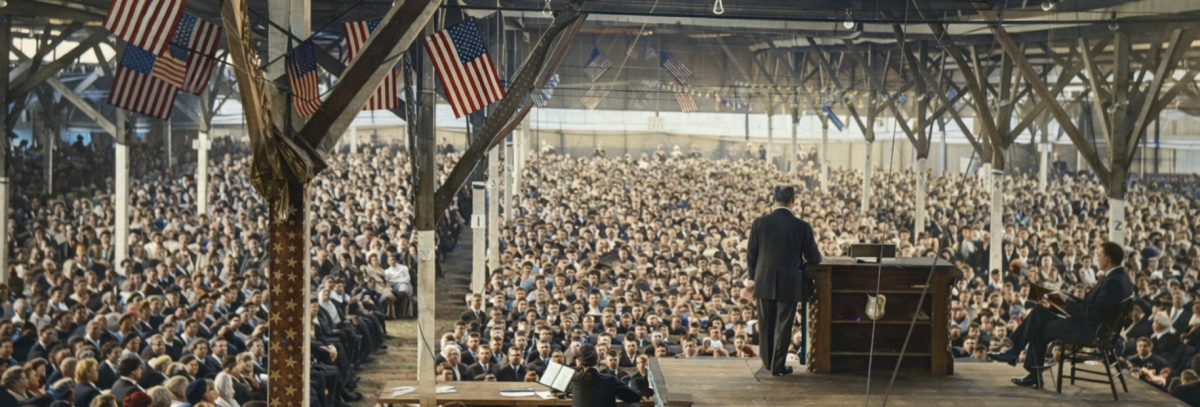
ONE of the most impressive and successful days in the great campaign was Mother’s Day, as suggested by Rev. Mr. Sunday. The following request was published:
Every person is requested to wear a white flower or ribbon to-day in honor of mother. If your mother is alive do her an act of kindness. Telegraph or write to her, or give her a gift to express your love. If mother is not alive, perform an act of kindness to somebody else’s mother. The services at the tabernacle will be for mothers, although everybody is invited. Businessmen are invited to close their places of business from two to four o’clock, or at least to let as many employees off as possible. An offering will be taken at the tabernacle to be given to the Woman’s Club to be distributed to the charities of the city as the club deems best.
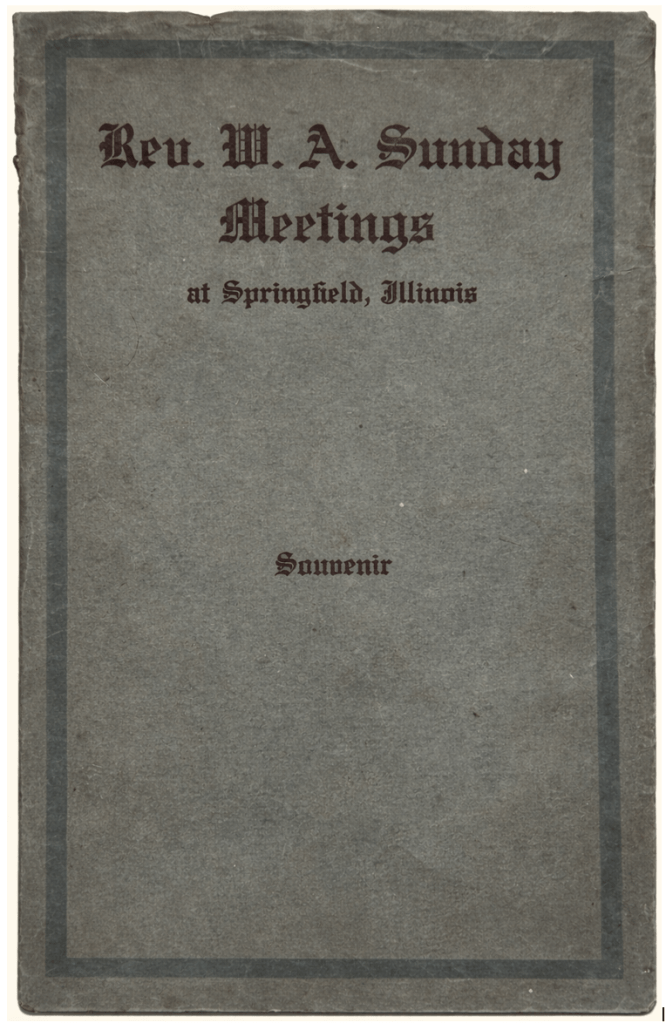
The Billy Sunday campaign published a souvenir booklet in 1910 that summarized the Springfield, Illinois campaign (Feb 26 – Apr 12, 1909). The following narrative shared much about the Rev. William A. ‘Billy’ Sunday
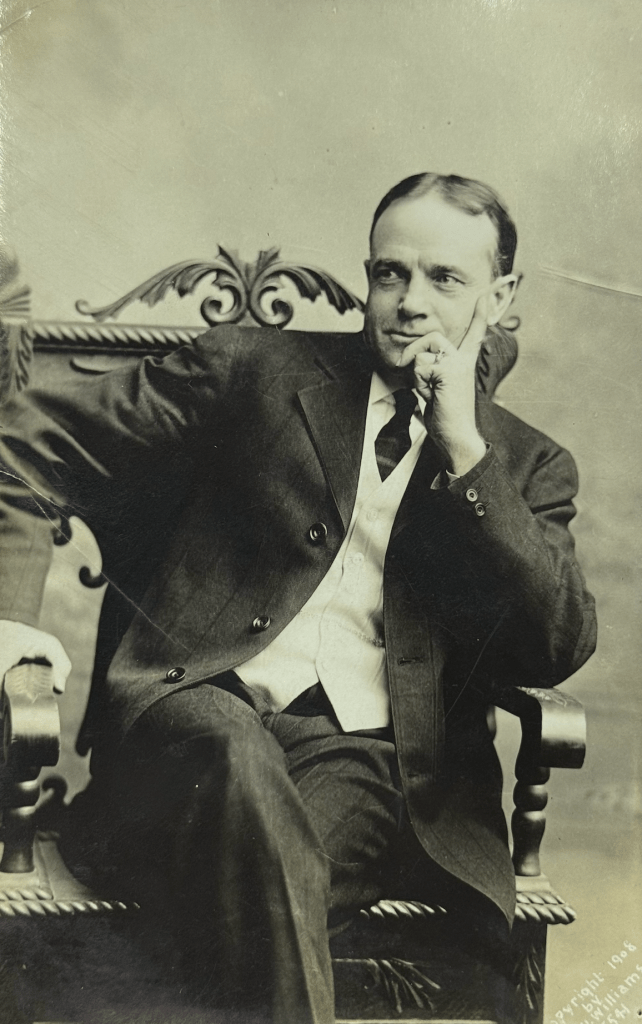
Rev. W. A. Sunday
WILLIAM ASHLEY SUNDAY is the best beloved and the most abused, the simplest and the most misunderstood, the most soulful and the most like a vaudeville performer, the most powerful in oratory and the least appealing to the emotions, the most persuasive and the most controversial, the most scholarly and the plainest, not to say coarsest, the greatest poet in essence and the greatest scrapper, of any man on the forum, the platform, or the stage of the world today.
He has been styled, the polygonal preacher, because he has so many sides, each a complete, finished, forceful fact. A character picture of the man, to be complete, must be a description of each of these baker’s dozen sides of his personality, none of which is much more important than any other one. The most that can be done within a small space—or indeed within any limitation of space—is to sketch in broad lines the mere outlines of this evangelist who is preaching the gospel of peace on earth and fighting the devil with the hottest of fire at the same time.
His father was killed in the civil war. The little boy was sent to the Iowa home for soldiers’ orphans. Later he made his own living at a youthful age, and his school teacher of that time says she would often watch him on the playground and wonder whether he would be the greatest crook or the greatest power for good in America—she was even then sure he would be one of the two. The boy took the right hand road.
When a young man he was a locomotive fireman on the Chicago and Northwestern Railroad and lived at Marshalltown. This was also the home of the famous A. C. Anson, captain of the old Chicagos, who watched Billy Sunday play baseball on corner lots while at home in Marshalltown. Anson took him to Chicago, discovered in him a great baseball player, and Sunday held the record for base running for years, a record which he still holds; was the second man chosen on the All-American team to tour the world—an accident to his knee kept him from making the tour—and was a popular idol of the fans.
An old time catcher for the Louisville team says that in those days when en route the rest of the men would play poker in the Pullman, but Billy Sunday was always back on the cushions with a book. He has kept close to books ever since. He has a remarkable faculty of choosing the very best and most authoritative writing on any particular subject and reading that only—and hence the range of subjects upon which he is thoroughly and accurately informed, includes almost everything from histology to astronomy and from bacteriology to history—it is a little interesting to notice that chemistry is the one topic unmentioned in his sermons. Three medical college professors who met at the end of his sermon which includes a half hour of the deepest microscopical pathology, agreed that William A. Sunday is the only layman they ever heard or read who was accurate in all he said about medical science.
One night a bunch of baseball players strolling along a Chicago street ran into a curbstone evangelist and stopped to be amused. Sunday stayed after the others went on. He went from there to the Pacific Garden mission, where he was converted. He kept on playing baseball, and nobody who ever heard it will ever forget his own description of how the others of that famous Chicago team approved his home run into Christianity.
A little later he was employed by the Chicago Young Men’s Christian Association at a small salary, only part of it paid during the panic of 1893, and refusing offers of $500 a month to return to the diamond. As a part of his work, he addressed groups of men—he always did know men, because of his early life and hard struggles. The addresses became longer and stronger with the growth of the work and experience in it. That great evangelist, Wilbur F. Chapman, took Sunday away from the Chicago Y.M.C.A. to be his assistant. Sunday learned the art of evangelizing and after learning it thoroughly treated it as Napoleon treated the art of war—he re-made it for himself, so that its old practitioners hardly recognize it, and at the same time made it produce victories hitherto undreamed of. The William A. Sunday methods of campaigning for Christ are unlike any others; they include the best of those of the past and many things unique; probably only Sunday could use them successfully in all their details; but it seems certain that they have factors not found in most others which really are the corner stones of successful work in evangelism. Some of the chief parts of the art of evangelism, as practiced by William A. Sunday, are these: Absolute accuracy in every statement made, whether one of the essential parts of the argument, or merely an illustration; hew close to the line that Jesus Christ laid down, regardless of the falling chips, and wherever that line leads; use language that everybody can understand, never talk down to an audience, but be lucid to the most ignorant while you are talking up to the most scholarly persons before you; avoid sectarianism; demand united work from all the evangelical churches in the city, and push united work by all the members of those churches; roast the skin of vice and sin in all its forms, from backsliding and carelessness to murder and adultery, rub salt into the burnt flesh, and then apply a healing balm that causes the object of the criticism to leave the tabernacle chastened in spirit, but loving the rod that smote him; avoid all fads and fancies, all tangential movements of society, but do a common thing in a most unusual way; and—many others. Starting with small towns and a few hundred converts at each series of meetings, the same plan of campaign has been used for all the years involving campaigns in cities of all sizes, and the first meetings years ago were, so far as Mr. Sunday is concerned, almost exactly like the meetings in Springfield. Of course, some minor modifications have been made, but these are few. Always there are the first sermons to get the church members back out of the world into the influence of Christ and to get the public to come to the tabernacle—the public seems to find its greatest attraction in hearing church-member hypocrites and Pharisees skinned like eels. Always the strenuosity of the sermons almost imperceptibly lessens gradually until the preacher who preaches as man never preached before is less athletic and more rhetorical about the middle of the series. Then, to the amazement of people who judged the man from his first pulpit stunts, the Reverend William Ashley Sunday preaches like the great orator that he is, the scholar that he is, the poet-philosopher that he is. This many sided man cannot be even sketched within a hundred pages. There is competent authority for saying of him these superlatives as being strictly true: He understands the minds and feelings of men as few men ever have done. He is one of the greatest orators the world has ever seen—and this is proved by the results of his work.
He is one of the most remarkable stylists in literature, his perfect imitation in one hour of the styles of Carlyle, Gibbon, Ingersoll, and several other writers of individual styles being an unprecedented feat.
He is said by scientists to be the most—and indeed the only—perfectly accurate preacher in matters of science. And a large part of his sermons deal with science.
He appeals entirely to the reason of the people, and rarely or never to their emotions, and in this he is the greatest of evangelists in the opinion of many people.
In numbers of converts, dramatic height of scenes, and wonderful stirring of the audience, several of his meetings have eclipsed anything in the history of evangelism since pentecost—and the most of these have been meetings for men.
The following is a biographical sketch of Helen Sunday, wife of Billy Sunday. Part of the 1909 Springfield campaign souvenir.
Mrs. W. A. Sunday
THE biographer who omits to study the wife of his subject certainly will miss the key to his problem of investigation. The world talks of the influence of the mothers upon its men; but it, curiously enough, generally omits appreciation of the strong influence of the wife upon any man; and perhaps more men have been made and unmade by their wives than by their mothers, when heredity is omitted from the matter.
Mrs. William A. Sunday was a girl of great strength of character when she was Miss Helen A. Thompson, the daughter of a Chicago business man. She married a famous baseball player and found herself the wife of one of the greatest of evangelists—and she not only made the revolutionary change with him but is one of the chief causes of William A. Sunday being what he is in the eyes of the world. She was a church worker, a shining exception to the rule of the results of marrying a man to make him better. She upheld the hands of her husband when he was in poverty and the poorly paid worker of the Chicago Y.M.C.A., writing letters declining, for seven times his salary, to return to the baseball field. When William A. Sunday was starting out as an evangelist along entirely new lines of endeavor which merged into In his entirely unprecedented lines of achievement, his wife helped greatly to keep up his courage, keep him along the line he had chosen, and keep him as much as possible free from worries. Mrs. Sunday complements her husband perfectly—they are not at all similar, and she is strongest where he is weakest and weakest where he is strongest. If he had a helpmeet like himself, Mr. Sunday might be plunging into hot water every month and every year. Luckily for him, his wife guides him around and over most obstacles, keeps his fingers out of the fire, and does what Mr. Sunday never thinks of doing—looks after his own interests.
The wedding of Mr. and Mrs. William A. Sunday was not the kind one finds pictured in Paul and Virginia by any manner of means; it was a twentieth-century marriage of two distinct individuals joining as helpmeets, without either submerging a personality in the other—certainly not the old kind of entire submergence of the wife in the husband. They disagree about as many things as other people do, but each knows in what things the other is best informed or strongest, and the one best qualified always decides the question. The result is that they are more free from actual, important disagreements—the kind called love spats or marital troubles—than most people. This is a match of brains as well as of hearts, of sense as well as of souls, and of respect as well as of love.
Mrs. Sunday does what she can in public during a series of meetings conducted by her husband, but the most important thing she does is to keep her husband able to do the great things he accomplishes in every city in which he works. She is a perfect wife for a very remarkable man.
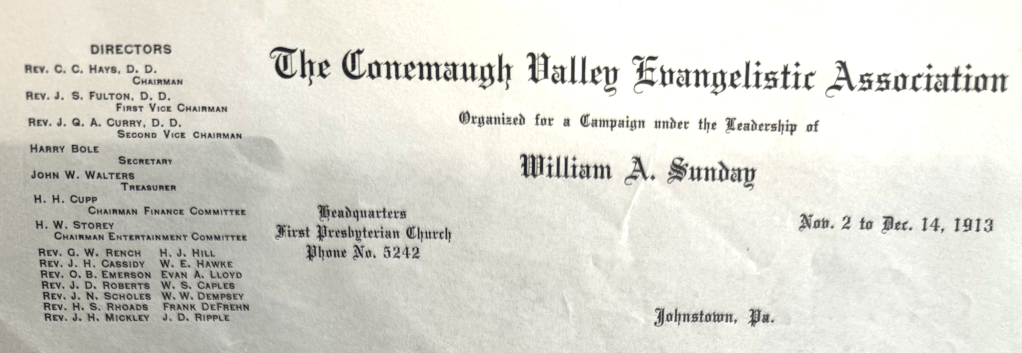
The logistics behind each revival campaign Billy held was simply massive. Here is an example of letterhead pertaining to his Johnstown, PA campaign (November 2, to December 14, 1913.
His letterhead usually indicated the key local personnel who were part of the Committee, the name of the organization formed to promote the revival, the name of a local host church serving as the revival headquarters, and the date of the event.
Permission to use artifact granted by the Morgan Library, Billy Sunday Archives, Grace College.
Here is First Presbyterian Church, Johnstown, PA (picture credit from their web site)
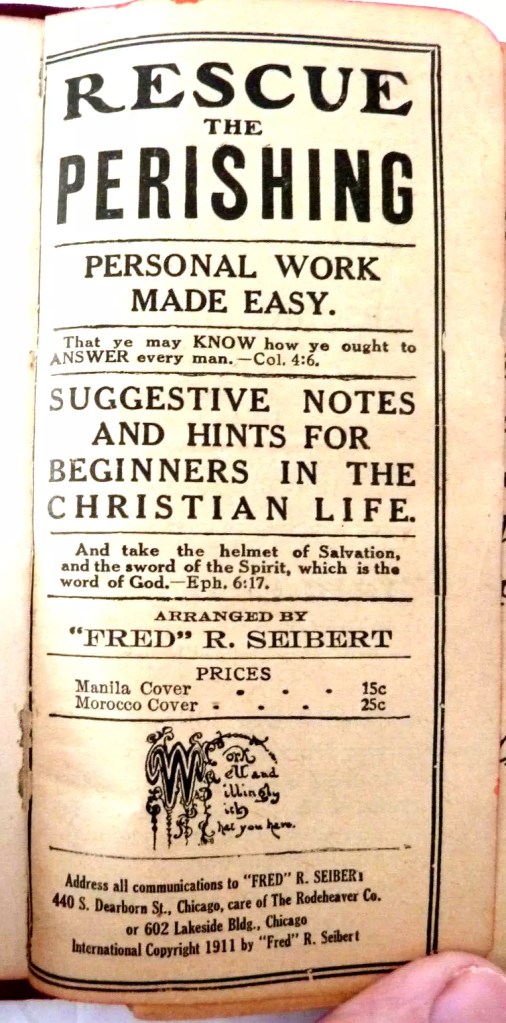
That ye may KNOW how ye ought to ANSWER every man.—Col. 4:6.
SUGGESTIVE NOTES AND HINTS FOR BEGINNERS IN THE CHRISTIAN LIFE.
And take the helmet of Salvation, and the sword of the Spirit, which is the word of God.—Eph. 6:17.
ARRANGED BY “FRED” R. SEIBERT
Author’s Collection
Books Proving Handy.
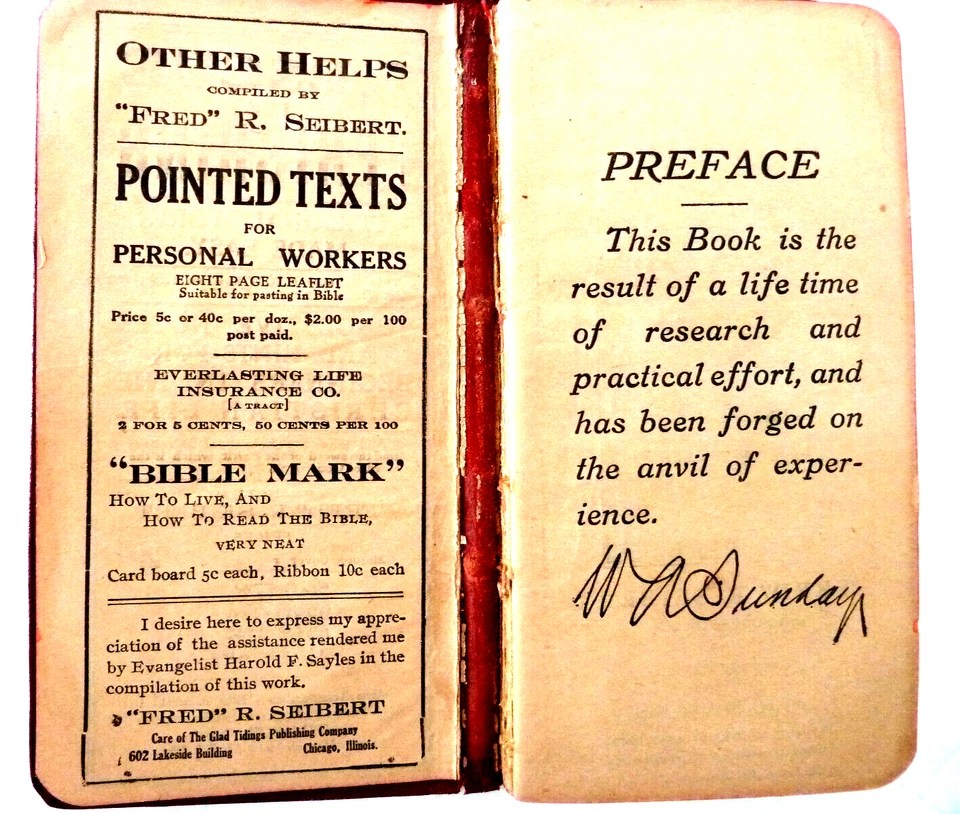
Those who assist in the personal work at the tabernacle are finding that the little book on this line of endeavor sold by Fred Seibert to be of much value. The ex-cowboy, in addition to selling the book on personal work, handles the hymnals and has for sale two of Billy Sunday’s sermons, ‘Moral Lepers’ and ‘Three Groups.’
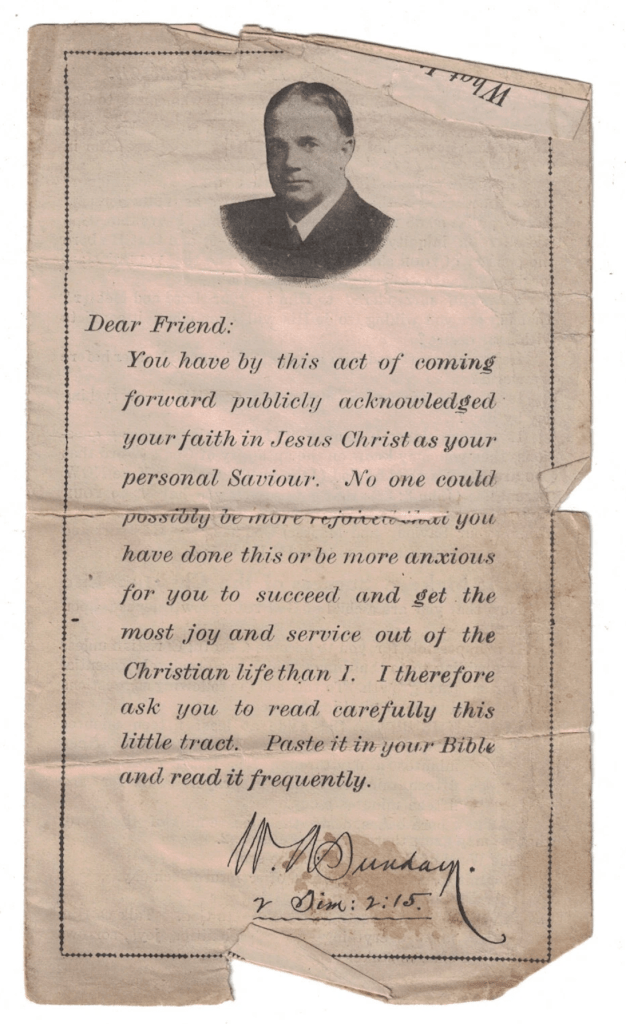
You have by this act of coming forward publicly acknowledged your faith in Jesus Christ as your personal Saviour. No one could possibly be more rejoiced that you have done this or be more anxious for you to succeed and get the most joy and service out of the Christian life than I. I therefore ask you to read carefully this little tract. Paste it in your Bible and read it frequently.
What it means to be a Christian
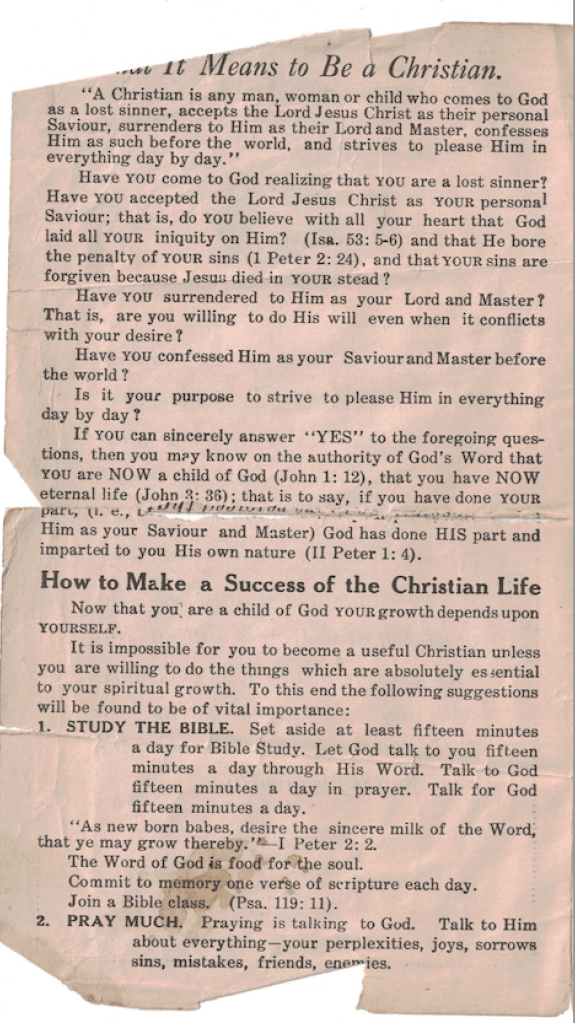
What It Means to Be a Christian.
“A Christian is any man, woman or child who comes to God as a lost sinner, accepts the Lord Jesus Christ as their personal Saviour, surrenders to Him as their Lord and Master, confesses Him as such before the world, and strives to please Him in everything day by day.”
Have you come to God realizing that you are a lost sinner?
Have you accepted the Lord Jesus Christ as your personal Saviour; that is, do you believe with all your heart that He bore the penalty of your sins (I Peter 2: 24), and that now your sins are forgiven because Jesus died in your stead?
Have you surrendered to Him as your Lord and Master?
That is, are you willing to do His will even when it conflicts with your desire?
Have you confessed Him as your Saviour and Master before the world?
Is it your purpose to strive to please Him in everything day by day?
If you can sincerely answer “YES” to the foregoing questions, then you may know on the authority of God’s Word that you are NOW a child of God (John 1: 12), that you have NOW eternal life (John 3: 36); that is to say, if you have done your part (i.e., accept the Lord Jesus Christ as your Saviour and Master) God has done HIS part and imparted to you His own nature (II Peter 1: 4).
How to Make a Success of the Christian Life
Now that you are a child of God your growth depends upon YOURSELF.
It is impossible for you to become a useful Christian unless you are attending to the things which are absolutely essential to your spiritual growth. To this end the following suggestions will be found to be of vital importance. that ye may grow thereby.” — I Peter 2: 2.
STUDY THE BIBLE. Set aside at least fifteen minutes a day for your Bible Study. Let God talk to you fifteen minutes a day through His Word. Talk to God fifteen minutes a day in prayer. Talk for God fifteen minutes a day.”As newborn babes, desire the sincere milk of the Word,
The Word of God is food for the soul.
Commit to memory one verse of scripture each day.
Join a Bible Class. (Psalm 119:11
2. PRAY MUCH. Praying is talking to God. Talk to Him about everything: your perplexities, joys, sorrows sins, mistakes, friends, enemies.
“Be careful for nothing; but in every thing by prayer and supplication with thanksgiving let your requests be made known unto God
3. WIN SOMEONE FOR CHRIST. For spiritual growth we need not only food (Bible study) but exercise. Work for Christ. The only work Christ ever set for Christians is to win others.
“Go ye into all the world and preach the gospel to every creature” Mark 16:15.
“When I say unto the wicked, Thou shalt surely die; and thou givest him not warning, nor speakest to warn the wicked from his wicked way, to save his life; the same wicked man shall die in his iniquity; but his blood will I require at thine hand.” Ezek. 3:18.
4. SHUN EVIL COMPANIONS. Avoid bad people, bad books, bad thoughts. (Read the 1st Psalm.)
“Be ye not unequally yoked together with unbelievers: for what fellowship hath righteousness with unrighteousness, and what communion hath light with darkness—what part hath he that believeth with an infidel—wherefore come out from among them and be ye separate saith the Lord” II Cor. 6:14-17.
Try to win the wicked for God but do not choose them for your companions.
5. JOIN SOME CHURCH. Be faithful in your attendance at the Sabbath and mid-week services.
“Not forsaking the assembling of ourselves together, as the manner of some is;” Heb. 10:25
Co-operate with your pastor. God has appointed the pastor to be a shepherd over the church and you should give him due reverence and seek to co-operate with him in his plans for the welfare of the church
6. GIVE TO THE SUPPORT OF THE LORD’S WORK. Give as the Lord hath prospered you. I Cor. 16:2.
“Give not grudgingly or of necessity, for God loveth a cheerful giver.” II Cor. 9:7
7. DO NOT BECOME DISCOURAGED. Expect temptations, trials, suffering and persecution; The Christian life is warfare.
“Yea and all who will live godly in Christ Jesus shall suffer persecution” II Tim. 3:12.
The eternal God is thy refuge. We have the promise that all things, even strange and hard unaccountable obstacles work together for our good. Many of God’s brightest saints who are now in glory, have passed through dark trials, the hottest fire, and were blessed and used mightily in the world made better because they had lived in it.
Read often the following passages of Scripture: Romans 8:18; I Corinthians 10:13




 Evangelist Billy Sunday (1862-1935)