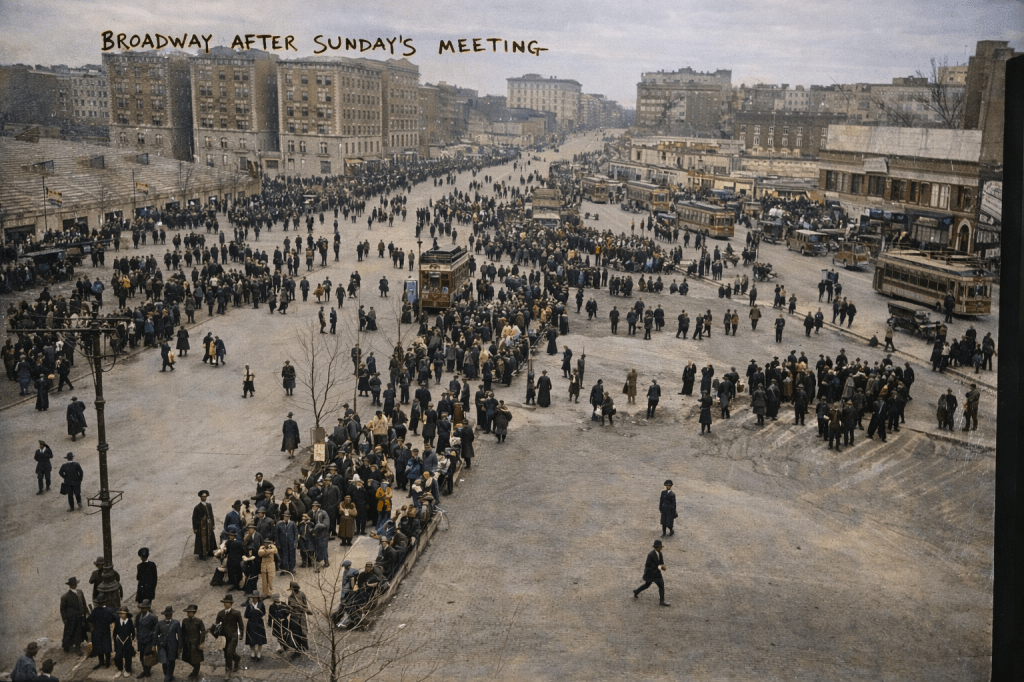
“Read good books,” urged Billy Sunday.

In October 1906 Billy preached to a crowd of roughly 800 people in Salida, Colorado, at First Presbyterian Church. During his message he exhorted the crowd…..

Read good books and keep good company. Every gambler and drunkard became so by imitating the gang he went with. Good books and good companions are to character what water is to the fruit trees, the grasses and the vegetables in this beautiful valley.

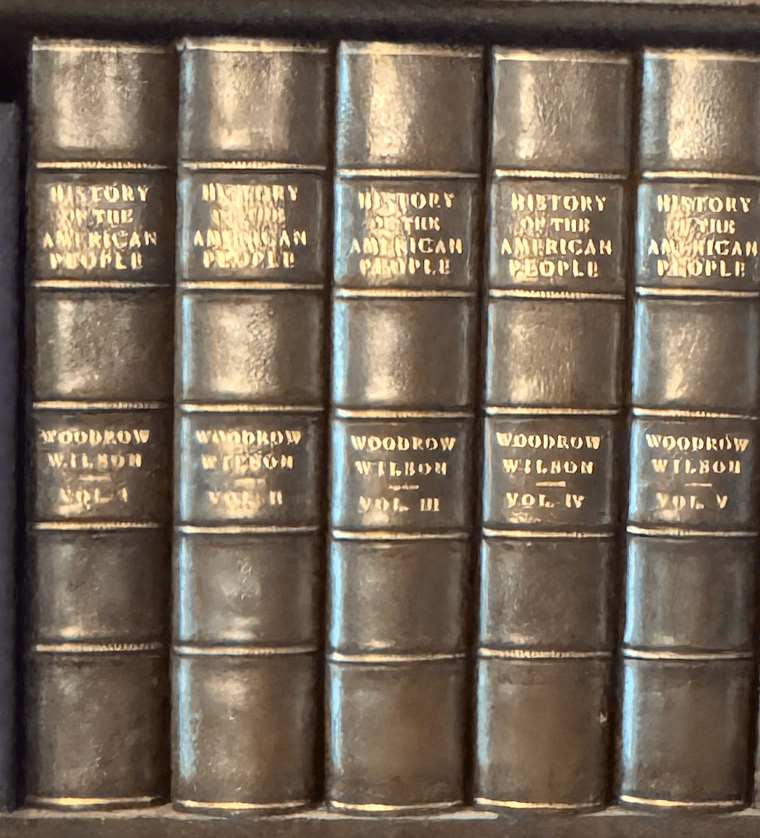
There are a few hundred books in the present Winona Lake home that Billy lived in for the last 30 years of his ministry. On the shelf, one can find A History of the American People, by Wodrow Wilson in the first edition (1902).

While Sunday’s authority came from Scripture, A History of the American People offered a grand, moral narrative of the United States that fit seamlessly with his revivalistic call: a chosen nation needing repentance and reform to fulfill its destiny. Wilson’s combination of national mission, moral urgency, and literary flair reinforced Sunday’s belief that evangelism and patriotism were inseparable in early-20th-century America.

Morgan Library at Grace College (Winona Lake) has several cards or notes in which Sunday and Wilson communicated together. They seemed to have liked each other.

Circa 1890s notebook belonging to Billy

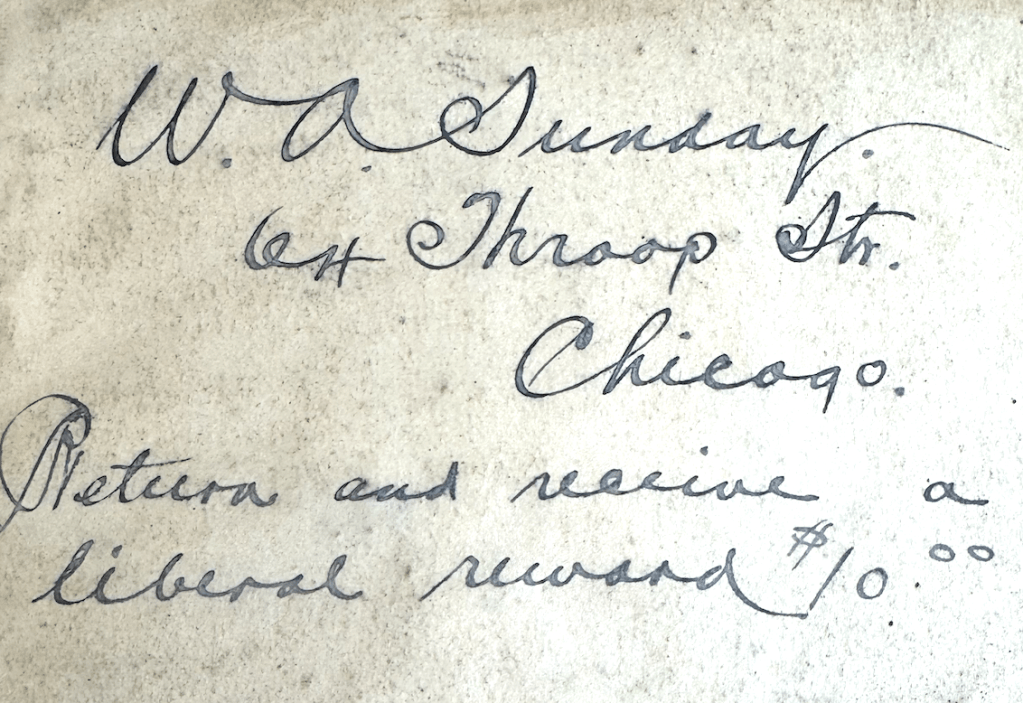
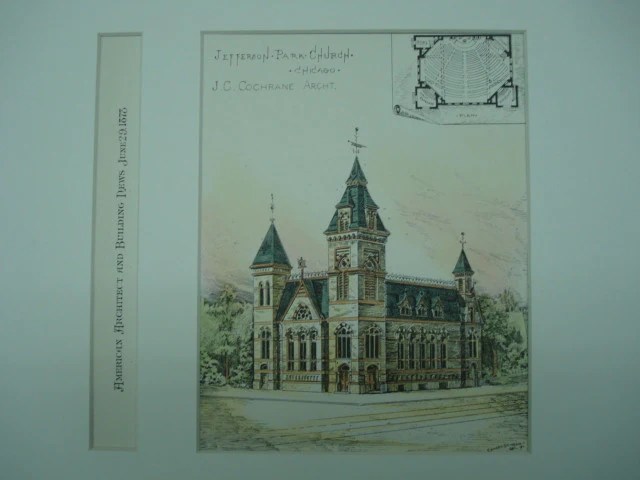
Morgan Library at Grace College has a wonderful artifact that appears to be a notebook with various (mostly) handwritten notes, undoubetdly by Billy himself, that resemble the raw materials and resources Billy used in his earliest ministry days, perhaps as early as the 1890s. It is chalked full with handwritten notes, stats, illustrations, and what appears to be outlines for messages. It is personally inscribed by W.A. Sunday with an address of 64 Throop St. Chicago. The address is interesting because across the street from the home (now gone) is Jefferson Park Church (see Bruns:47).

This Google Earth views shows the site of the previous Park Jefferson Church (8-story red building today). 64 Throop would have been right across today, where a long distribution or warehouse sits today.

A churchless community?

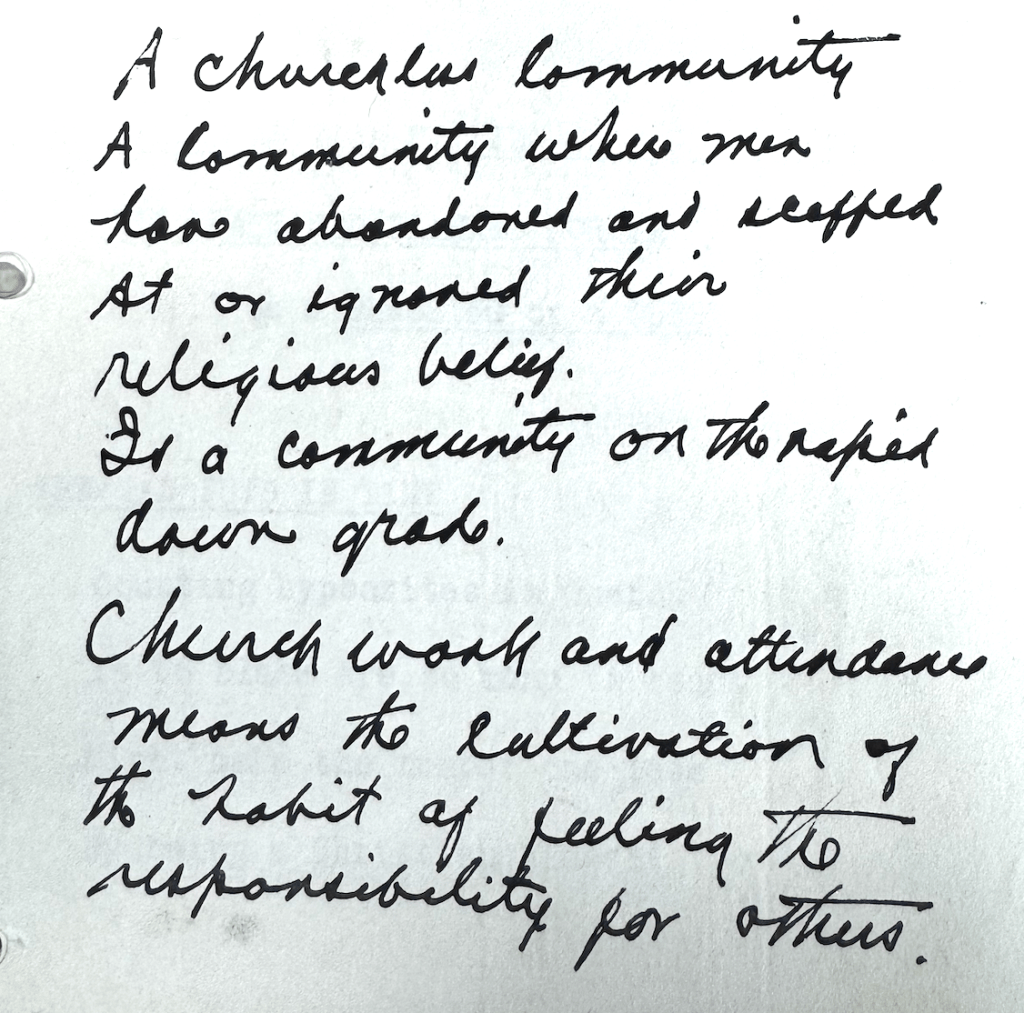
Here’s what Billy Sunday personally wrote in a sermon note about a churchless community.

“A churchless community is a community where men have abandoned and scoffed at or ignored their religious belief. It is a community on the rapid down grade. Church work and attendance means a cultivation of the habit of feeling the responsibility for others.” – not dated but likely 1934. Grace College. Morgan Library.

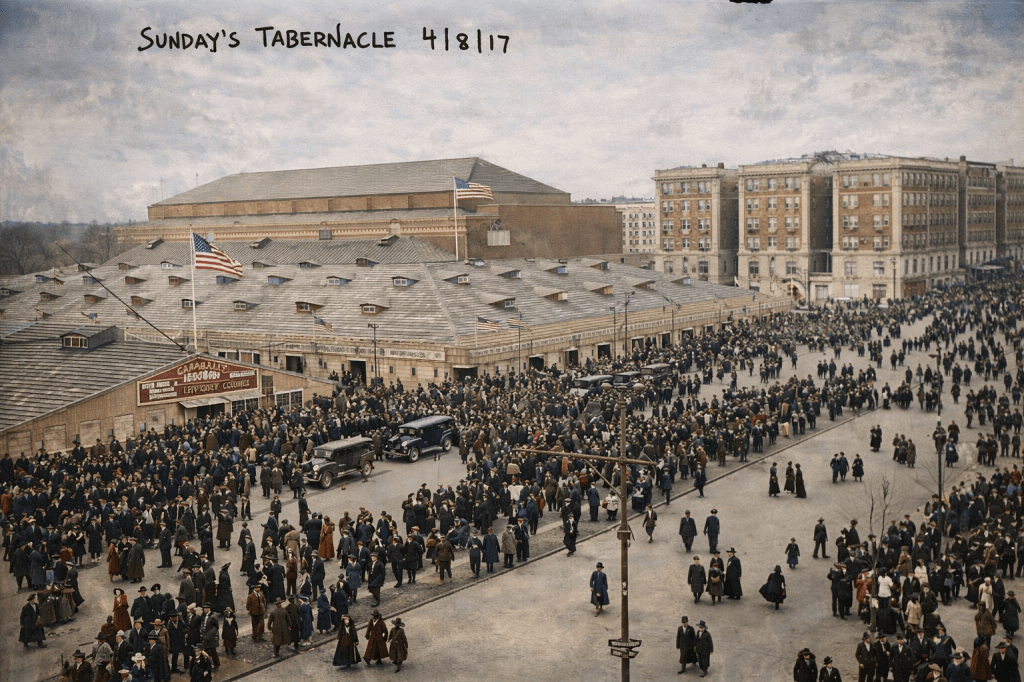
Philadelphia campaign. January 3 – March 20, 1915

Billy’s words to the people at Philadelphia, farewell:

“And this is only the beginning. The revival is a failure that comes to a close when the tabernacle is torn down; we have enlisted –not for a campaign—but for the war. “There remains much land yet to be possessed”. Not in many years has a large city been so generally permeated by the Spirit of God. But only in part has the harvest been gathered; the convicted should be converted; the lives of those who have taken their first step must be linked to the church of Christ; the young convert must be taught; These thousands of men “whose hearts God has touched” must be kept true by being kept

busy for the Master”. – Morgan Library

A contemporary account of Billy Sunday (c 1921)?

The following account (excerpted) is in the Morgan Library Billy Sunday Archives.

“Life and Labors of William A. Sunday”

[Billy’s own view of his first sermon.]

“I diagnosed the sins and difficulties of people as existing in the gray matter. I figured I had to show people. You ought to have heard my [first] sermon. It was a hummer. I had stacks of books all around me. There were words that would make the jaws of a Greek professor squeak for a week. When I sprung it, it went off like a firecracker and busted in the middle. I figured that I was going to the old sinful world to its knees and yet nothing happened. Then I loaded my old muzzle loading gun with ipecac , buttermilk, rough on rats, rock salt and whatever else came handy and the gang has been ducking and the feathers flying ever since. I was wrong. It was the heart and not the gray matter that was wrong.

“In 1891 Sunday left baseball to become secretary of religious work at the Chicago Y.M.C.A. After three years he became advance man for J.Wilbur Chapman, also holding meetings in connection with the campaigns. About Jan.1,1896 Chapman returned to the pastorate and simultaneously Sunday received his first call [editor: this is not correct] as an evangelist. This meeting was held at Garner, Iowa and dates the beginning of this mans remarkable career.”

[Billy as a man of prayer.]

In regard to the personality of the man I would say first that he is fundamentally a man of prayer. Let the mistaken critic of Sunday rid himself at once of the notion that his meetings are merely big displays of the powers of advertising and organized enthusiasm and the product of a man who is called “a great salesman”. The life of the man and the activities of a campaign are shot through and through with prayer. In every place where he holds a meeting he chooses a secluded spot from whence he storms heaven. This place becomes a Bethel to him. In prayer he is natural. His prayers are not long but to the point and usually open with “and now Jesus” from whence he proceeds in his peculiar manner to pray for all the matters pertaining to the success of the meetings. Without prayer he believes he would be as Samson shorn of his strength. He makes no decision or takes no step without first taking the matter to the Lord.

[Billy’s passion for souls?”

He has an intense passion for souls. Here is a man who carries the people of a community upon his heart and is ready to give his very life and strength and energy in order to see them saved. He will continue day after day, preaching twice and three times only to see men turn to God.

[Billy’s power of perception?]

Mr. Sunday is endowed with a remarkable power of perception. Passing through a building he sees things that readily lend themselves for sermon stuff. His remarkable memory is brought into evidence in his sermons as he pours forth anecdote, history, statistics and quotations from literature with remarkable rapidity. He is equipped with a clear eye that takes in the entire tabernacle into its scope and gives him a remarkable advantage over his audience.

[Billy’s executive ability?]

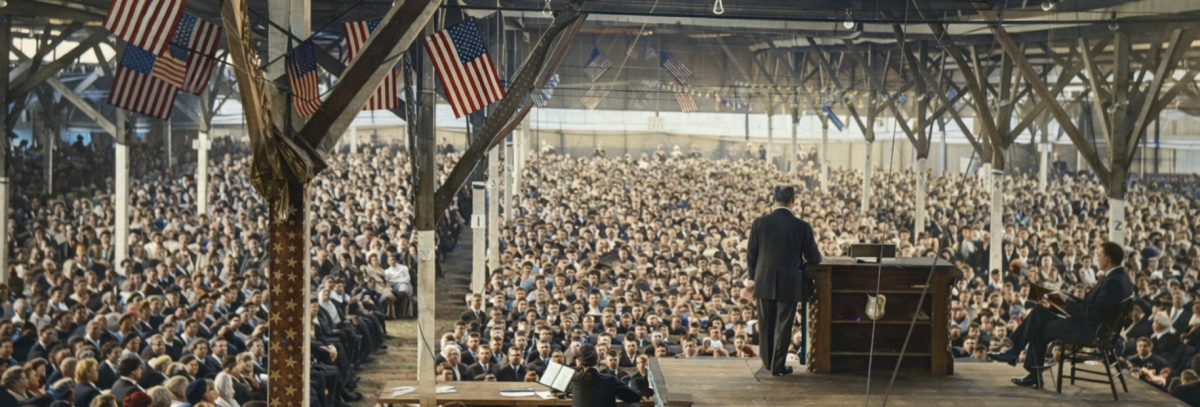
We must here mention the executive ability of the man. He has the happy faculty of surrounding himself with co-workers who are very efficient and it is to the credit of Mr. Sunday that the personnel of his staff is the same today that it was in 1916 with the possible exception of the tabernacle building as my memory fails me on this point. Space will not permit us to discuss the form of organization in a campaign except the fact that towns from 5 to 20 miles from the seat of activity are touched through the organized spirit of prayer that emanates from the campaign.

[Billy’s imagination?]

His imagination enables him to make the commonplace radiant with beauty. He uses no Greek or Latin but the plainest and most expressive language. He calls things by their right name and often his words burn and blister. It is doubtful if there is any living preacher who can pour out such a stream of red-hot and sizzling adjectives to show his scorn and contempt for sin. There are moments when he makes you think of the way Jesus denounced the scribes and Pharisees.

[Billy’s use of slang?]

We must give a little space to the matter of slang. It is futile to attempt to apologize in behalf of Mr. Sunday as he would not welcome such an apology. It is his point of contact. He calls it, “corn bread and potatoes”. Asked to tone down his preaching in this regard he replied to a committee of ministers that, “If I preached like you do I would have about as many people to preach to as you do.” Slang is defined as language in the making and unconventional speech. Study carefully the Bible characters whom God has used. How many are there of the stereotyped kind? It was the rams horn rather than the silver trumpet that led Joshua’s army to victory. Samson thinned the army of the alien with the jaw-bone of an ass. David used a sling and Shamgar an ox goad and we are also reminded that the Master himself “taught not as the scribes”.

[Billy’s use of illustrations?]

. . . his style is direct and expressive. His sermons teem with illustrations that illustrate. He combs the ends of the earth for material for his sermons and his ready references to science, history, literature and other branches both delight and stagger the hearer. Sentiment, pathos, logic, word pictures, impersonation etc are all used to drive home truth.

Evangelist Billy Sunday compared to others in the itinerant class

The following information* was addressed to the Wilkes-Barre Editor in 1913, probably just before the February revival. It was likely drafted by Billy himself or someone else close to him from his campaign team. The revival at Wilkes-Barre took place February 22 (23), thru April 13th, 1913.

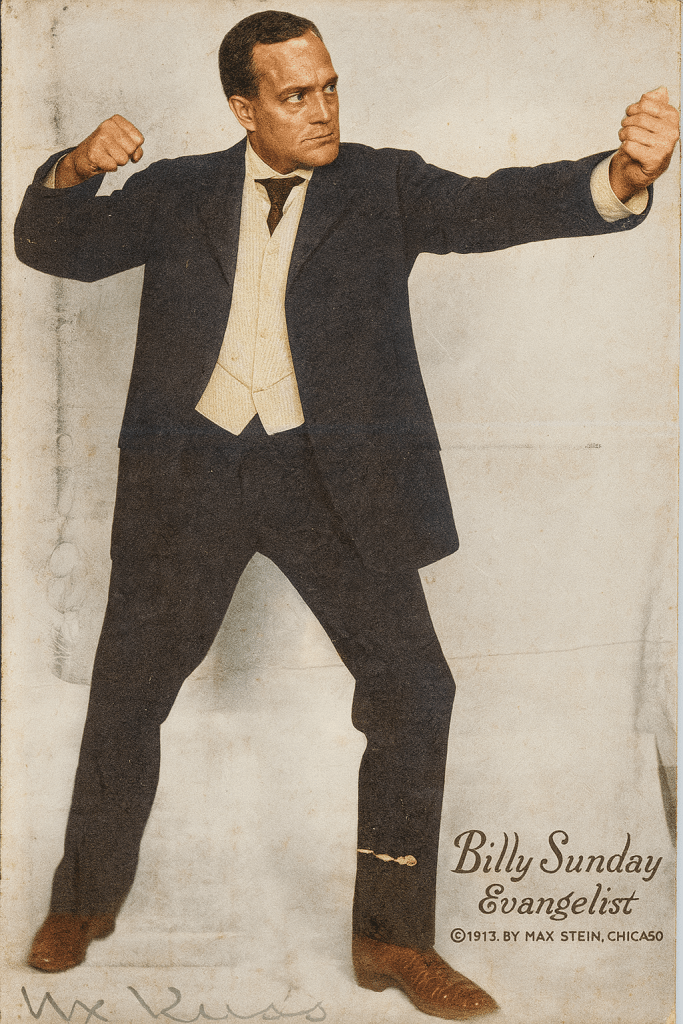
Image made by J. Inbody, Elkhart, Indiana. Author’s collection. From a 1915 postmarked postcard.

“He [Billy] has skimmed the literature of the English race for information and illustrations, and has a slang vocabulary that is simply astounding. He uses his knowledge with such telling effect that those who come to scoff remain to pray. His earnestness, his transparent honesty, carries his hearers with him, and his slang is all forgotten in his clarion call for repentance; his denunciation of all that is bad, vile and wicked, and in his praise of God, home and country.

“The old school of evangelists were of the itinerant class, moving rapidly through the country, their evangelism seemed sudden in its effects, and I am afraid somewhat evanescent in its results. It is just here that Sunday’s campaign gives promise of more lasting good. His coming has been carefully prepared for, and his meeting place is undenominational and unconventional in character. His is a movement conducted with great business acumen and sound common sense. He trains the ministers and church workers in such a way as to make them capable of caring for the harvest when it comes. Like a good farmer, he prunes the fruit trees with vigor, cuts out all the dead wood and sprays well to get rid of moths, beetles, and such like, so that when the new fruit shall ripen it will be sound and good. Mr. Sunday is a man with a great faith. He prays for the blessing, he prepares for the blessing, and he is sure of getting it. It is therefore no surprise to him when it comes.”

*Original artifact is in the Billy Sunday Archives at the Morgan Library, Grace College.

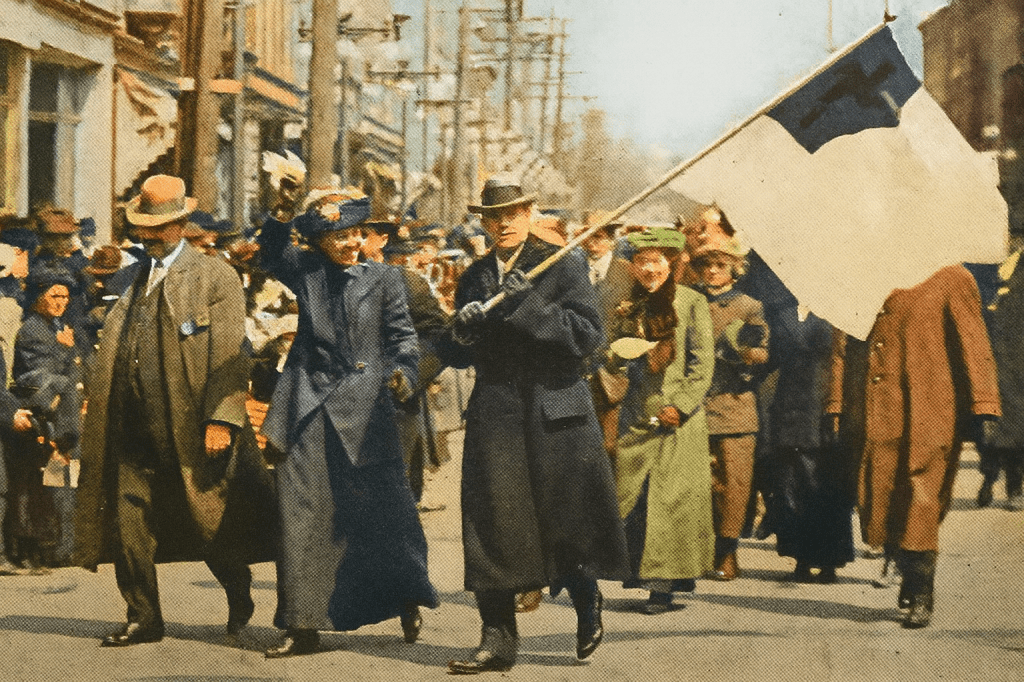
Billy Sunday, and wife Helen, lead a procession of around 20,000 people in a
Sunday School parade at Wilkes-Barre. Colorized by the author.

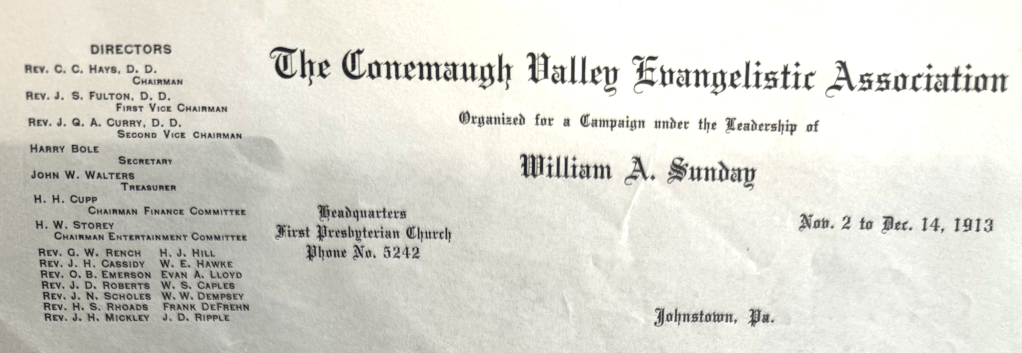
Letterhead for the Johnstown, PA campaign in 1913

The logistics behind each revival campaign Billy held was simply massive. Here is an example of letterhead pertaining to his Johnstown, PA campaign (November 2, to December 14, 1913.

His letterhead usually indicated the key local personnel who were part of the Committee, the name of the organization formed to promote the revival, the name of a local host church serving as the revival headquarters, and the date of the event.

Permission to use artifact granted by the Morgan Library, Billy Sunday Archives, Grace College.

Here is First Presbyterian Church, Johnstown, PA (picture credit from their web site)

Billy knows his Bible – says a fellow minister, c. 1913

“Dr. Sunday (Westminster College had just conferred an honorary doctorate upon Sunday) knows his Bible which is the true body of divinity in theological lore. Mr. Sunday has devoted his life to the supreme task of world evangelization for which the Bible is the great charter.

He is, therefore, both in scholarship and practical effort entitled to the degree. Just as a Doctor of Medicine is supposed to know the Science of Medicine and practice the art of healing, so a Doctor of Divinity who know the truth about God and practices the art of saving 1s entitled to the degree. In many institutions it is customary to bestow the honorary degree of Doctor of Divinity upon those who are men noted for their knowledge of “the traditions of the scribes and pharisees” than for knowledge and practical use of the Bible itself.”

Sincerely yours,

R.M. Russell to T.T. Frankenberg (Columbus, Ohio)
August 30, 1913

Artifact credit: Morgan Library, Grace College

The recipient of this letter, Theodore Thomas Frankenberg, was no casual correspondent. A Columbus-based journalist and author, Frankenberg was in the midst of gathering materials for what would become the first popular biography of the evangelist, Billy Sunday: The Man and His Message (published in 1914). Letters like Russell’s provided him with both anecdotal color and institutional validation—evidence that Sunday was not just a charismatic revivalist but a figure respected by the academic establishment.

This exchange captures an important cultural moment. Westminster’s degree signaled a rare bridging of worlds: a Presbyterian college recognizing a frontier-style evangelist whose power lay not in polished scholarship but in the raw urgency of his preaching. To Sunday’s critics, the degree may have looked like a concession to populism. To his supporters, it was overdue acknowledgment that the man who knew his Bible best and preached it most widely deserved the honor more than those “scribes and Pharisees” who merely debated it in lecture halls.

In the end, Frankenberg’s biography helped cement Sunday’s reputation, weaving together stories, letters, and testimonies like this one. And tucked inside that narrative is the 1913 moment when Westminster College draped Billy Sunday in academic robes, placing him—at least symbolically—among the doctors of divinity.

The value of Helen ‘Ma’ Sunday?

“Winona people are beginning to know something of Mrs Sunday’s gifts and abilities, as they never have before understood them. She works with unusual tact, and gives evidence of thinking every subject through before action is taken. Personally, I appreciate such a counsellor more than I can express. I feel satisfied that her spirit has touched the heart of every Commissioner of the General Assembly; and this has resulted in inspiring their confidence in Winona’s present, and enlarged their vision of the great future this Institution faces.”

Letter from J.C. Breckenridge, General Secretary, Winona Assembly and Bible Conference. May 24, 1921. Addressed to Billy Sunday. Morgan Library. Billy Sunday Archives.

U.S. Grant’s advice to young people?

The following is attributed to U.S. Grant and Billy Sunday wrote this into sermon notes labeled “Science.” No date. Morgan Library, Grace College.

“Hold fast to the Bible as the sheet anchor of your liberties.”