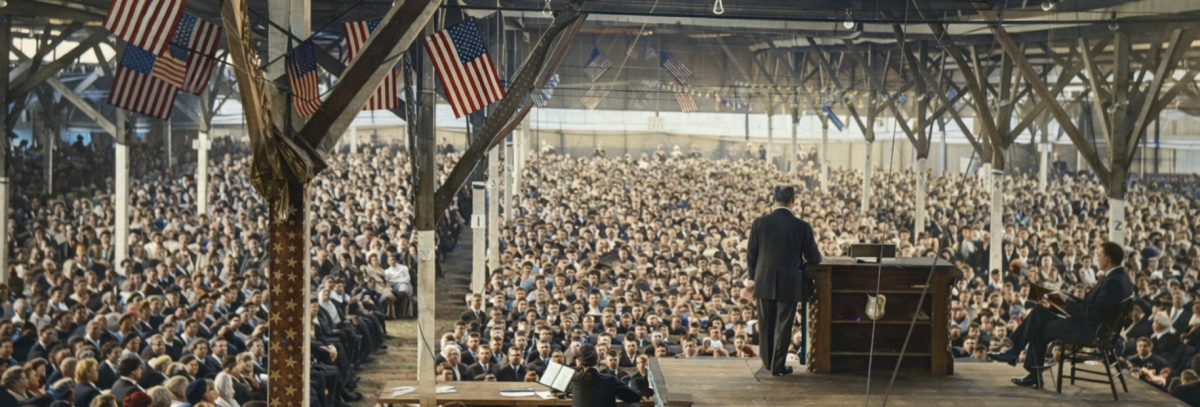
What kind of prep-work went into hosting a campaign for Billy Sunday (c 1918, Duluth, Minnesota)?

The Duluth News Tribune. Mon, Apr 08, 1918 ·Page 3

ADVANCE MAN IS HERE TO PAVE WAY FOR BILLY SUNDAY

Looks to Building of Tabernacle at Courthouse Square—Construction Starts Next Week.

Actual work in preparation for Billy Sunday’s campaign in Duluth will begin early next week when workmen will commence construction of the huge tabernacle in which the meetings will be held.

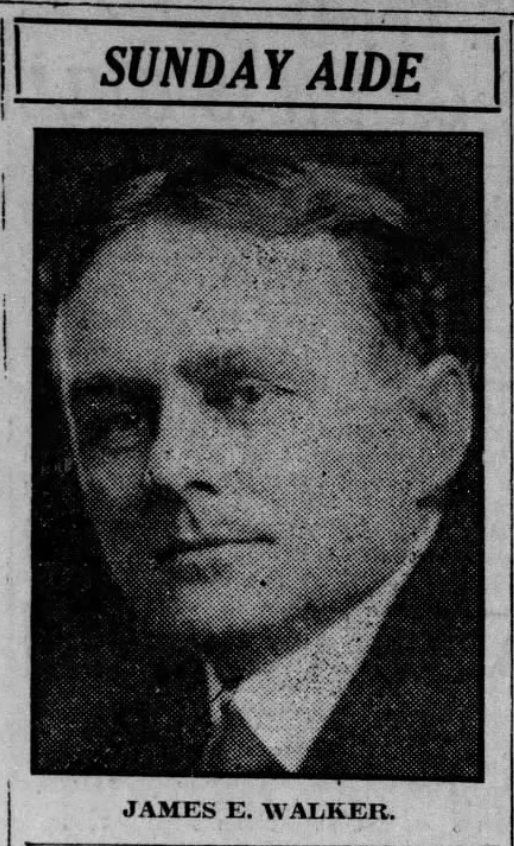
This was the announcement made yesterday by James E. Walker, advance representative for the evangelist. Mr. Walker reached Duluth Saturday and immediately plunged into the work of preparation for Sunday’s appearance in Duluth. He met representatives from Duluth, Superior and range churches at the First Presbyterian church at 3 o’clock yesterday afternoon.
Richard Close and W. L. Smithies, of the men’s interchurch council addressed the meeting. Both gave their impressions of the Sunday campaign in Chicago. Mr. Smithies was in Chicago Saturday and witnessed the mammoth parade, held at noon, which preceded the largest meeting that has yet been held at the Chicago tabernacle.

Sunday’s Methods Outlined.

Walker’s talk outlined, for the local workers, the Sunday method of conduction a campaign. His classification divides the work into three parts. The preparatory work, he says, usually covers a period of eight weeks preceding the campaigns. The latter constitutes the second division and the third division in, in Walker’s words, “the follow-up campaign or work of conservation.” The first part is now well under way in Duluth.

The Sunday campaigns are usually conducted by 15 committees. Fourteen of these will be in operation in Duluth within a short time. The fifteenth, constituting a restaurant committee, often necessary through the comparative inaccessibility of the tabernacles, will not be needed in Duluth owing to the central location of the tabernacle.

Two Thousand Ushers.

The other committees, some of which are already being formed, together with Walker’s estimate of the number required for each, follow: Music committee, including the personnel of three choruses, 2,500; Neighborhood prayer meeting committee, 2,000; ushers and doorkeepers, who will work in relays, 700; personal workers, 500; secretaries, who will take the names of “trail-hitters” at the meetings, 300; men’s Bible class organizers and workers, 500; finance, automobile, hospital and students committees, 500. This, in the round figures of Walker’s estimate, will total a working staff of 7,000. “And every one of them,” said Walker last night, “will have something to do.”

“The most important part of the work,” said Walker, “is the neighborhood prayer meetings, previous to and during the campaign. If Sunday’s coming did nothing else than serve as an incentive for the organization of these meetings, he would have done enough. It is his wish that a great deal of time and care be spent in the perfecting of the committee which will be in charge of these meetings.

Territory Divided.

“The territory surrounding Duluth and the city itself will be divided into districts, these districts subdivided into sections and these sections again divided into communities or, as we call them, neighborhoods. It is our plan to have prayer meetings for two nights each week for three weeks previous to Sunday’s appearance. These meetings will not be held in the churches of the communities but in the private homes. There were 99 conversions reported at similar meetings which preceded the Los Angeles campaign.

“Billy Sunday’s request is that, at these meetings, those who attend pray for the success of the campaign. The attendance at the Los Angeles prayer meetings was recorded at 73,938. There were 7,556 homes open for meetings.

Tabernacle 8,000 Capacity.

The Duluth tabernacle, according to the present estimate, will accommodate 8,000. It will include, besides the main auditorium, the usual rooms that are built in all Sunday tabernacles. The Duluth structure will be of the turtle-back type that is used in a majority of the cities. Its dimensions will be approximately 176 by 224 feet. It will be built on the courthouse grounds at Fourth avenue West from First to Second streets. Sunday will conclude his Chicago campaign on May 19. He will come to Duluth during the following week and will open here May 26. Walker has established his offices on the second floor of the Y. M. C. A. in the offices of Mr. Smithies. He will direct the preparatory campaign from there and will remain here until after the opening of the campaign proper.

From the Duluth Herald May 2, 1918

How did the 1918 Billy Sunday Chicago campaign do by the numbers?

Chicago Tribune. Mon, May 20, 1918 ·Page 1

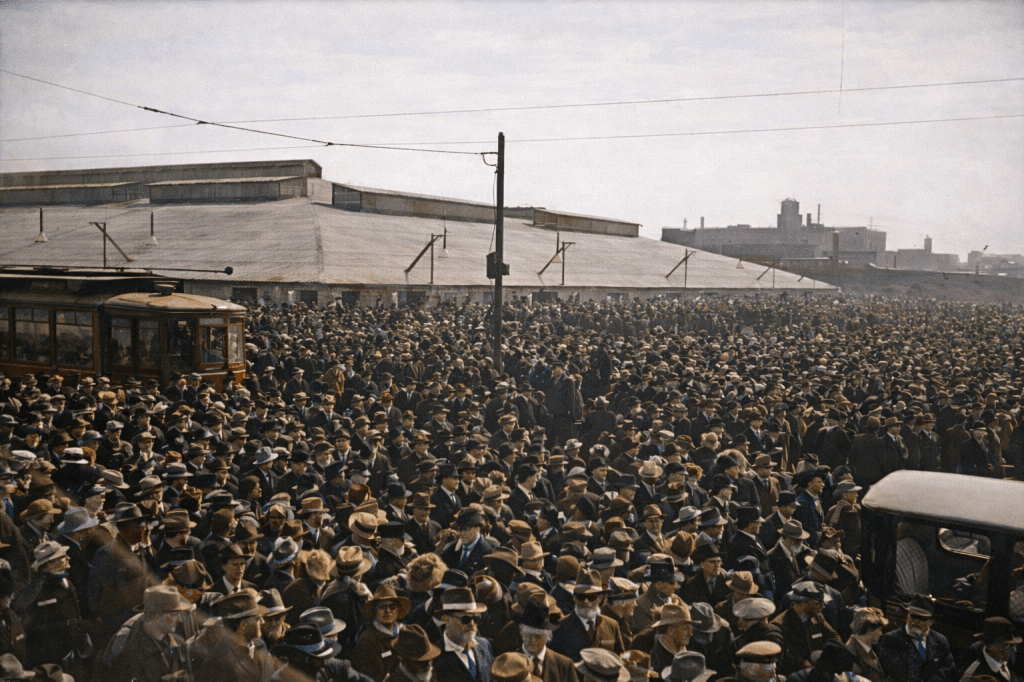
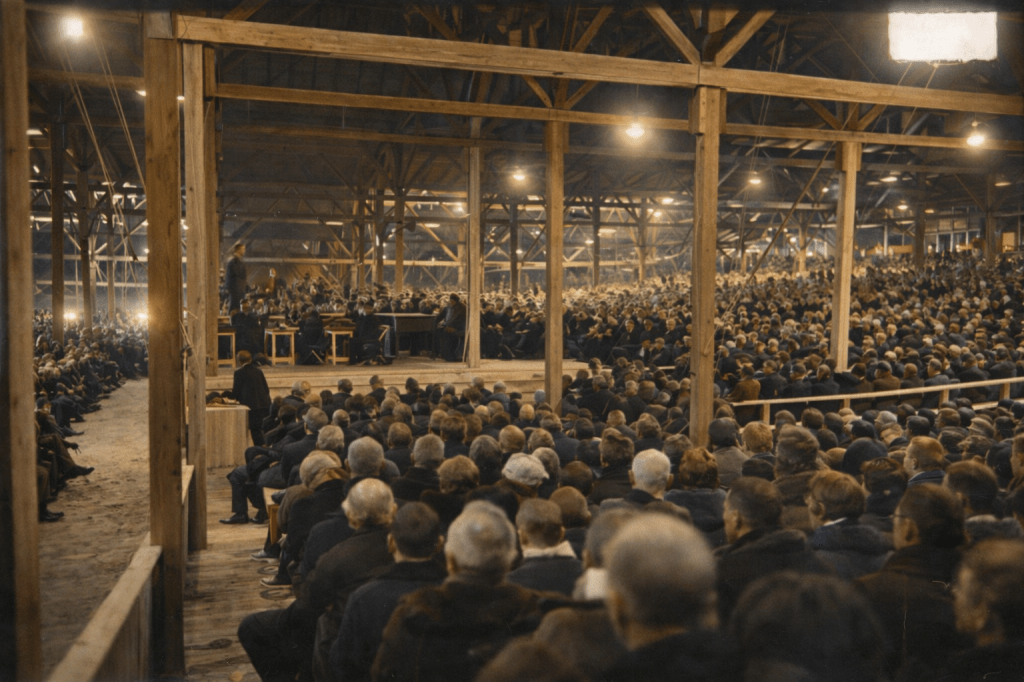
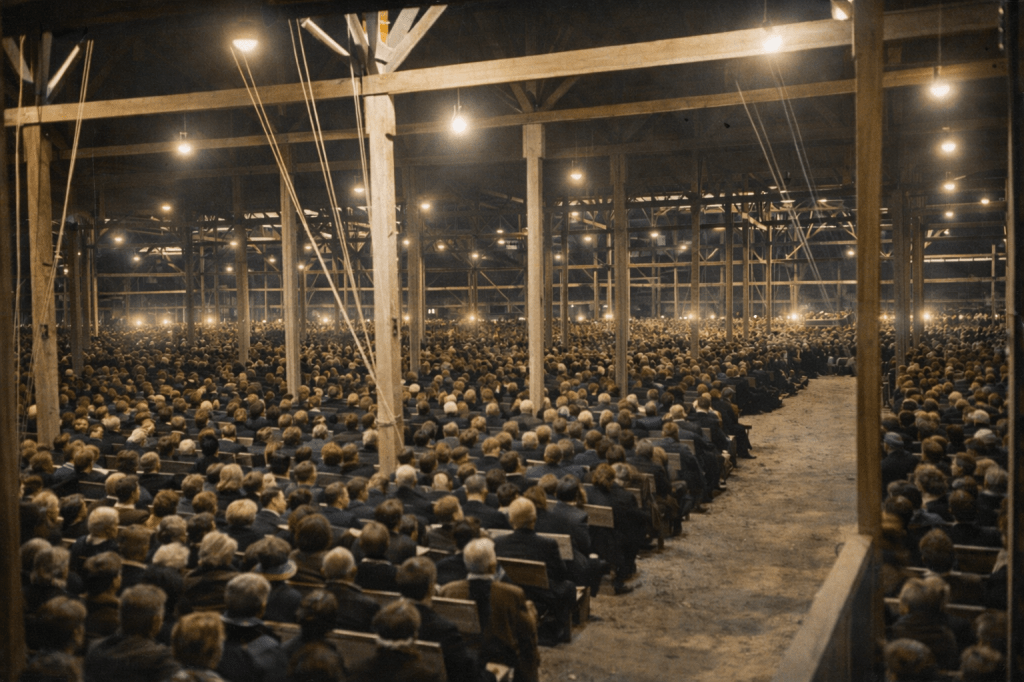
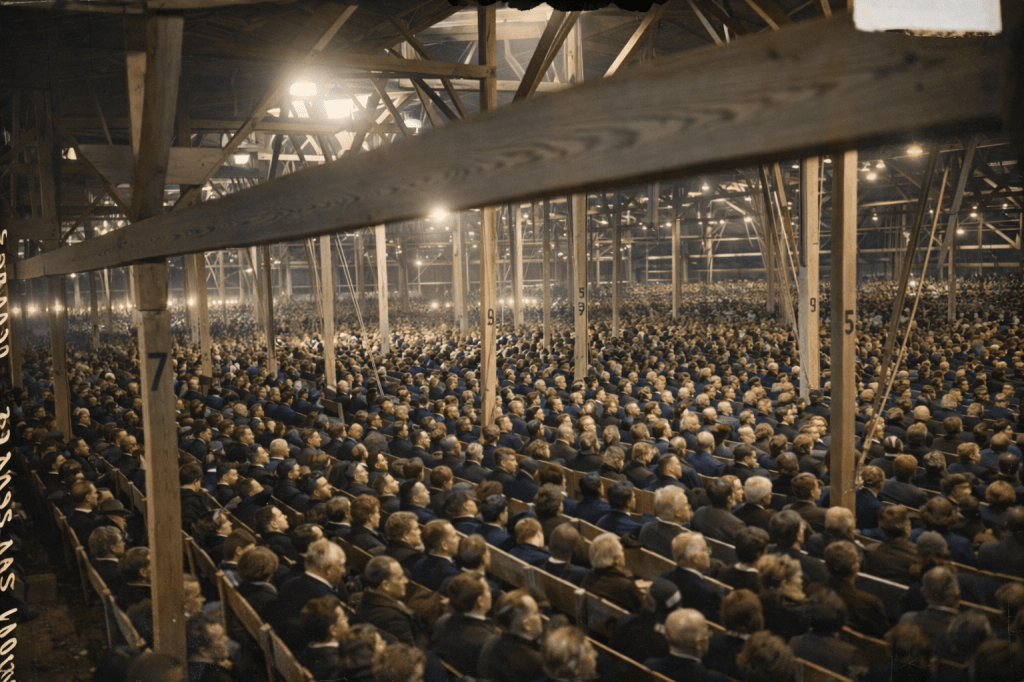
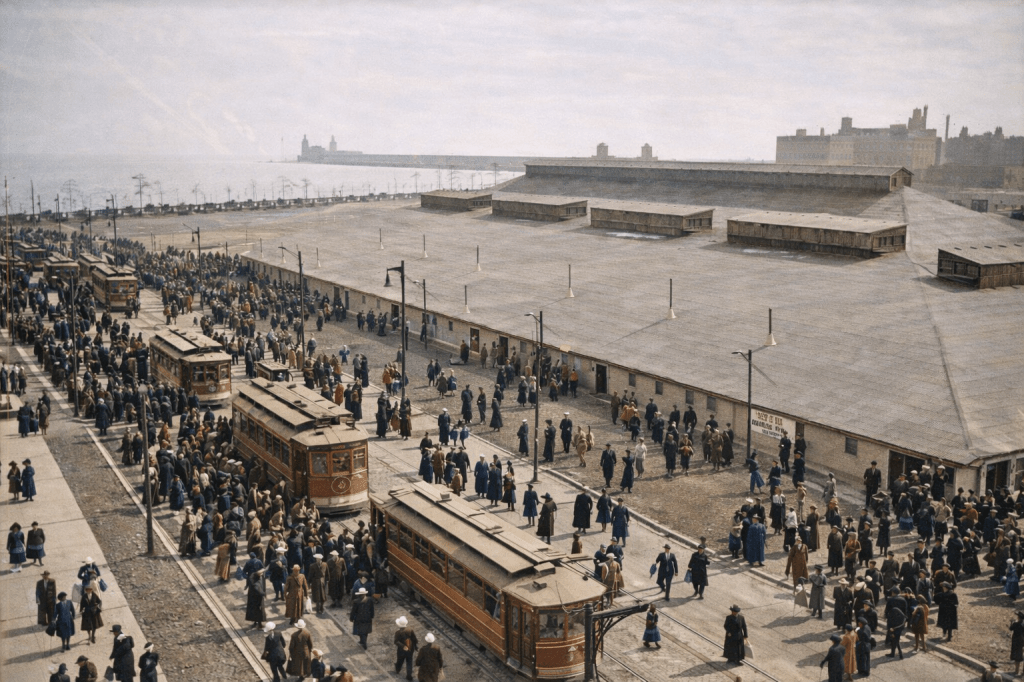
Bily Sunday Tabernacle. Chicago, Navy Pier, c. 1918.

49,165 SOULS AND $56,000, BILLY’S SCORE

Great Crowd Hears Revivalist Close Campaign.

Trail hitters (total) ………… 49,165

Attendance at tabernacle and meetings led by members of the Sunday party ………… 1,200,000

Money raised for current expenses ………… $135,000

Money raised for free will offering to Billy Sunday, which he will give in its entirety to the Pacific Garden mission ………… $56,000

Number of churches co-operating ………… 424

Length of campaign (including 11 Sundays) ………… 10 weeks

BY THE REV. W. B. NORTON.

Billy Sunday has prepared his own epitaph, which he says he wants chiseled on his tombstone when he shall be laid away in Forest Home cemetery, where, he says, he expects his body to rest. It is this:

“I have fought a good fight, I have finished my course, I have kept the faith: Henceforth there is laid up for me a crown of righteousness, which the Lord, the righteous judge, shall give me at that day.”

Last night Billy announced the end of his revival campaign here by saying:

“I’ve done my duty. Like a physician after he hands the new baby over to the mother and the nurse, takes his departure, so I commit these new converts to the churches and I go on my way to other fields.”

A Strenuous Finish.

For the first time since Billy began preaching in the tabernacle at Chicago avenue and the lake ten weeks ago, he pulled off both coat and collar and went at his task as in the old baseball days. It was his final sermon and he put into it all the power and feeling he could command.

The rain beat heavily on the roof, and occasionally an umbrella began to rise, but was quickly put down again, so as not to obstruct the view of others. Finally all of the roof windows were closed and the doors opened. At least 13,000 were present, many of them standing. A considerable number were in the seats at 5 o’clock with knitting or papers in hands, determined to have a seat for the final service, no matter how large the crowd.

Appeals for the free will offering for Billy, which is to go to the Pacific Garden mission, were made by George W. Dixon, chairman of the committee on the offering; W. A. Peterson, chairman of the finance committee; the Rev. John Timothy Stone, and Mel Trotter, superintendent of the Pacific Garden mission.

1918, Navy Pier.

Chicago Tribune. Mon, May 20, 1918 ·Page 4

Sunday Is Pleased.

“I consider the most remarkable feature of the meetings has been the evident hunger of the people to hear the gospel, their eagerness of attention, and the steadiness with which they have come,” Mr. Sunday said yesterday. “Every time the invitation has been given there has been a steady stream of hitters, not as I have seen it elsewhere, many coming at one meeting and almost no one the next time. I feel that it has been a remarkable meeting.”

Chicago Tribune. Tue, Jun 25, 1918 ·Page 3

The building (at Chicago Avenue and the lake) is the largest tabernacle ever built for the use of Mr. Sunday and was fourteen feet longer than the next largest one built in New York. It accommodated an audience of 16,000 when the vestibule was filled, as was done on several occasions during the revival campaign.

More images of the Chicago 1918 campaign.

What did Billy Sunday’s 1918 campaign mean to Chicago?

The Muscatine Journal. Tue, May 21, 1918 ·Page 3

WHAT BILLY SUNDAY MEANT.

“Billy” Sunday has come and gone. His mission is a matter of history. What did it signify? Some of the facts of the great revival are indicated in figures. The famous “trail” of the tabernacle for example was touched by nearly 50,000 pairs of feet seeking Mr. Sunday.

Chicago Daily News, no copyright.

The combined audiences at all the Sunday meetings are again reckoned at something like 1,200,000. Plainly a very considerable section of Chicago listened to the Sunday message. No politician, nor even a statesman, ever enjoyed such a hearing.

The novelty in the evangelist’s preachments arose from his unique personality. The doctrines preached by the Rev. William A. Sunday were essentially much the same as those the Chicago of another generation heard from the Rev. Dwight Moody. They were the same to be heard today in the four hundred-odd churches which were represented by the Sunday campaign.

The homely virtues, individual rectitude in business, personal morality in domestic life—these were the essentials. The code preached by “Billy” Sunday was familiar to his congregations. It is characteristically American. The “thou shalts” and “thou shalt nots” are the precepts and the prohibitions of the United States.

Mr. Sunday gave a new emphasis to a creed learned by most of his hearers in infancy. Like all successful missionaries in the home field, he affirmed persuasively what his converts believed, but did not consistently practice.

Many of those who renewed their religious pledges in the tabernacle will be better citizens. Chicago like Billy Sunday. His sincerity and disinterestedness made a good impression.

Every one wishes him success in his next public work.—Chicago Herald- Examiner.

For more information:

The Wheaton College Archives. The Chicago Campaign, 1918.

When did Billy Sunday host an evangelistic campaign in Chicago?

Billy Sunday’s 1918 revival campaign in Chicago, held from March 10 to May 20, was one of his most ambitious and high-profile efforts. It occurred during a pivotal moment in American history, as the nation grappled with World War I, the temperance movement, and the looming influenza pandemic.

The Billy Sunday Tabernacle, Chicago. 1918. Bill Sunday (left), Homer Rodeheaver (right).
Public domain.

Campaign Overview

The campaign was strategically timed to bolster support for Prohibition in Chicago, a city known for its vibrant nightlife and strong opposition to temperance reforms. Sunday, a fervent advocate for the ban on alcohol, delivered his fiery sermon “Get on the Water Wagon,” in which he vividly denounced the liquor industry. He likened the “booze interests” to a “rattlesnake that wriggled its miserable carcass out of hell,” vowing to fight them relentlessly—even “on ice” if hell froze over.

Despite his passionate rhetoric and widespread attention, Sunday’s efforts did not yield the desired political outcome. Chicago voters rejected a local Prohibition initiative during the campaign, a defeat famously referenced in Frank Sinatra’s song “Chicago (That Toddlin’ Town)” with the line: “The town that Billy Sunday could not shut down.”

Attendance and Impact

The campaign drew substantial crowds, with estimates suggesting that over 650,000 people attended the meetings over the course of seven weeks.

Sunday’s dynamic preaching style and the campaign’s extensive organization contributed to its broad reach and influence.

Legacy

Although the immediate goal of enacting local Prohibition in Chicago was not achieved, the campaign underscored Sunday’s significant role in the national temperance movement. His efforts contributed to the broader momentum that led to the ratification of the Eighteenth Amendment in 1919, establishing Prohibition across the United States. The Chicago campaign remains a notable example of Sunday’s impact on American society during a transformative era.