Billy Refuses to Help “Make Circus of Religion”

The Washington Herald. January 7, 1918

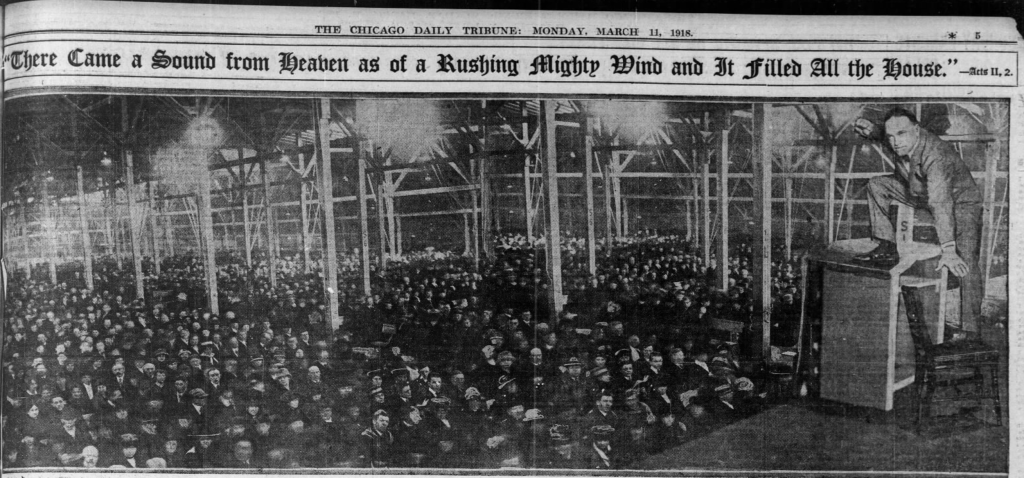
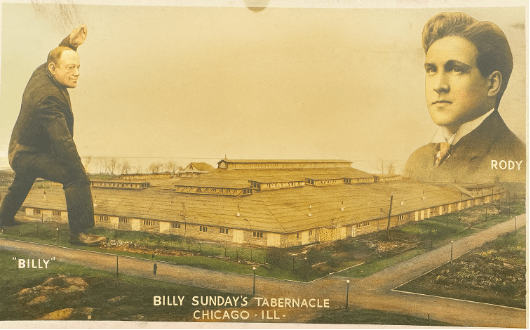
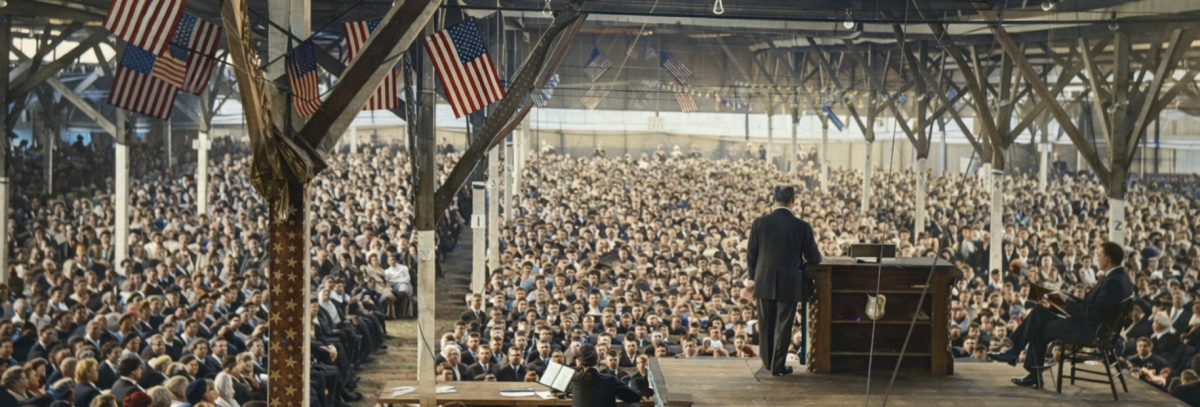
Billy Sunday told about 9,000 persons who attended his afternoon meeting in the Tabernacle how the “movie” people had offered him a cold $1,000,000 to pose for a film serial. And he told them how he had replied to their offer in this fashion:

“You can’t commercialize my mug for $10,000,000; you’re not going to get any help from me to make a circus of God’s religion. Not on your tintype.”
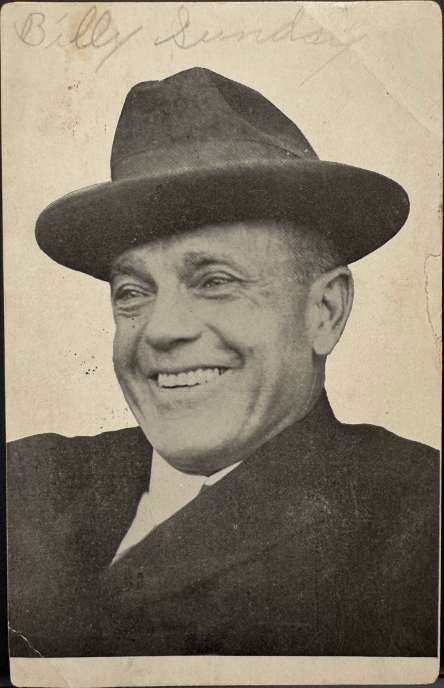
The “movie” reference was injected into Billy’s remarks through the presence of several “movie” cameramen at the Tabernacle just before he came into the building. They tried hard to “slip one over” on Billy and catch him as he got out of his limousine and started for the Tabernacle door. “Ma” Sunday, who was with Billy, protected the evangelist from the pointed cameras and pushed him inside the big building.

“Big Hand” for Billy.

The crowd cheered Billy to the echo. On the platform was Mrs. Marshall Field, widow of the noted Chicago merchant, with a party of friends from the Windy City. They, too, cheered Billy’s references to the “movie men.”

Billy’s afternoon sermon was chuck full of patriotic references and of slambang punches at “old Kaiser Bill.” And just before he finished it, he asked all those in the big audience who would pledge themselves to give undivided support to the national government in “its hour of need” to stand up. And the entire audience arose. Then he asked for a “Chautauqua salute,” and thousands of handkerchiefs waved over the great auditorium.

Billy took a hard slam at the “knocker,” who, he said, “is always going up and down the land, shouting that we are not prepared and that we should have done so and so long ago.”

“You folks ought to remember,” shouted Billy, “that we have a whale of a job on our hands. But we’ve got a whale of a country and we’re going to put it over. And we don’t propose to unsheath the sword until we have that gang on its knees pleading with Uncle Sam to call off the war.”

In his sermon Billy spoke of the drummer boy in Napoleon’s army who refused to beat a “retreat” when ordered by his commander. He looked squarely into the eyes of about 100 soldiers who were in the Tabernacle and declared loudly: “We don’t know how to beat a retreat either, do we boys? You bet your life we don’t! But we can beat a charge that can dig a grave so deep for that bunch of Kaiser Bill’s hot dogs that they won’t even hear the Angel Gabriel’s horn on the last day.”

The soldiers cheered Billy and the big crowd joined in. Billy emphasized that “we’ve got to scrap as well as play” and he declared that with such a fine army and such a navy as Uncle Sam boasts, there “isn’t a power anywhere in the world that can stand up against it, much less that bunch of cut-throats who would drag their Hohenzollern teachings into the land of the free.”

Billy took a hard rap at the Industrial Workers of the World and declared that if he had anything to do with “that bunch,” they all “would have faced the firing squad long ago.” His sermon was a likening of the Christian workers of the world to the grenadiers of old and the point he emphasized was that Christians everywhere are “fighters for the cause of Christ” in just as much the same sense as are the soldiers fighting now the cause of the allies.
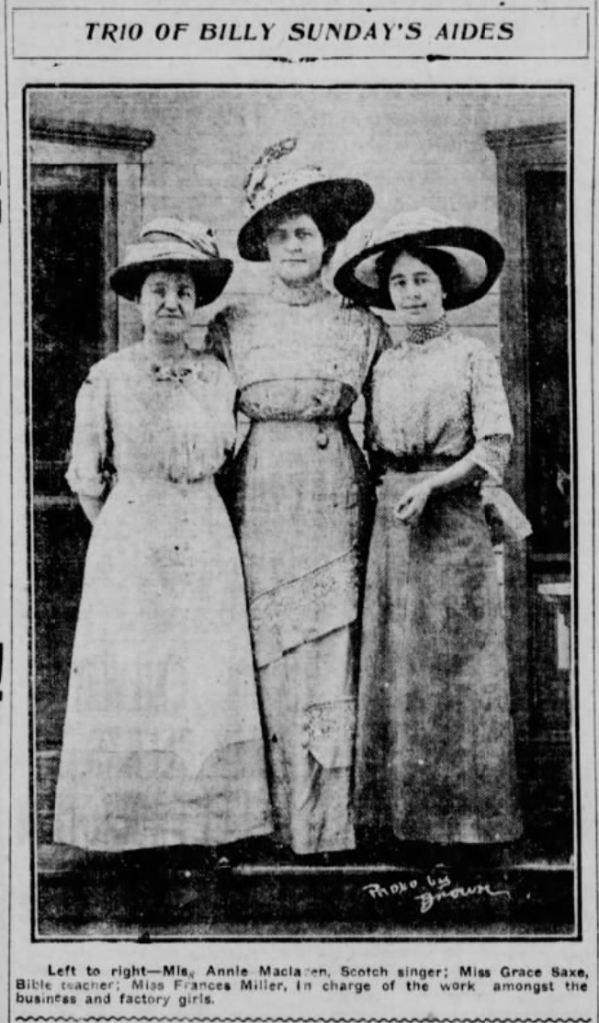
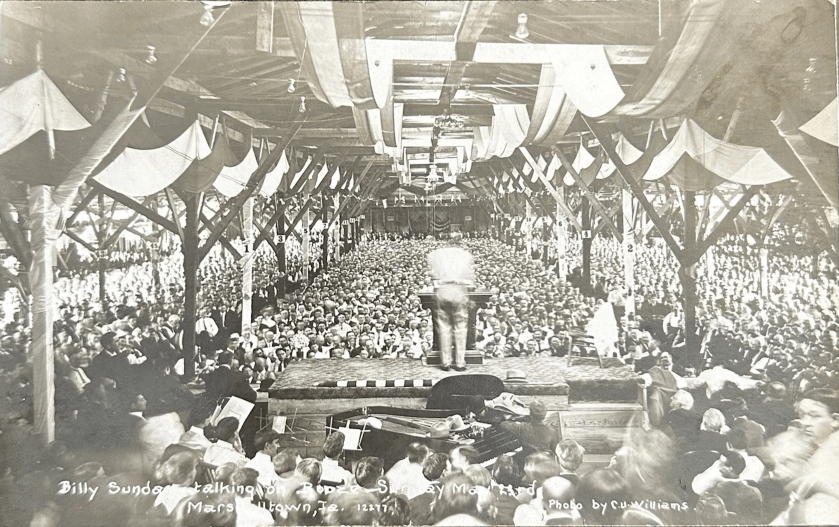
Billy is for the women; sure, give them a vote, 1918

In 1918, Billy Sunday stepped into one of America’s most divisive debates — women’s suffrage. What drove him? What can we learn from that boldness?

A century later, his words still challenge us to consider what moral courage looks like in public life today.

This original 1918 newspaper article captures Billy Sunday’s public support for women’s right to vote. At a time when the nation was debating suffrage, Sunday’s words reveal both his moral clarity and his ability to speak into civic life with conviction and wit.

The Washington Herald. Jan 9

Evangelist Says He Favored Proposition Long Before It Became a Fad. To Open Suffrage Session With Prayer.

With the vote on the suffrage amendment coming tomorrow, Rev. William A. Sunday is another prominent individual who is taking the opportunity to reiterate his faith in “votes for women.”

In a signed statement which “Billy” Sunday gave Mrs. Lawrence Lewis, of the National Woman’s Party, last night, the evangelist says:

“It is nothing new for me to favor woman suffrage. I have been advocating it for years, even before it became popular. We are living today in a new era. If she is good enough to be our mother and our wife, good enough to preside over our home, to care for us in times of sickness and to share our joys and our sorrows, why should she be denied the privilege of voting?

“Today, more nearly than ever before, she bears equally with men the world’s burdens. What would the nations of the earth do without her aid, either in times of peace or war? Women are sharing equally with men the burdens and the sacrifices of this war.

“They are in the munitions factories and in the fields of agriculture and in all other departments of war service. Without their co-operation the war could not be waged to a successful conclusion. As they share in the burdens they should also share in the responsibilities of government.

“I see no reason why the men and women of the nation should not walk side by side in the matters of law enactment as well as in the home and social life.”

Mr. Sunday will offer the prayer at the opening of the House tomorrow when the suffrage vote is take.

<End of newspaper article>

Sunday’s endorsement came just months before Congress passed the 19th Amendment in 1919. His statement offers a glimpse into how revivalists connected moral reform with public policy—a reminder that faith and social conscience have always been intertwined in the American story.

Trail hitters remain firm, say converts. Circa 1918.

When revival calls crowds to the aisle, a critical question follows: “Will that decision endure?” In 1918, after Billy Sunday’s campaigns, journalists followed up with converts and organizers to ask whether the spiritual fervor survived time. The answers—preserved in this article—offer rare insight into how revival might seed long-term change. Read on to see what those trail hitters said, and what it teaches us about lasting faith.

The Washington Herald. Tue, Jan 29, 1918 ·Page 8

TRAIL HITTERS REMAIN FIRM, SAY CONVERTS

Effect of Sunday Revivals in Other Cities Has Been Permanent.

BY ARTHUR JOYCE.

Does ‘trail hitting’ at Billy Sunday campaign meetings show any permanent results? Are those persons who walk the sawdust aisles over at the Tabernacle interested only in formally shaking the hand of the evangelist – or is there something definite behind it all?

Thousands who have seen approximately 6,000 persons ‘hit the trail’ at the Tabernacle in this city are asking these questions. And about the only way in which they can be answered with any degree of accuracy is to look over the field where the evangelist has campaigned and see what’s the situation a year or two following the campaigns.

I recently had a talk with two influential representatives of cities in which Billy has campaigned and I put the questions to each of them. One is Gen. C. Edward Murray, quartermaster general of New Jersey, the other is Lucius L. Jeddy, head of the Merchants National Bank, of Syracuse, N.Y. Both were Billy Sunday ‘trail hitters’ – Gen. Murray in Trenton, N.J., and Mr. Eddy in Syracuse.

Big Sunday Club.

Gen. Murray is president of the Billy Sunday Club, of Trenton, an organization of ‘trail hitters’ formed after the evangelist’s Trenton campaign. That club now has a big membership and every member in it is personally interested in leading others to Christ.

‘The campaign in Trenton,’ said Gen. Murray, ‘awakened a remarkable interest in Christian work, especially among the men and women who ‘hit the trail.’ Churches have increased their membership to a remarkable extent; booze joints that keeled over; Sunday schools are crowded and everywhere there is shown a wonderful interest in things religious. I know many noted men who have passed up the cigars and joined the church and I know of one politician who formerly represented the booze interests, who has been converted and is now an active election on an anti-booze ticket.

‘On the whole, I should say that the Sunday campaign in Trenton has done more to evangelize the city than any other one happening in recent years. And I’m satisfied that the men who ‘hit the trail’ are still going right with the Lord and are doing their best to lead the aisles for Christ.’

Mr. Eddy told of the workings of the Billy Sunday Club in Syracuse. Every member of the organization was a ‘trail hitter’ and in the last two years, he said, they have led more than 20,000 men to Christian lives.

‘The ‘trail hitters’ not only themselves ‘stuck to their declarations to stand on God’s side,’ said Mr. Eddy, ‘but they’ve inaugurated an active campaign to bring others into the fold. And if that doesn’t show the permanency of ‘trail hitting’ I’ve lost my guess.’

Senator Vardaman, of Mississippi, made the statement that if the evangelist shall win only one person to Christ in his Washington campaign, ‘we will have been well repaid for our efforts in the revival cause here.’

In Philadelphia – three years after the Sunday campaign – there is a ‘trail-hitting’ organization in virtually every church where the evangelist assisted in the revival. There are probably 7,000 members enrolled in these organizations, and they’re campaigning every day to bring others to the church.

In Scranton, Pa., one church added 2,000 members to its rolls within six months after the Sunday campaign. Another Scranton church increased its enrollment by 1,000 in a year following the campaign. The same is true of the churches in Wilkes-Barre, Pa., and in Carbondale, Pa., churches.

In Wichita, Kan., three men of national reputation have been converted who call ‘gospel teams.’ These ‘teams’ go about the country and work in the Middle West to preach the gospel and tell of the wonderful work Billy Sunday did in their campaigns. Out of these teams has been formed a National Federation of Gospel Teams’ which are made up of leading men throughout the country – all of whom are either ‘trail hitters’ at Sunday meetings or are in the church as a result of the work of ‘trail-hitters’ who have taken up personal work. These teams have a record of 11,000 conversions to their credit.

Don’t All Stay.

Detroit has a ‘trail-hitters’ club’ of nearly 1,000 members; Los Angeles has one with about 500 men on its rolls; Atlanta has just finished organization of a Billy Sunday Club with several hundred members. And in virtually every city and town where the evangelist has campaigned there are similar organizations continuing the work Billy began. Nearly every ‘trail hitter’ in these places has associated himself with these clubs.

Of course, every person who ‘hits the trail’ isn’t a sticker. But records made by Sunday party experience year after Billy’s campaigns in leading cities show that approximately 85 per cent of those who ‘walk the aisles’ represent permanent converts.

The object of the ‘trail hitting’ is not only to bring to the ‘front’ in a public confession of faith those who have been more before taken any stand in the matter. Billy’s ‘invitations’ are intended to induce the church members to ‘reconsecrate’ themselves and ask to be more earnest Christian life from those who have already ‘accepted’ Christianity.


Legacy & What It Means
This article offers more than historical curiosity: it reveals Sunday’s conviction that conversion must stick. His method didn’t end with a call to the front — it extended into communities, clubs, and networks of believers committed to nurturing change.

Application for Today
In contemporary ministries, it’s easy to emphasize decisions without long-term follow-through. What lessons does Sunday’s model offer us? Perhaps this: revival without discipleship is incomplete.

Reflection & Invitation
If “trail hitters” in 1918 were expected to keep walking, not wander off, who in your context needs that same encouragement today? How will the faith you ignite be sustained, multiplied, and anchored in life?

Rev. J.S. Ladd on Billy Sunday, 1918

I believe profoundly in Mr. Sunday, in the purity of his motive, in the truth of his purpose, the sincerity of his aim, and the transparency of his ambition. He undoubtedly has a divine commission to preach the gospel and the people hear him gladly. Mr. Sunday has a remarkable personality. It is one of his big assets. He is in possession of that undefinable something, the influence of which men feel but cannot explain.

I believe that in Chicago Mr. Sunday’s personality will count for more than in other cities because it has a fuller chance to come to the fore, coming back, as he does, to his home city, the city of so many pleasant associations and sacred memories.

Chicago Tribune. Mon, Mar 18, 1918 ·Page 4

$10,000 Raised In Ten Minutes for Negro YMCA – Atlanta 1917-1918

“Atlanta, Jan. 1.—Ten thousand dollars raised within ten minutes by white citizens of Atlanta yesterday assures the negroes of this city success in completing their Y.M.C.A. building. The white people are pledged to raise another ten thousand if necessary. A fifty thousand dollar fund was needed to obtain the gift of $25,000 from Julius Rosenwald. C.W. McClure made a donation with the statement that the friendly relations between the whites and the negroes were better than ever since Billy Sunday preached to both.”
Jan 1 paper

In the waning days of 1917, as Atlanta turned the page to a new year, a remarkable act of interracial philanthropy unfolded that would leave a lasting mark on the city’s history. Newspapers reported that ten thousand dollars had been raised in just ten minutes by white citizens of Atlanta to help fund a new YMCA building for the city’s Black community. The drive was part of a larger campaign to secure a matching gift of twenty-five thousand dollars from Julius Rosenwald, the Sears, Roebuck & Co. magnate whose generosity was transforming African American education and social life across the South. Local businessman C.W. McClure, who helped spearhead the effort, remarked that the relations between whites and Blacks in Atlanta had improved markedly since evangelist Billy Sunday had preached to both communities during his campaign there.

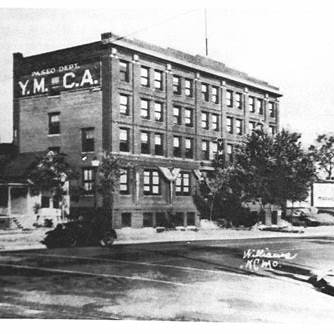
The fruits of that campaign materialized in the Butler Street YMCA—known in its day as the “Negro Y.” Built between 1918 and 1920, the new structure rose in the heart of the Sweet Auburn district, the beating center of Black enterprise and culture in Atlanta. The project followed Rosenwald’s signature pattern: a challenge grant that required local citizens—both white and Black—to raise the balance. The local enthusiasm kindled by Sunday’s revival evidently carried over into civic generosity, helping to meet the $50,000 goal needed to unlock Rosenwald’s contribution.

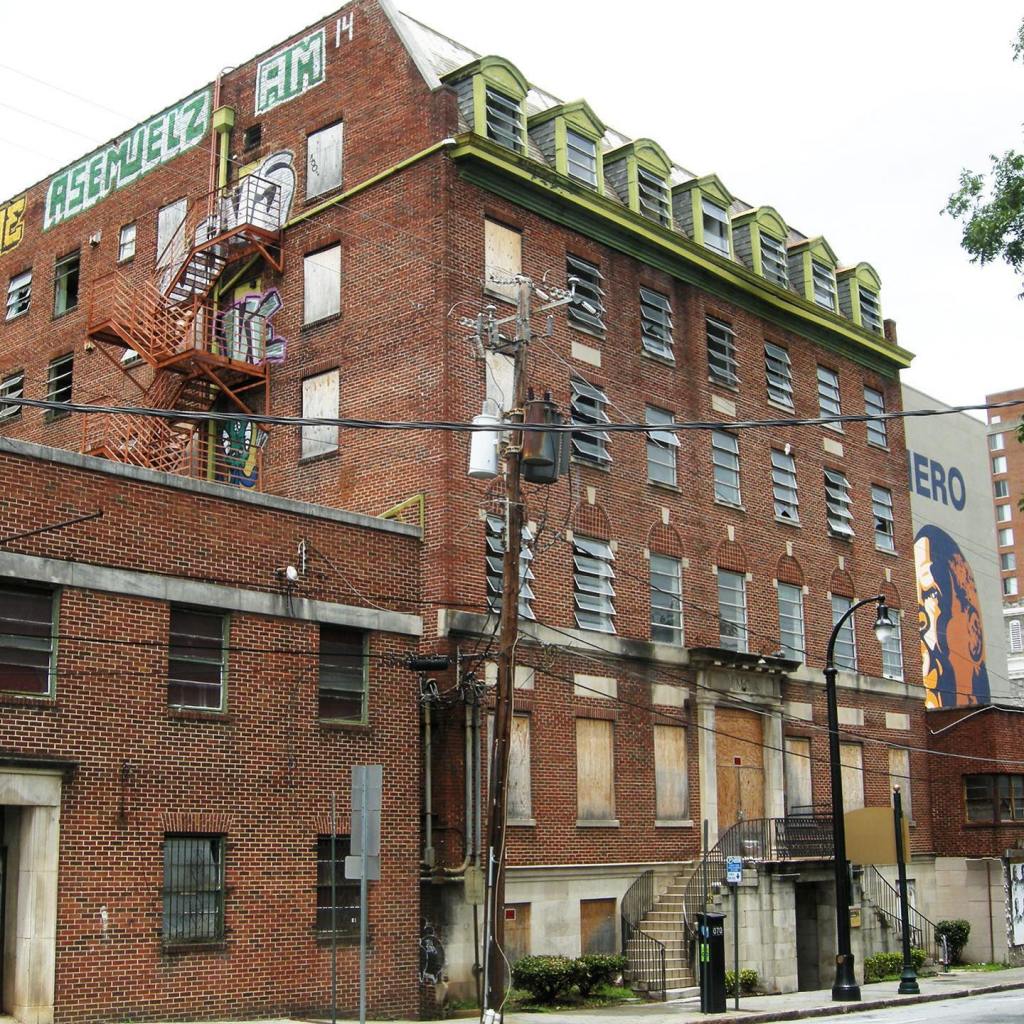
The Butler Street YMCA quickly became one of the South’s most important centers of African American life. Designed by the firm Hentz, Reid & Adler and built under the direction of Black contractor Alexander D. Hamilton, the facility was impressive for its time—three stories of brick and stone housing a swimming pool, gymnasium, dormitories, meeting halls, and classrooms. It provided a wholesome environment for young men seeking moral and social uplift in a city that offered them few such spaces.

More than a recreational facility, the Butler Street Y grew into a cornerstone of civic and spiritual leadership. Over the decades it came to be known as the “Black City Hall” of Atlanta, hosting meetings that shaped the course of civil rights and community advancement. Figures such as Martin Luther King Jr., Maynard Jackson, and Vernon Jordan would later pass through its doors. The Y stood as a living emblem of what cooperative goodwill and faith-inspired philanthropy could achieve during an era when segregation still divided the city.

The 1918 campaign that launched the Butler Street YMCA was more than a fundraising victory. It was a moment when revival energy turned outward—when the social conscience stirred by Billy Sunday’s preaching translated into practical generosity. In helping to fund the YMCA, the people of Atlanta built not only a structure but also a bridge between communities, one that carried forward the spirit of reform, service, and reconciliation that Sunday’s message had kindled. The Butler Street Y remained for nearly a century a monument to that brief but luminous cooperation—a place where faith met action and where the legacy of revival took tangible form in brick, mortar, and hope.

Butler YMCA, image from their Facebook page

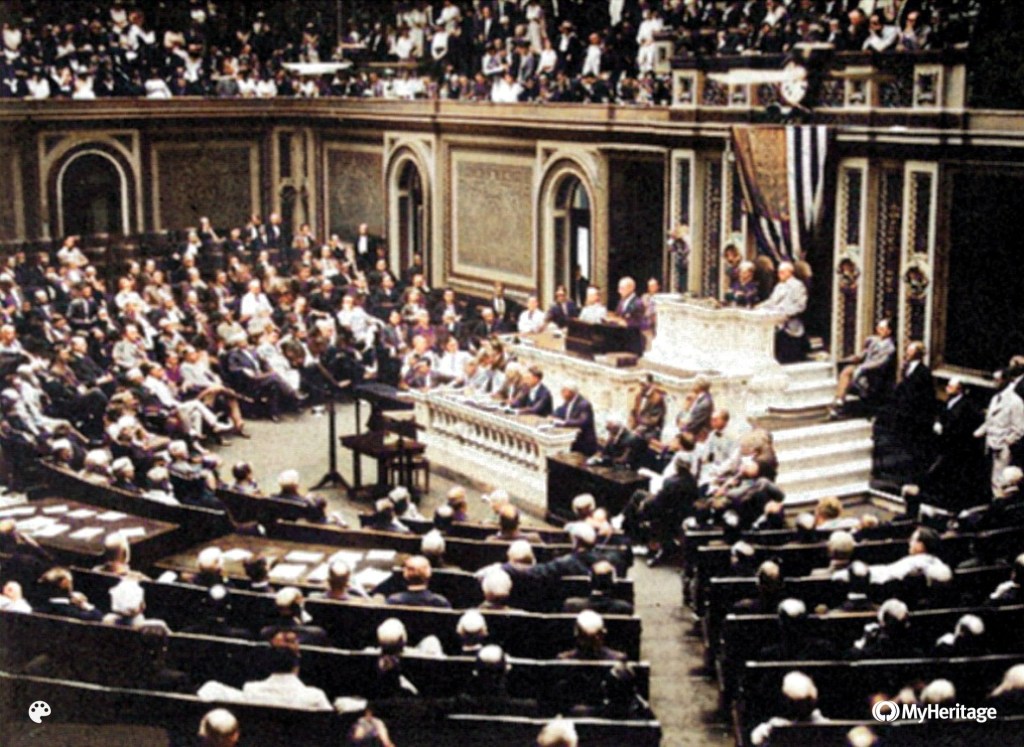
Billy Sunday’s prayer in the House of Representatives, Jan 10, 1918

Advertiser (Adelaide, SA : 1889 – 1931), Saturday 23 March 1918, page 7

The U.S. House of Representatives, 1918. Colorized by author.

BILLY SUNDAY’S PRAYER.

CHEERED IN PARLIAMENT.

Billy Sunday prayed in the House of Representatives at Washington on Thursday, January 10, and was applauded at the close of his appeal. Mr. Champ Clark, Speaker of the House, extended the invitation to Mr. Sunday to take the place of the regular House chaplain. Mr. Sunday, in his prayer, verbally assailed the Germans, and invoked the aid of Divine Providence to help the President, the Secretary of War, and Congress to defeat Prussianism.

“We thank Thee that we are Americans,” prayed the evangelist, ‘”and live beneath the protecting folds of the Stars and Stripes. We thank Thee, that Thou canst look over the battlements of glory on our land and see that there is not one stain on any star or stripe. We thank Thee for our happy homes. We thank Thee for our wives and little ones. We thank Thee for the fruitful trees and bountiful harvests. We thank Thee that as a nation we have never gone to bed  hungry, or scraped the bottom of our flour barrel, and we pray for Thy continued mercy and blessing.

Most Infamous Nation in History.

“We pray that Thou wilt forgive our transgressions and blot out our iniquities. Thou knowest, O Lord, that we are in a life-and-death struggle with one of the most vile, infamous, greedy, avaricious, bloodthirsty, sensual, and vicious nations that ever disgraced the pages of history.

‘”Thou knowest that Germany from the eyes of mankind has wrung enough tears to make another sea; that she has drawn blood to redden every wave upon that sea; that she has drawn enough shrieks and groans from the breasts of men, women, and children to make another mountain.

‘”We pray Thee that Thou wilt bare Thy mighty arm and strike that great pack ot hungry, wolfish Huns, whose fingers drip with blood and gore. We pray Thee that the stars in their courses and the winds and waves may fight against them.

“We pray Thee that Thou wilt bless our beloved President and give him strength of mind and body and courage of heart for his arduous duties in these sorrow laden, staggering days. We pray Thee to bless the Secretary of War and the Secretary of the Navy, and bless, we pray Thee the Navy Strategy Board. Bless we pray Thee, the generals at the head of our army and the boys across the sea. somewhere in France, and bless those protecting our transports, loaded to the water’s edge with men and provisions.

Prays for Allied Victory- ‘ “Bless our boys at home who are in ‘ cantonments. Bless, we pray Thee, this Senate and House, and give them wisdom and strength, for they seem to have come into the kingdom for such a time as this.

“‘And, Lord, may every man, woman, and child from Maine to California, from Minnesota to Louisiana, stand up to the last ditch and be glad and willing to suffer and endure until final victory sha’ll come. Bless our Alliée, and may victory be ours. And in Thy own time, and in Thy own way, we pray Thee that Thou wilt release the white-winged dove of peace until it shall dispel the storm and clouds that hang lowering over this sin-cursed, blood-soaked, and sorrowing world, and when it is all over we will uncover our heads and lift our faces to the heavens ‘ and ring with a new meaning

“‘My country, “tis of thee, sweet laud of Liberty.

” Of thee I sing.’

“‘And the praise shall come to Thee forevermore through Jesus Christ. Amen.”

The House broke into instant applause at the ending words of the prayer. Many members crowded around the evangelist, and shook hands with him, and an in-formal reception was held in the lobby.


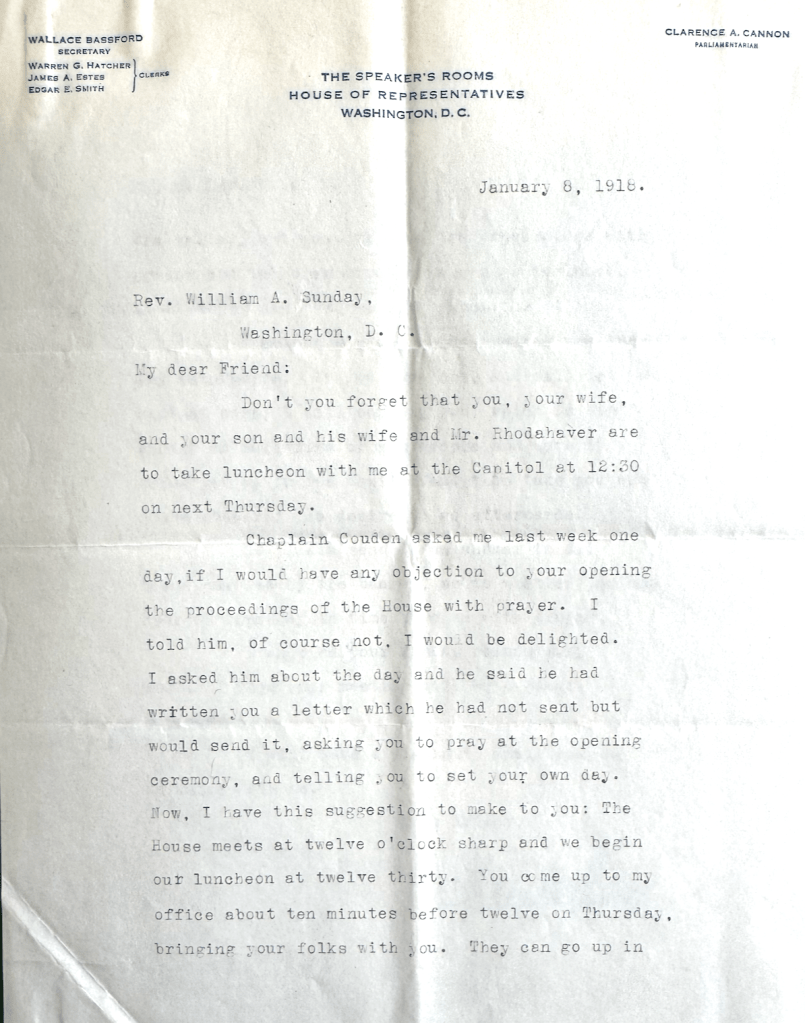
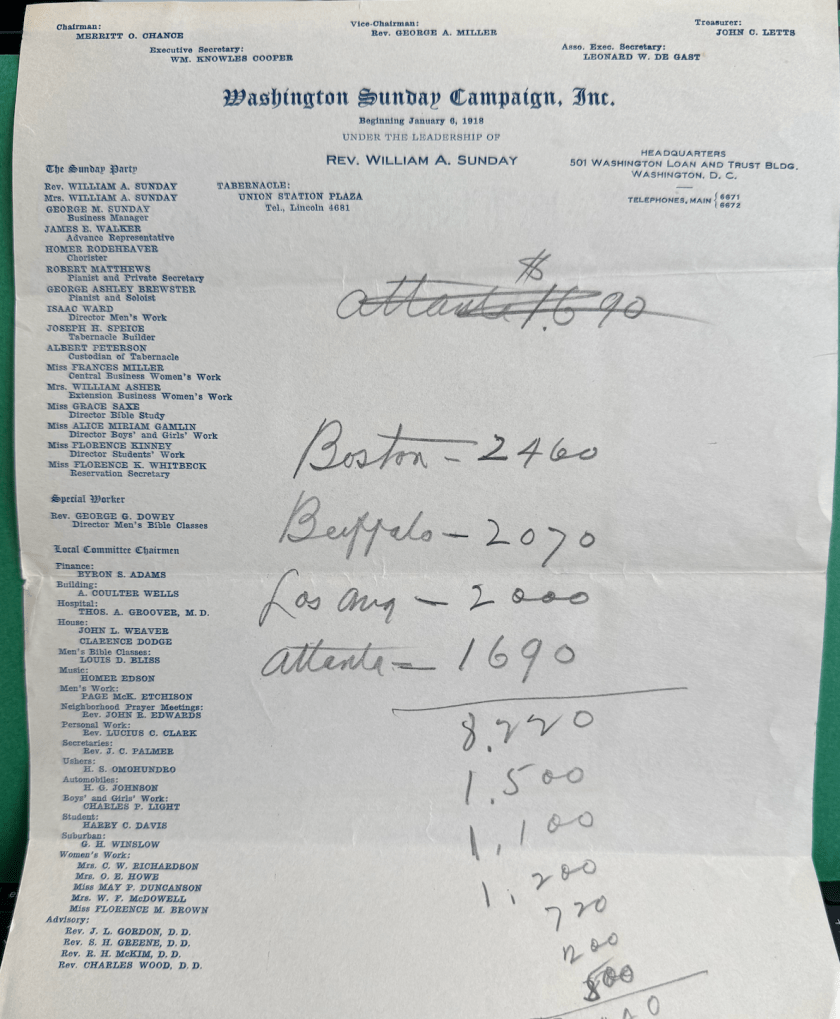
The Billy Sunday archives at Grace College in Warsaw, Indiana have the following related artifact in their archives. He seems to have spoken at Union Station Plaza, starting January 6, 1918.

Champ Clark (James Beauchamp Clark, 1850–1921) was a prominent American politician and leading Democrat in the early 20th century. By 1918, he was near the end of his long and distinguished career in the U.S. House of Representatives, which he had served in almost continuously since 1893.

Transcription of above letter:

WALLACE BASSFORD, SECRETARY

THE SPEAKER’S ROOMS
HOUSE OF REPRESENTATIVES

WASHINGTON, D.C.

January 8, 1916.

Rev. William A. Sunday,

My dear Friend:

Don’t you forget that you, your wife, and your son and his wife and Mr. Rodehever are to take luncheon with me at the Capitol at 12:30 on next Thursday. Chaplain Couden asked me last week one day, if I would have any objection to your opening the proceedings of the House with prayer. I told him, of course not. I would be delighted.

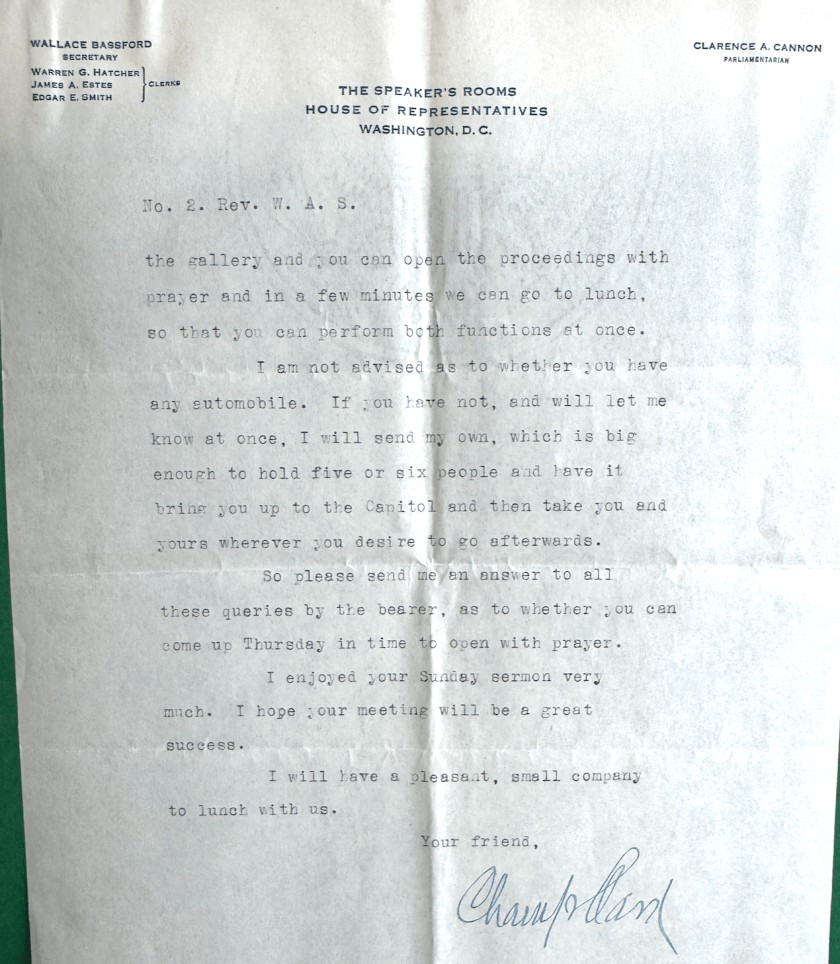
I asked him about the day, and he said he had written you a letter which he had not sent but would send it, asking you to pray at the opening ceremony, and telling you to set your own day.

Now, I have this suggestion to make to you: The House meets at twelve o’clock sharp and we begin our luncheon at twelve thirty. You come up to my office about ten minutes before twelve on Thursday, bringing your folks with you. They can go up in the gallery and you can open the proceedings with prayer and in a few minutes we can go to lunch, so that you can perform both functions at once.

I am not advised as to whether you have any automobile. If you have not, and will let me know at once, I will send my own, which is big enough to hold five or six people and have it bring you up to the Capitol and then take you and yours wherever you desire to go afterwards.

So please send me an answer to all these queries by the bearer, as to whether you can come up Thursday in time to open with prayer.

I enjoyed your Sunday sermon very much. I hope your meeting will be a great success.

I will have a pleasant, small company to lunch with us.

Your friend,

Champ Clark

What was a typical evening program like at a Billy Sunday campaign?

Source: The Washington Herald. Tue, Feb 19, 1918 ·Page 8

Tonight’s program at the Tabernacle:

7 p. m.—Overture…Brewster and Matthews

7:05 to 7:15—Selections……………The Choir

7:15—Solo, “We’ll Be Waiting”……..Rody

7:17 to 7:45—Request numbers….The Choir

7:45—Entrance of the star……………Billy

7:45—Selections……………………….The Choir

7:55—Prayer…………………………….A minister

8:00—Requests to audience………….Rody

8:02—Monologue ………………………Billy

9:00—Trail hitting……………………..The Saved

9:10—Prayer and good night.

This program will be repeated by request every evening this week and next, excepting Monday.

Billy Sunday was sued in 1918 about his book “Great Love Stories of the Bible.”

The Echo, Buffalo, New York

Thu, May 02, 1918 ·Page 1

ANOTHER SUIT AGAINST THE “REV.” BILLY SUNDAY

Man Who Wrote Book for Him Sues for $100,000 for Breach of Contract.

The Rev. William A. Sunday, the evangelist, was sued in the New York City Supreme Court last Wednesday by Hugh C. Weir of New Rochelle to recover $100,000 for breach of a contract, under which Weir alleges he wrote the series of “Great Love Stories of the Bible,” which appeared with Billy Sunday’s name as the author. Weir also alleges that under the agreement with Sunday he was to write “Billy Sunday’s Own Story,” and another series based on the Bible.

Weir says that he was to get 50 per cent. of the royalties on all the books except “Great Love Stories of the Bible,” for which Sunday got 60 per cent., out of which he was to pay 10 per cent. to a Bible historical authority for proofreading. Sunday was to advance $5,000 to Weir and collect out of the latter’s share of the royalties. The plaintiff also alleges that Sunday agreed to arrange for the sale of the books at all his meetings.

The complaint alleges that although a contract has been made with a reputable house for the publication of the books the evangelist has repudiated his agreement in all respects.

Mr. Sunday has served his answer in the suit, in which he admits that Weir collaborated with him in writing “Great Love Stories of the Bible,” but denies that he has broken any agreement made with Weir

Billy Sunday’s Theology (c 1918)

The Duluth News Tribune. Thu, May 02, 1918 ·Page 8

Billy Sunday’s Theology

WE ARE for Billy Sunday.

There are a lot of people sincerely worried because his specially built tabernacle is to cost $25,000 when money is needed for the war. There are others who worry because holes have been dug in the courthouse lawn.

Others fear that, aroused by the impassionate William, a good many people on that last day of his visit may add to his wealth. A still larger number do not like his brand of theology and rebel at his salvation processes.

But it is a fact that most folks, if they did not worry about one thing would worry about some others. The building salvage will be considerable for the tabernacle; the grass will grow again, and no one who does not wish to do so need give a cent to Billy or even go to hear him. It is all free will, not foreordination.

Moreover, there is a psychology in giving. The money he gets from his hearers would not go to any other cause; no one else could get it, and he does not destroy it. As a matter of fact, war work will get more through his coming. He himself gives liberally to every war cause and then buys Liberty bonds. But besides this, he finds the combination to purses that no one else can open. He creates and strengthens the spirit of giving.

The more any community gives, the easier it is for it to give, and this goes on increasingly. Billie knows this and for himself only asks the last day’s collection. He takes his chance, and if he gets more or less, he earns it. He works six weeks for the result, and leaves behind this greater willingness to give.

Billy Sunday certainly has one brand of theology we like. He has a religion to which we respond. He has a gospel which needs to be preached here, as everywhere. This is the theology, the religion, the gospel of Americanism.

He preaches it with unequalled force and vigor. He drives it home with a club. He has no more doubts as to it, as great a faith in it as in his old-fashioned brand of Christianity. He does not quibble, nor apologize, nor temporize, nor emasculate as to either.

Tens of thousands will go to hear him. He will have many thousands no one else can reach or attract. They will all hear this gospel of Americanism, not just preached, but driven home and spiked down. He has exactly the methods needed to accomplish the result.

Thousands who hear him may be no better Christians afterwards, or may backslide in the niceties of Christian conduct, but what is much the same thing today as is the unwavering, unquestioning Christianity he preaches, they will all be better Americans and that will stick. He takes doubt as to this war, as to its righteousness and our common duty in supporting it, and scalps it, leaving not a hair of its camouflaged head to comfort or conceal an ingrowing brain and conscience.

If for no other reason than this, we are for Billy. We do not it would be money well spent to arouse the people of all this section to their obligations just as citizens. He is the best recruiting agent, the best antidote for the slacker, the best seller of Liberty bonds, the best promoter of war giving and the most inspiring sledgehammer of unadulterated Americanism this country has produced. If for no other reason, we are for Billie Sunday. We do not care what his other theology is, his American theology is right and it is needed. We will all be better citizens, more loyal, more un- selfishly patriotic, more willing to give what is dearer than our own lives, for his coming.