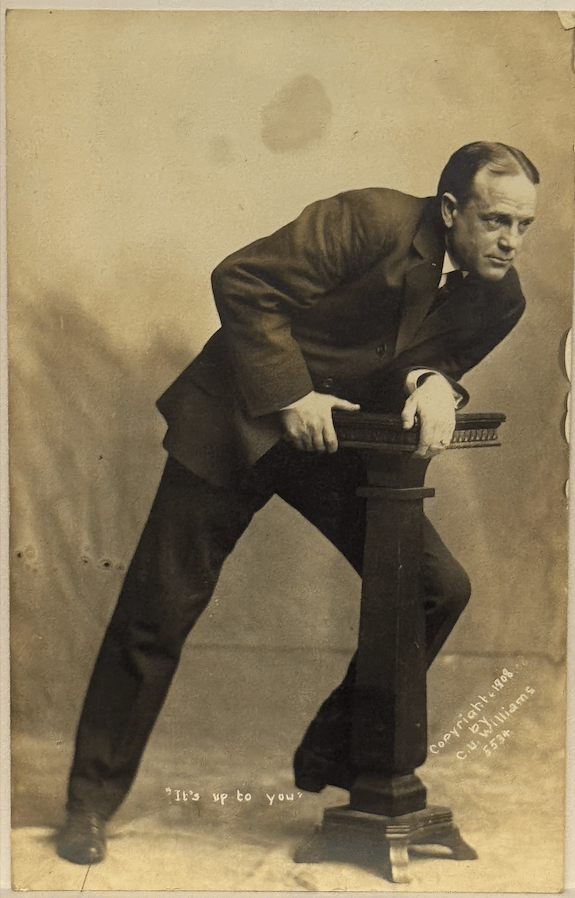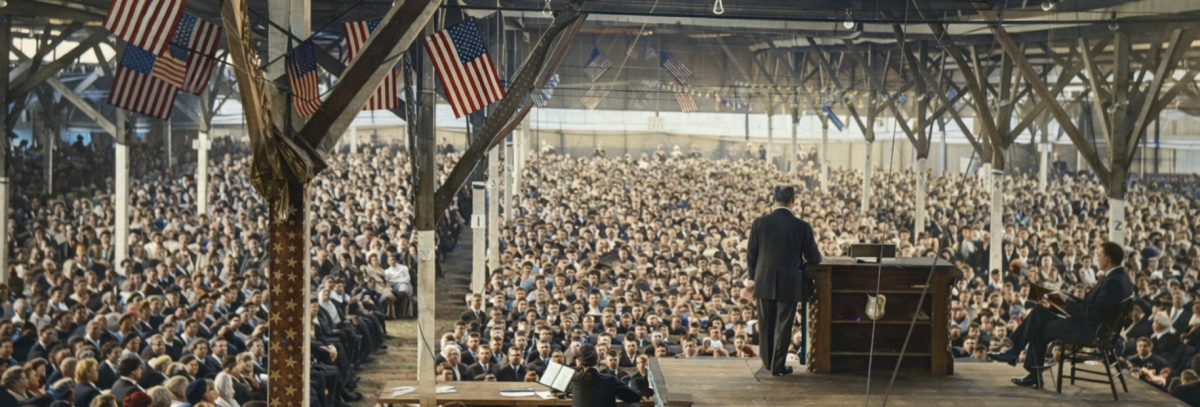
Winona Lake hosted a summer chatauqua assembly in the summer of 1913

Citation: The South Bend Tribune. Fri, May 16, 1913 ·Page 2

WINONA PLANS FOR GREATEST SUMMER

MANY CONVENTIONS ARRANGED FOR THE SEASON.

BIBLE SESSION FEATURE

William Jennings Bryan, David Lloyd George, Gipsy Smith, “Catch-My-Pal” Patterson and Others Will Speak at Gathering.
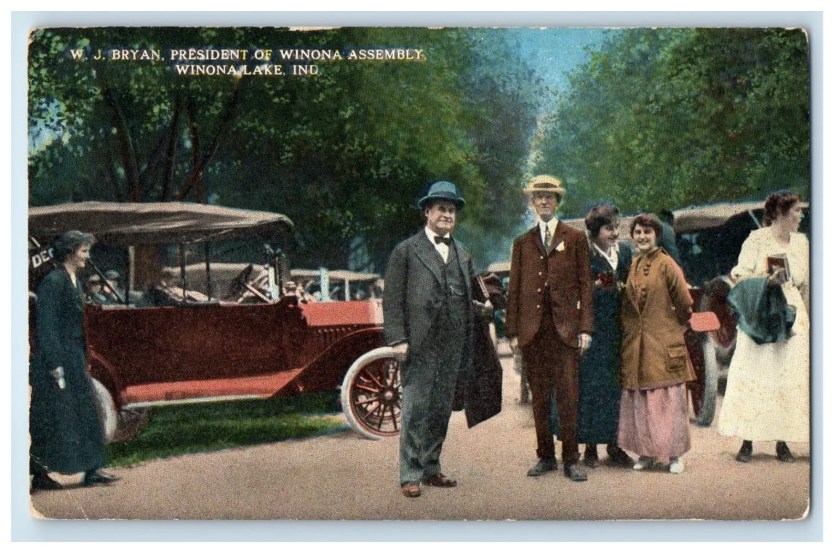
William Jennings Bryan. President of Winona Assembly. Winona Lake, Indiana.

The Tribune’s Special Service.

WARSAW, Ind., May 16.—Winona assembly, which will operate this season free from its load of debt, having arranged for the settlement of $300,000 claims by an agreement with the creditors, has prepared for a program of events that will establish a new record. One of the biggest events of the year will be the annual conference of the Church of the Brethren, which will start May 28 and continue until June 7. Between 40,000 to 75,000 churchmen are expected to attend.

The chautauqua program will start June 29 and will continue for 10 weeks. Among the spectacular offerings are the following: Ahasuerus, a sacred opera under the direction of William Dodd Cheney; “The Lost Princess,” under the direction of Mrs. Hortense R. Reynolds; Venetian night, and a great water carnival under the direction of Capt. J. R. Pine. Preparations for the latter event are already under way.

Will Hold Mission School.

Some very notable gatherings are booked to occur during the chautauqua season and at its close. Beginning June 19 and ending June 27, the summer school of missions will be in session. This will be held under the auspices of the interdenominational committee of the assembly. The summer conference of the Presbyterian young people will be held July 9 to 16. The annual meeting of the Ohio Farmers’ Insurance company will be held July 23 and 24. The Health and Happiness club with Mrs. Louise L. McIntyre and Miss Margaret Hall as directors, will be in session July 7 to 14.

The fourth annual conference of the Young Friends of America will be held during the assembly season. The fourth annual session of the international district training school for Sunday school workers will be held Aug. 11 to 21. The Kappa Sigma Pi, the new boys’ movement which was established in 1912 by Homer Rodeheaver, conductor of music for Rev. Billy Sunday, will be in session during July. W. M. Collisson will act as secretary and will be in charge.

Photographers Will Meet.

The 18th annual convention of the Indiana Association of Photographers will meet July 7 to 10. This will be held under the auspices of the National Reform Association. Among the speakers are Dr. James S. Martin, Dr. Lyman E. Davis, Dr. Grant W. Bower, Dr. James McGraw, Ng Poon Chew, of China, Dr. Merle de Aubing, of France, Dr. Armenag of Turkey, and Dr. R. J. Patterson, of Ireland.

One of the big events will be the annual Bible conference, which will be held Aug. 22 to 31. Dr. Sol C. Dickey will be director. He is already busy arranging for the meetings which will bring churchmen here from all parts of the world. Prof. E. O. Excell will have charge of the music and Rev. W. E. Biederwolf will be the assistant director. The opening address will be by Secretary of State William Jennings Bryan, who will also be president of the board of directors of Winona assembly to welcome the visitors. Among the other speakers already engaged are Rev. C. Campbell Morgan, of London; Rev. Gipsy Smith, of Connecticut; Rev. Robert (Catch-My-Pal) Patterson, of Belfast, Ireland, and Hon. David Lloyd-George, chancellor of the British parliament.

The South Bend Tribune. Fri, May 16, 1913 ·Page 2
Billy Sunday favored women’s suffrage.

BILLY SUNDAY IS FOR SUFFRAGE FIRST, LAST AND ALL THE TIME

Woman suffragists ought to like Billy Sunday.

“Do you favor woman suffrage?” he was asked the other day.

“Why not?” he hurled at the reporter just as though the latter were an “anti.”

“I don’t know,” murmured the representative of the press, in a tone measured to encourage Mr. Sunday to a further discussion of the subject. And Mr. Sunday was quite willing to talk about it. And talk he can on any subject.

He launched into one of the most picturesquely worded and one of the most emphatic indorsements of woman suffrage that its most ardent supporters could ever wish to have, “Why shouldn’t women have the franchise? They are as worthy of it as the men,” was the substance of what he said.

There are 6,000,000 women and girls working for a livelihood in this country, he statistically declared to the reporter.

He urged that the working woman fills an important place in the industrial and business life of the country.

“Take them out of the offices, mills, factories and stores, and you’ll miss them quickly enough.” These 6,000,000 women so engaged were advanced as one of Mr. Sunday’s reasons for granting the franchise to women.

All an interviewer of Mr. Sunday can hope to do is to get impressions. In answering one question he said enough interesting things on the equal suffrage question to fill a small volume. He invented enough aphorisms and sprung enough epigrams to make an issue of Elbert Hubbard’s Philistine look like a mere sample package.

If you go to interview Mr. Sunday take the best stenographer in the state with you. No, take two or three. Mr. Sunday uses words with exceeding celerity. He confessed that he could use as many as 350 a minute. The interviewer gained the impression that he was trying to break the speed limit yesterday.

“There’s only one stenographer I have known who could get my speeches in full,” he said, “and he missed one word in ten.”

The South Bend Tribune. Thu, May 15, 1913 ·Page 9

Poem: Hit the Trail

“HIT THE TRAIL.”

BY J. ANDREW BOYD,

Wilkes-Barre, Pa.

Mister Man, it’s up to you To “Hit the Trail;”

If you’d show that you are true,

Just “Hit the Trail,”

Some will laugh, and some will jeer,

Some will point at you and sneer,

But be brave and never fear,

Just “Hit the Trail.”

If you want to start out right,

Just “Hit the Trail,”

To fight the devil with your might,

Just “Hit the Trail,”

Walk up like a hero brave,

Prove your soul you want to save,

Let old Satan rant and rave,

Just “Hit the Trail.”

You will need a courage high

To “Hit the Trail”;

Say, “I’ll do it if I die,”

So, “Hit the Trail”;

Grasp the preacher by the hand,

For the right then take your stand,

Join the brave and happy band,

And “Hit the Trail.”

The South Bend Tribune. Thu, May 15, 1913 ·Page 8

Did Billy Sunday have more than one copy of his sermons?

TO HAVE SERMONS DEPOSITED IN VAULT

BILLY SUNDAY GOING TO TAKE PRECAUTION AGAINST FIRE.

Citation: The South Bend Tribune. Tue, May 13, 1913 ·Page 7

Just Now, Evangelist Has No Duplicate Copies of His Famous Addresses—Ackley Does Work.

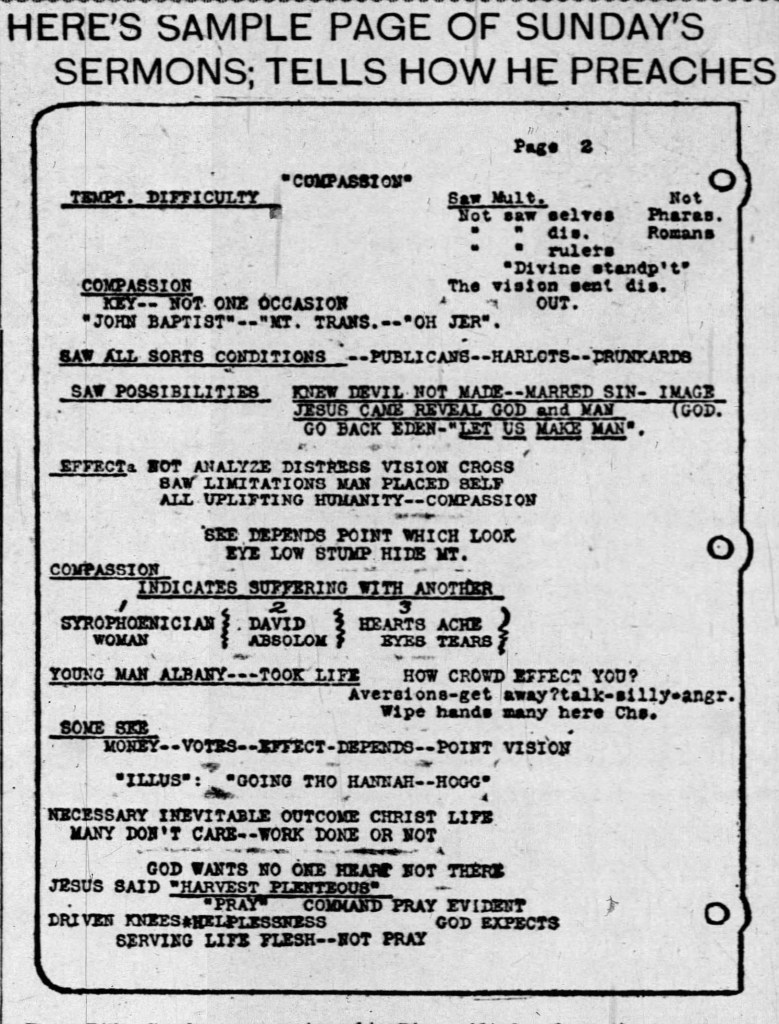
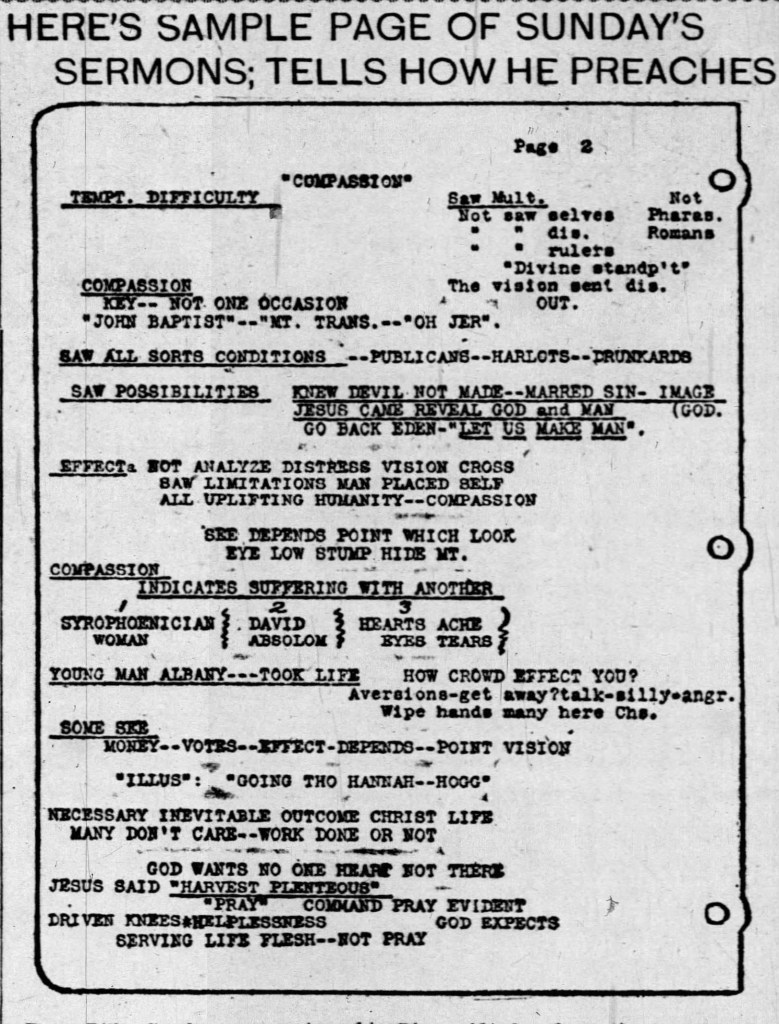
“No, I have only the one copy of each of my sermons,” replied Billy Sunday to a question as to whether he had duplicates of his sermons.

“These sermons are not in full,” continued the evangelist, as he showed the books in which he keeps the addresses that sway so many thousands; “they are just mere skeletons of the sermon and no one else but myself can read them, or at least I don’t think that anyone else can.”

Mr. Sunday was asked if he could remember the sermons if they were stolen and he replied that he recalled the majority of the material that composed them. He says that he intends to have duplicates made of the sermons and have them put into a safety deposit vault so that if one is stolen or should be destroyed by fire or in some other manner, he will have a copy.

“I thought at first that I would be able to get them copied this summer,” he said, “but it don’t look like the work will be accomplished, as I have so much to do this year.”

B. D. Ackley, pianist of the Sunday party, and secretary to the evangelist, copies the sermons of Mr. Sunday. This work takes up quite a bit of the pianist’s time, as Mr. Sunday is continually adding and detracting from his sermons as he acquires new material from many different sources.

“I always let Ackley fix up the sermons. He has a knack for doing things up pretty and nice,” said Sunday, while talking of his work.

“Now, boss, just because we have company you don’t need to make fun of me to my very face. He knows that I can’t fix them right,” said Ackley, as he turned to the visitor.

“That is all right; you do it just to suit me,” replied Sunday.

It is probable that sometime within the next year or so the evangelist will have all his sermons duplicated and deposited in a safety deposit vault.

The South Bend Tribune. Tue, May 13, 1913 ·Page 7

Billy Sunday One Man in Millions, South Bend Tribune, c. 1913

Citation: The South Bend Tribune. Sat, May 10, 1913 ·Page 11

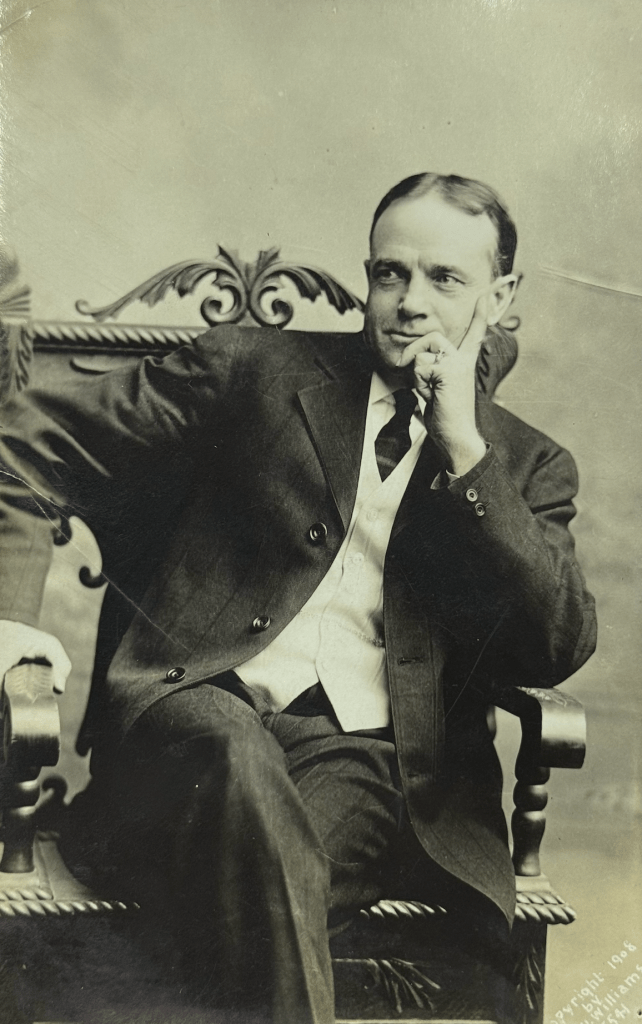
Billy Sunday, 1908. Author’s Collection.

In connection with the coming of Mr. Sunday not a few of us have been guilty of judging the man before seeing him or hearing him. Current reports, like most current reports have been one-sided and unfair. Mr. Sunday’s preaching may have many of the faults upon which hearsay has so extensively dwelt. When one listens to the man, however, one finds these faults largely obscured by the man’s numerous and tremendous excellencies.

That Mr. Sunday is a man of genius, not even his bitterest opponents will dispute. That he is clever and brilliant and witty and eloquent admits absolutely of no question. Not one man in 10,000,000 possesses Mr. Sunday’s enormous powers. The man not only draws the vast audience but what is much more he deserves the vast audiences.

Success Through Ability.

Mr. Sunday ascribes his amazing success to the soundness of his doctrines and the righteousness of his platform. In this, Mr. Sunday is admirably modest. As matter of fact, Mr. Sunday’s success is due not to his doctrines but to his ability. Fortunately his tremendous ability is being devoted to a good cause. Yet the same ability would attract similar throngs no matter what the cause and what the doctrine.

To hear the man makes one think of an Elijah, an Amos, an Isaiah, a Savonarola.

That Mr. Sunday is sincere there exists no real ground for doubting. Hardly would an insincere man be so marvellously effective. Insincerity is the death of eloquence. And Mr. Sunday is superbly eloquent.

Again it is difficult to see just wherein Mr. Sunday would be tempted to be insincere. Men are insincere when they have no other means of gaining their ends. Mr. Sunday does not need to be insincere. Insincerity is the weapon of the weak. Mr. Sunday possesses a Titan’s strength.

Regrettable Feature.

The crudeness and naivete of some of Mr. Sunday’s doctrines may give rise to the suspicion of insincerity. This is indeed perhaps the only thing about Mr. Sunday that need be seriously deplored. His prejudiced attitude toward the high criticism and toward the doctrine of evolution, not to mention his furious attacks upon Unitarianism, Universalism, Christian Science, Spiritualism and other doctrines, coming as they do from a man of his influence, are distinctly regrettable. It is hard to see just what is to be gained by these attacks. Just how the salvation of souls is to be furthered by assaults on this, that or the other doctrine is far from easy to understand.

Still, many a great speaker has had a child’s philosophy. The question has actually been raised whether a broad philosophic vision is compatible with fiery throng-swaying eloquence. The philosopher and the orator rarely dwell together in the same person. It is not unlikely that advanced views in philosophical and theological matters would preclude a man’s burning with white hot ardor. It takes a narrow channel to give a strong current. Broaden and deepen the channel and the current becomes slow and feeble. A large philosophical horizon means, as often as not, a frail and listless propaganda. Therefore there need be no doubt as to Mr. Sunday’s sincerity even though his theological outlook be somewhat contracted. His wonderful effectiveness proves his sincerity.

Money No Object.

The most unjust of all charges brought against Mr. Sunday is that of mercenariness. A man with whom money is an end and aim could not possibly do what Mr. Sunday is doing. If Mr. Sunday derives large sums of money from his activities, it should be remembered that every cent of it is given freely and eagerly by the myriads whose hearts he has stirred. A man of Mr. Sunday’s ability and fidelity is well worth all the money he receives. Considering the work he is doing, several times the sum would not be excessive and undeserved compensation—surely not unnecessary compensation. In view of the energies he expends, Mr. Sunday requires means for adequate rest and recuperation not to mention provisions against premature aging and even death. There was not a little pathos in his intimation a few nights ago that, at the rate he is working, a high old age for him is not probable.

It should be well known by this time that the collections up to the last day of the meetings and some of the collections on the last day go to defray expenses. The very persons who have been disparaging Mr. Sunday for urging liberality of contributions might be the first to censure him as a “dead beat” if, remiss about urging contributions, he should fail to meet his financial obligations.

Rendering Great Service.

Mr. Sunday would be rendering the community an inestimable service if he did no more than bring those magnificent crowds together to listen to that sweet music and to sing those beautiful songs. What a powerful stimulus to the sense of human brotherhood and solidarity when thousands congregate and in unison set their hearts beating to the rythm of holy thoughts harmoniously expressed!

A religious campaign of the kind that Mr. Sunday is leading expresses the progress of democracy more profoundly than any other movement of our day. At the basis of Mr. Sunday’s work is a thought which is the most democratic thought in the world, the thought namely that every soul is worth saving. Beneath the roof of that tabernacle, class discriminations are utterly obliterated. The only possession that counts for anything there is a person’s soul. The Sunday campaign is attended by the earnest realization on the part of thousands that nothing is really good excepting “the kingdom of God and His righteousness.”

Fourteen hundred years ago Saint Augustine said:

“Thou hast made us for Thee, O Lord, and restless is our heart until in Thee it finds its rest.”

Only Kind of Life.

A quickened realization of this truth seems to be the quest of this revival. We of South Bend are coming now to understand better than ever before that the life of exalted thoughts and pure affections and clean conduct and worthy deeds is after all the only kind of life that is worth living.

Mr. Sunday has dedicated his extraordinary talents to bringing home this truth to persons of all classes and of all callings. May there be an abundant harvest from his sowing. May there be “showers of blessings.” May the cleansing torrents of righteousness surge through our community making every life sweet and holy and pure.

The South Bend Tribune. Sat, May 10, 1913 ·Page 11

South Bend Tribune labels Billy Sunday as the ‘Real American Product.’

BILLY SUNDAY REAL AMERICAN PRODUCT

EVANGELIST IS DISCUSSED BY WILKES-BARRE, PA., MAN.

COMPARED WITH OTHERS

Billy Sunday, 1908. Author’s Collection.

Writer in Newspaper Compares Former Baseball Player With Famous Evangelist of Few Year Ago—Does Much Good.

The Tribune’s Special Service.

WILKES-BARRE, Pa., May 9.—Rev. William A. Sunday and his methods have been reviewed from so many angles that it seems difficult even for a veteran to add anything to the sum total of knowledge of this wonderful evangelist, says “G. A. E.” writing for the Wilkes-Barre Record.

Continuing “G. A. E.” who made a careful study of the evangelist while he was conducting his campaign here, says:

“However, as the preachers say, ‘firstly, secondly, thirdly and one word more,’ and this may be ‘finally and in conclusion.’

“Billy Sunday, as we now familiarly term him, stands in a class by himself, and if I compare him with evangelists of other days it is not for disparaging comment or odious comparison. He is peculiarly an American product and becomes immediately at faith with his audiences because of his intense patriotism, his love of the starry flag and his intense belief in the present and future greatness of the United States. He is a paladin of defense.

Sunday Protector.

“No, siree, the devil shall never capture this country so long as Billy Sunday can put up his dukes or raise his voice in protest.

“I have been privileged to hear many great pulpit orators and revivalists both in this country and abroad, among the latter, Weaver, Spurgeon, Booth (before his Salvation army days) Moody, Torrey. Of these for keenness of argument, beauty of diction, fierceness of invective and charm of pathos. I would place Rev. Charles H. Spurgeon in first place, with Gen. W. Booth in the next. But from speech of my mother and grandparents even these giants could not compare with Whitfield, Williams O’Wern, Charles Wesley, Christmas Evans and Rowland Hill. The men I have named were all different in their method, none of them staying long in one place, and their work was largely denominational in character. These men were all successful and their trumpet calls led many to a newness of life.

Orthodox Gospel.

“The story they told and the gospel they preached was the old orthodox one, ‘He that believeth shall be saved, and he that believeth not shall be damned.’ Sunday’s success is in proportion as he sticks to the old doxv and the old ‘Thus saith the Lord,’ but it is worth noting that while the old exhorters emphasized ‘hell fire,’ and ‘fire and brimstone,’ Billy does not add to the agony of those consigned to the place prepared for unbelievers by using those words.

“Mr. Sunday, like Spurgeon and many other successful exhorters, is a voluminous speaker, but not a profound thinker. He has read for dramatic effect, he has skimmed the literature of the English race for illustrations, and is endowed with a slang vocabulary that is simply astounding. He uses his knowledge with such marvelous effect that all who come ‘to scoff return to pray.’ His earnestness, his transparent honesty, carries all his hearers with him and his slang solecisms are all forgotten in his clarion call for repentance, his denunciation of all that is bad, vile and wicked and in his praise of God, home and country.

More Lasting Good.

“The old school of revivalists were of the itinerant class, moving rapidly through the country, their evangelism seemed sudden in its effect and I am afraid somewhat evanescent in its general results. It is just here that Mr. Sunday’s campaign gives promise of more lasting good. His coming has been carefully prepared for, his meeting place is undenominational in character. It is a movement conducted with great business acumen and sound common sense. He trains the ministers and church workers in such a way as to make them capable of caring for the harvest when it comes. Like a good farmer, he prunes the fruit trees with vigor, cuts out all the dead wood and sprays them well to get rid of moths, beetles and canker worms, so that when the new fruit shall ripen it will be sound and beneficial. ‘And the leaves of the trees shall be for the healing of the nations.’ Mr. Sunday is a man endowed with a great faith. He prays for the blessing, he prepares for the blessing, he is sure of getting it and it is therefore no surprise that he is so eminently successful.

Campaign Well Conducted.

“The late revival in Wales was a marvelous spontaneous outburst of religious fervor and roused large sections of the community. It was conducted by a young man named Roberts, who was ill fitted both mentally and physically and he subsequently broke down. Want of well directed effort, want of unity on the part of the churches to look after and care for the converts robbed the movement of much of its success. The converts were left to the mercy of the world, flesh and the devil, and thus the promise of a great and last revival petered out.

“The Sunday campaign is conducted vastly different. It is an old evangel, presented in racy Americanesque speech and run upon up-to-date business principles. The evangelical churches are a unit. It has been aided by the enterprise of the daily newspapers and publicity is given to the religious movement unknown to our fathers. Despite a few doubting Thomases the spirit of success is in the air, for the Wyoming valley is realized that the ‘hour and the man’ glorious religious revival has just passed and the effects of it are to continue.”

The South Bend Tribune. Fri, May 09, 1913 ·Page 7

Billy Sunday souvenirs sold at his revival campaigns

PUBLISHER OF SUNDAY SOUVENIRS IS IN CITY

H. A. Lorberg Will Remain Through Balance of Campaign.

H. A. Lorberg, publisher and dealer in postal cards, portrait buttons and other souvenirs of the Billy Sunday campaign has reached South Bend and will remain in the city throughout the balance of the revival. Mr. Lorberg, who has followed the party for years, has secured quarters at the Y. M. C. A. and will shortly open a place in this city, where his wares will be placed on sale.

Mr. Lorberg not only carries with him pictures of Billy Sunday, but he also has copyrighted photographic souvenirs of various kinds relating to other members of the party. He also has charge of the sale of a number of songs and books, which were written and published by various members of the party. Among these publications is the book of the Acts, written by Miss Grace Saxe.

For a long time Mr. Lorberg had difficulty in keeping possession of his book of hymns for worship in the tabernacle. This he overcome or attempted to overcome several months ago, by marking with letters two inches high on the backs of his hymnal “Thou shalt not steal.” The scheme has been effective, Mr. Lorberg says.

The South Bend Tribune · Mon, May 05, 1913 · Page 7 · (South Bend, Indiana)

Poem sent from Wilkes-Barre, PA to Billy Sunday c May 1913

Just prior to starting the late April 1913 South Bend revival campaign, Billy Sunday finished his campaign in Wilkes-Barre, PA. He was apparently sorely missed just days afterward as a citizen-employee from Vulcan Ironworks sent this poem to the South Bend Tribune, published Mon, May 05, 1913 ·Page 7.

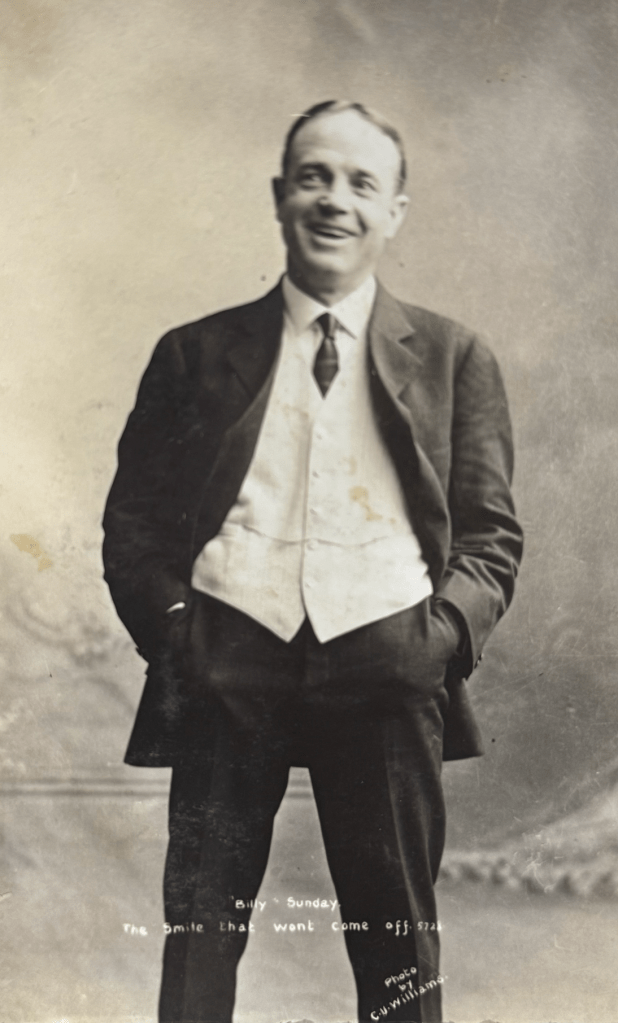
Copyright 1908. Author’s Collection.

Tribute to Sunday.

Tell your friends, we knew a fellow

Who’s the real thing through and through.

He’s a friend well worth having,

And he’ll be a friend to you.


When he came to old Wilkes-Barre,

Some of us were pretty tough.

And we thought that Billy Sunday

Was a grafter, sure enough.


But, one night we went to hear him—

With a banner and his band—

And we found that Billy Sunday

Is the best man in all the land.


How he hits the old ‘booze-fighter,’

And his cussing, spewing life—

Tells you how he starves his children,

Kills his poor, long-suffering wife.


Then he preaches Christ the Saviour

And His divine love, until

All the crowds just melt around you,

“Leaving God and you and ‘Bill.'”


When he says, ‘Don’t trust your feelings

“Come to Christ. He’ll never fail.’

And he holds his hand out pleading,

‘Fore you know, you’ve hit the trail.


Why, he makes sin seem so awful,

And religion seems so grand,

That you wish ten thousand “Billies”

Could sweep over this whole land.


But the best part can’t be told, friends,

How God fills your heart with peace,

And with hope and strength and courage,

And with joys that never cease.


So, three cheers for “Billy” Sunday,

Yes, three cheers, and three times three,

For the man who makes salvation

Plain to men like you and me.


And through all this great republic

‘Twould be mighty hard to find

Your grateful bunch of fellows,

Than his friends, the undersigned.